
A complete issue · 48 pages · 1915
Life — August 26, 1915
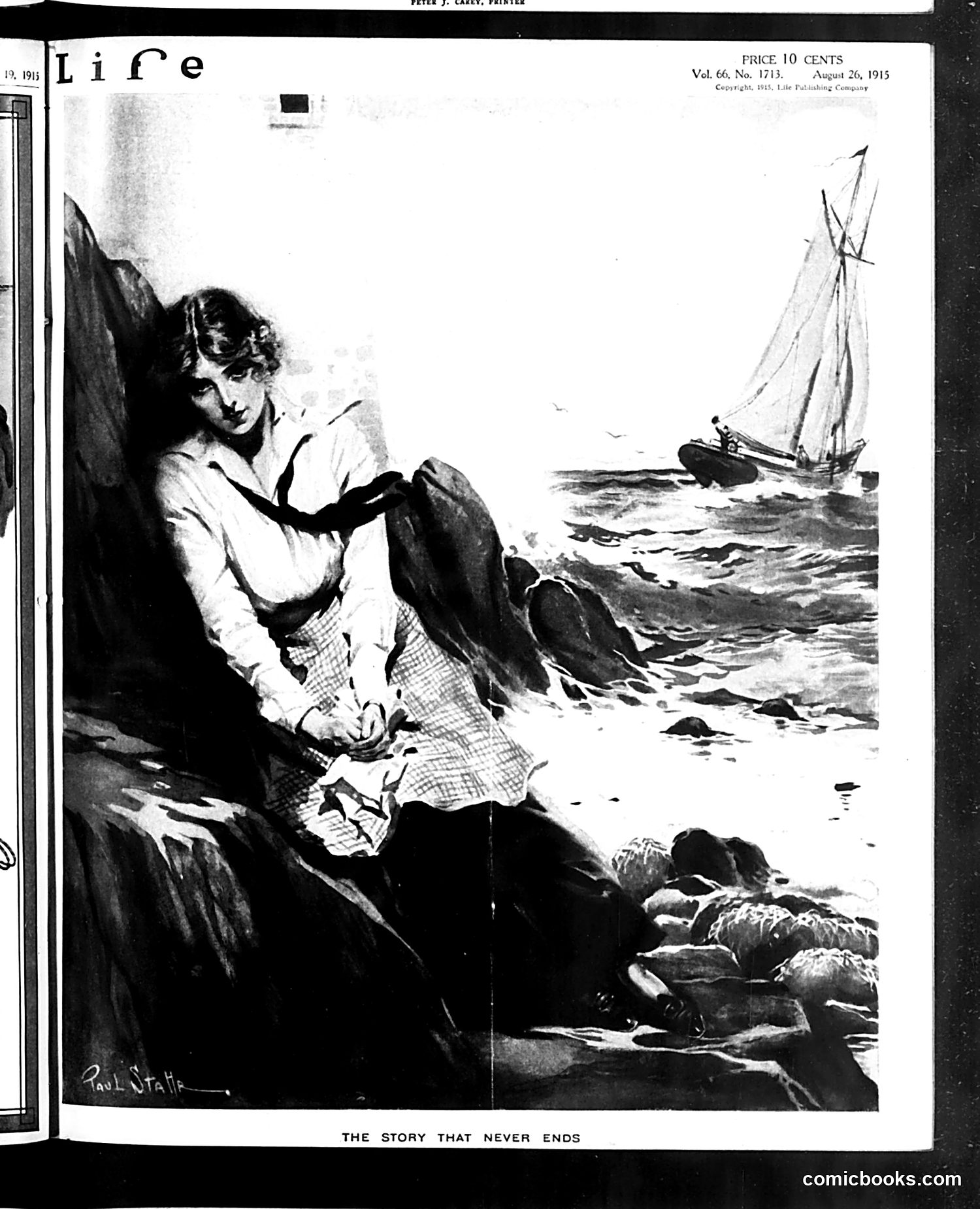
This illustration by Paul Stahr depicts a woman sitting on rocks by the sea, gazing toward a sailing ship in distress on rough waters. The caption reads "THE STORY THAT NEVER ENDS." The image appears to be a romantic or sentimental illustration rather than political satire. It likely references a common literary and artistic trope of the early 20th century: a woman patiently waiting for her lover or husband to return from the sea. The "never ends" caption suggests the eternal nature of such waiting—a timeless human experience of longing and separation. The illustration exemplifies Life magazine's use of sentimental artwork alongside its satirical content, appealing to readers' emotional sensibilities.
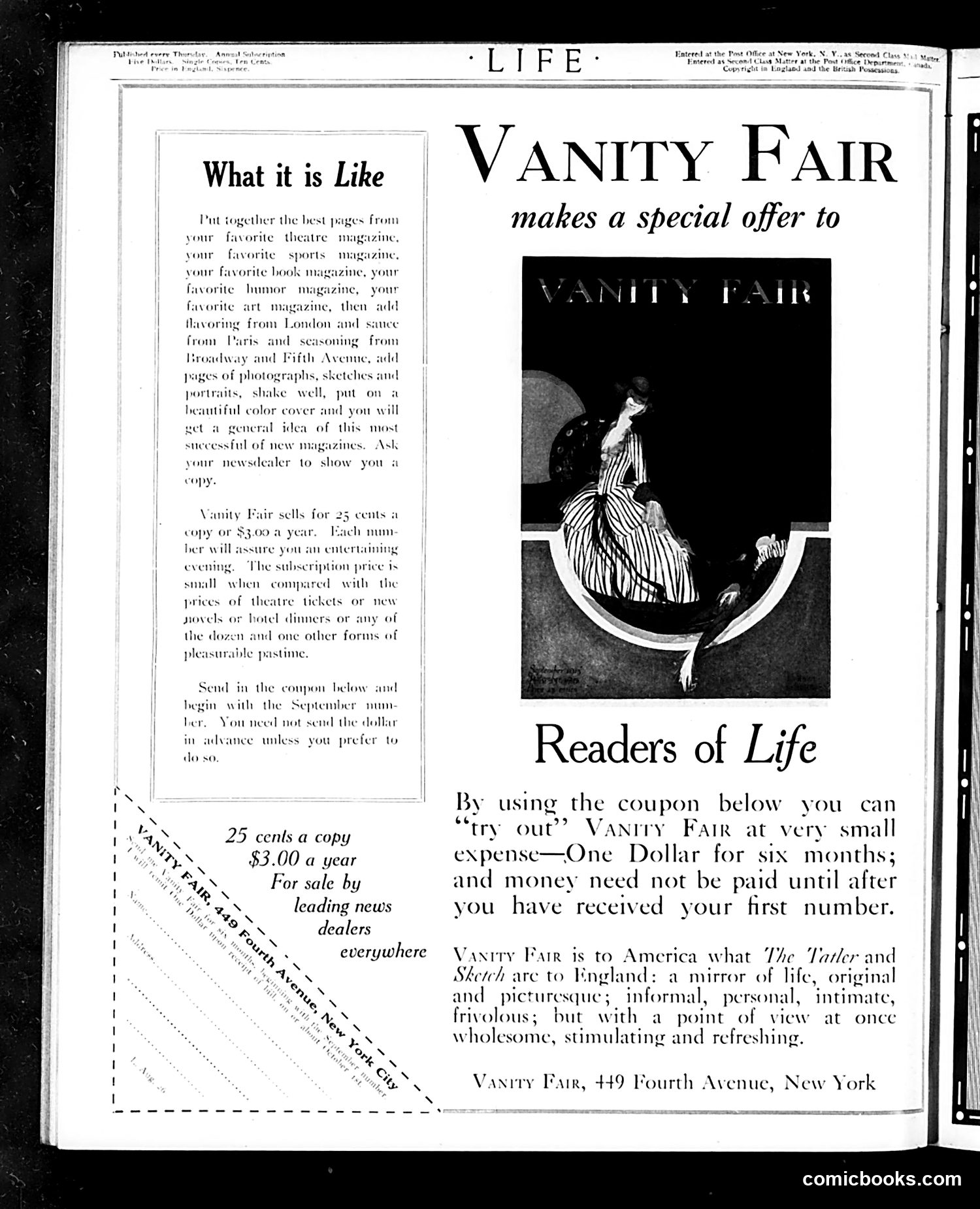
This page is primarily **advertising** for Vanity Fair magazine, not political satire. The left column explains Vanity Fair's content—combining theater, sports, books, humor, and art magazines with "flavoring from London and Paris" and "seasoning from Broadway and Fifth Avenue." The right side features an art deco illustration of a fashionable woman in 1920s style dress, promoting a subscription offer: 25 cents per copy or $3.00 yearly. The text compares Vanity Fair to British publications *The Tatler* and *Sketch*, describing it as "a mirror of life, original and picturesque; informal, personal, intimate, frivolous; but with a point of view at once wholesome, stimulating and refreshing." No specific political figures or events are referenced—this is straightforward magazine promotion targeting Life's readers.
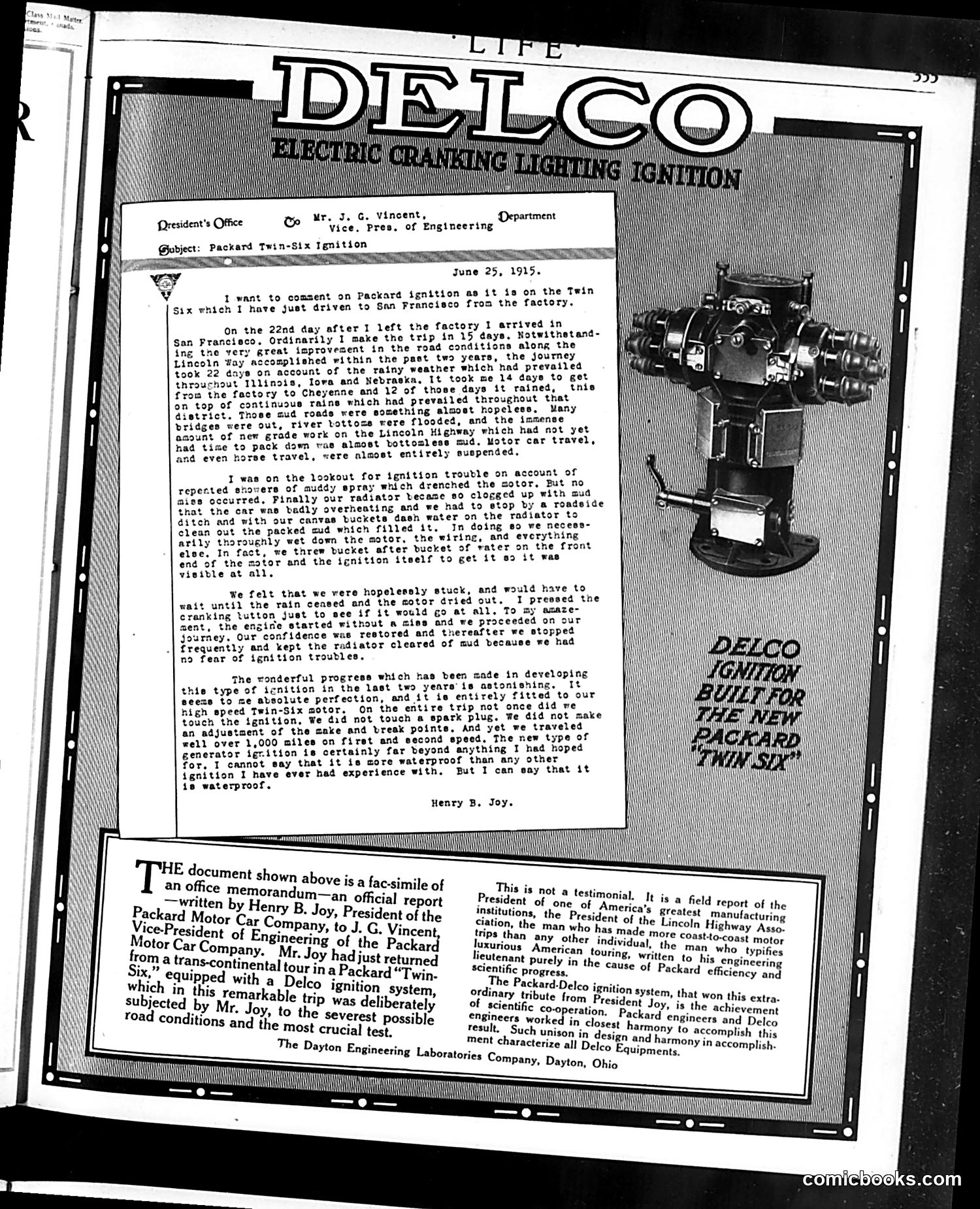
This page is **not a cartoon or satire**—it's primarily **advertising content** disguised as editorial material. The document shows a 1915 memorandum from Henry B. Joy, President of Packard Motor Car Company, describing a cross-country trip in a Packard "Twin-Six" automobile equipped with Delco ignition. Joy recounts severe road conditions, mechanical challenges, and how the Delco system performed reliably throughout. The bottom section explicitly identifies this as a "fac-simile of an office memorandum" used as a testimonial. It acknowledges Joy's prominence (President of the Lincoln Highway Association) to lend credibility to the endorsement. **This is pure product advertising**, leveraging a notable businessman's name and a challenging real journey to market automotive reliability to Life's readers.
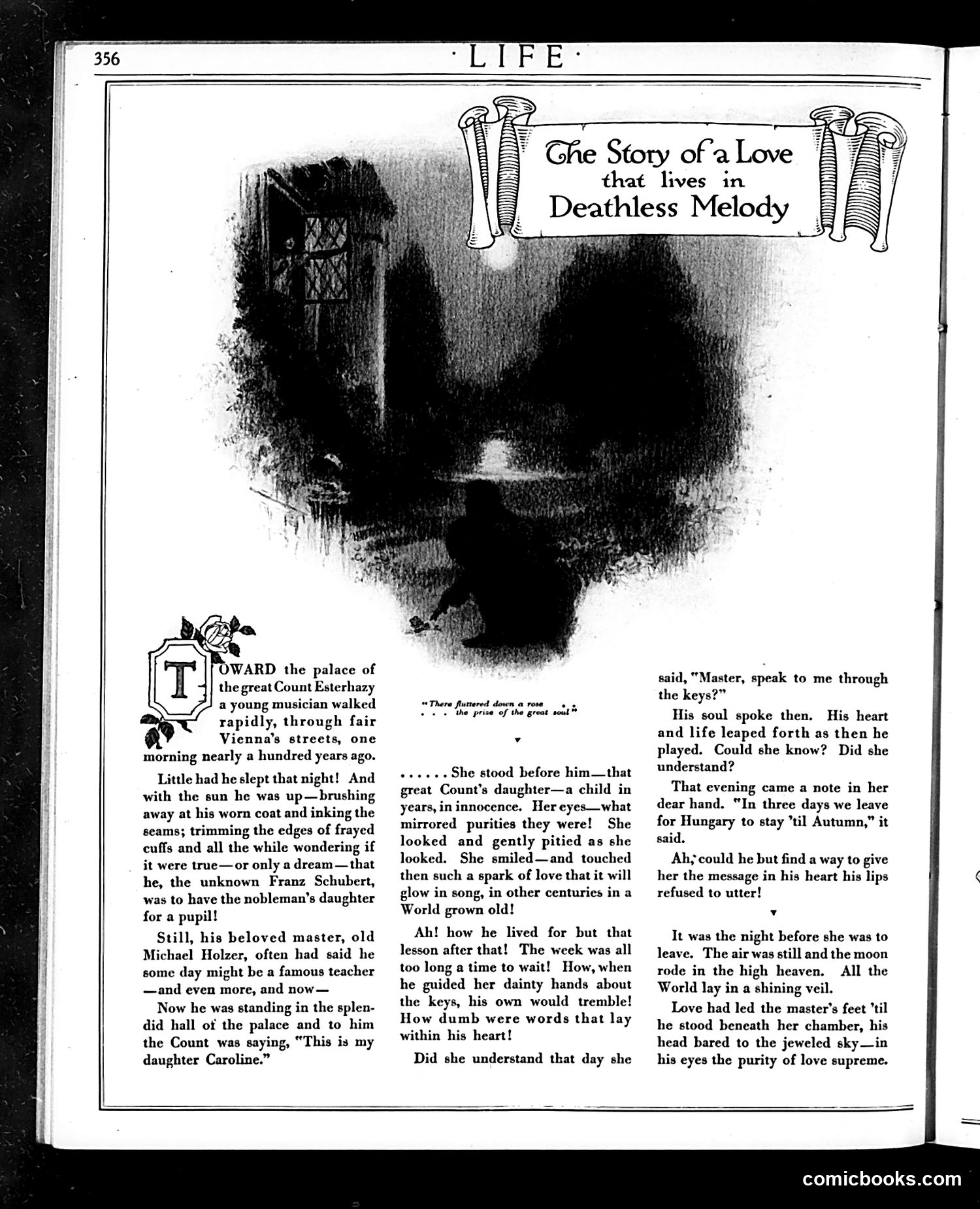
This page is not a political cartoon but rather a romantic short story illustrated with atmospheric artwork. The narrative concerns a young musician (apparently named Franz Schubert, based on the reference to "Master Schubert") who encounters the daughter of an Austrian Count in Vienna approximately a century before this publication. The story is sentimental rather than satirical: it depicts an unrequited or tragic love affair between a poor musician and an aristocratic young woman named Caroline. The illustration shows their intimate moment together. The narrative emphasizes the power of music to transcend social class barriers and preserve emotion across time—a Romantic-era sensibility that Life magazine presented for its middle-class readers' entertainment.
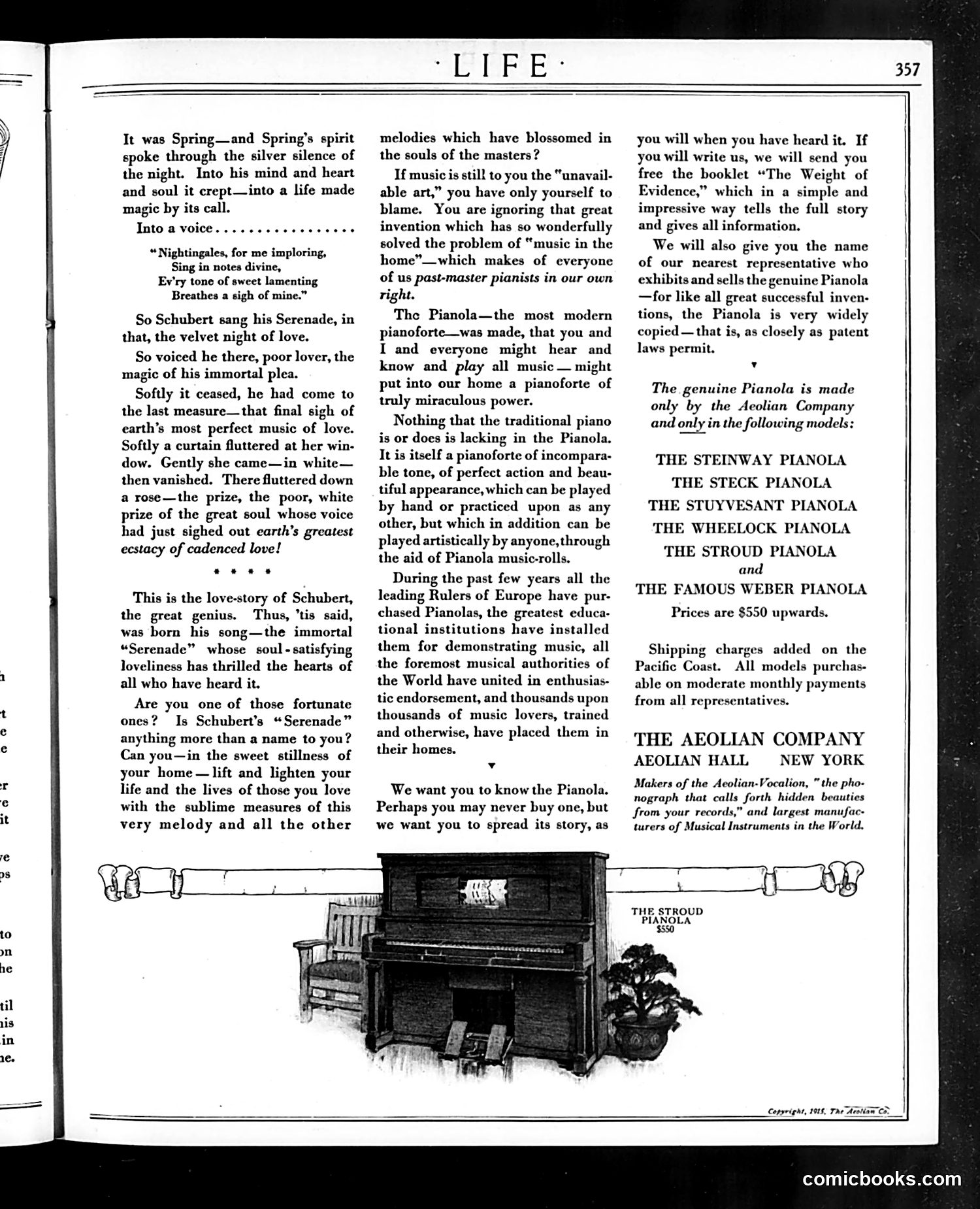
This page is **primarily an advertisement**, not satire or political commentary. It promotes the Pianola, an early automatic piano manufactured by The Aeolian Company. The advertising copy uses romantic, aspirational language to market the instrument—comparing it to Schubert's music and positioning piano ownership as a path to cultural refinement and domestic happiness. The text emphasizes that the Pianola allows anyone to play classical music without training, using pre-programmed "music-rolls." The image shows the Stroud Pianola model priced at $550 (substantial for 1912). Below the piano sits decorative sheet music and a potted plant, staging it as an attractive home furnishing. This represents early 20th-century consumer marketing targeting middle-class aspirations for culture and sophistication.
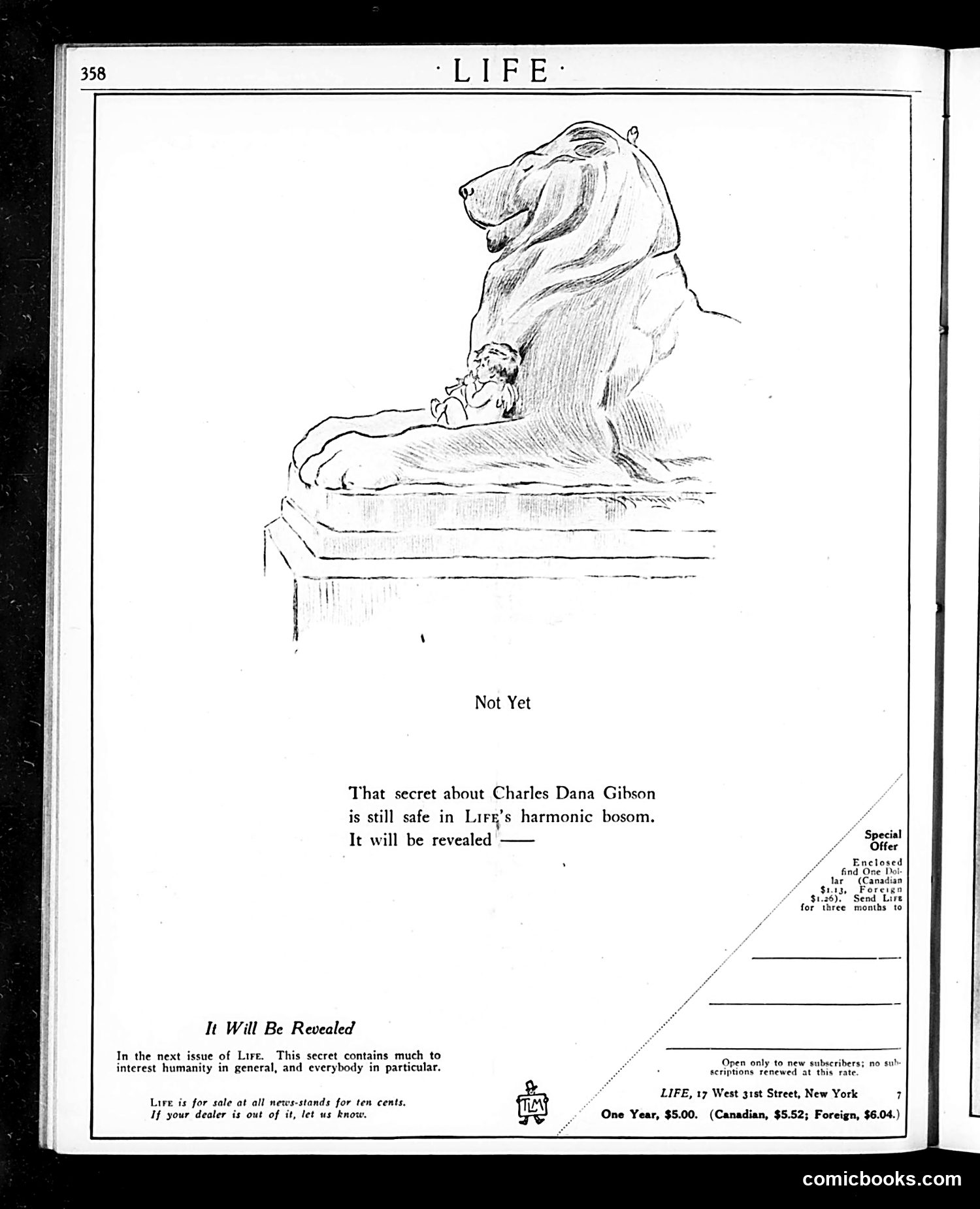
This is primarily an **advertisement for Life magazine**, not a political cartoon. The page announces a forthcoming revelation about "Charles Dana Gibson" (the magazine's founder and illustrator). The illustration shows a large hippo with a tiny human figure, titled "Not Yet." The text promises that a secret about Gibson "will be revealed" in the next issue, claiming this secret "contains much to interest humanity in general, and everybody in particular." This appears to be a **teaser advertisement**—a marketing tactic to drive subscriptions by promising sensational unrevealed information. The hippo image's significance remains unclear without additional context, though it may be an inside joke recognizable to Life's contemporary readers. The page includes subscription pricing ($5.00 yearly) and newsstand information.

This page is primarily **advertising**, not satire or political commentary. It's a Fisk Non-Skid Tires advertisement from Life magazine (page 359). The ad promotes Fisk brand tires, emphasizing "Safety, Service and Satisfaction" at low prices. A pricing table compares Fisk casings favorably against competitors. The main visual is a large photograph of a tire showing its distinctive tread pattern. The small illustration in the upper right appears to be the Fisk company mascot or logo—a figure in classical dress, possibly meant to evoke reliability or quality. The ad claims Fisk Non-Skids cost only 5% more than plain treads, last six months longer, and offers superior service through Fisk's organization. The company's factory location is listed as Chicopee Falls, Massachusetts. This is straightforward commercial promotion, not satire.
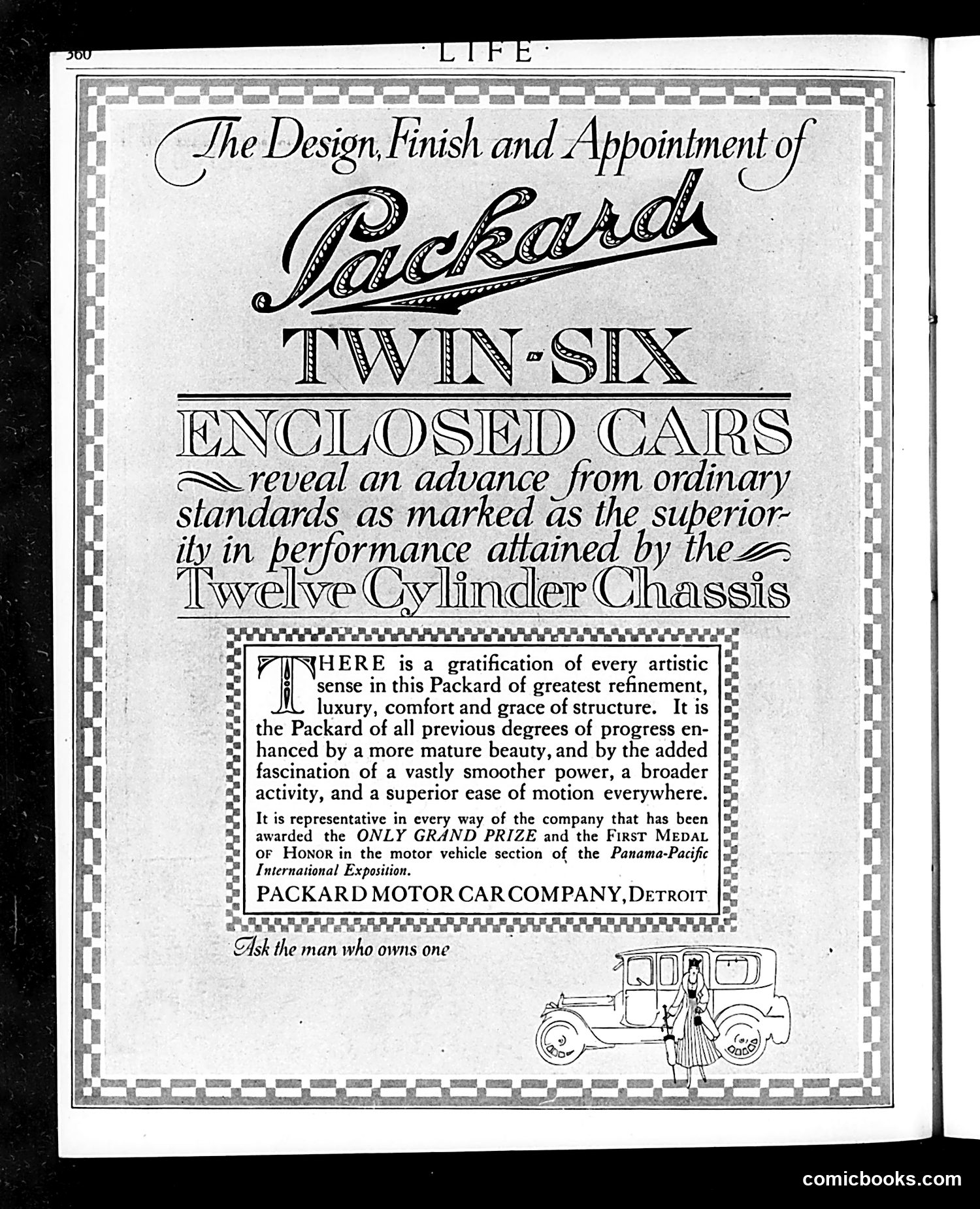
This is a **full-page advertisement**, not satirical content. It promotes the Packard Twin-Six enclosed car, highlighting its luxury features and design sophistication. The ad claims the vehicle represents "an advance from ordinary standards" and superior performance compared to competitors. It references the Packard Motor Car Company's awards: the "Only Grand Prize" and "First Medal of Honor" from the Panama-Pacific International Exposition. The illustration shows a woman in period dress standing beside the automobile, a common marketing technique of the era suggesting elegance and refinement. The closing line—"Ask the man who owns one"—was apparently Packard's actual advertising slogan, positioning ownership as a status symbol and appealing to potential buyers' aspirations. This represents early 20th-century luxury automotive marketing rather than political or social satire.
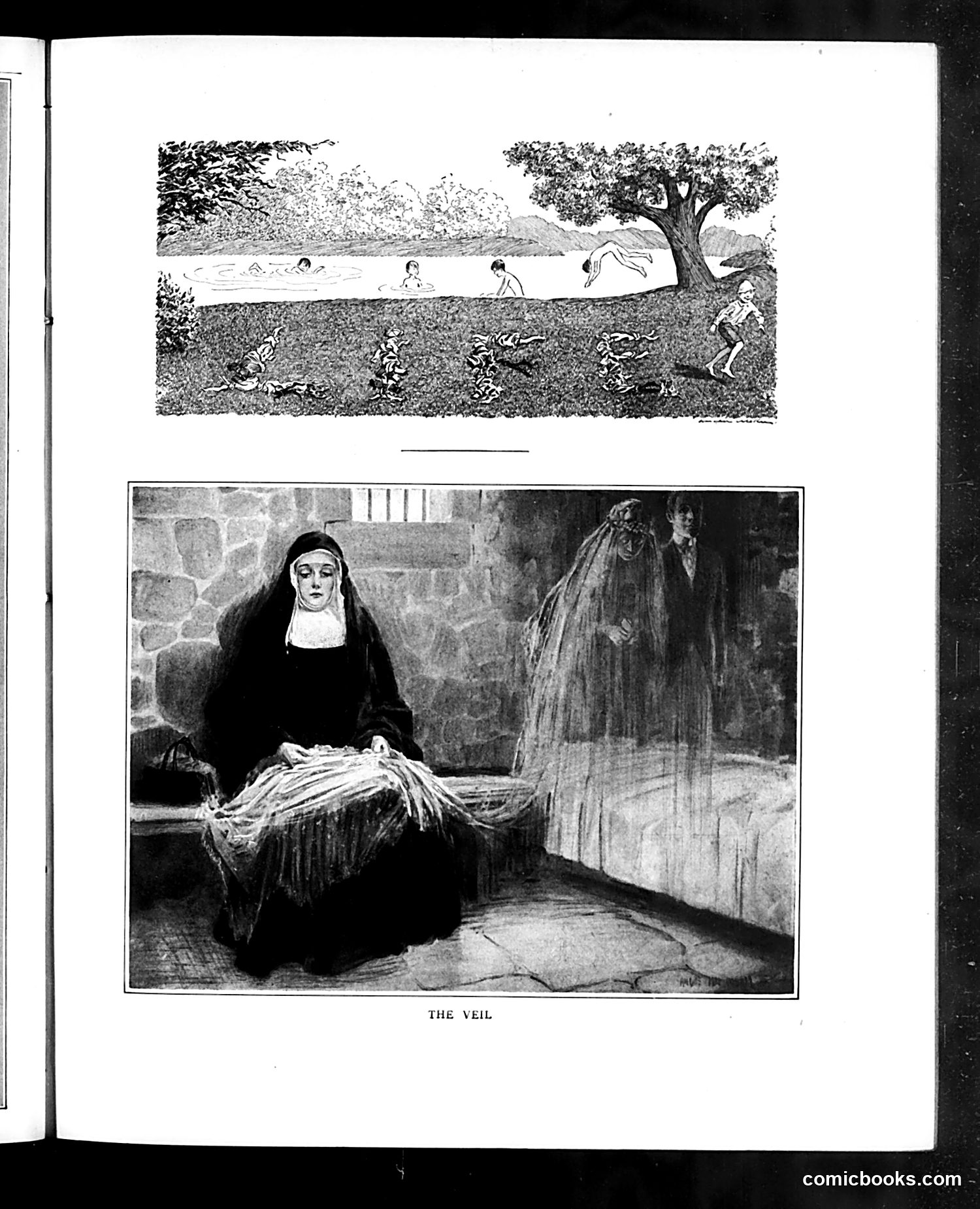
This page contains two illustrations. The upper sketch depicts children playing by a riverbank near trees—an idyllic pastoral scene. The lower image, titled "The Veil," shows a nun in black habit and white coif sitting with what appears to be a shrouded or veiled figure beside her in a stone chamber. A ghostly or spectral figure appears in the background. Without additional context from surrounding pages, the specific satirical point remains unclear. This could be social commentary on religious institutions, mortality, or women's roles in convents—themes Life magazine frequently addressed. The juxtaposition of innocent childhood play above with the solemn, mysterious religious scene below suggests potential ironic contrast, but the exact intended critique is not definitively determinable from the image alone.
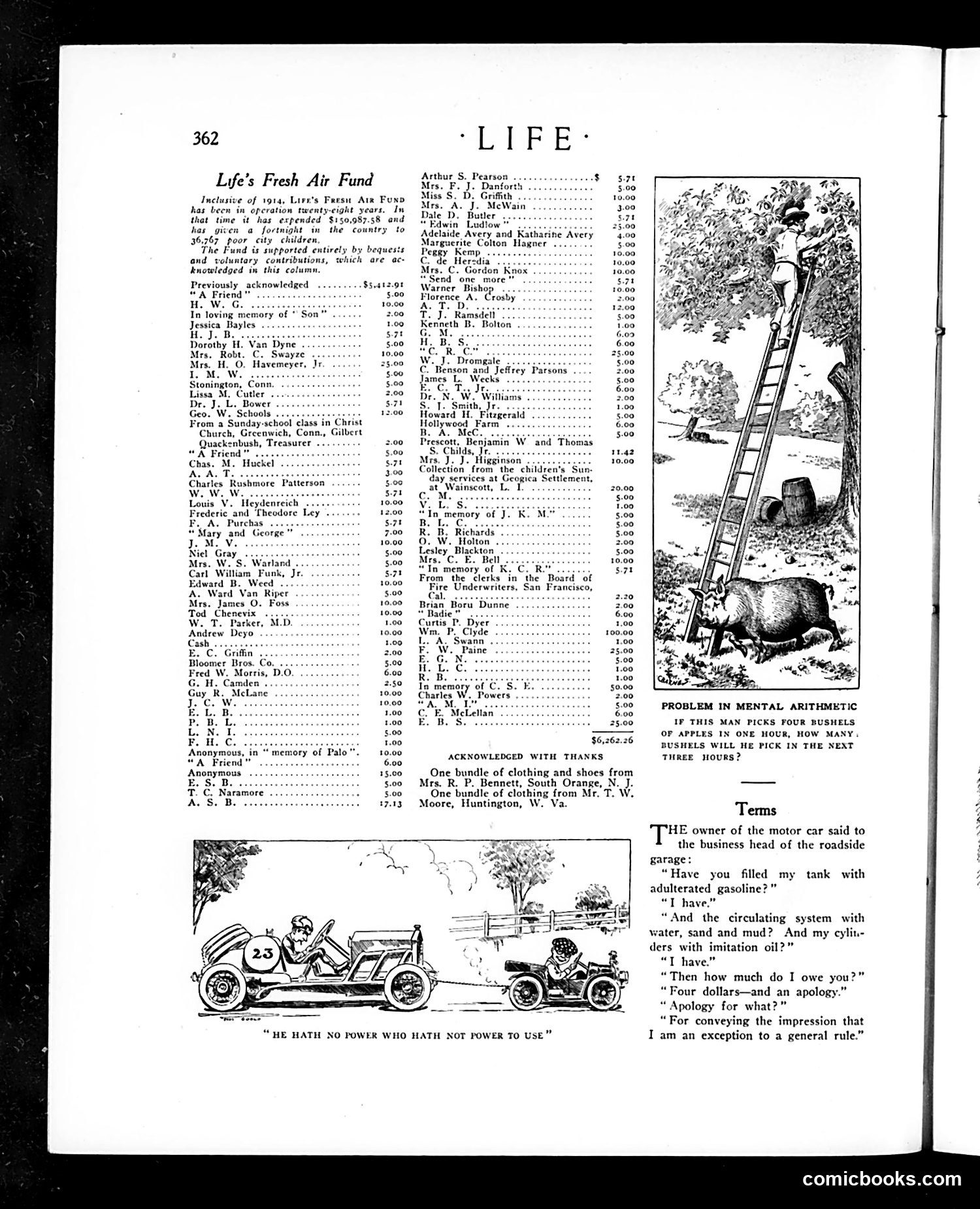
This page primarily documents **Life's Fresh Air Fund** — a charitable initiative providing country vacations for urban children. The left column lists donors and contributions totaling $6,262.25. The cartoon at bottom depicts a conversation between a motor car owner and a roadside garage mechanic. The owner sarcastically asks if the mechanic has properly maintained the vehicle (filled tank, flushed cooling system, oiled cylinders). The mechanic responds with inflated charges and an apologetic excuse about being "an exception to a general rule" — satirizing mechanics' reputation for overcharging and poor work while claiming special circumstances. The caption "He hath no power who hath not power to use" ironically suggests the mechanic abuses his professional authority.
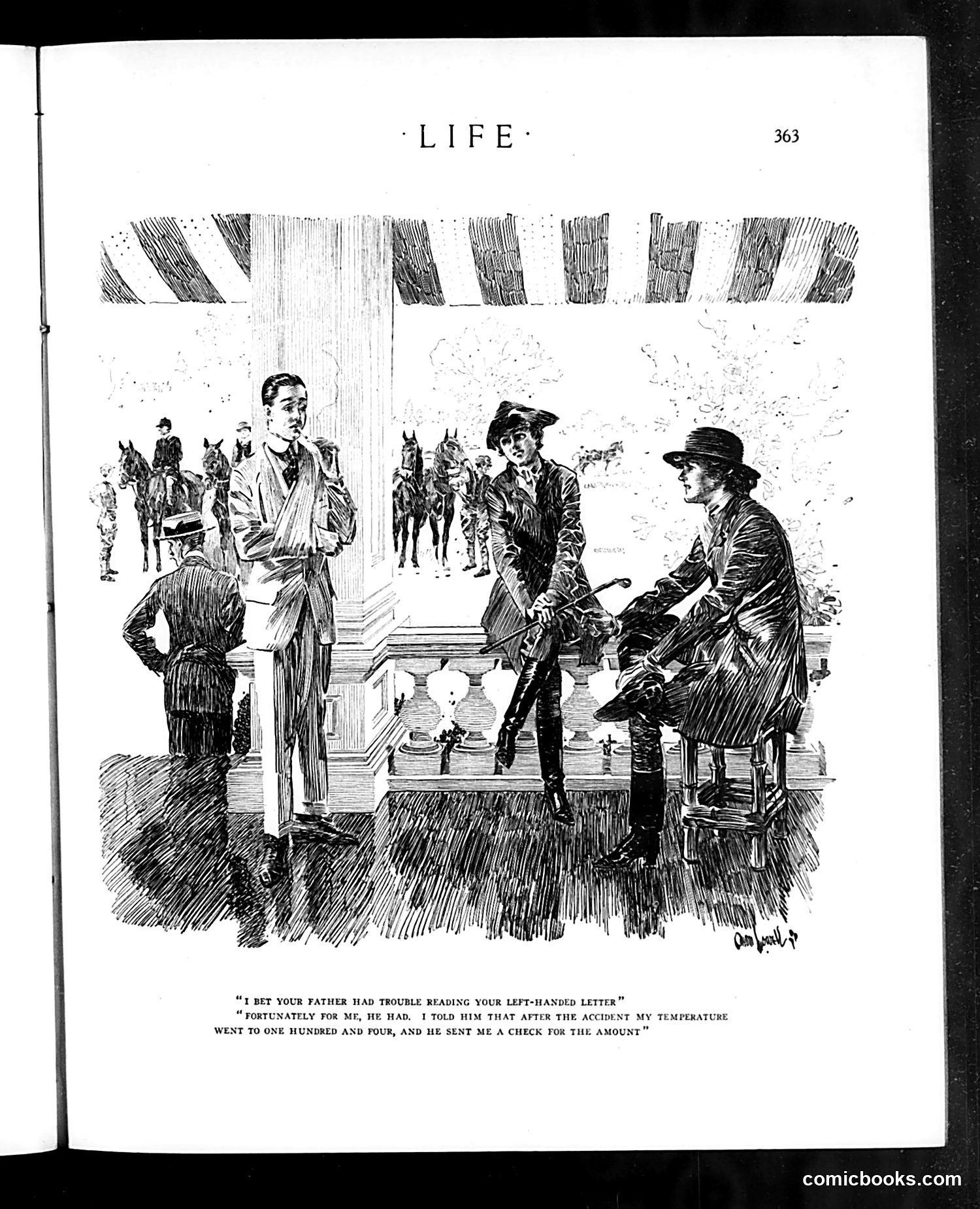
This is a single cartoon from *Life* magazine (page 363) depicting a military or diplomatic scene. The image shows several men in formal attire and military dress on what appears to be a porch or veranda, with mounted soldiers visible in the background. The caption reveals the joke's context: someone mentions difficulty reading a "left-handed letter," and another character explains that after an accident, his temperature rose to 104 degrees, prompting him to send a check for "the amount." The humor appears to rest on a misunderstanding or clever wordplay involving the left-handed letter and the subsequent payment, though the specific historical or political reference remains unclear without additional context about *Life* magazine's publication date and contemporary events. The military setting suggests possible diplomatic or administrative business being conducted.
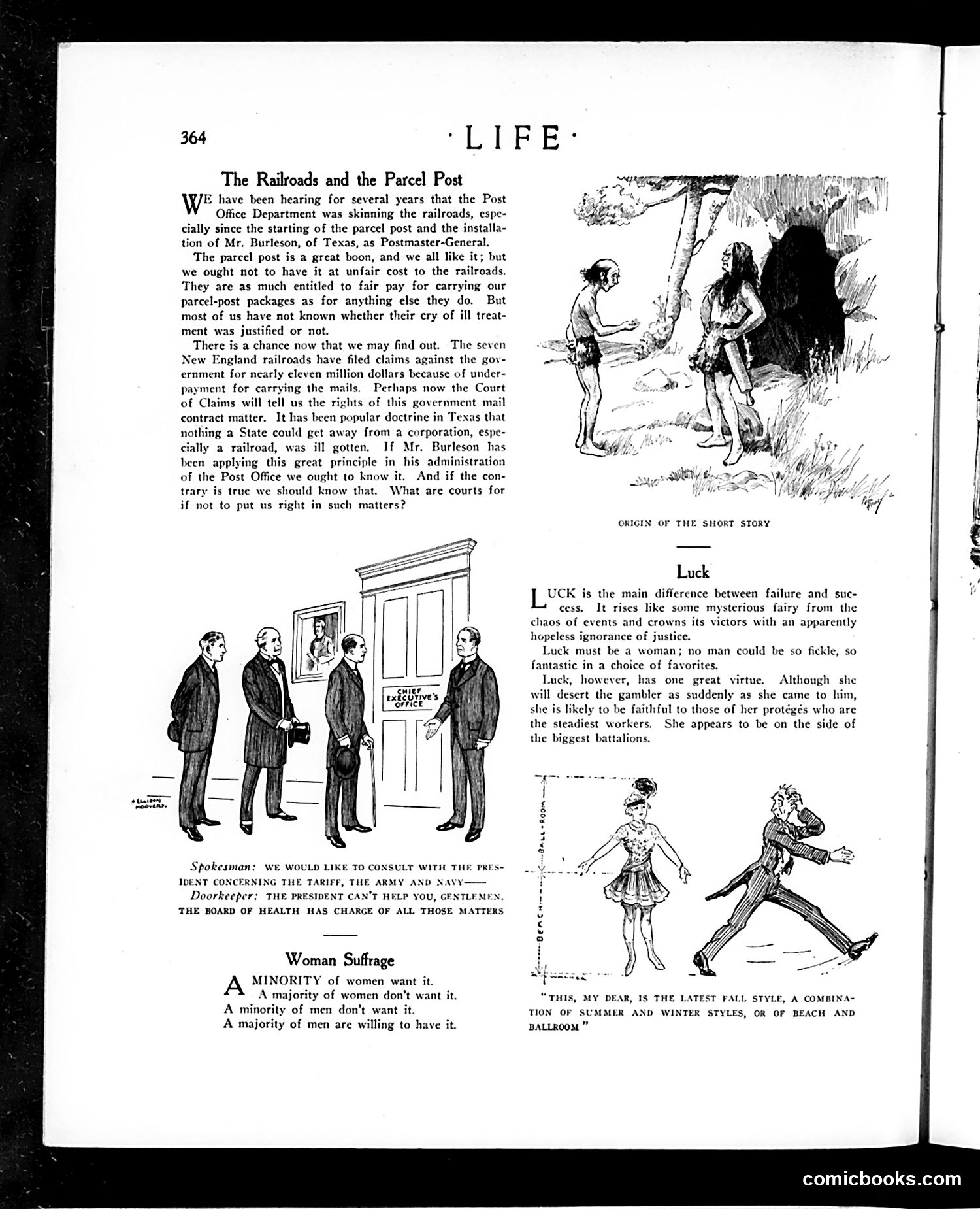
**"The Railroads and the Parcel Post"** discusses a legal dispute: seven New England railroads sued the government for nearly eleven million dollars, claiming unfair competition from the Post Office's parcel post service. The author argues railroads deserve fair compensation for mail carriage and suggests the courts should protect government contracts fairly. **"Woman Suffrage"** presents a brief satirical statement: minorities of women and men oppose suffrage, but a majority of men support it—implying male support undermines the cause's legitimacy or reveals hypocrisy in the suffrage debate. **"Luck"** is a short story introduction defining luck as the mysterious force determining success or failure, personified as a woman who favors the industrious. The fashion illustration mocks contemporary styles blending summer and winter aesthetics.
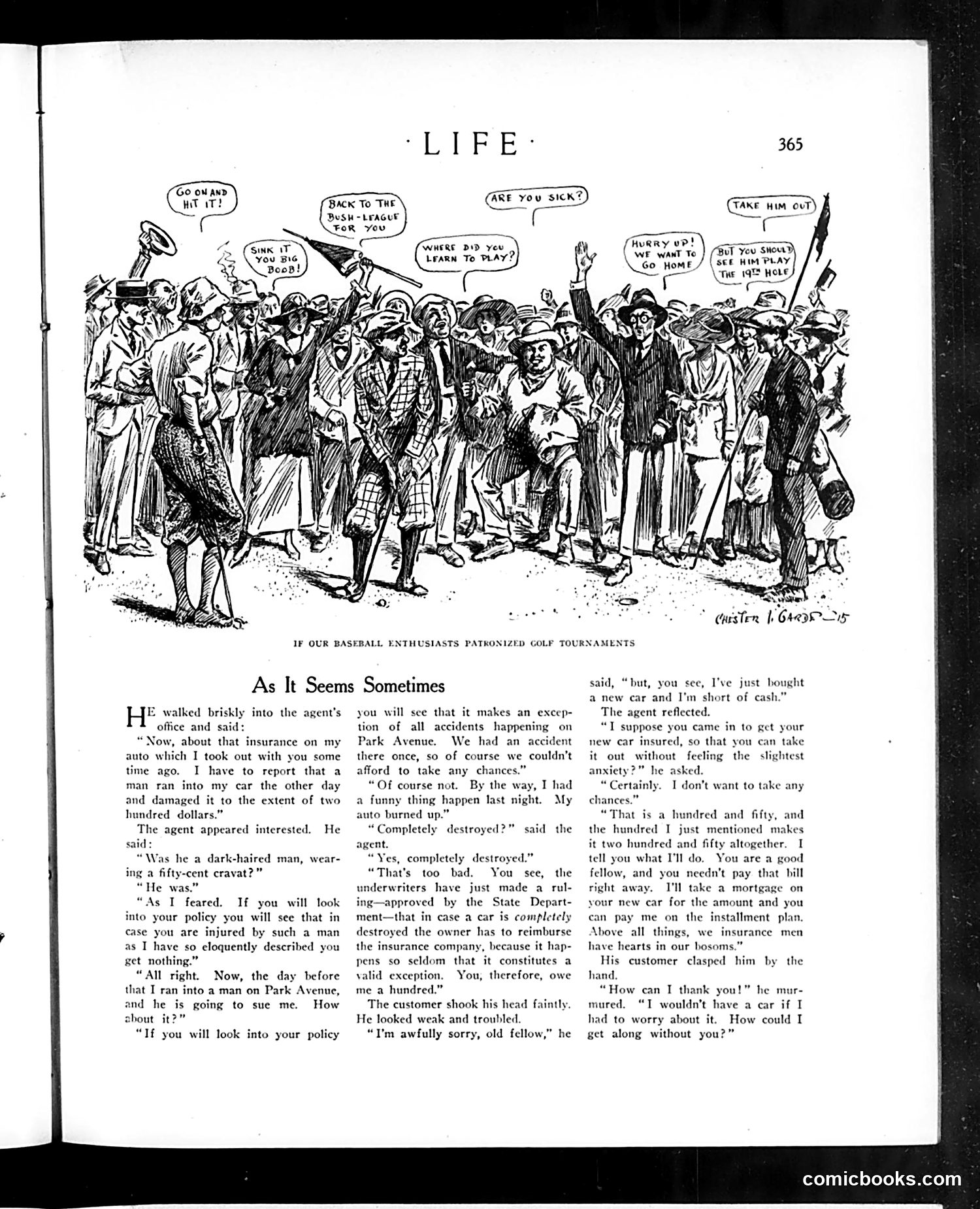
The top cartoon satirizes baseball fans who patronize golf tournaments. The sketch shows a rowdy crowd at a golf event behaving like baseball spectators—shouting advice ("Go on and hit it!", "Where did you learn to play?"), treating it as entertainment rather than a serious sport. The accompanying story "As It Seems Sometimes" depicts an insurance agent negotiating with a customer about car damage. The humor lies in the agent's bureaucratic language and resistance to paying claims, contrasting with the customer's desperate need for help. The agent insists the damage constitutes a "valid exception" to coverage, ultimately offering only a hundred dollars for a destroyed vehicle. Both pieces mock contemporary American attitudes: rowdy sports culture and insurance company reluctance to honor policies.
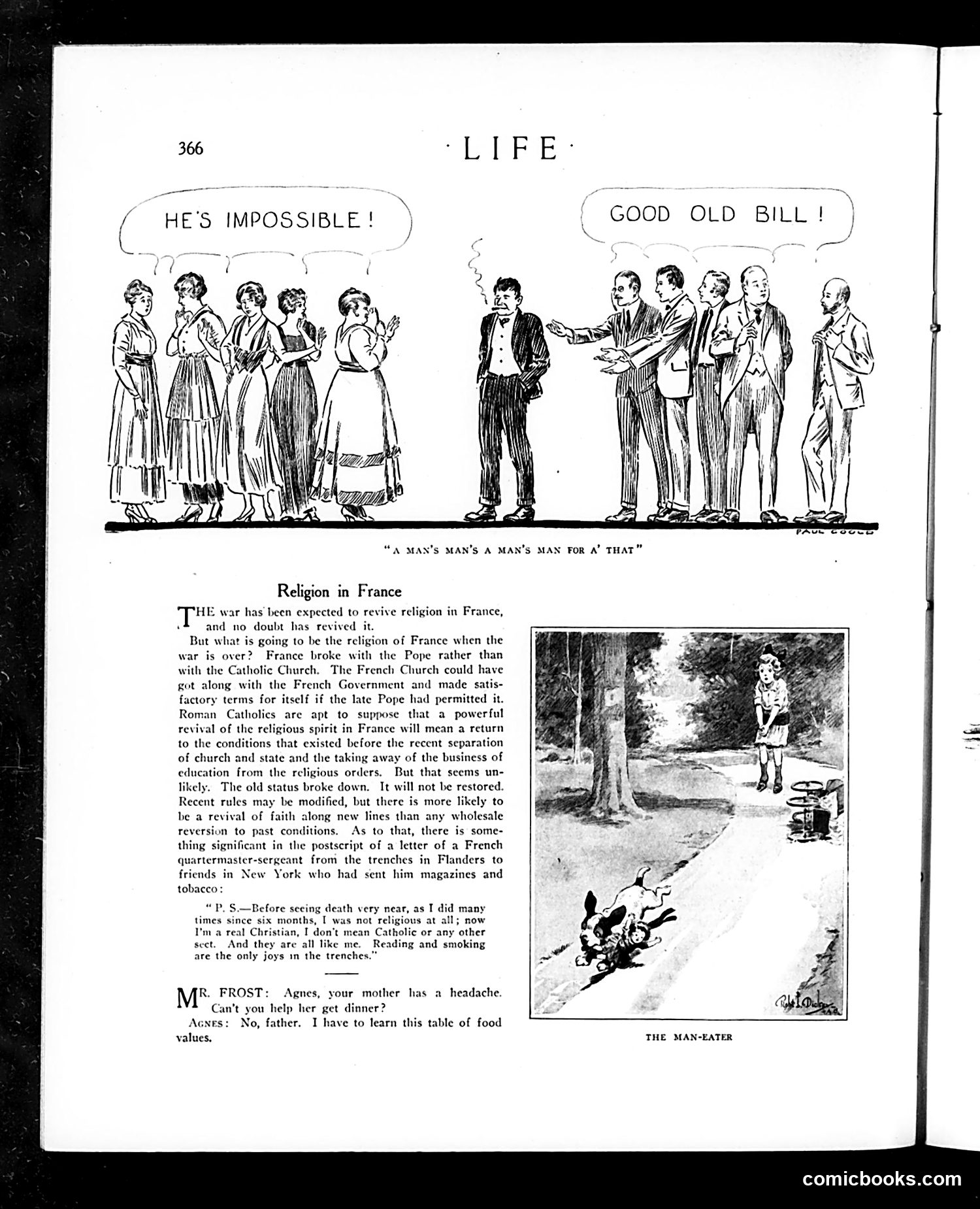
**Top Cartoon:** Shows a gender divide—women on the left exclaim "HE'S IMPOSSIBLE!" about a man, while men on the right greet him warmly with "GOOD OLD BILL!" The caption "A MAN'S MAN'S A MAN'S MAN FOR A' THAT" suggests this "Bill" is popular among his male peers but considered difficult by women, likely reflecting early 20th-century gender attitudes about masculine behavior that women found objectionable but men celebrated. **Article & Illustration:** Discusses religion's revival in post-WWI France, noting the French Church broke with the Pope during wartime. A photograph titled "THE MAN-EATER" shows soldiers in a trench with what appears to be a large rat, darkly humorously depicting the brutal conditions soldiers faced. **Bottom Dialogue:** A brief domestic scene about education versus household duties.
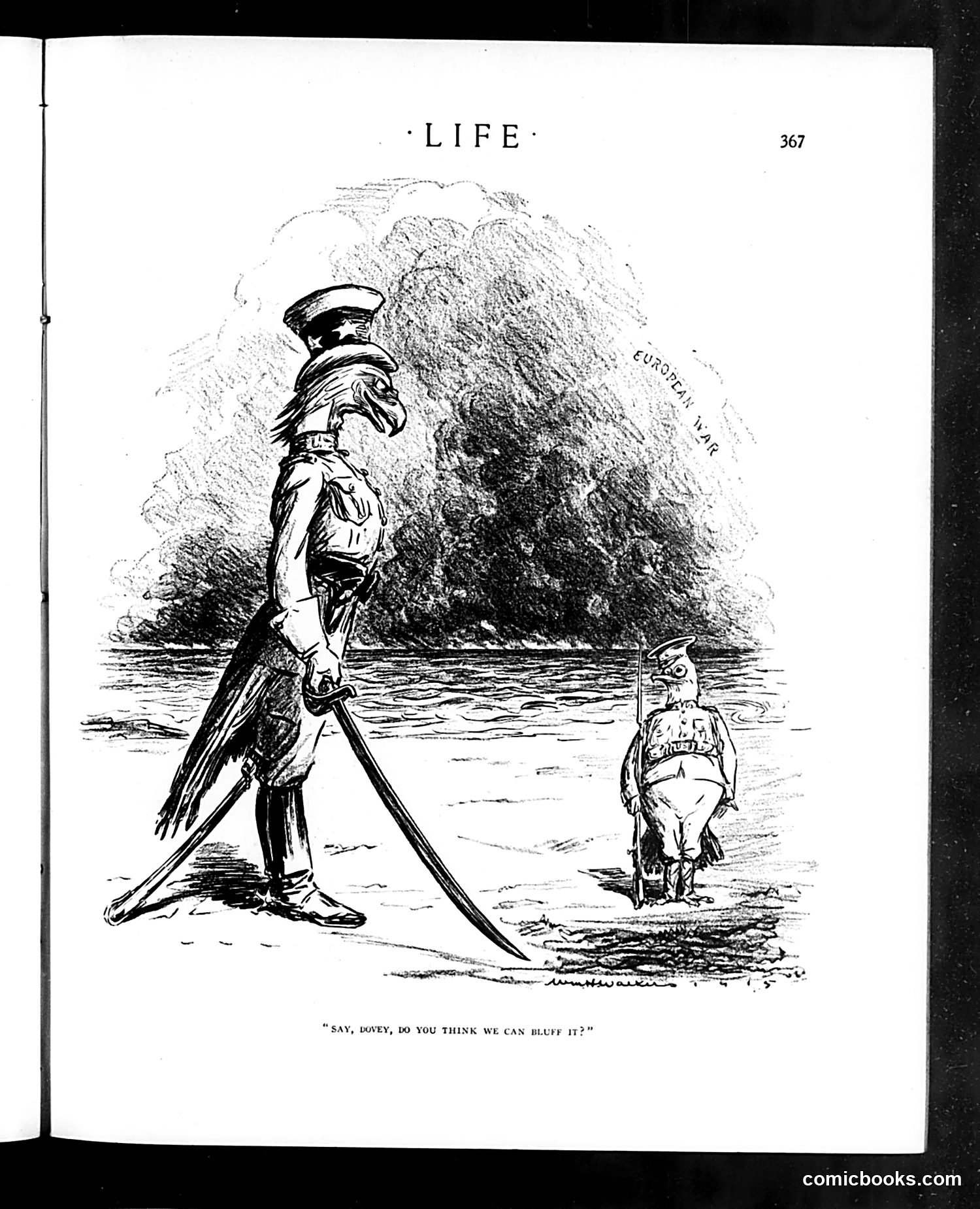
This Life magazine cartoon depicts a military figure in uniform with an enormous sword confronting a much smaller, younger soldier. The caption reads: "SAY, LOVEY, DO YOU THINK WE CAN BLUFF IT?" The cartoon appears to be WWI-era political satire about European military strategy. The large figure likely represents an established European power (possibly Germany or Austria-Hungary, suggested by the military uniform style), while the smaller figure represents a smaller nation or ally. The "bluff" reference suggests commentary on whether military posturing and threats can succeed without actual combat engagement. The background shows water and mountains, possibly indicating a specific European theater. The satire criticizes overconfidence in military intimidation tactics or questions the viability of war strategy built on deception rather than genuine military capability.
This page contains two short stories from **Life magazine's short-story contest**, which invited submissions answering: "How short can a short story be and still be a short story?" **"Her Memory" by Dwight M. Wiley** (left column): A romantic tale of a man named Arrington who becomes jealous at a summer resort when another guest monopolizes Virginia's attention. He encounters a mysterious, flirtatious woman by moonlight who claims to be "Romance." They share an intimate moment. When her mother approaches, the woman calmly reveals the truth: the man (Mr. Brown) was merely discussing doctors because his uncle shares her condition—she is "hopelessly paralyzed." The twist implies her romantic performance was theatrical deception. **"Collusion" by Lincoln Spofford** (right column): A brief story about a woman before a judge, accused of perjury. Her lawyer argues lies are sometimes necessary. She claims her only fault was falling in love with a man she brought together with her old friend—suggesting she facilitated their relationship while concealing her own feelings. Both stories explore deception and hidden truths in romantic contexts.
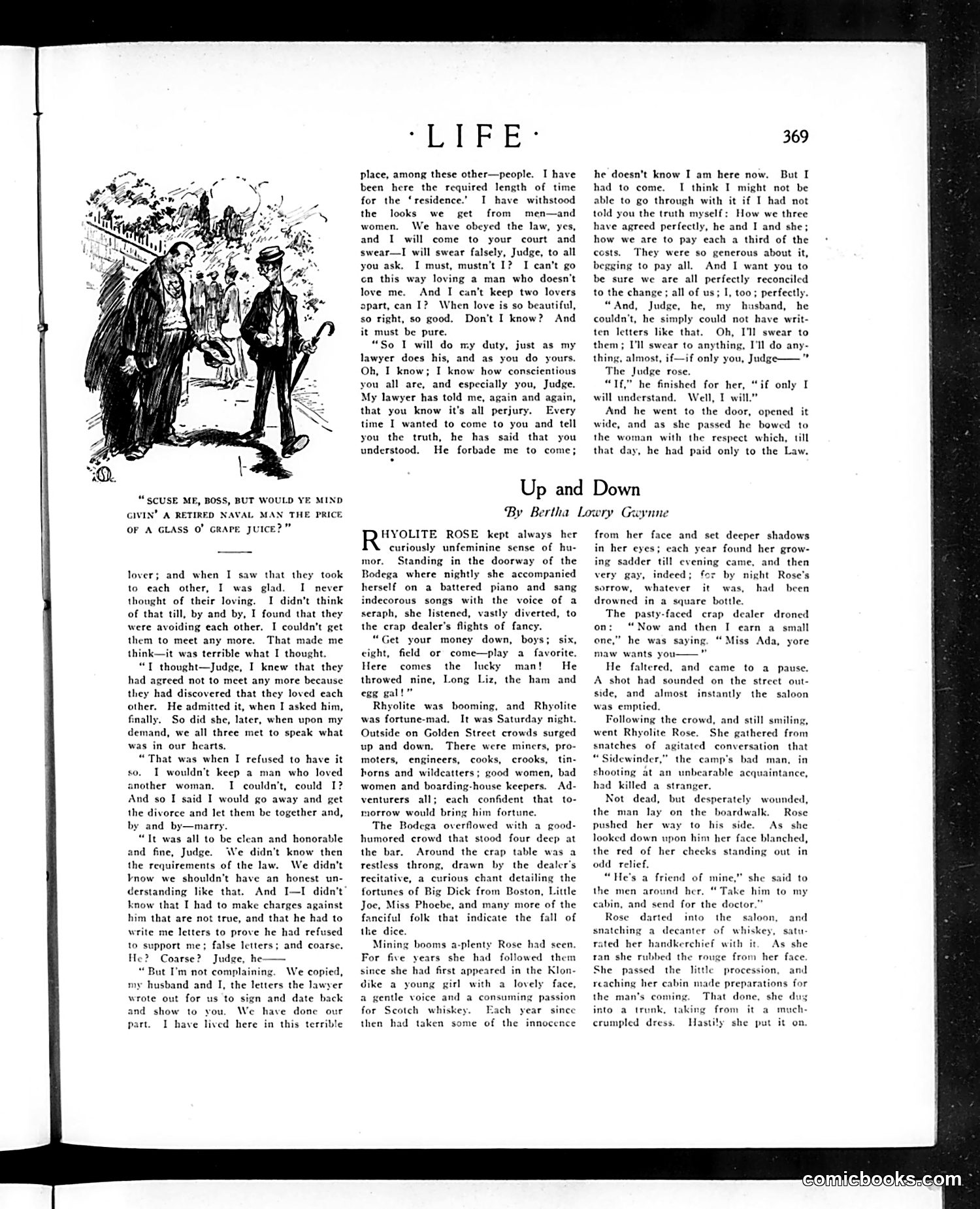
The page contains two distinct pieces of satirical content: **Top cartoon and monologue**: A woman appears before a judge seeking divorce. The satire targets divorce law hypocrisy—she must commit perjury (swearing to false charges) to obtain a legal divorce, with her lawyer's full knowledge and encouragement. The judge implicitly condones this fraud. The satirical point: the legal system *requires* dishonesty to function, forcing conscientious people into moral compromise. The ragged beggar's caption ("retired naval man") in the cartoon appears unrelated, likely a separate visual gag. **"Up and Down" story**: A woman named Rhyolite Rose works as a singer in a rough establishment (the Bodega). The opening suggests she maintains dignity and humor despite her lowbrow surroundings. The story appears to explore class contrasts and female agency in working-class settings, though the full narrative extends beyond this page. Both pieces reflect early 20th-century Life magazine's focus on social critique wrapped in humor and literary narrative.
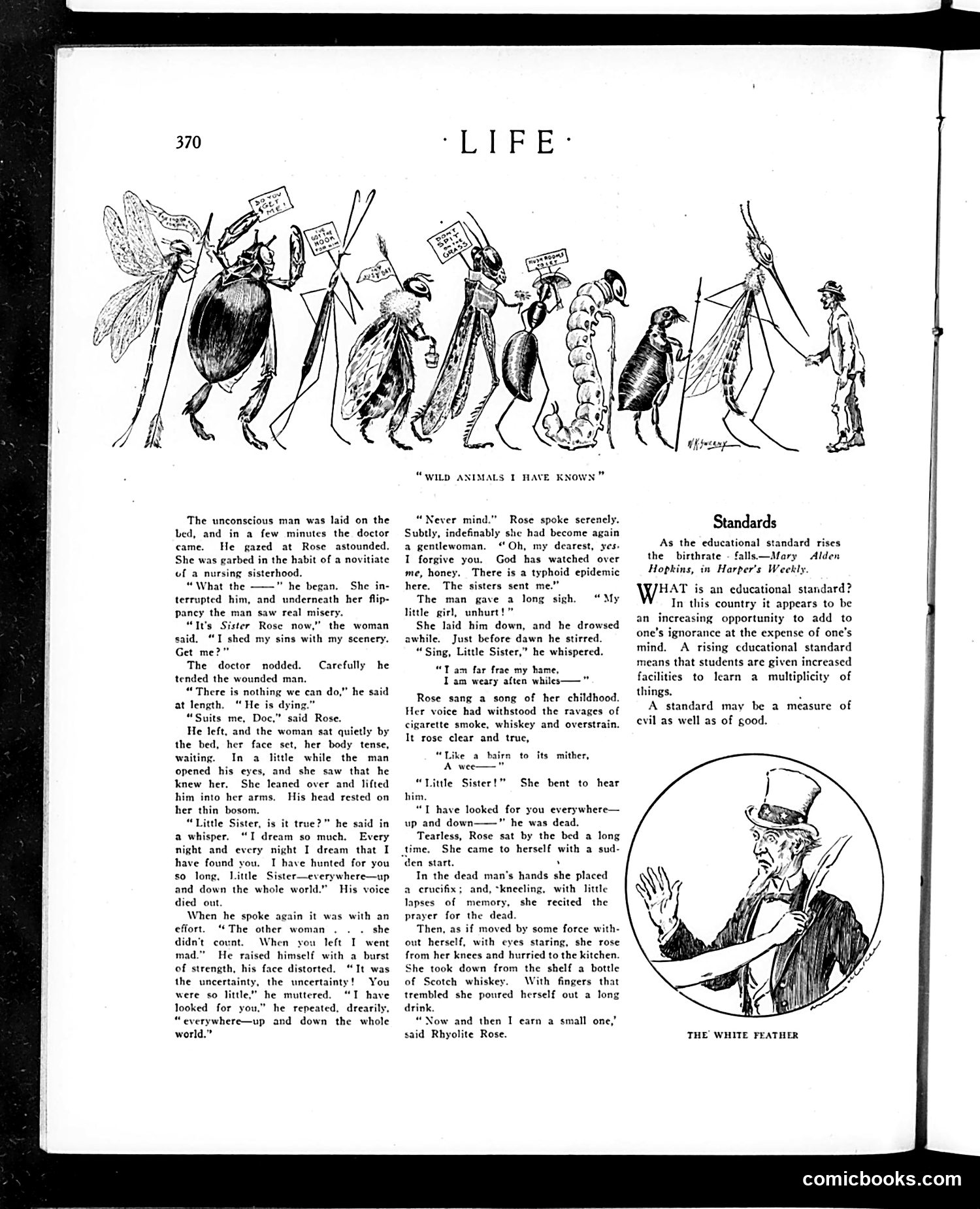
**The Main Story ("Wild Animals I Have Known"):** This sentimental narrative depicts a deathbed reunion between a man and a woman called "Little Sister" who has become a nun. The story romanticizes her redemption—she's abandoned a dissolute past (implied by references to cigarettes and whiskey) to join a nursing sisterhood. The man dies recognizing her, and she grieves, then immediately seeks solace in alcohol, suggesting her reformation is superficial. **The Satire:** The cartoon at top shows anthropomorphized animals carrying protest signs—a visual joke about social activism and "wild animals" (likely referring to suffragettes or labor agitators as uncivilized). **"Standards" Editorial Section:** This criticizes rising educational standards as mere expansion of quantity over quality—students gain "facilities to learn a multiplicity of things" without genuine intellectual improvement. The editorial suggests educational standards can measure evil as well as good, implying contemporary educational expansion may be misguided. Together, the page contrasts sentimental narratives of redemption with skeptical commentary on social progress and institutional claims.
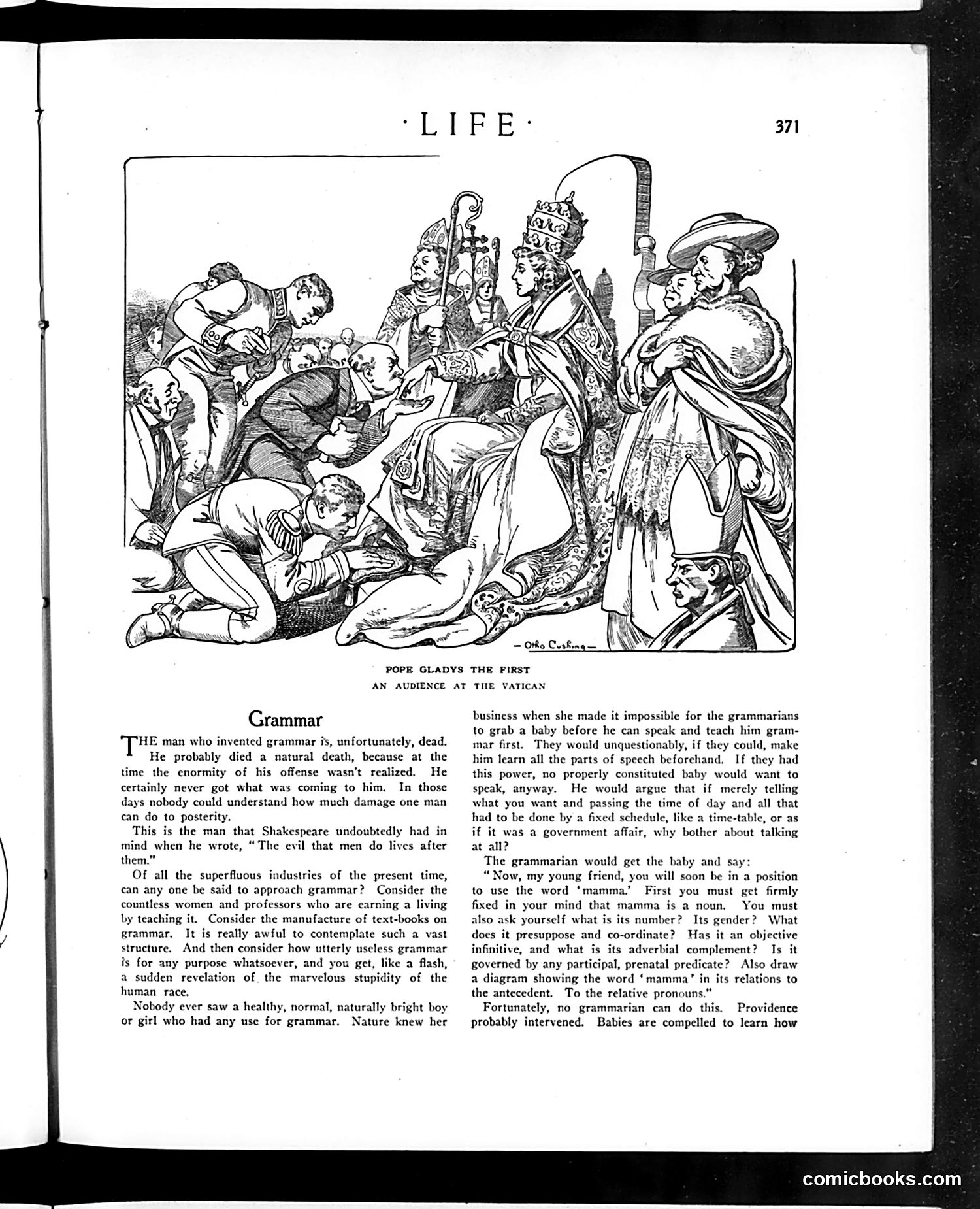
The cartoon depicts Pope Gladys I granting an audience at the Vatican, surrounded by clergy and supplicants. The accompanying essay satirizes grammar instruction as a useless, superfluous industry that damages children's natural development. The satire's point: grammarians are portrayed as bureaucratic pedants who complicate simple speech with meaningless rules (parts of speech, diagramming, gender, objective infinitives). The author argues that children naturally learn language without formal grammar instruction, and that forcing rigid grammatical analysis upon babies would actually *prevent* them from speaking. "Pope Gladys" likely mocks the authoritarian, quasi-religious reverence given to grammar instruction and its practitioners—treating grammatical rules as dogma rather than practical tools. The Vatican setting reinforces this religious analogy, suggesting grammar teaching functions like institutional religion: unnecessary, oppressive, and sustained by self-interested professionals. This reflects early-20th-century progressive skepticism toward rigid educational formalism.
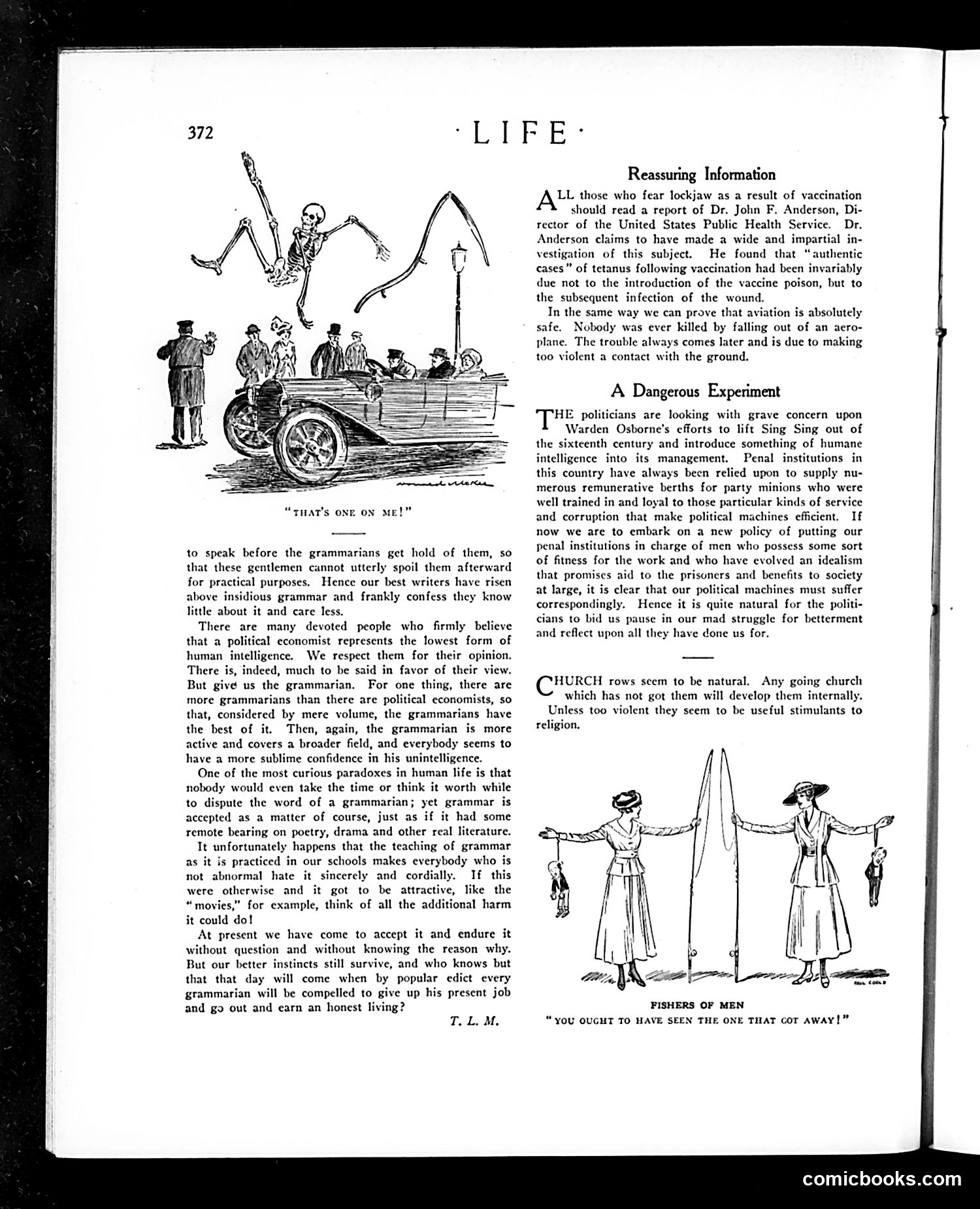
**Top Cartoon ("That's One On Me!")**: Shows a skeletal figure being ejected from a car while pedestrians watch. This appears to satirize automobile safety—the joke being that the skeleton represents someone who crashed, illustrating the magazine's point (made in the adjacent text) that aviation and vaccines aren't inherently dangerous; rather, the *consequences* of misuse cause harm. The title suggests the skeleton is "getting one back" on critics. **Main Articles**: The page contains three satirical pieces: 1. **Grammar criticism**: Mocks grammarians as pretentious but incompetent, arguing they're given undue authority despite their "unintelligence." 2. **Vaccine safety**: Sarcastically defends vaccination by claiming tetanus cases result from infection, not the vaccine itself—using absurdist logic (aviation is "safe" because people don't die from falling, only from hitting the ground). 3. **Sing Sing Prison reform**: Criticizes politicians opposing Warden Osborne's humane prison reforms, arguing they fear losing patronage jobs for party loyalists. **Bottom Cartoon ("Fishers of Men")**: Two women fishing, discussing "the one that got away"—a gentle joke about church attendance or religious practice.
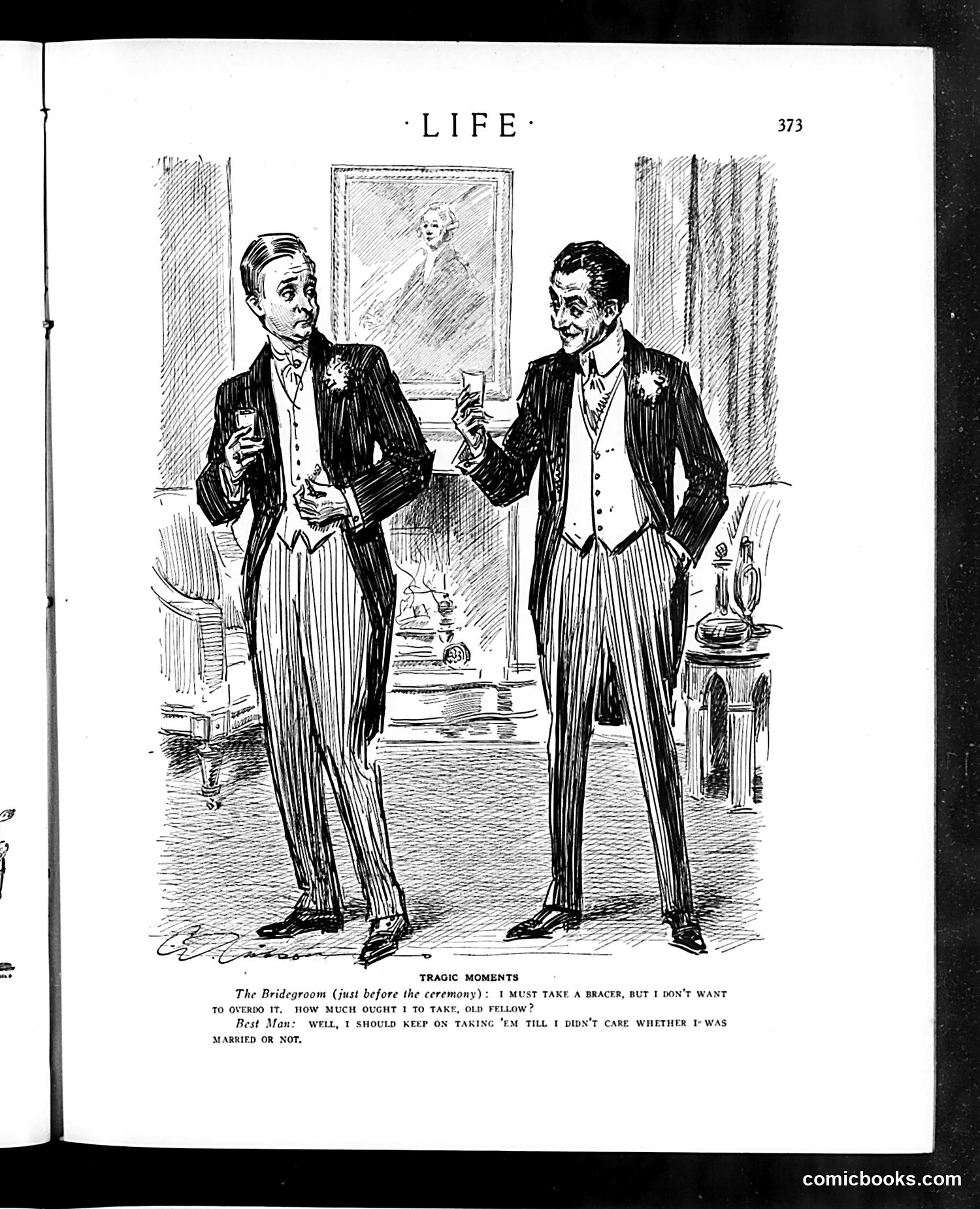
This satirical cartoon depicts two men in formal wedding attire—the bridegroom and best man—discussing alcohol consumption before a ceremony. The bridegroom asks how much he should drink to calm his nerves, and the best man cynically advises him to keep drinking until he becomes indifferent to whether he gets married at all. The humor operates on multiple levels: it mocks pre-wedding jitters as something requiring alcohol to endure, suggests marriage itself is an undesirable fate requiring intoxication to accept, and captures a particular masculine attitude toward matrimony as an obligation rather than a desired event. The title "Tragic Moments" underscores this perspective, treating marriage as something to be endured rather than celebrated. The cartoon reflects early 20th-century satirical attitudes toward marriage and bachelor anxiety.
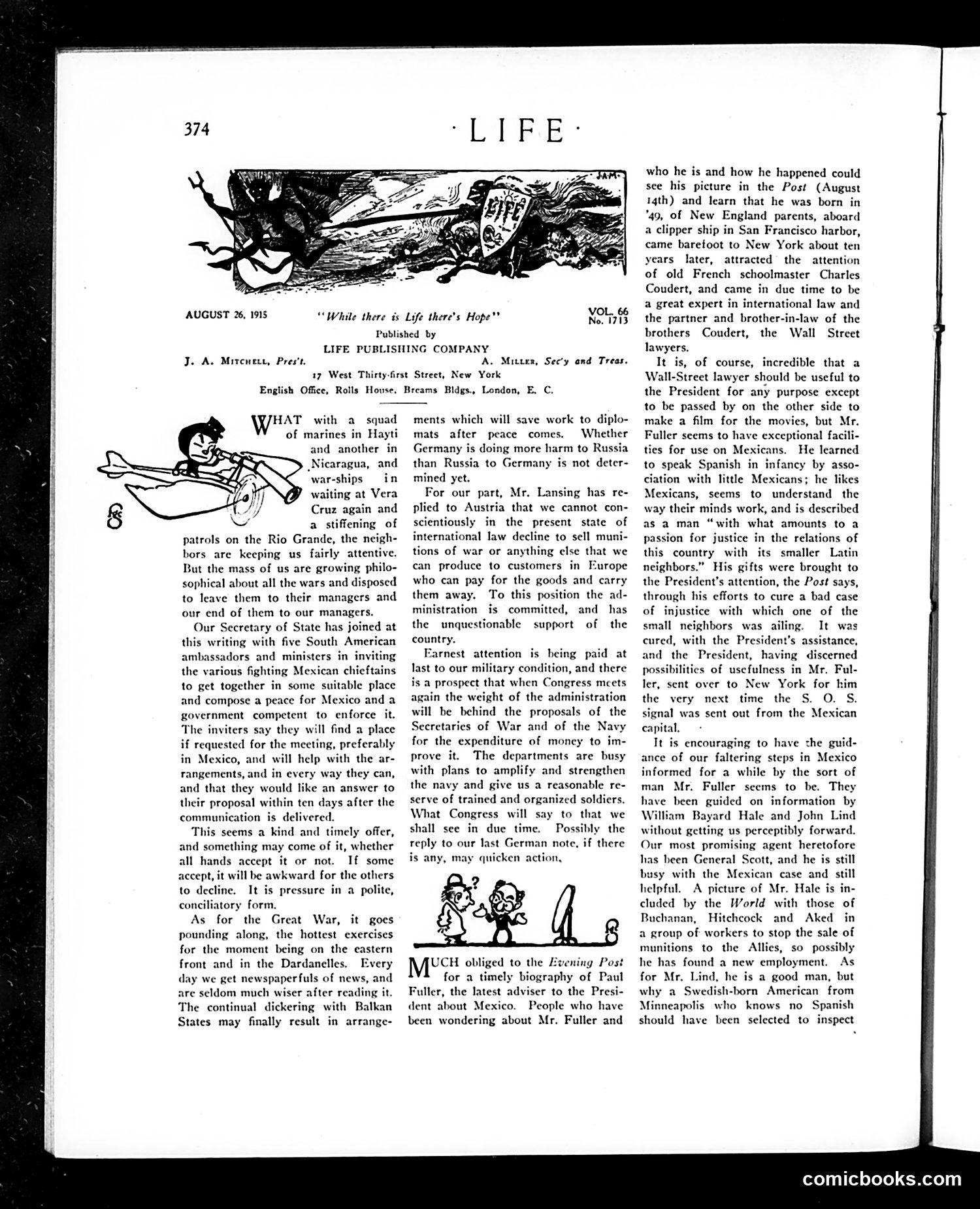
This page discusses American foreign policy during World War I, focusing on three issues: U.S. military interventions in Haiti, Nicaragua, and Mexico; America's neutrality stance toward the European war; and Paul Fuller, a Wall Street lawyer newly advising President Wilson on Mexican affairs. The cartoons (small illustrations at top and middle) appear satirical but are not clearly legible in this reproduction. The text's satire is more evident: the author mocks the State Department's "polite, conciliatory" peace invitation to Mexican factions as naive pressure diplomacy, and expresses sardonic surprise that a Wall Street lawyer could usefully advise the President—suggesting distrust of business elites in government roles. The piece reflects 1915 American debate over neutrality, military preparedness, and intervention in neighboring countries.
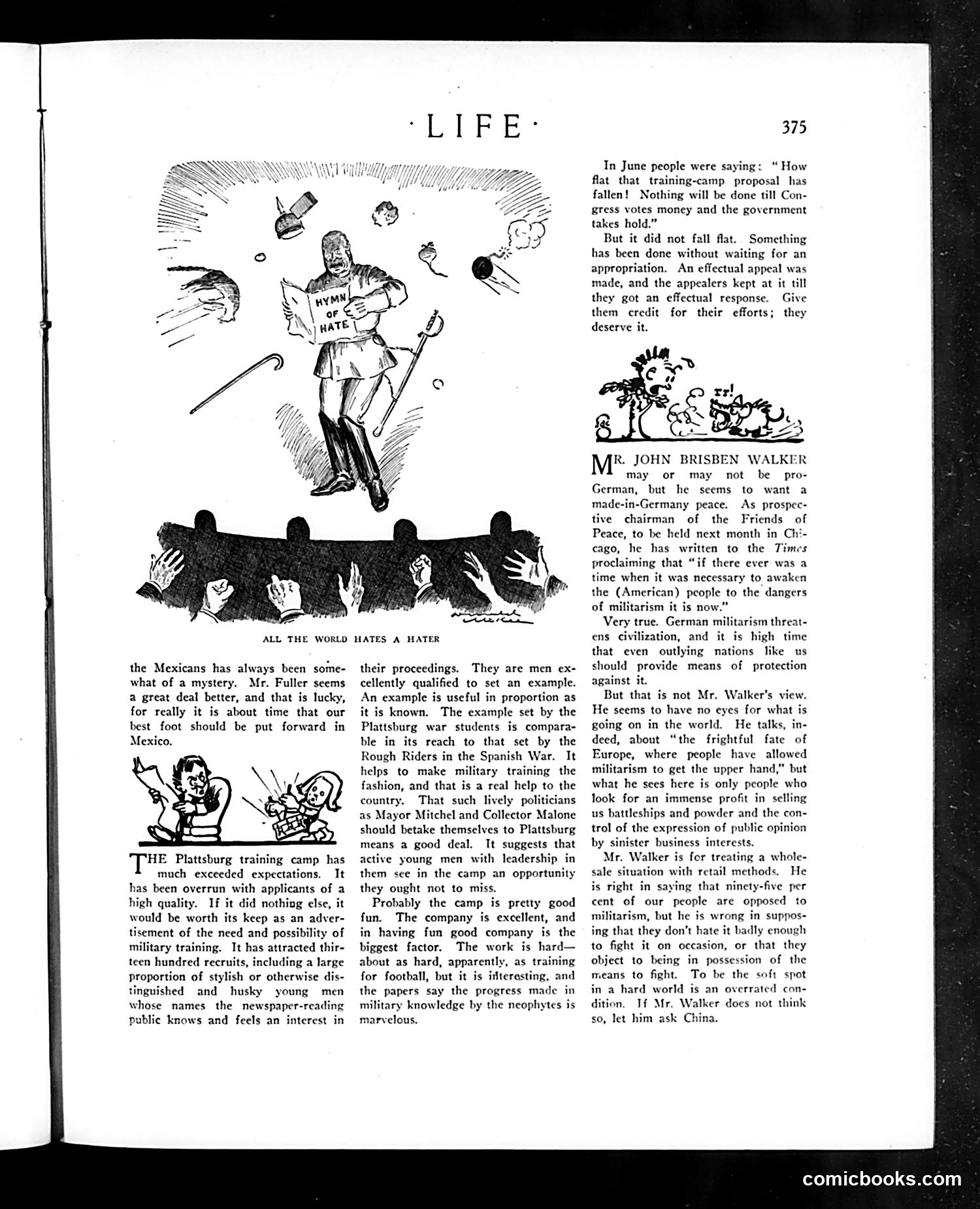
**The Main Cartoon** ("All the World Hates a Hater") depicts a figure labeled "HYMN OF HATE" standing above a crowd with fists raised, surrounded by falling objects. This satirizes anti-militarism sentiment—likely referencing German writer Ernst Lissauer's 1914 "Hymn of Hate" against England. The point: hatred and pacifism are themselves destructive forces. **The Plattsburg Training Camp**: The article praises this voluntary military training initiative (established 1915), noting it attracted prominent New York figures like Mayor Mitchel and Collector Malone. Life celebrates it as fashion-setting preparedness without waiting for Congressional funding. **John Brisben Walker Critique**: Walker, a pacifist and peace advocate, is criticized for opposing militarism while ignoring German threats to civilization. Life's argument: Walker applies "retail methods" (individual opposition) to a "wholesale situation" (global conflict). The China reference suggests Walker's pacifism leaves nations vulnerable to aggression. **Historical Context**: Pre-WWI America debated preparedness versus isolationism.
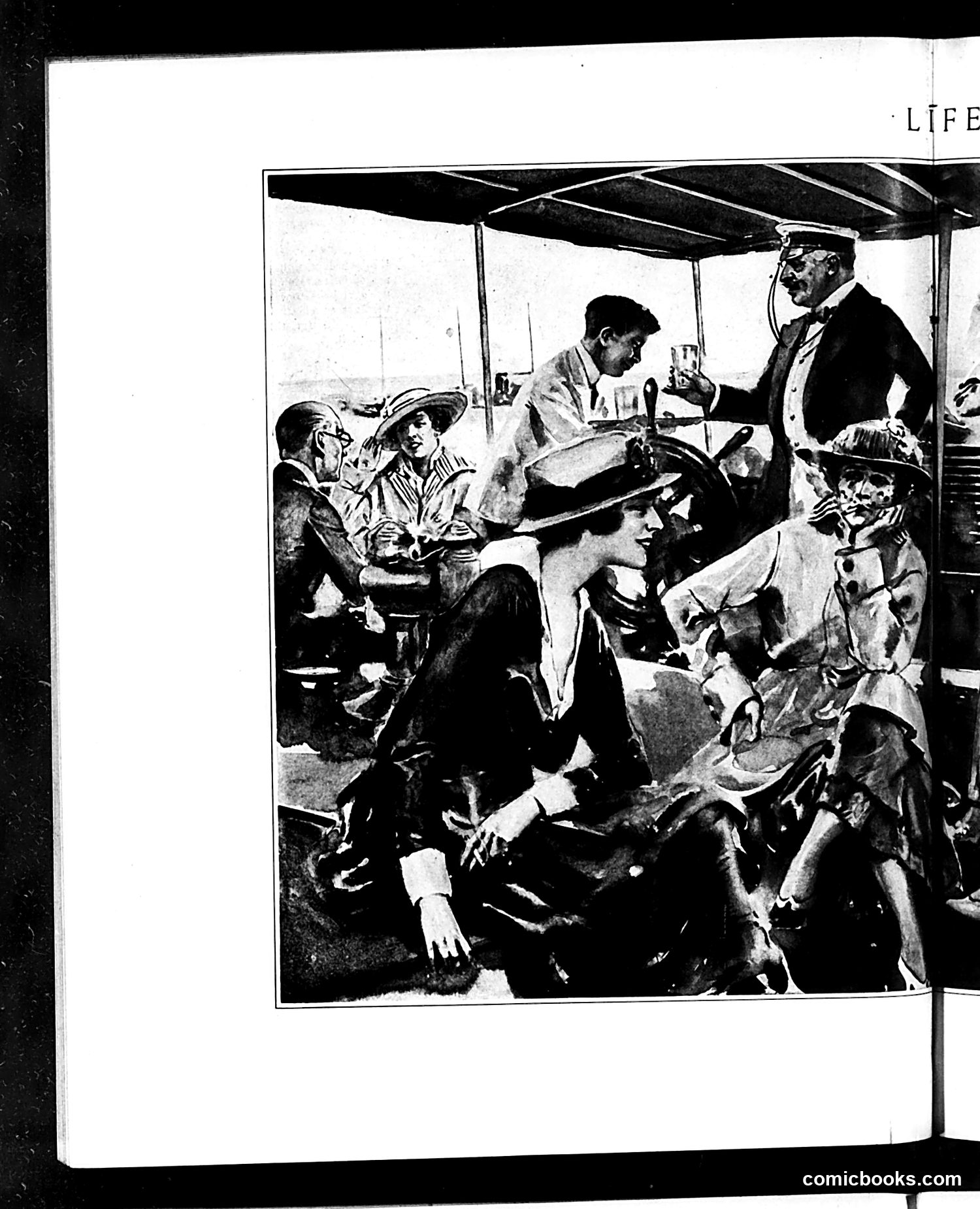
This black and white illustration depicts a social scene under a tent or awning, showing well-dressed figures in early 20th-century attire. The scene appears to satirize wealthy leisure activities or social gatherings of the era. The composition shows multiple figures in formal dress interacting—some seated, others standing—suggesting a commentary on upper-class social conventions or gatherings. The style is typical of Life magazine's satirical approach to American society during this period. Without additional caption text visible on this page, the specific political or social target remains unclear. The illustration likely mocks either pretentious social behavior, class divisions, or contemporary social customs, which were common themes for Life's satirical cartoons. The exact subject and point of satire cannot be definitively determined from the image alone.
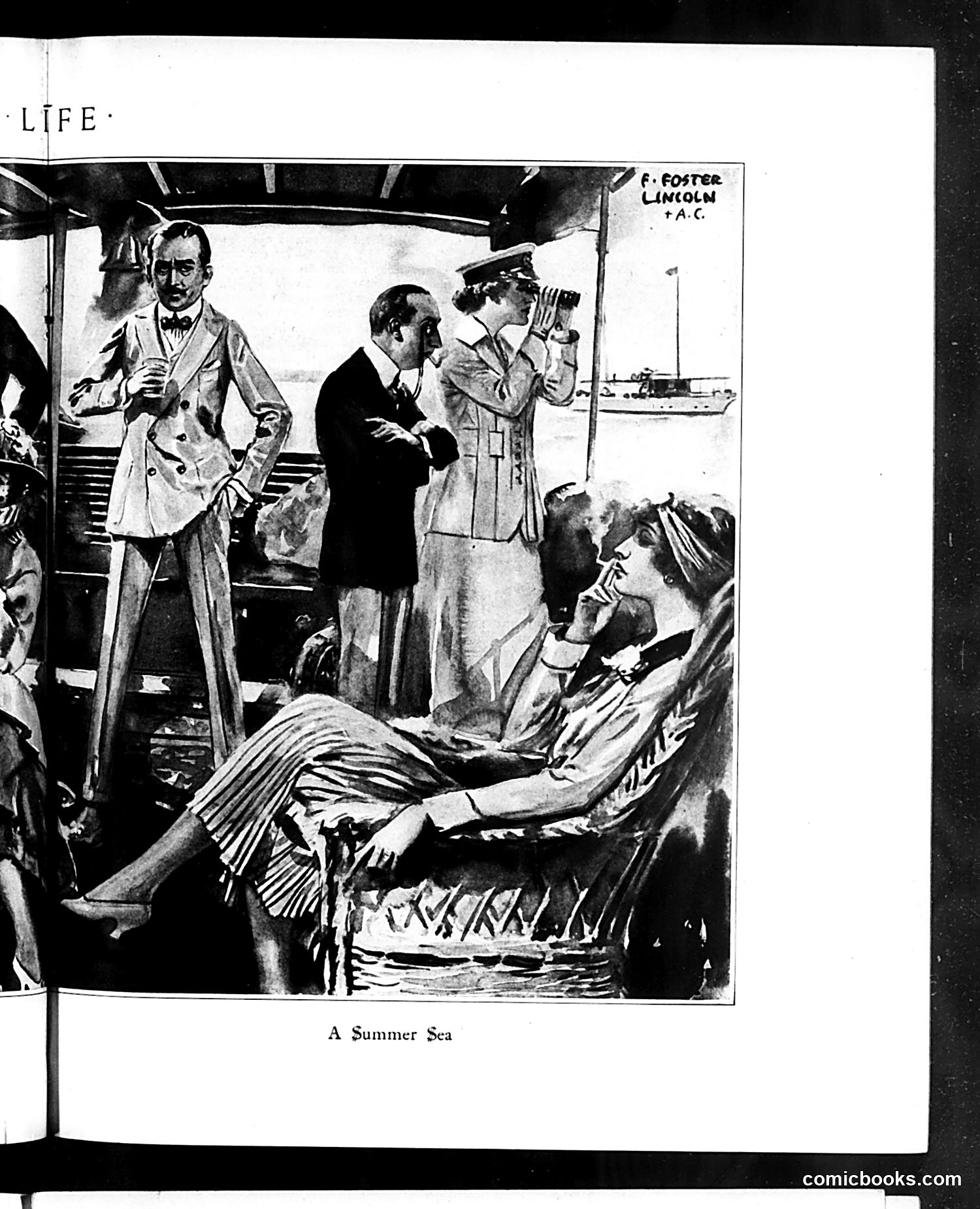
This Life magazine illustration depicts a leisure scene aboard what appears to be a yacht or pleasure boat. The caption credits "F. Foster Lincoln + A.C." as the artist(s). The image shows well-dressed passengers relaxing—women in period dress lounging in deck chairs while men in suits stand conversing. One man holds binoculars, apparently observing a naval vessel visible on the horizon. The scene satirizes the leisure activities of the wealthy elite during summer months. Without additional context about the specific publication date, the precise political references remain unclear. However, the illustration likely comments on the contrast between the comfortable leisure of affluent passengers and either contemporary naval/military concerns or broader class disparities of the era.
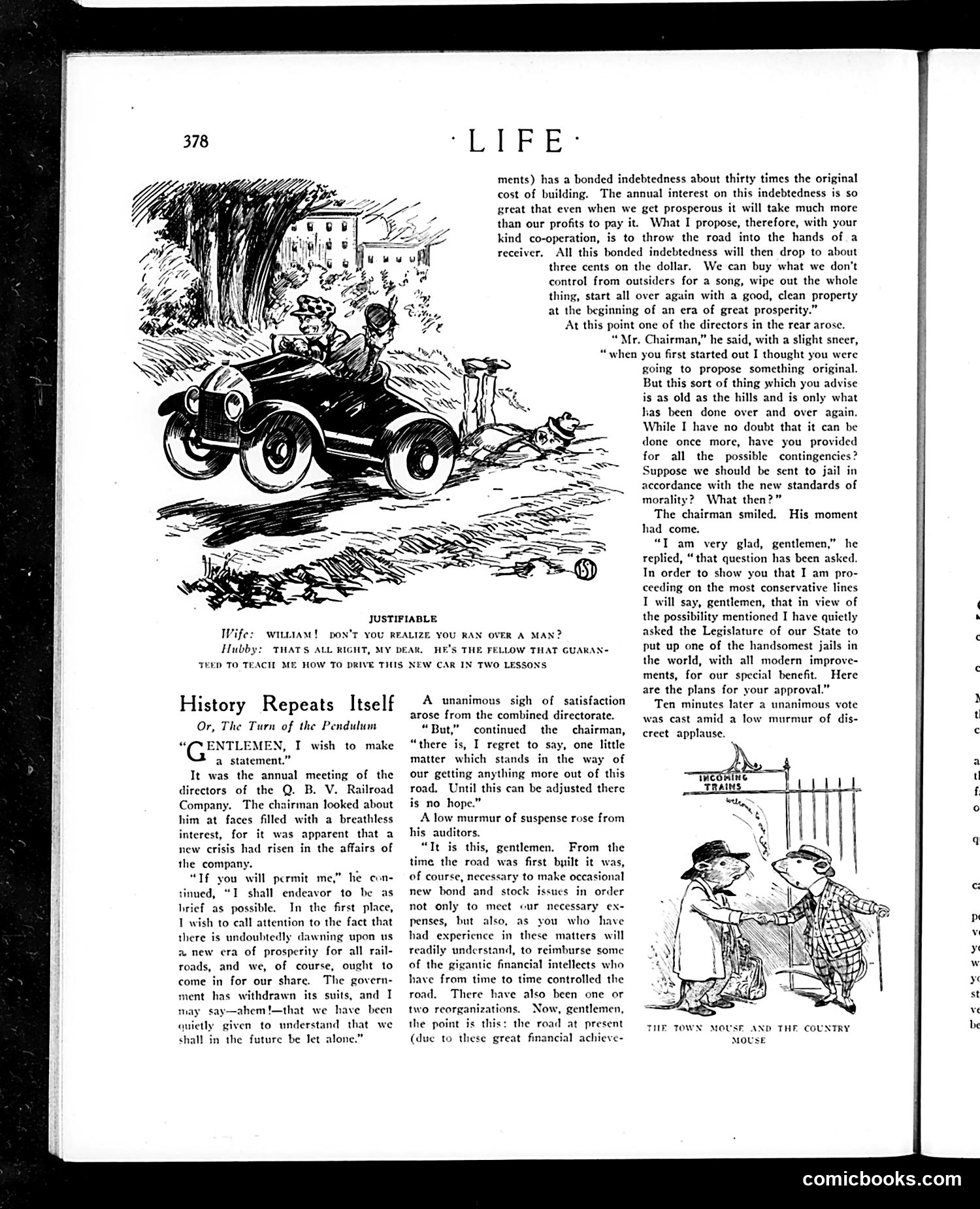
**Top Cartoon ("Justifiable"):** A husband has hit a pedestrian with his new automobile. The wife protests; the husband dismisses it because the victim was merely the driving instructor who guaranteed to teach him in two lessons. The satire mocks both reckless early-automobile drivers and the absurdity of finding someone "expendable" because they failed at their job. **Main Story ("History Repeats Itself"):** A railroad chairman addresses directors about the Q.B.V. Railroad's financial crisis. He proposes bankruptcy—throwing the road into receivership so bonded debt drops to "three cents on the dollar," then rebuilding with a clean slate. When a director warns about potential jail time under "new standards of morality," the chairman casually reveals he's already had the state legislature fund a luxurious jail—"for our special benefit." The satire targets railroad corruption: executives repeatedly bankrupted lines through financial manipulation, faced no real consequences, and expected government complicity. The chairman's preemptive jail construction satirizes how the wealthy anticipated legal accountability yet remained confident in avoiding genuine punishment.
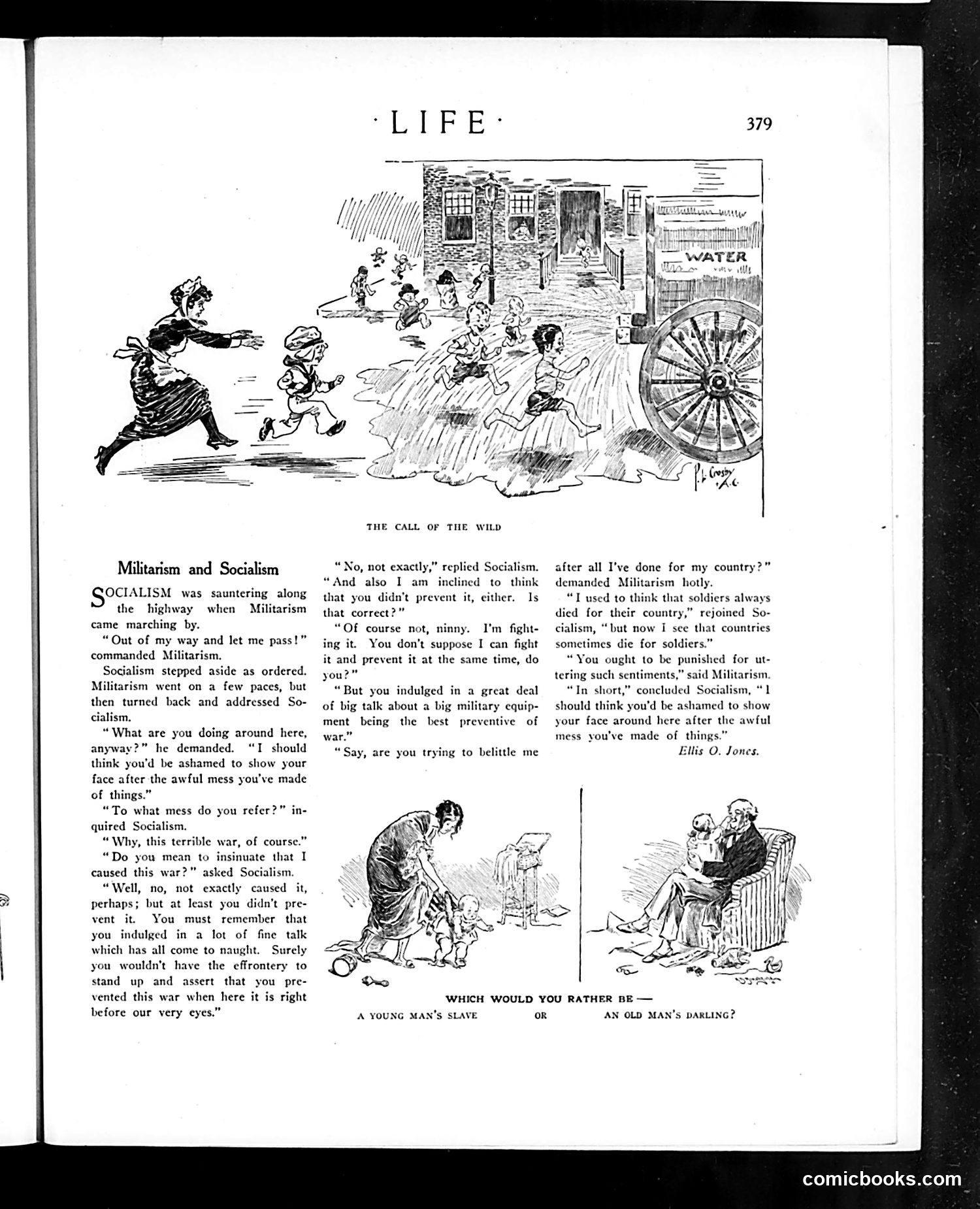
This satirical dialogue, attributed to Ellis O. Jones, presents a debate between two personified ideologies during World War I (the reference to "this terrible war" suggests WWI-era publication). **The argument:** Militarism blames Socialism for the war's occurrence, claiming Socialist pacifist rhetoric failed to prevent it. Socialism counters that Militarism's pre-war advocacy for military buildup as a "preventive" was equally ineffective—and hypocritical. **The satire's point:** Both ideologies share blame for the war yet blame each other. The cartoon critiques their mutual ineffectiveness: Militarism can't prevent war while fighting it; Socialism's fine talk accomplished nothing. **The final jab:** Socialism's retort—"countries sometimes die for soldiers" (rather than soldiers dying for countries)—inverts the nationalist ideal, suggesting military expansion prioritizes soldiers' interests over national welfare. The page's lower cartoon presents an unrelated domestic social question about economic dependency.
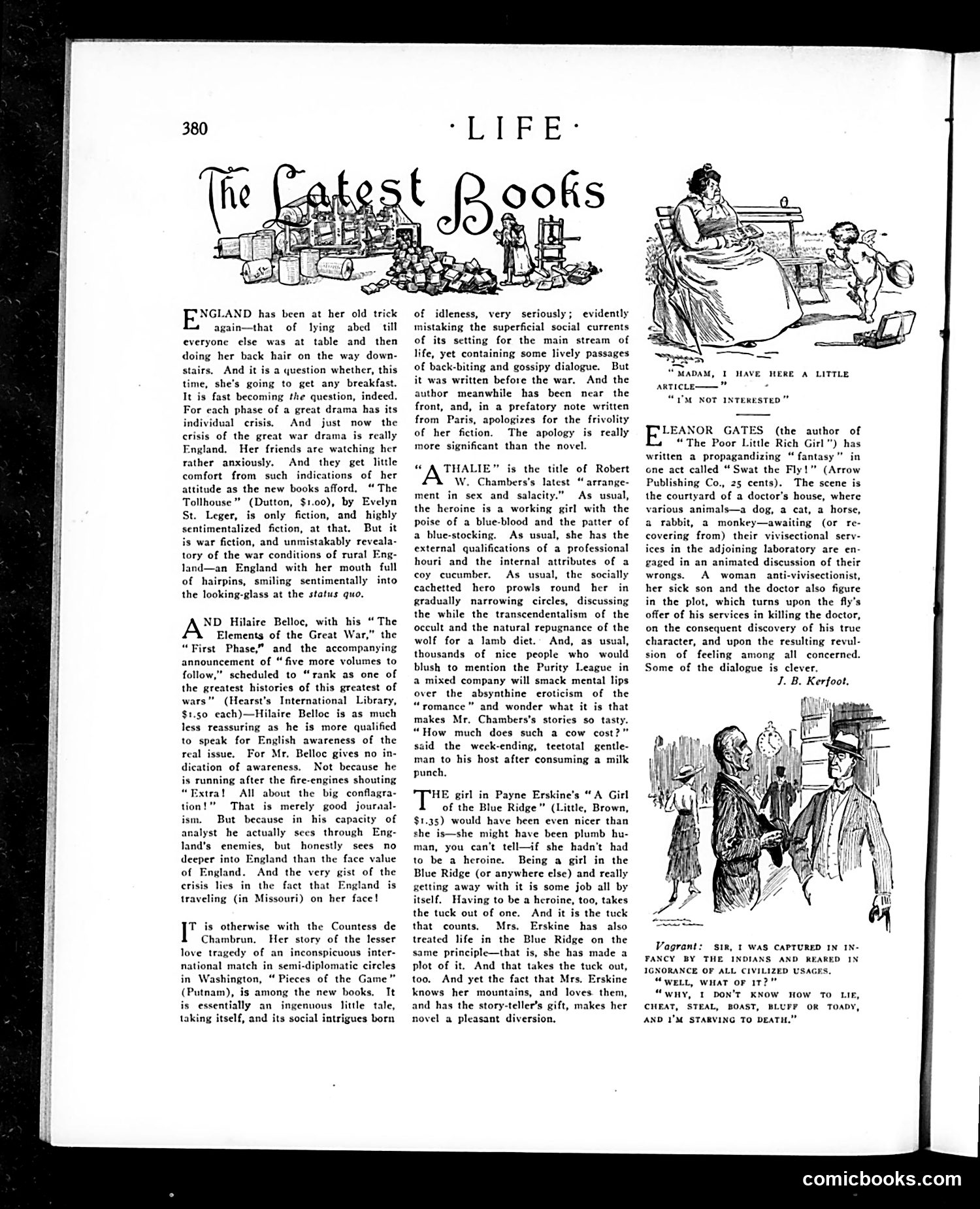
This page from *Life* magazine reviews several wartime books, using them to critique England's perceived complacency during World War I. The author suggests England is metaphorically "lying abed" and fixing her hair while the war rages—preoccupied with trivial matters rather than facing the crisis seriously. The satire targets: 1. **"The Tollhouse"** by Evelyn St. Leger—dismissed as sentimental rural fiction that ignores the war's gravity 2. **Hilaire Belloc's war histories**—criticized for analyzing enemies but lacking real insight into England's own deeper problems 3. **Robert W. Chambers's novels**—mocked for shallow eroticism that distracts respectable readers with titillating "romance" rather than substance 4. **Payne Erskine's work**—faulted for prioritizing heroine conventions over authentic characterization The cartoons (right side) appear to illustrate this frivolity through domestic scenes. The author's fundamental complaint: England's cultural output reveals superficial awareness of the war's true stakes, suggesting the nation is failing to reckon seriously with its existential challenge.
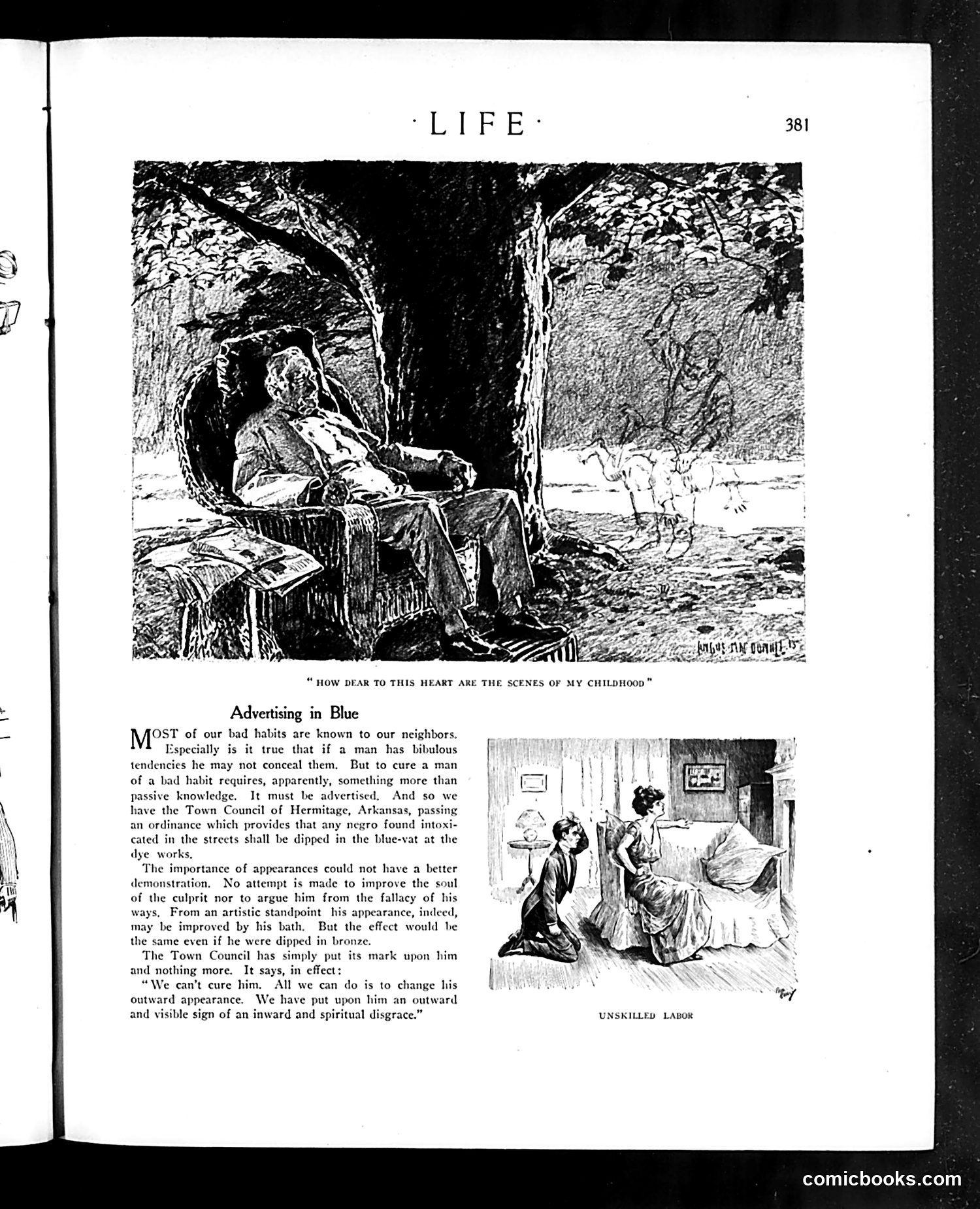
This article satirizes a real ordinance from Hermitage, Arkansas that mandated public shaming: any Black person found intoxicated would be dipped in blue dye at the town's dye works, marking them visibly. Life's satirical point: the town council has abandoned any pretense of rehabilitation or moral improvement. Instead, they've chosen pure **public humiliation**—literally branding offenders like merchandise. The piece mocks this as theatrically absurd: painting someone blue accomplishes nothing except creating a visible "mark of shame." The accompanying illustrations show domestic scenes contrasting with this brutalization. Life argues that such punitive spectacle reveals moral bankruptcy—society isn't trying to help or reform people, merely to publicly stigmatize them. The satire exposes the cruel logic of racial shame-based justice in Jim Crow America, where Black bodies become canvases for white community punishment and social control.
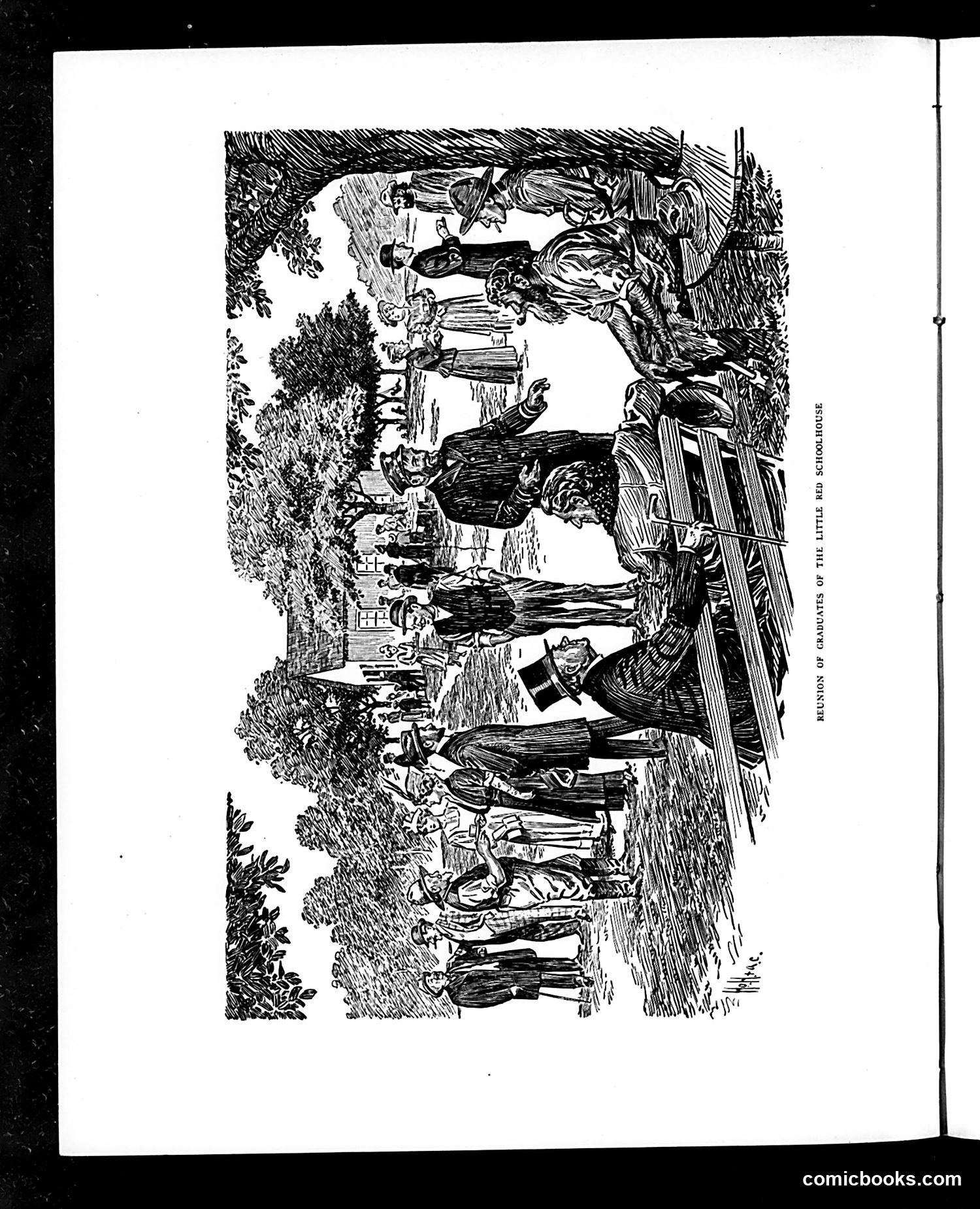
This page is printed sideways (rotated 90 degrees), making it difficult to read clearly. The OCR text appears to be corrupted formatting characters rather than actual content. The illustration itself is an engraving showing what appears to be a Victorian-era social or political scene with multiple figures in period dress arranged in a landscape setting with trees and buildings. Without legible accompanying text, I cannot definitively identify: - The specific figures depicted - The political or social event being satirized - The intended joke or commentary - The publication date or artist To properly analyze this cartoon's meaning for a modern reader, I would need either clearer OCR text or confirmation of the issue's date and publication context.
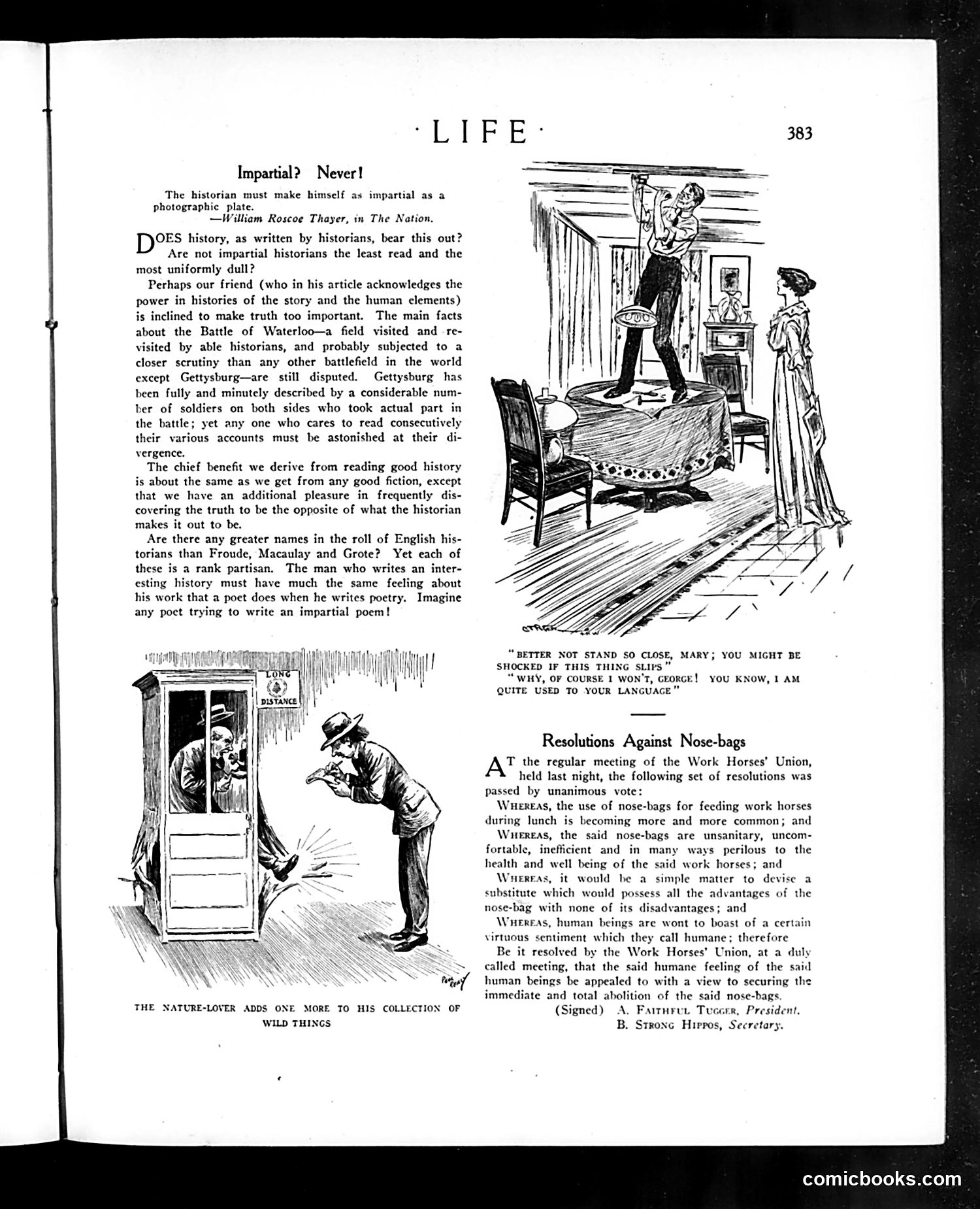
**Main Article ("Impartial? Never!"):** This essay critiques historian William Roscoe Thayer's claim that historians should be "impartial as a photographic plate." The author argues that truly impartial histories are dull and unread, citing how even intensely studied battles like Waterloo and Gettysburg have conflicting accounts from eyewitnesses. The piece suggests great English historians (Froude, Macaulay, Grote) were all partisan, and that interesting history requires passion like poetry—true impartiality is impossible and undesirable. **Top Cartoon:** Shows a man standing on furniture while a woman enters. His dialogue about "this thing slips" appears to reference his precarious balance or behavior; her response about being "used to your language" suggests marital discord or his crude speech. **Bottom Cartoon:** Labeled "The Nature-Lover Adds One More to His Collection of Wild Things," depicts a man at a door, seemingly collecting specimens—a satirical jab at amateur naturalists. **"Resolutions Against Nose-bags":** Mock-formal document from a "Work Horses' Union" protesting feed bags as unsanitary and calling for humane alternatives—satirizing both labor activism and sentimental animal welfare rhetoric.
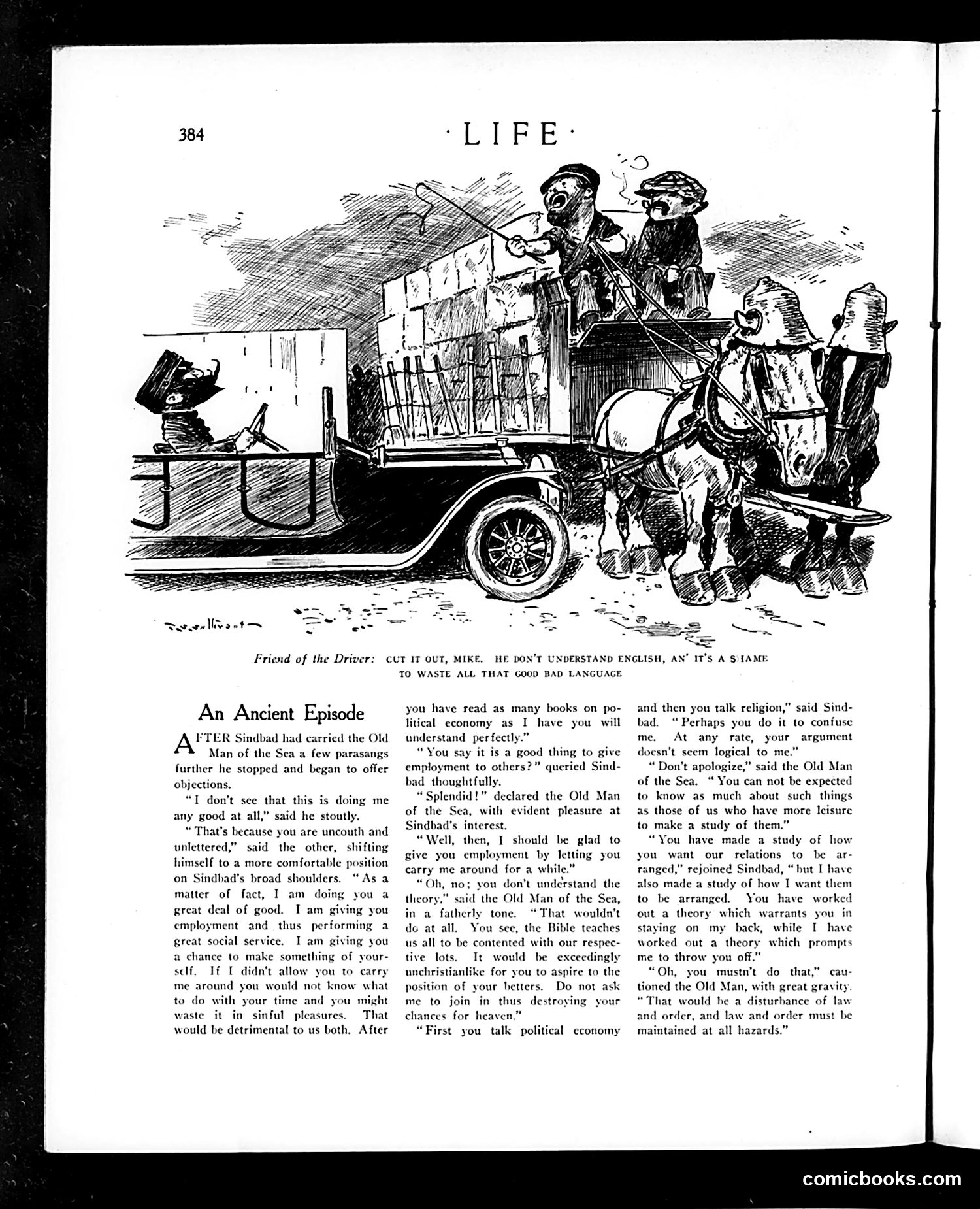
This page presents two satirical pieces about exploitative power dynamics: **The Cartoon** ("Friend of the Driver") shows a driver being criticized by passengers for swearing. The joke mocks hypocrisy: those complaining about "bad language" are themselves engaged in unreasonable behavior (likely demanding service or acting entitled). **"An Ancient Episode"** adapts the Sindbad legend to satirize capitalist justifications for labor exploitation. The Old Man of the Sea represents wealthy employers who use circular logic to keep workers subordinate: he claims giving Sindbad employment is morally beneficial, yet refuses to reverse roles. When Sindbad points out this hypocrisy—that if employment is good, the Old Man should accept being carried—the Old Man retreats to religious doctrine and appeals to "law and order." The satire targets how the wealthy justify inequality through contradictory arguments: political economy, religious duty, and appeals to stability. Sindbad's rational objections are dismissed as ignorance, a common rhetorical tactic against labor demands in the early 20th century when *Life* published this.
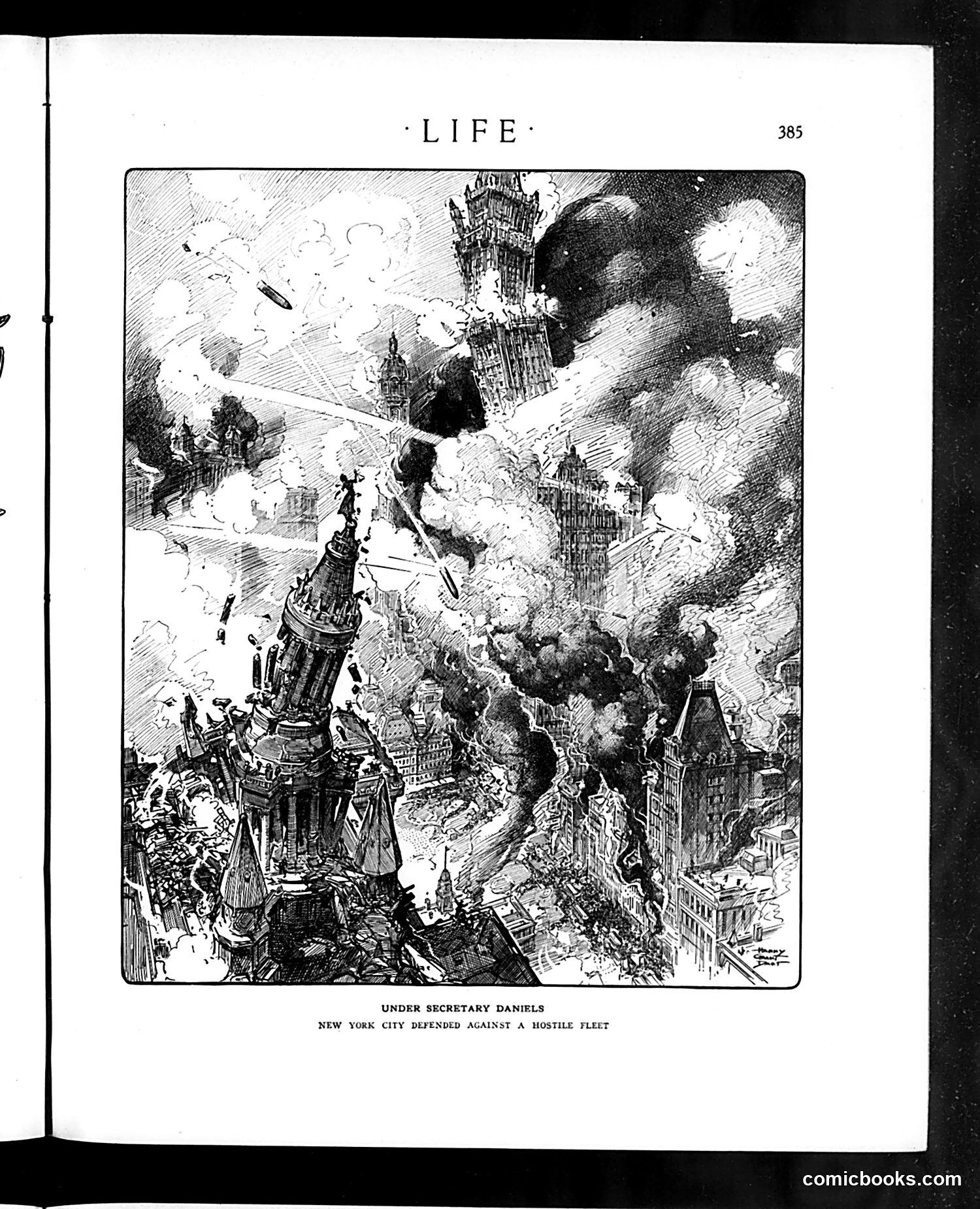
This is a satirical illustration depicting New York City under attack by a hostile naval fleet. The caption names "Under Secretary Daniels" as the defender, referring to Josephus Daniels, who served as Secretary of the Navy during World War I. The cartoon shows dramatic destruction—explosions, collapsing buildings (notably including what appears to be tall structures like skyscrapers), and smoke engulfing the cityscape. The satire appears to mock either Daniels' naval preparedness or the vulnerability of American cities to enemy attack. The exaggerated, catastrophic imagery suggests the cartoon critiques either inadequate coastal defenses or questions whether the Navy could actually protect major cities from modern warfare threats. Without the specific publication date visible, the exact political context—whether referencing pre-WWI preparedness debates or another period—remains unclear.
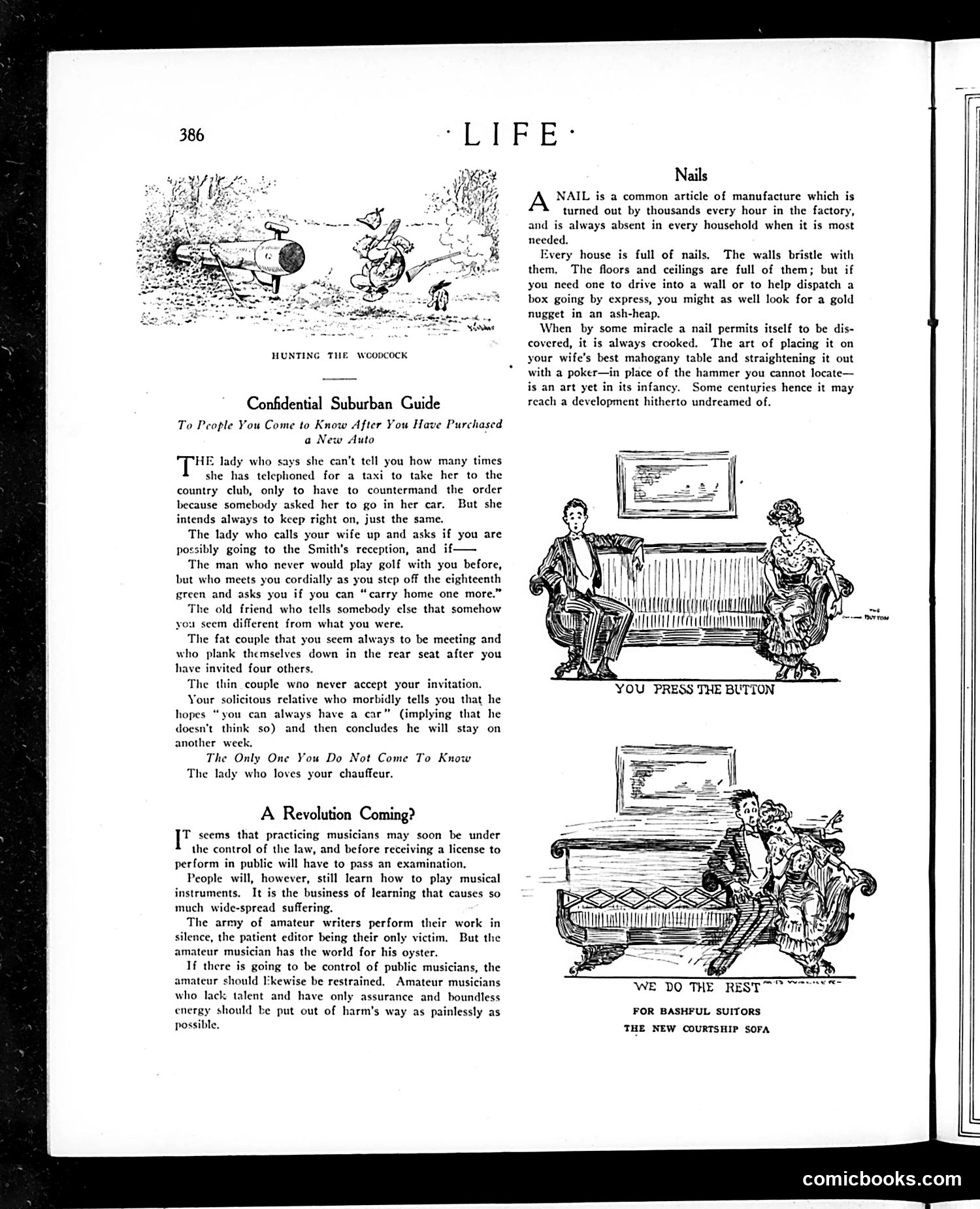
This page contains three humorous pieces satirizing early 1900s American life: **"Confidential Suburban Guide"** mocks social dynamics among car owners. The satire targets how automobile ownership changed social hierarchies—suddenly people who never socialized before now seek rides, uninvited guests impose themselves, and those without cars either fish for invitations or avoid the car owner entirely. The "lady who loves your chauffeur" suggests romantic complications servants introduce. **"A Revolution Coming?"** ironically proposes licensing musicians to control public performance. The joke is that amateur musicians plague their audiences with unbearable playing, yet unlike amateur writers (who suffer silently), musicians inflict their incompetence on the world. The author sarcastically suggests amateurs should be "restrained...as painlessly as possible"—dark humor about muting bad musicians. **"Nails"** is domestic humor: every house contains countless nails, yet when one is actually needed, none can be found or they're crooked. The absurdist observation that straightening a nail on mahogany furniture with a poker (lacking a hammer) represents helpless domesticity. The **courtship sofa illustrations** advertise furniture with suggestive designs for courting couples.
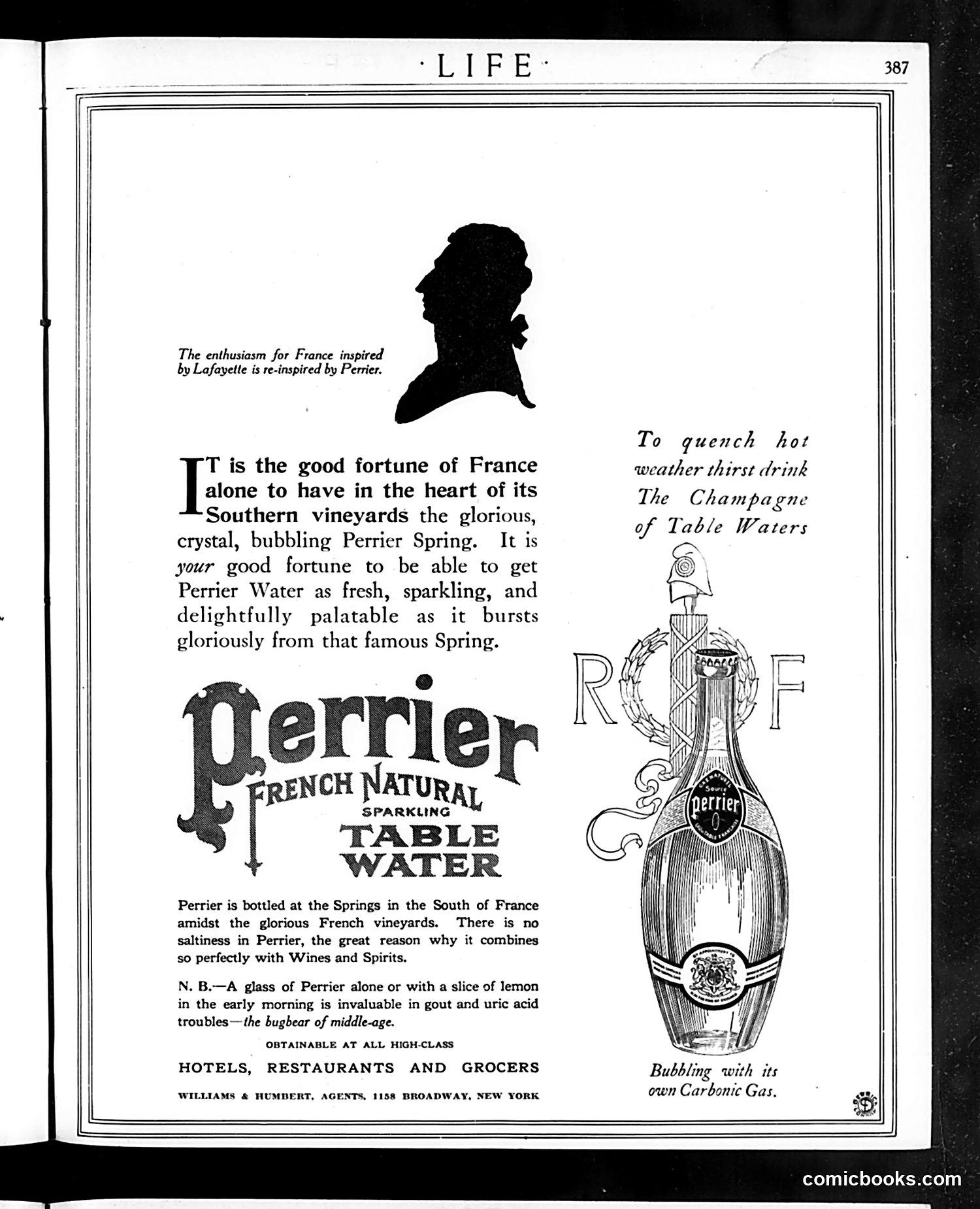
This is primarily a **product advertisement** for Perrier sparkling water, not political satire. The page appears from *Life* magazine's advertising section (page 387). The silhouette at top depicts **Lafayette**, the French Revolutionary War hero, establishing a patriotic association with France. The ad cleverly links Perrier to French prestige by invoking "the enthusiasm for France inspired by Lafayette." The marketing pitch emphasizes Perrier's French origins ("Southern vineyards"), purity, and health benefits—notably claiming it helps with "gout and uric acid troubles—the bugbear of middle-age," targeting wealthy, aging male consumers who frequented high-class establishments. The bottle illustration and tagline "The Champagne of Table Waters" position it as an upscale alternative to plain water. The ad's tone suggests early 20th-century American enthusiasm for Continental luxury goods, particularly among the affluent classes who patronized the "high-class hotels, restaurants and grocers" mentioned.
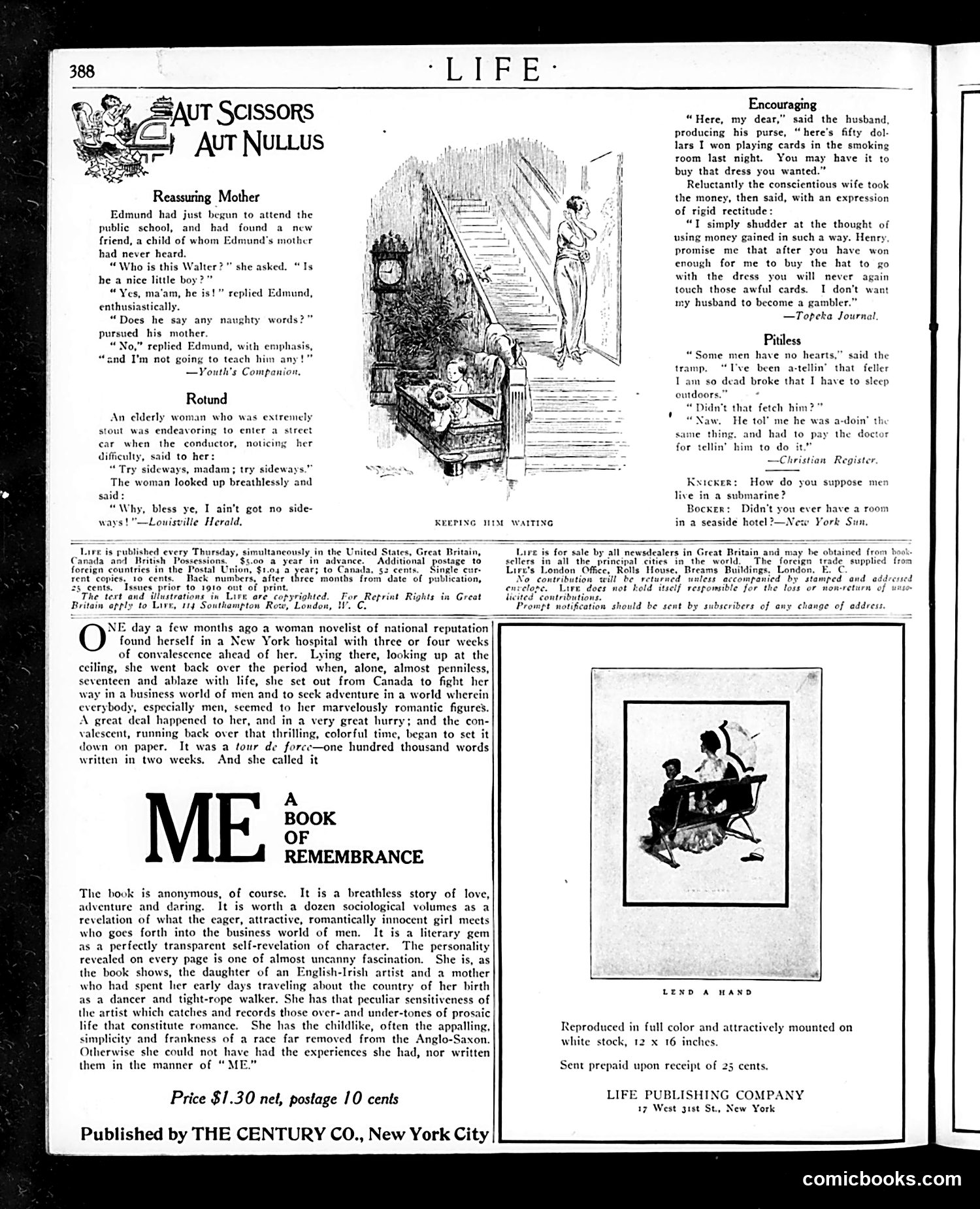
This page contains four brief humorous anecdotes typical of early 20th-century American magazines: **"Reassuring Mother"**: A mother interrogates her son about a new school friend, asking if the boy uses "naughty words." Edmund assures her he doesn't—and won't teach him any. The joke satirizes anxious middle-class parenting and moral propriety concerns. **"Round"**: An extremely obese woman struggles boarding a streetcar. When the conductor suggests she try entering sideways, she replies she has no "sideways"—a self-aware fat joke relying on body-shaming humor typical of the era. **"Encouraging" and "Pitiless"**: Two brief vignettes about morality: one depicts a wife reluctantly accepting gambling winnings while moralizing against the habit; the other shows a tramp's sob story failing to move a hardened listener. The page also advertises a novel called *Me: A Book of Remembrance*, described as an anonymous woman novelist's rapid memoir about navigating the business world as a young, romantic woman from Canada.
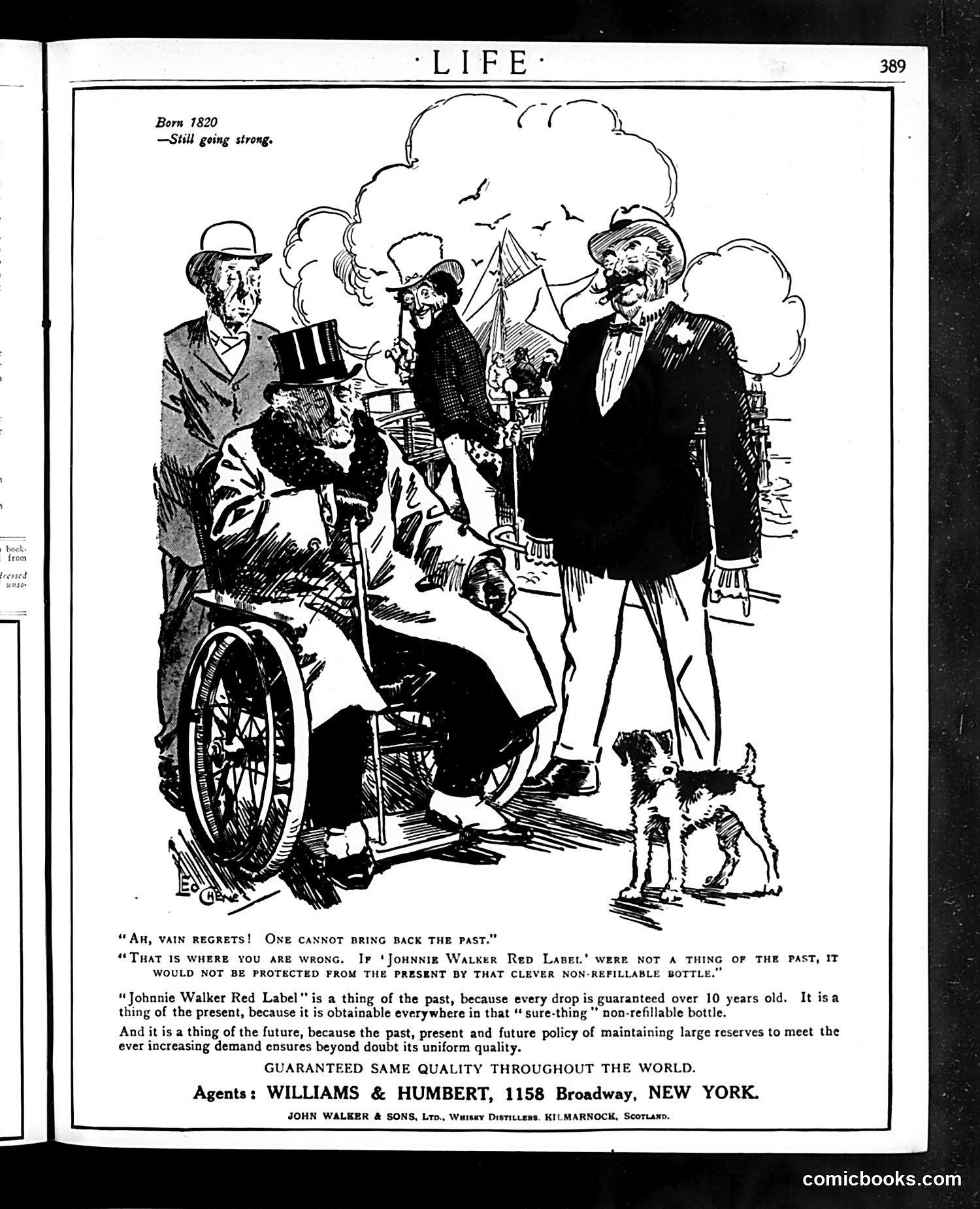
This is a **Johnnie Walker whisky advertisement** disguised as satirical content in Life magazine. The cartoon depicts well-dressed men discussing regret and the past, with one seated in what appears to be a wheeled chair or invalid's seat. The "joke" is a marketing pitch: the ad argues that Johnnie Walker Red Label—aged over 10 years—literally embodies the past, present, and future simultaneously. The clever non-refillable bottle allegedly preserves quality and prevents counterfeiting. The phrase "Born 1820—Still going strong" refers to Johnnie Walker whisky's founding date, personifying the brand as enduring. **Context**: This represents early 20th-century advertising disguised as editorial content, a common practice in magazines. The "vain regrets" dialogue is merely a hook to sell the product's age and reliability as selling points. The satire is minimal; it's primarily product placement dressed up as witty commentary.
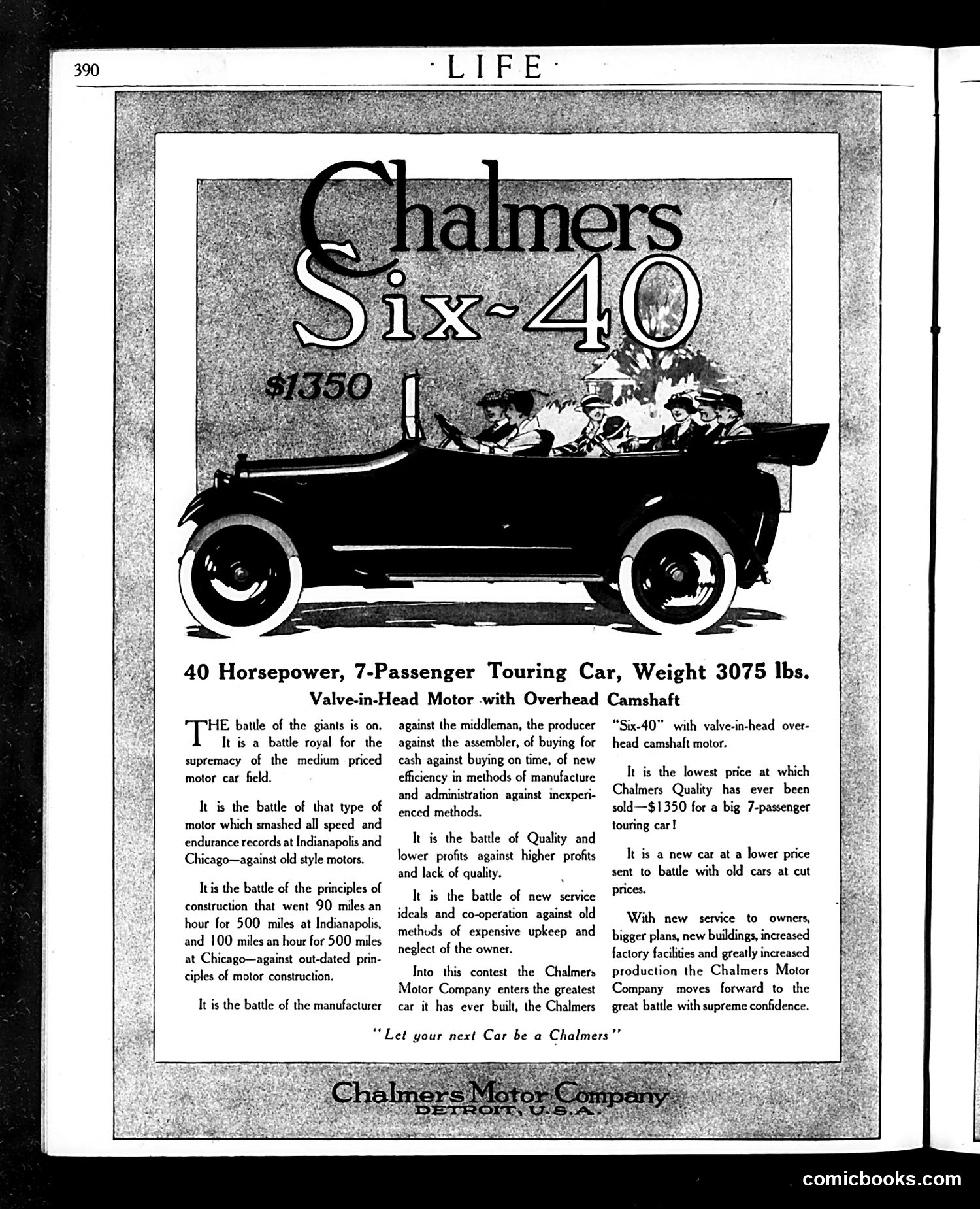
This is **not a political cartoon or satire**—it's a automobile advertisement from Life magazine for the Chalmers Motor Company's "Six-40" model priced at $1,350. The ad uses militaristic "battle" language metaphorically to position the new car as competition against rivals in the medium-priced automobile market. It emphasizes Chalmers' innovations (valve-in-head motor, overhead camshaft) against "old style motors," and contrasts the company's quality and service ideals against competitors prioritizing higher profits. The illustration shows a touring car loaded with passengers, meant to showcase the vehicle's 7-passenger capacity and appeal. This represents early 20th-century automotive marketing rhetoric, when manufacturers competed intensely on technological advancement and cost. The "battle of the giants" framing was typical advertising language of the era, appealing to consumer desire for proven performance at reasonable prices.
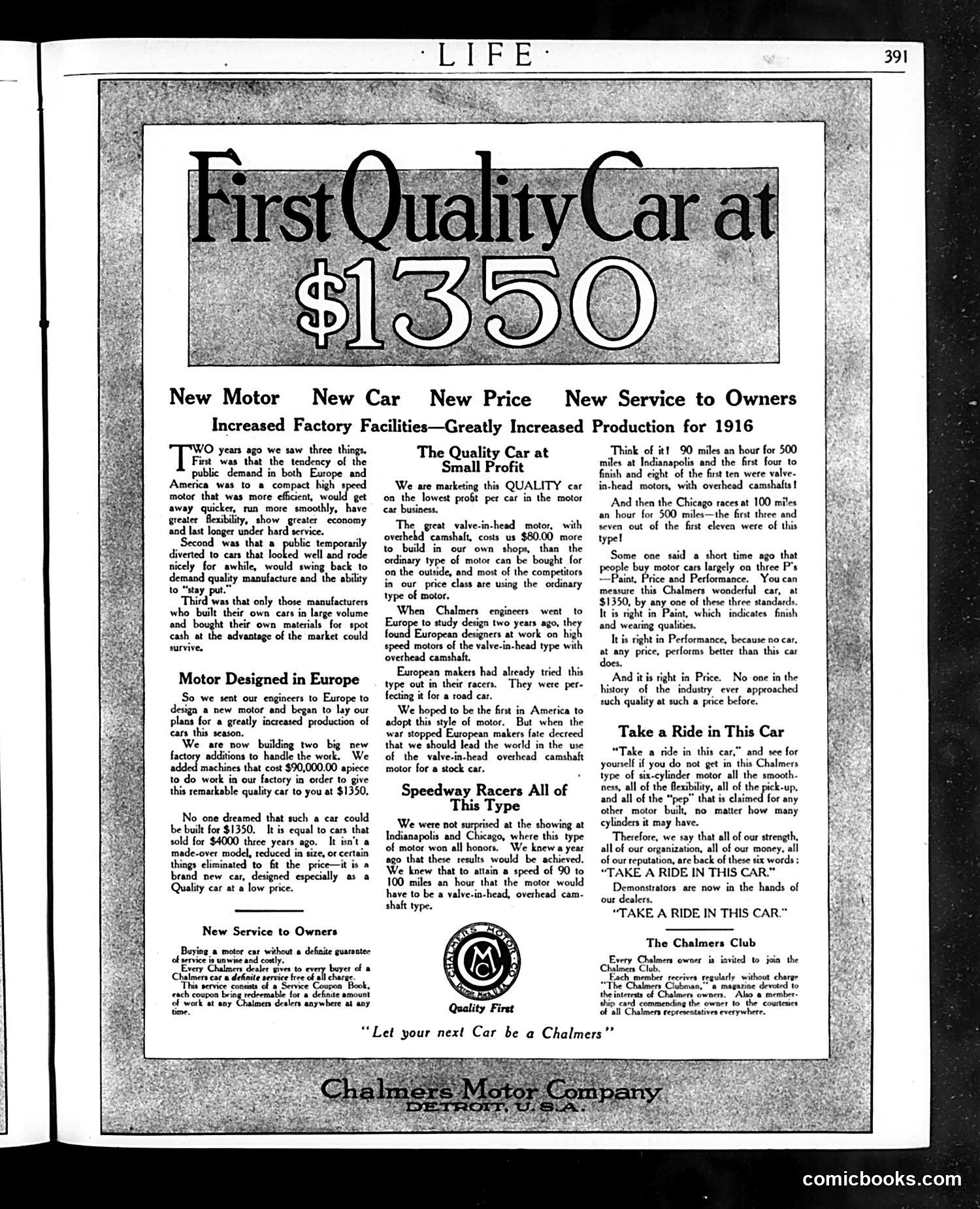
This is a **Chalmers Motor Company advertisement**, not a cartoon. It promotes their new automobile model priced at $1,350 for 1916. The key claims are: **Technical Innovation**: Chalmers engineers traveled to Europe to study advanced "valve-in-head" motors with overhead camshafts—a superior design European racers used but American manufacturers hadn't yet adopted for consumer cars. **Performance Proof**: The ad emphasizes Indianapolis 500 and Chicago race victories, where valve-in-head Chalmers motors dominated (first four finishers at Indianapolis; first three at Chicago races). This demonstrates the technology's reliability and speed (90-100 mph for 500 miles). **Value Proposition**: The company claims to offer quality rivaling $4,000 cars at $1,350 by manufacturing their own parts and operating at minimal profit margins. **Marketing Strategy**: Appeals to three "P's"—Paint (finish), Price (affordability), and Performance (racing success)—to justify the purchase. This represents early automotive advertising that leverages technological innovation and motorsport achievement to convince skeptical consumers that an affordable car could match expensive competitors' quality.
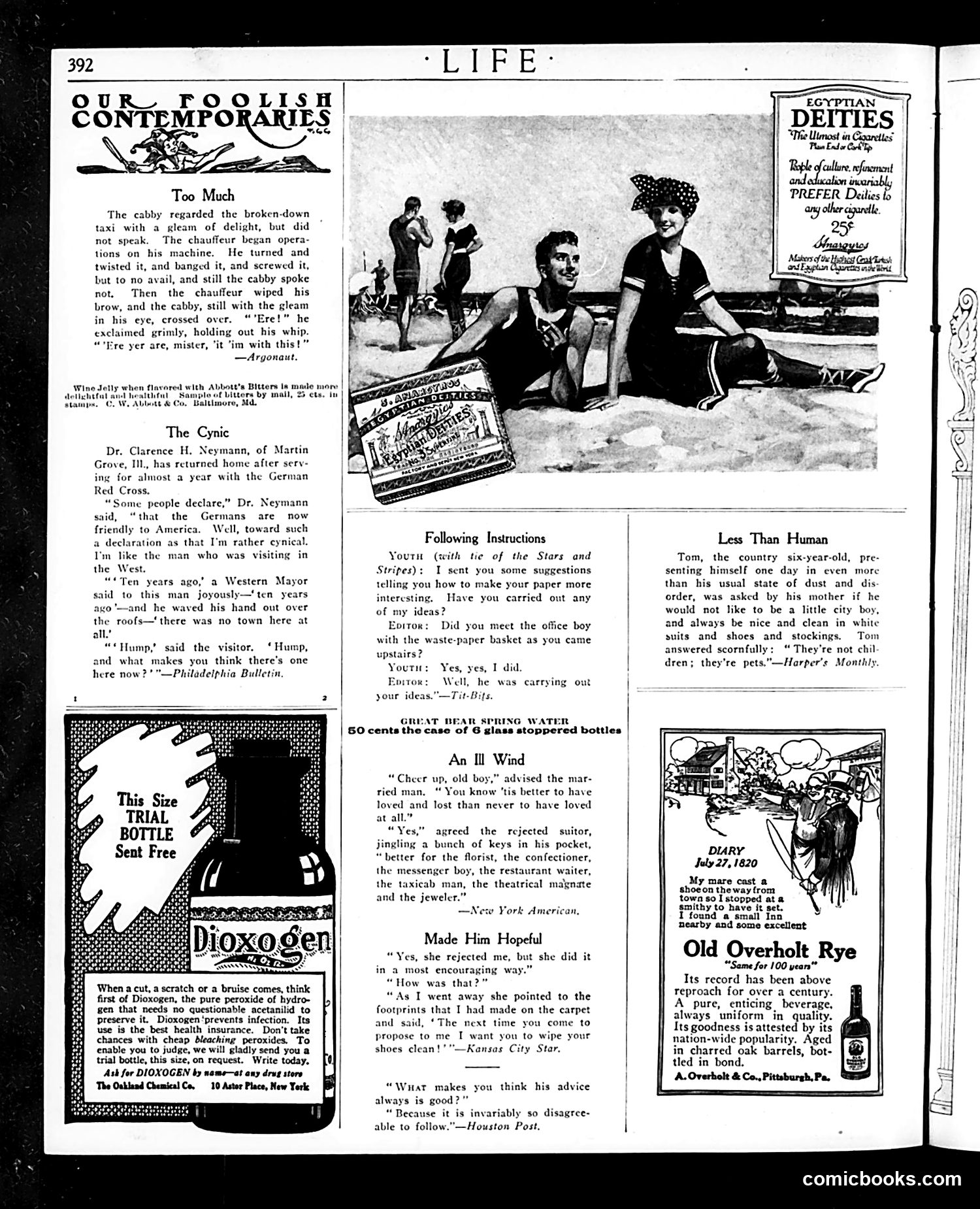
This page contains primarily **humorous anecdotes and advertisements** rather than political cartoons. The main satirical content includes: **"Too Much"** — A cabby jokes with a frustrated chauffeur whose taxi has broken down, offering his whip as a solution, mocking both mechanical frustration and working-class attitudes. **"The Cynic"** — Dr. Neymann's skepticism about German-American friendliness is illustrated through a parable: a Western mayor boasts of developing a town from nothing in ten years; the visitor cynically notes the town still appears non-existent. This satirizes exaggerated boasting and suggests underlying doubt beneath surface claims. **"Following Instructions"** — A young contributor's story suggestions are rejected via the office boy carrying waste-paper, satirizing how publications dismiss unsolicited advice. Other brief jokes mock rejected suitors' wasteful spending and overly-optimistic interpretations of rejection. The page is predominantly **commercial**, featuring advertisements for Dioxogen disinfectant, Egyptian Deities cigarettes, Great Bear Spring Water, and Old Overholt Rye whiskey.
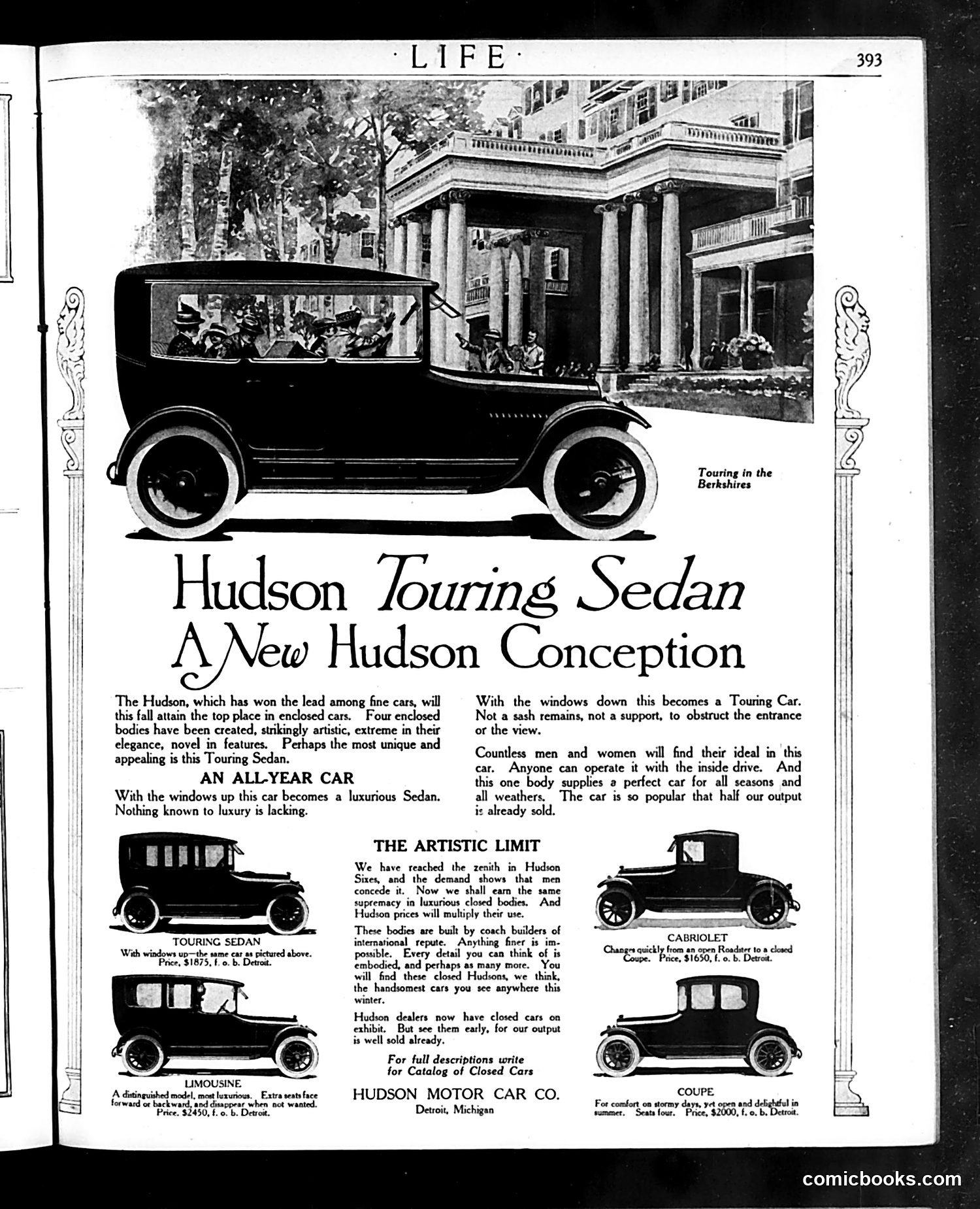
This is **not a cartoon or satire**—it's a straightforward automobile advertisement from Life magazine's advertising section (page 393). Hudson Motor Car Company showcases their new "Touring Sedan," emphasizing its innovative convertible design: windows can be raised for a luxurious enclosed sedan or lowered to function as an open touring car. The ad highlights versatility ("An All-Year Car") and ease of operation via inside drive. The page displays four body styles: Touring Sedan, Limousine, Cabriolet, and Coupe, with pricing around $1,873-$2,000. Text emphasizes Hudson's quality ("reached the zenith"), international coach-builders, and strong sales ("half our output is already sold"). The photograph shows the sedan parked before an elegant mansion in the Berkshires, targeting wealthy consumers. This reflects early 1920s automotive marketing: positioning closed cars as luxury items comparable to fine homes and leisured lifestyle.
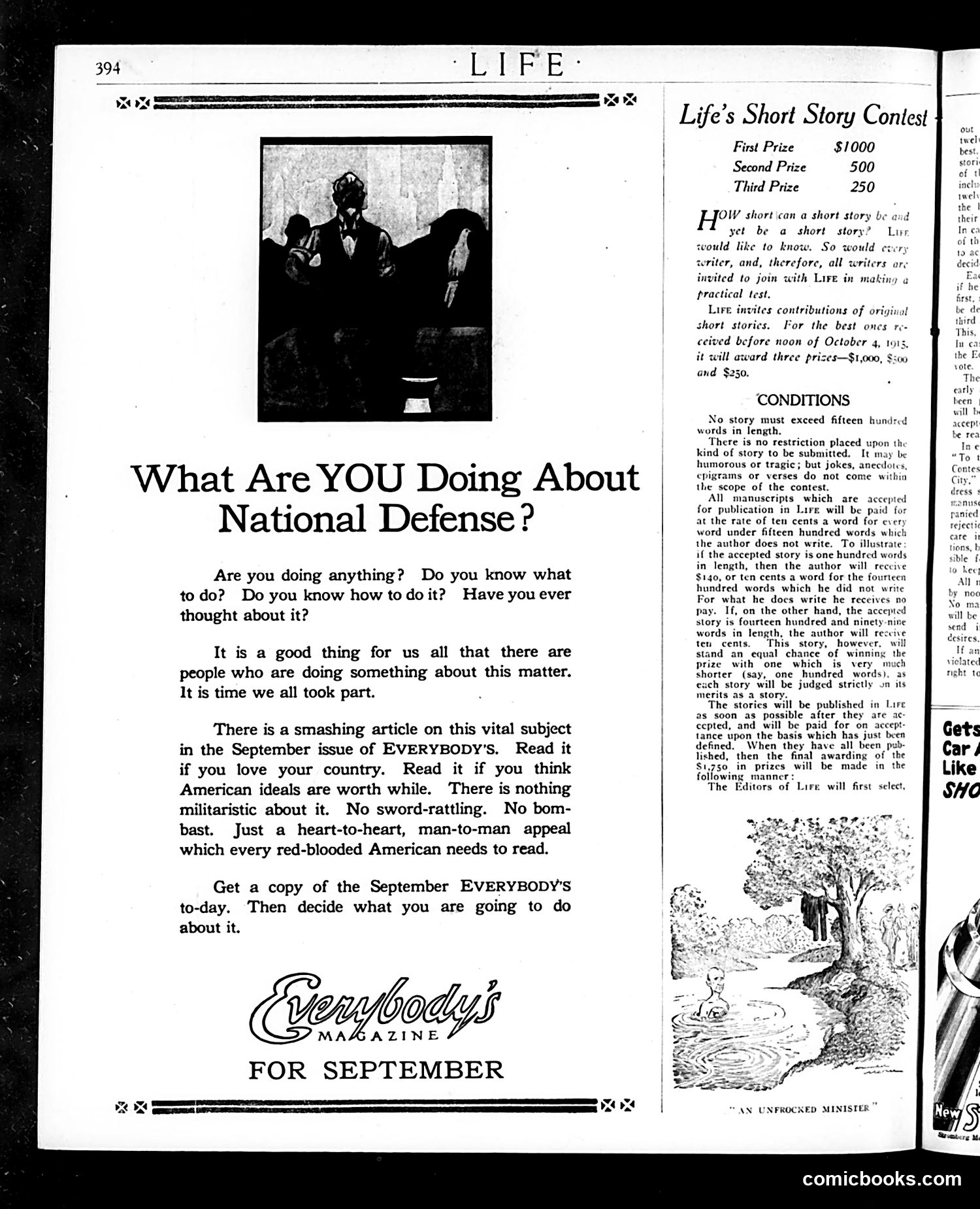
This page contains two distinct elements: a public service advertisement and a literary contest announcement. **The Main Advertisement** ("What Are YOU Doing About National Defense?") appeals to American patriotism regarding national defense preparedness. The silhouetted image shows what appears to be military or defense officials in discussion. The text urges readers to engage with an article in *Everybody's* magazine about defense, framing it as a patriotic duty for "every red-blooded American." This reflects pre-World War I or early WWI-era American anxieties about military readiness. **The Right Column** announces *Life's* short story contest with substantial prizes ($1,000 first place). The rules are detailed and somewhat unusual—authors are paid ten cents per word *not* written (capped at 1,500 words), creating an incentive for brevity. The accompanying illustration shows a pastoral scene titled "An Unfrocked Minister." Together, the page balances civic exhortation with entertainment, typical of *Life's* approach as a satirical but culturally engaged publication.
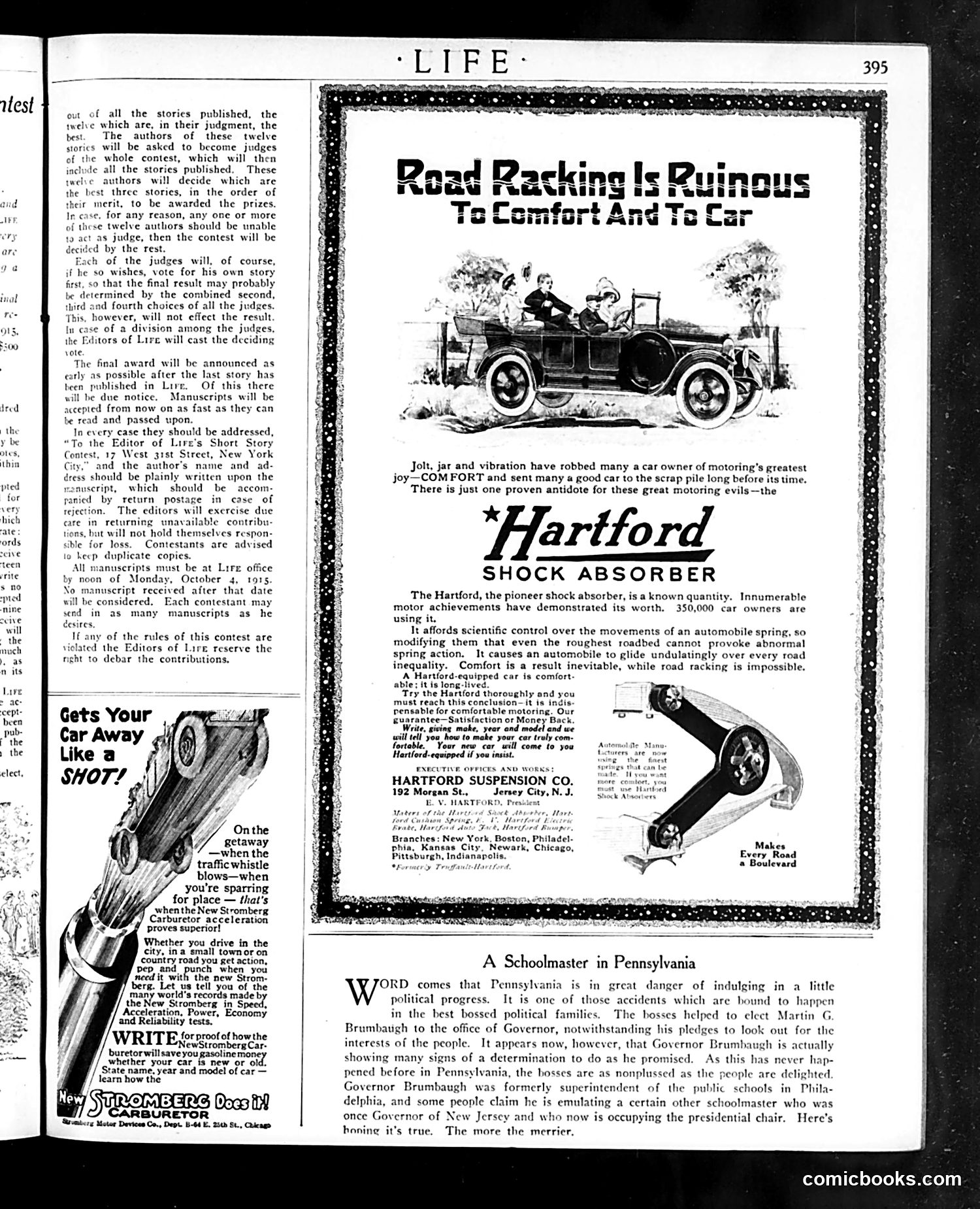
This page is primarily **advertising**, dominated by a full-page Hartford Shock Absorber advertisement featuring an illustration of an early automobile laden with luggage and passengers. The ad's headline claims road-racking "ruins" comfort and cars, positioning the shock absorber as essential protection. Below appears the beginning of an article titled "A Schoolmaster in Pennsylvania," which references political controversy: Pennsylvania Governor **Martin G. Brumbaugh** is accused of favoring political cronies over qualified candidates for public office. The text suggests Brumbaugh—formerly superintendent of Philadelphia schools—may be the same person as a New Jersey governor occupying the Pennsylvania governor's chair, or that he's emulating such nepotistic behavior. This appears to be **satirical political commentary** on state-level corruption and patronage politics. Smaller advertisements for Stromberg Carburetors also appear, typical of automotive trade publications from this era.
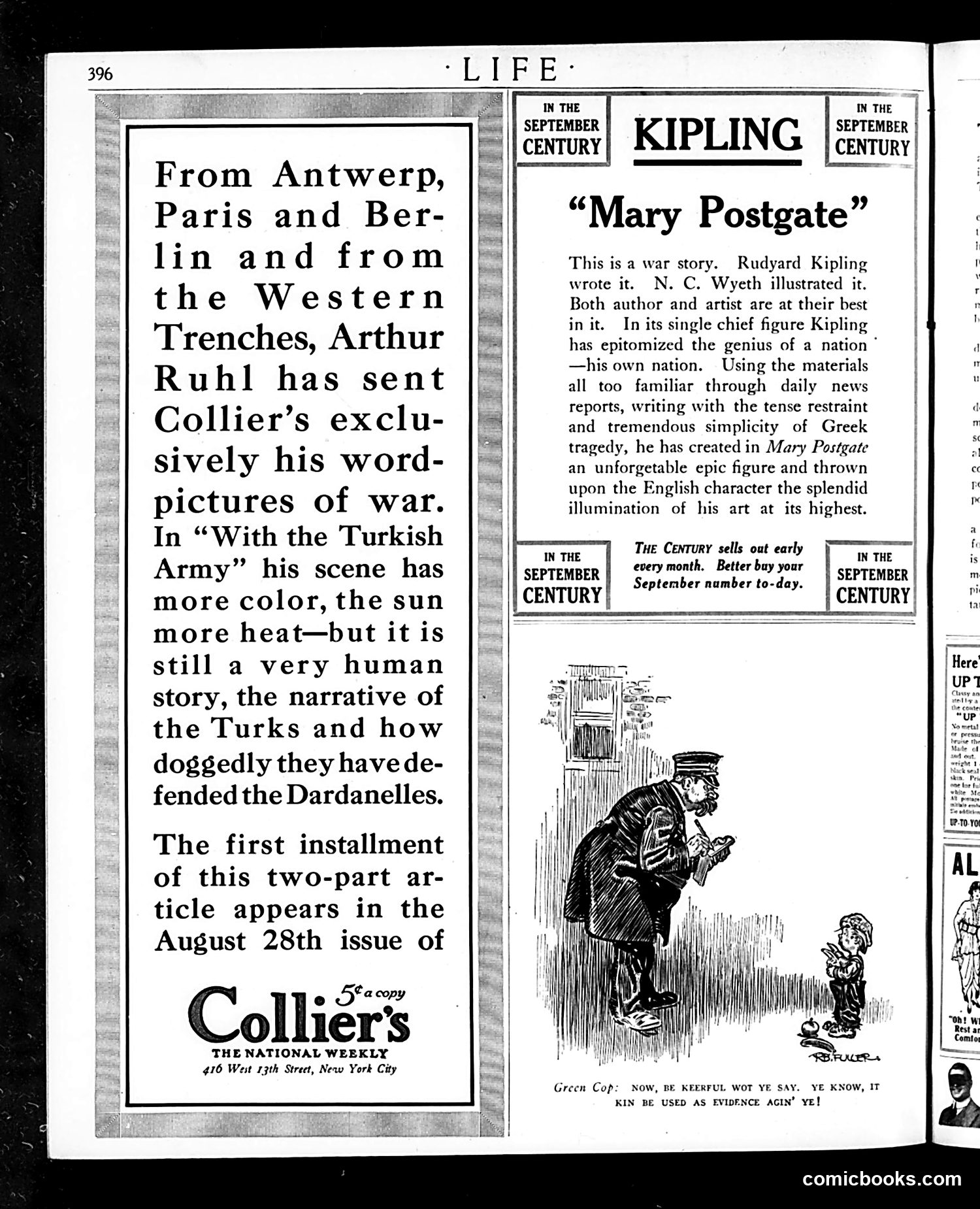
This page advertises two war-related literary pieces from major American magazines during World War I. **Left side:** Collier's magazine promotes Arthur Ruhl's war correspondence from European fronts, including a two-part article about Turkish forces defending the Dardanelles—a significant WWI battle site. **Right side:** The Century magazine features Rudyard Kipling's short story "Mary Postgate," illustrated by N.C. Wyeth. The text praises both creator for capturing English character and national spirit through tragedy, using language echoing classical Greek drama. **The cartoon below** depicts a British policeman warning a small figure (appears to be a child or working-class person) about careful speech during wartime, noting statements "kin be used as evidence agin' ye"—a satirical jab at wartime censorship and surveillance, suggesting the government monitored civilian speech for seditious remarks.
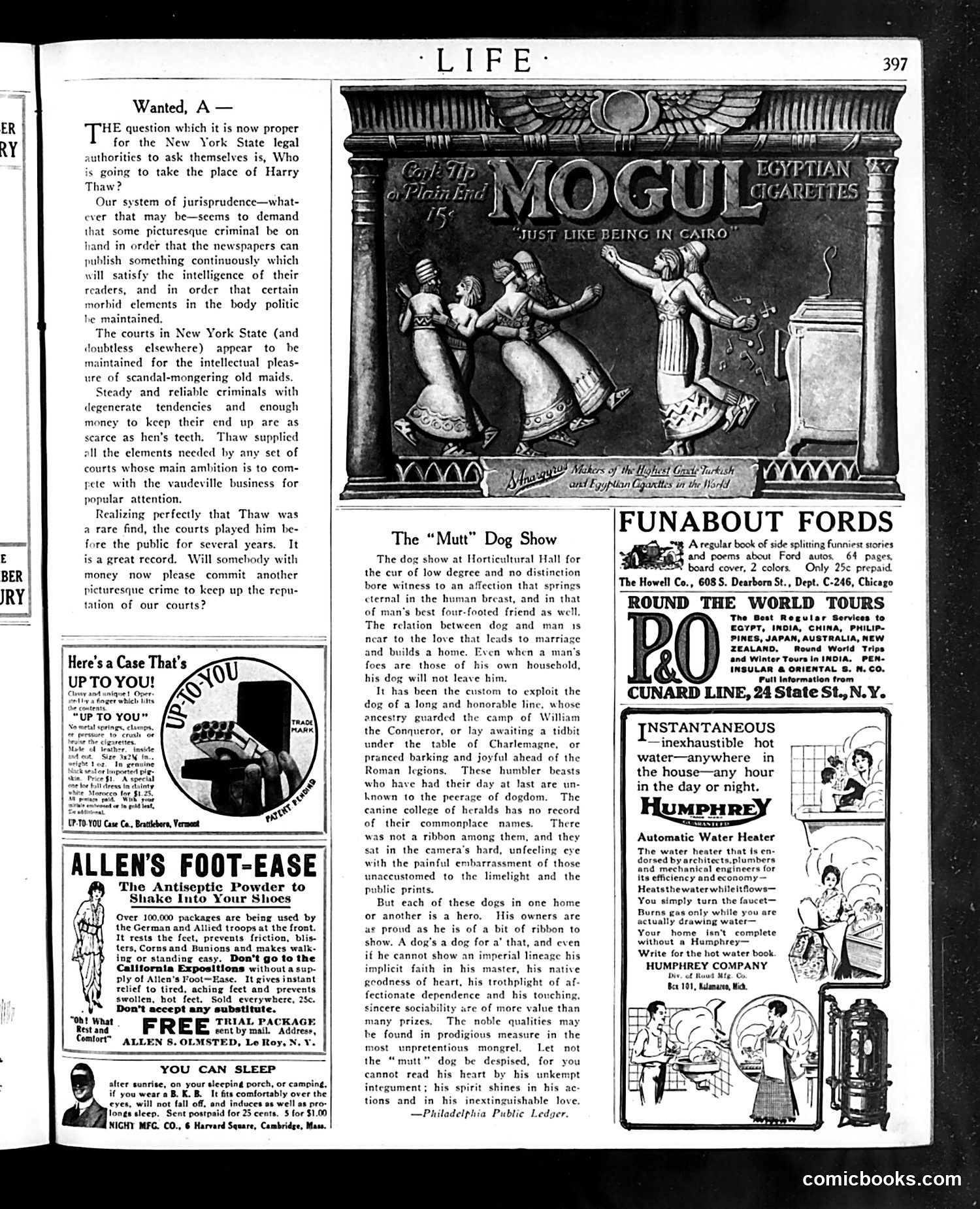
This Life magazine editorial satirizes New York's judicial system through the lens of the Harry Thaw scandal. Thaw, a wealthy man involved in a sensational murder case, had dominated newspapers for years with lurid court proceedings that captivated the public. Life's critique: the courts function like entertainment for scandal-hungry readers and "morbid elements" of society rather than serving justice. The piece sarcastically mourns that Thaw—a "rare find" offering all elements needed for a media spectacle—is no longer available, asking who will provide the next "picturesque crime" to satisfy the courts' appetite for publicity. The satire targets both the judicial system's apparent complicity in theatrical trials and the public's appetite for sensational criminal cases as entertainment. It's fundamentally about how wealth enables criminals to become celebrities while the justice system obliges.
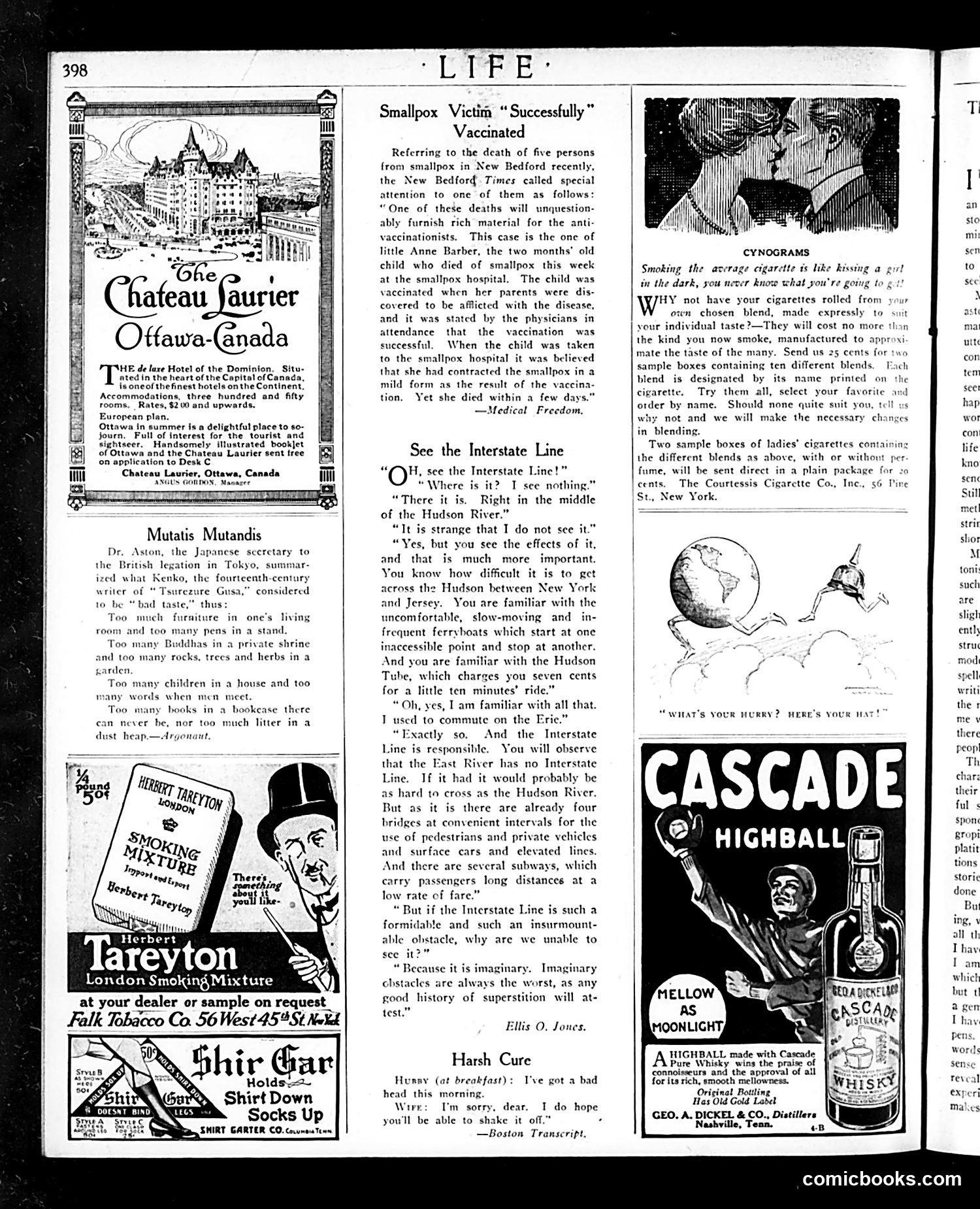
This page contains **anti-vaccination satire** and period advertisements. The main article mocks anti-vaccination advocates by reporting on a two-month-old girl, Anne Barber, who died of smallpox despite being vaccinated. The *New Bedford Times* had highlighted her death as ammunition for anti-vaccinationists, but the article sarcastically notes the child contracted smallpox "in mild form as the result of the vaccination"—implying vaccination actually worked by reducing severity—yet she died anyway, likely from other causes. The dialogue feature "See the Interstate Line" humorously compares the invisible Interstate Line (between New York and New Jersey) to the difficult Hudson River crossing, using geographic absurdity to entertain readers. The remaining content is **period advertising**: Château Laurier hotel, Herbert Tareyton smoking tobacco, Shir Garters, ladies' cigarettes, and Cascade Highball whiskey—typical early 20th-century product placements reflecting contemporary consumer culture and social norms around tobacco and alcohol.
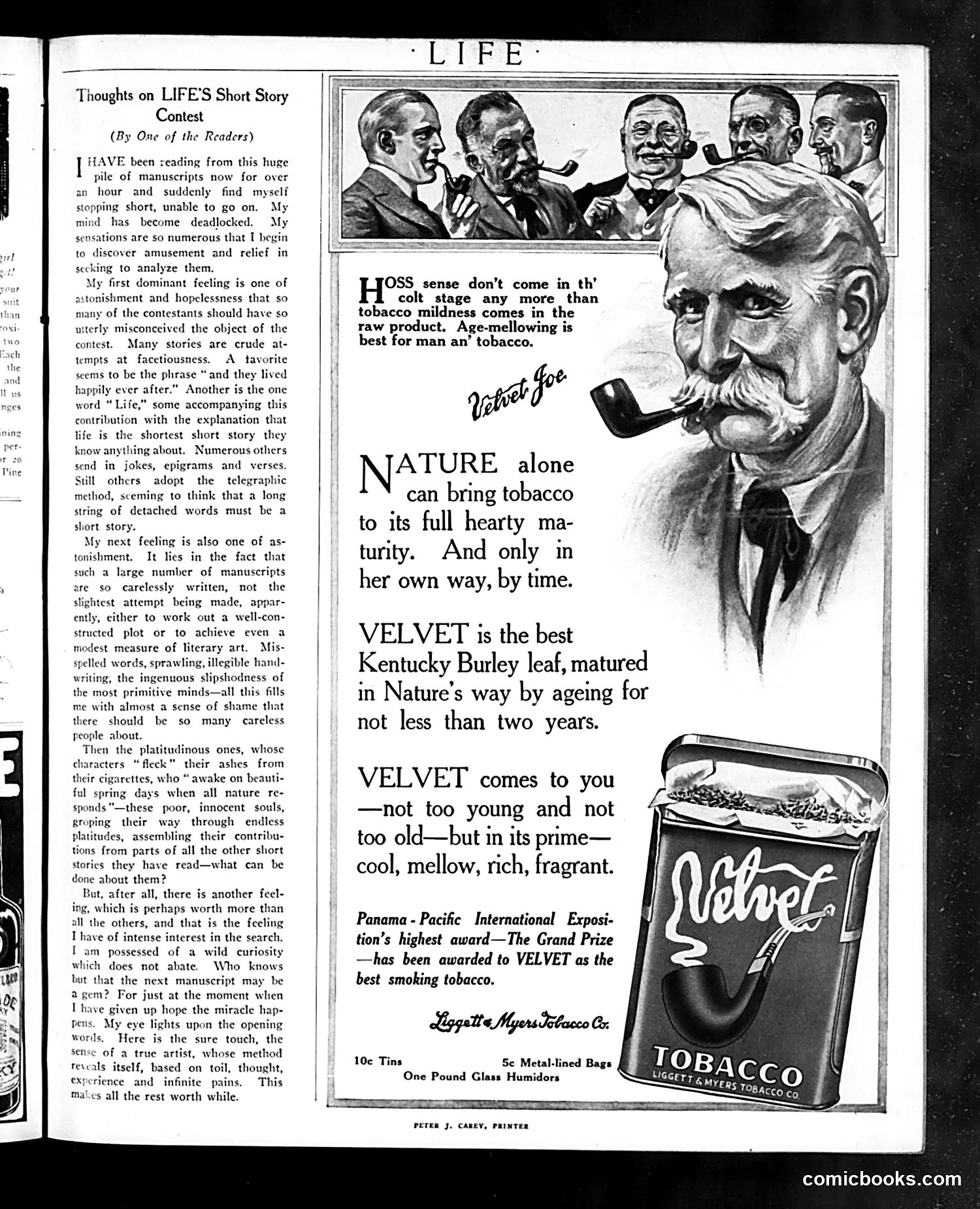
This page combines editorial content about a short-story contest with a tobacco advertisement—a typical Life magazine layout of the era. **Left side:** A reader critiques submissions to Life's short-story contest, expressing frustration with entries that misunderstand the assignment. Common failures include: treating it as a joke or epigram, submitting single words like "Life," using telegraphic style, and poor craftsmanship (misspellings, illegible handwriting). The writer also complains about clichéd writing—characters flicking cigarette ash, references to spring days and nature's response. Yet despite these failures, the writer maintains hope that genius might appear in the next manuscript. **Right side:** A full-page **Velvet tobacco advertisement** featuring a caricatured older man with exaggerated features smoking a pipe. The ad uses a folksy voice claiming tobacco needs aging like fine wine—two years minimum—to achieve proper "mellow" quality. It emphasizes that Velvet won a Grand Prize at the Panama-Pacific International Exposition. The juxtaposition is incidental—typical magazine layout rather than intentional satire. The ad represents period tobacco marketing before health warnings existed.
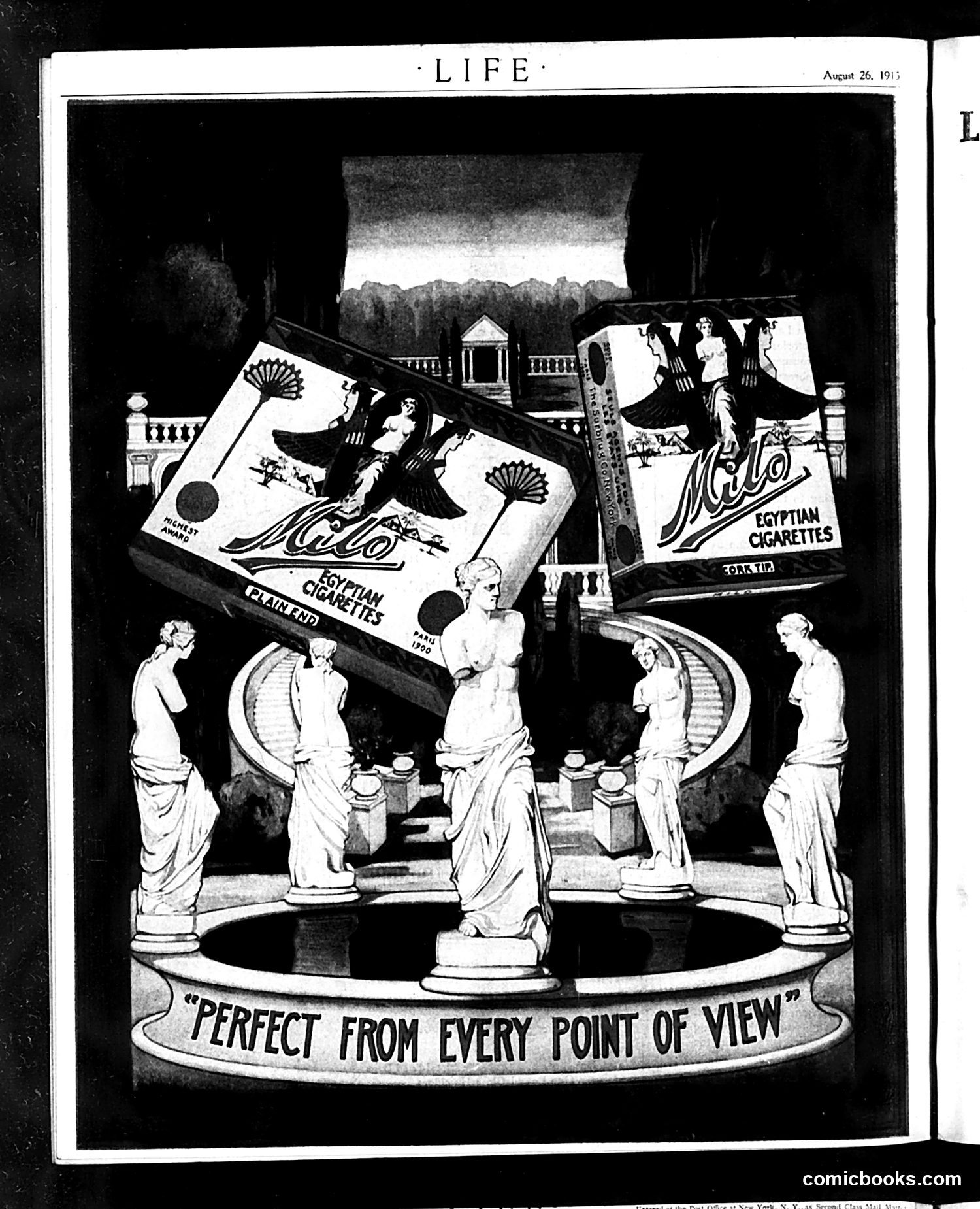
This is a **Milo Egyptian Cigarettes advertisement** from Life magazine (August 26, 1915). The ad uses classical Greco-Roman statuary arranged in a circular composition to advertise cigarettes with the tagline "Perfect From Every Point of View." The visual joke plays on the phrase's double meaning: the statues can be viewed from any angle and appear equally attractive, while also suggesting the cigarettes are universally excellent. The neoclassical aesthetic—featuring draped figures and a formal garden setting—evokes sophistication and refinement, qualities advertisers of the era associated with premium cigarette brands. The advertisement reflects early 20th-century marketing tactics that emphasized elegance and artistic imagery to sell luxury tobacco products. No political satire is present; this is straightforward commercial advertising using classical imagery.