
Life, 1915-08-26 · page 27 of 48
Life — August 26, 1915 — page 27: what you’re looking at
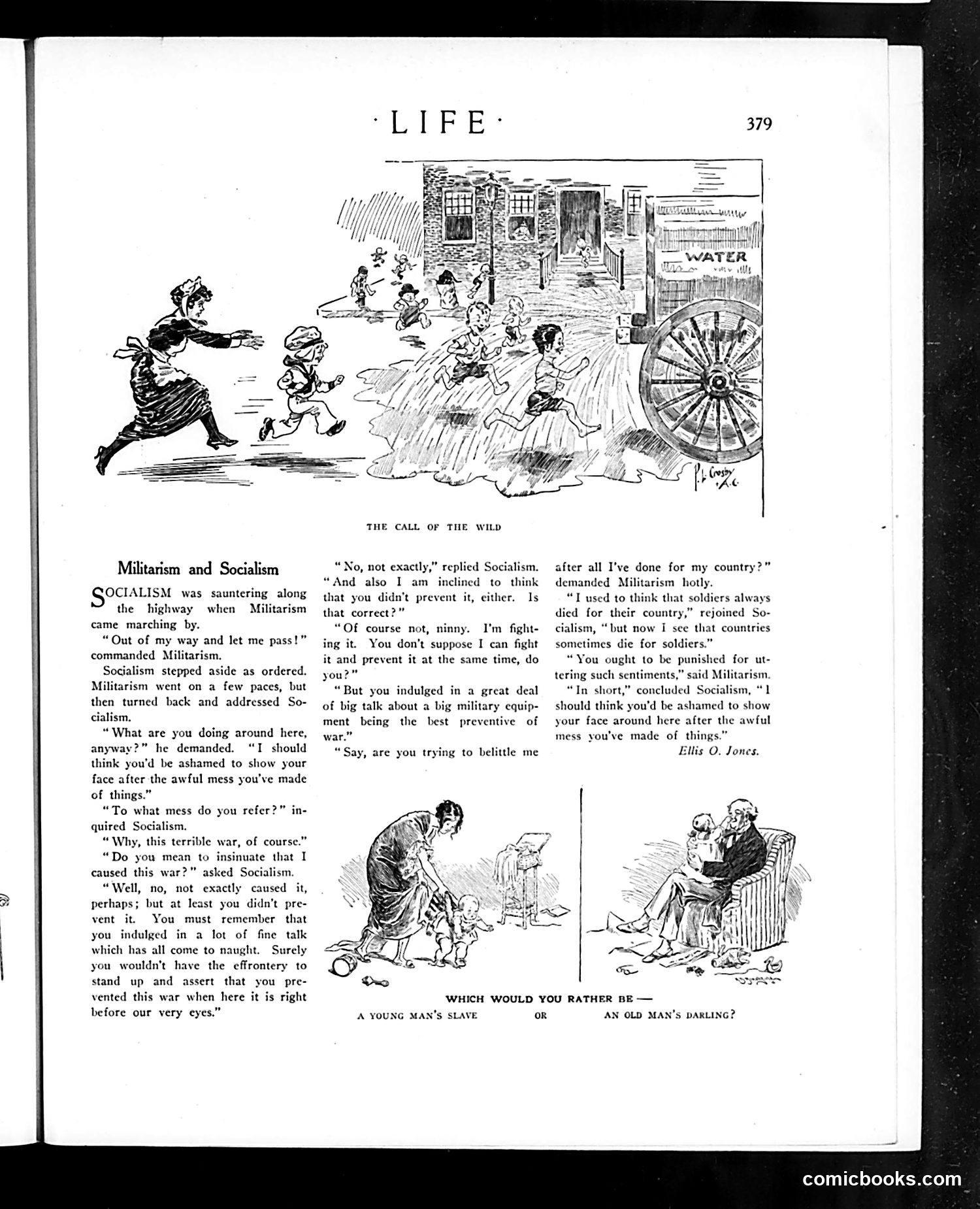
What you’re looking at
This satirical dialogue, attributed to Ellis O. Jones, presents a debate between two personified ideologies during World War I (the reference to "this terrible war" suggests WWI-era publication). **The argument:** Militarism blames Socialism for the war's occurrence, claiming Socialist pacifist rhetoric failed to prevent it. Socialism counters that Militarism's pre-war advocacy for military buildup as a "preventive" was equally ineffective—and hypocritical. **The satire's point:** Both ideologies share blame for the war yet blame each other. The cartoon critiques their mutual ineffectiveness: Militarism can't prevent war while fighting it; Socialism's fine talk accomplished nothing. **The final jab:** Socialism's retort—"countries sometimes die for soldiers" (rather than soldiers dying for countries)—inverts the nationalist ideal, suggesting military expansion prioritizes soldiers' interests over national welfare. The page's lower cartoon presents an unrelated domestic social question about economic dependency.
📄 Transcribed text from this page (OCR, searchable)
Machine-transcribed from the original scan — historical spelling and the odd misread are preserved.
Militarism and Socialism SOciALIsM was sauntering along the highway when Militarism came marching by. “Out of my way and let me pass!” commanded Militarism. Socialism stepped aside as ordered. Militarism went on a few paces, but then turned back and addressed So- cialism, “What are you doing around here, anyway he demanded. “TI should think you'd be ashamed to show your face after the awful mess you've made of things.” “To what mess do you refer?” in- quired Socialism. “Why, this terrible war, of course.” “Do you mean to insinuate that I caused this war?" asked Socialism. “Well, no, not exactly caused it, perhaps; but at least you didn’t pre- vent it. You must remember that you indulged in a lot of fine talk which has all come to naught. Surely you wouldn't have the effrontery to stand up and assert that you pre- vented this war when here it is right before our very eyes.” THE CALL OF THE WILD “No, not exactly,” replied Socialism. “And also I am inclined to think that you didn’t prevent it, either. Is that correct?” “OF course not, ninny. I'm fight- ing it. You don’t suppose I can fight it and prevent it at the same time, do you?” “But you indulged in a great deal of big talk about a big military cquip- ment being the best preventive of war.” “Say, are you trying to belittle me < after all I've done for my country?” demanded Militarism hotly. “T used to think that soldiers always died for their country,” rejoined So- cialism, “but now I see that countries sometimes die for soldiers.” “You ought to be punished for ut- tering such sentiments,” said Militarism. ialism, “1 should think you'd be ashamed to show your face around here after the awful mess you've made of things.” Ellis O. Jones. ‘WHICH WOULD YOU RATHER BE — A YOUNG MAN'S SLAVE oR AN OLD MAN'S DARLING? comicbooks.com