
Life, 1915-08-26 · page 22 of 48
Life — August 26, 1915 — page 22: what you’re looking at
What you’re looking at
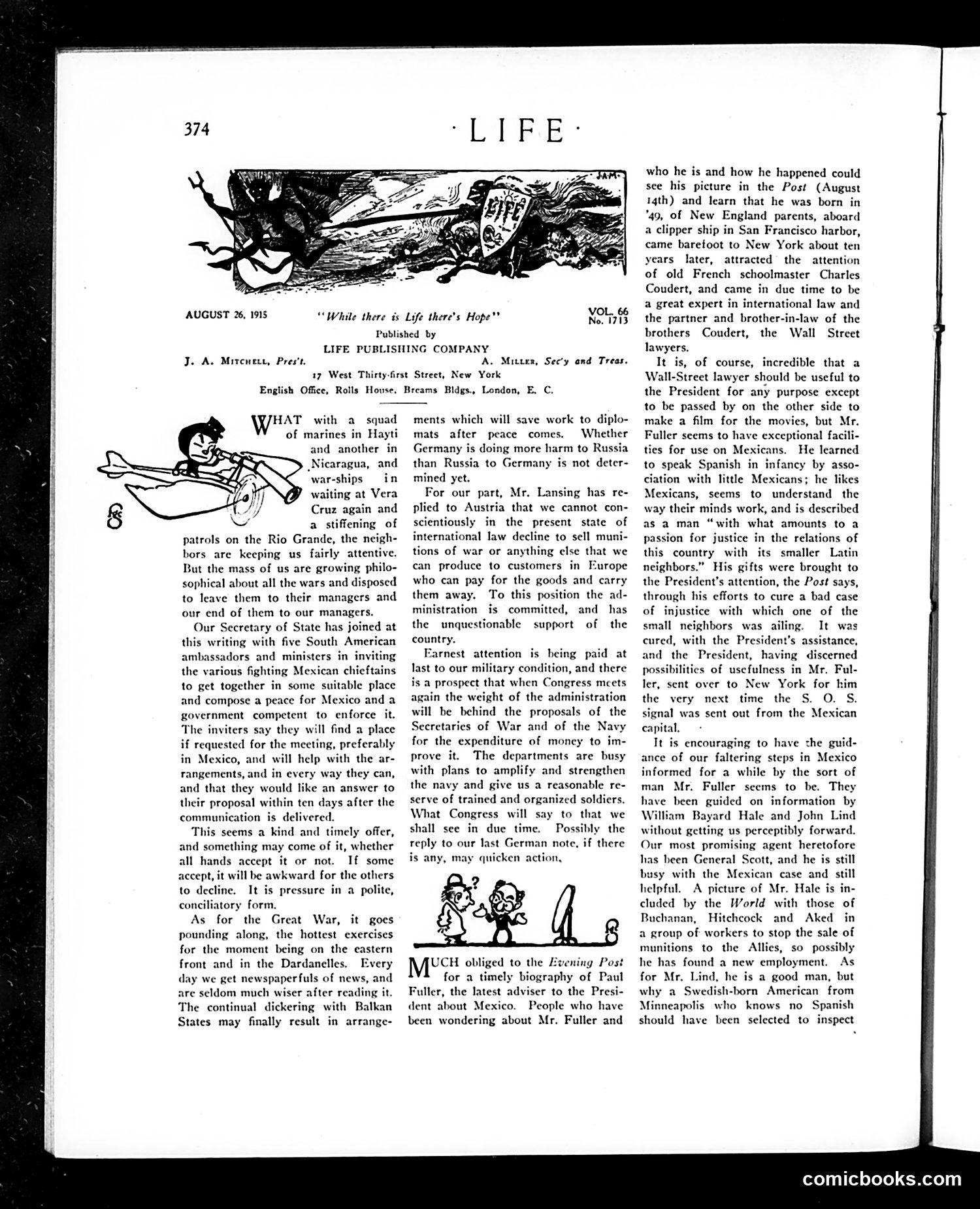
This page discusses American foreign policy during World War I, focusing on three issues: U.S. military interventions in Haiti, Nicaragua, and Mexico; America's neutrality stance toward the European war; and Paul Fuller, a Wall Street lawyer newly advising President Wilson on Mexican affairs. The cartoons (small illustrations at top and middle) appear satirical but are not clearly legible in this reproduction. The text's satire is more evident: the author mocks the State Department's "polite, conciliatory" peace invitation to Mexican factions as naive pressure diplomacy, and expresses sardonic surprise that a Wall Street lawyer could usefully advise the President—suggesting distrust of business elites in government roles. The piece reflects 1915 American debate over neutrality, military preparedness, and intervention in neighboring countries.
📄 Transcribed text from this page (OCR, searchable)
Machine-transcribed from the original scan — historical spelling and the odd misread are preserved.
AUGUST 26, 1915 “While there is Life there's Hope” Published by LIFE PUBLISHING COMPANY A. Mittes, Sec’y and Treas. 17 West Thirty-first Street, New York English Office, Rolls House, Breams Bldgs, London, E. C. J. A. Mircette, Pres’t. HAT with a of marines in Hayti and another in (Nicaragua, and war-ships in waiting at Vera Cruz again and a stiffening of patrols on the Rio Grande, the neigh- bors are keeping us fairly attentive. But the mass of us are growing philo- sophical about all the wars and disposed to leave them to their managers and. our end of them to our managers. Our Secretary of State has joined at this writing with five South American ambassadors and ministers in inviting the various fighting Mexican chieftains to get together in some suitable place and compose a peace for Mexico and a government competent to enforce it. The inviters say they will find a place if requested for the meeting, preferably in Mexico, and will help with the ar- rangements, and in every way they can, and that they would like an answer to their proposal within ten days after the communication is delivered. This seems a kind and timely offer, and something may come of it, whether all hands accept it or not. If some accept, it will be awkward for the others to decline. It is pressure in a polite, conciliatory form. As for the Great War, it goes pounding along, the hottest exercises for the moment being on the eastern front and in the Dardanelles. Every day we get newspaperfuls of news, and are seldom much wiser after reading it. The continual dickering with Balkan States may finally result in arrange- squad ments which will save work to diplo- mats after peace comes. Whether Germany is doing more harm to Russia than Russia to Germany is not deter- mined yet. For our part, Mr. Lansing has re- plied to Austria that we cannot con- scientiously in the present state of international law decline to sell muni- tions of war or anything else that we can produce to customers in Europe who can pay for the goods and carry them away. To this position the ad- ministration is committed, and has the unquestionable support of the country. Earnest attention is being paid at last to our military condition, and there is a prospect that when Congress mcets again the weight of the administration will be behind the proposals of the Secretaries of War and of the Navy for the expenditure of money to im- prove it. The departments are busy with plans to amplify and strengthen the navy and give us a reasonable re- serve of trained and organized soldiers. What Congress will say to that we shall see in due time. Possibly the reply to our last German note, if there is any, may quicken action, UCH obliged to the pning Post for a timely biography of Paul Fuller, the latest adviser to the Presi- dent about Mexico. People who have been wondering about Mr. Fuller and who he is and how he happened could see his picture in the Post (August 14th) and learn that he was born in "49, of New England parents, aboard a clipper ship in San Francisco harbor, came baretoot to New York about ten years later, attracted the attention of old French schoolmaster Charles Coudert, and came in due time to be a great expert in international law and the partner and brother-in-law of the brothers Coudert, the Wall Street lawyers, It is, of course, incredible that a Wall-Street lawyer should be useful to the President for any purpose except to be passed by on the other side to make a film for the movies, but Mr. Fuller seems to have exceptional facili ties for use on Mexicans. He learned to speak Spanish in infancy by asso- ciation with little Mexicans; he likes Mexicans, seems to understand the way their minds work, and is described as a man “with what amounts to a passion for justice in the relations of this country with its smaller Latin neighbors.” His gifts were brought to the President’s attention, the Post says, through his efforts to cure a bad case of injustice with which one of the small neighbors was ailing. It was cured, with the President's assistance, and the President, having discerned possibilities of usefulness in Mr. Ful- ler, sent over to New York for kim the very next time the S. O. S. signal was sent out from the Mexican capital, It is encouraging to have the guid- ance of our faltering steps in Mexico informed for a while by the sort of man Mr. Fuller seems to be. They have been guided on information by William Bayard Hale and John Lind without getting us perceptibly forward. Our most promising agent heretofore has been General Scott, and he is still busy with the Mexican case and still helpful. A picture of Mr. Hale is in- cluded by the World with those of Buchanan, Hitchcock and Aked in a group of workers to stop the sale of munitions to the Allies, so possibly he has found a new employment. As for Mr, Lind, he is a good man, but why a Swedish-born American from Minneapolis who knows no Spanish should have been selected to inspect comicbooks.com