
Life, 1915-08-26 · page 18 of 48
Life — August 26, 1915 — page 18: what you’re looking at
What you’re looking at
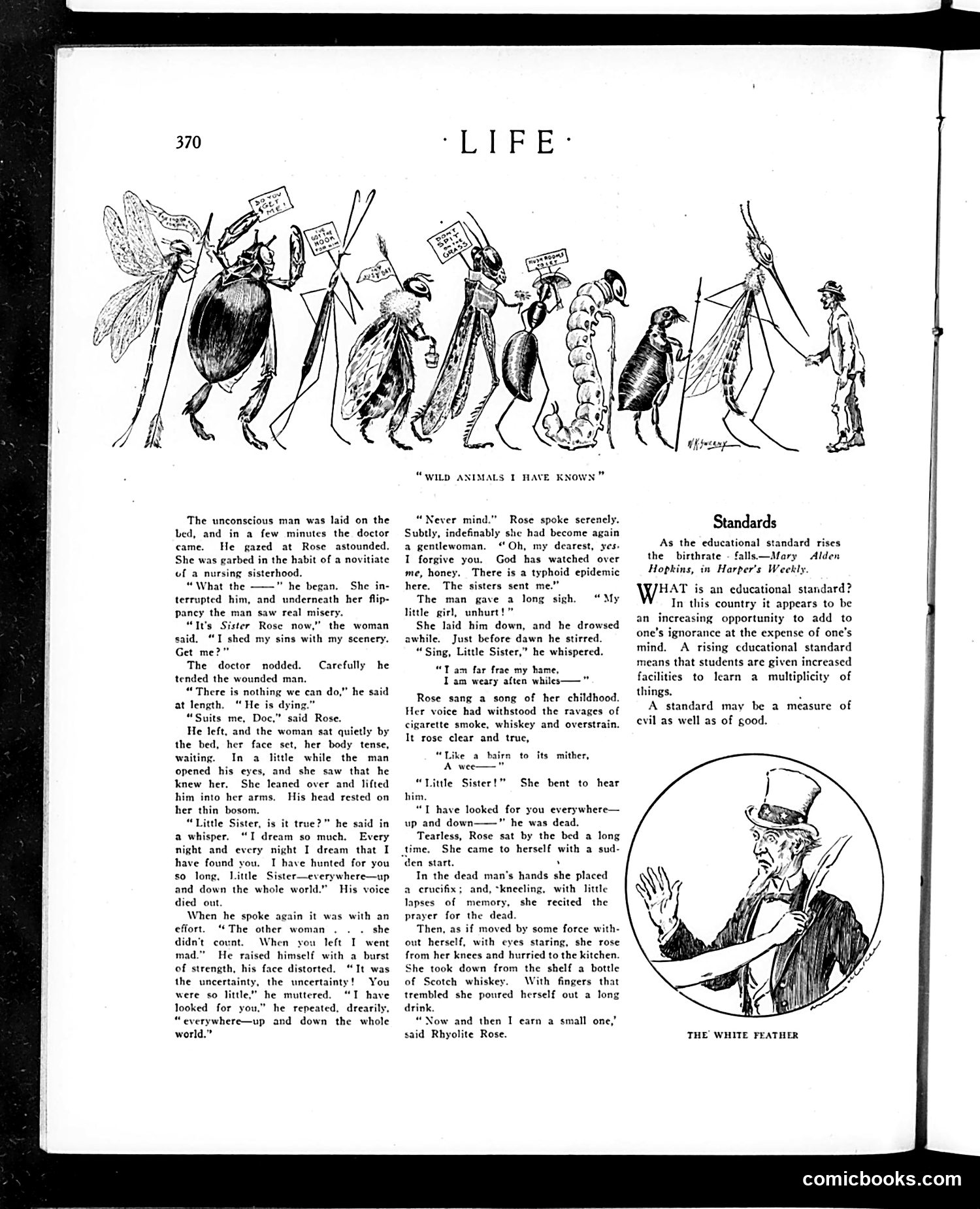
**The Main Story ("Wild Animals I Have Known"):** This sentimental narrative depicts a deathbed reunion between a man and a woman called "Little Sister" who has become a nun. The story romanticizes her redemption—she's abandoned a dissolute past (implied by references to cigarettes and whiskey) to join a nursing sisterhood. The man dies recognizing her, and she grieves, then immediately seeks solace in alcohol, suggesting her reformation is superficial. **The Satire:** The cartoon at top shows anthropomorphized animals carrying protest signs—a visual joke about social activism and "wild animals" (likely referring to suffragettes or labor agitators as uncivilized). **"Standards" Editorial Section:** This criticizes rising educational standards as mere expansion of quantity over quality—students gain "facilities to learn a multiplicity of things" without genuine intellectual improvement. The editorial suggests educational standards can measure evil as well as good, implying contemporary educational expansion may be misguided. Together, the page contrasts sentimental narratives of redemption with skeptical commentary on social progress and institutional claims.
📄 Transcribed text from this page (OCR, searchable)
Machine-transcribed from the original scan — historical spelling and the odd misread are preserved.
The unconscious man was laid on the Led, and in a few minutes the doctor came. He gazed at Rose astounded. She was garbed in the habit of a novitiate of a nursing sisterhood. “What the "he began, She in- terrupted him, and underneath her flip- pancy the man saw real misery. “It’s Sister Rose now,” the woman said. “I shed my sins with my scenery. Get me?” The doctor nodded. tended the wounded man. “There is nothing we can do,” he said at length. “He is dying.” “Suits me, Doc,” said Rose. He left, and the woman sat quietly by the bed, her face set, her body tense, waiting, In a little while the man opened his eyes, and she saw that he knew her. She leaned over and lifted him into her arms. His head rested on her thin bosom. “Little Sister, is it true?” he said in a whisper. “I dream so much. Every night and every night I dream that I have found you. I have hunted for you so long, Little Sister—everywhere—up and down the whole world.” His voice died out When he spoke again it was with an effort. “The other woman . she didn’t count. When you left I went mad.” He raised himself with a burst of strength, his face distorted. “It was the uncertainty, the uncertainty! You were so little,” he muttered. “I have looked for you,” he repeated, dreari “everywhere—up and down the whole world. Carefully he time, “WILD ANIMALS I HAVE KNOWN” “Never mind. Subtly, indefinabl Rose spoke serenely. he had become again a gentlewoman. Oh, my dearest, yes: I forgive you. God has watched over me, honey. There is a typhoid epidemic here. The sisters sent me. The man gave a long sigh. little girl, unhurt!” She laid him down, and he drowsed awhile. Just before dawn he stirred. Sing, Little Sister,” he whispered. “My “Tam far frae my hame, I am weary aften whiles— ” Rose sang a song of her childhood. Her voice had withstood the ravages of cigarette smoke, whiskey and overstrain. It rose clear and true, a bairn to its mither, Like A wee— “Little Sister!” She bent to hear I have looked for you everywhere— up and down——" he was dead. Tearless, Rose sat by the bed a long She came to herself with a sud- den start. . In the dead man’s hands she placed a crucifix; and, “kneeling, with little lapses of memory, she recited the prayer for the dead. Then, as if moved by some force with- out herself, with eyes staring, she rose from her knees and hurried to the kitchen. She took down from the shelf a bottle of Scotch whiskey. With fingers that trembled she poured herself out a long drink. “Now and then I earn a small one,’ said Rhyolite Rose. Standards As the educational the birthrate . falls.—Mary Hopkins, in Harper's Weekly. tandard rises Alden HAT is an educational standard? In this country it appears to be an increasing opportunity to add to one’s ignorance at the expense of one’s mind. A rising cducational standard means that students are given increased facilities to learn a multiplicity of things. . A standard may be a measure of evil as well as of good. THE WHITE FEATHER comicbooks.com