
Life, 1915-08-26 · page 13 of 48
Life — August 26, 1915 — page 13: what you’re looking at
What you’re looking at
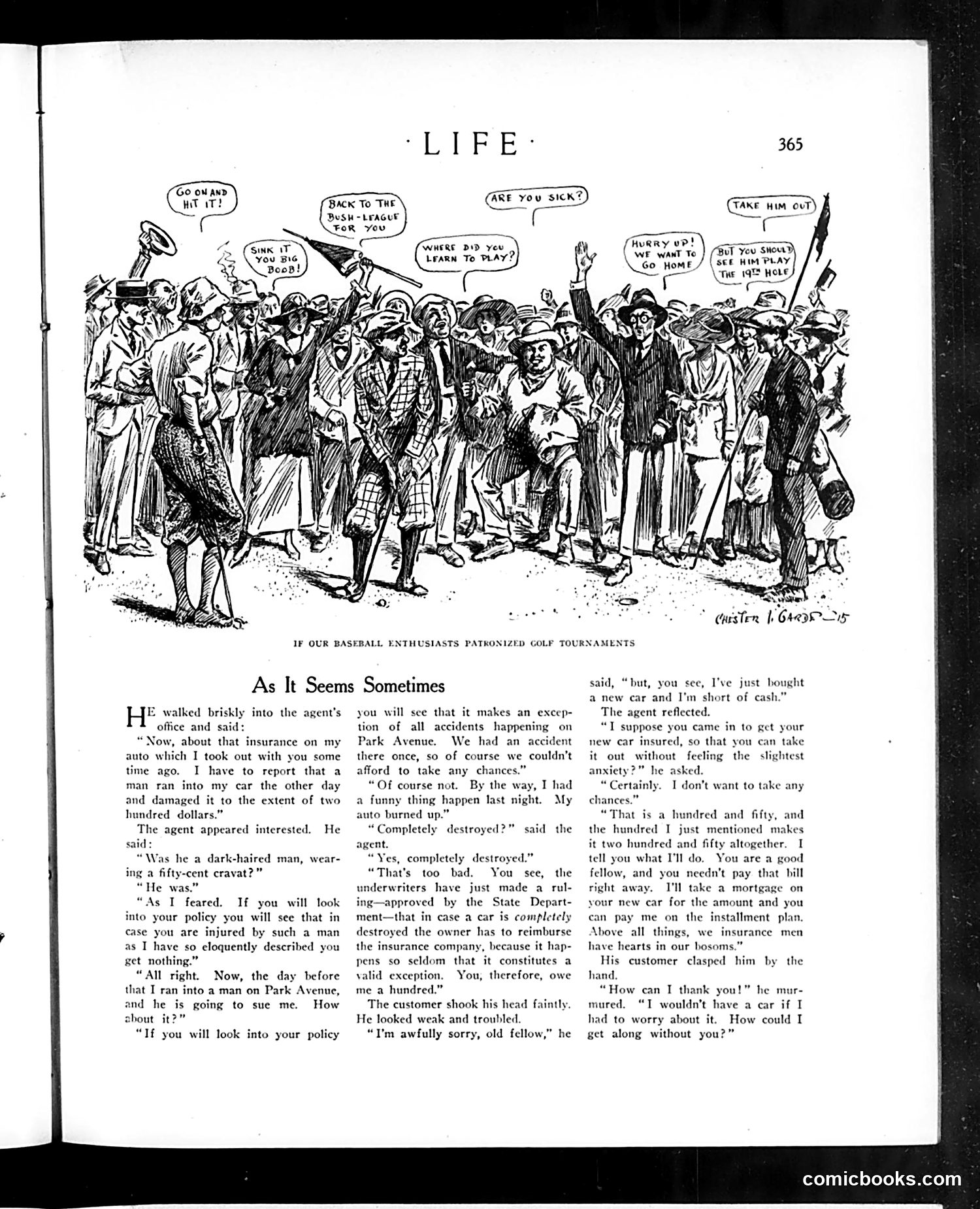
The top cartoon satirizes baseball fans who patronize golf tournaments. The sketch shows a rowdy crowd at a golf event behaving like baseball spectators—shouting advice ("Go on and hit it!", "Where did you learn to play?"), treating it as entertainment rather than a serious sport. The accompanying story "As It Seems Sometimes" depicts an insurance agent negotiating with a customer about car damage. The humor lies in the agent's bureaucratic language and resistance to paying claims, contrasting with the customer's desperate need for help. The agent insists the damage constitutes a "valid exception" to coverage, ultimately offering only a hundred dollars for a destroyed vehicle. Both pieces mock contemporary American attitudes: rowdy sports culture and insurance company reluctance to honor policies.
📄 Transcribed text from this page (OCR, searchable)
Machine-transcribed from the original scan — historical spelling and the odd misread are preserved.
BACK To THE LIFE Bush -LrAGue _ Gee: DID you =) ( LEARN To PLAY?, of 365 Hurry uP wr cer To (or You Snow Go Home EE HIM PLAY fT \ tae pat wot oN Guster | Orr IF OUR BASEBALL ENTHUSIASTS PATRONIZED GOLF TOURNAMENTS As It Seems Sometimes E walked bris! into the agent's office and said: “Now, about that insurance on my auto which I took out with you some time ago. I have to report that a man ran into my car the other day and damaged it to the extent of two hundred dollars.” The agent appeared interested. said: “Was he a dark-haired man, wear- ing a fifty-cent cravat?” He was.” s I feared. If you will look into your policy you will see that in case you are injured by such a man as I have so eloquently described you get nothing. “All right. Now, the day before that I ran into a man on Park Avenue, and he is going to sue me. How about it?” “If you will look into your policy He you will see that it makes an excep- tion of all accidents happening on Park Avenue. We had an accident there once, so of course we couldn't afford to take any chances.” “Of course not. By the way, I had a funny thing happen last night. My auto burned up.” “Completely destroyed?” said the agent. “Yes, completely destroyed.” “That's too bad. You see, the underwriters have just made a rul- ing—approved by the State Depart- ment—that in case a car is completely destroyed the owner has to reimburse the insurance company, because it hap- pens so seldom that it constitutes a valid exception. You, therefore, owe me a hundred.” The customer shook his head faintly. He looked weak and troubled. “I'm awfully sorry, old fellow,” he said, “but, you see, I've just bought a new car and I'm short of cash.” The agent reflected. “T suppose you came in to get your new car insured, so that you can take it out without feeling the slightest y?" he asked. I don’t want to take any “That is a hundred and fifty, and the hundred I just mentioned makes it two hundred and fifty altogether. I tell you what I'll do. You are a good fellow, and you needn't pay that bill right away. I'll take a mortgage on your new car for the amount and you can pay me on the installment plan. Above all things, we insurance men have hearts in our bosoms.” His customer clasped him by hand. “How can I thank you!” he mur- mured. “TI wouldn't have a car if I had to worry about it. How could I get along without you?” the comicbooks.com