
Life, 1915-08-26 · page 17 of 48
Life — August 26, 1915 — page 17: what you’re looking at
What you’re looking at
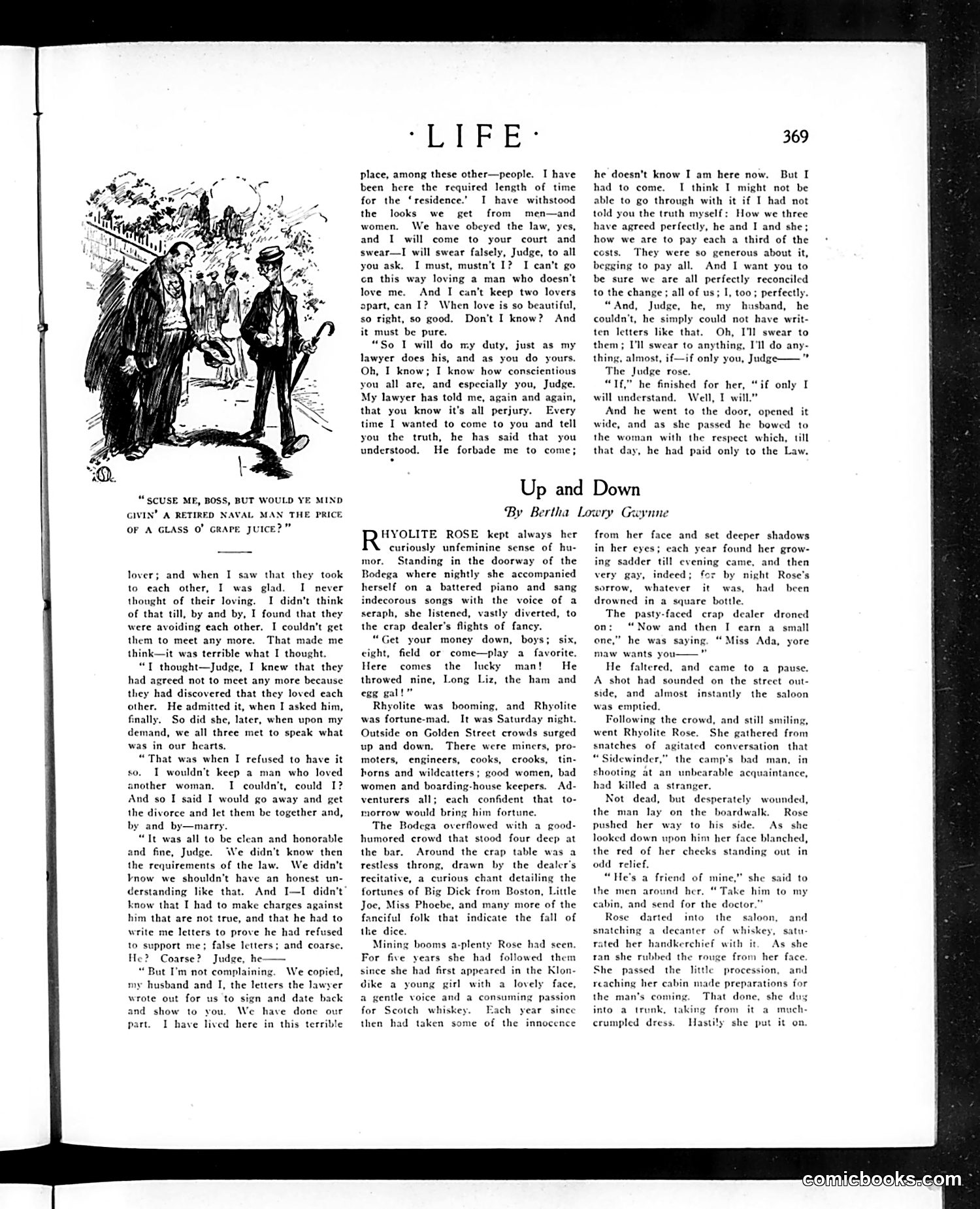
The page contains two distinct pieces of satirical content: **Top cartoon and monologue**: A woman appears before a judge seeking divorce. The satire targets divorce law hypocrisy—she must commit perjury (swearing to false charges) to obtain a legal divorce, with her lawyer's full knowledge and encouragement. The judge implicitly condones this fraud. The satirical point: the legal system *requires* dishonesty to function, forcing conscientious people into moral compromise. The ragged beggar's caption ("retired naval man") in the cartoon appears unrelated, likely a separate visual gag. **"Up and Down" story**: A woman named Rhyolite Rose works as a singer in a rough establishment (the Bodega). The opening suggests she maintains dignity and humor despite her lowbrow surroundings. The story appears to explore class contrasts and female agency in working-class settings, though the full narrative extends beyond this page. Both pieces reflect early 20th-century Life magazine's focus on social critique wrapped in humor and literary narrative.
📄 Transcribed text from this page (OCR, searchable)
Machine-transcribed from the original scan — historical spelling and the odd misread are preserved.
“SCUSE ME, BOSS, BUT WOULD YE MIND GIVIN’ A RETIRED NAVAL MAN THE PRICE OF A GLASS 0” GRAPE JUICE?” lover; and when I saw that they took to each other, I was glad. I never thonght of their loving. I didn’t think of that till, by and by, I found that they were avoiding each other, I couldn't get them to meet any more. That made me think—it was terrible what I thought. “T thought—Judge, I knew that they had agreed not to mcet any more because they had discovered that they loved each other. He admitted it, when I asked him, finally. So did she, later, when upon my demand, we all three met to speak what was in our hearts, “That was when I refused to have it so. I wouldn't keep a man who loved another woman. I couldn't, could I? And so I said I would go away and get the divorce and let them be together and, by and by—marry. “Tt was all to be clean and honorable and fine, Judge. We didn’t know then the requirements of the law. We didn't know we shouldn’t have an honest un- derstanding like that. And I—I didn’t know that I had to make charges against him that are not true, and that he had to write me letters to prove he had refused to support me; false letters; and coarse. He? Coarse? Judge, he— “ But I'm not complaining. We copied, my husband and I, the letters the lawyer wrote out for us to sign and date back and show to you. We have done our part. I have lived here in this terrible “ETRE place, among these other—people. I have been here the required length of time for the ‘residence.’ I have withstood the looks we get from men—and women. We have obeyed the law, yes, and I will come to your court and swear—lI will swear falsely, Judge, to all you ask, I must, mustn't 1? I can’t go on this way loving a man who doesn't love me. And I can’t keep two lovers opart, can 1? When love is so beautiful, so right, so good. Don't I know? And it must be pure. “So I will do my duty, just as my lawyer does his, and as you do yours. Oh, I know; I know how conscientious you all are, and especially you, Judge. My lawyer has told me, again and again, that you know it's all perjury. Every time I wanted to come to you and tell you the truth, he has said that you understood. He forbade me to come; 369 he doesn't know I am here now. But I had to come. I think I might not be able to go through with it if I had not told you the truth myself: How we three have agreed perfectly, he and I and she; how we are to pay each a third of the costs. They were so generous about it, begging to pay all. And I want you to be sure we are all perfectly reconciled to the change; all of us; I, too; perfectly. “And, Judge, he, my husband, he couldn't, he simply could not have writ- ten letters like that. Oh, I'll swear to them; I'll swear to anything, I'll do any- thing, almost, if—if only you, Judge— ” The Judge rose. “If,” he finished for her, “if only I will understand, Well, Twill.” And he went to the door, opened it wide, and as she passed he bowed to the woman with the respect which, till that day, he had paid only to the Law. Up and Down By Bertha Lowry Gwynne HYOLITE ROSE kept always her curiously unfeminine sense of hu- mor. Standing in the doorway of the Bodega where nightly she accompanied herself on a battered piano and sang indecorous songs with the voice of a seraph, she listened, vastly diverted, to the crap dealer's flights of fancy. “Get your money down, boys; six, cight, field or come—play a favorite. Here comes the lucky man! He throwed nine, Long Liz, the ham and egg gal!” Rhyolite was booming, and Rhyolite was fortune-mad. It was Saturday night. Outside on Golden Street crowds surged up and down, There were miners, pro- moters, engineers, cooks, crooks, tin- horns and wildcatters; good women, bad women and boarding-house keepers. Ad- venturers all; each confident that to- morrow would bring him fortune. The Bodega overflowed with a good- humored crowd that stood four deep at the bar. Around the crap table was a restless throng, drawn by the dealer's recitative, a curious chant detailing the fortunes of Big Dick from Boston, Little Joc, Miss Phoebe, and many more of the fanciful folk that indicate the fall of the dice. Mining booms a-plenty Rose had seen. For five years she had followed them since she had first appeared in the Klon- dike a young girl with a lovely face, a gentle voice and a consuming passion for Scotch whiskey. Each taken some of the year then had innoc from her face and set deeper shadows in her eyes; each year found her grow- ing sadder till evening came, and then very gay, indeed; Rose's sorrow, whatever i been drowned in a square bottle. The pasty-faced crap dealer droned on: “Now and then IT earn a small one,” he was saying. “Miss Ada, yore maw wants you- ud He faltered, and came to a pause. A shot had sounded on the street out- side, and almost instantly the was emptied. Following the crowd, and still smiling, went Rhyolite Rose. She gathered from snatches of agitated conversation that “ Sidewinder,” the camp's bad man, in shooting at an unbearable acquaintance, had killed a stranger. Not dead, but desperately wounded, the man lay on the boardwalk. pushed her way to his side. As sh looked down upon him her face blanched, the red of her checks standing out in odd relief. “He's a friend of mine,” sh by night was, had saloon Rose said to the men around her. “Take him to my. cabin, and send for the doctor.” Rose darted snatching a decanter of whiskey, satu rated her handkerchief with it, As she ran she rubbed the rouge from her face She passed the little and reaching her cabin made preparations for That done, she dus much- it on. into the saloon, an procession, the man’s coming. into a trunk, crumpled dress. taking from a Hastity she put