
Life, 1915-08-26 · page 16 of 48
Life — August 26, 1915 — page 16: what you’re looking at
What you’re looking at
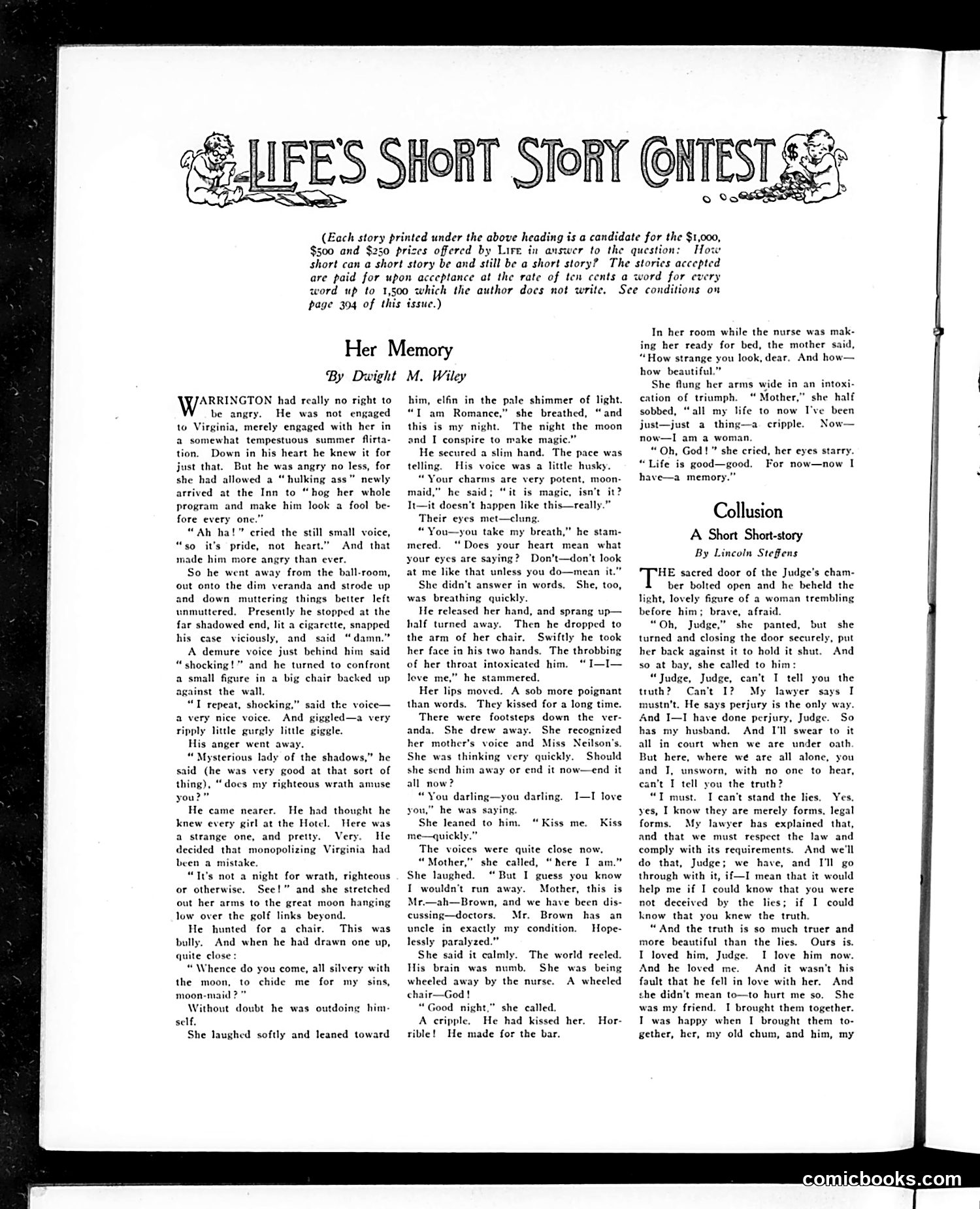
This page contains two short stories from **Life magazine's short-story contest**, which invited submissions answering: "How short can a short story be and still be a short story?" **"Her Memory" by Dwight M. Wiley** (left column): A romantic tale of a man named Arrington who becomes jealous at a summer resort when another guest monopolizes Virginia's attention. He encounters a mysterious, flirtatious woman by moonlight who claims to be "Romance." They share an intimate moment. When her mother approaches, the woman calmly reveals the truth: the man (Mr. Brown) was merely discussing doctors because his uncle shares her condition—she is "hopelessly paralyzed." The twist implies her romantic performance was theatrical deception. **"Collusion" by Lincoln Spofford** (right column): A brief story about a woman before a judge, accused of perjury. Her lawyer argues lies are sometimes necessary. She claims her only fault was falling in love with a man she brought together with her old friend—suggesting she facilitated their relationship while concealing her own feelings. Both stories explore deception and hidden truths in romantic contexts.
📄 Transcribed text from this page (OCR, searchable)
Machine-transcribed from the original scan — historical spelling and the odd misread are preserved.
(Each story printed under the above heading is a candidate for the $1,000, $500 and $250 prizes offered by Lire in answer to the question: How short can a short story be and still be a short story? The stories accepted are paid for upon acceptance at the rate of ten cents a word for every word up to 1,500 which the author docs not write. page 304 of this issue.) Her Memory By Dwight ARRINGTON had really no right to be angry. He was not engaged to Virginia, merely engaged with her in a somewhat tempestuous summer flirta- tion. Down in his heart he knew it for just that. But he was angry no less, for she had allowed a “hulking ass” newly arrived at the Inn to “hog her whole program and make him look a fool be- fore every one.” “Ah ha!” cried the still small voice, “so it's pride, not heart.” And that made him more angry than ever. So he went away from the ball-room, out onto the dim veranda and strode up and down muttering things better left unmuttered. Presently he stopped at the far shadowed end, lit a cigarctte, s his case viciously, and said A demure voice just behind him said “ shocking!” and he turned to confront a small figure in a big chair backed up against the wall. “T repeat, shocking,” said the voice— a very nice voice. And giggled—a very ripply little gurgly little giggle. His anger went away. “ Mysterious lady of the shadows,” he said (he was very good at that sort of thing), “does my righteous wrath amuse you? He came nearer. knew every girl at the Hotel. a strange one, and pretty. decided that monopolizing V been a mistake. “It’s not a night for wrath, righteous or otherwise. See!” and she stretched out her arms to the great moon hanging low over the golf links beyond. He hunted for a chair. This was bully, And when he had drawn one up, quite close = “Whence do you come, all silvery with the moon, to chide me for my sins, moon-maid ? ” Without doubt he was outdoing him- self. She laughed softly and leaned toward He had thought he Here was Very. He ia had M. Wiley him, elfin in the pale shimmer of light. “Tam Romance,” she breathed, “and this is my night. The night the moon and I conspire to make magic.” He secured a slim hand. The pace was telling. His voice was a little husky. “Your charms are very potent, moon- maid,” he said; “it is magic, isn’t it? It—it doesn’t happen like this—really.’ Their eyes met—clung. “You—you take my breath,” he stam- mered. “Does your heart mean what your eyes are saying? Don’t—don't look at me like that unless you do—mean it.” She didn’t answer in words. She, too, was breathing quickly. He released her hand, and sprang up— half turned away. Then he dropped to the arm of her chair. Swiftly he took her face in his two hands. The throbbing of her throat intoxicated him. “ I—I— love me,” he stammered. Her lips moved. A sob more poignant than words. They kissed for a long time. There were footsteps down the ver- anda, She drew away. She recognized her mother’s voice and Miss Neilson’s. She was thinking very quickly. Should she send him away or end it now—end it all now? “You darling—you darling. he was saying. She leaned to him. me—quickly.” The voices were quite close now, “Mother,” she called, “ere I am.” She laughed. “But I guess you know I wouldn't run away. Mother, this is Mr.—ah—Brown, and we have been dis- cussing—doctors. Mr. Brown has an uncle in exactly my condition. Hope- lessly paralyzed.” She said it calmly. The world reeled. His brain was numb. She was being wheeled away by the nurse. A wheeled chair—God! “Good night,” she called. A cripple. He had kissed her. rible!) He made for the bar. T love “Kiss me. Kiss Hor- See conditions on In her room while the nurse was mak- ing her ready for bed, the mother said, “How strange you look, dear. And how— how beautiful.” She flung her arms wide in an intoxi- cation of triumph. “ Mother,” she half sobbed, “all my life to now I've been just—just a thing—a cripple. Now— now—I am a woman. “Oh, God!” she cried, her eyes “Life is good—good. For now—now I have—a memory. Collusion A Short Short-story By Lincoln Steffens HE sacred door of the Judge's cham- ber bolted open and he beheld the light, lovely figure of a woman trembling before him; brave, afraid. “Oh, Judge,” she panted, she turned and closing the door securely, put her back against it to hold it shut. And so at bay, she called to him: “Judge, Judge, can't I tell you the truth? Can't 1? My lawyer says I mustn't. He says perjury is the only way. And I—I have done perjury, Judge. So has my husband, And I'll swear to it all in court when we are under oath But here, where we are all alone, you and I, unsworn, with no one to hear, can't I tell you the truth? “T must. I can’t stand the lies. Yes, yes, I know they are merely forms, legal forms. My lawyer has explained that, and that we must respect the law and comply with its requirements. And we'll do that, Judge; we have, and I'll go through with it, if—I mean that it would help me if I could know that you were not deceived by the lies; if I could know that you knew the truth. “And the truth is so much truer and more beautiful than the lies. Ours is. I loved him, Judge. I love him now. And he loved me. And it wasn’t his fault that he fell in love with her. And she didn’t mean to—to hurt me so. She was my friend. I brought them together. I was happy when I brought them to- gether, her, my old chum, and him, my but