
Life, 1915-08-26 · page 28 of 48
Life — August 26, 1915 — page 28: what you’re looking at
What you’re looking at
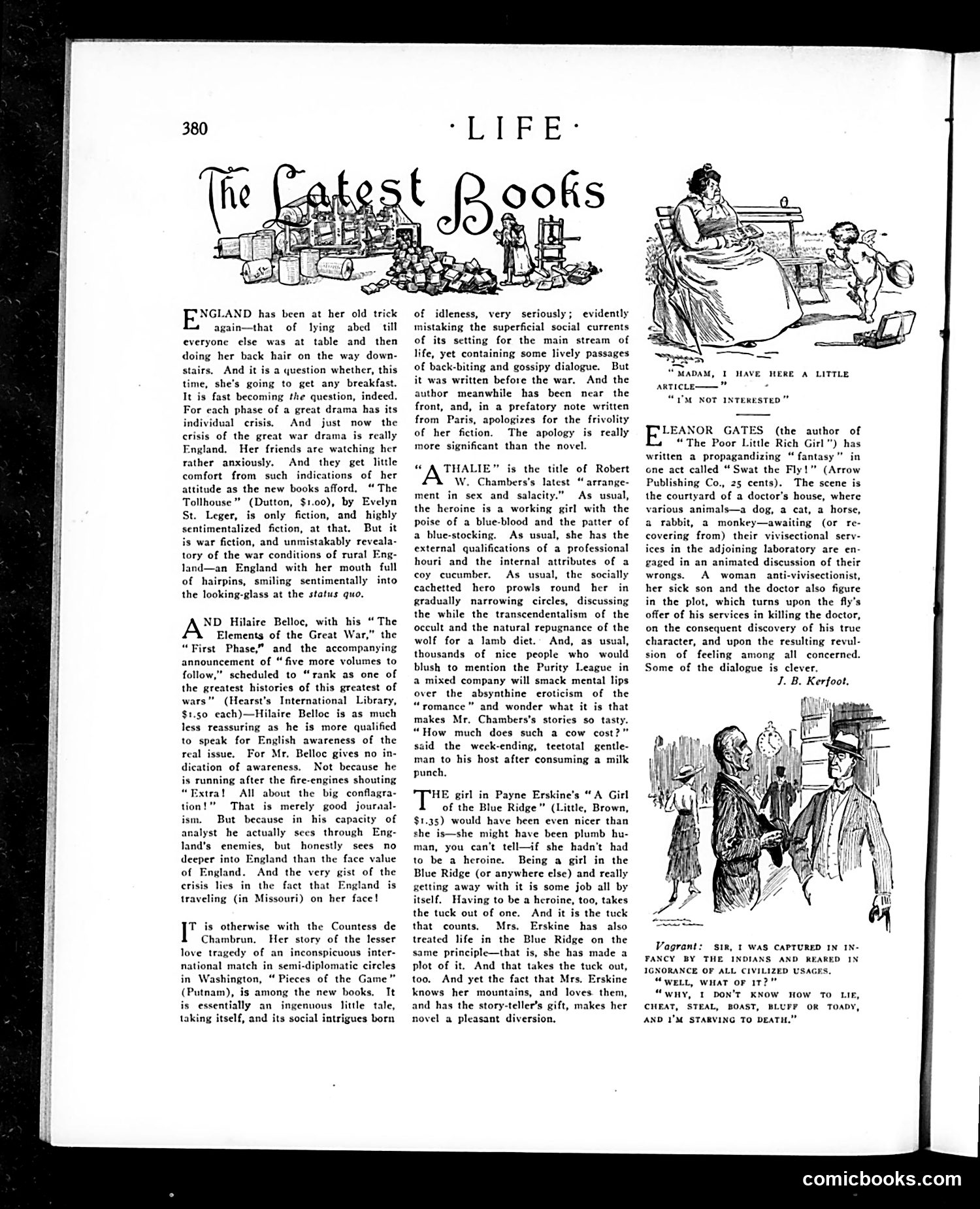
This page from *Life* magazine reviews several wartime books, using them to critique England's perceived complacency during World War I. The author suggests England is metaphorically "lying abed" and fixing her hair while the war rages—preoccupied with trivial matters rather than facing the crisis seriously. The satire targets: 1. **"The Tollhouse"** by Evelyn St. Leger—dismissed as sentimental rural fiction that ignores the war's gravity 2. **Hilaire Belloc's war histories**—criticized for analyzing enemies but lacking real insight into England's own deeper problems 3. **Robert W. Chambers's novels**—mocked for shallow eroticism that distracts respectable readers with titillating "romance" rather than substance 4. **Payne Erskine's work**—faulted for prioritizing heroine conventions over authentic characterization The cartoons (right side) appear to illustrate this frivolity through domestic scenes. The author's fundamental complaint: England's cultural output reveals superficial awareness of the war's true stakes, suggesting the nation is failing to reckon seriously with its existential challenge.
📄 Transcribed text from this page (OCR, searchable)
Machine-transcribed from the original scan — historical spelling and the odd misread are preserved.
NGLAND has been at her old trick again—that of lying abed till everyone else was at table and then doing her back hair on the way down- stairs. And it is a question whether, this time, she’s going to get any breakfast. It is fast becoming the question, indeed. For each phase of a great drama has its individual | crisi: And just now the crisis of the great war drama is really England, Her friends are watching her rather anxiously. And they get little comfort from such indications of her attitude as the new books afford. “ The Tollhouse” (Dutton, $1.00), by Evelyn St. Leger, is only fiction, and highly sentimentalized fiction, at that. But it is war fiction, and unmistakably reveala- tory of the war conditions of rural Eng- land—an England with her mouth full of hairpins, smiling sentimentally into the looking-glass at the status quo. ND Hilaire Belloc, with his “ The Elements of the Great War,” the rst’ Phase,” and the accompanying announcement of “ five more volumes to follow,” scheduled to “rank as one of the greatest histories of this greatest of wars” (Hearst's International Library, $1.50 each)—Hilaire Belloc is as much less reassuring as he is more qualified to speak for English awareness of the real issue. For Mr. Belloc gives no in- dication of awareness. Not because he is running after the fire-engines shouting xtra! All about the big conflagra- That is merely good journal- ism. But because in his capacity of analyst he actually sees through Eng- land's enemies, but honestly sees no deeper into England than the face value of England. And the very gist of the crisis lies in the fact that England is traveling (in Missouri) on her face! T is otherwise with the Countess de Chambrun, Her story of the lesser love tragedy of an inconspicuous inter- national match semi-diplomatic circles in Washington, “Pieces of the Game” (Putnam), is among the new books, It is essentially an ingenuous little tale, taking itself, and its social intrigues born of idleness, very seriously; evidently mistaking the superficial social currents of its setting for the main stream of life, yet containing some lively passages of back-biting and gossipy dialogue. But it was written before the war, And the author meanwhile has been near the front, and, in a prefatory note written from Paris, apologizes for the frivolity of her fiction. The apology is really more significant than the novel. “ A THALIE” is the title of Robert W. Chambers’s latest “ arrange- ment in sex and salacity.” As usual, the heroine is a working girl with the poise of a blue-blood and the patter of a blue-stocking. As usual, she has the external qualifications of a professional houri and the internal attributes of a coy cucumber. As usual, the socially cachetted hero prowls round her in gradually narrowing circles, discussing the while the transcendentalism of the occult and the natural repugnance of the wolf for a lamb diet. And, as usual, thousands of nice people who would blush to mention the Purity League in a mixed company will smack mental lips over the absynthine eroticism of the “romance” and wonder what it is that makes Mr. Chambers’s stories so tasty. “How much does such a cow cost?” said the weck-ending, teetotal gentle- man to his host after consuming a milk punch, HE girl in Payne Erskine's “A Girl of the Blue Ridge” (Little, Brown, $1.35) would have heen even nicer than she is—she might have been plumb hu- man, you can't tell—if she hadn't had to be a heroine. Being a girl in the Blue Ridge (or anywhere else) and really getting away with it is some job all by itself. Having to be a heroine, too, takes the tuck out of one. And it is the tuck that counts, Mrs. Erskine has also treated life in the Blue Ridge on the same principle—that is, she has made a plot of it. And that takes the tuck out, too. And yet the fact that Mrs. Erskine knows her mountains, and loves them, and has the story-teller’s gift, makes her novel a pleasant diversion, “MADAM, 1 ARTICLE: * “VM NOT INTERESTED” MAVE MERE A LITTLE LEANOR GATES (the author of “The Poor Little Rich Girl”) has written a propagandizing “fantasy” in one act called “ Swat the Fly!” (Arrow Publishing Co., 25 cents). The scene is the courtyard of a doctor’s house, where various animals—a dog, a cat, a horse, a rabbit, a monkey—awaiting (or r covering from) their vivisectional ser ices in the adjoining laboratory are en- gaged in an animated discussion of their wrongs. A woman anti-vivisectionist, her sick son and the doctor also figure in the plot, which turns upon the fly's offer of his services in killing the doctor, on the consequent discovery of his true character, and upon the resulting revul- sion of feeling among all concerned. Some of the dialogue is clever. J.B. Kerfoot. Vagrant: in, 1 WAS CAPTURED IN IN- FANCY BY THE INDIANS AND REARED IN IGNORANCE OF ALL CIVILIZED USAGES. “WELL, WHAT oF 17?” ind HY, 1 DON’T KNOW HOW To LiF, CUEAT, STEAL, BOAST, BLUFF OR TOADY, AND I'M STARVING TO DEATH,” comicbooks.com