
A complete issue · 48 pages · 1915
Life — August 19, 1915
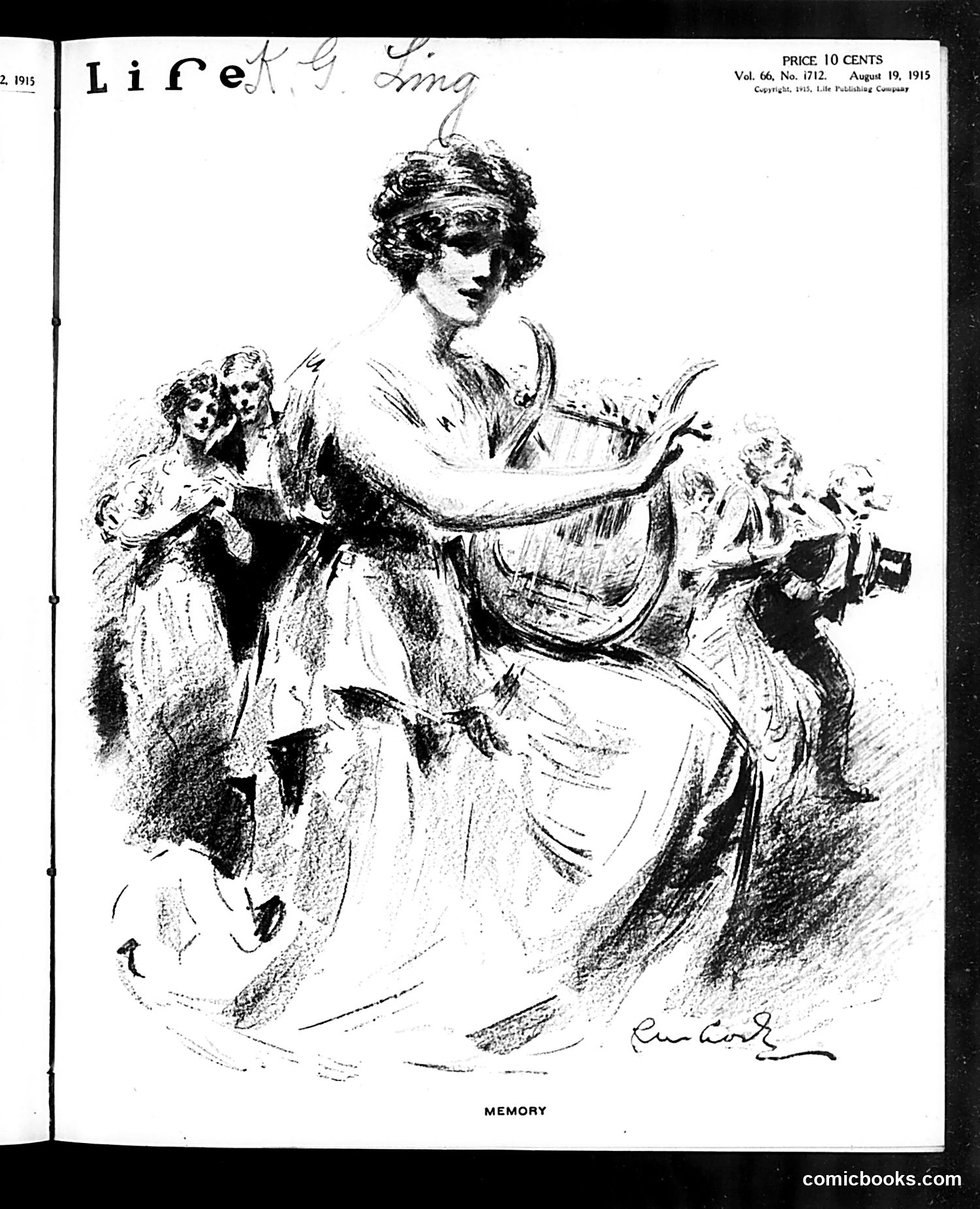
This sketch, titled "Memory," depicts a classical female allegorical figure (likely representing Memory itself) holding or gathering cherubic figures around her. The style is typical of early 20th-century sentimental illustration. Without additional context from accompanying articles or captions on this page, the specific satirical or political point remains unclear. The image appears decorative rather than sharply satirical. It could reference nostalgic cultural themes popular in 1915, or possibly commemorate historical figures or events, but the precise subject cannot be determined from the visual alone. The artist's signature appears in the lower right corner of the sketch.
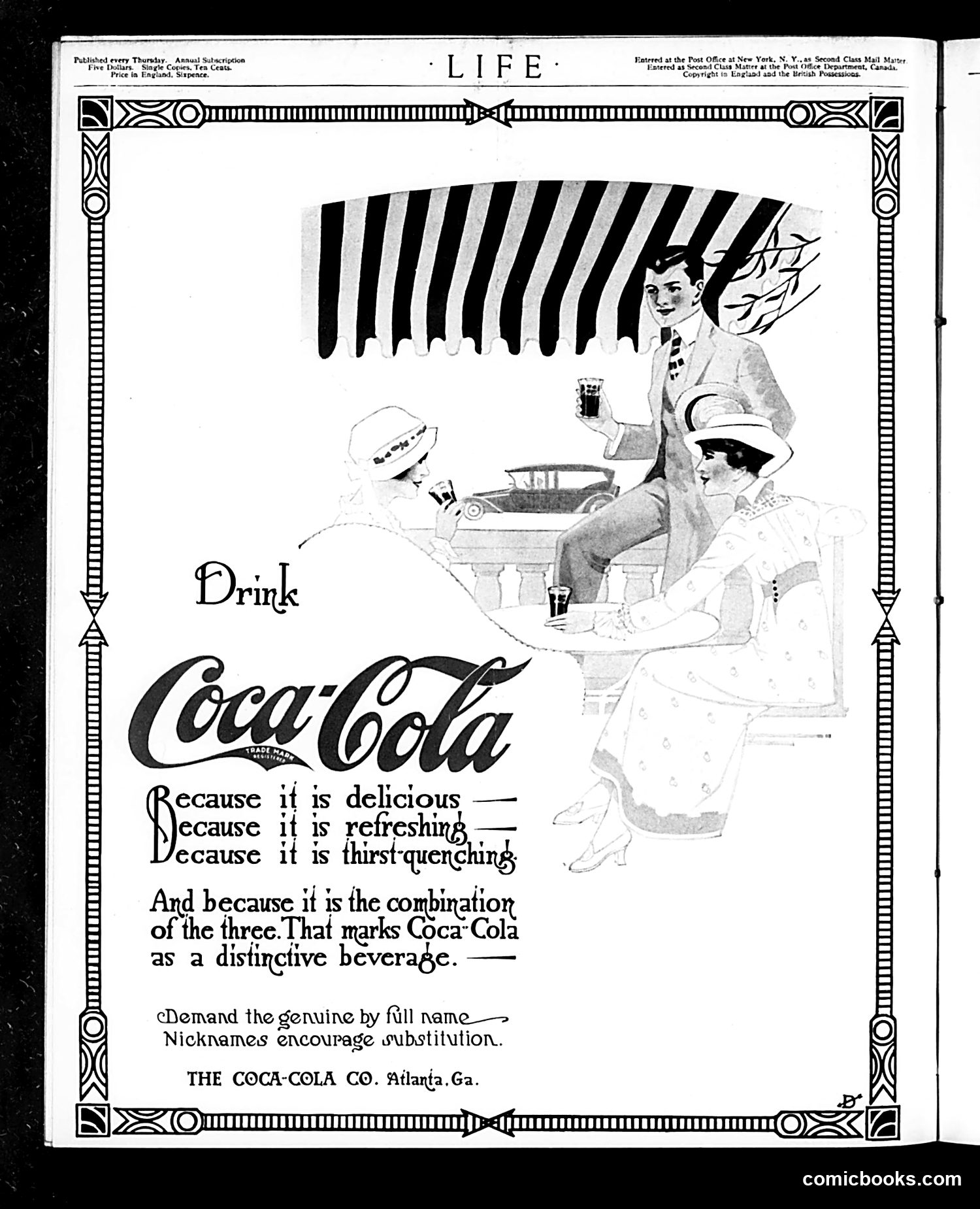
This is a **Coca-Cola advertisement**, not political satire. The page depicts a 1920s social scene: three fashionably dressed people in a convertible automobile, with a man serving drinks from what appears to be a cooler. The ad emphasizes Coca-Cola's appeal during the Prohibition era (1920-1933), when alcohol was illegal. The tagline "Because it is delicious — Because it is refreshing — Because it is thirst-quenching" positions the soft drink as an attractive alternative to banned alcoholic beverages. The warning to "Demand the genuine by full name — Nicknames encourage substitution" suggests counterfeit or illicit products were common concerns. The fashionable characters and automobile setting convey modernity and sophistication to appeal to wealthy consumers during the Jazz Age.

This page is primarily a **commercial advertisement**, not political satire. It promotes White Rock mineral water from Waukesha, Wisconsin, marketed as "the world's best table water" and "mildly alkaline." The ad employs classical imagery—an eagle, globes, columned architecture, and stars—to convey prestige and American superiority. The opening claim that this water enjoys "unquestioned superiority now being preferred by the American public" uses nationalist appeals typical of early 20th-century marketing. The ornate Art Deco design and elaborate framing suggest this ran in an upscale publication targeting affluent consumers. The New York City office address (100 Broadway) indicates national distribution. This represents commercial marketing dressed in patriotic language rather than editorial commentary or satire.
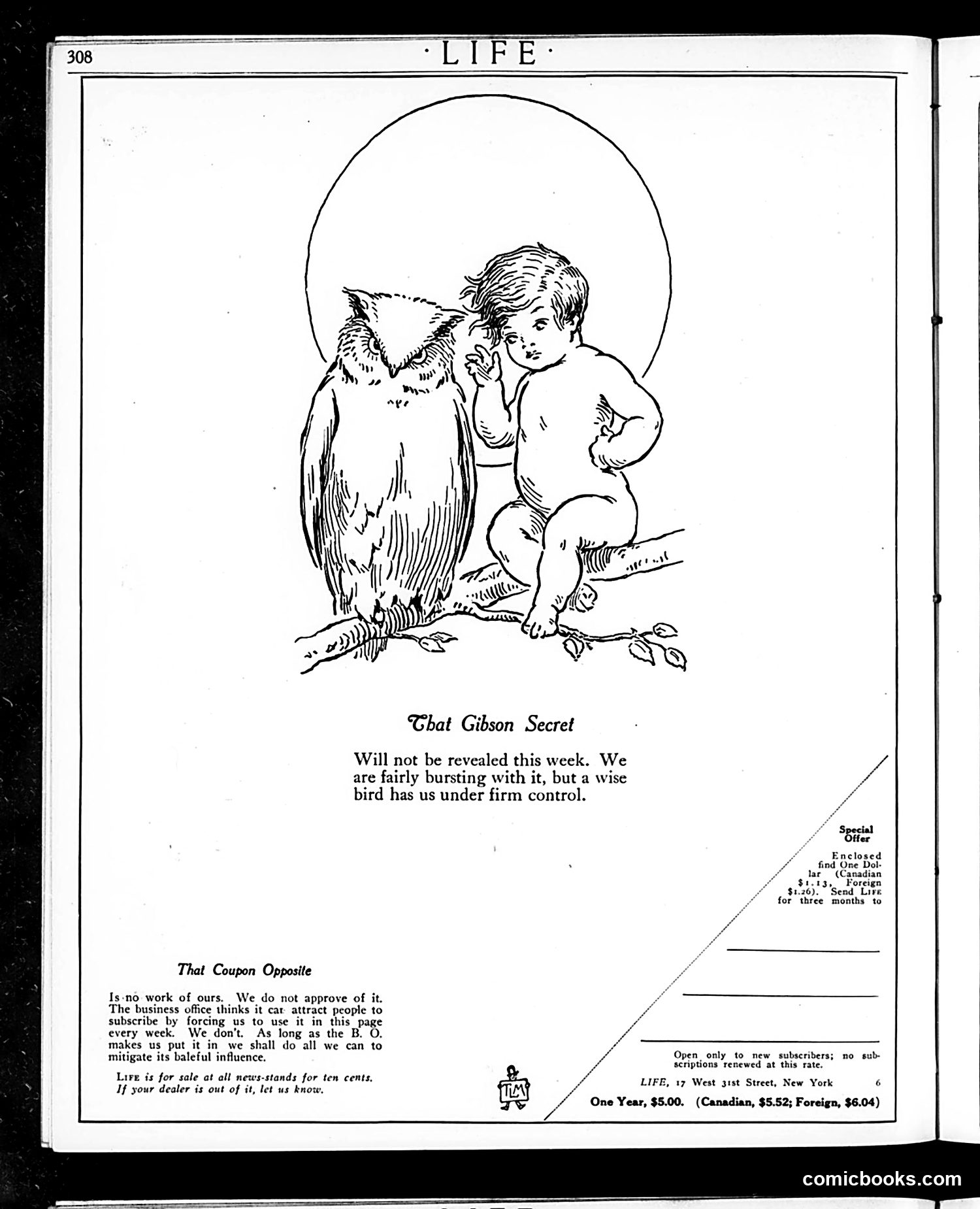
The main illustration depicts a cherub or cupid figure sitting beside a large owl, with a halo above them both. The caption "That Gibson Secret" references Charles Dana Gibson, the famous illustrator whose "Gibson Girl" defined early 1900s idealized femininity. The text playfully suggests Life magazine is keeping a secret about Gibson—"a wise bird has us under firm control"—implying the owl symbolizes secrecy or wisdom guarding unrevealed information. Below, "That Coupon Opposite" addresses a subscription offer the magazine distances itself from, claiming the business office added it against editorial preference to attract subscribers. This reveals internal magazine tension between commercial and editorial interests. The page is primarily a subscription advertisement for Life magazine at five dollars yearly.
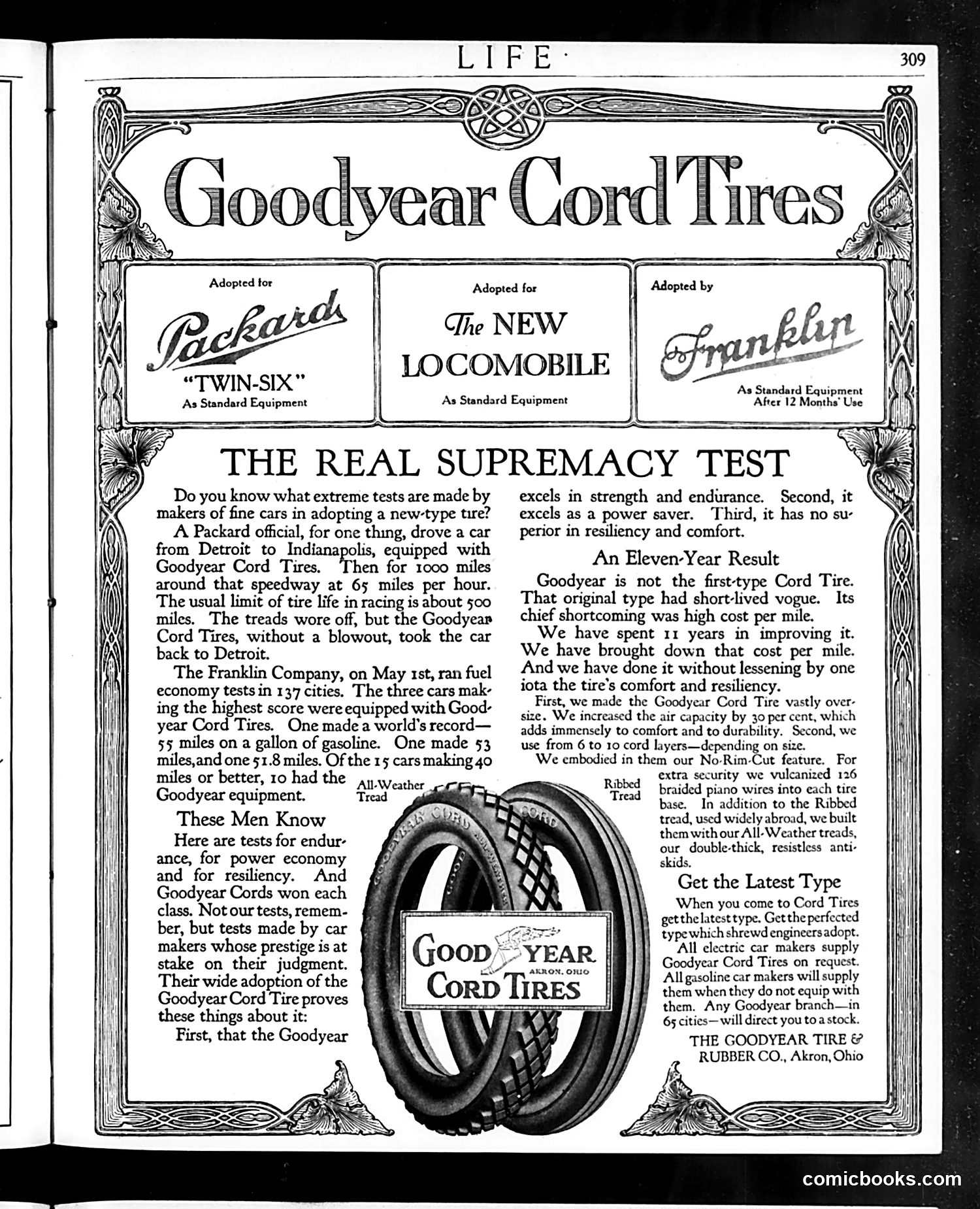
This page is **not a cartoon or satire** — it's a straightforward **advertisement for Goodyear Cord Tires** from *Life* magazine (page 309). The ad promotes Goodyear's tire technology by claiming endorsements from three luxury automobile manufacturers: Packard, Locomotive (Franklin), and Franklin. It describes "extreme tests" performed by Packard engineers, including a 1,000-mile high-speed run and fuel economy comparisons. The ad emphasizes technological superiority through an "Eleven-Year Result" narrative, claiming Goodyear improved tire durability while reducing cost-per-mile. It highlights features like their "No-Kin-Cut" design and reinforced construction. The central image shows two Goodyear Cord Tires with a company label, serving as the product focal point for this premium automotive advertisement.
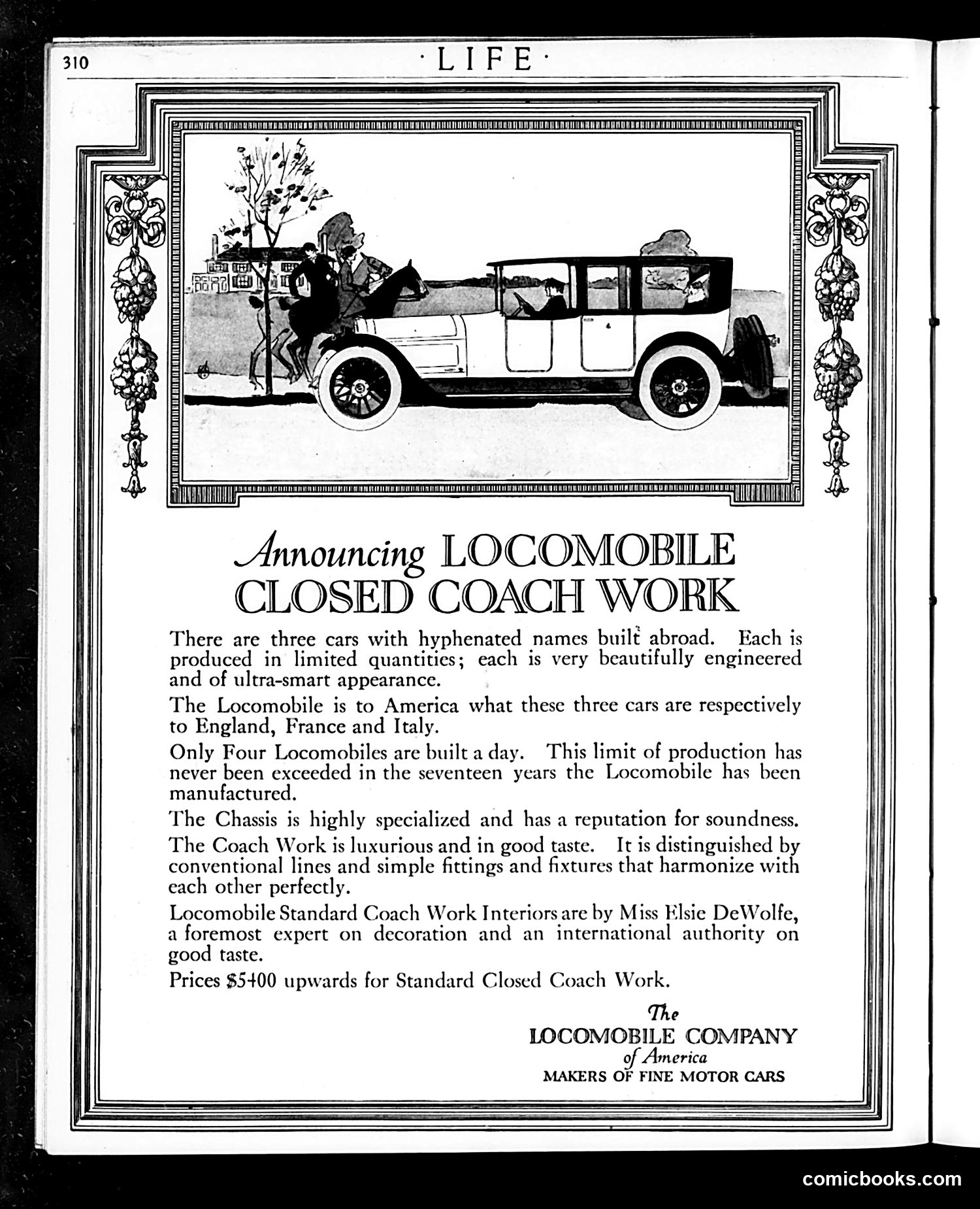
This is primarily a **luxury automobile advertisement**, not political satire. It announces the Locomobile Company's "Closed Coach Work" — high-end car bodies crafted with refined interiors designed by Miss Elsie DeWolfe, a noted decorator. The ad's only satirical element is its opening comparison: the Locomobile positions itself as America's equivalent to three prestigious European cars from England, France, and Italy. This is aspirational marketing — claiming American manufacturing rivals European luxury and craftsmanship. The illustration shows a well-dressed couple with a fashionable automobile and countryside estate, reinforcing the product's elite status. The "$5400 upwards" price tag (substantial in this era) confirms this targets wealthy consumers. There is **no political commentary** here — purely commercial messaging dressed in refined graphic design.
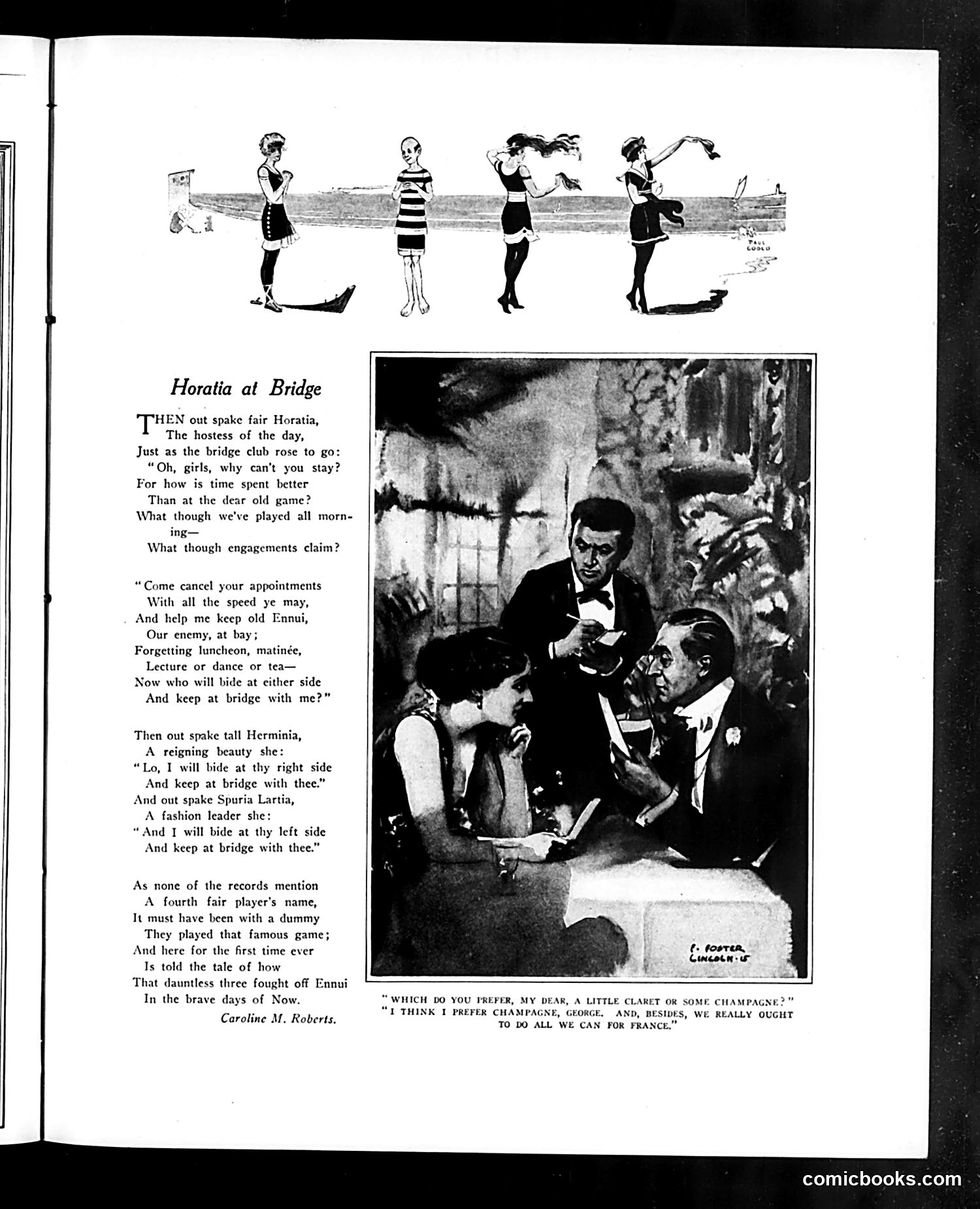
This page presents a humorous poem by Caroline M. Roberts about a social situation at a bridge club—a popular leisure activity among upper-class women in the early 20th century. The satire mocks how seriously women took bridge competitions and social obligations. Horatio (the hostess) pleads with her guests to cancel their appointments—lunch, theater, lectures, dances—to help her keep "old Ennui" (boredom) "at bay." Three women agree to stay and play bridge, though notably "none of the records mention / A fourth fair player's name," suggesting someone played without proper recognition. The photograph shows what appears to be a theatrical scene of people socializing, likely illustrating the social gatherings referenced in the poem. The satire gently critiques how women prioritized bridge-playing and social status over other commitments.
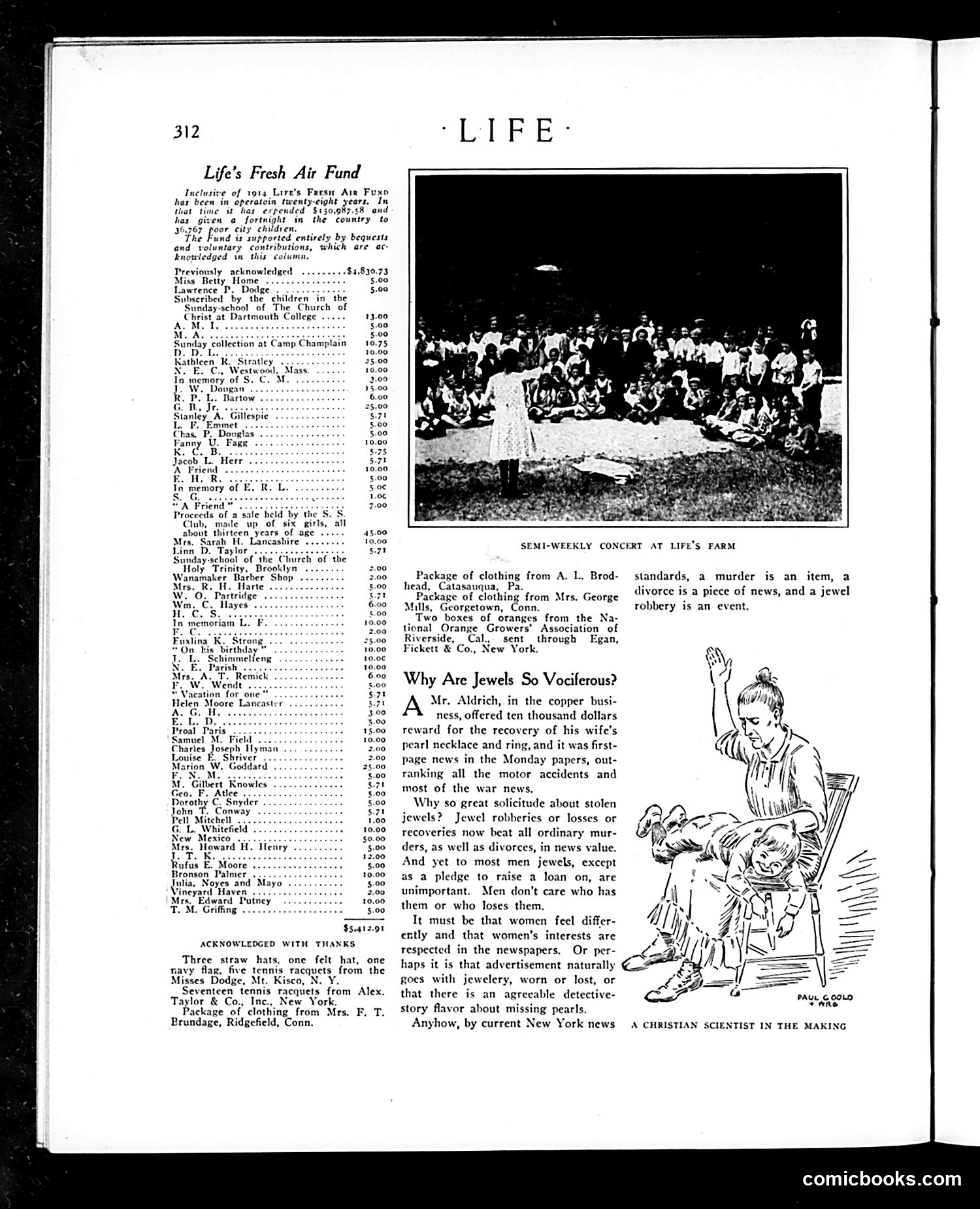
This page contains a "Life's Fresh Air Fund" section listing donations, a photograph of a semi-weekly concert at Life's farm, and an article titled "Why Are Jewels So Vociferous?" The article presents a social commentary about news values: Mr. Aldrich offered a large reward for his wife's stolen pearls, making it front-page news—outranking motor accidents and war coverage. The piece questions why jewelry theft receives such prominent attention, suggesting that women's interests (jewelry, fashion, divorces) dominate newspaper coverage because advertising naturally follows these topics. The accompanying illustration shows a woman reading to children, labeled "A Christian Scientist in the Making." The humor critiques both newspaper priorities and gender stereotypes in media coverage of the era.
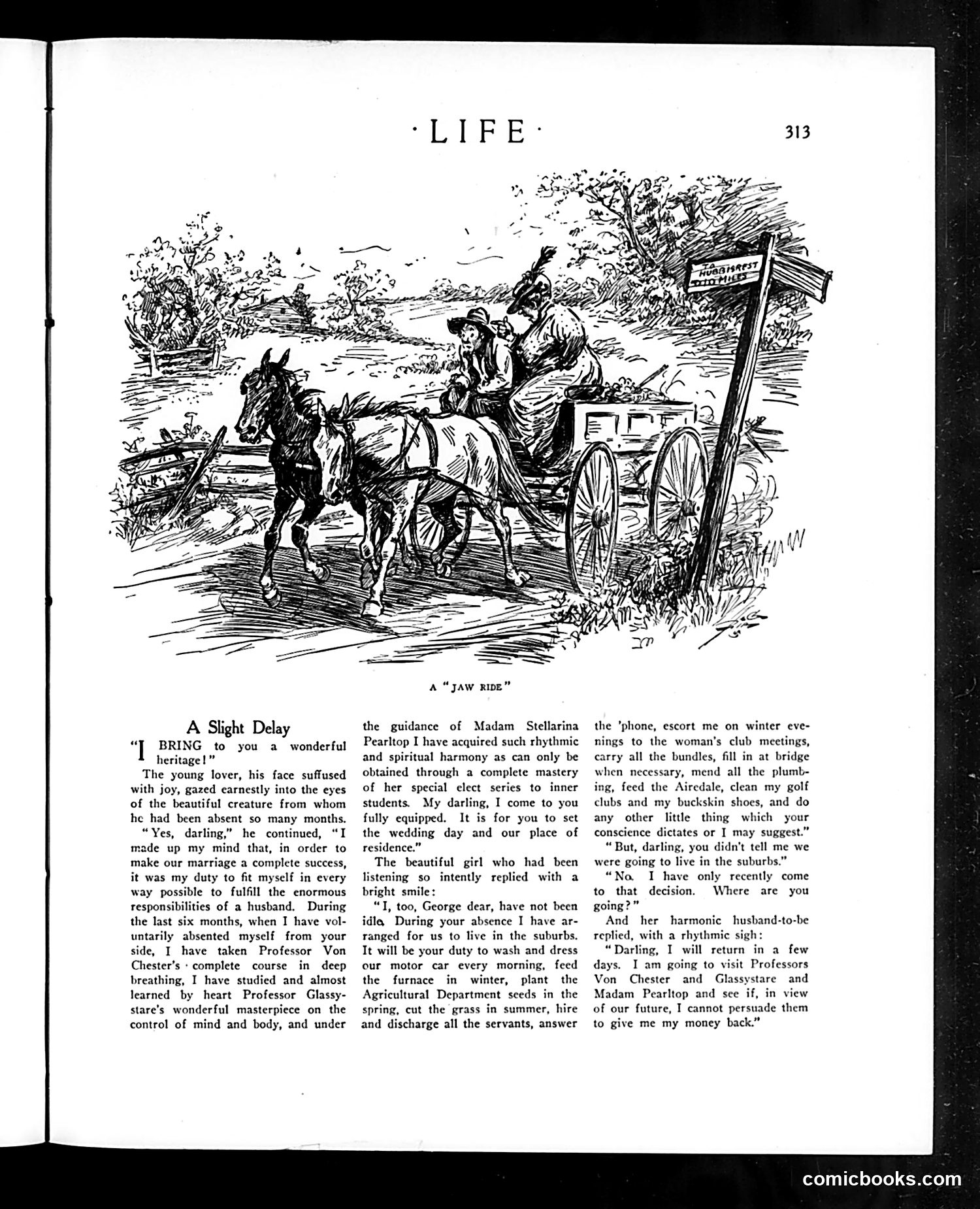
This is a narrative fiction piece, not political satire. The illustration shows a couple in a horse-drawn wagon labeled "A 'JAW RIDE'" on a country road. The story depicts a young bridegroom who has delayed his marriage to pursue education under Professor Von Chester and Madam Stellarina, studying "mind and body control" and spiritualism. He writes to his fiancée explaining his absence and outlining domestic duties she must master during their engagement—washing the motor car, managing servants, and handling household finances. The satire gently mocks the pretentious self-improvement culture and the groom's patronizing expectations that his bride-to-be serve as an unpaid household manager while he pursues self-development. The "jaw ride" title likely references the jawing (talking/complaining) that results from these demanding conditions.
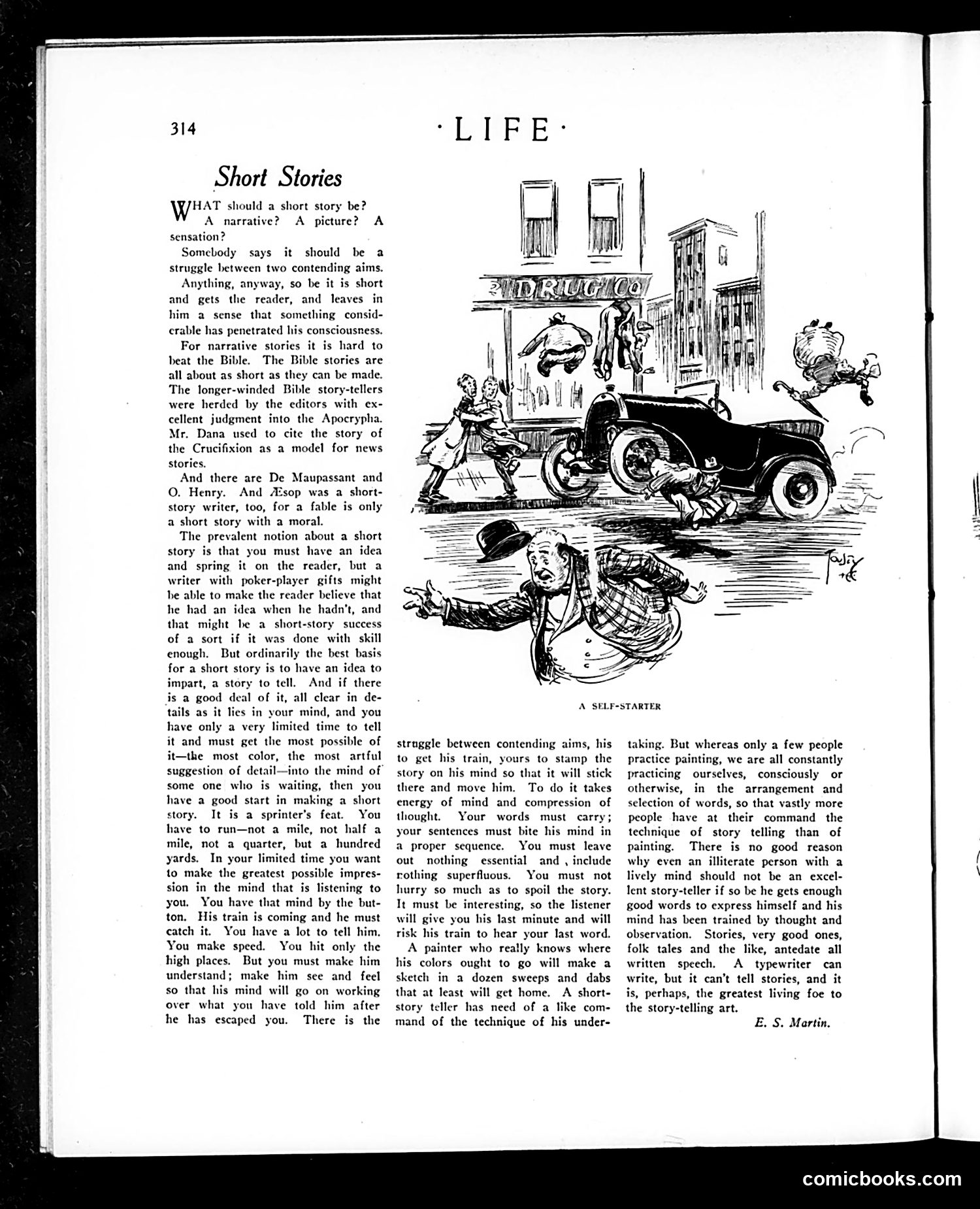
This page from *Life* magazine contains an article about short-story writing by E.S. Martin, accompanied by a cartoon illustration titled "A Self-Starter." The cartoon depicts a chaotic street scene: a car has struck a pedestrian near a drugstore, with the victim apparently propelled upward by the impact. The humor relies on the visual pun of "self-starter"—referencing both the automobile's mechanical self-starting feature (newly common in the 1920s) and the injured man's involuntary, violent propulsion from the car's collision. The joke is darkly satirical: the accident victims have become "self-starters" through violent impact rather than intention—a commentary on the automobile age's casual brutality and the era's emerging traffic hazards in urban America.
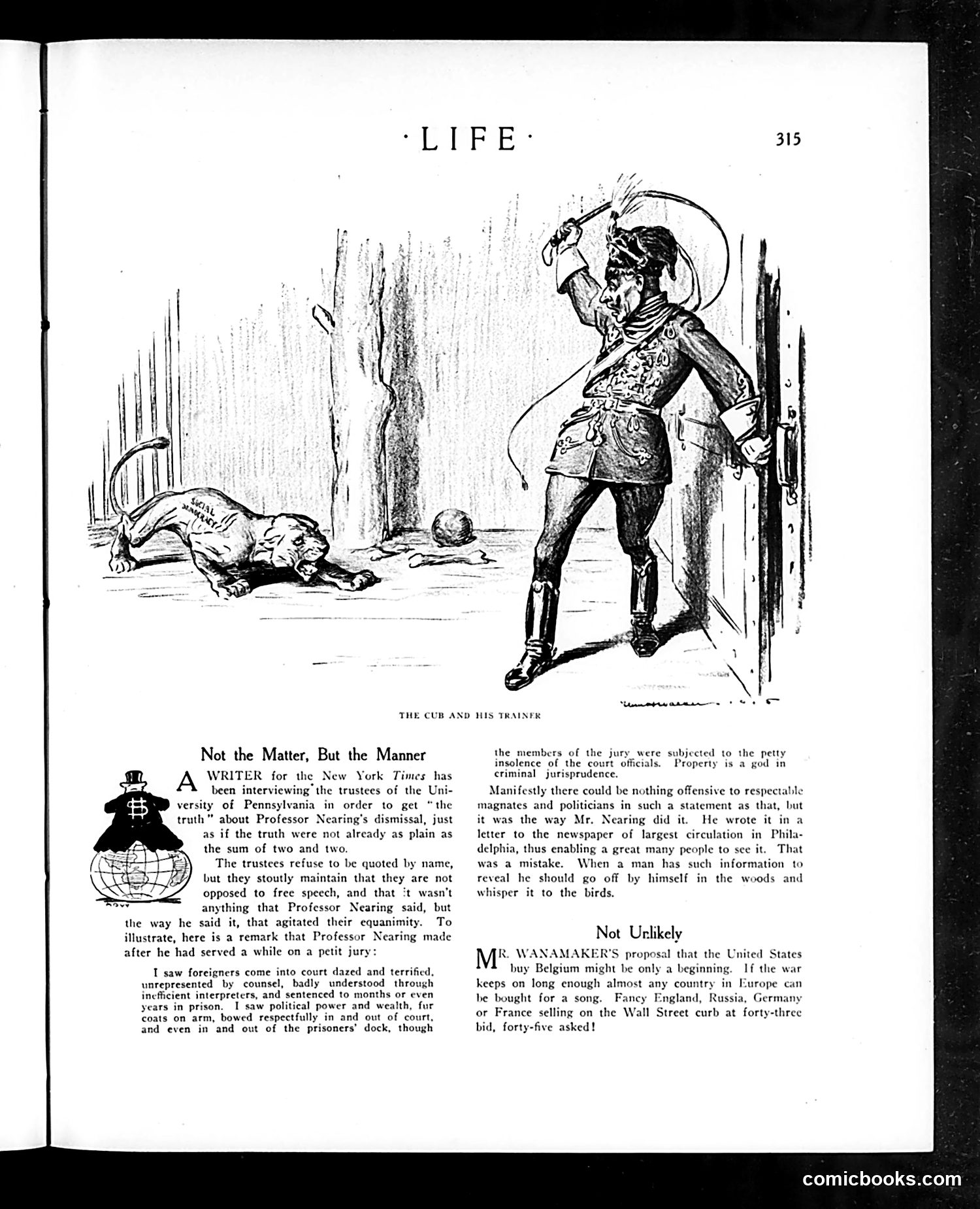
The main cartoon depicts a military officer standing over a prone figure labeled as a "cub." The illustration satirizes Professor Nearing's dismissal from University of Pennsylvania, discussed in the article "Not the Matter, But the Manner." The satire critiques how university trustees handled Nearing's removal—not objecting to his views themselves, but objecting to *how* he expressed them publicly. The "trainer" (authority figure) represents institutional power disciplining the "cub" (Nearing or radical academics generally). The article quotes Nearing's complaint that court officials showed "petty insolence" and that he was forced to resign rather than be dismissed outright. The cartoon visually represents this power dynamic: institutional authority training or punishing dissenting intellectuals through intimidation rather than direct confrontation.
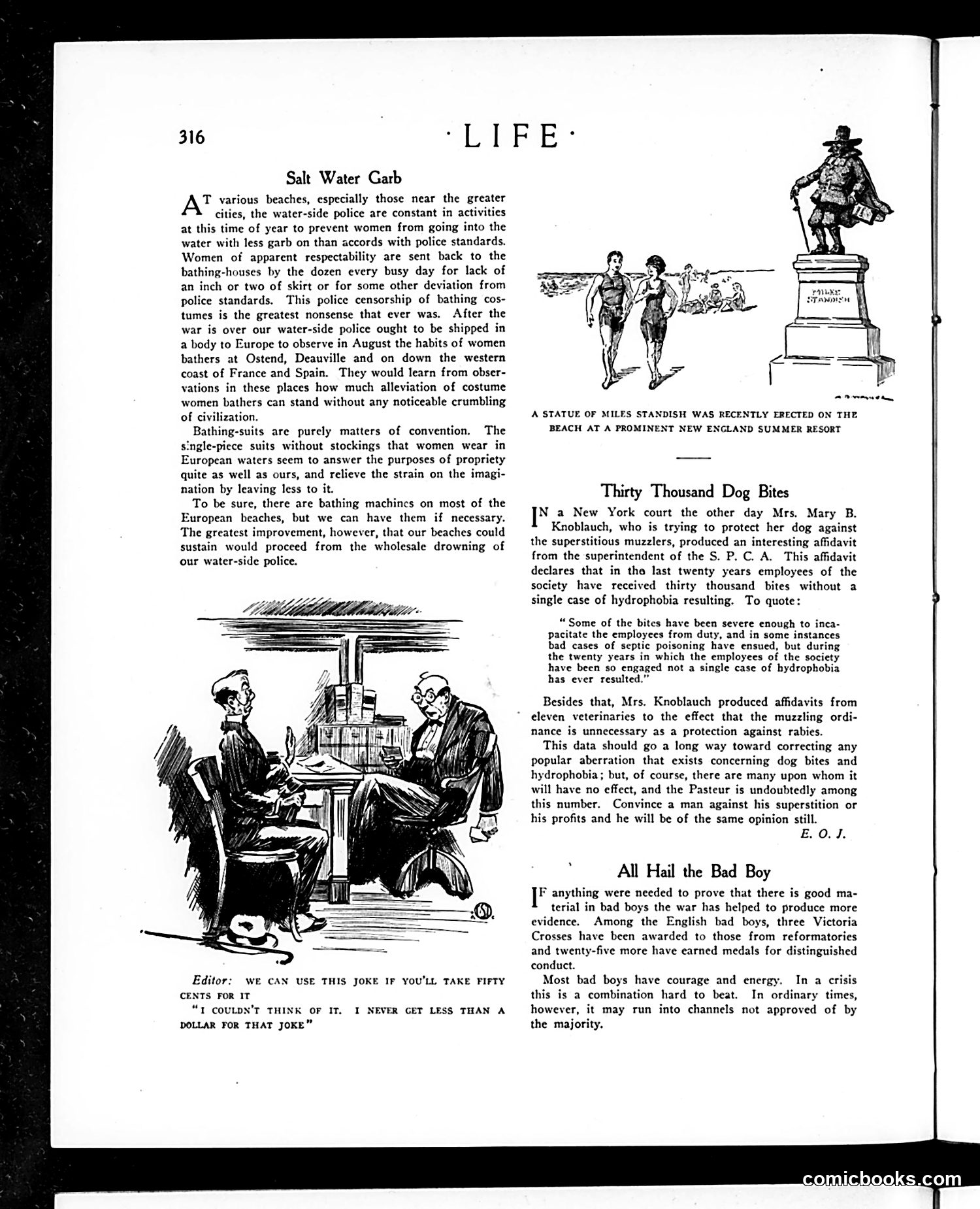
This page contains three distinct sections: **"Salt Water Carb"** (top): A satirical article about police enforcement of bathing suit standards at beaches, particularly near major cities. The text criticizes authorities for sending inspectors to monitor women's swimwear compliance, calling it "the greatest nonsense that ever was." A sketch shows two women in swimwear on a beach. **"Thirty Thousand Dog Bites"** (center-right): Reports on Mrs. Mary B. Knoplauch's court case against the S.P.C.A., presenting affidavits claiming 30,000 dog bites occurred without causing hydrophobia, suggesting rabies vaccination may be unnecessary. **"All Hail the Bad Boy"** (bottom): Discusses how wartime has produced "bad boys" with courage and energy, noting three Victoria Crosses and twenty-five medals awarded to reformatory youth, suggesting crisis reveals character. The cartoon (lower left) appears unrelated to these articles.
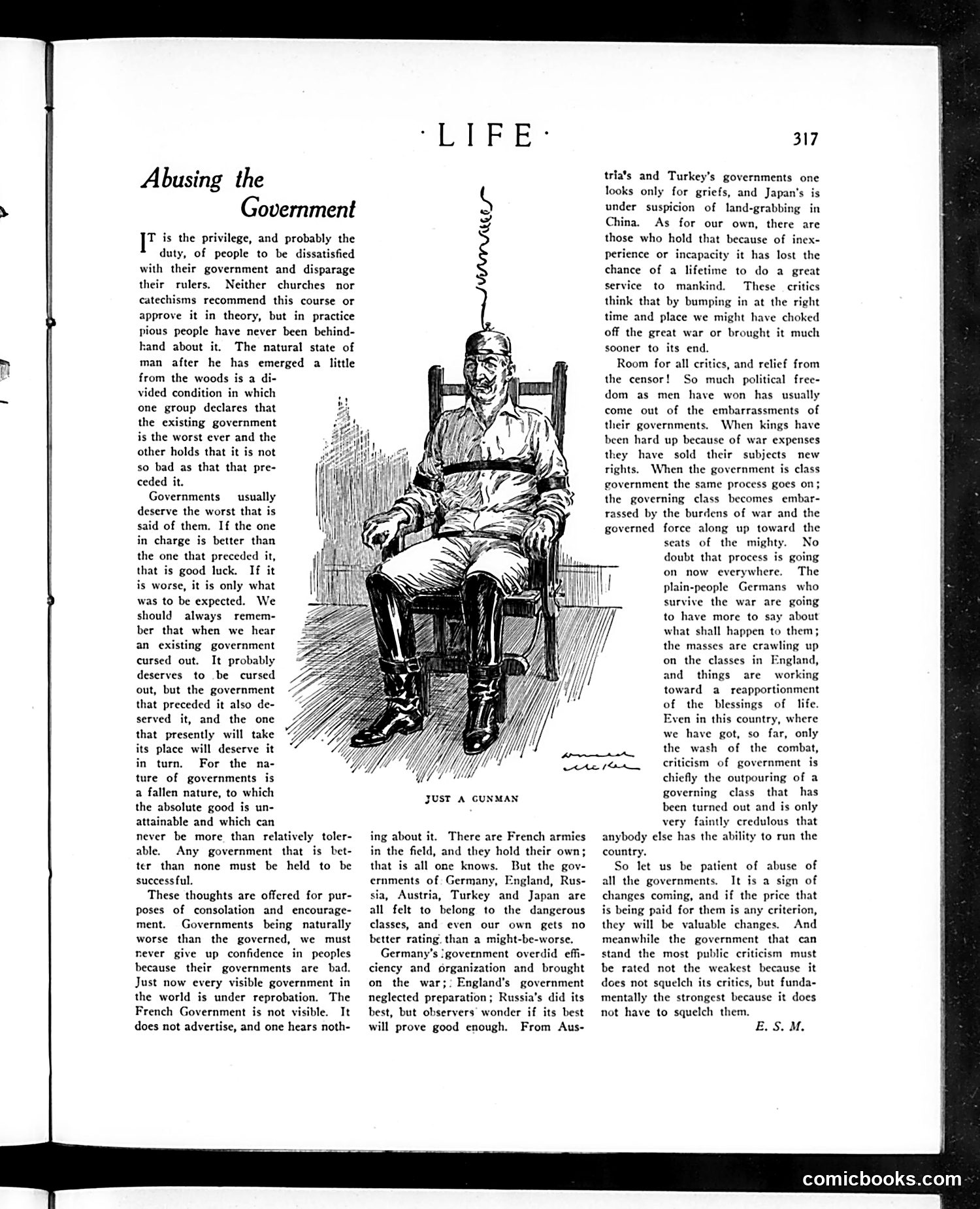
This satirical piece defends citizens' right to criticize government, arguing it's a democratic duty rather than disloyalty. The accompanying sketch, titled "Just a Gunman," depicts a military or autocratic figure seated in a chair—likely representing an authoritarian ruler or war leader. The article references WWI-era governments (Germany, England, Russia, Austria, Turkey, Japan) as examples of failed or inefficient leadership. It argues that "governing classes" have been "turned out," suggesting post-war political upheaval. The satire's point: strong governments need public criticism to improve; they shouldn't suppress dissent. The "gunman" image suggests that without accountability, governments rule by force rather than consent. The piece advocates for patient tolerance of government flaws while maintaining robust criticism.
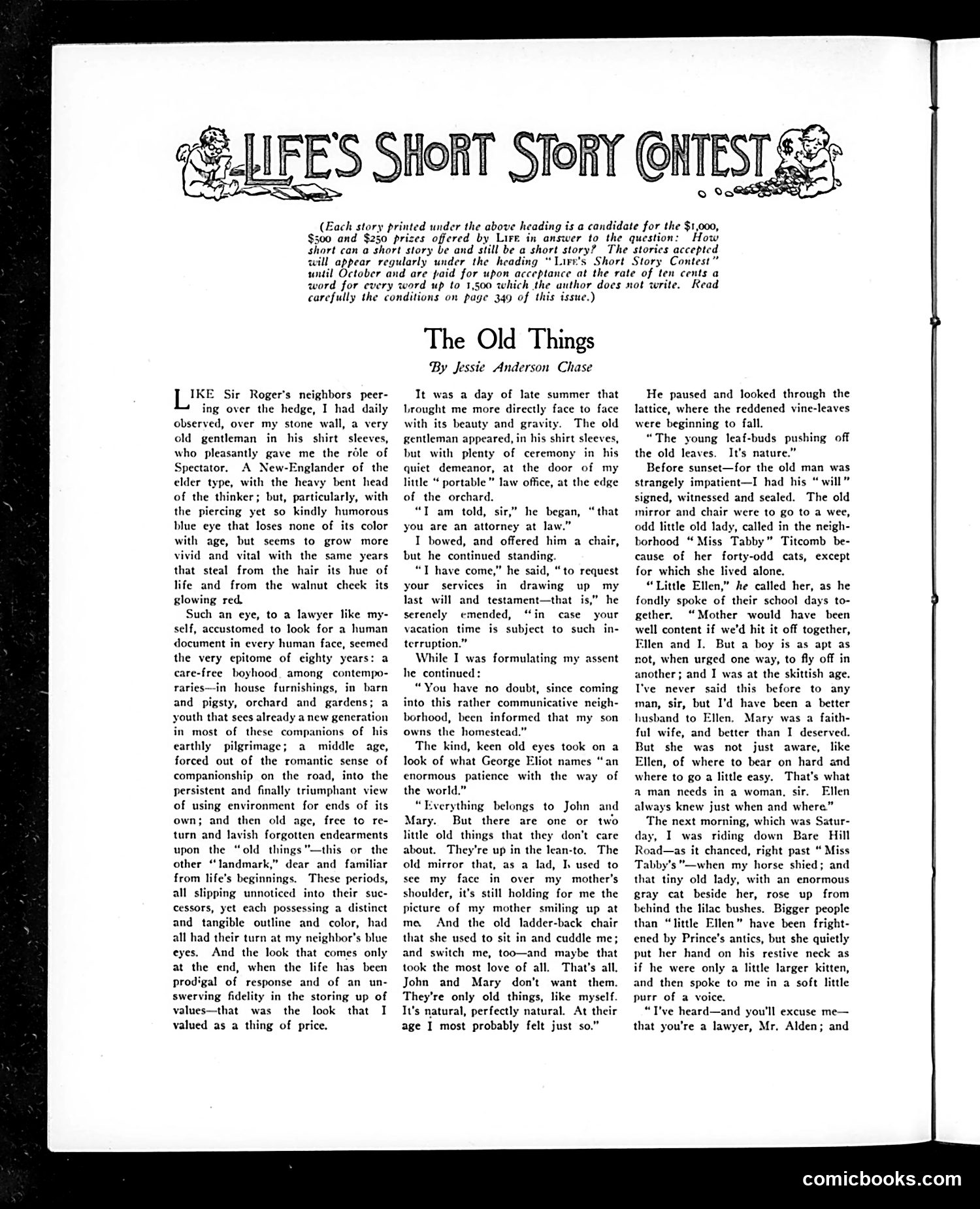
This is a short story submission to Life magazine's contest, not a political cartoon. The narrative concerns an elderly gentleman—described as a retired lawyer—who visits the narrator to discuss his will and estate planning. The story explores themes of aging, legacy, and sentiment through the lens of old possessions that hold emotional rather than monetary value. The piece reflects early 20th-century American social attitudes: respect for elderly gentlemen, the formality of legal matters, and nostalgia for inherited family objects. The story's central irony appears to be the tension between a lawyer's practical view of "old things" as disposable versus their profound sentimental meaning to those who cherish them.
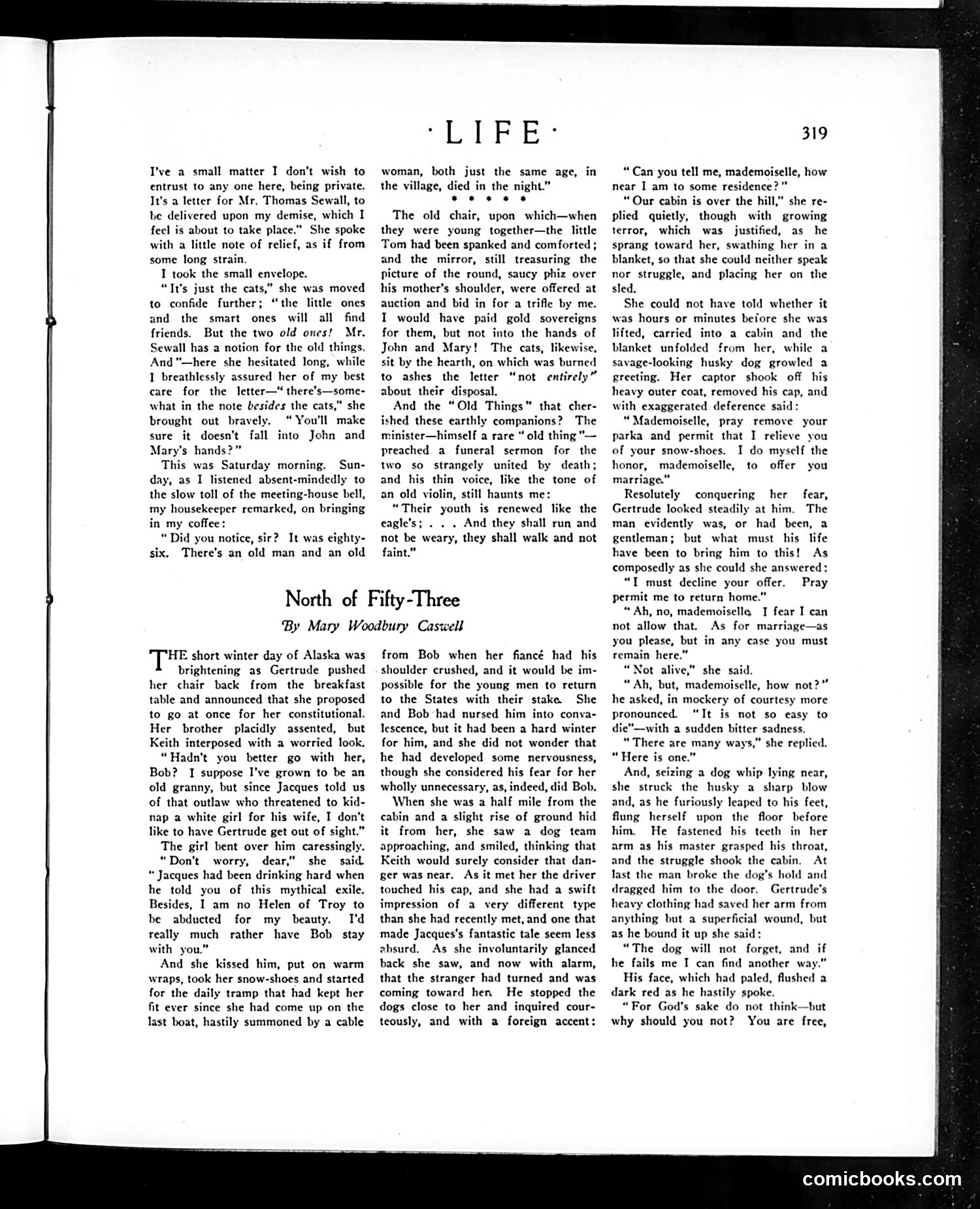
This page contains the beginning of a short story titled "North of Fifty-Three" by Mary Woodbury Cassell. The narrative concerns Gertrude, a woman in Alaska during winter who has rejected a marriage proposal from a gentleman caller. The story details her life in the remote north and her relationship with Bob, her fiancé, who has been injured. The text explores themes of frontier life, romance, and Gertrude's difficult choice between returning home and remaining in Alaska. This appears to be a serialized fiction piece rather than political satire or a cartoon. The page is primarily text-based literary content typical of Life magazine's varied editorial offerings during this period.
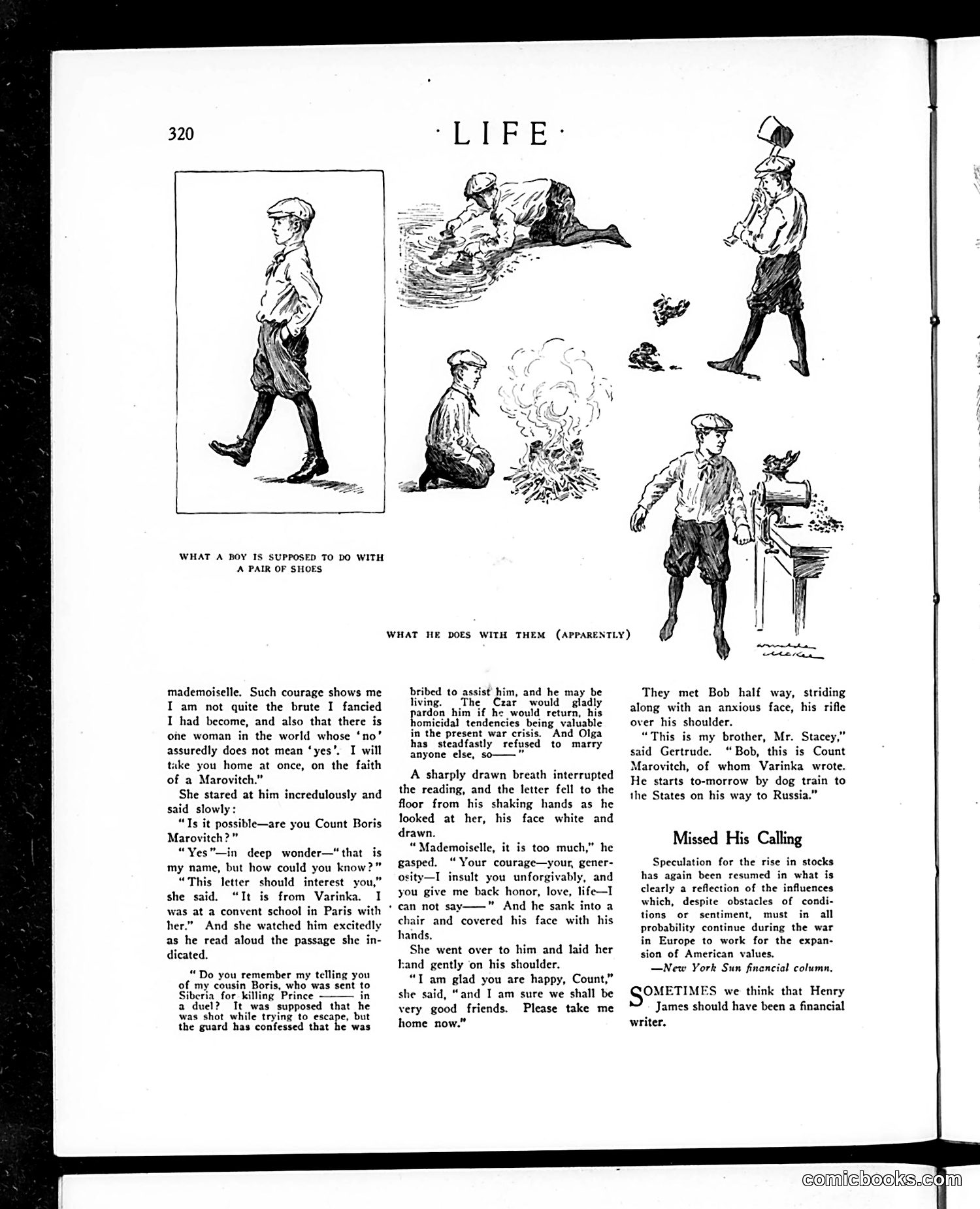
This page combines a serialized romantic story with satirical commentary. The main narrative involves Count Boris Marovitch, a Russian exile, reuniting with a woman who helps restore his honor through a letter from his former love, Varinka. The satire appears in the final section, "Missed His Calling." It mocks the pretentious language of financial columnists by quoting an absurdly overwrought Wall Street analysis about stock speculation during wartime. The passage uses grandiose, flowery prose to discuss mundane market activity—employing phrases like "expansion of American values" to describe simple profit-seeking. The joke: the editors suggest author Henry James (known for dense, philosophical prose) should have been a financial writer, sarcastically implying that financial writers already match James's notoriously complicated style. This ridicules both Wall Street's verbose self-importance and literary affectation disguising simple greed. The cartoon above illustrates the story's themes about boys and misbehavior with shoes.
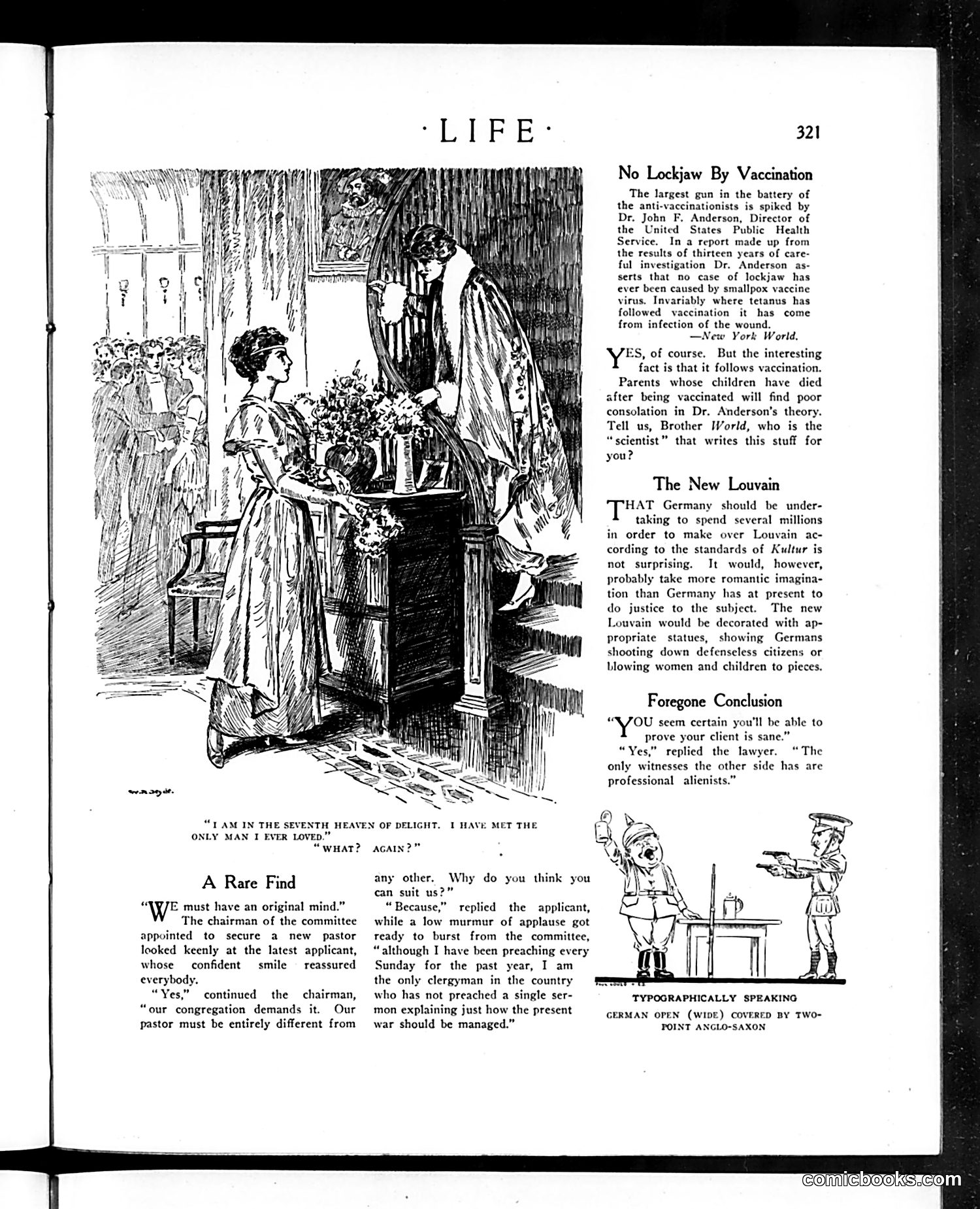
This page contains three separate satirical pieces: **"A Rare Find"** mocks American clergy's obsession with commenting on World War I. A church committee seeking an "original" pastor celebrates finding the only clergyman in America who *hasn't* preached about how to manage the war—positioning abstention from this trendy commentary as rare virtue. **"No Lockjaw By Vaccination"** attacks anti-vaccination propagandists. It cites Dr. Anderson's claim that vaccine-caused lockjaw is actually wound infection, not vaccine injury. Life sarcastically questions the anti-vaccinationists' credibility while acknowledging bereaved parents' legitimate grief—suggesting their emotional pain is being exploited by pseudoscientific arguments. **"The New Louvain"** references Germany's plan to rebuild the Belgian city of Louvain (destroyed during WWI occupation). Life sardonically suggests any German reconstruction would fittingly commemorate German atrocities—"showing Germans shooting down defenseless citizens or blowing women and children to pieces." **"Foregone Conclusion"** is a brief legal joke: a lawyer confidently proves his client sane because opposing psychiatrist-witnesses are "professional alienists"—implying their expertise makes them unreliable.
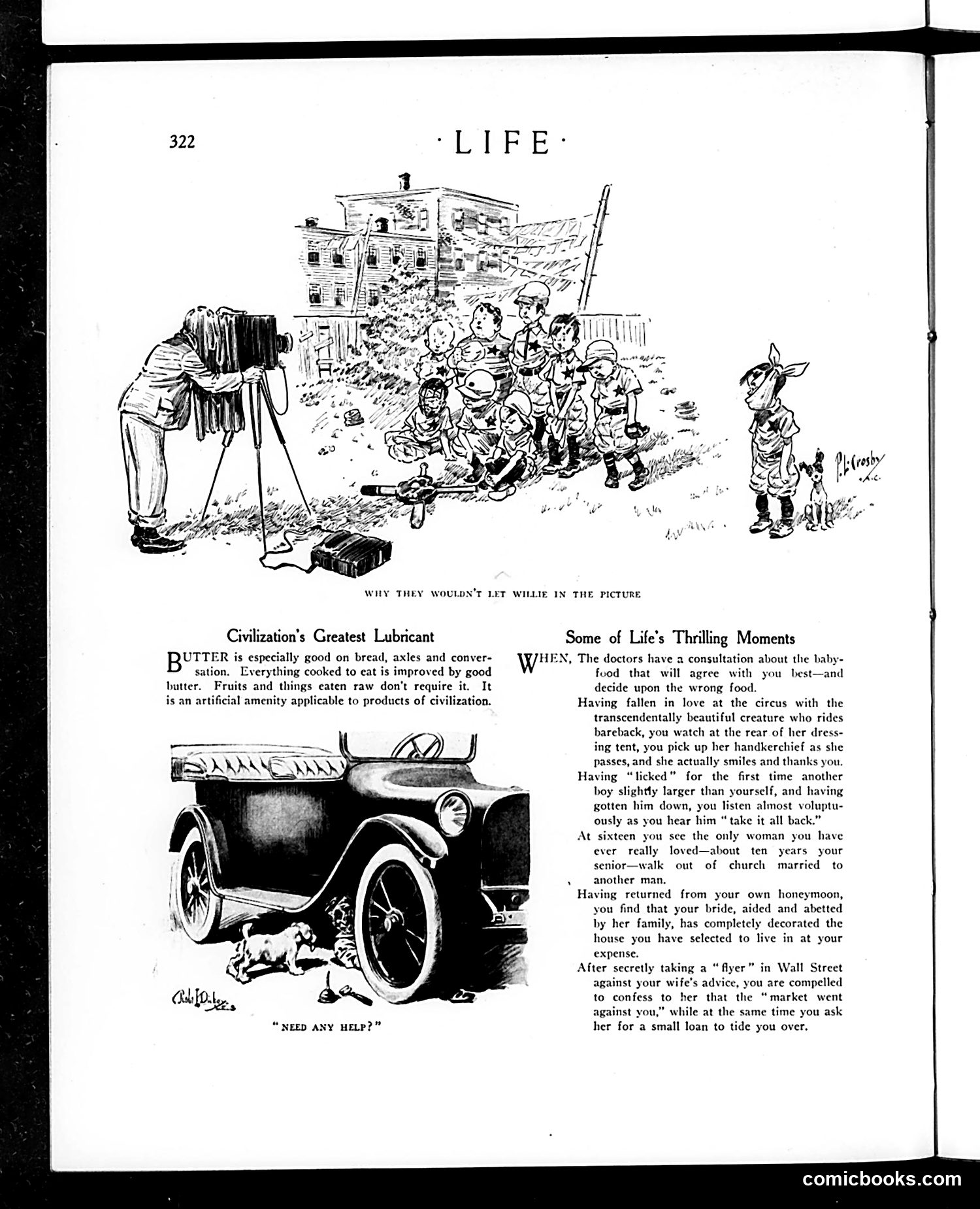
This page contains two satirical pieces from Life magazine (a humor/satire publication, not the photo magazine): **Top cartoon:** Shows a photographer trying to take a picture of children and a house, but one child ("Willie") is excluded. The joke plays on the caption "Why They Wouldn't Let Willie in the Picture"—likely suggesting Willie was misbehaving or wouldn't cooperate, making him unsuitable for the formal family photograph. **Bottom section:** - Left: A car advertisement cleverly titled "Need Any Help?" showing a small dog under an automobile, suggesting butter ("civilization's greatest lubricant") helps everything run smoothly, even in humorous situations. - Right: A humorous list titled "Some of Life's Thrilling Moments" describing universal male experiences of romantic and financial disappointment—unrequited love, marital financial disputes, and stock market losses. The tone is satirical, treating mundane domestic troubles as dramatic life events. The page combines advertising copy with gentle satire of middle-class American life, relationships, and masculinity.
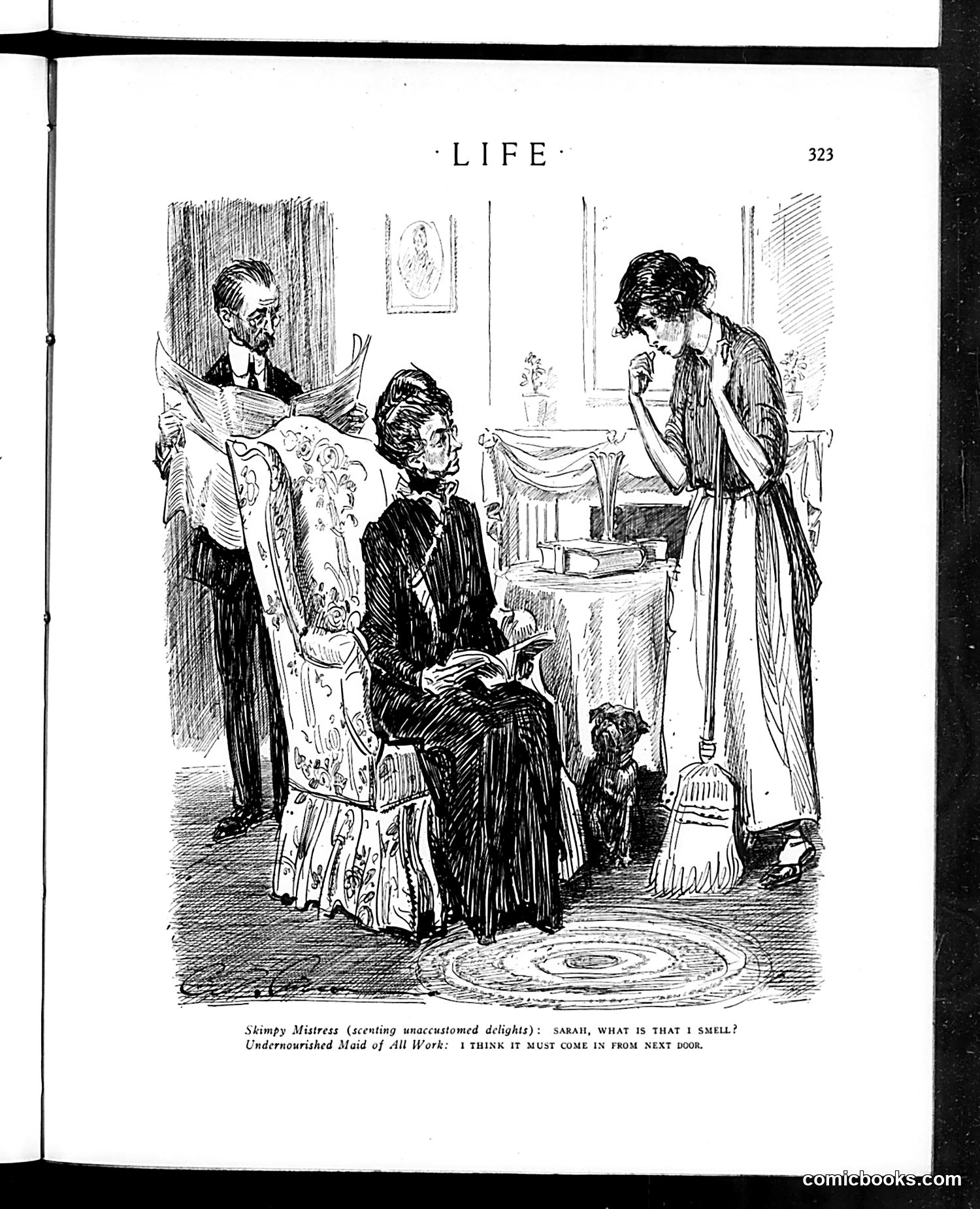
This is a satirical cartoon about class inequality and poverty in late 19th/early 20th-century America. The "Skimpy Mistress" represents an upper-class woman so accustomed to deprivation that she doesn't recognize pleasant cooking smells. The "Undernourished Maid of All Work" is an overworked servant so underfed she assumes the appealing aroma comes from a neighbor's kitchen—implying she never experiences such food in her employer's home. The joke satirizes wealthy households that underfed and underpaid their domestic workers while maintaining pretense of respectability. The cartoon critiques both the mistress's obliviousness to luxury and the servant's resignation to hunger, exposing the harsh realities of servant labor and the indifference of the wealthy.
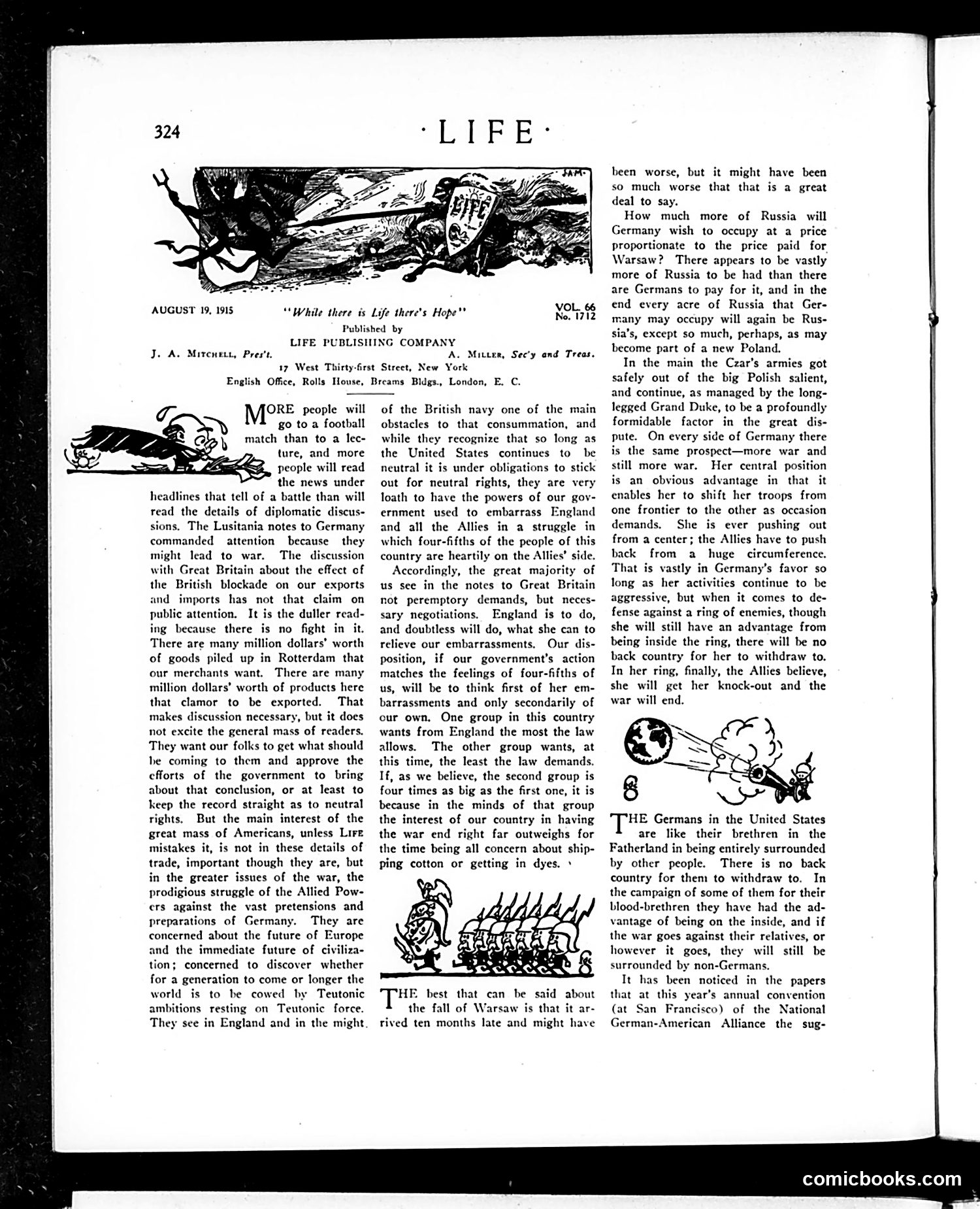
This *Life* magazine editorial from August 1915 addresses American public opinion during WWI. The text argues that most Americans (roughly four-fifths) sympathize with the Allied cause against Germany, despite official U.S. neutrality. It discusses tension between protecting American commercial rights (shipping goods to Britain) and avoiding actions that embarrass Britain and its allies. The second section comments on Russia's fall of Warsaw to German forces—a significant 1915 Eastern Front loss. The author notes the Germans captured it "ten months late" (suggesting it was strategically inevitable) and that vast Russian territory cannot sustain permanent German occupation. The cartoons (though partially visible) appear to satirize the war's scope and Germany's ambitions, using caricature to mock German militarism—characteristic of American anti-German propaganda during this pre-entry period.
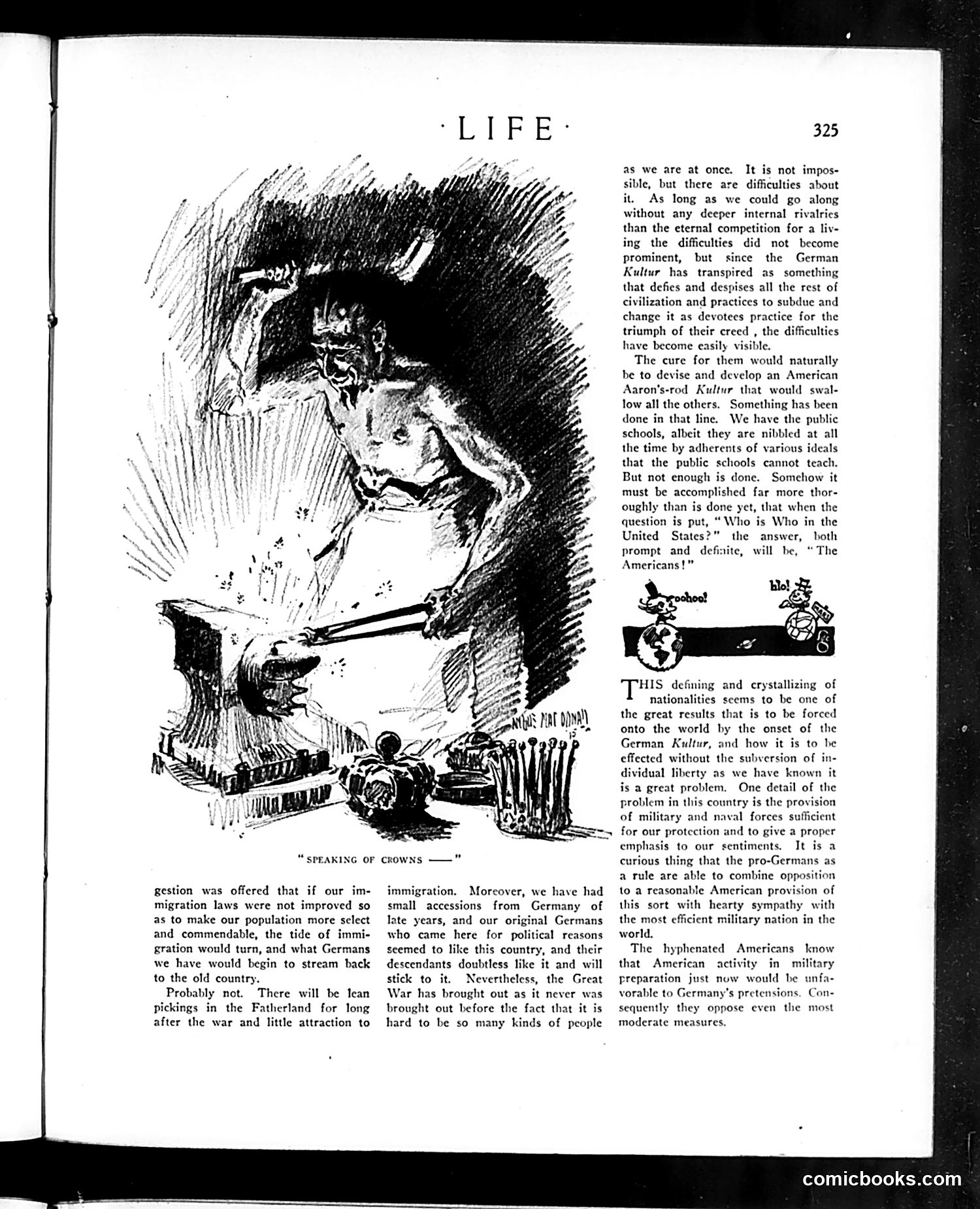
This Life magazine page addresses German-American identity during World War I. The cartoon depicts a grotesque crowned figure (representing German "Kultur"—culture/militarism) dominating smaller figures beneath it, symbolizing Germany's aggressive cultural and military expansion. The accompanying text argues that German immigrants and "hyphenated Americans" (those with divided loyalties) pose a challenge to American unity. The author contends that German Kultur "defies and despises" other civilizations and threatens American cohesion. The satirical point critiques German-Americans and those sympathetic to Germany for simultaneously opposing American military preparation while supporting efficient militarism—exposing what the author sees as their pro-German bias. The cartoon suggests German imperial ambitions threaten American values of individual liberty. This reflects WWI-era anxiety about loyalty and assimilation among immigrant populations.
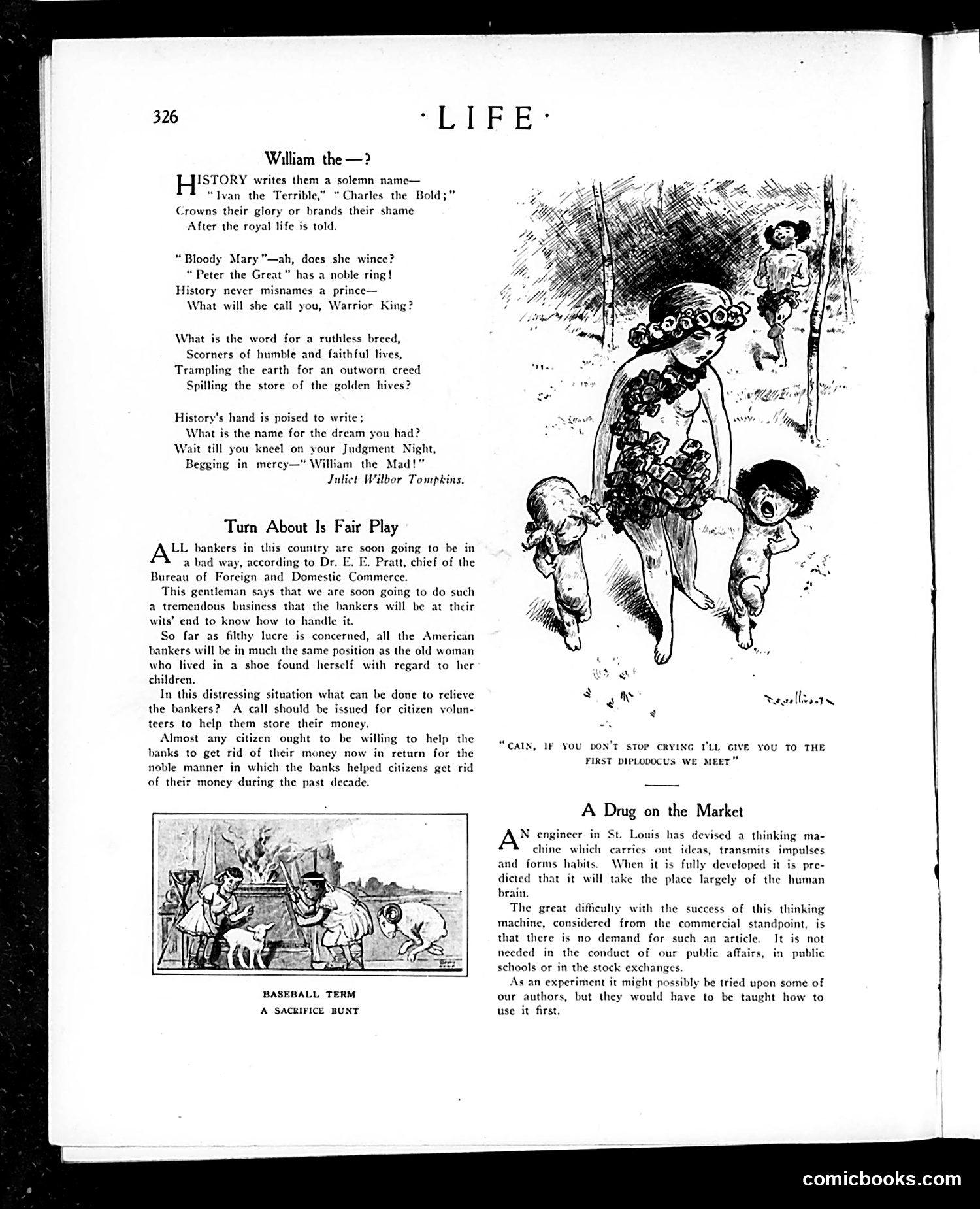
This page from *Life* magazine (undated but early 20th century) contains three satirical pieces: **"William the —?"** attacks a contemporary political figure called "Warrior King" (likely Kaiser Wilhelm II of Germany). The poem mocks him by asking what unflattering epithet history will assign—suggesting "William the Mad" for his ruthless, destructive policies that harm common people. **"Turn About Is Fair Play"** uses dark humor about Depression-era banking. It sardonically proposes that citizens should voluntarily help banks store money, reversing the damage banks inflicted on ordinary people during "the past decade" (the 1920s financial collapse). **"A Drug on the Market"** ridicules a newly invented "thinking machine" by joking it has no commercial demand—implying it's useless because there's no market for thinking in business, government, schools, or stock exchanges. The final jab suggests even authors would need instruction to use it. The page exemplifies *Life*'s satirical tradition: biting social and political commentary through humor and caricature.
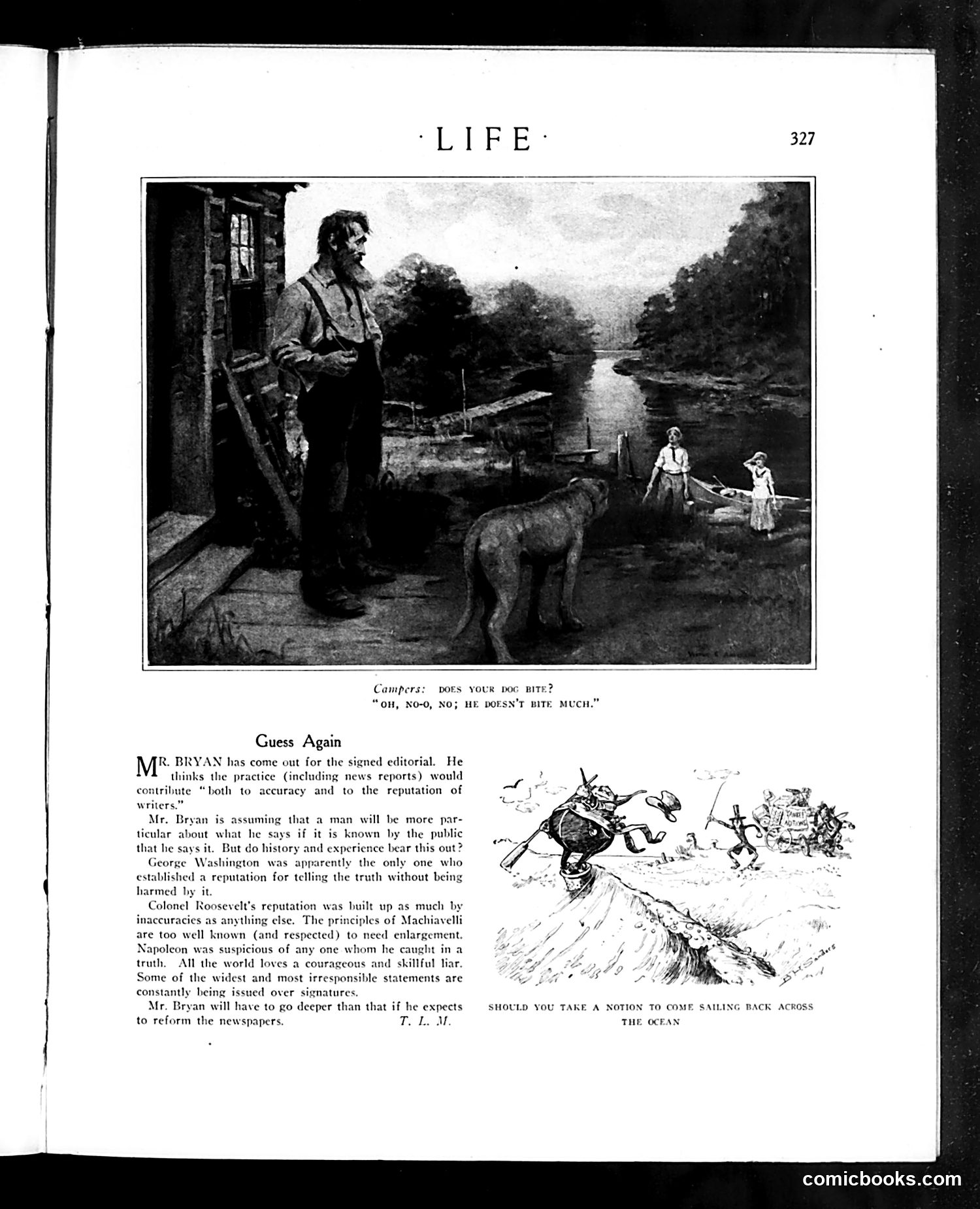
This page satirizes William Jennings Bryan's proposal that newspaper writers and editors sign their work to ensure accuracy and responsibility. **The Main Argument:** The editorial argues Bryan's assumption is naive. The text claims that signing one's name doesn't guarantee truthfulness—history shows otherwise. It cites George Washington as the rare exception who told truth without harm, while Colonel Roosevelt built his reputation through *inaccuracies*, and Napoleon distrusted truthful people. The piece concludes that "the world loves a courageous and skillful liar," so signed editorials won't reform newspapers. **The Cartoons:** The top illustration shows a camper being asked if his dog bites, responding "Oh, no—he doesn't bite much"—a joke about misleading but technically true statements. The bottom cartoon appears to show someone falling into water, captioned about "coming sailing back across the ocean," likely mocking someone (unclear who) in a related satirical context. **The Point:** The satire suggests that requiring signatures won't fix journalistic dishonesty because society rewards skilled deception, not truth-telling.
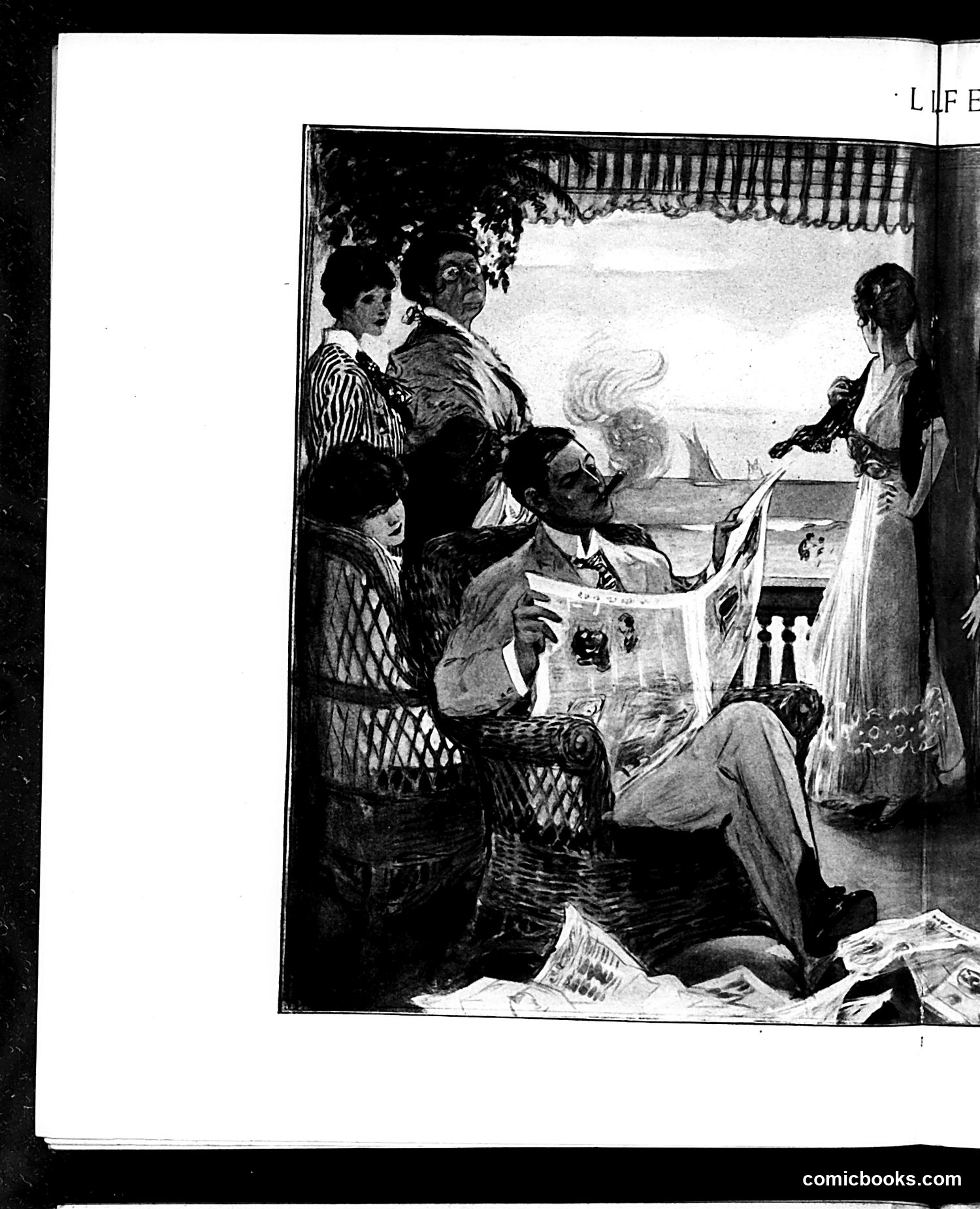
The OCR text is largely illegible, so I'm relying on the image itself. This appears to be an early 20th-century satirical illustration showing a man seated reading a newspaper while surrounded by several women in period dress. The scene is set in what looks like a parlor or sitting room, with a seaside view visible through a window behind them. The satire likely comments on **gender dynamics and newspaper reading habits** of the era. The central figure—presumably a man of leisure or importance—is absorbed in his paper while multiple women attend to him or seek his attention, suggesting commentary on either male self-absorption, female subservience, or the growing prominence of newspapers in daily life. Without clearer text or additional context, the specific political or social critique remains unclear, though it appears to mock contemporary social conventions around class, gender, or media consumption.
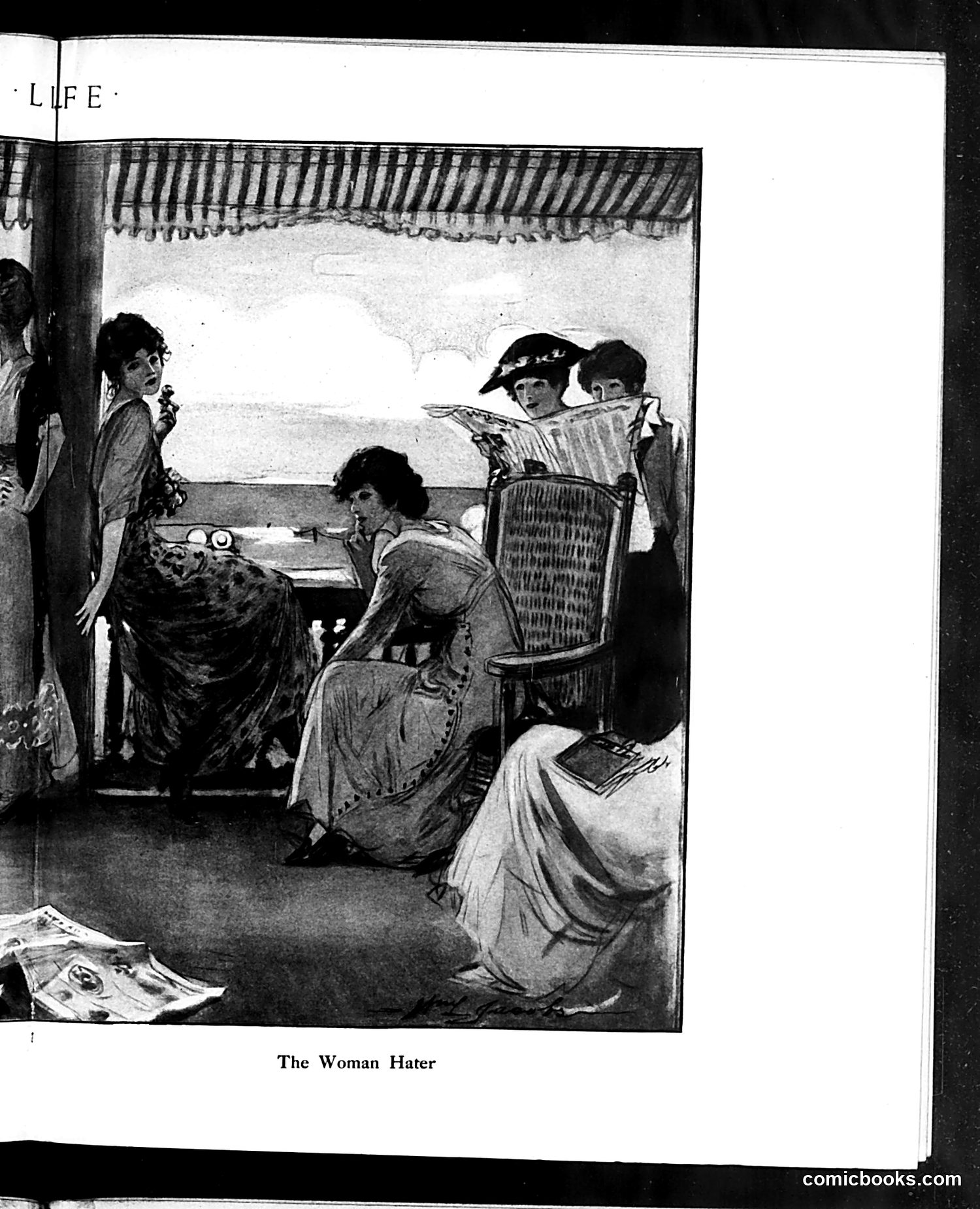
This illustration depicts a domestic interior scene where a man sits reading a newspaper while several women surround him in what appears to be a parlor setting. The caption's title, "The Woman Hater," suggests ironic commentary on male-female social dynamics of the era (likely early 1900s based on the clothing and interior style). The satire likely mocks either: (1) a man's attempt to avoid female company while remaining in a female-dominated domestic space, or (2) misogynistic attitudes of the period shown to be impractical or hypocritical. The women's engaged, social behavior contrasts with the man's isolated newspaper-reading, suggesting he cannot actually escape female interaction despite his supposed aversion to women. The specific social commentary remains somewhat unclear without additional context.
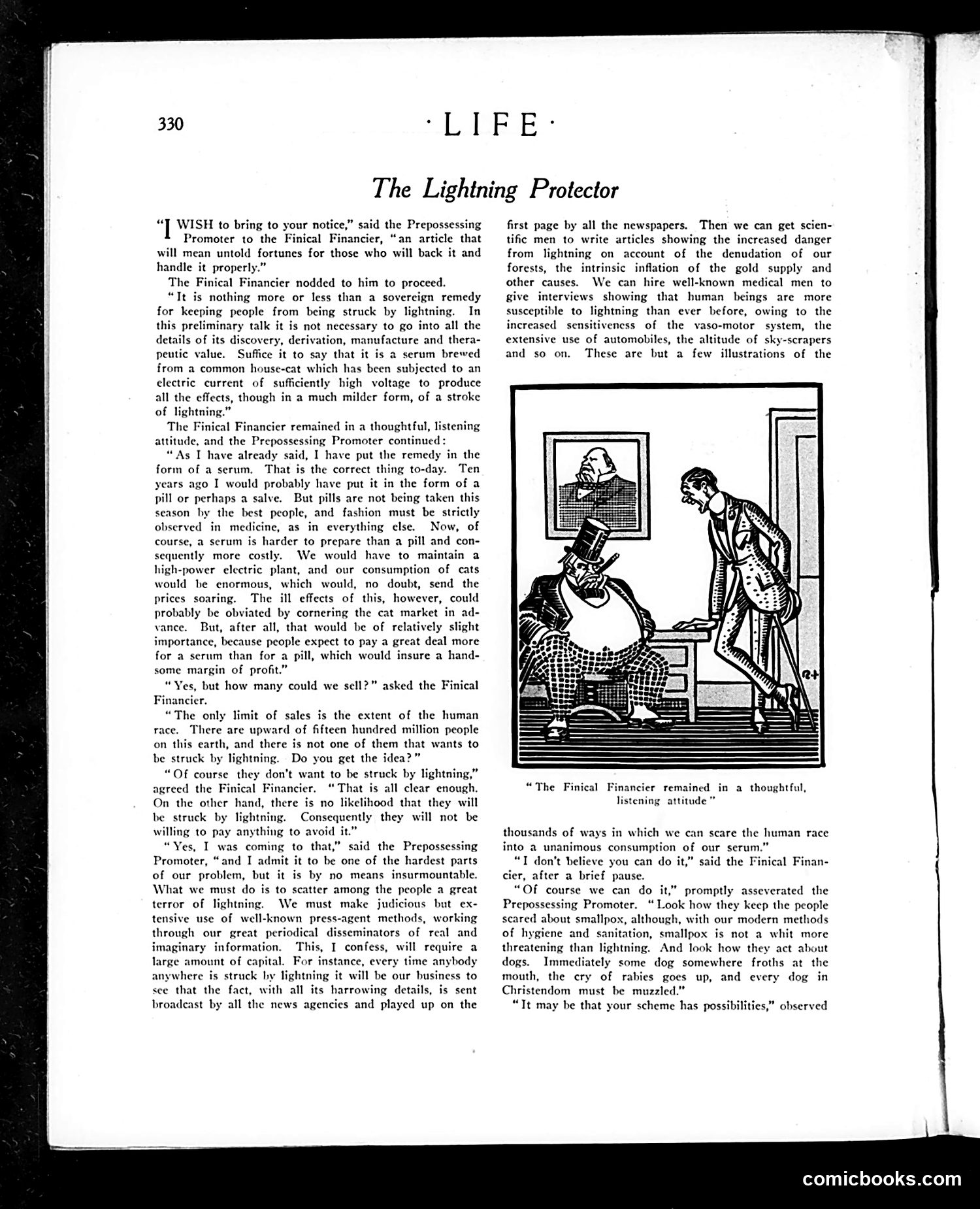
This story satirizes the fraudulent patent medicine industry and manipulative marketing tactics common in early 20th-century America. Two characters—a smooth-talking "Prepossessing Promoter" and a skeptical "Finical Financier"—discuss launching a bogus "lightning protection serum" made from electrocuted house cats. The satire exposes the con: the product is useless (lightning strikes are rare), but the Promoter proposes manufacturing demand through coordinated media manipulation. He'll ensure lightning incidents get sensational newspaper coverage, hire scientists to exaggerate lightning danger, and blame modern conveniences (automobiles, skyscrapers) for increased risk. The joke is the Financier's eventual realization: people won't buy protection against something unlikely to happen. The Promoter's solution—creating artificial panic through press manipulation—mocks both the advertising industry's power and the public's gullibility. Life magazine is critiquing how fear-mongering and manufactured anxiety drive consumer spending on worthless remedies.
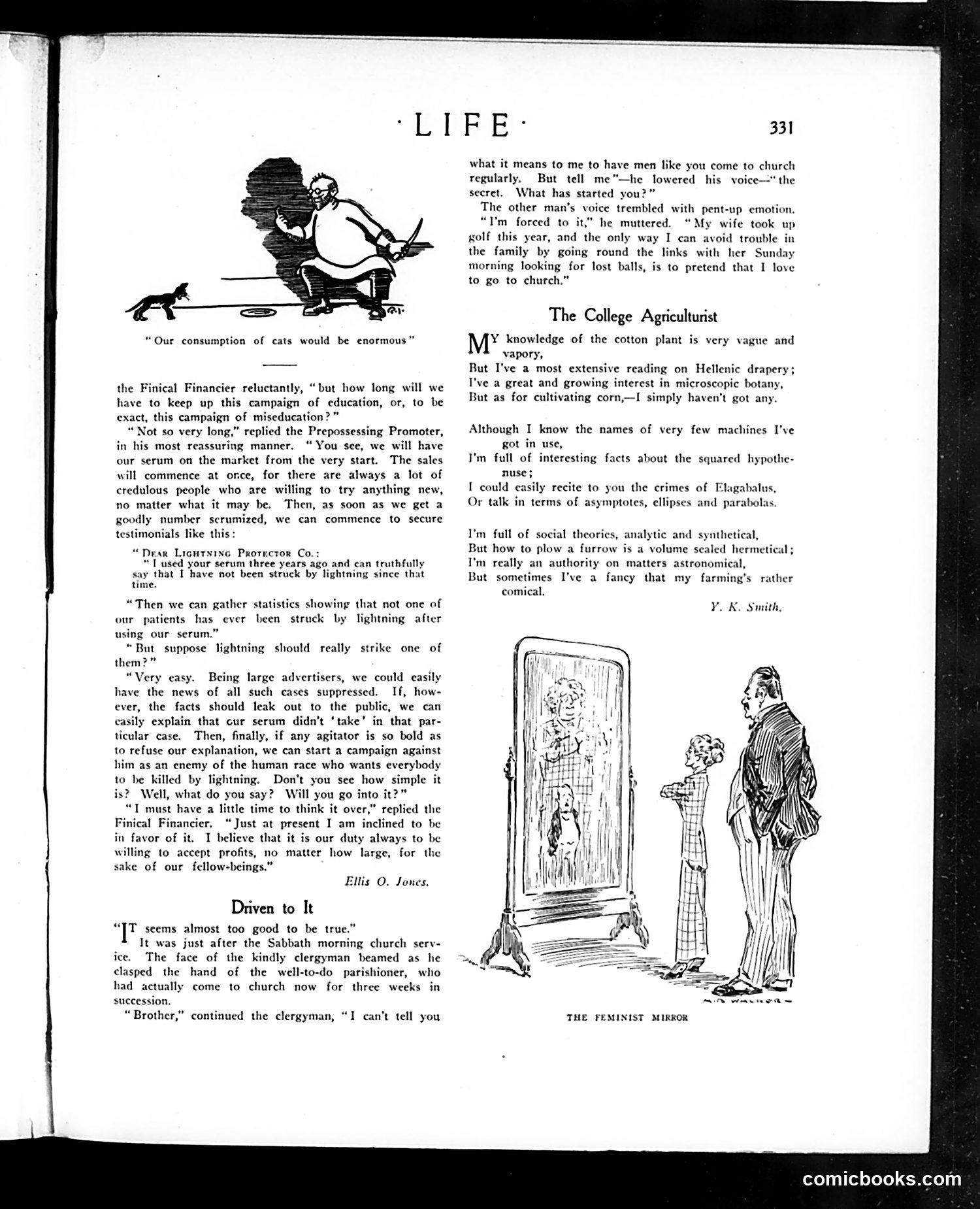
This page contains three distinct satirical pieces mocking various social pretenses: **"Our Consumption of Cats"**: A con artist scheme where a "Prepossessing Promoter" pitches a fake lightning-protection serum to a "Finical Financier." The satire targets fraudulent medical advertising and credulous consumers—the promoter plans to suppress negative evidence and smear critics as enemies of humanity. It's a biting critique of turn-of-century patent medicine scams. **"Driven to It"**: A husband admits he only attends church to escape his wife's new golf obsession on Sundays. The joke satirizes both religious hypocrisy and the emerging leisure culture of wealthy women taking up golf—presenting it as something so consuming it drives men to desperate measures. **"The College Agriculturist"**: A poem mocking educated men who study classical humanities and theoretical mathematics but are utterly useless at actual farming. It skewers impractical academic knowledge divorced from practical utility. The illustration "The Feminist Mirror" shows a woman examining herself—likely commenting on vanity or self-absorption.
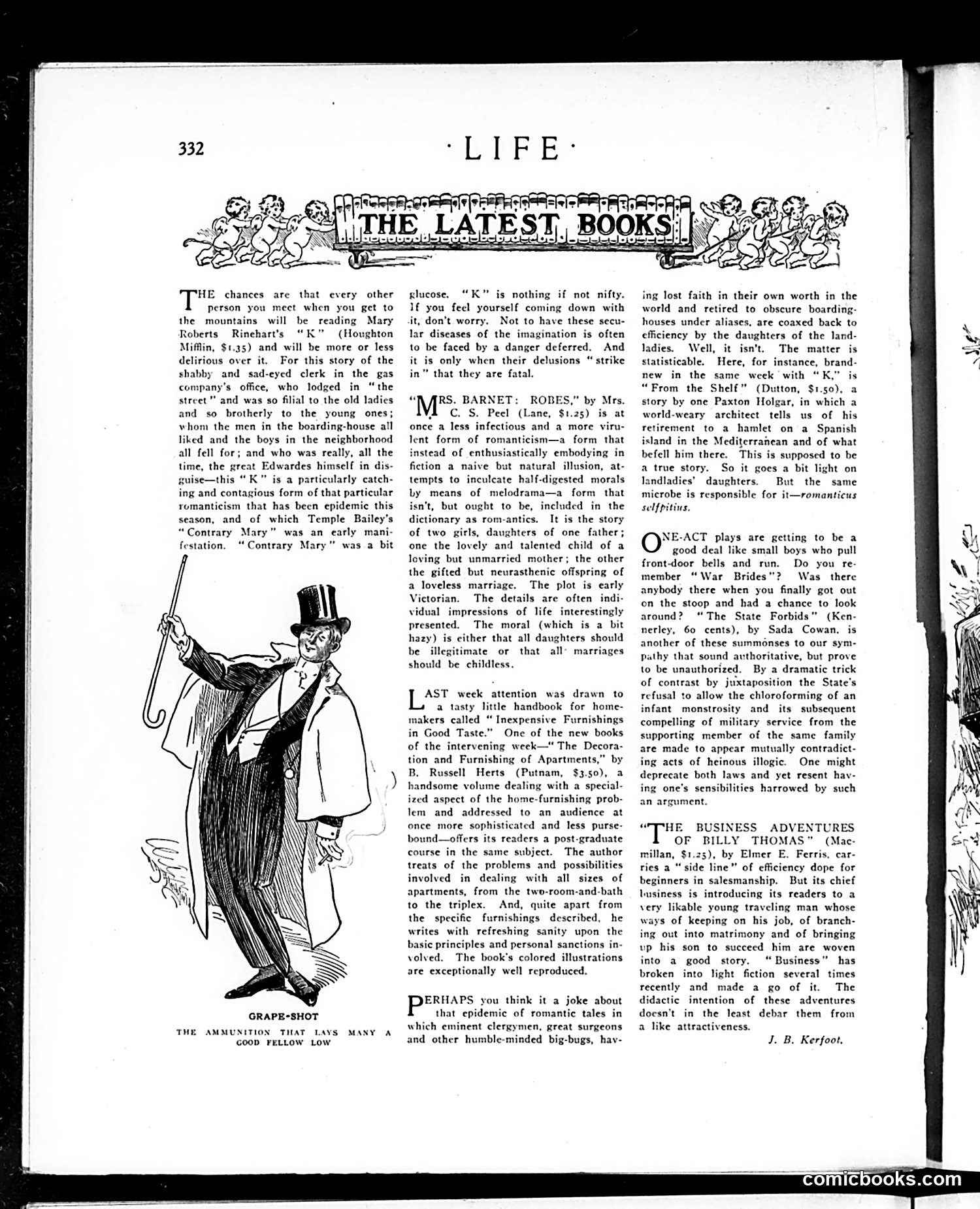
This page from *Life* magazine reviews recent popular novels, with particular focus on what the critic calls an "epidemic of romantic tales." The cartoon—labeled "GRAPE-SHOT"—depicts a well-dressed man being shot, illustrating the metaphor that sentimental romance novels are "ammunition that lays many a good fellow low." The critic identifies a specific literary trend: stories where accomplished men (clerks, architects, surgeons, clergymen) abandon their careers, hide in boarding houses or remote locations under aliases, and are ultimately "rescued" by young women—particularly landladies' daughters. Examples cited include Mary Roberts Rinehart's *"K"* and *"From the Shelf"* by Paxton Holgar. The satire targets both the implausibility of these plots and their apparent contagious appeal to readers. The critic treats this romanticized male failure-to-redemption formula as a genuine social phenomenon worthy of mockery, suggesting it reflects broader anxieties about masculinity and purpose in this era.
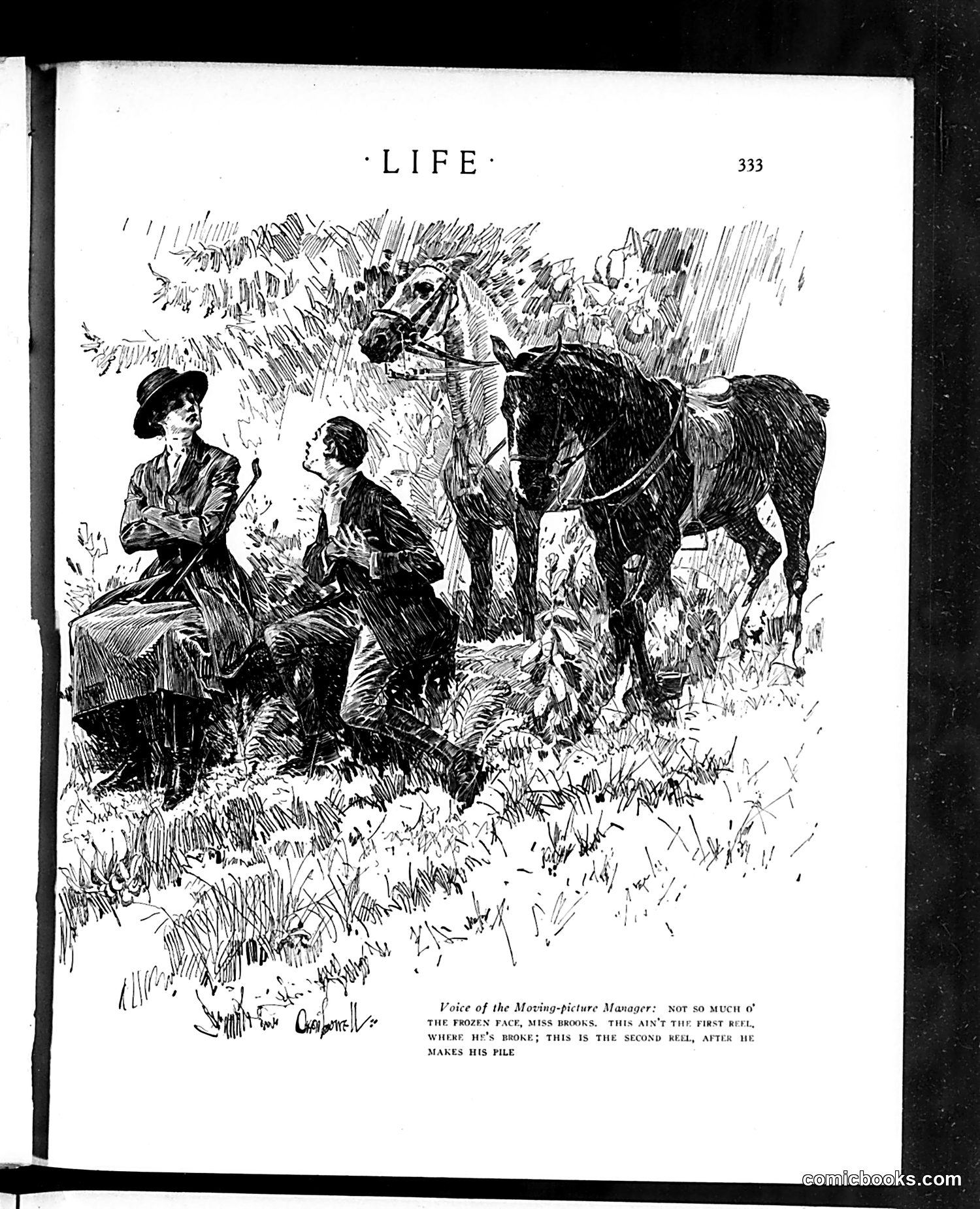
This is a satirical cartoon about early silent film cinema. The scene depicts a moving-picture manager criticizing an actress named Miss Brooks for her "frozen face" performance. The caption explains he's discussing a film narrative where a character breaks financially ("where he's broke") in the first reel, then recovers ("makes his pile") in the second reel. The satire targets the melodramatic conventions of silent films—particularly the exaggerated, static facial expressions actors were forced to use without dialogue. The manager's complaint reflects contemporary criticism of silent film acting as wooden and unconvincing compared to stage performance. This page satirizes both the film industry's growing prominence and the artistic debates surrounding this emerging medium in early 20th-century America.
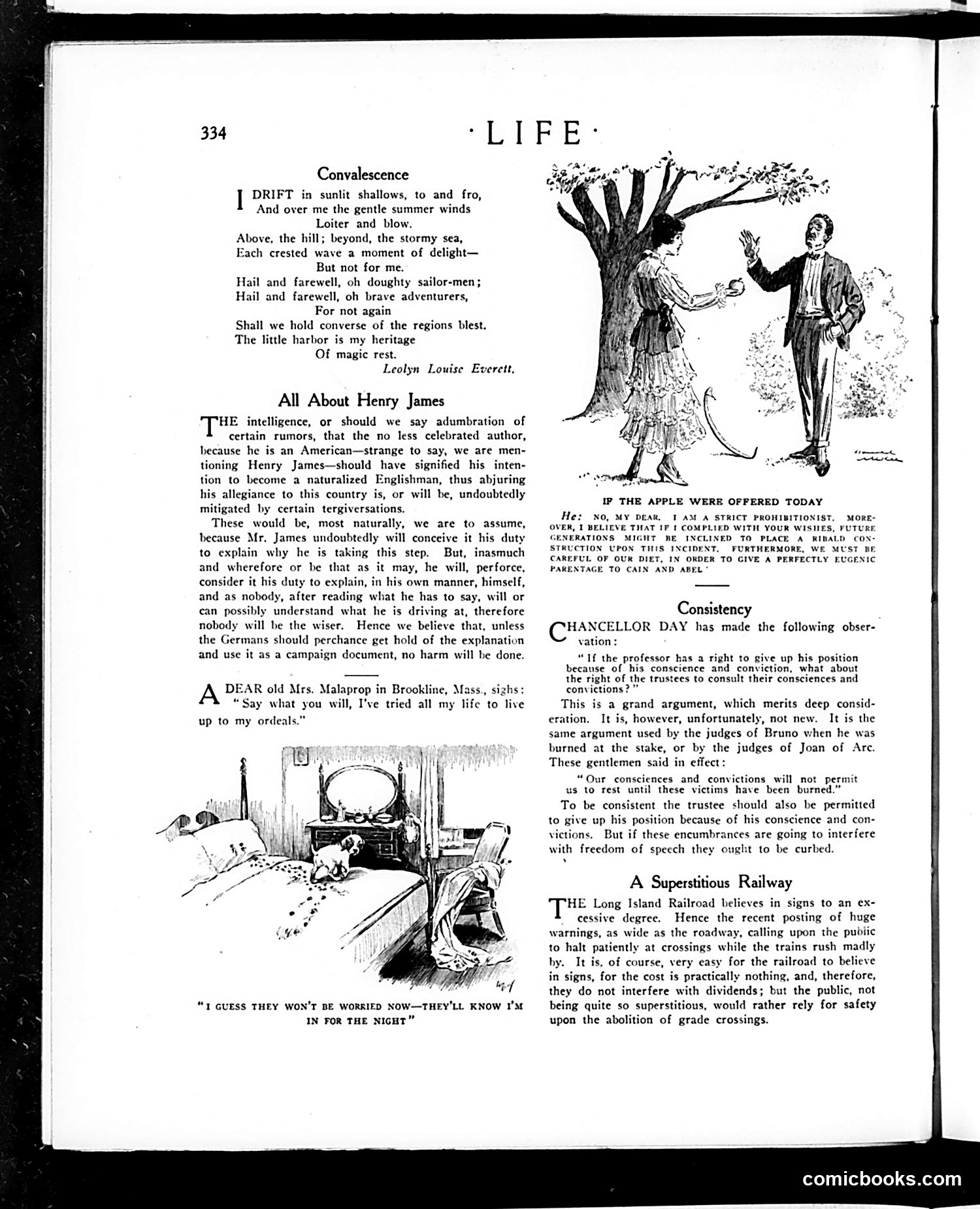
This page contains several satirical pieces mocking contemporary figures and institutions: **"All About Henry James"** mocks the American author's reported intention to become a British citizen. The satire suggests James's explanation will be so convoluted and incomprehensible that "nobody will be the wiser"—a jab at his notoriously dense prose style. The piece implies his defection is inconsequential unless Germany uses it propagandistically. **The cartoon labeled "If the Apple Were Offered Today"** depicts a modern man rejecting temptation through pseudo-intellectual arguments about prohibition and eugenics—satirizing contemporary self-righteousness disguised as principled restraint. **"Consistency"** critiques academic freedom debates, comparing trustees who restrict professors' speech to historical inquisitors who burned heretics. It argues that conscience shouldn't excuse silencing free speech. **"A Superstitious Railway"** mocks the Long Island Railroad for posting warning signs rather than actually eliminating dangerous grade crossings—criticizing performative safety theater over genuine reform. The page overall targets intellectual pretension, moral hypocrisy, and institutional evasion.
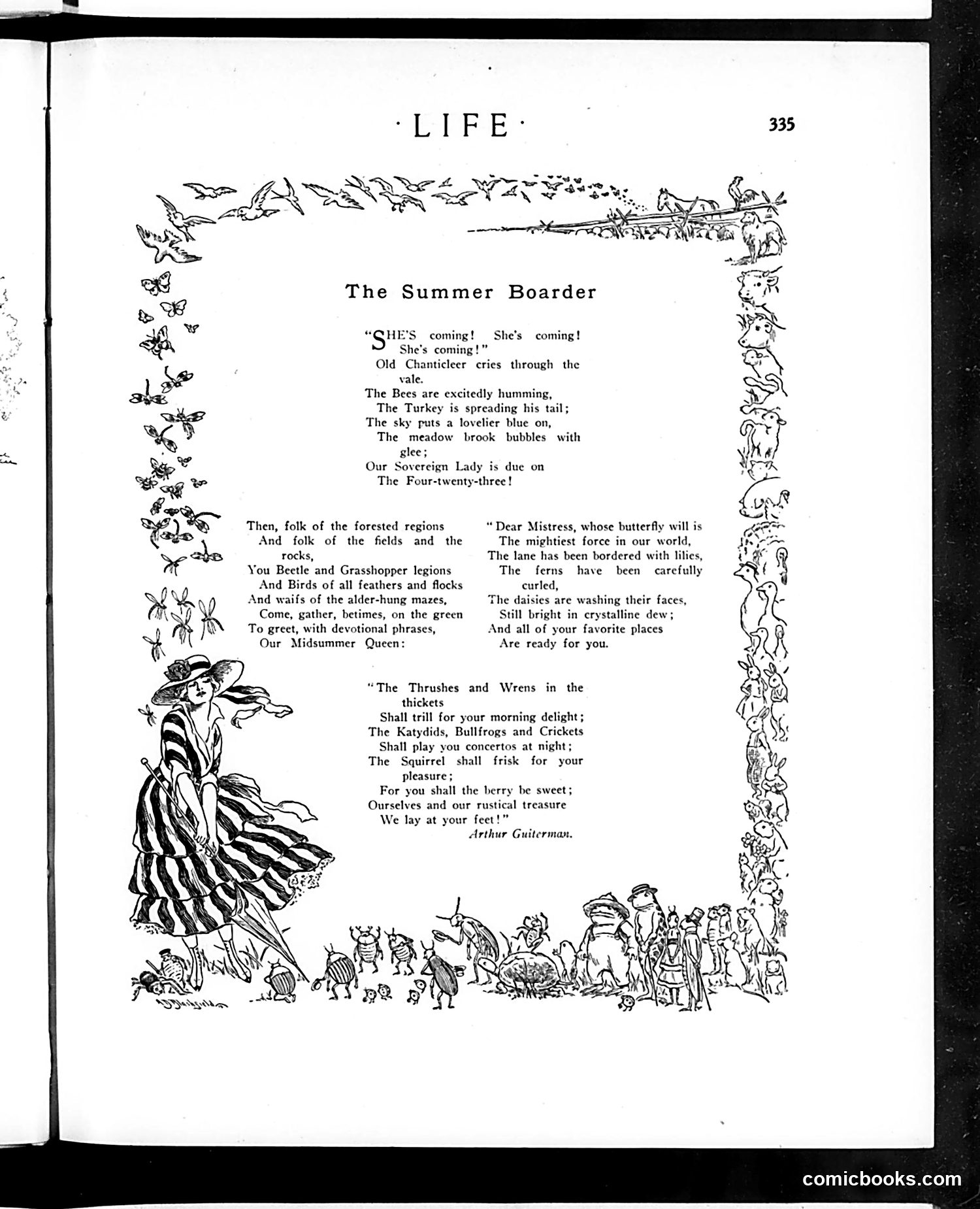
This is a whimsical poem-and-illustration piece celebrating the arrival of a wealthy female summer visitor to a rural area. The "Summer Boarder"—a woman of means who rents lodging in the countryside during warm months—is treated as visiting royalty by the local community and nature itself. The satire targets the social dynamics of early 20th-century leisure culture: rural folk eagerly anticipate the money such visitors bring, deferentially greeting her as "Sovereign Lady" and "Midsummer Queen." Even animals and landscape elements are anthropomorphized as preparing elaborate welcomes. The illustration shows a fashionably dressed woman in a striped dress, surrounded by anthropomorphic creatures and people bowing. The joke lies in the exaggerated deference shown to someone who is essentially a temporary tourist, and the romanticized rural setting that locals have carefully curated for her entertainment and comfort.
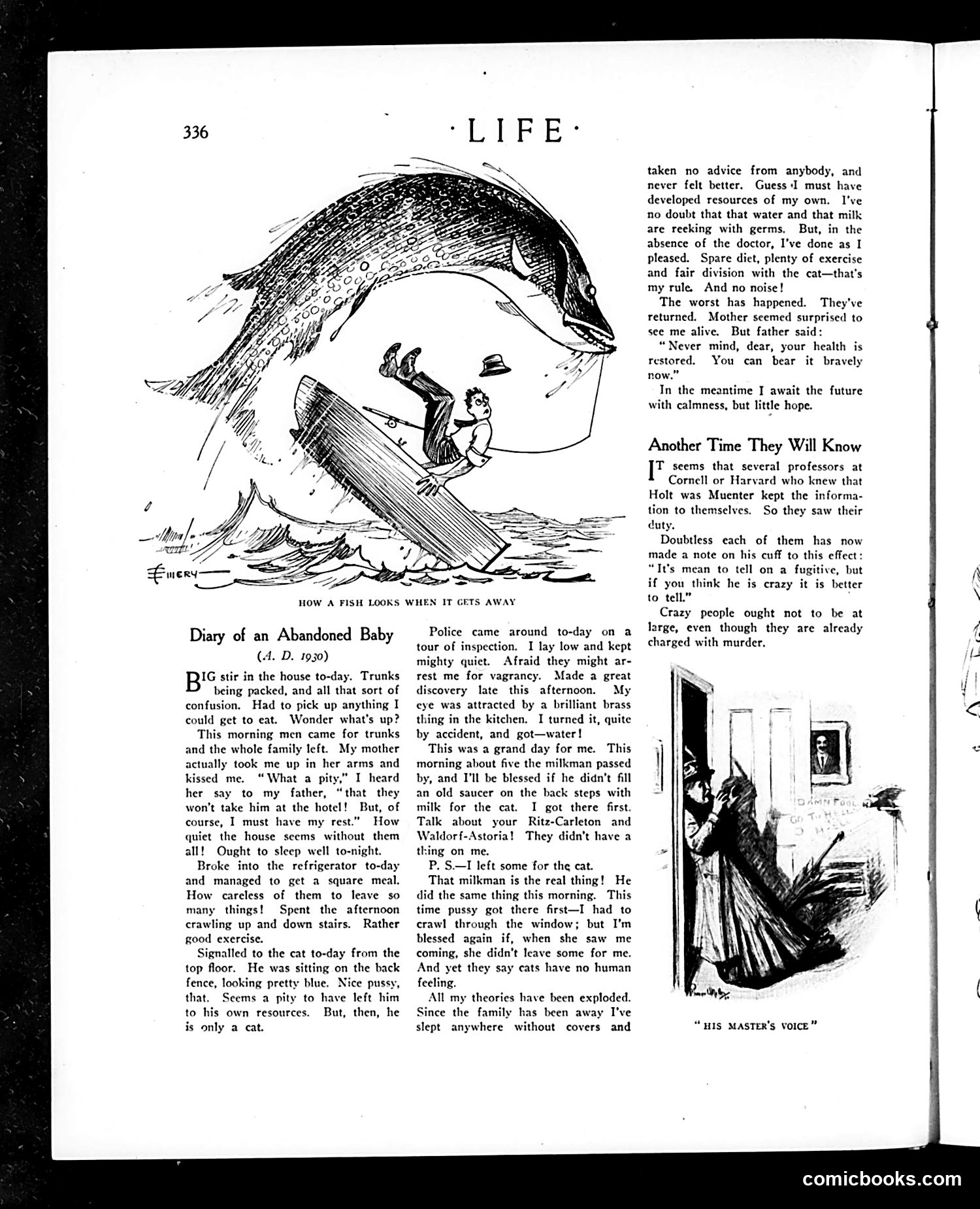
## Main Cartoon: "How a Fish Looks When It Gets Away" The illustration shows a large fish escaping from a small figure on a log, humorously depicting the fisherman's perspective of loss. ## "Diary of an Abandoned Baby" This satirical piece presents a baby's first-person account of being left behind when parents vacation at a hotel that doesn't allow children (a common 1930s practice). The satire critiques parental neglect and overprotective child-rearing norms. The baby thrives without supervision—discovering water from the tap, sharing milk with a compassionate milkman and the family cat—contradicting contemporary medical advice about germs and constant oversight. The dark humor lies in the parents' surprise the child survived, and the child's dread upon their return. ## "Another Time They Will Know" This brief item references "Holt" and "Muenter" (appears to reference a fugitive case), criticizing professors at Cornell or Harvard for remaining silent about knowing a wanted person's whereabouts, wrestling with competing moral obligations regarding fugitives versus dangerous individuals.
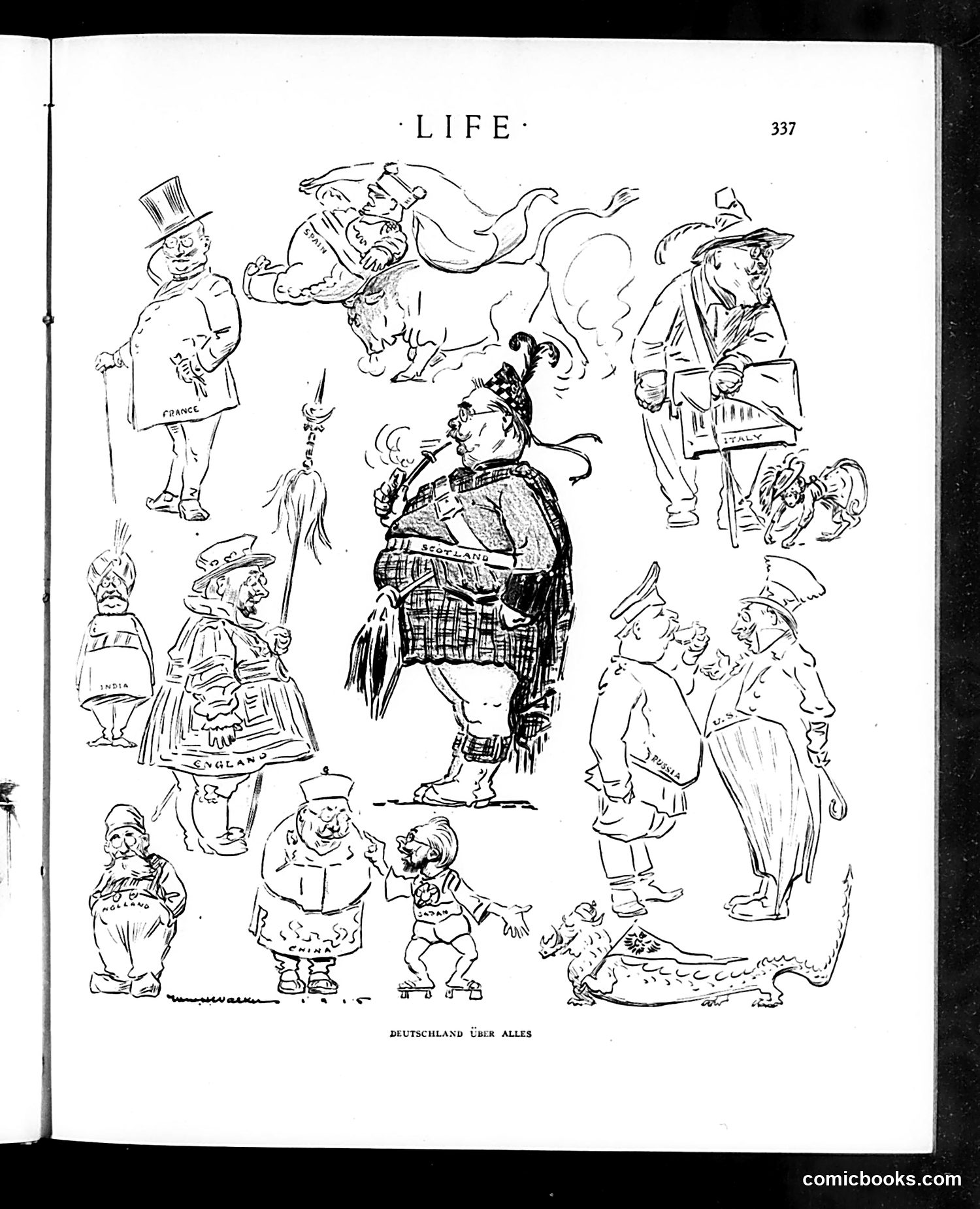
This is a German-language political cartoon satirizing German imperialism and militarism. The central figure is a caricatured German military leader or Kaiser, depicted as bloated and aggressive, surrounded by various national personifications (France, Italy, India, England labeled on figures). The title "Deutschland Über Alles" ("Germany Above All") references the German national anthem, here used mockingly to critique German expansionist ambitions. The cartoon portrays Germany as a threatening, militaristic power dominating or threatening other nations. The exaggerated physical grotesqueness and the aggressive posturing are typical of early 20th-century satirical commentary on European imperial rivalries, likely responding to German military buildup or aggressive foreign policy of that era.
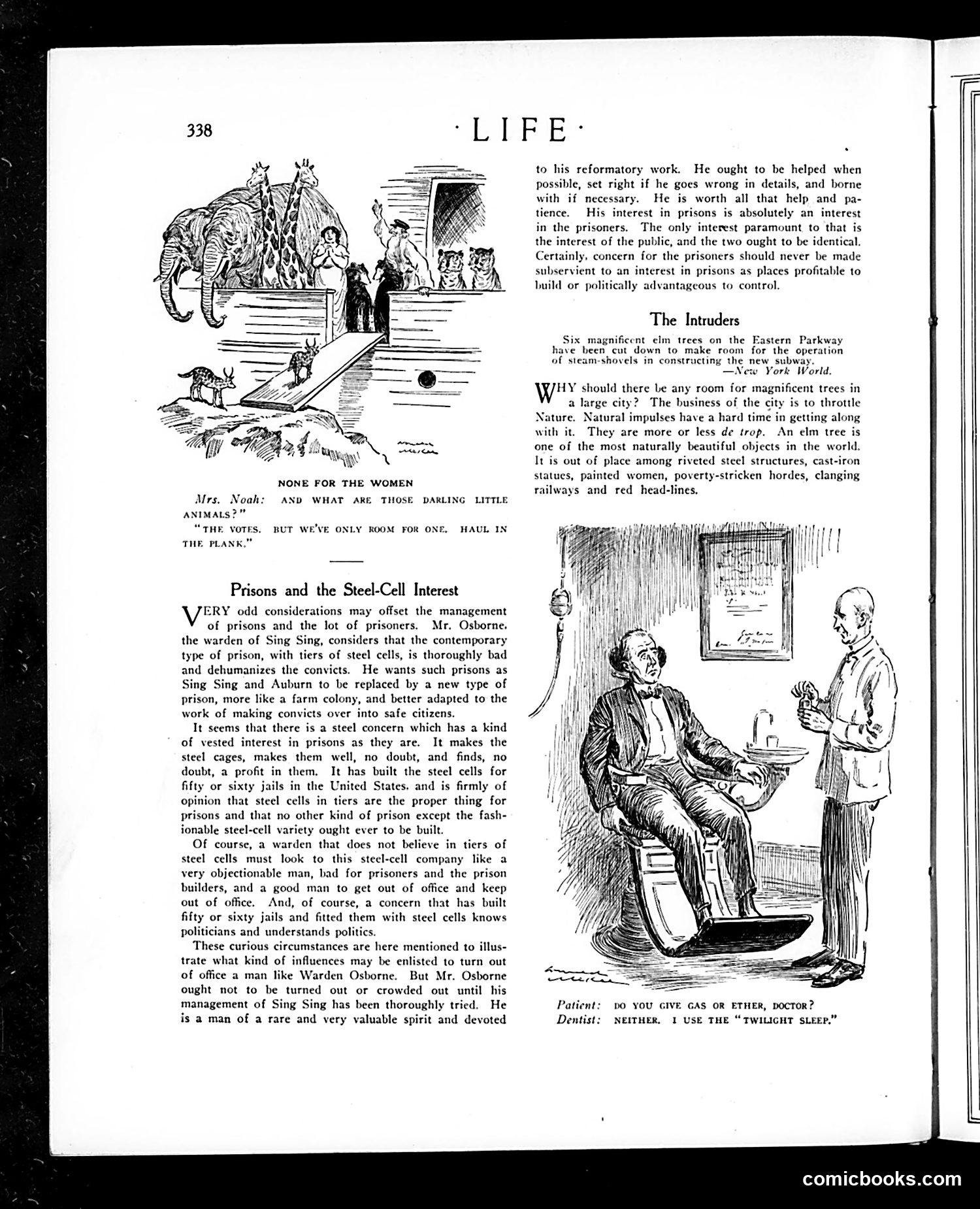
This page contains three distinct satirical pieces: **"None for the Women"** (top cartoon): A Noah's Ark joke mocking women's suffrage. Mrs. Noah asks about "darling little animals," but they're actually votes. The response—"we've only room for one, haul in the plank"—satirizes the exclusion of women from voting rights, suggesting votes (political power) aren't for women. **"Prisons and the Steel-Cell Interest"** (main article): Criticizes corporate influence on prison policy. Warden Osborne of Sing Sing advocates replacing brutal steel-cage prisons with humane farm colonies. The article exposes how a steel company that profits from building prison cells uses political connections to undermine Osborne's reforms—putting corporate profit above prisoner welfare. **"The Intruders"** (right): Mocks urban development destroying nature. Elm trees on Brooklyn's Eastern Parkway were cut down for subway construction. The satire suggests cities inherently throttle nature, treating trees as obstacles rather than valuable. **"Twilight Sleep"** (bottom cartoon): A dental joke about anesthesia alternatives.
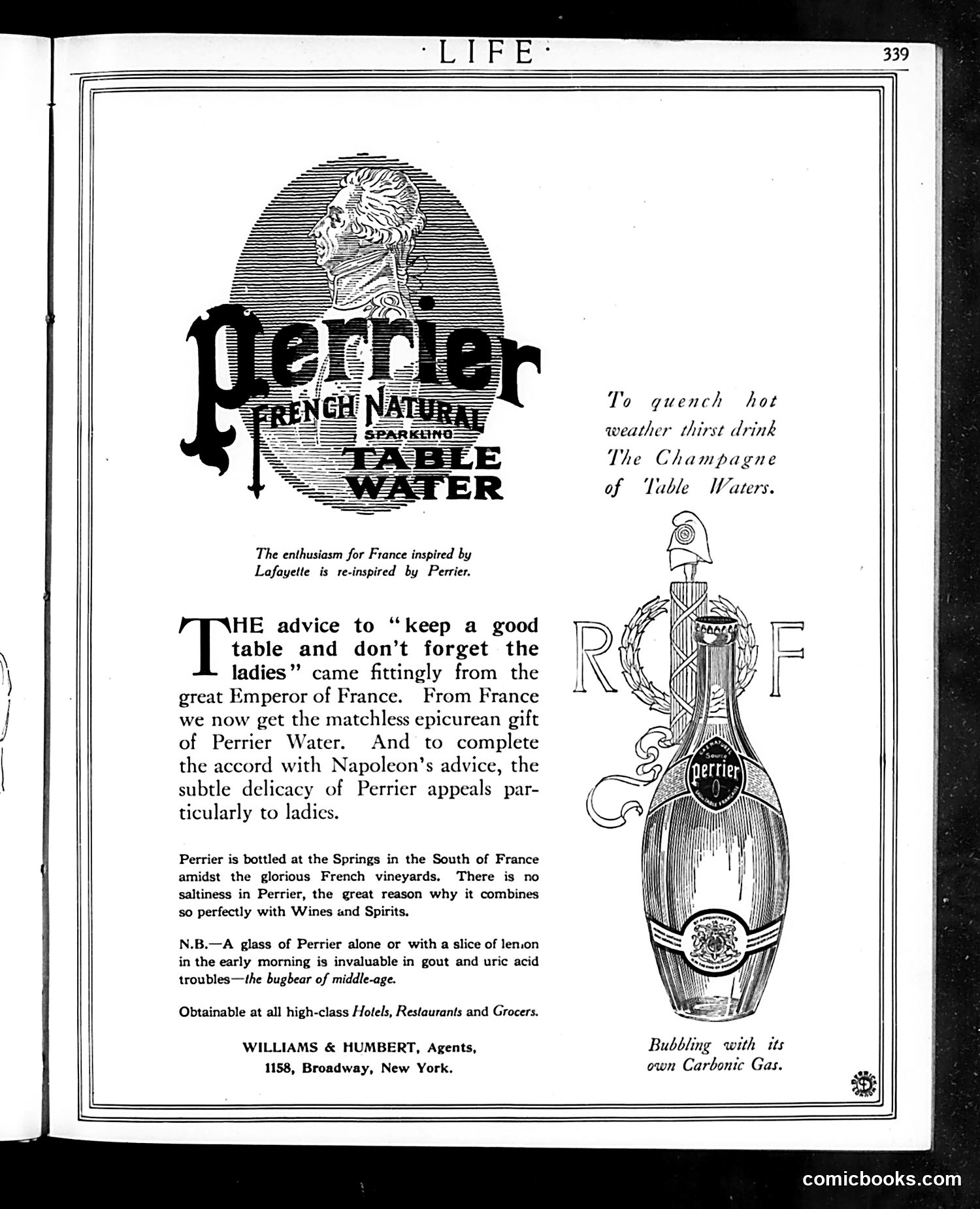
This is primarily a **product advertisement**, not a political cartoon. It markets Perrier sparkling water to American consumers by invoking French prestige and historical figures. The ad references **Napoleon Bonaparte** ("the great Emperor of France") and his famous advice to "keep a good table and don't forget the ladies"—positioning Perrier as a sophisticated French product that appeals especially to women. The comparison to **Lafayette** invokes Franco-American friendship and cultural admiration. The imagery shows a classical bust (likely Napoleon or a generic French dignitary) and an ornate Perrier bottle. The copy emphasizes that Perrier contains no saltiness, making it ideal for mixing with wines and spirits at refined social gatherings. A medical note claims the water aids "gout and uric acid troubles"—common complaints among affluent middle-aged men—adding health credibility to the luxury product pitch. The distributor, Williams & Humbert, was based in New York.
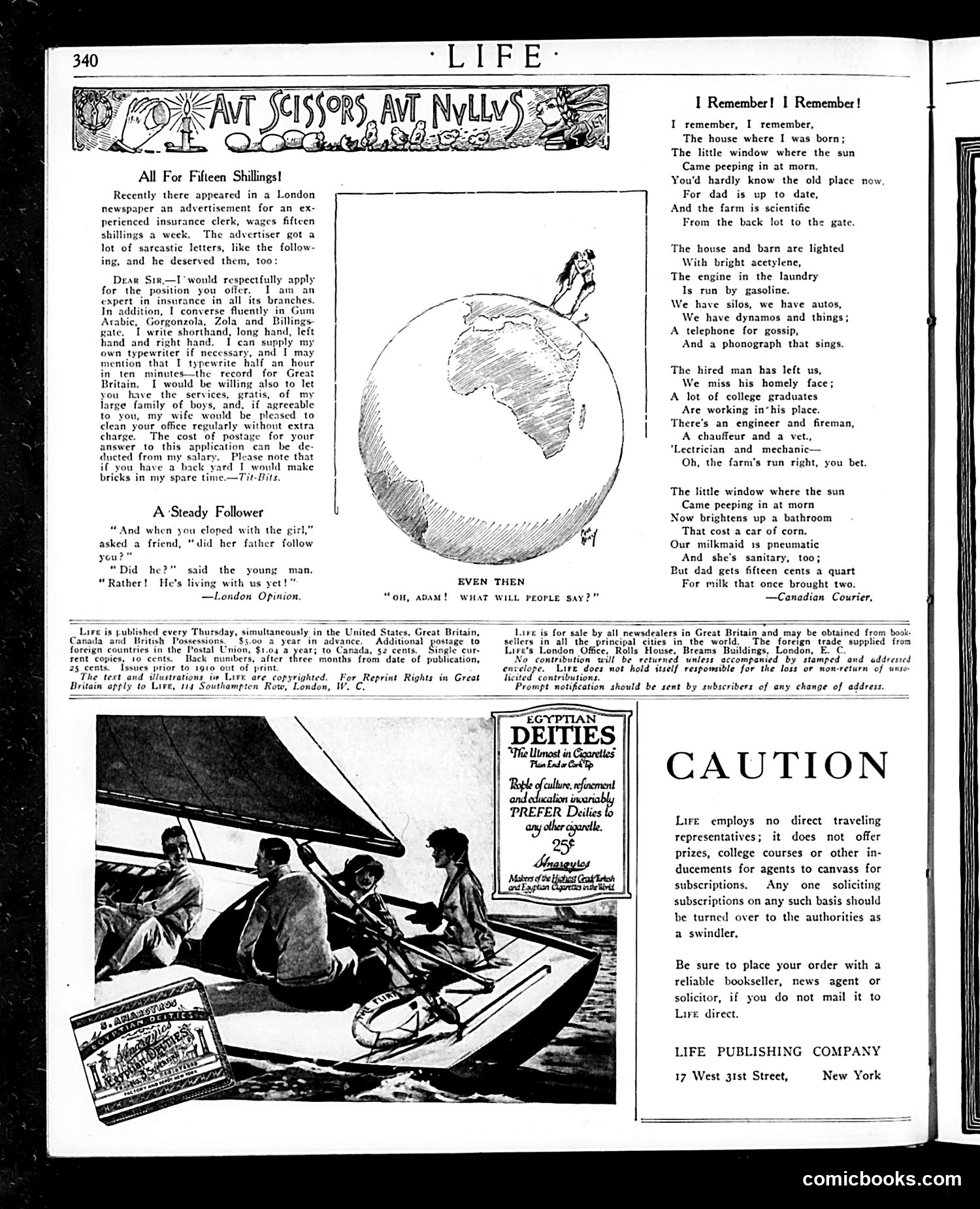
This page contains two distinct satirical pieces: **"All For Fifteen Shillings!"** mocks a London job advertisement offering extremely low wages (15 shillings weekly). The sarcastic response letter parodies the absurd qualifications desperate applicants might claim—fluency in nonsense subjects, impossible typing speeds, offering free family labor, and even making bricks in spare time. The satire targets exploitative employment practices and the desperation of job-seekers during economically difficult times. **"I Remember! I Remember!"** is a parody of Wordsworth's nostalgic poem, but inverts it to mock agricultural "progress." While the original celebrates rural childhood, this version sarcastically catalogs modern farm mechanization—acetylene lights, gasoline engines, automobiles, telephones, phonographs—that has replaced traditional labor and community. The ironic conclusion: despite all this technological advancement, the farmer now receives *less* money per quart of milk than previously. Both pieces use satire to critique economic conditions: inadequate wages and the questionable benefits of industrial "progress" in farming.
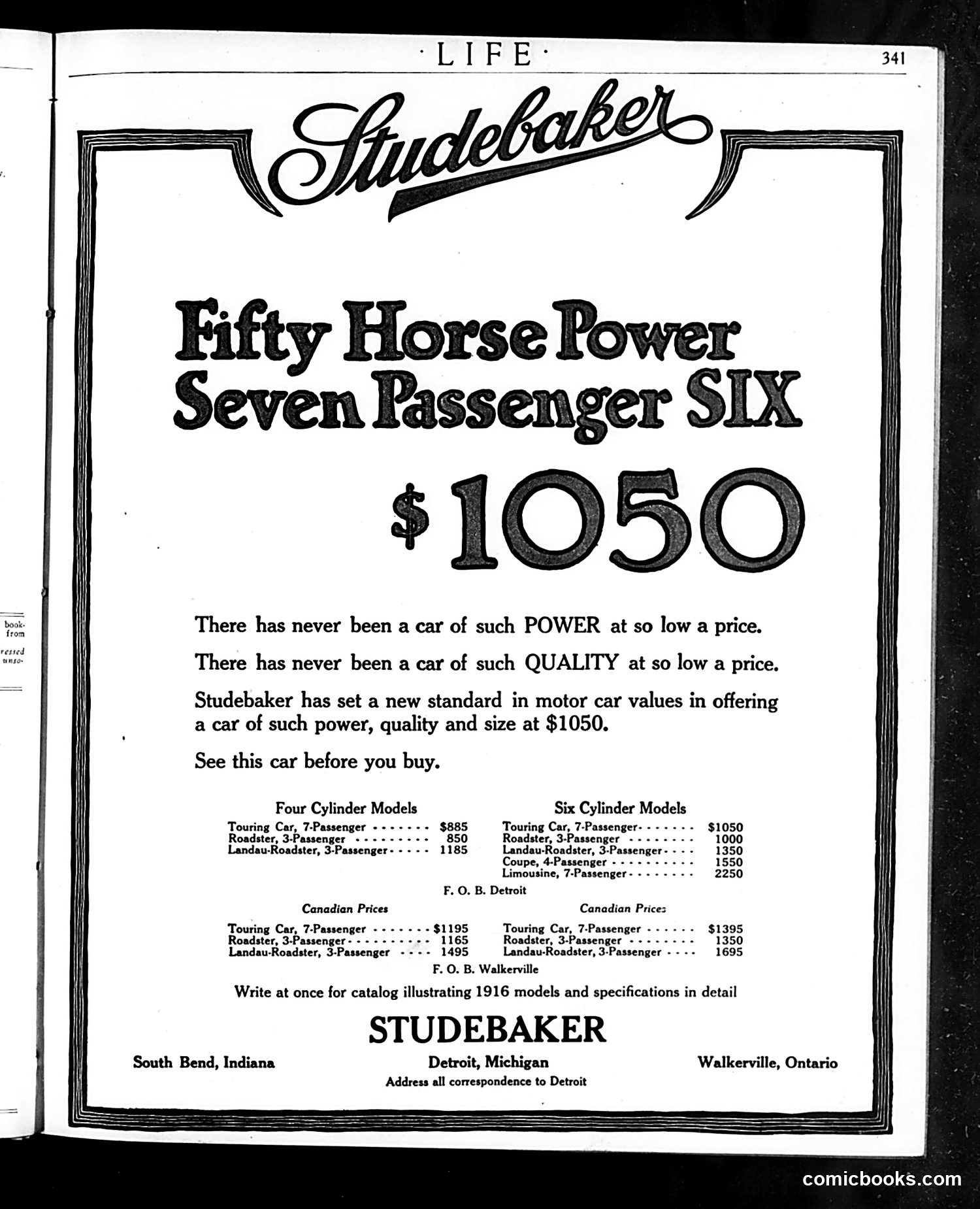
This is primarily a **Studebaker automobile advertisement**, not political satire or commentary. It appears in *Life* magazine (page 341), which by this era carried substantial advertising alongside its humor content. The ad promotes Studebaker's 1916 "Six Cylinder" model at $1,050—positioned as revolutionary value: "never been a car of such POWER at so low a price" and "never been a car of such QUALITY at so low a price." The repeated emphasis suggests Studebaker is claiming to disrupt the automotive market with an affordable, powerful vehicle. The ad lists multiple body styles (Touring Car, Roadster, Coupe, Limousine) in both U.S. and Canadian pricing, with manufacturing locations in South Bend, Indiana; Detroit, Michigan; and Walkerville, Ontario. There is no cartoon, caricature, or satirical content visible—this is straightforward commercial messaging targeting early-automobile buyers during the rapid expansion of motorcar ownership in America.
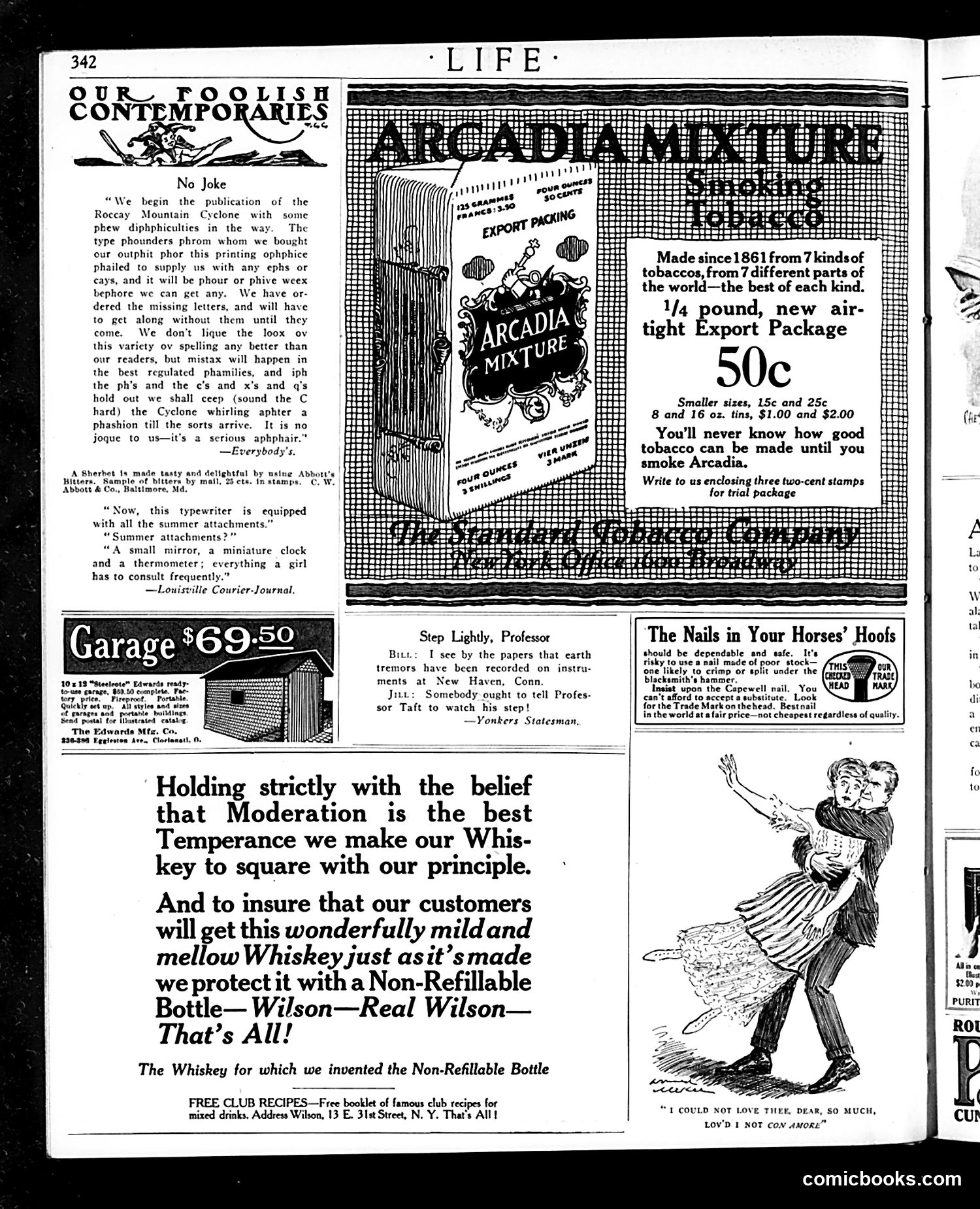
This page is primarily **advertising** with brief humorous sections interspersed. The main content includes: - A joke about the "Rocky Mountain Cyclone" newspaper's printing problems (missing letters), satirizing frontier publishing incompetence - A quip about Professor Taft needing to "watch his step" (likely referencing William Howard Taft, president 1909-1913, in a pun about earthquake tremors recorded at Yale) - A cartoon showing a man and woman dancing, captioned with a play on Lovelace's poem about love and alcohol ("Love'd I not Con amore") The advertisements promote Arcadia tobacco, Wilson whiskey (emphasizing its non-refillable bottle to prevent adulteration), Capewell horseshoe nails, and other products. These ads reflect early 20th-century consumer goods and concerns about product authenticity and safety. The page reflects Life's format as a satirical magazine mixing light humor with commercial content.
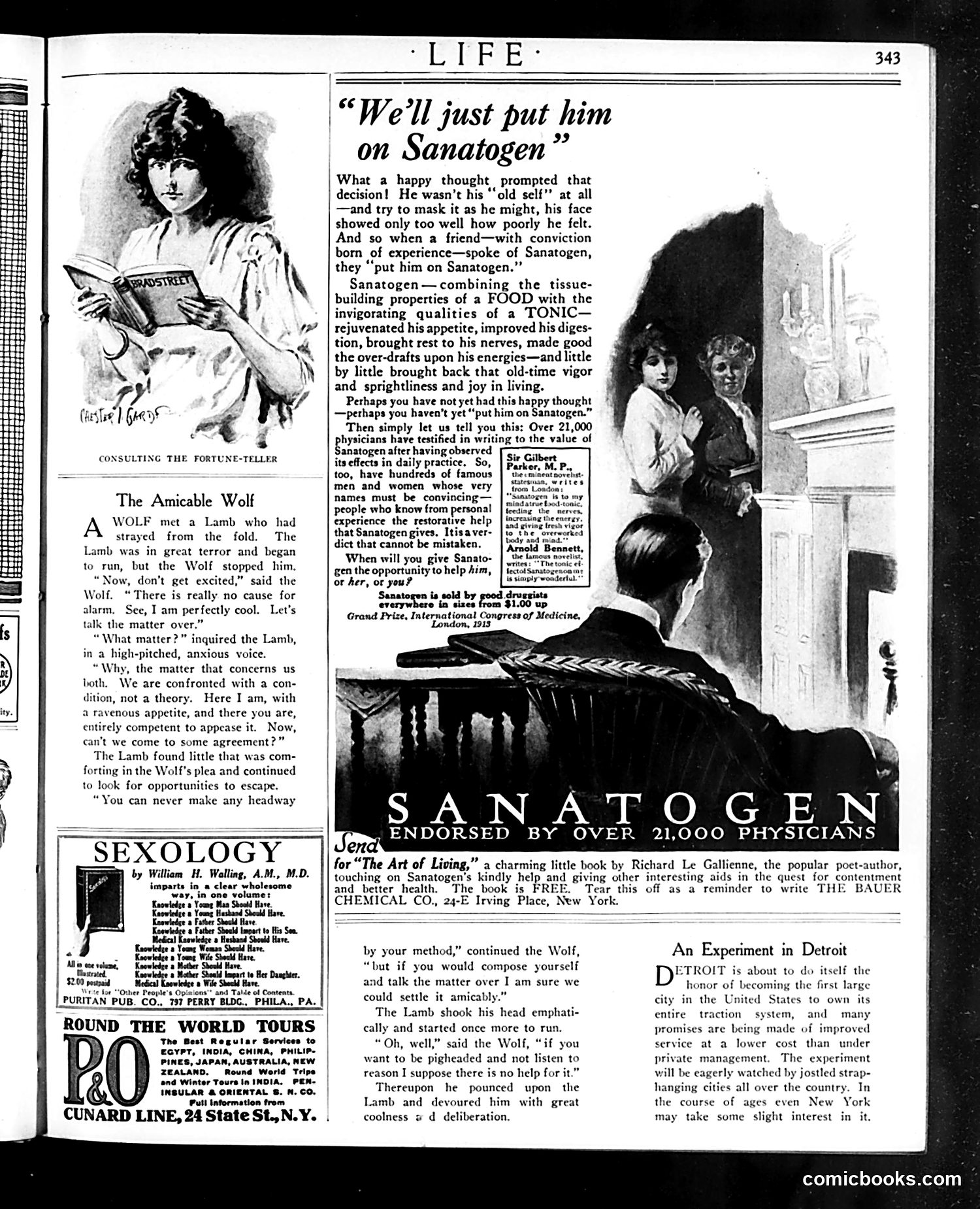
This fable satirizes dishonest negotiation and false civility masking predatory intent. The Wolf represents a powerful actor (likely capital, management, or an aggressor state) who uses calm, reasonable rhetoric to disarm the Lamb (the vulnerable—workers, the poor, or a weaker nation). The Wolf claims they can "come to some agreement," but his true goal is exploitation and consumption. The joke is that the Wolf's polite reasonableness is entirely performative; when the Lamb refuses to be persuaded, the Wolf simply attacks anyway. The satire critiques how power uses the language of negotiation and mutual benefit to disguise inherently exploitative relationships. The outcome—the Lamb's destruction through the Wolf's "coolness and deliberation"—suggests that no genuine compromise exists when one party's fundamental interest is to dominate the other.
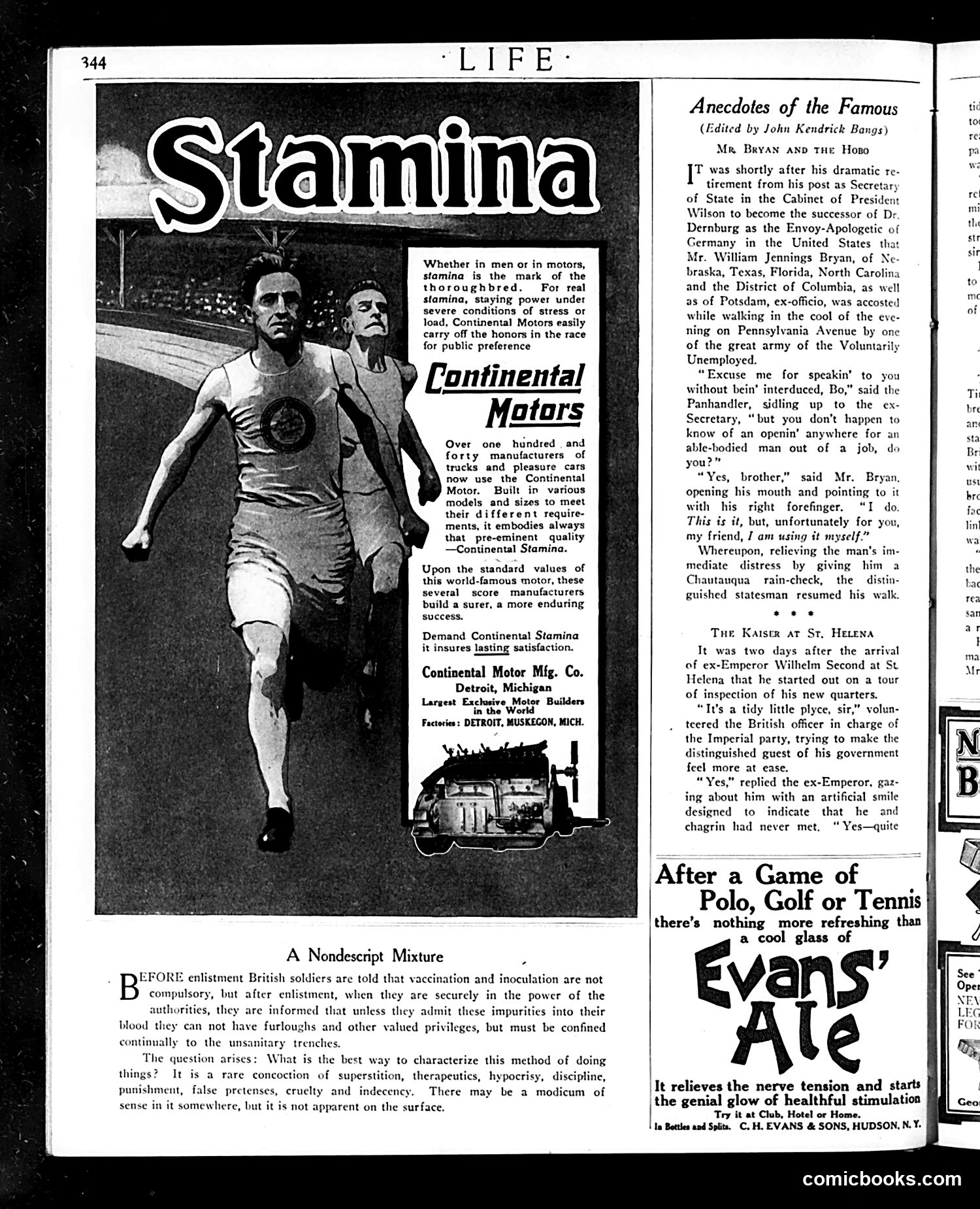
This page contains three satirical anecdotes about famous political figures of the era: 1. **William Jennings Bryan**: The joke mocks Bryan's reputation as a prolific speaker. A jobless man asks Bryan for employment advice; Bryan points to his mouth, claiming he's "using it myself"—a dig at his constant speechmaking and perceived verbosity. 2. **Kaiser Wilhelm II**: The humor derives from Wilhelm's recent exile to St. Helena (after WWI defeat). A British officer tries politely showing him his modest quarters; Wilhelm responds with forced cheerfulness, suggesting he and "chagrin had never met"—ironic understatement about his humiliation and loss of power. 3. **Military Vaccination**: A serious satire criticizing British Army coercion—soldiers told vaccination is optional before enlistment, then forced to comply afterward or face confinement in unsanitary trenches. The piece condemns this as hypocritical deception. The page also contains advertisements for Continental Motors and Evans' Ale, typical of period magazines.
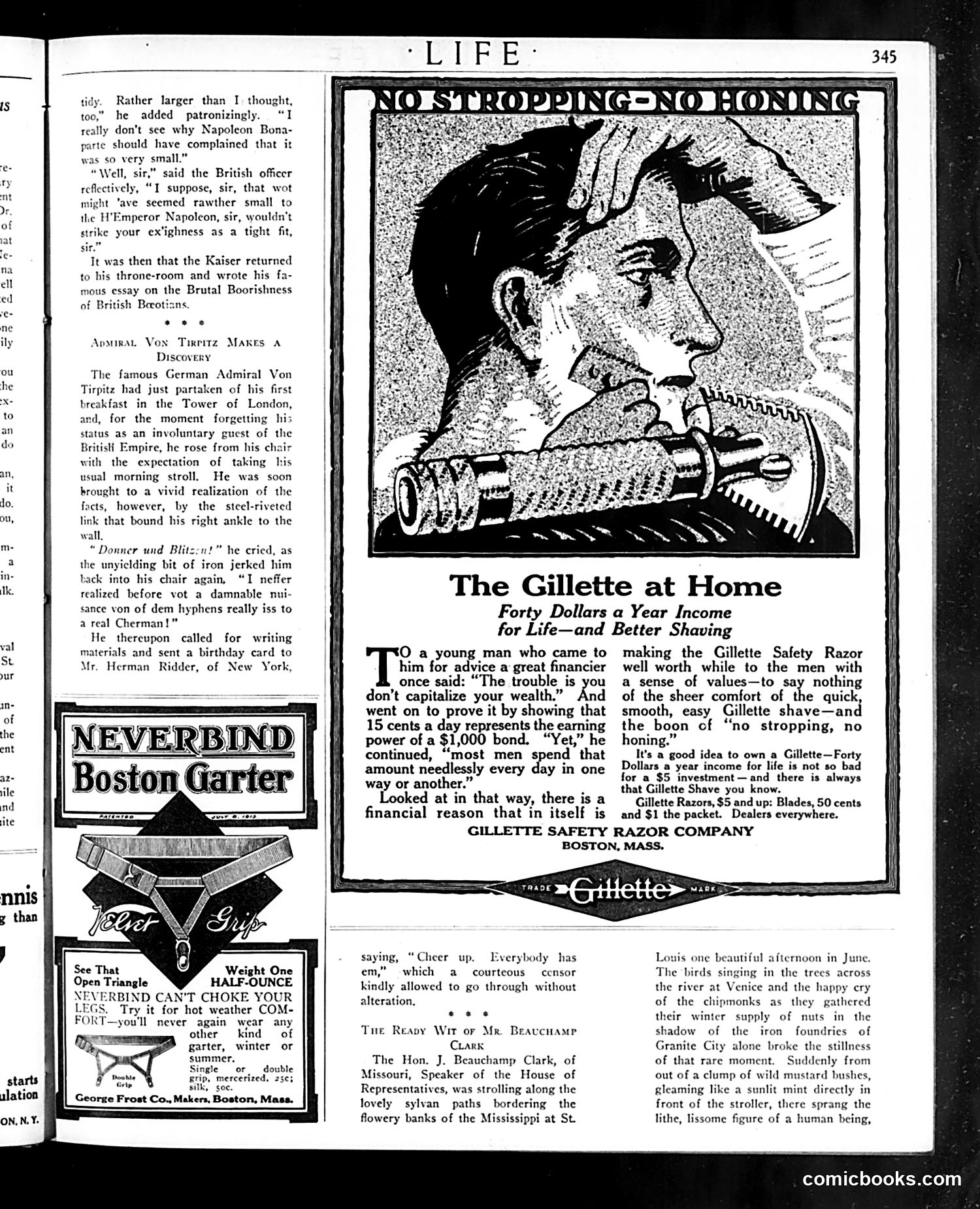
This page contains satirical anecdotes about German military figures during World War I, mocking their pride and circumstances. **The Kaiser and Napoleon anecdote** ridicules the German Kaiser's vanity. A British officer suggests the Kaiser's accommodations (likely a prison or confined space) wouldn't seem small to him as they did to Napoleon—implying the Kaiser is physically smaller or lesser than Napoleon. The Kaiser responds by writing an essay on "British Boorishness," turning his embarrassment into blame-shifting. **The Admiral Von Tirpitz story** portrays the famous German admiral as a prisoner in the Tower of London, comically discovering an ankle shackle during his morning routine. His outburst about "hyphens" being a nuisance appears to be a coded complaint about German compound words, used for comedic effect. The anecdote ends with him sarcastically sending a birthday card to a New York recipient, likely Herman Ridder, a German-American publisher. Both pieces use humor to demean German leadership while celebrating British superiority and control over German prisoners.
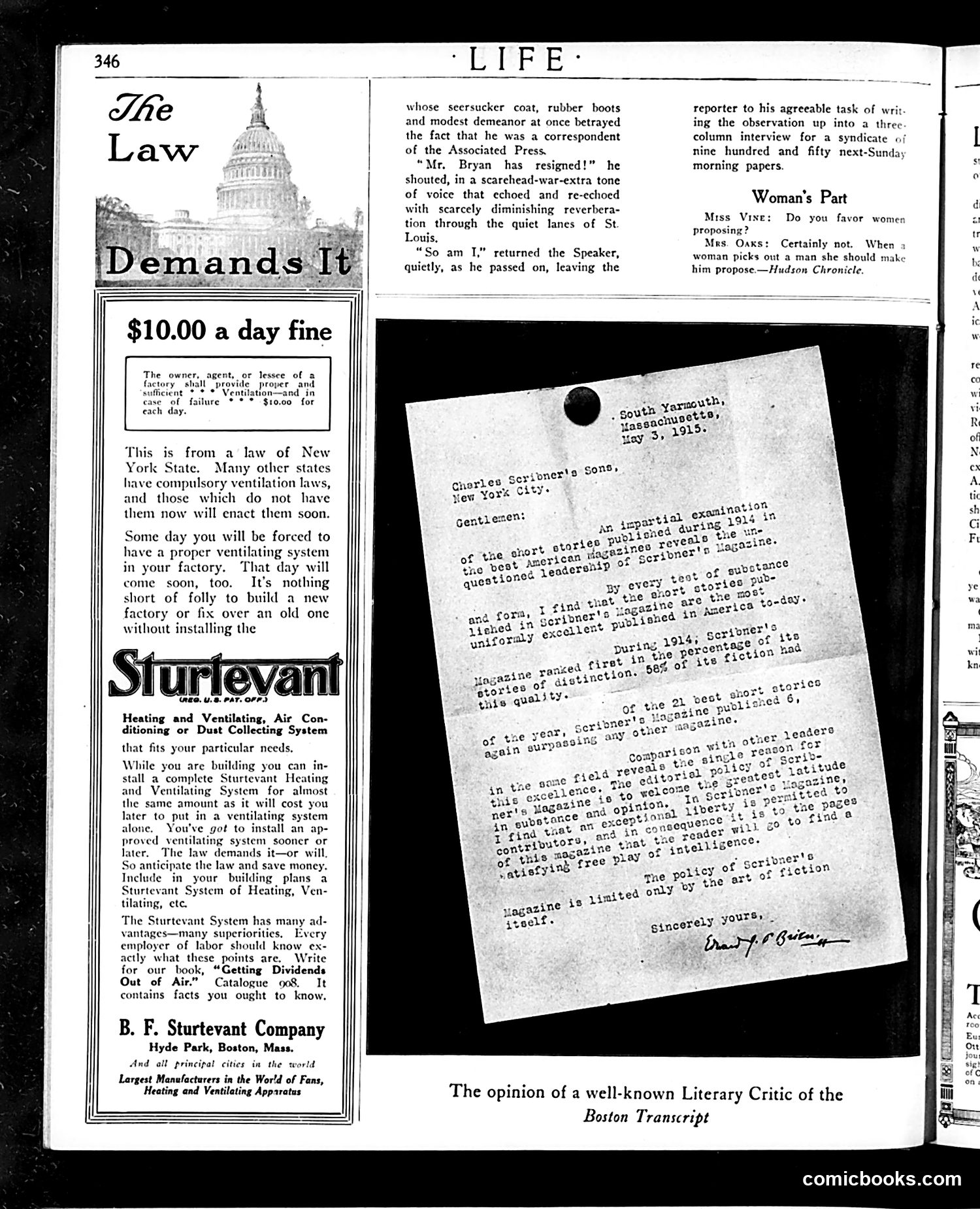
This page combines **advertisements** (left side: Sturtevant ventilation systems) with **satirical humor** (right side). The main cartoon joke references **William Jennings Bryan**, the prominent three-time presidential candidate. A newspaper correspondent rushes through St. Louis shouting that "Mr. Bryan has resigned!" The Speaker of the House (identity unclear from image) replies calmly, "So am I"—a quip suggesting Bryan's political relevance has declined so much that his resignation is meaningless. Below is a "Woman's Part" humor column where Miss Vixe and Mrs. Oaks debate women proposing to men. Mrs. Oaks insists women should *make* men propose rather than propose themselves—typical early 20th-century gender expectations satirized here. The page also features a **letter from a Boston Transcript literary critic** praising Scribner's Magazine, likely part of Life's editorial content rather than a true independent testimonial.
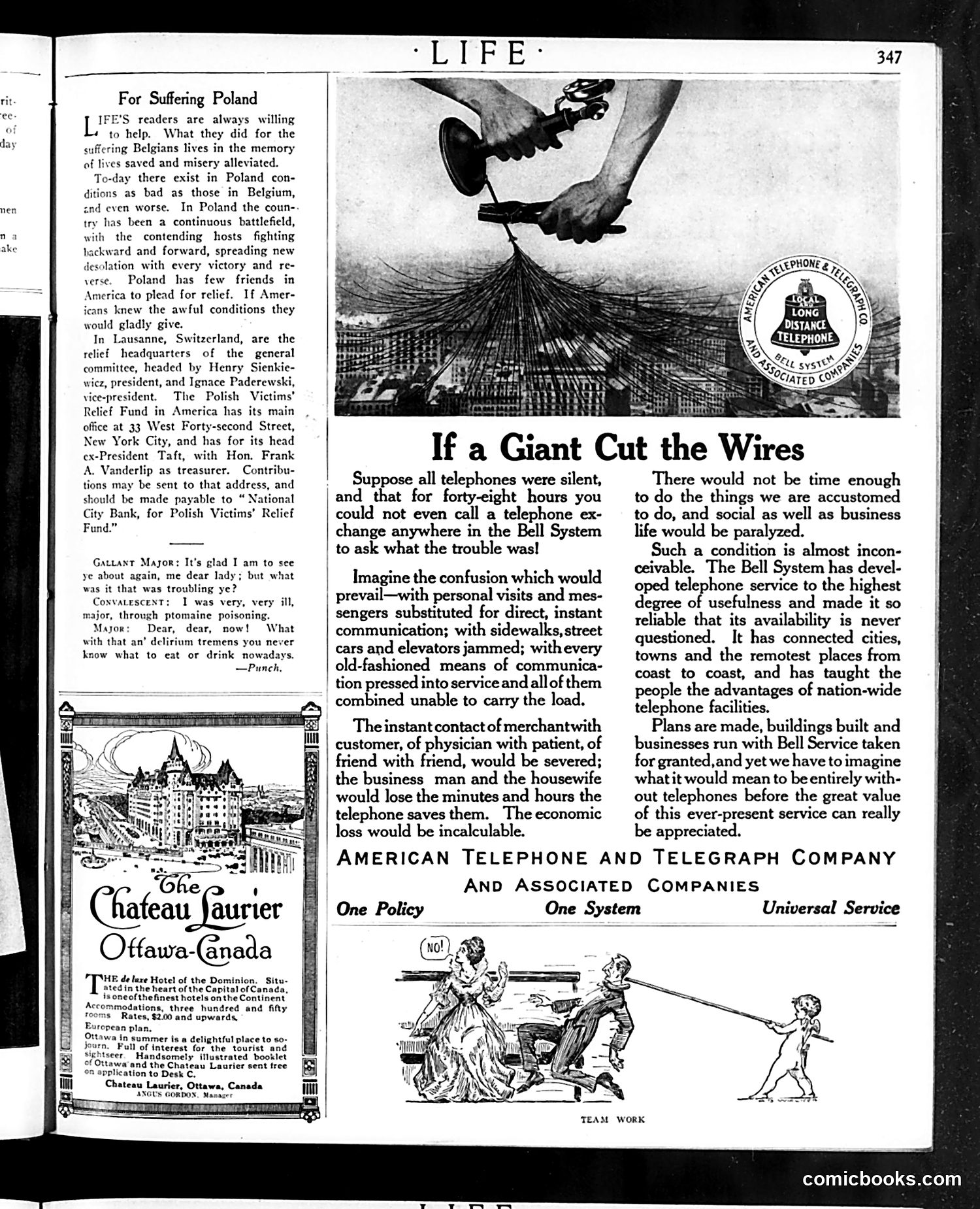
This page combines charitable appeals with corporate advertising. The left column solicits donations for Polish war relief—Poland is suffering from continuous battlefield conflict worse than Belgium's WWI devastation. Relief headquarters are in Switzerland, with the American fund managed by ex-President Taft and banker Frank Vanderlip. The right side features a Bell Telephone System advertisement using a hypothetical catastrophe scenario: "If a Giant Cut the Wires." The ad imagines a 48-hour telephone blackout, describing resulting chaos—severed communications, jammed transportation, paralyzed business and social life. The rhetorical strategy is indirect praise: by depicting communication collapse, Bell argues for the indispensability of its nationwide telephone network, which connects remote areas and enables modern commerce. A small Punch joke appears (bottom left) about a convalescent woman whose illnesses—ptomaine poisoning and delirium tremens—stem from not knowing what's safe to eat or drink.
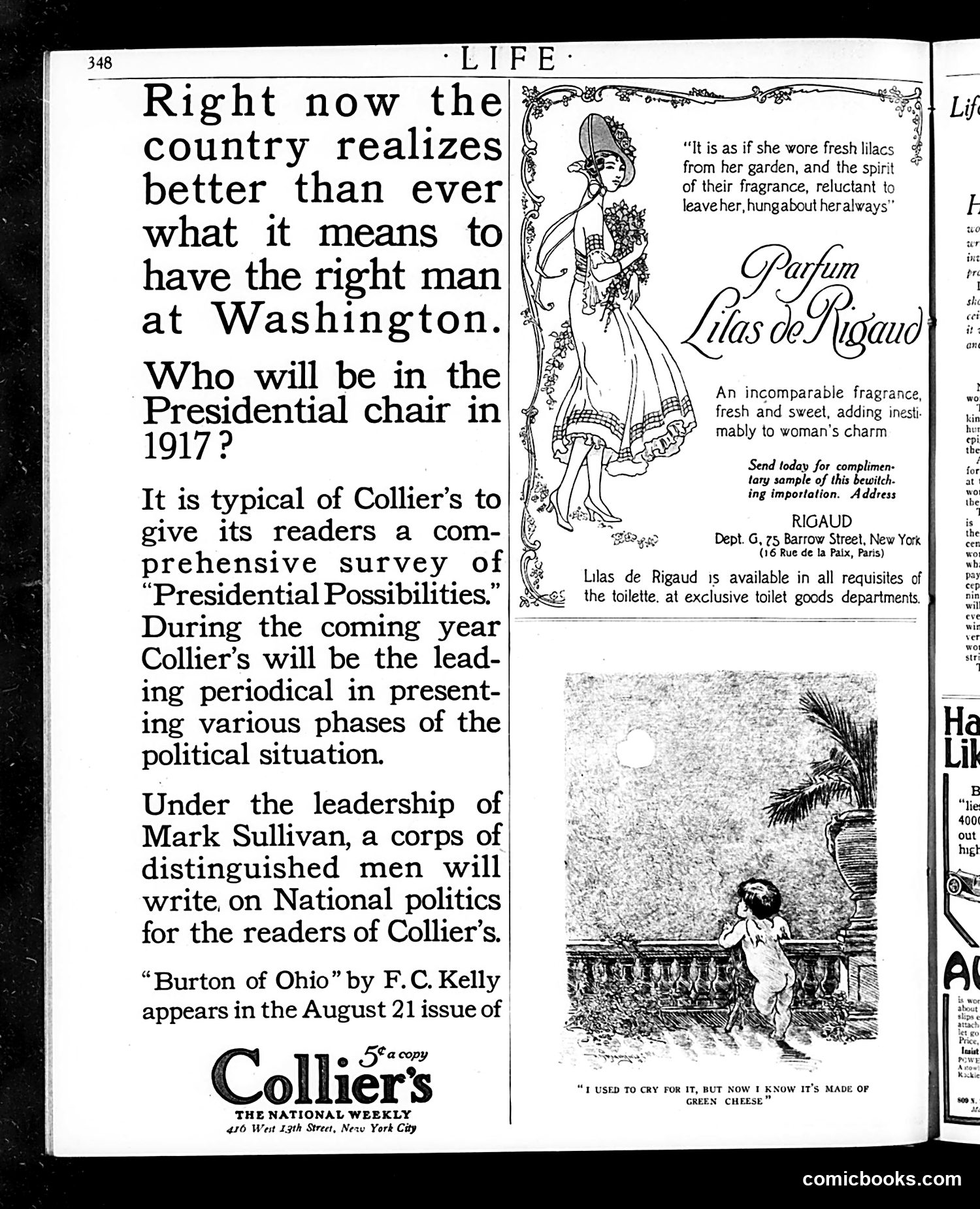
This page mixes political commentary with advertising. The left side features **Collier's magazine** promoting its upcoming 1916 presidential election coverage, asking "Who will be in the Presidential chair in 1917?" and promising comprehensive analysis under editor Mark Sullivan. It specifically mentions an article on "Burton of Ohio" by F.C. Kelly—likely referring to a potential presidential candidate from Ohio (a politically significant state). The right side contains two unrelated advertisements: a perfume ad for "Lilas de Rigaud" and a cartoon showing a child saying "I used to cry for it, but now I know it's made of green cheese"—likely a sardonic reference to believing false claims or propaganda, possibly commenting on gullibility during election season. The political content reflects pre-1916 election speculation about presidential succession.
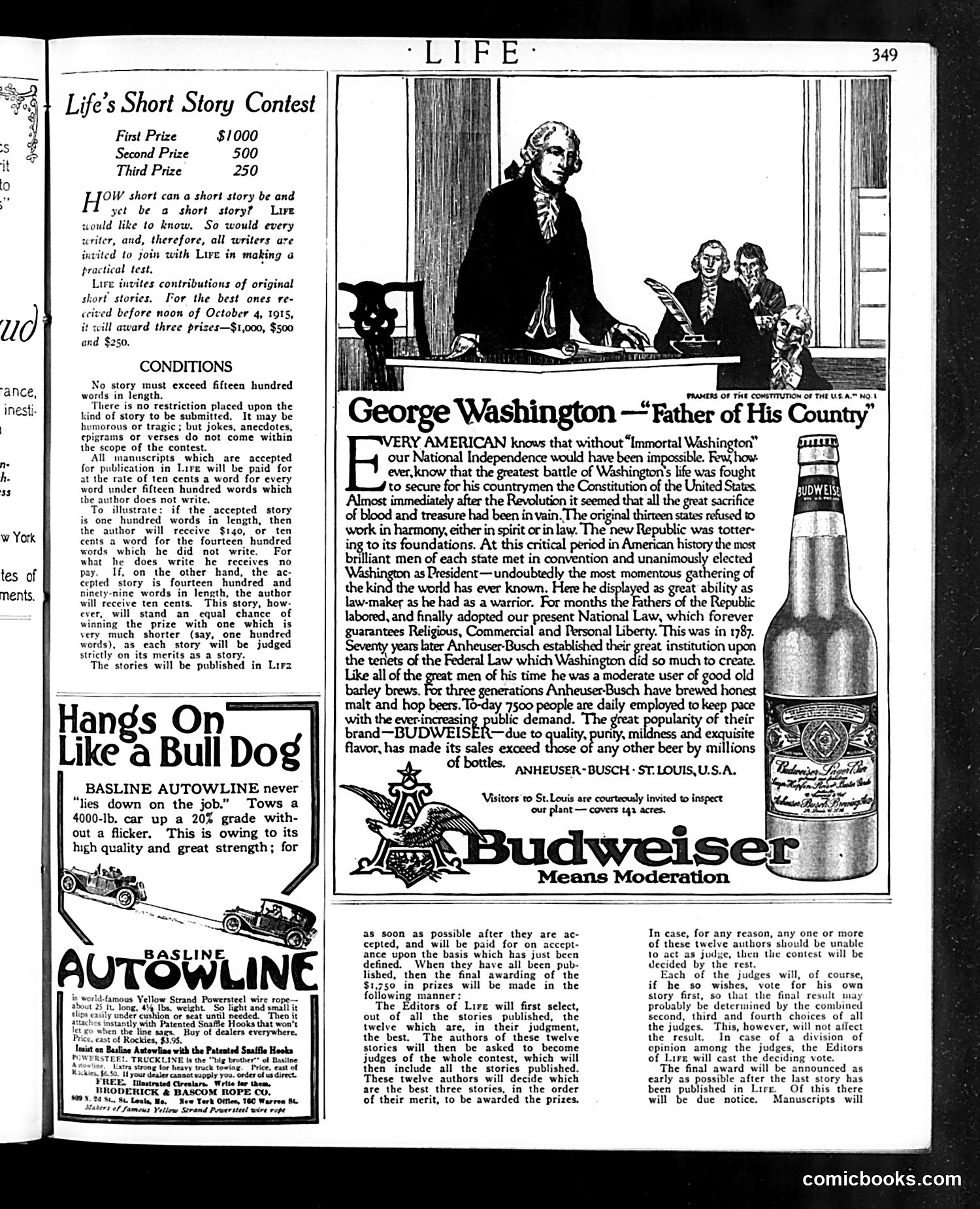
This page combines a **short-story writing contest** with **period advertising**. The main visual is a historical illustration labeled "George Washington—'Father of His Country,'" depicting Washington at a desk with two younger men, likely representing the Constitutional Convention of 1787. The accompanying text celebrates Washington's role securing the Constitution and guarantees of "Religious, Commercial and Personal Liberty" (1787). Notably, this historical narrative transitions into an advertisement for **Budweiser beer**, claiming the brewery was "established upon the tenets of the Federal Law which Washington did so much to create" and that Washington himself was "a moderate user of good old barley brews." This represents aggressive **prohibition-era advertising**—using patriotic mythology to defend alcohol consumption against growing temperance movements. By linking beer to the Founding Fathers and national liberty, Anheuser-Busch attempts to frame drinking as fundamentally American. The page also advertises **Basline Autowline** rope and promotes Life's fiction contest ($1,000 first prize).
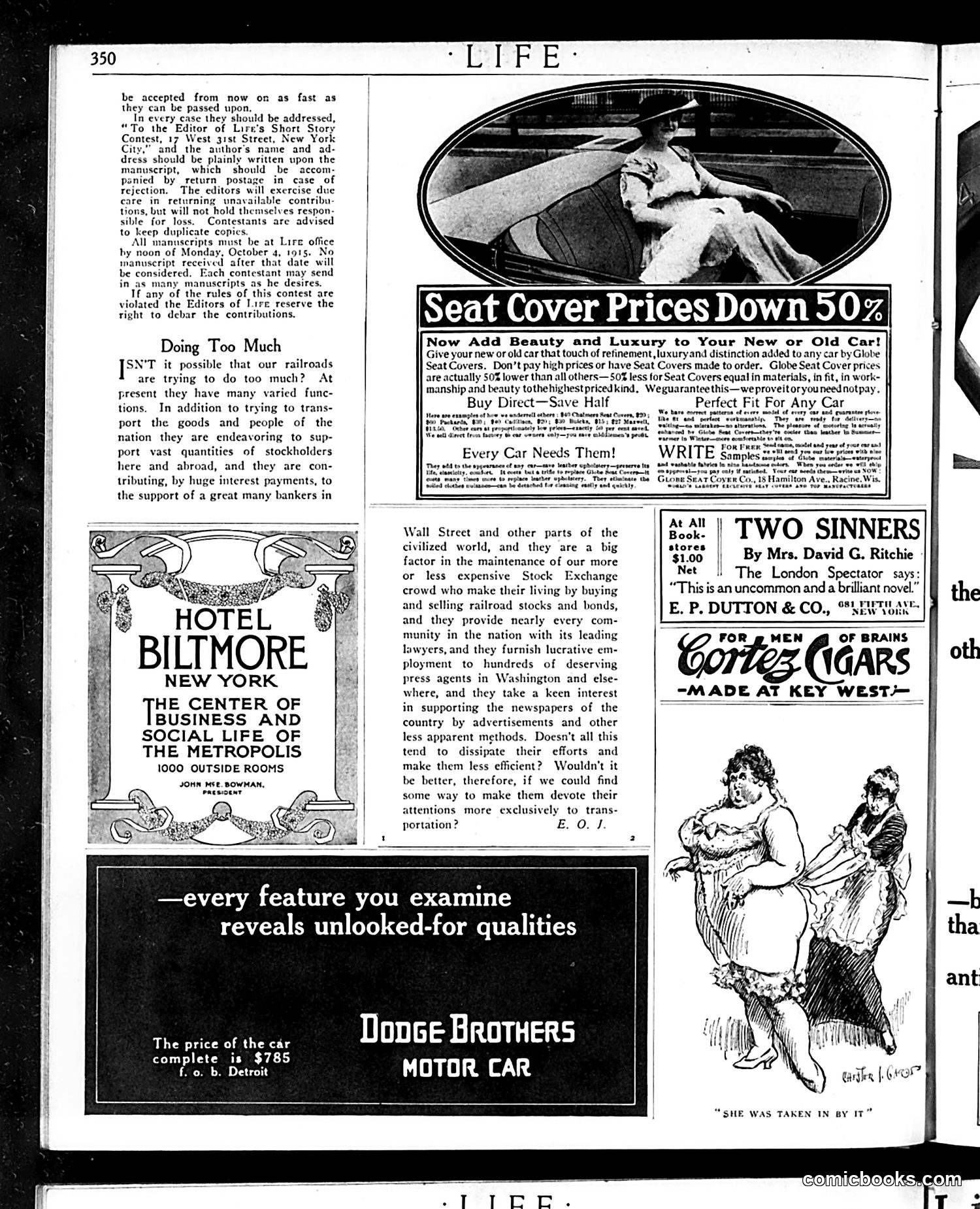
This page is primarily **advertisements and editorial notices**, not political satire. The main content includes: 1. **Story contest rules** for *Life* magazine's Short Story competition (deadline October 4, 1915) 2. **"Doing Too Much"** — A brief satirical piece (signed E.O.J.) critiquing American railroads. The writer sarcastically lists railroads' supposed obligations: supporting distant stockholders, funding bankers' interest payments, employing lawyers and press agents, and subsidizing newspapers through advertising. The satire questions whether railroads are so burdened supporting financial interests and infrastructure that they neglect their actual function: transporting goods and people. 3. **Advertisements** for seat covers, Hotel Biltmore, Dodge Brothers motor cars, and Cortez Cigars, plus a book advertisement for *Two Sinners* by Mrs. David G. Ritchie. The "Two Sinners" cartoon illustration (captioned "She Was Taken In By It") appears to depict a moral or romantic situation, but the caption alone doesn't clarify the specific reference.
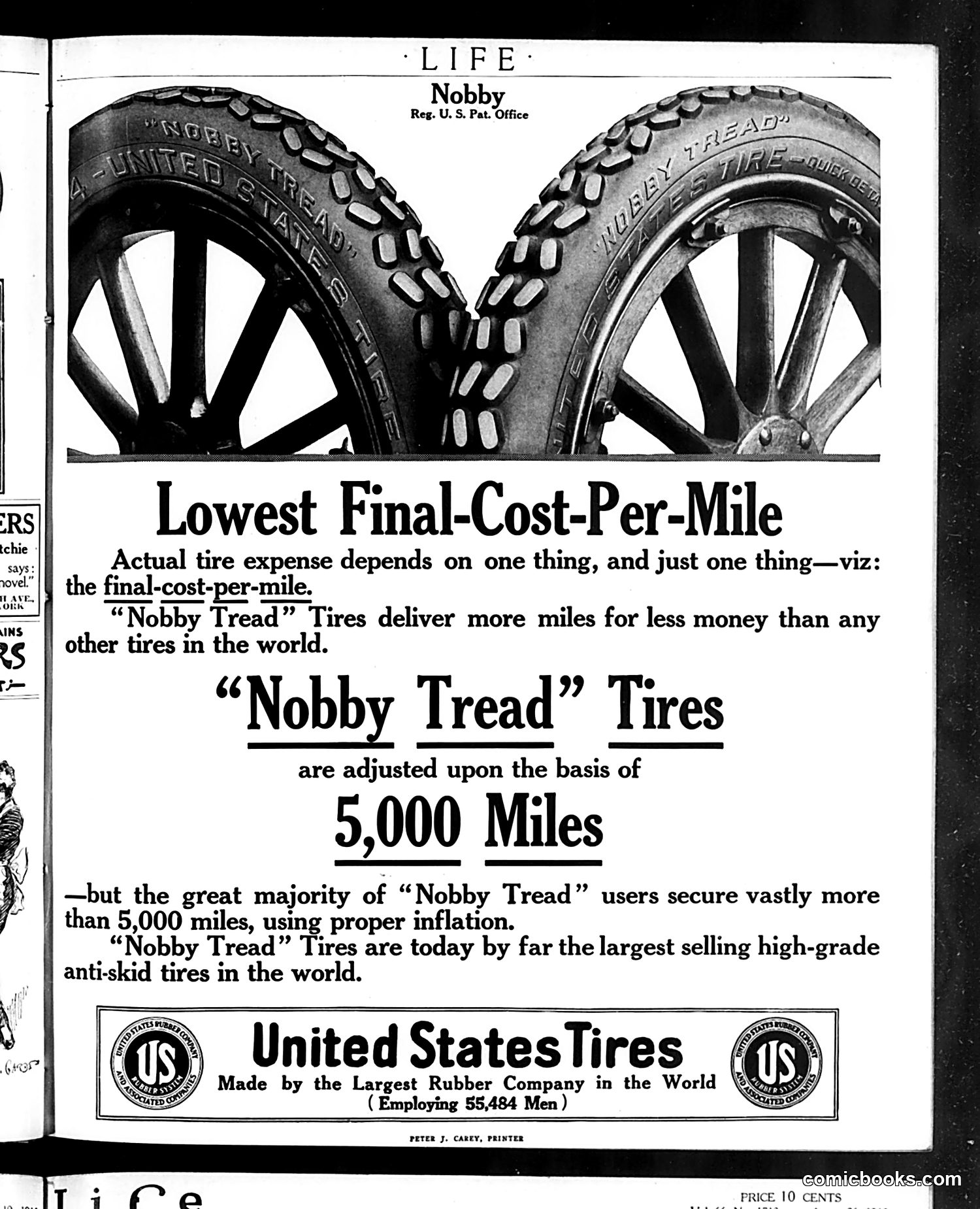
This is a **product advertisement**, not a political cartoon. It promotes "Nobby Tread" tires manufactured by United States Tires, claiming they offer the lowest cost-per-mile of any tire on the market. The page features two tire images at top showing the distinctive tread pattern. The advertisement's central claim is that tire value depends solely on "final-cost-per-mile"—how many miles you get before replacement—rather than initial purchase price. Key selling points highlighted: - Tires are "adjusted" for 5,000 miles but typically exceed that with proper inflation - They're the "largest selling high-grade anti-skid tires in the world" - Made by "the Largest Rubber Company in the World" employing 55,484 men For modern readers: this represents early automotive-era marketing emphasizing durability and value—concepts still used today, though the specific tire brand is now obsolete. The employment figure suggests Depression-era messaging about American manufacturing jobs.
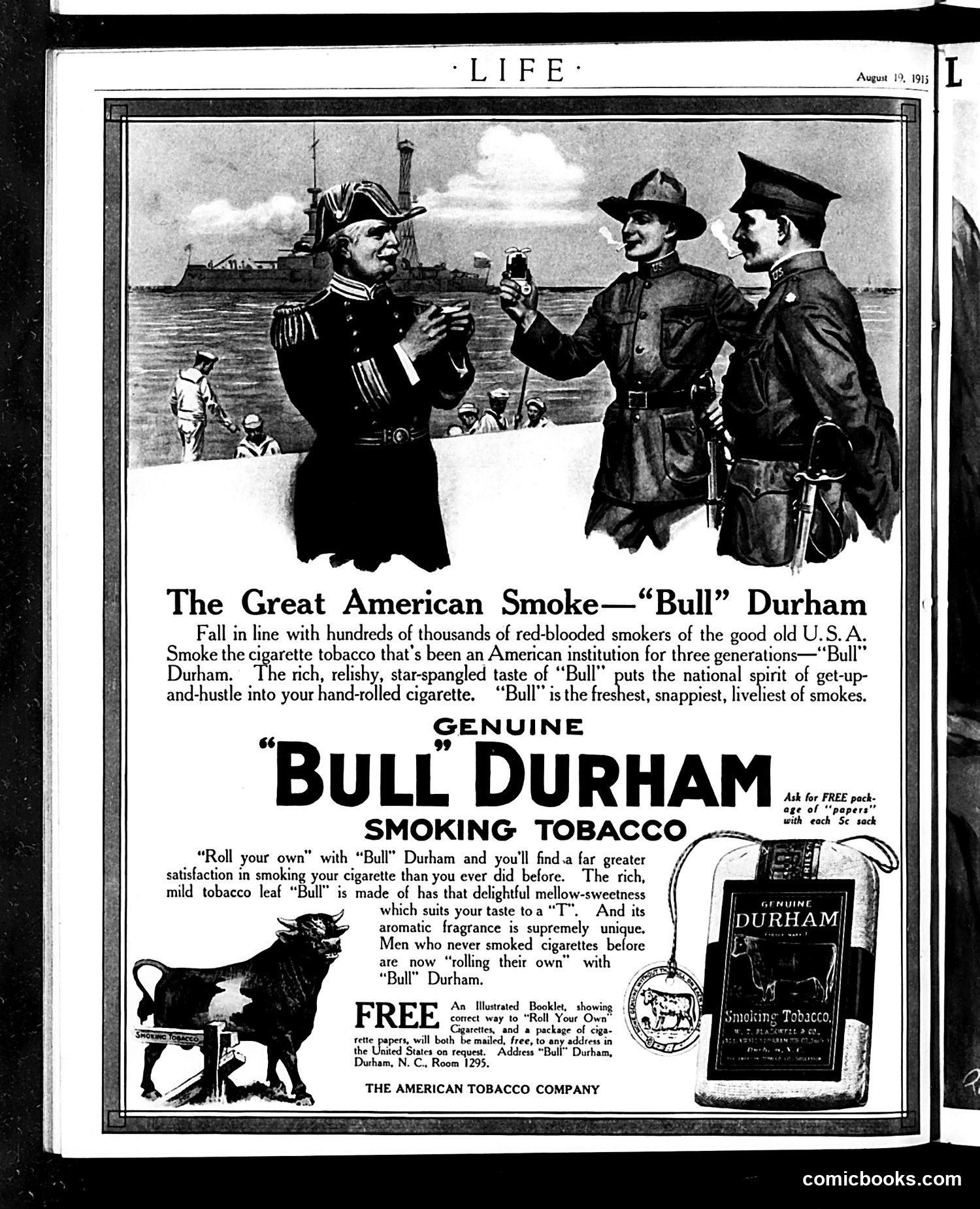
This is primarily a **tobacco advertisement**, not a political cartoon. It occupies the full page from Life magazine (August 19, 1915). The image shows three military figures in uniform near a warship, appearing to share a celebratory moment. The ad's headline—"The Great American Smoke"—uses patriotic language ("red-blooded," "national spirit," "star-spangled") to associate Bull Durham tobacco with American masculinity and military service. The satirical implication, likely clear to 1915 readers, is that this product represents authentic American identity. The military setting suggests durability, camaraderie, and strength. The "roll your own" concept appeals to self-reliance and craftsmanship. By modern standards, the advertisement is striking for its casual promotion of smoking to soldiers and its unironic use of military imagery to sell tobacco—practices now considered unethical. The page demonstrates how thoroughly tobacco marketing once permeated American culture without health disclaimers or restrictions.