
Life, 1915-08-19 · page 13 of 48
Life — August 19, 1915 — page 13: what you’re looking at
What you’re looking at
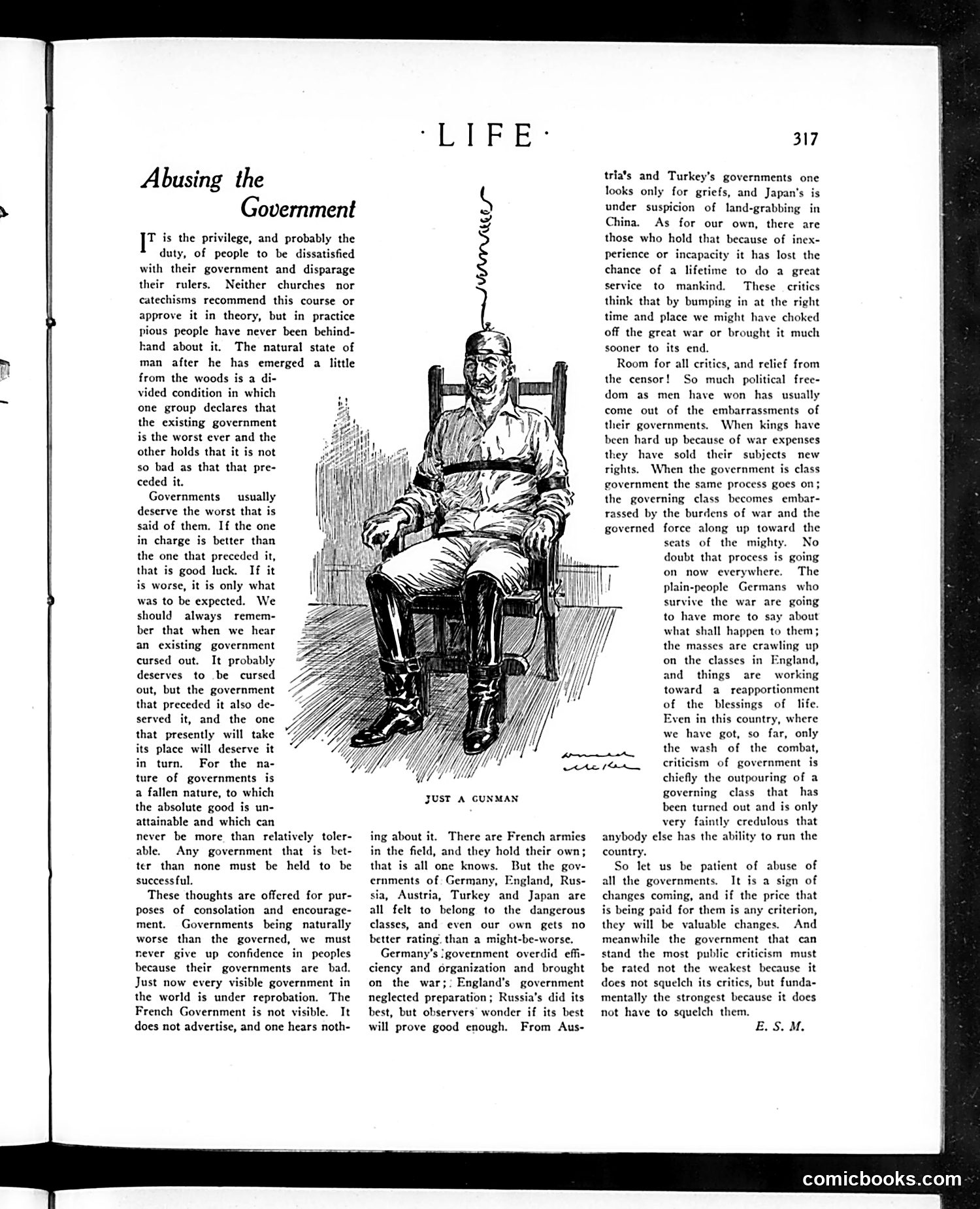
This satirical piece defends citizens' right to criticize government, arguing it's a democratic duty rather than disloyalty. The accompanying sketch, titled "Just a Gunman," depicts a military or autocratic figure seated in a chair—likely representing an authoritarian ruler or war leader. The article references WWI-era governments (Germany, England, Russia, Austria, Turkey, Japan) as examples of failed or inefficient leadership. It argues that "governing classes" have been "turned out," suggesting post-war political upheaval. The satire's point: strong governments need public criticism to improve; they shouldn't suppress dissent. The "gunman" image suggests that without accountability, governments rule by force rather than consent. The piece advocates for patient tolerance of government flaws while maintaining robust criticism.
📄 Transcribed text from this page (OCR, searchable)
Machine-transcribed from the original scan — historical spelling and the odd misread are preserved.
Abusing the Government r is the privilege, and probably the duty, of people to be dissatisfied with their government and disparage their rulers. Neither churches nor catechisms recommend this course or approve it in theory, but in practice pious people have never been behind- hand about it. The natural state of man after he has emerged a little from the woods is a di- vided condition in which one group declares that the existing government is the worst ever and the other holds that it is not so bad as that that pre- ceded it. Governments usually deserve the worst that is said of them. If the one in charge is better than the one that preceded it, that is good luck. If it is worse, it is only what was to be expected. We should always remem- ber that when we hear an existing government cursed out. It probably deserves to be cursed out, but the government that preceded it also de- served it, and the one that presently will take its place will deserve it in turn, For the na- ture of governments is a fallen nature, to which the absolute good is un- attainable and which can never be more than relatively toler- able. Any government that is bet- ter than none must be held to be successful. These thoughts are offered for pur- Poses of consolation and encourage- ment. Governments being naturally worse than the governed, we must never give up confidence in peoples because their governments are bad. Just now every visible government in the world is under reprobation. The French Government is not visible. It does not advertise, and one hears noth- JUST A GUNMAN ing about it. There are French armies in the field, and they hold their own; that is all one knows. But the gov- ernments of Germany, England, Rus- sia, Austria, Turkey and Japan are all felt to belong to the dangerous classes, and even our own gets no better rating. than a might-be-worse. Germany's :government overdid effi- ciency and organization and brought on the war;: England's government neglected preparation; Russia's did its best, but observers’ wonder if its best will prove good enough. From Aus- 317 tria’s and Turkey’s governments one looks only for griefs, and Japan's is under suspicion of land-grabbing in China. As for our own, there are those who hold that because of inex- perience or incapacity it has lost the chance of a lifetime to do a great service to mankind. These critics think that by bumping in at the right time and place we might have choked off the great war or brought it much sooner to its end. Room for all critics, and relief from the censor! So much political free- dom as men have won has usually come out of the embarrassments of their governments. When kings have been hard up because of war expenses they have sold their subjects new rights. When the government is class government the same process goes on; the governing class becomes embar- rassed by the burdens of war and the governed force along up toward the seats of the mighty. No doubt that process is going on now everywhere. The plain-people Germans who survive the war are going to have more to say about what shall happen to them; the masses are crawling up on the classes in England, and things are working toward a reapportionment of the blessings of life. Even in this country, where we have got, so far, only the wash of the combat, criticism of government is chiefly the outpouring of a governing class that has been turned out and is only very faintly credulous that anybody else has the ability to run the country, So let us be patient of abuse of all the governments. It is a sign of changes coming, and if the price that is being paid for them is any criterion, they will be valuable changes. And meanwhile the government that can stand the most public criticism must be rated not the weakest because it does not squelch its critics, but funda- mentally the strongest because it does not have to squelch them. ELS. M. comicbooks.com