
Life, 1915-08-19 · page 30 of 48
Life — August 19, 1915 — page 30: what you’re looking at
What you’re looking at
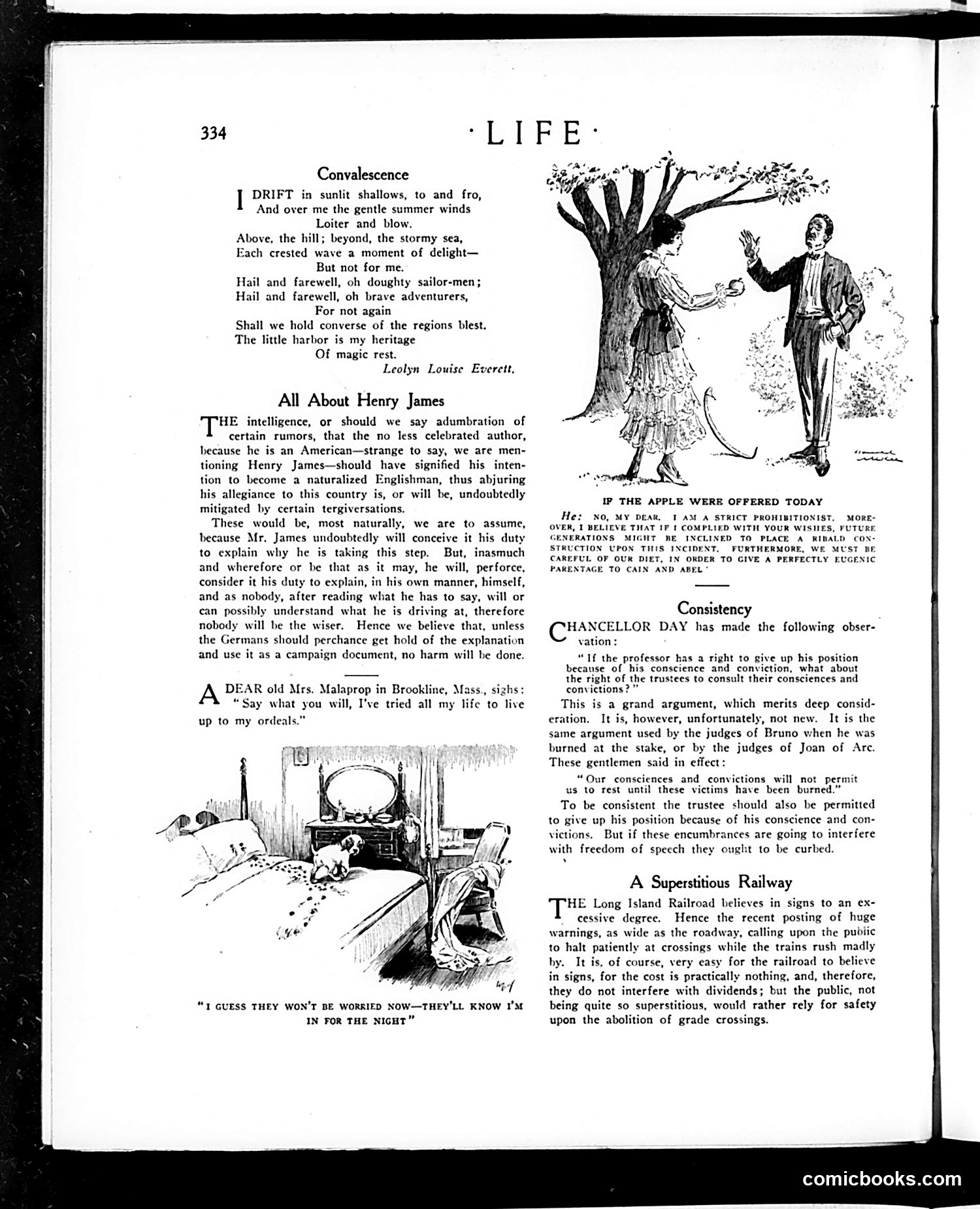
This page contains several satirical pieces mocking contemporary figures and institutions: **"All About Henry James"** mocks the American author's reported intention to become a British citizen. The satire suggests James's explanation will be so convoluted and incomprehensible that "nobody will be the wiser"—a jab at his notoriously dense prose style. The piece implies his defection is inconsequential unless Germany uses it propagandistically. **The cartoon labeled "If the Apple Were Offered Today"** depicts a modern man rejecting temptation through pseudo-intellectual arguments about prohibition and eugenics—satirizing contemporary self-righteousness disguised as principled restraint. **"Consistency"** critiques academic freedom debates, comparing trustees who restrict professors' speech to historical inquisitors who burned heretics. It argues that conscience shouldn't excuse silencing free speech. **"A Superstitious Railway"** mocks the Long Island Railroad for posting warning signs rather than actually eliminating dangerous grade crossings—criticizing performative safety theater over genuine reform. The page overall targets intellectual pretension, moral hypocrisy, and institutional evasion.
📄 Transcribed text from this page (OCR, searchable)
Machine-transcribed from the original scan — historical spelling and the odd misread are preserved.
Convalescence DRIFT in sunlit shallows, to and fro, And over me the gentle summer winds Loiter and blow. Above, the hill; beyond, the stormy sea, Each crested wave a moment of delight— But not for me. Hail and farewell, oh doughty sailor-men; Hail and farewell, oh brave adventurers, For not again Shall we hold converse of the regions blest. The little harbor is my heritage Of magic rest. Leolyn Louise Everett, All About Henry James HE intelligence, or should we say adumbration of certain rumors, that the no less celebrated author, because he is an American—strange to say, we are men- tioning Henry James—should have signified his inten- tion to become a naturalized Englishman, thus abjuring his allegiance to this country is, or will be, undoubtedly mitigated by certain tergiversations. These would be, most naturally, we are to assume, because Mr. James undoubtedly will conceive it his duty to explain why he is taking this step. But, inasmuch and wherefore or be that as it may, he will, perforce, consider it his duty to explain, in his own manner, himself, and as nobody, after reading what he has to say, will or can possibly understand what he is driving at, therefore nobody will be the wiser. Hence we believe that, unless the Germans should perchance get hold of the explanation and use it as a campaign document, no harm will be done. DEAR old Mrs. Malaprop in Brookline, Mass., sighs: Say what you will, I've tried all my life to live up to my ordeals. “1 GUESS THEY WON'T BE WORRIED NOW—THEY'LL KNOW I'M IN FOR THE NIGHT” IP THE APPLE WERE OFFERED TODAY He: NO, MY DEAR. I AM A STRICT PROHIBITIONIST. MORE- OVER, I BELIEVE THAT IF { COMPLIED WITH YOUR WISHES, FUTURE. GENERATIONS MIGHT RE INCLINED TO PLACE A RIBALD CON- STRUCTION UPON THIS INCIDENT, FURTHERMORE, WE MUST BE CAREFUL OF OUR DIET, IN ORDER TO GIVE A PERFECTLY EUGENIC PARENTAGE TO CAIN AND ABEL” Consistency Cre ELLOR DAY has made the following obser- vation : “If the professor has a right to give up his position because of his conscience and conviction, what about the right of the trustees to consult their consciences and convictions?” This is a grand argument, which merits deep consid- eration. It is, however, unfortunately, not new. It is the same argument used by the judges of Bruno when he was burned at the stake, or by the judges of Joan of Arc. These gentlemen said in effect: “Our consciences and convictions will not permit us to rest until these victims have been burned.” To be consistent the trustee should also be permitted to give up his position because of his conscience and con- victions, But if these encumbrances are going to interfere with freedom of speech they ought to be curbed. A Superstitious Railway 'HE Long Island Railroad believes in signs to an ex- cessive degree. Hence the recent posting of huge warnings, as wide as the roadway, calling upon the pubiic to halt patiently at crossings while the trains rush madly hy. It is, of course, very easy for the railroad to believe in signs, for the cost is practically nothing, and, therefore, they do not interfere with dividends; but the public, not being quite so superstitious, would rather rely for safety upon the abolition of grade crossings. comicbooks.com