
Life, 1915-08-19 · page 16 of 48
Life — August 19, 1915 — page 16: what you’re looking at
What you’re looking at
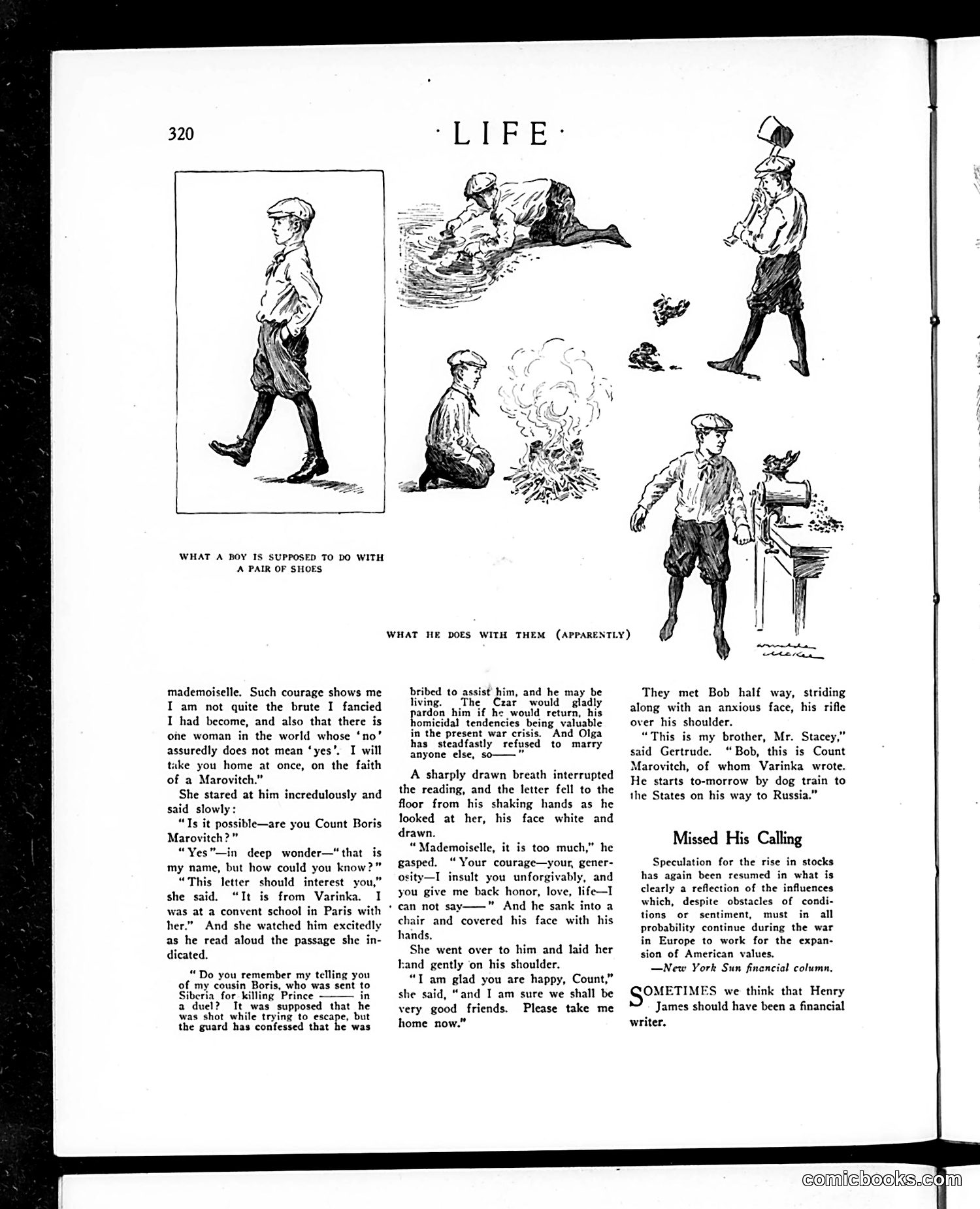
This page combines a serialized romantic story with satirical commentary. The main narrative involves Count Boris Marovitch, a Russian exile, reuniting with a woman who helps restore his honor through a letter from his former love, Varinka. The satire appears in the final section, "Missed His Calling." It mocks the pretentious language of financial columnists by quoting an absurdly overwrought Wall Street analysis about stock speculation during wartime. The passage uses grandiose, flowery prose to discuss mundane market activity—employing phrases like "expansion of American values" to describe simple profit-seeking. The joke: the editors suggest author Henry James (known for dense, philosophical prose) should have been a financial writer, sarcastically implying that financial writers already match James's notoriously complicated style. This ridicules both Wall Street's verbose self-importance and literary affectation disguising simple greed. The cartoon above illustrates the story's themes about boys and misbehavior with shoes.
📄 Transcribed text from this page (OCR, searchable)
Machine-transcribed from the original scan — historical spelling and the odd misread are preserved.
WHAT A BOY IS SUPPOSED TO DO WITH A PAIR OF SHOES WHAT HE DOES WITH THEM (APPARENTLY) mademoiselle. Such courage shows me I am not quite the brute I fancied I had become, and also that there is ohe woman in the world whose ‘no’ assuredly does not mean ‘yes’. I will tuke you home at once, on the faith of a Marovitch.” She stared at him incredulously and said slowly: “Ts it possible—are you Count Boris Marovitch?” “Yes"—in deep wonder—" that is my name, but how could you know?” “This letter should interest you,” she said. “It is from Varinka. I was at a convent school in Paris with ° her.” And she watched him excitedly as he read aloud the passage she in- dicated. “Do you remember my telling you of my cousin Boris, who was sent to Siberia for killing Prince in a duel? It was supposed that he was shot while trying to (aig 6 but the guard has confessed that he was bribed to assist him, and he may be living. The Czar would gladly pardon him if he would return, his omicidal tendencies being valuable in the present war crisis. And Olga has steadfastly refused to marry anyone else, so— ” A sharply drawn breath interrupted the reading, and the letter fell to the floor from his shaking hands as he looked at her, his face white and drawn. “Mademoiselle, it is too much,” he gasped. “Your courage—your, gener- osity—I insult you unforgivably, and you give me back honor, love, life—I can not say——" And he sank into a chair and covered his face with his hands, She went over to him and laid her Land gently on his shoulder. “T am glad you are happy, Count,” she said, “and I am sure we shall be very good friends. Please take me home now.” They met Bob half way, striding along with an anxious face, his rifle over his shoulder. “This is my brother, Mr. Stacey,” said Gertrude. “Bob, this is Count Marovitch, of whom Varinka wrote. He starts to-morrow by dog train to the States on his way to Russia.” Missed His Calling Speculation for the rise in stocks has again been resumed in what is clearly a reflection of the influences which, despite obstacles of condi- tions or sentiment, must in all probability continue during the war in Europe to work for the expan- sion of American values. —New York Sun financial column, OMETIMES we think that Henry James should have been a financial writer. comichooks.cqi