
Life, 1915-08-19 · page 20 of 48
Life — August 19, 1915 — page 20: what you’re looking at
What you’re looking at
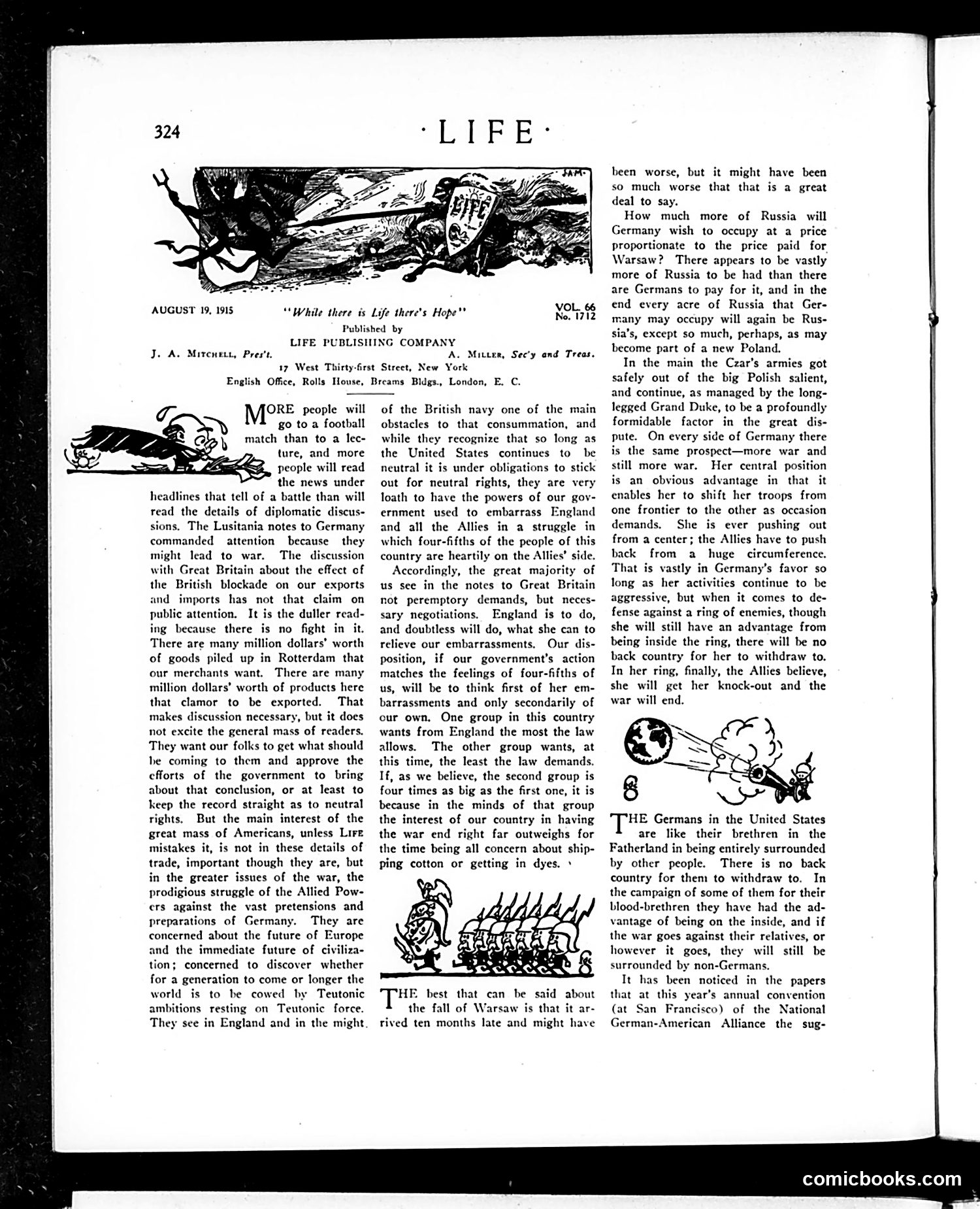
This *Life* magazine editorial from August 1915 addresses American public opinion during WWI. The text argues that most Americans (roughly four-fifths) sympathize with the Allied cause against Germany, despite official U.S. neutrality. It discusses tension between protecting American commercial rights (shipping goods to Britain) and avoiding actions that embarrass Britain and its allies. The second section comments on Russia's fall of Warsaw to German forces—a significant 1915 Eastern Front loss. The author notes the Germans captured it "ten months late" (suggesting it was strategically inevitable) and that vast Russian territory cannot sustain permanent German occupation. The cartoons (though partially visible) appear to satirize the war's scope and Germany's ambitions, using caricature to mock German militarism—characteristic of American anti-German propaganda during this pre-entry period.
📄 Transcribed text from this page (OCR, searchable)
Machine-transcribed from the original scan — historical spelling and the odd misread are preserved.
AUGUST 19, 1915 J. A. Mivenett, Pres’t. ORE people will go to a football match than to a lec- ture, and more people will read the news under headlines that tell of a battle than will read the details of diplomatic discus- sions. The Lusitania notes to Germany commanded attention because they might lead to war. The discussion with Great Britain about the effect of the British blockade on our exports and imports has not that claim on public attention. It is the duller read- ing because there is no fight in it. There are many million dollars’ worth of goods piled up in Rotterdam that our merchants want. There are many million dollars’ worth of products here that clamor to be exported. That makes discussion necessary, but it does not excite the general mass of readers. They want our folks to get what should be coming to them and approve the efforts of the government to bring about that conclusion, or at least to keep the record straight as to neutral rights. But the main interest of the great mass of Americans, unless Lire mistakes it, is not in these details of trade, important though they are, but in the greater issues of the war, the prodigious struggle of the Allied Pow- ers against the vast pretensions and preparations of Germany. They are concerned about the future of Europe and the immediate future of civiliza- tion; concerned to discover whether for a generation to come or longer the world is to be cowed by Teutonic ambitions resting on Teutonic force. They see in England and in the might “While there is Life there's Hope'* Published by LIFE PUBLISHING COMPANY A. Miter, Sec'y and Treas. 17 West Thirty-first Street, New York English Office, Rolls House, Breams Bldgs., London, E. C. VOL. 66 No. 1712 of the British navy one of the main obstacles to that consummation, and while they recognize that so long as the United States continues to be neutral it is under obligations to stick out for neutral rights, they are very loath to have the powers of our gov- ernment used to embarrass England and all the Allies in a struggle in which four-fifths of the people of this country are heartily on the Allies’ side. Accordingly, the great majority of us see in the notes to Great Britain not peremptory demands, but neces- sary negotiations. England is to do, and doubtless will do, what she can to relieve our embarrassments. Our dis- position, if our government’s action matches the feelings of four-fifths of us, will be to think first of her em- barrassments and only secondarily of cur own, One group in this country wants from England the most the law allows. The other group wants, at this time, the least the law demands. If, as we believe, the second group is four times as big as the first one, it is because in the minds of that group the interest of our country in having the war end right far outweighs for the time being all concern about ship- ping cotton or getting in dyes. + HE best that can be said about the fall of Warsaw is that it ar- rived ten months late and might have been worse, but it might have been so much worse that that is a great deal to say. How much more of Russia will Germany wish to occupy at a price proportionate to the price paid for. Warsaw? There appears to be vastly more of Russia to be had than there are Germans to pay for it, and in the end every acre of Russia that Ger- many may occupy will again be Rus- sia’s, except so much, perhaps, as may become part of a new Poland. In the main the Czar’s armies got safely out of the big Polish salient, and continue, as managed by the long- legged Grand Duke, to be a profoundly formidable factor in the great dis- pute. On every side of Germany there is the same prospect—more war and still more war. Her central position is an obvious advantage in that it enables her to shift her troops from one frontier to the other as occasion demands. She is ever pushing out from a center; the Allies have to push back from a huge circumference. That is vastly in Germany’s favor so long as her activities continue to be aggressive, but when it comes to de- fense against a ring of enemies, though she will still have an advantage from being inside the ring, there will be no back country for her to withdraw to. In her ring, finally, the Allies believe, she will get her knock-out and the war will end. ~ By y)) 8 SS HE Germans in the United States are like their brethren in the Fatherland in being entirely surrounded by other people. There is no back country for them to withdraw to. In the campaign of some of them for their Ulood-brethren they have had the ad- vantage of being on the inside, and if the war goes against their relatives, or however it goes, they will still be surrounded by non-Germans. It has been noticed in the papers that at this year’s annual convention (at San Francisco) of the National German-American Alliance the sug- comicbooks.com