
Life, 1915-08-19 · page 10 of 48
Life — August 19, 1915 — page 10: what you’re looking at
What you’re looking at
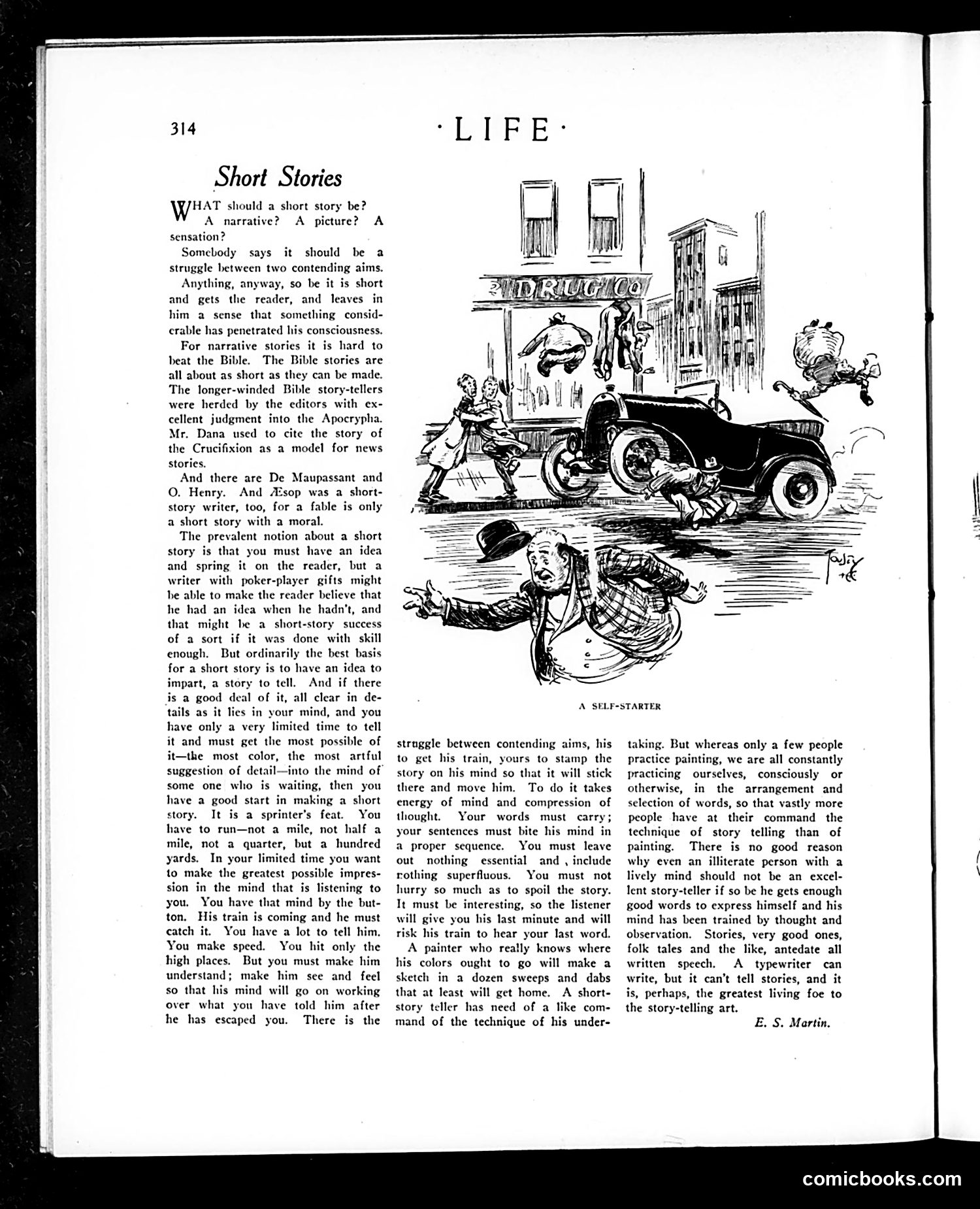
This page from *Life* magazine contains an article about short-story writing by E.S. Martin, accompanied by a cartoon illustration titled "A Self-Starter." The cartoon depicts a chaotic street scene: a car has struck a pedestrian near a drugstore, with the victim apparently propelled upward by the impact. The humor relies on the visual pun of "self-starter"—referencing both the automobile's mechanical self-starting feature (newly common in the 1920s) and the injured man's involuntary, violent propulsion from the car's collision. The joke is darkly satirical: the accident victims have become "self-starters" through violent impact rather than intention—a commentary on the automobile age's casual brutality and the era's emerging traffic hazards in urban America.
📄 Transcribed text from this page (OCR, searchable)
Machine-transcribed from the original scan — historical spelling and the odd misread are preserved.
Short Stories HAT should a short story be? A narrative? A picture? A sensation? Somebody says it should be a struggle between two contending aims. Anything, anyway, so be it is short and gets the reader, and leaves in him a sense that something consid- crable has penetrated his consciousness. For narrative stories it is hard to Deat the Bible. The Bible stories are all about as short as they can be made. The longer-winded Bible story-tellers were herded by the editors with ex- cellent judgment into the Apocrypha. Mr. Dana used to cite the story of the Crucifixion as a model for news stories. And there are De Maupassant and O. Henry. And Asop was a short- story writer, too, for a fable is only a short story with a moral. The prevalent notion about a short story is that you must have an idea and spring it on the reader, but a writer with poker-player gifts might he able to make the reader believe that he had an idea when he hadn't, and that might be a short-story success of a sort if it was done with skill enough. But ordinarily the best basis for a short story is to have an idea to impart, a story to tell. And if there is a good deal of it, all clear in de- tails as it lies in your mind, and you have only a very limited time to tell it and must get the most possible of it—the most color, the most artful suggestion of detail—into the mind of” some one who is waiting, then you have a good start in making a short story. It is a sprinter’s feat. You have to run—not a mile, not half a mile, not a quarter, but a hundred yards. In your limited time you want to make the greatest possible impres- sion in the mind that is listening to you. You have that mind by the but- ton. His train is coming and he must catch it. You have a lot to tell him, You make speed. You hit only the high places. But you must make him understand; make him see and feel so that his mind will go on working over what you have told him after he has escaped you. There is the A SELF-STARTER struggle between contending aims, his to get his train, yours to stamp the story on his mind so that it will stick there and move him. To do it takes energy of mind and compression of thought. Your words must carry; your sentences must bite his mind in @ proper sequence. You must leave out nothing essential and , include rothing superfluous. You must not hurry so much as to spoil the story. It must be interesting, so the listener will give you his last minute and will tisk his train to hear your last word. A painter who really knows where his colors ought to go will make a sketch in a dozen sweeps and dabs that at least will get home. A short- story teller has need of a like com- mand of the technique of his under- taking. But whereas only a few people practice painting, we are all constantly practicing ourselves, consciously or otherwise, in the arrangement and selection of words, so that vastly more people have at their command the technique of story telling than of painting. There is no good reason why even an illiterate person with a lively mind should not be an excel- lent story-teller if so be he gets enough good words to express himself and his mind has been trained by thought and observation. Stories, very good ones, folk tales and the like, antedate all written speech. A typewriter can write, but it can’t tell stories, and it is, perhaps, the greatest living foe to the story-telling art. E, S. Martin. comicbooks.com