
Life, 1915-08-19 · page 28 of 48
Life — August 19, 1915 — page 28: what you’re looking at
What you’re looking at
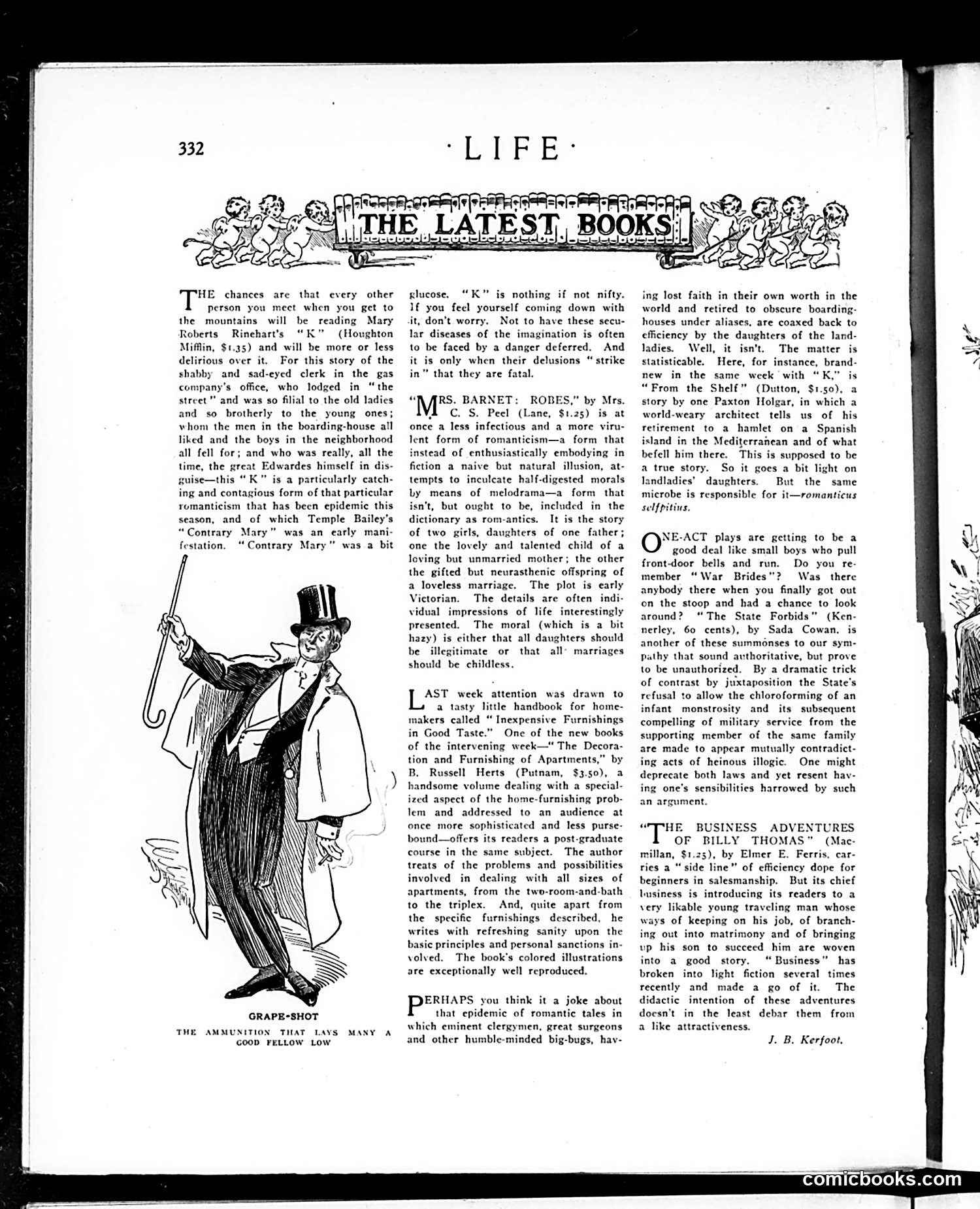
This page from *Life* magazine reviews recent popular novels, with particular focus on what the critic calls an "epidemic of romantic tales." The cartoon—labeled "GRAPE-SHOT"—depicts a well-dressed man being shot, illustrating the metaphor that sentimental romance novels are "ammunition that lays many a good fellow low." The critic identifies a specific literary trend: stories where accomplished men (clerks, architects, surgeons, clergymen) abandon their careers, hide in boarding houses or remote locations under aliases, and are ultimately "rescued" by young women—particularly landladies' daughters. Examples cited include Mary Roberts Rinehart's *"K"* and *"From the Shelf"* by Paxton Holgar. The satire targets both the implausibility of these plots and their apparent contagious appeal to readers. The critic treats this romanticized male failure-to-redemption formula as a genuine social phenomenon worthy of mockery, suggesting it reflects broader anxieties about masculinity and purpose in this era.
📄 Transcribed text from this page (OCR, searchable)
Machine-transcribed from the original scan — historical spelling and the odd misread are preserved.
HE chances are that every other Person you mect when you get to the mountains will be reading Mary Roberts Rinehart’s “K” (Houghton Mifflin, $1.35) and will be more or less delirious over it. For this story of the shabby and sad-eyed clerk in the gas company's office, who lodged in “the street” and was so filial to the old ladies and so brotherly to the young ones; whom the men in the boarding-house all liked and the boys in the neighborhood all fell for; and who was really, all the time, the great Edwardes himself in dis- guise—this “K" is a particularly catch- ing and contagious form of that particular romanticism that has been epidemic this season, and of which Temple Bailey's “Contrary Mary” was an early mani- festation. “Contrary Mary” was a bit GRAPE-SHOT AMMUNITION THAT LAYS MANY A GOOD FELLOW Low THE glucose. “K" is nothing if not nifty. If you feel yourself coming down with it, don’t worry. Not to have these secu- lar diseases of the imagination is often to be faced by a danger deferred. And it is only when their delusions “ strike in” that they are fatal. om RS. BARNET: ROBES,” by Mrs. C. S. Peel (Lane, $1.25) is at once a less infectious and a more viru- lent form of romanticism—a form that instead of enthusiastically embodying in fiction a naive but natural illusion, at- tempts to inculcate half-digested morals by means of melodrama—a form that isn't, but ought to be, included in the dictionary as rom-antics. It is the story of two girls, daughters of one father; one the lovely and talented child of a loving but unmarried mother; the other the gifted but neurasthenic offspring of a loveless marriage. The plot is early Victorian. The details are often indi- vidual impressions of life interestingly presented. The moral (which is a bit hazy) is either that all daughters should be illegitimate or that all: marriages should be childless. AST week attention was drawn to a tasty little handbook for home- makers called “ Inexpensive Furnishings in Good Taste.” One of the new books of the intervening week—" The Decora- tion and Furnishing of Apartments,” by B. Russell Herts (Putnam, $3.50), a handsome volume dealing with a special- ized aspect of the home-furnishing prob- lem and addressed to an audience at once more sophisticated and less purse- bound—offers its readers a post-graduate course in the same subject. The author treats of the problems and possibilities involved in dealing with all sizes of apartments, from the two-room-and-bath to the triplex. And, quite apart from the specific furnishings described, he writes with refreshing sanity upon the basic principles and personal sanctions in- volved. The book's colored illustrations are exceptionally well reproduced. ERHAPS you think it a joke about that epidemic of romantic tales in which eminent clergymen, great surgeons and other humble-minded big-bugs, hav- ing lost faith in their own worth in the world and retired to obscure boarding- houses under aliases, are coaxed back to efficiency by the daughters of the land- ladies. Well, it isn't. The matter is statisticable. Here, for instance, brand- new in the same week with “K,” is “From the Shelf” (Dutton, $1.50), a story by one Paxton Holgar, in which a world-weary architect tells us of his retirement to a hamlet on a Spanish island in the Mediterranean and of what befell him there. This is supposed to be a true story. So it goes a bit light on landladies’ daughters. But the same microbe is responsible for it—romanticus selfpitius. O -ACT plays are getting to be a good deal like small boys who pull front-door bells and run. Do you re member “War Brides"? Was there anybody there when you finally got out on the stoop and had a chance to look around? “The State Forbids” (Ken- nerley, 60 cents), by Sada Cowan, is another of these summonses to our sym- pathy that sound authoritative, but prove to be unauthorized. By a dramatic trick of contrast by juxtaposition the State's refusal to allow the chloroforming of an infant monstrosity and its subsequent compelling of military service from the supporting member of the same family are made to appear mutually contradict- ing acts of heinous illogic. One might deprecate both laws and yet resent hav- ing one’s sensibilities harrowed by such an argument. THOMAS millan, $1.25), by Elmer E. Ferris, car- ide line” of efficiency dope for beginners in salesmanship. But its chief lusiness is introducing its readers to a very likable young traveling man whose ways of keeping on his job, of branch- ing out into matrimony and of bringing up his son to succeed him are woven into a good story. “Business” has broken into light fiction several times recently and made a go of it. The didactic intention of these adventures doesn't in the least debar them from a like attractiveness. J. B. Kerfoot, comicbooks.com