
A complete issue · 44 pages · 1915
Life — July 22, 1915
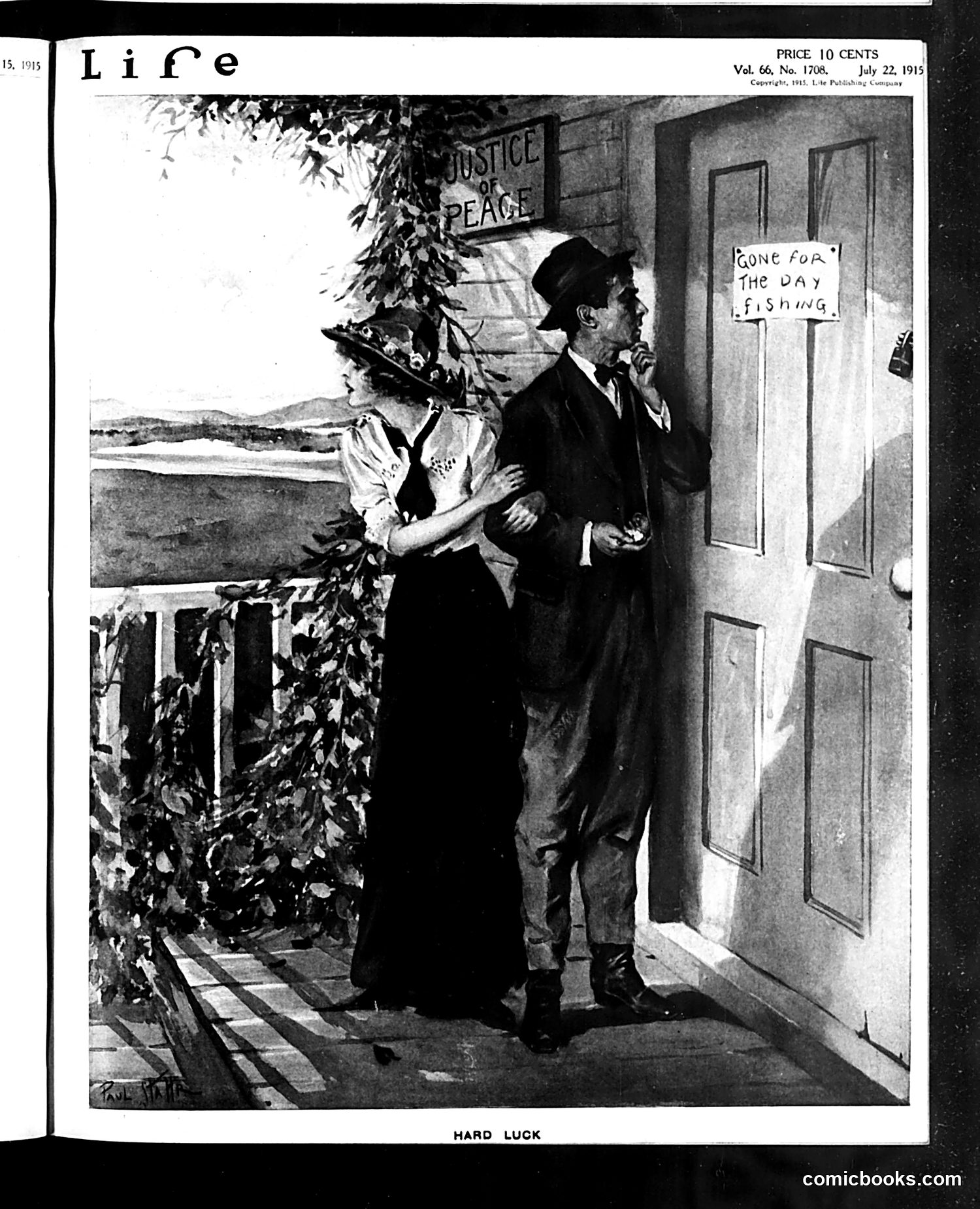
This cartoon depicts a domestic scene with comedic irony. A well-dressed man leaves through a door marked "GONE FOR THE DAY FISHING" while a woman in a hat (appearing to be his wife) stands beside him. Behind them, a sign reads "JUSTICE OF THE PEACE," suggesting they're at an official's residence or office. The joke appears to be about marital conflict or escape: the man is fleeing domestic complications—possibly related to the "Justice of the Peace" location—by claiming he's going fishing. The title "Hard Luck" reinforces the theme that he's in an unfortunate predicament, likely domestic trouble he's attempting to avoid. The cartoon satirizes men's attempts to evade spousal confrontations through transparent excuses.
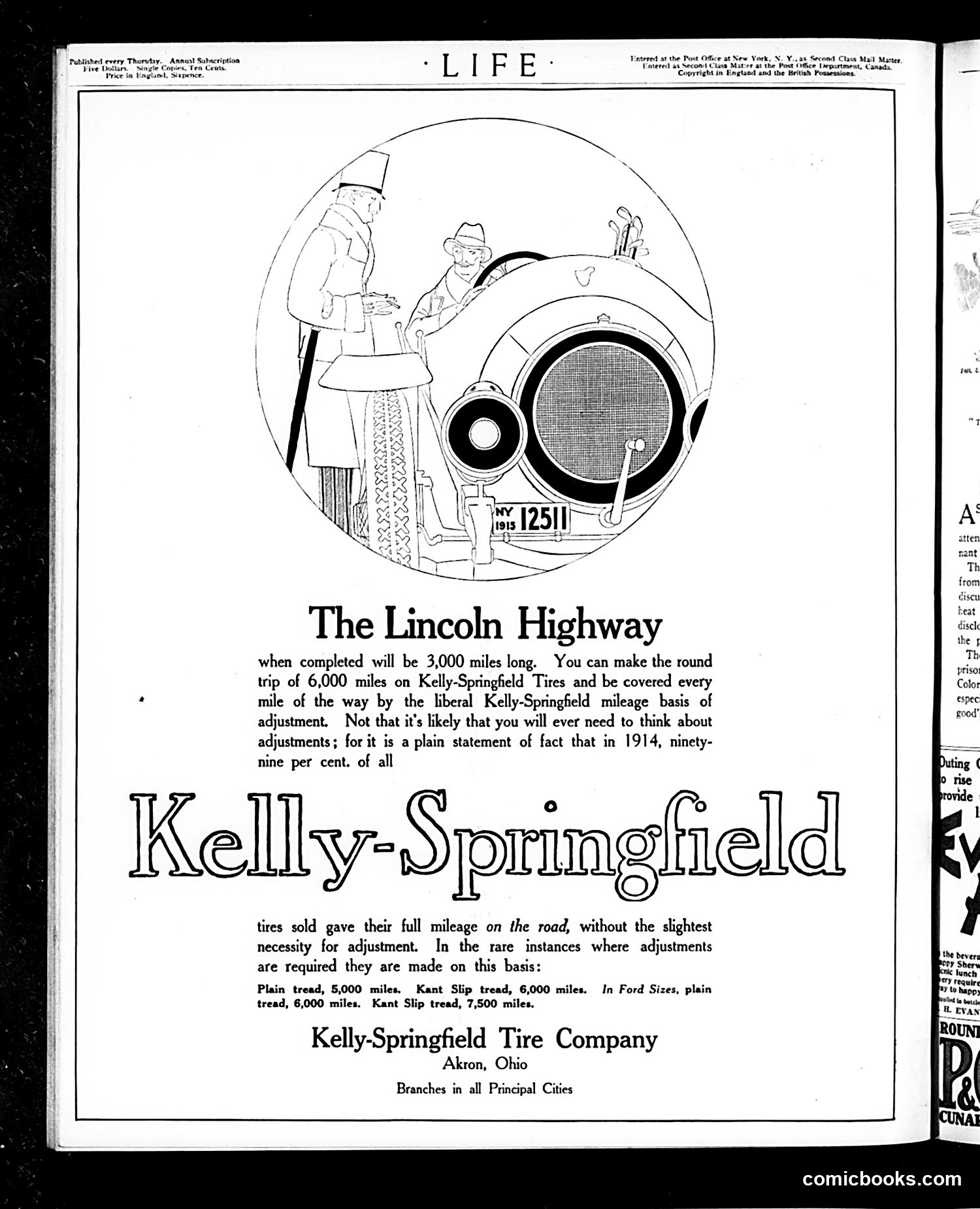
This page is primarily **advertising**, not political satire. It promotes Kelly-Springfield Tires through an illustration of the Lincoln Highway, a famous early 20th-century cross-country auto route. The circular vignette shows a well-dressed couple with their automobile, emphasizing leisure travel. The ad claims Kelly-Springfield tires require minimal adjustment over 3,000-6,000 miles—a significant selling point for a 1914 audience when tire durability was a genuine concern for motorists attempting long-distance journeys. The Lincoln Highway reference appeals to American automobile culture and the era's excitement about cross-country motoring. The ad targets middle-to-upper-class car owners, positioning Kelly-Springfield as reliable for ambitious road trips. The mileage guarantees listed at bottom (plain vs. Kant-Slip treads) were concrete proof of product quality.
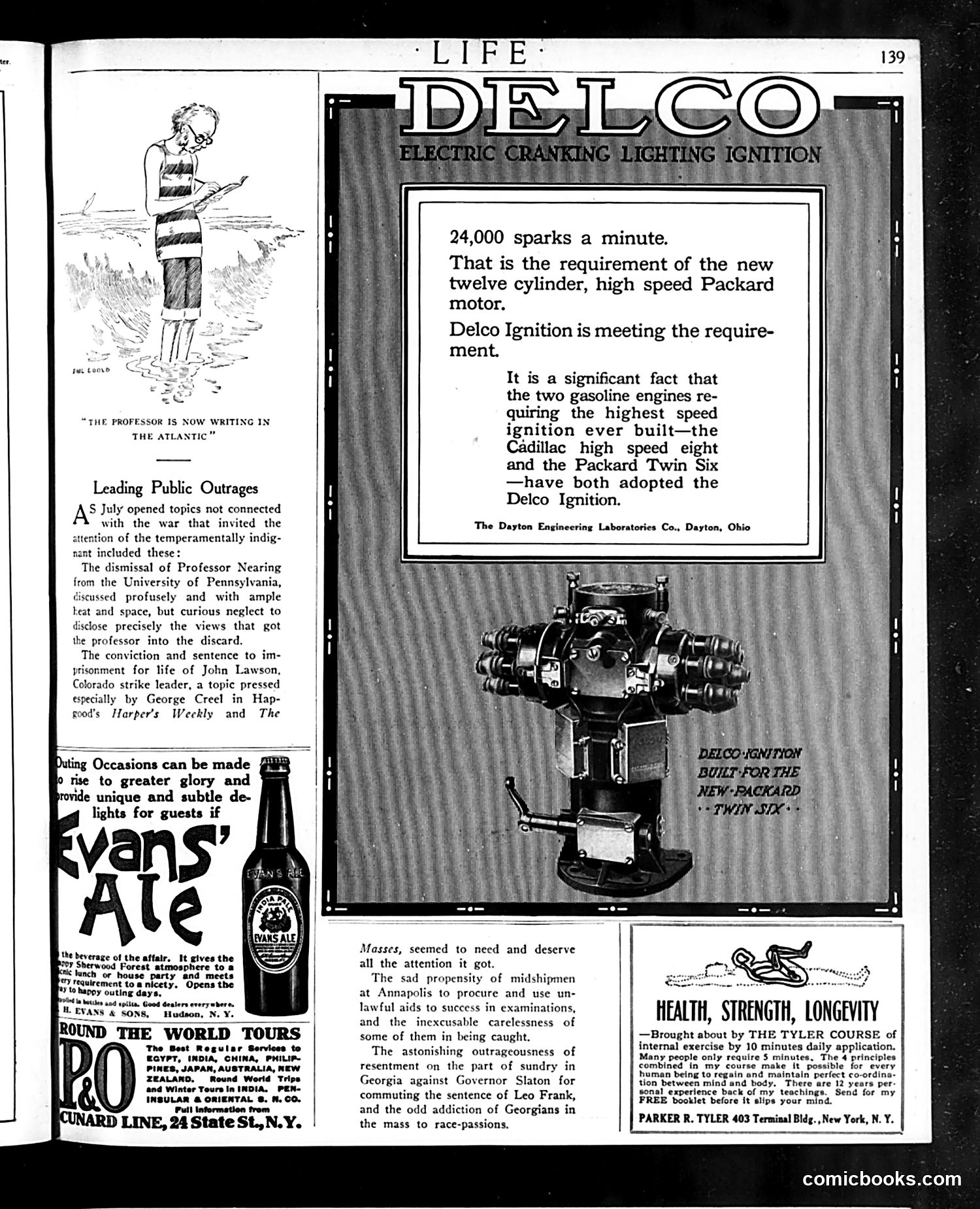
This page is primarily **advertising and editorial content** rather than political satire. The cartoon on the left ("The Professor is Now Writing in the Atlantic") shows a figure wading in water, likely satirizing an academic's pretensions—suggesting someone has moved from obscurity to prestigious publication. However, without more context, the specific reference is unclear. The main content comprises advertisements for **Delco ignition systems**, **Evans Ale**, **P&O Cunard Line** (ocean travel), and **Parker R. Tyler's health device**. These were typical commercial pitches in 1910s Life magazine. The editorial section discusses Professor Nearing's dismissal from University of Pennsylvania and sentencing of labor leader John Lawson—contemporary political controversies about academic freedom and labor justice—but these brief mentions lack satirical cartoons to illustrate the points.
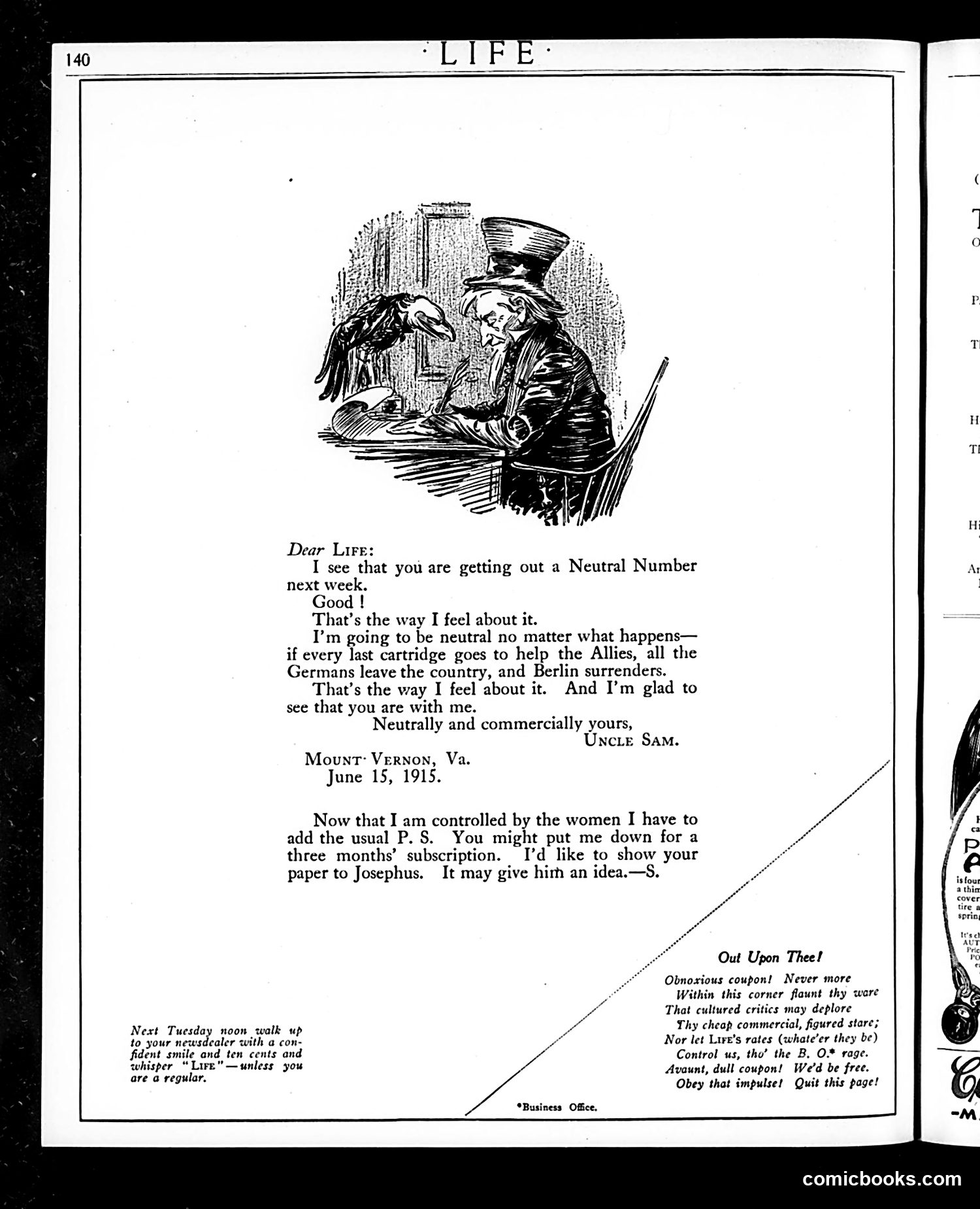
This page from *Life* magazine (June 15, 1915) satirizes American neutrality during World War I. A letter from "Uncle Sam" to *Life* magazine expresses support for remaining neutral while acknowledging his sympathy for the Allies against Germany and the Central Powers. The satire's point: Uncle Sam claims neutrality is his position, yet his language reveals clear bias—he hopes Germans will be defeated and Berlin will surrender. The accompanying illustration shows Uncle Sam conversing with a bird (likely an eagle, symbolizing America), reinforcing the hypocrisy. The post-script about "women" controlling him references women's suffrage activism and growing female influence on editorial policy during this period. The final verse mocks the contradiction between stated neutrality and actual sympathies, calling the position a false "coupon" that cannot truly bind the nation's preferences.
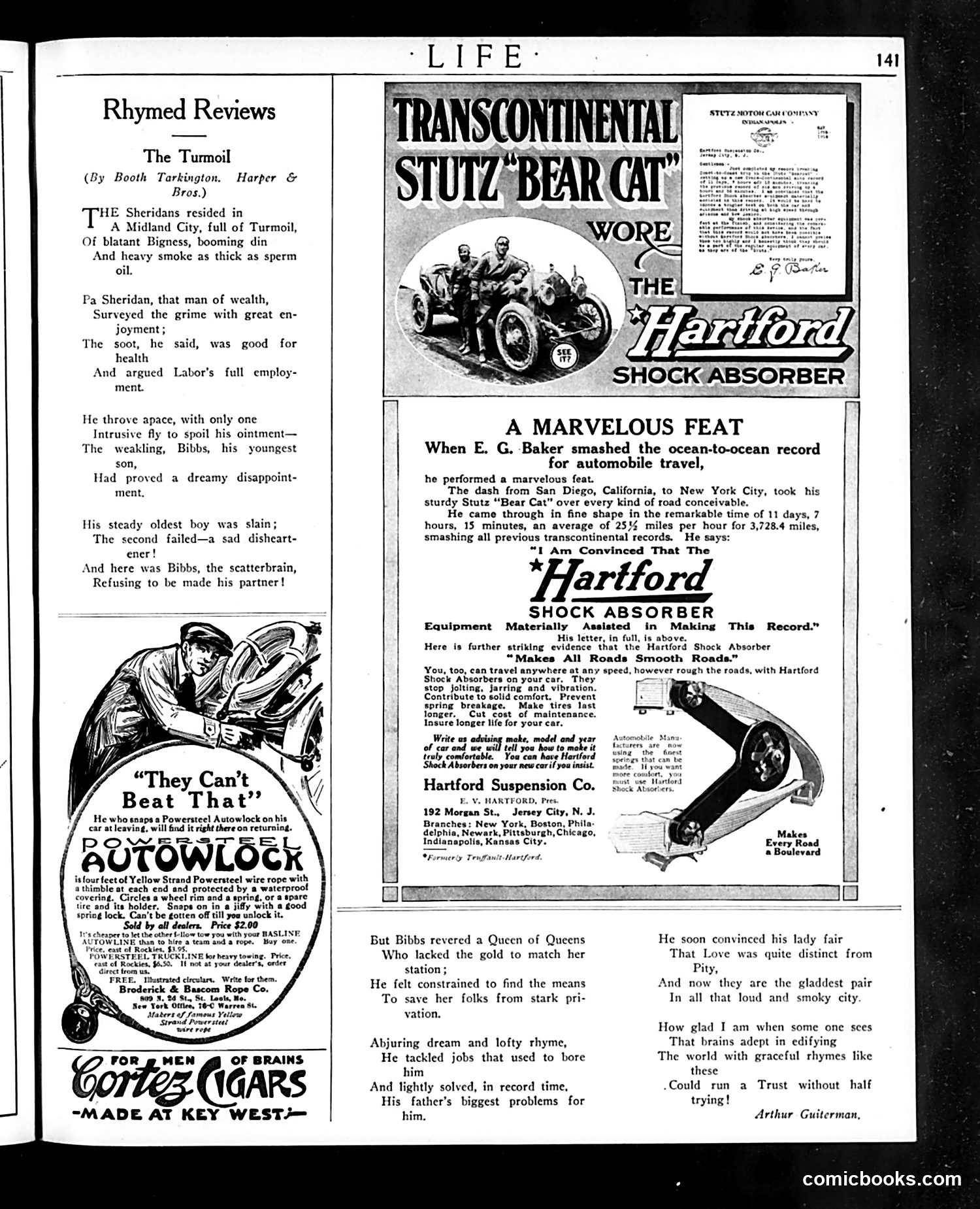
This page is predominantly **advertising** interspersed with light entertainment content rather than political satire. The left side features a "Rhymed Review" poem about *The Turmoil* by Booth Tarkington, narrating a businessman's family disappointments. Below is a "Powerlock" auto-lock advertisement with vintage illustration. The main content consists of **car advertisements**: a Stutz "Bear Cat" sports car and Hartford Shock Absorber promotions emphasizing E.G. Baker's transcontinental speed record. These ads stress product reliability and performance. The page concludes with the poem's continuation and a Cortez Cigars advertisement. There is **no political cartoon or satire**—this is a typical early 20th-century magazine page blending editorial content with commercial messaging, reflecting the era's advertising-heavy publication model.
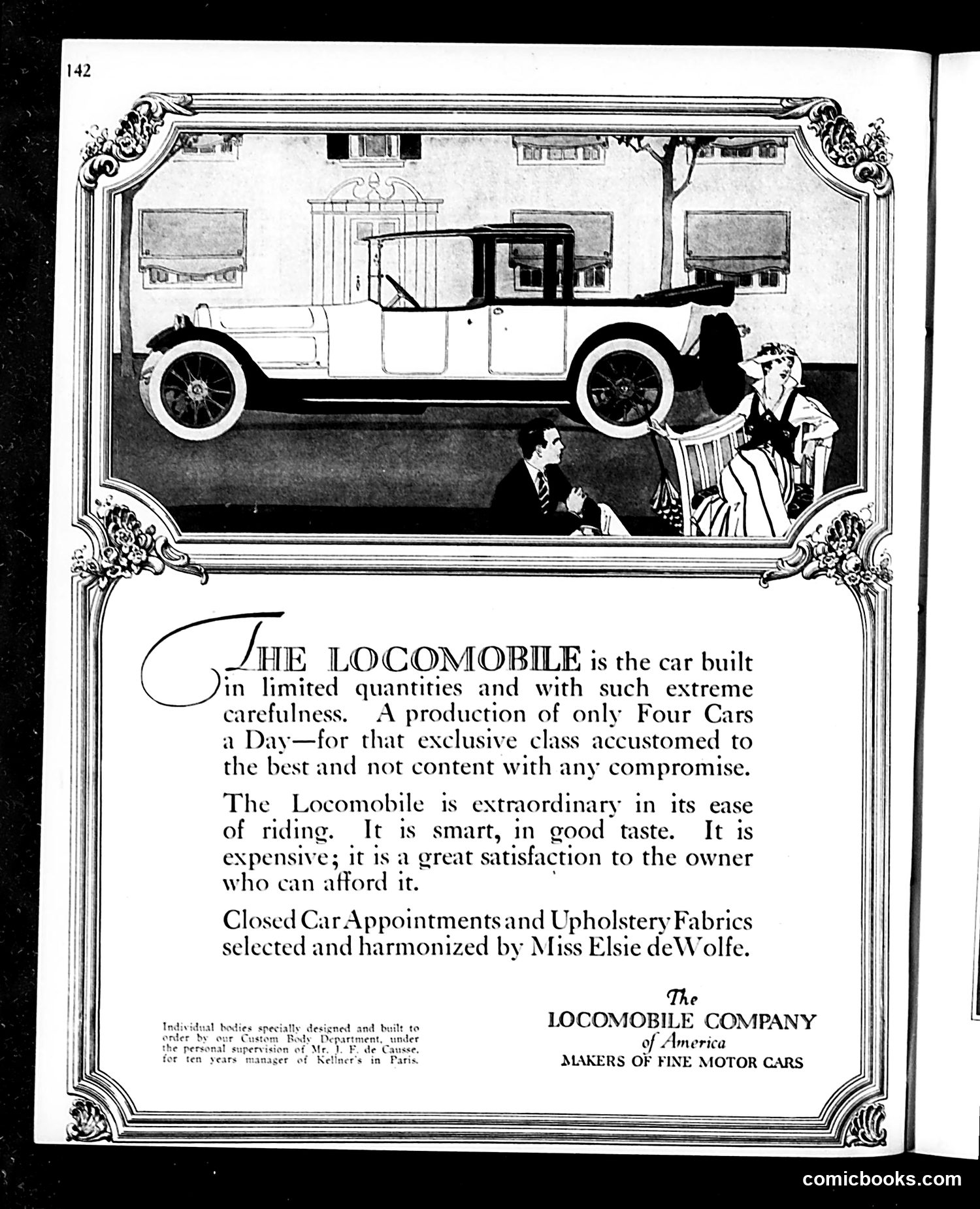
This page is primarily **a luxury automobile advertisement**, not a political cartoon. It advertises the Locomobile, a high-end American motorcar marketed to wealthy elites. The advertisement emphasizes exclusivity: production of only "Four Cars a Day" for "that exclusive class accustomed to the best." It highlights luxury features—ease of riding, smart design, expensive pricing—and notes that upholstery fabrics were "selected and harmonized by Miss Elsie deWolfe," a famous society decorator of the era. The illustration shows well-dressed figures (likely representing affluent customers) admiring the vehicle, reinforcing its status as a prestige purchase. This reflects early 20th-century marketing targeting the wealthy, where limited production and designer involvement signaled exclusivity and taste.
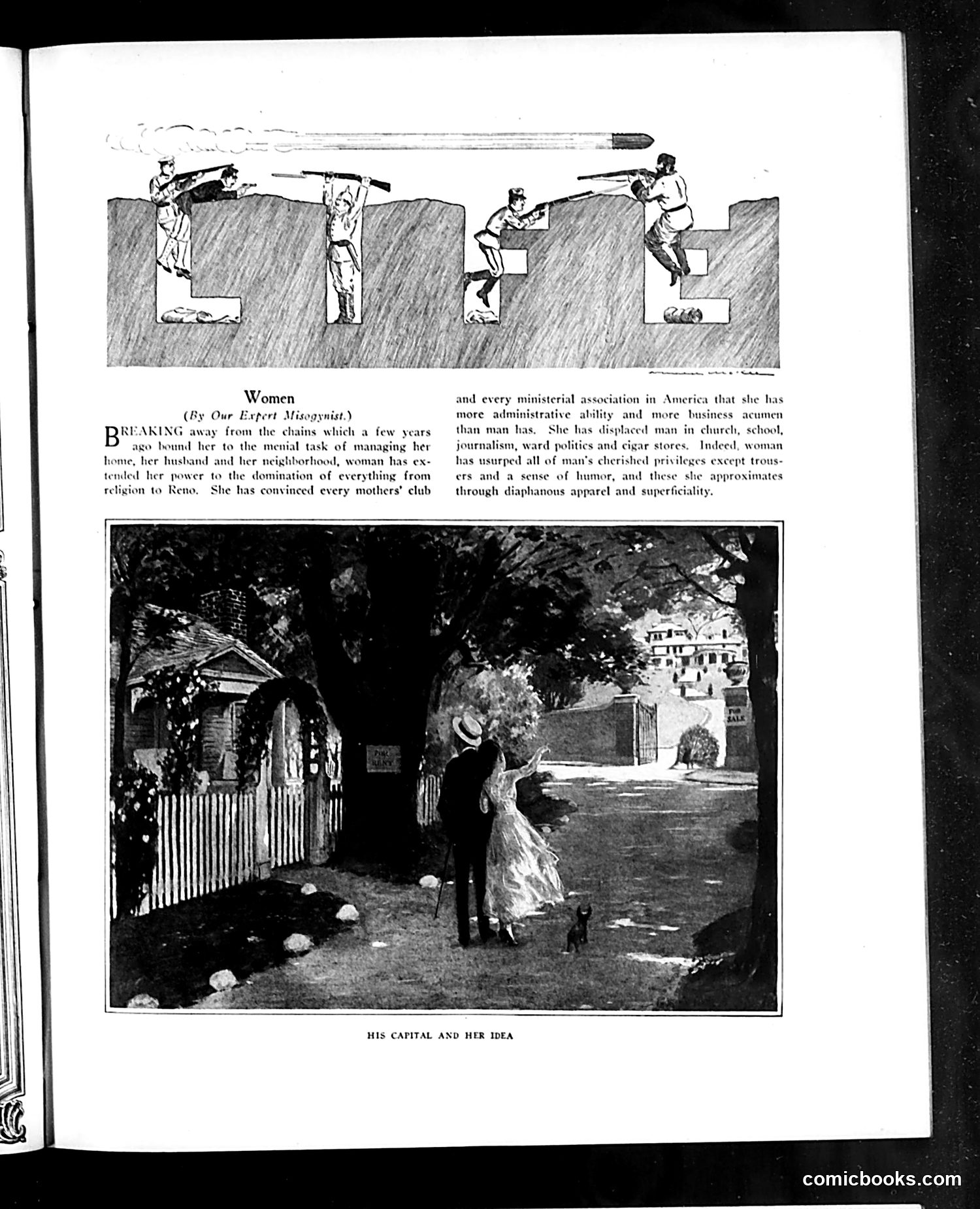
This page satirizes women's expanding social and political power in early 20th-century America. The top illustration shows women in various masculine roles—wielding rifles, conducting orchestras, and holding leadership positions—depicting them "breaking away from the chains" of domestic life. The text celebrates women's administrative competence, claiming they've surpassed men in church, school, journalism, and business management. It notes women possess "a sense of humor" and "dispassionate" judgment—qualities the text suggests distinguish them favorably. The photograph below, captioned "His Capital and Her Idea," appears to show a couple in a domestic or romantic setting, likely contrasting traditional gender roles with the empowered women depicted above. The overall message is ambiguous: it may praise women's achievements or satirize anxieties about shifting gender hierarchies during the suffrage era.
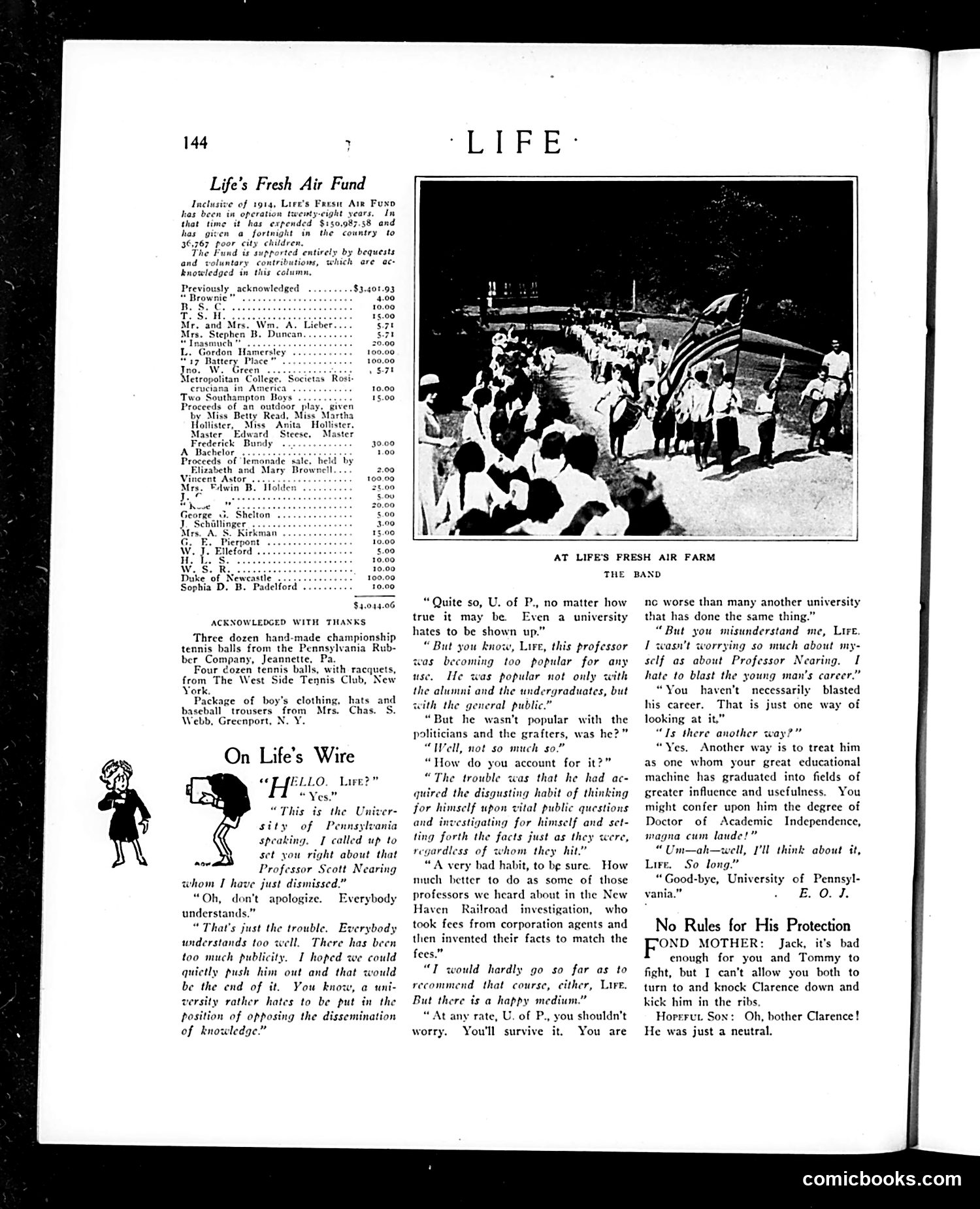
This small cartoon depicts a dialogue between two figures about a university professor's popularity problem. One character ("Life") counsels another ("Litt?") about Professor Scott Nearing, who apparently faced criticism for his public statements and activism. The joke centers on academic freedom versus institutional reputation. The professor became "too popular" with the general public and politicians due to his vocal positions on public questions—behavior the university found embarrassing. Life suggests the professor should either moderate his public engagement or accept the consequences. This appears to satirize tension between scholarly independence and institutional caution, a recurring 1910s-1920s controversy when academics faced dismissal for controversial speech.
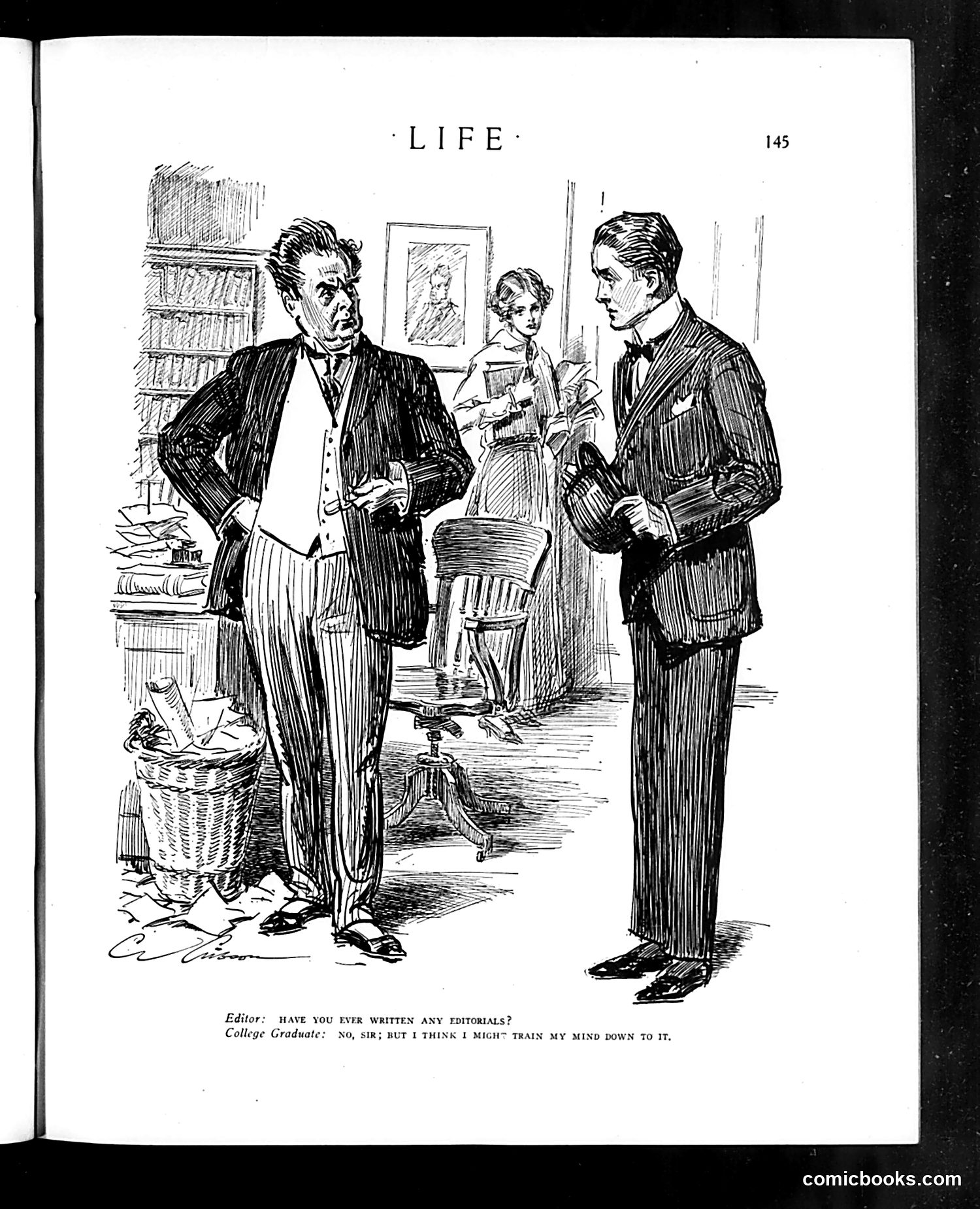
This cartoon satirizes the pretensions of recent college graduates. An editor interviews a young graduate applying for a job, asking if he's written editorials. The graduate's response—"No, sir; but I think I might; train my mind down to it"—reveals his arrogance: he considers editorial writing beneath his current intellectual level and assumes he could easily do it with minimal effort. The joke targets the overconfidence of newly educated young men who believed their diplomas qualified them for important work without practical experience. The editor's skeptical expression suggests he finds this attitude ridiculous. The cartoon mocks both the graduate's inflated ego and the cultural assumption that a college degree automatically conferred superior judgment and capability.
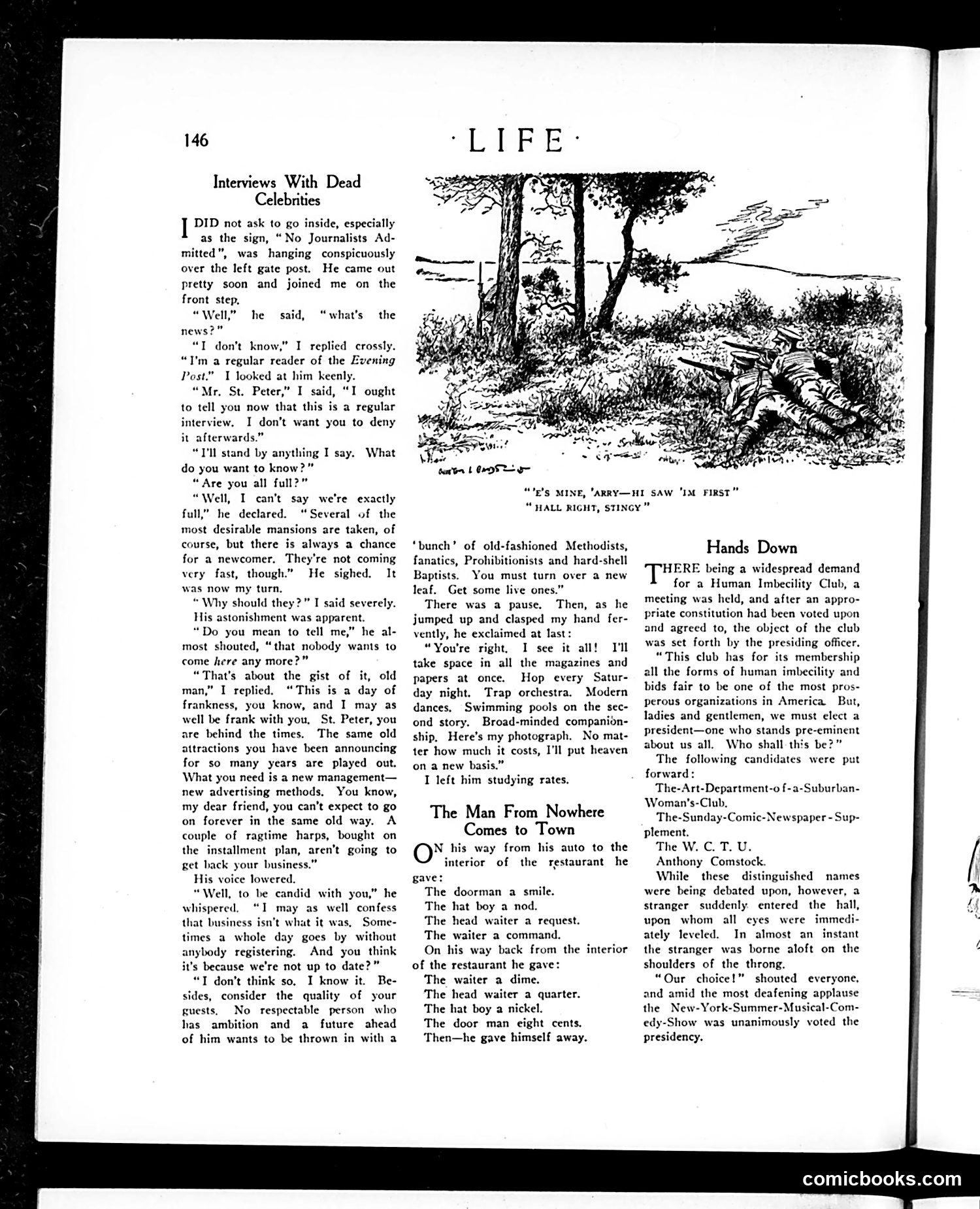
This page contains two separate satirical pieces. The main content discusses "Interviews With Dead Celebrities," mocking pretentious journalism. The narrator interviews "Mr. St. Peter" about exclusive access to the afterlife, satirizing sensationalist newspaper practices and reporters' attempts to secure novel stories. The illustrated section titled "The Man From Nowhere Comes to Town" appears to be a humorous poem about a restaurant visitor's journey, with each action generating increasingly modest monetary tips (smile, nod, request, command, interior view, dime, quarter, nickel, eight cents). The joke satirizes the expectation and calculation of gratuities. The right column announces a "Human Interest Club" meeting, listing member organizations that suggest upper-middle-class women's civic groups popular in that era.
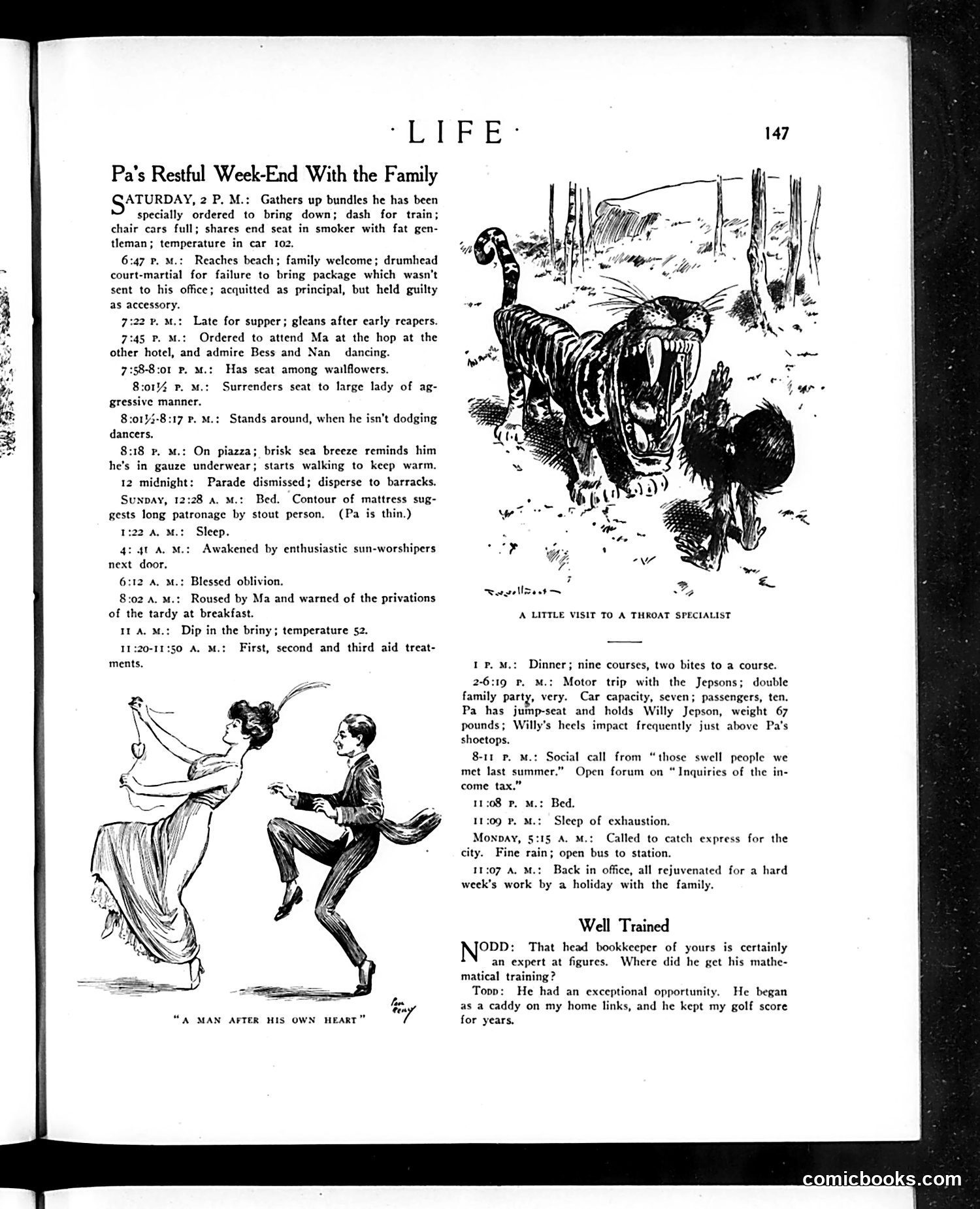
This satirical piece humorously chronicles a father's weekend, contrasting the title's promise of "rest" with constant domestic chaos. The detailed timeline shows Pa dealing with family demands—bringing children home, attending social events, managing seat disputes, eating late, attending dances, dealing with beach crowds, and enduring various interruptions. The accompanying sketches depict: a couple dancing (labeled "A Man After His Own Heart"), and "A Little Visit to a Throat Specialist"—showing goats, likely illustrating the noise and disorder Pa endures. The satire mocks early 20th-century middle-class family life, suggesting that weekend leisure for fathers meant not relaxation but exhausting social obligations, family management, and constant commotion. The joke: Pa's "restful" weekend is anything but.
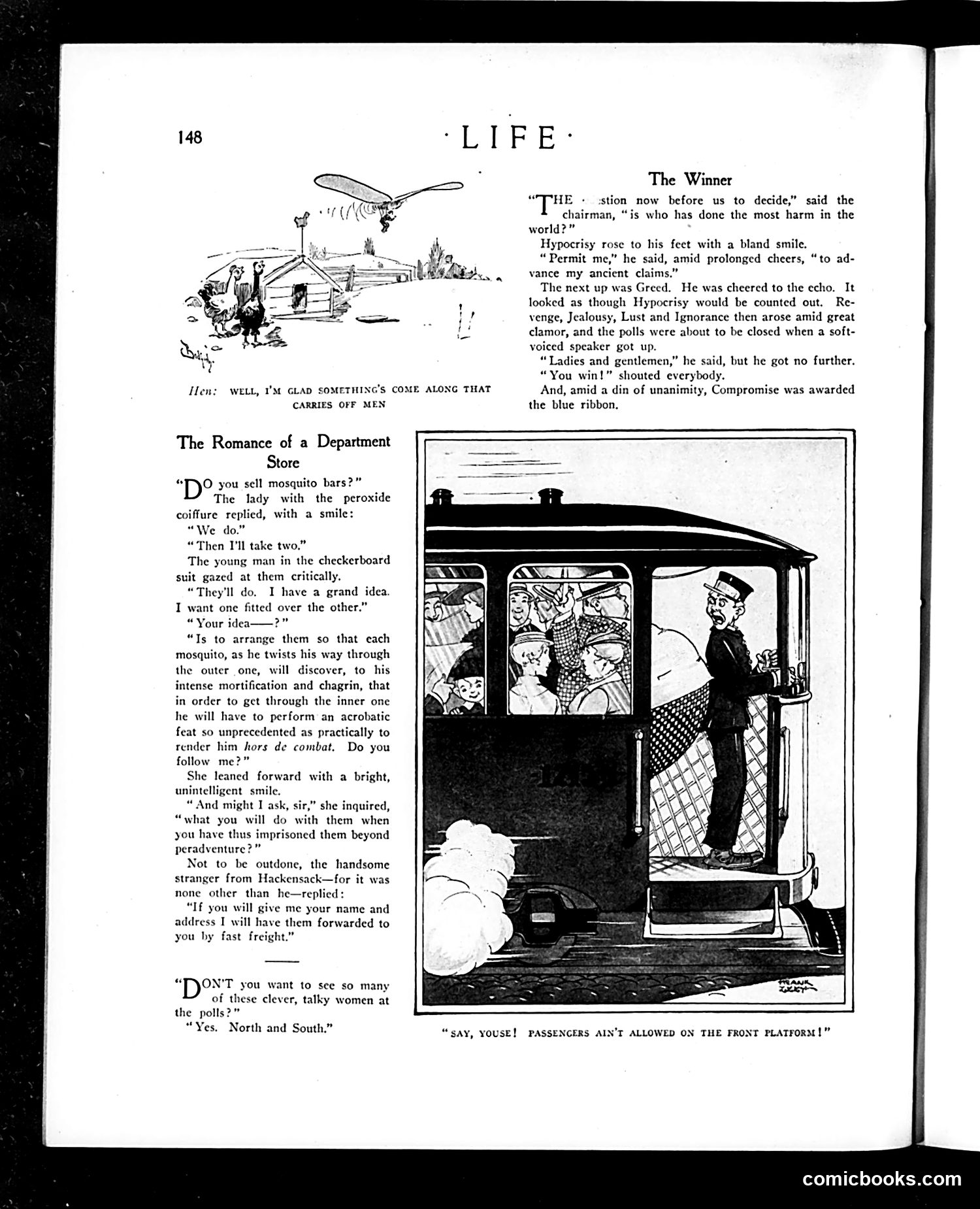
This page contains two distinct pieces of humor: **"The Winner"** (top): An allegorical cartoon depicting personified vices (Hypocrisy, Greed, Jealousy, Lust, Ignorance) competing in some kind of contest. Hypocrisy emerges victorious and receives a blue ribbon, while Compromise receives an award as runner-up. The satire suggests that hypocrisy "wins" in worldly affairs—a cynical commentary on human nature and society's actual values versus professed ones. **"The Romance of a Department Store"** (bottom): A humorous dialogue between a salesman and customer about mosquito bars (mesh netting), escalating into absurdist physical comedy involving acrobatic feats. The accompanying cartoon shows a crowded streetcar with a conductor enforcing platform rules—likely satirizing urban transportation overcrowding and petty regulations of the era.
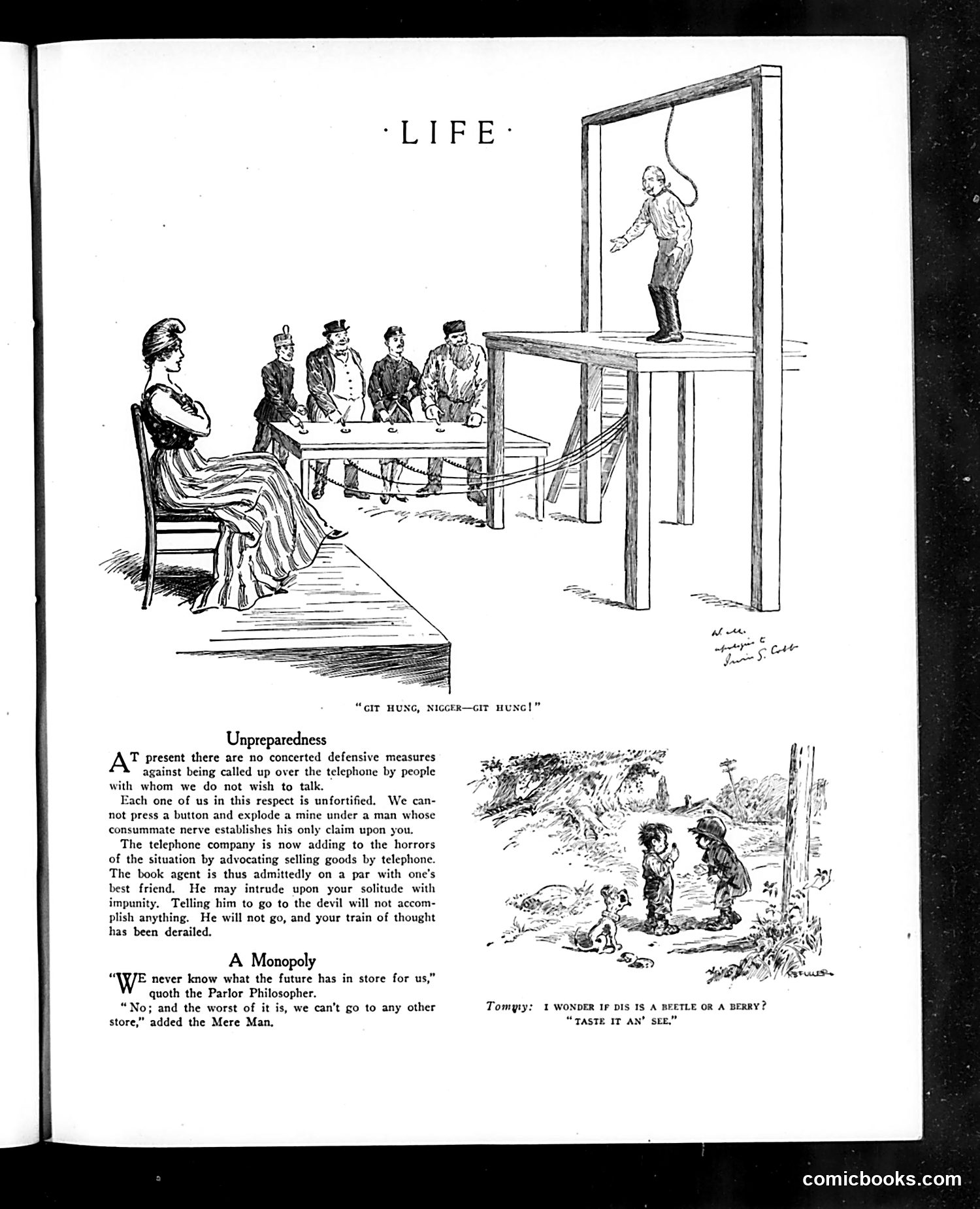
This page from *Life* magazine contains two satirical pieces: **Top cartoon** ("Git Hung, Nigger—Git Hung!"): Depicts an execution scene where a woman watches a man about to be hanged. The crude caption suggests lynching violence, likely satirizing either actual lynching or violent rhetoric of the era. **"Unpreparedness"**: Criticizes lack of defensive measures against unwanted solicitation. It mocks both aggressive sales tactics (pressing buttons, mine explosions as metaphors) and telephone companies' new practice of selling goods by phone, presented as invasive and unstoppable. **"A Monopoly"**: A brief dialogue joke about monopolistic business practices—the "Mere Man" notes that consumers have no choice of alternative stores, trapping them. The bottom illustration shows children discovering something outdoors, with Tommy asking if it's a beetle or berry. Without knowing the specific publication date, the exact historical context remains unclear.
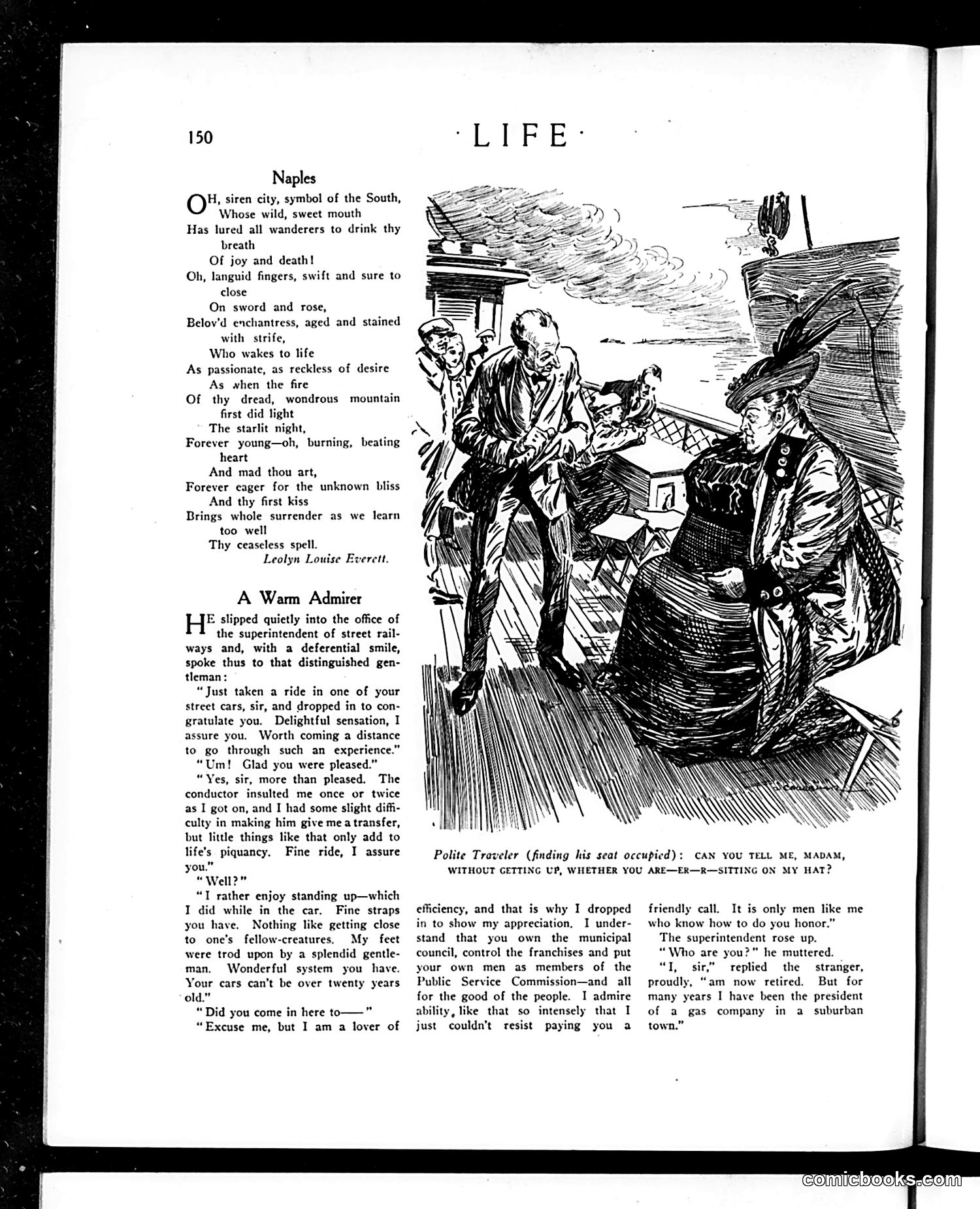
This satirical piece depicts a man entering a street railway superintendent's office to congratulate him on a pleasant trolley ride experience. The humor lies in the contrast: the visitor praises the conductor for giving him a transfer and general politeness—"little things" he says add to life's pleasantness. The superintendent, however, responds with skepticism, noting the cars are twenty years old and questioning why the man came in just to praise routine service. The satire targets the low expectations for public transit service—a rider is so shocked by basic competence and courtesy that he feels compelled to formally commend it. This reflects early-20th-century frustrations with urban transportation quality and worker indifference.
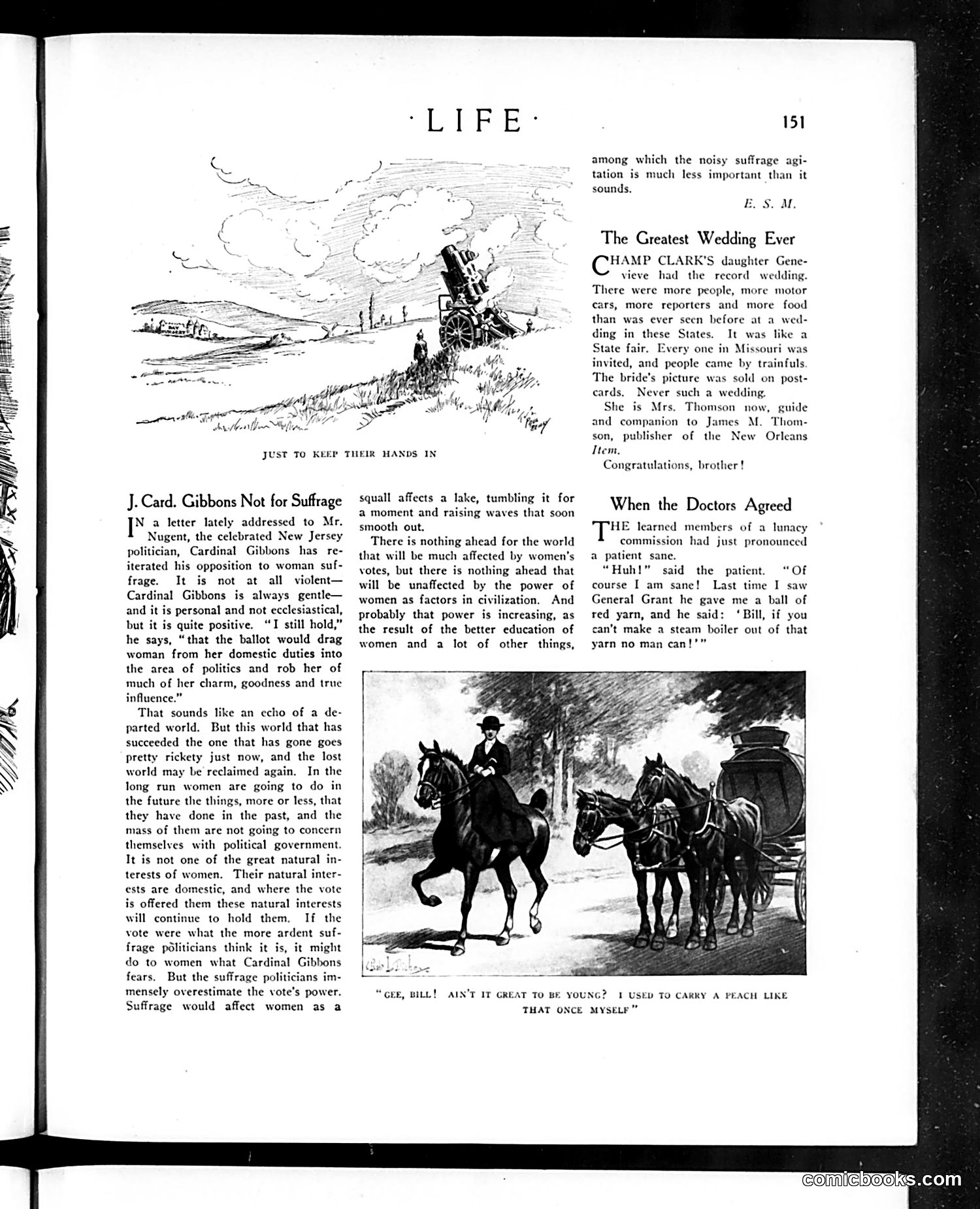
This page contains three separate pieces: 1. **"The Greatest Wedding Ever"** announces Champ Clark's daughter's wedding—a massive society event with trains, cars, and postcards, satirizing the scale of high-society celebrations. 2. **"J. Card. Gibbons Not for Suffrage"** critiques Cardinal Gibbons's opposition to women's suffrage. The text argues his concerns about women's political power are exaggerated, and that women's natural interests in domestic welfare should logically extend to voting rights. The satire mocks his paternalistic reasoning. 3. **"When the Doctors Agreed"** (bottom) is an illustrated anecdote about a patient and General Grant, with accompanying sketch showing a man on horseback. The joke's specific point is unclear from visible text. The page reflects early 20th-century debates over suffrage and women's rights.
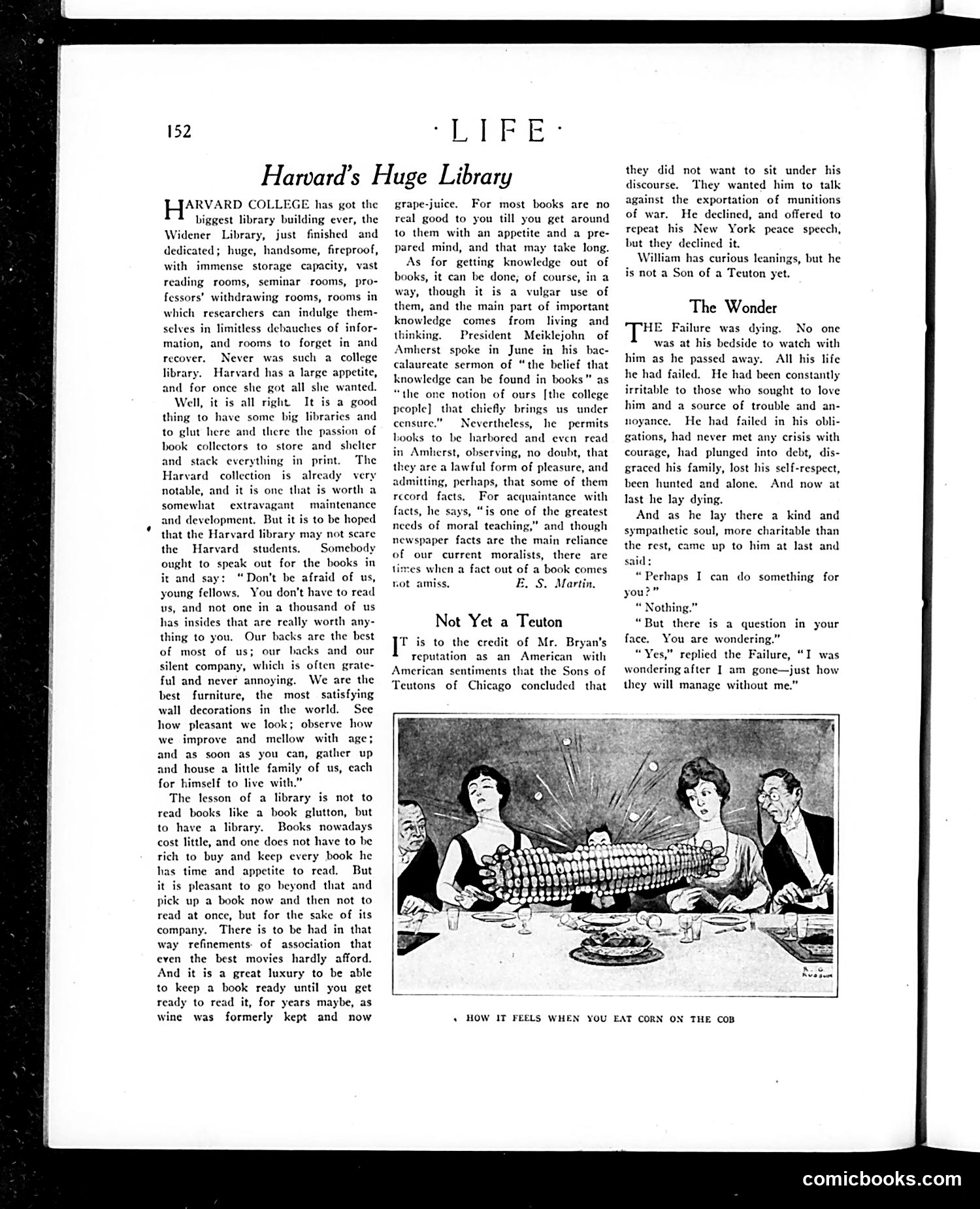
This page contains three distinct pieces of satirical commentary: **"Harvard's Huge Library"** mocks Harvard's massive new Widener Library by suggesting students shouldn't fear the books—they're merely decorative furniture. The satire critiques both academic pretension and the notion that simply owning books conveys knowledge. Author E.S. Martin argues books are best as companions and wall decorations rather than sources of practical learning. **"Not Yet a Teuton"** references William Bryan (likely William Jennings Bryan, the prominent political figure), who refused to speak against munitions exportation to Chicago's German-American ("Teuton") community. The satire mocks Bryan's inconsistency: he offered his New York peace speech instead, suggesting his pacifism was selective or performative. The title's pun—"not yet a Teuton"—implies he's not truly aligned with German-American interests. **The cartoon** illustrates "How It Feels When You Eat Corn on the Cob"—a humorous domestic scene showing the messy, awkward experience of eating corn.
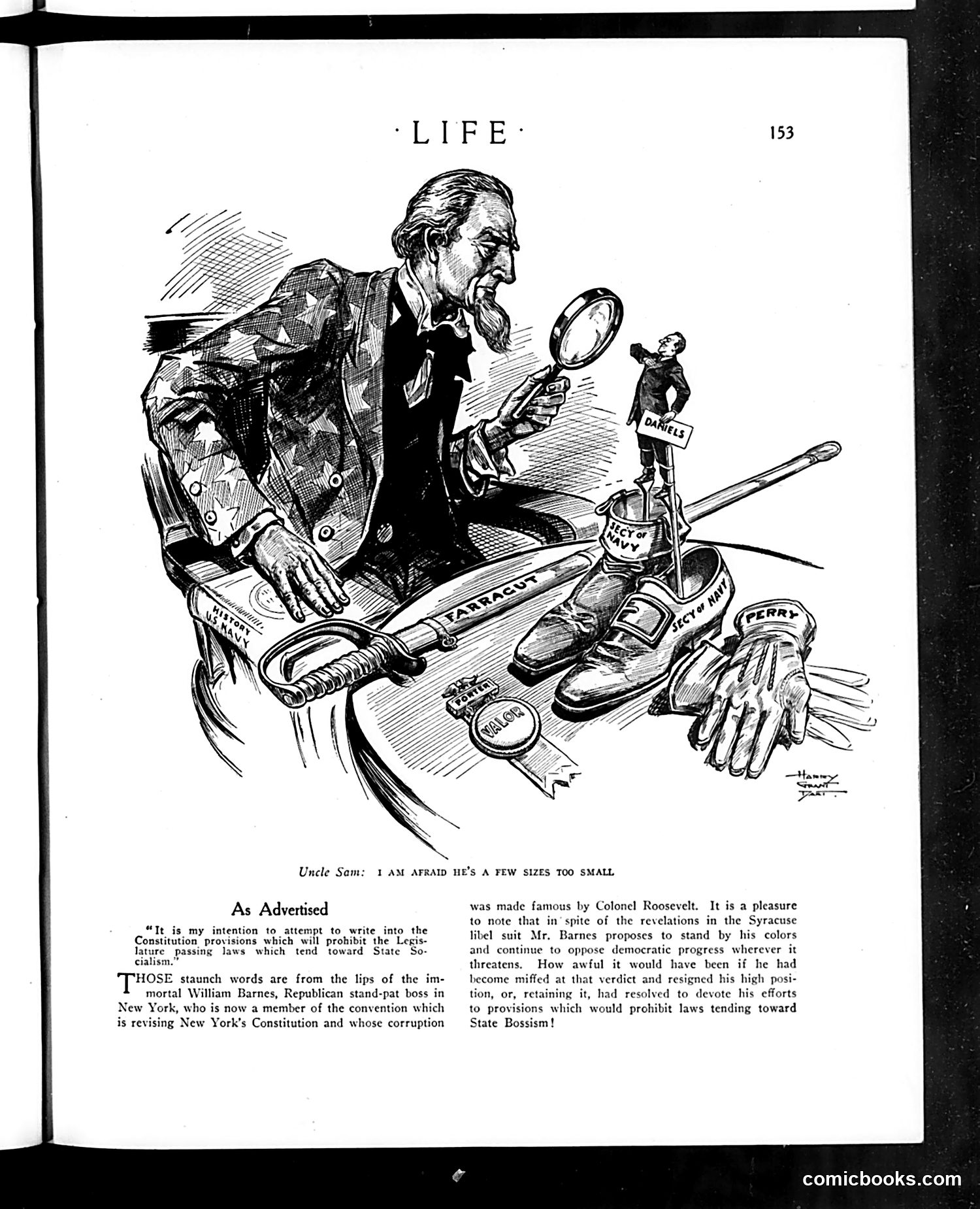
This Life magazine cartoon satirizes **William Barnes**, a corrupt Republican political boss in New York who was involved in a notorious libel suit with Colonel Theodore Roosevelt. The cartoon shows Uncle Sam as a tailor, examining Barnes (depicted as a tiny figure) against various consumer products laid out on a table—suggesting Barnes is being measured and found inadequate. The satire's point: Despite his public statements opposing "State Socialism" and defending constitutional conservatism, Barnes is exposed as a hypocrite. The caption's irony ("I AM AFRAID HE'S A FEW SIZES TOO SMALL") mocks his moral stature. The article beneath sarcastically notes how convenient it is that this corrupt figure—made infamous by Roosevelt—continues opposing "democratic progress" rather than resigning in shame. The cartoon criticizes machine politics and oligarchic control masquerading as constitutional principle.
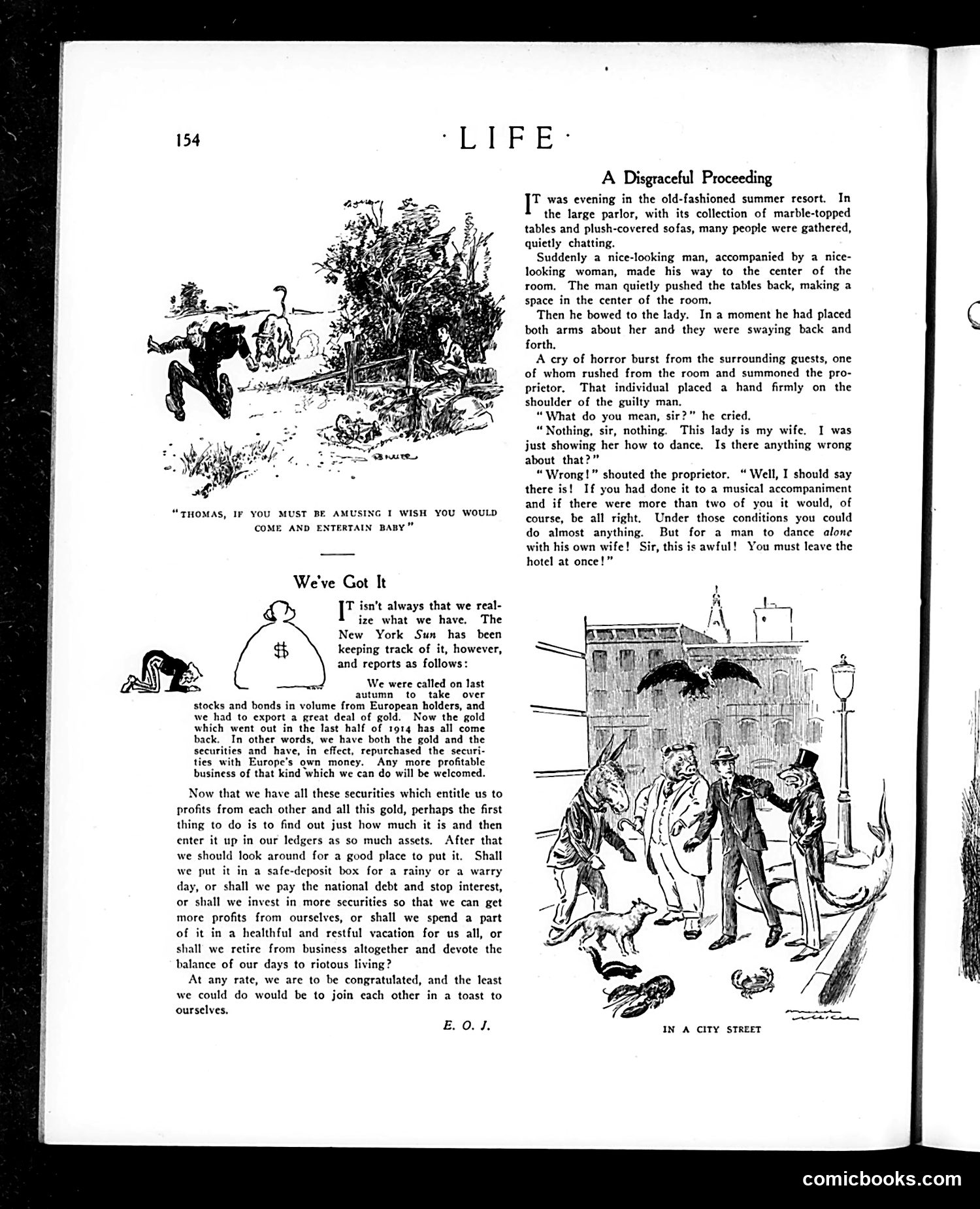
This satirical story mocks the rigid social conventions of the early 20th-century leisure class. A couple dancing alone together at a summer resort provokes outrage from guests and the proprietor—not because dancing itself is improper, but because it violates specific social rules: it lacks musical accompaniment and involves only two people instead of a group. The proprietor's response—that the same behavior would be "all right" with a orchestra and more dancers—exposes the absurdity of arbitrary social etiquette. The satire suggests that upper-class respectability depends not on genuine morality but on conforming to meaningless formalities. A husband and wife dancing intimately is deemed "awful," while identical movements become acceptable merely by adding external trappings. The joke targets how Victorian-era social arbiters prioritized appearance and ritual over substance or genuine propriety.
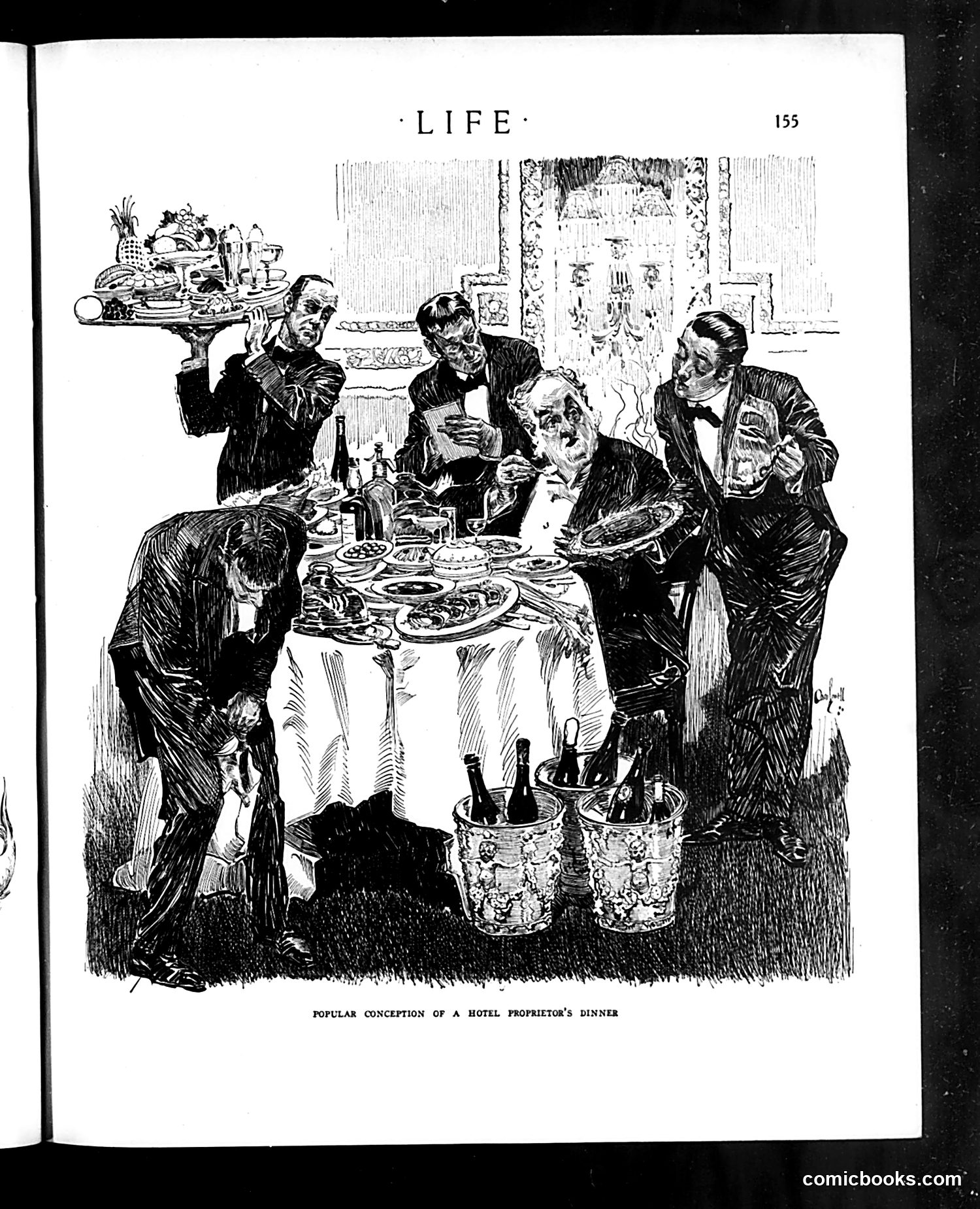
This satirical illustration from *Life* magazine depicts a wealthy hotel owner hosting a lavish dinner. The cartoon mocks the "popular conception" of such an event—showing servants attending to well-dressed gentlemen around a table laden with food, wine bottles in ice buckets, and elaborate place settings. The satire appears to target the ostentatious wealth and class hierarchy of the Gilded Age hotel industry. The contrast between the formally-dressed diners and the servants emphasizes the social stratification. The exaggerated abundance of food and drink suggests excess and self-indulgence by the proprietor class. The humor relies on viewers recognizing this as an idealized or stereotypical vision of high-society dining, likely critiquing both the wealth disparity and the pretensions of the era's wealthy hotel magnates.
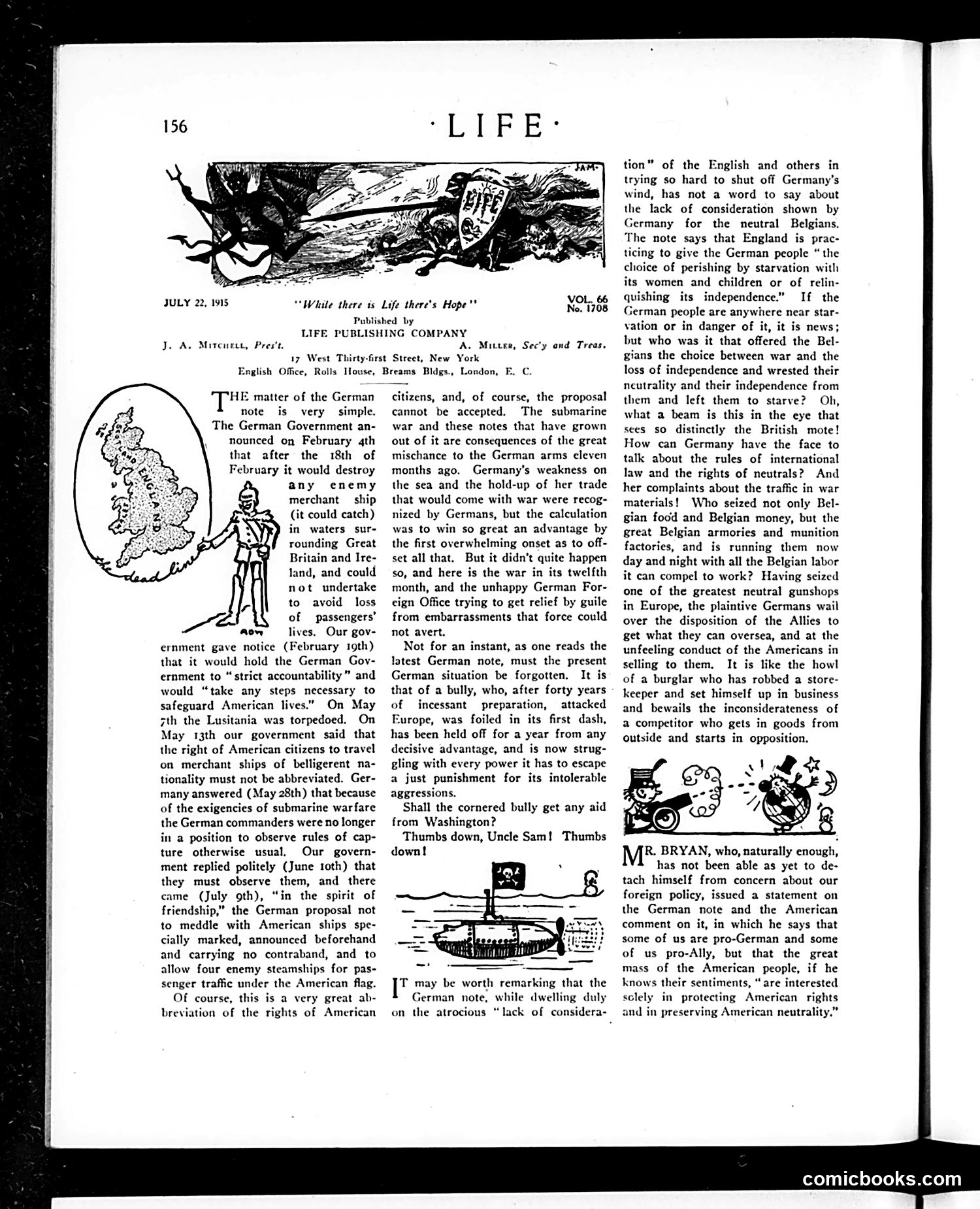
This page addresses the escalating diplomatic crisis between America and Germany over submarine warfare. The cartoon shows **Britain** (depicted as a soldier) trapping **Germany** (the trapped figure in the oval) while Uncle Sam watches. The text details Germany's February 1915 threat to sink merchant ships around Britain, the May sinking of the *Lusitania*, and subsequent diplomatic notes. Germany's latest proposal offers to spare American-marked ships if they carry no contraband—which Life's editors call an unacceptable "abbreviation of rights." The editorial characterizes Germany as **a bully who attacked Europe, failed in its initial assault, and now uses diplomatic "guile" to escape justified punishment**. The writer particularly criticizes Germany's hypocrisy: complaining about British treatment while ignoring its own violation of Belgian neutrality. The final verdict—"Thumbs down, Uncle Sam!"—urges American rejection of Germany's proposal, reflecting pre-1917 American debate over neutrality and maritime rights.
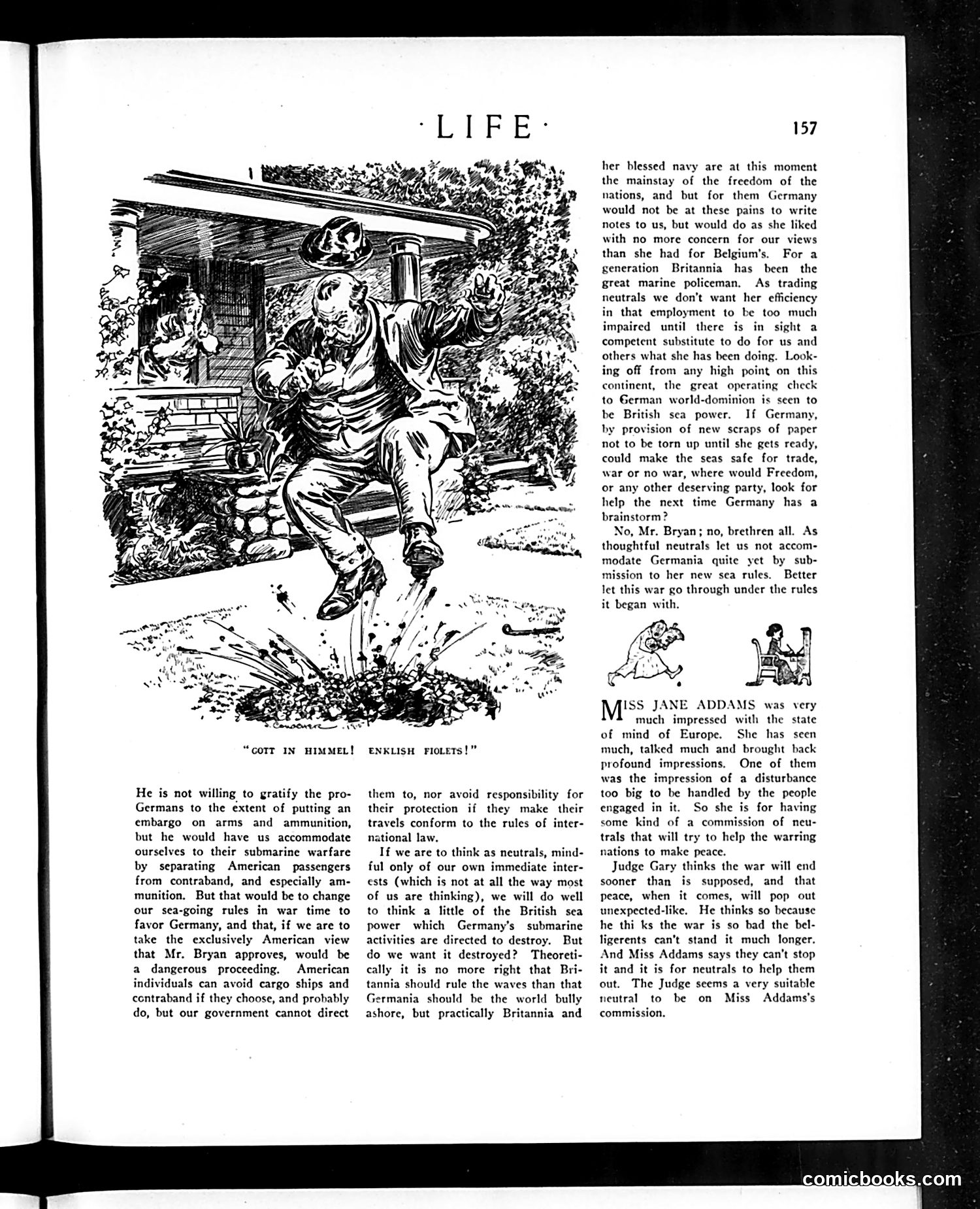
This page addresses American neutrality during World War I, likely 1915-1916. The cartoon shows a German soldier stepping on a mine labeled "GOTT IN HIMMEL! ENGLISH FIOLETS!" (God in heaven! English violets!)—a dark joke about German casualties inflicted by British naval power. The text debates whether the U.S. should accommodate German submarine warfare by separating American passengers from munitions shipments. The author argues against appeasing Germany, contending that British naval superiority currently protects neutral trade and freedom. They criticize Secretary of State William Jennings Bryan (referenced as "Mr. Bryan") for suggesting such accommodations. The page also mentions Jane Addams and Judge Gary's views on ending the war through neutral mediation—positioning them as somewhat naive about the conflict's intractability. The satire mocks both German aggression and American isolationist tendencies, while defending British sea power as a practical necessity for international order.
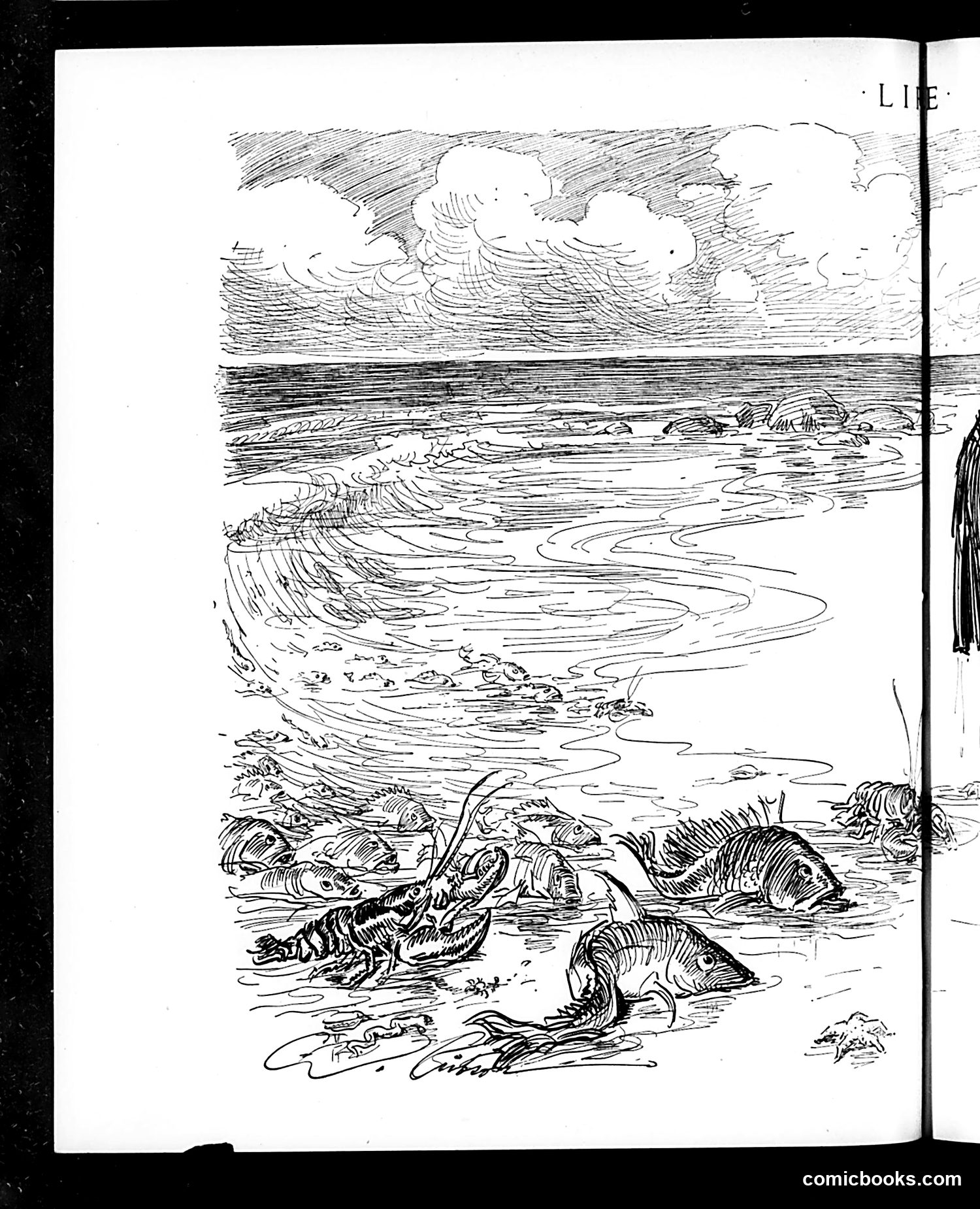
This is a satirical illustration from *Life* magazine showing a beach or shoreline scene populated with various crustaceans and sea creatures. The drawing appears to be social or political satire using anthropomorphized marine life as stand-ins for human figures or social types. The creatures—depicted with detailed cross-hatching in a naturalistic style—seem to represent different classes or groups engaging in beach activities. The elaborate rendering of their shells and forms suggests mockery of human pretension or social hierarchy through animal representation, a common *Life* magazine technique. However, **without additional context or visible text identifying specific figures**, I cannot definitively state which contemporary political or social issues this cartoon references. The satire's specific target remains unclear from the image alone.
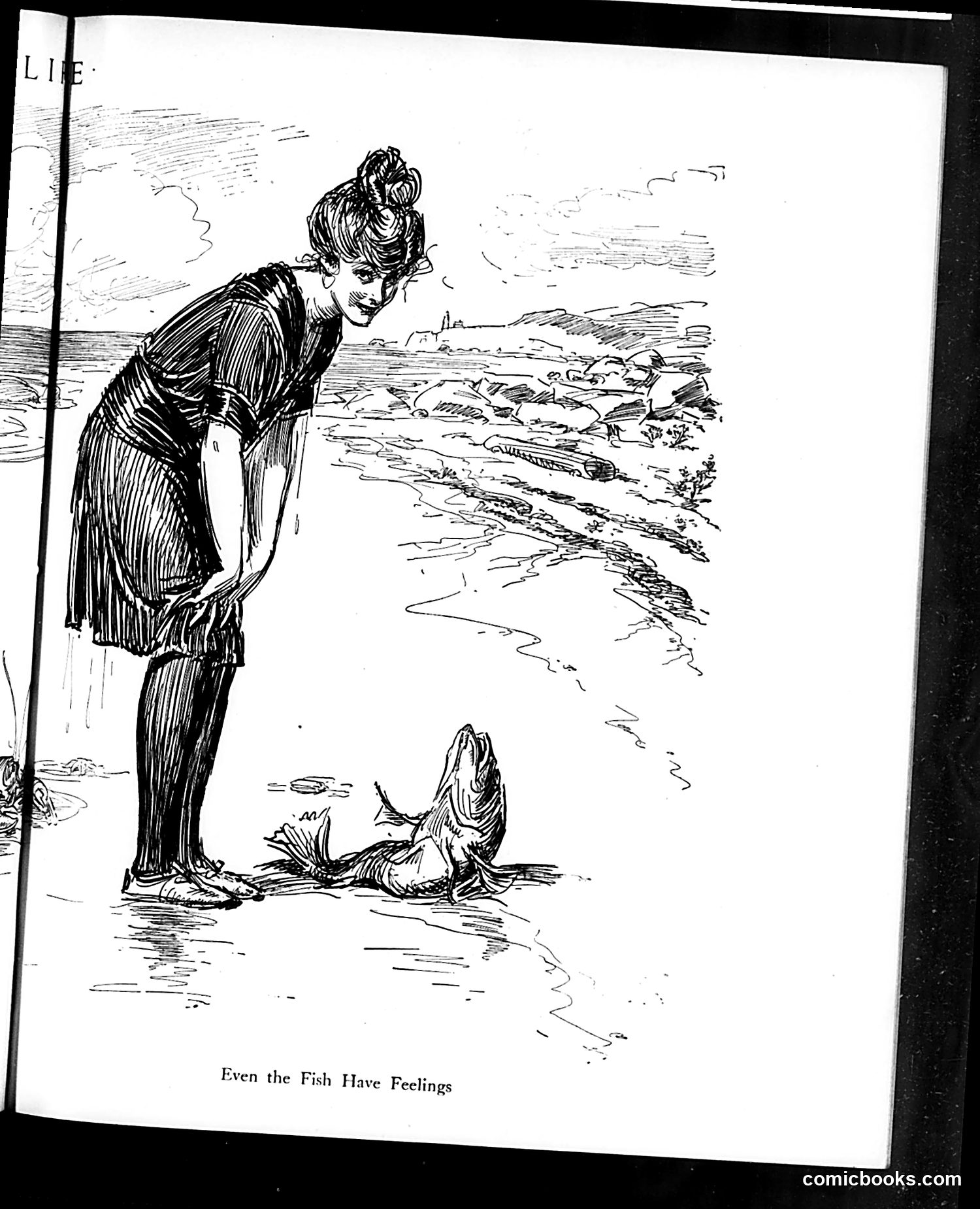
This Life magazine illustration depicts a well-dressed woman standing over a caught fish in shallow water, looking down at it with apparent concern or sympathy. The caption suggests ironic commentary on sentimentality toward animals. The cartoon likely satirizes early 20th-century attitudes about animal welfare or the growing trend of women expressing emotional concern for creatures. The woman's fashionable appearance and posture—bending to observe the fish—contrasts with the practical reality of fishing, suggesting the cartoon mocks excessive or performative compassion, particularly among upper-class women who might philosophize about animal feelings while engaging in activities that harm them. The satire critiques the gap between professed sentiment and actual behavior.
This is a short story contest entry (paying 10 cents per word) exploring ethnic and religious prejudice in early New Mexico settlement. The narrative contrasts two merchants in a boom town: **Ah Sin**, a Chinese-American (termed "Celestial" — a period term for Chinese immigrants) who operates an honest, established general store, versus **Moses**, a Jewish entrepreneur who opens a flashy competitor with aggressive marketing ("Golden Rule Emporium"). When Moses's novelty attracts customers away from Ah Sin's business, the Chinese storekeeper attributes his misfortune to Christian religious doctrine — reflecting period stereotypes about Jewish commercial success and Christian moral weakness. The story appears to satirize American racial/religious hierarchies and commercial competition in the early West, though the satire's target and ultimate message remain ambiguous from this excerpt alone.
This is a spy-thriller story, not a political cartoon. The narrative concerns wartime espionage during what appears to be WWI-era America. The plot involves **Max Steuler**, a man of German heritage (indicated by his accent), who is revealed to be a spy passing military secrets—specifications for the Wright Multiplane, Maxim Chlorine Shell, and a submarine—to enemy agents. **Barclay Norris**, a Secret Service official and old friend, confronts Steuler privately, offering him a chance to return the stolen documents and escape before arrest. When cornered, Steuler admits his guilt and shoots Norris. The story plays on contemporary anxieties about German spies and saboteurs operating within America during WWI, and explores the conflict between personal loyalty and patriotic duty. Steuler's character represents the "foreign element" suspected of undermining national security.
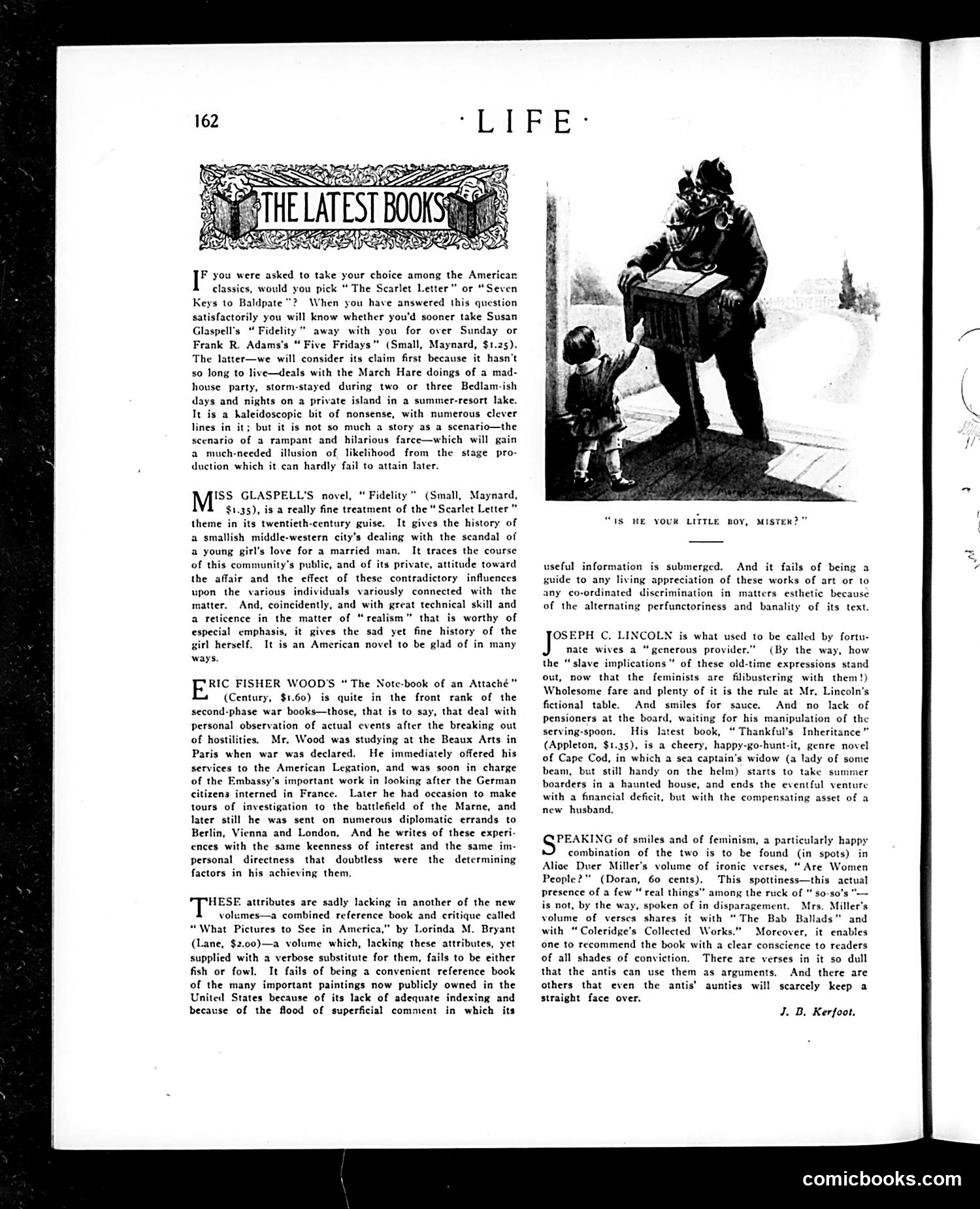
This page from *Life* magazine is a book review section titled "The Latest Books." The content consists of literary criticism rather than political satire or cartoons. The single illustration—captioned "Is he your little boy, mister?"—shows an adult and child in period clothing, likely accompanying a review of Frank R. Adams's novel *Five Fridays*, described as a "rampant and hilarious farce" set during a chaotic house party on a private island. The page reviews four books: Adams's *Five Fridays*, Susan Glaspell's *Fidelity* (compared favorably to *The Scarlet Letter*), Eric Fisher Wood's WWI-era *The Note-book of an Attaché*, and Lorinda M. Bryant's art guide *What Pictures to See in America* (criticized as poorly indexed). The brief aside about Joseph C. Lincoln contains period-specific social commentary—the reviewer humorously notes how outdated expressions like "generous provider" now seem to carry troubling implications in light of contemporary feminist activism.
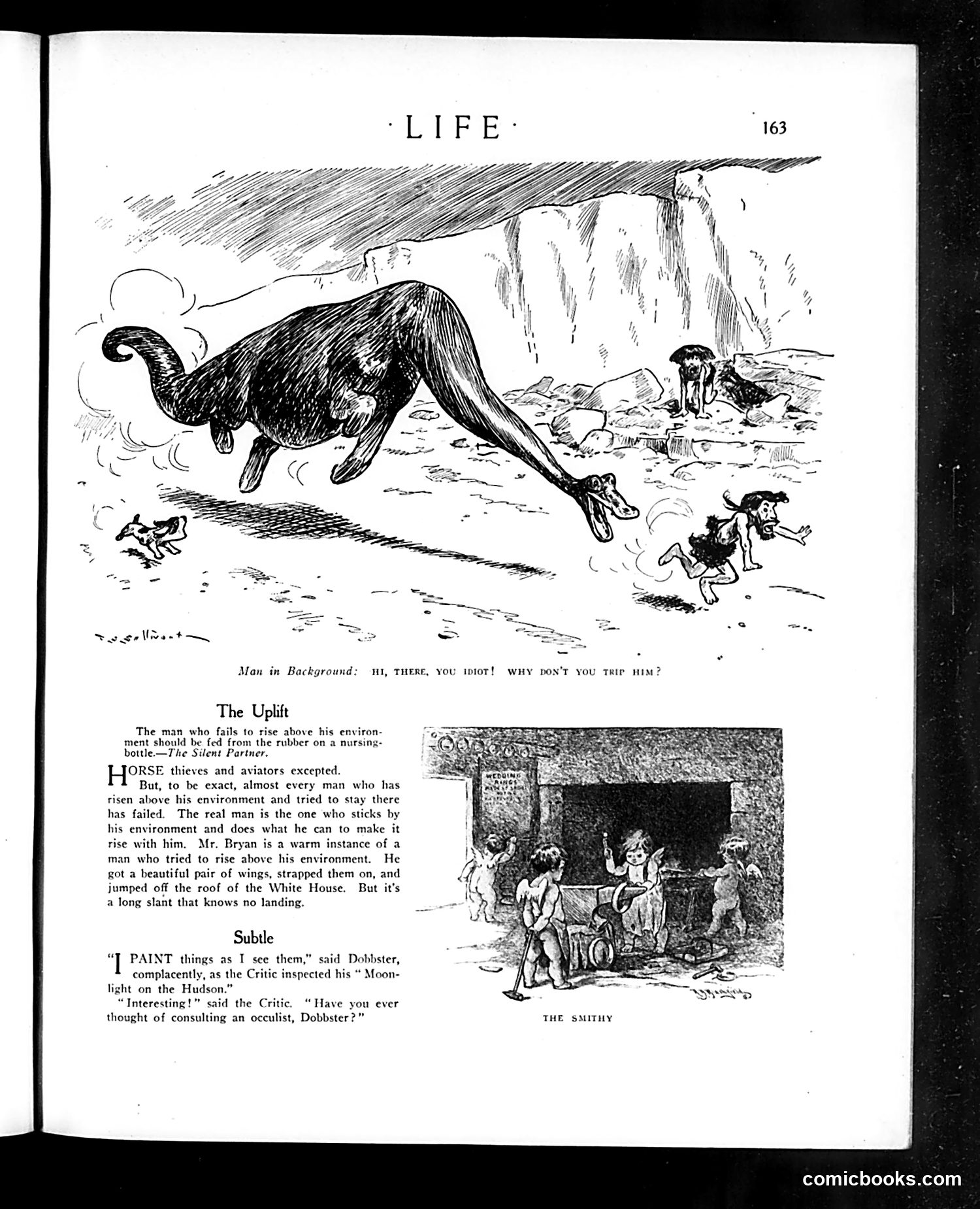
This *Life* magazine page contains satirical commentary on ambition and self-deception. **"The Uplift"** mocks William Jennings Bryan (the three-time presidential candidate), depicting him as someone who attempted to rise above his origins but failed spectacularly—metaphorically jumping off the White House roof with improvised wings. The text argues that truly admirable men improve their circumstances *without* abandoning their roots, unlike Bryan's failed attempts at elevation. **"Subtle"** is a brief art-world joke: a self-satisfied painter named Dobbster claims to paint what he sees, but a critic responds sarcastically that he should consult an eye doctor, implying his artistic vision is fundamentally flawed or delusional. The top cartoon shows a large dog being tripped by smaller dogs while a man shouts encouragement—likely commentary on mob mentality or schadenfreude, though the specific reference is unclear. The overall theme: pretension, failed ambition, and self-delusion deserve ridicule.
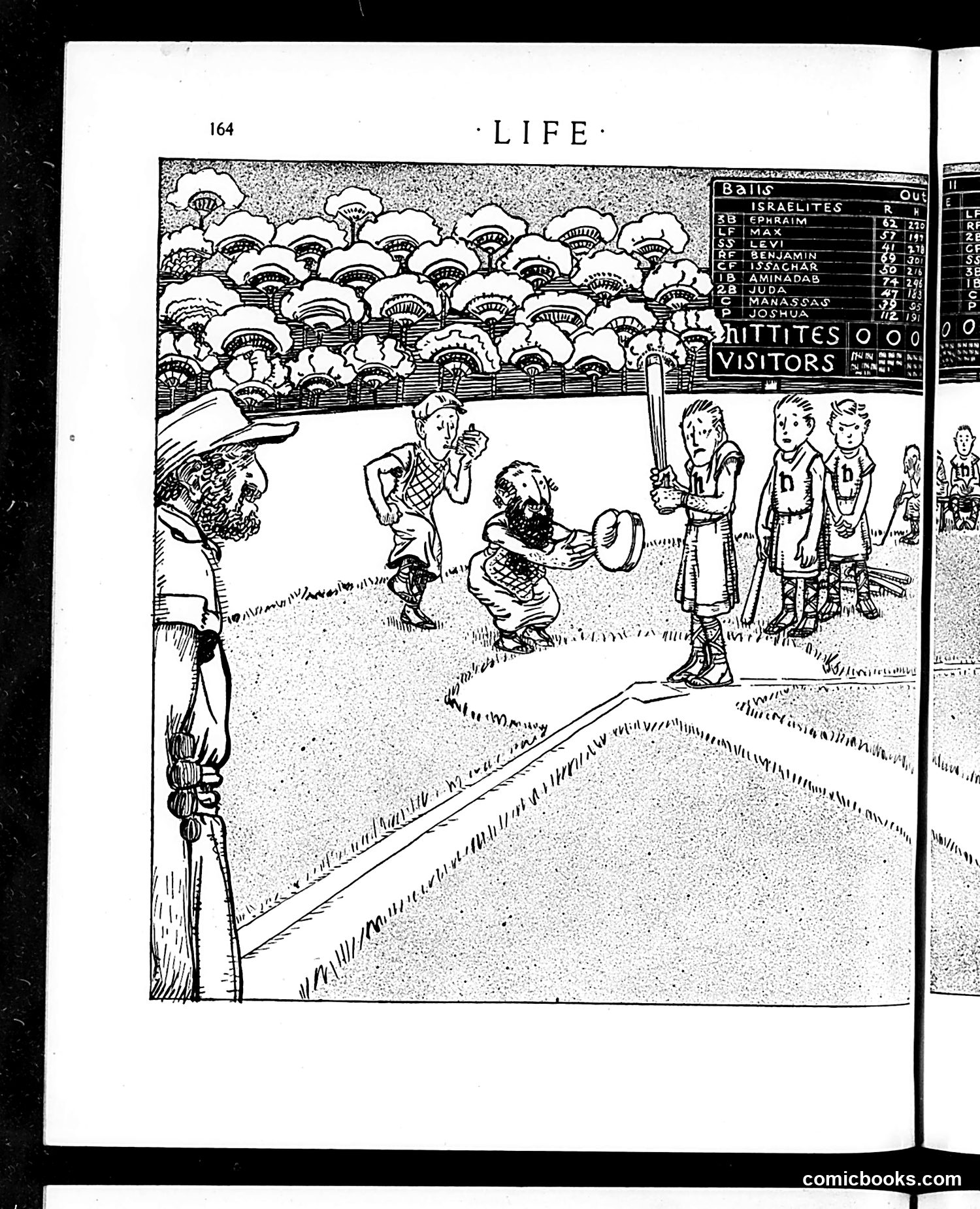
This cartoon depicts a baseball game with a scoreboard showing "Israelites 0, Visitors 0." The illustration appears to be a religious or ethnic satire, likely from the early-to-mid 20th century based on the art style. The scoreboard lists biblical names (Ephraim, Max, Levi, Benjamin, Issachar, Zebulun, Juda, Manasseh, Joshua), referencing the twelve tribes of Israel. The joke seems to play on stereotypes about Jewish participation in baseball—contrasting biblical/religious identity with American popular culture. The crowd in the stands and players on the field suggest this is satirizing either Jewish involvement in baseball or broader questions about immigrant assimilation. However, without publication date confirmation, the specific historical context and intended satirical target remain unclear.
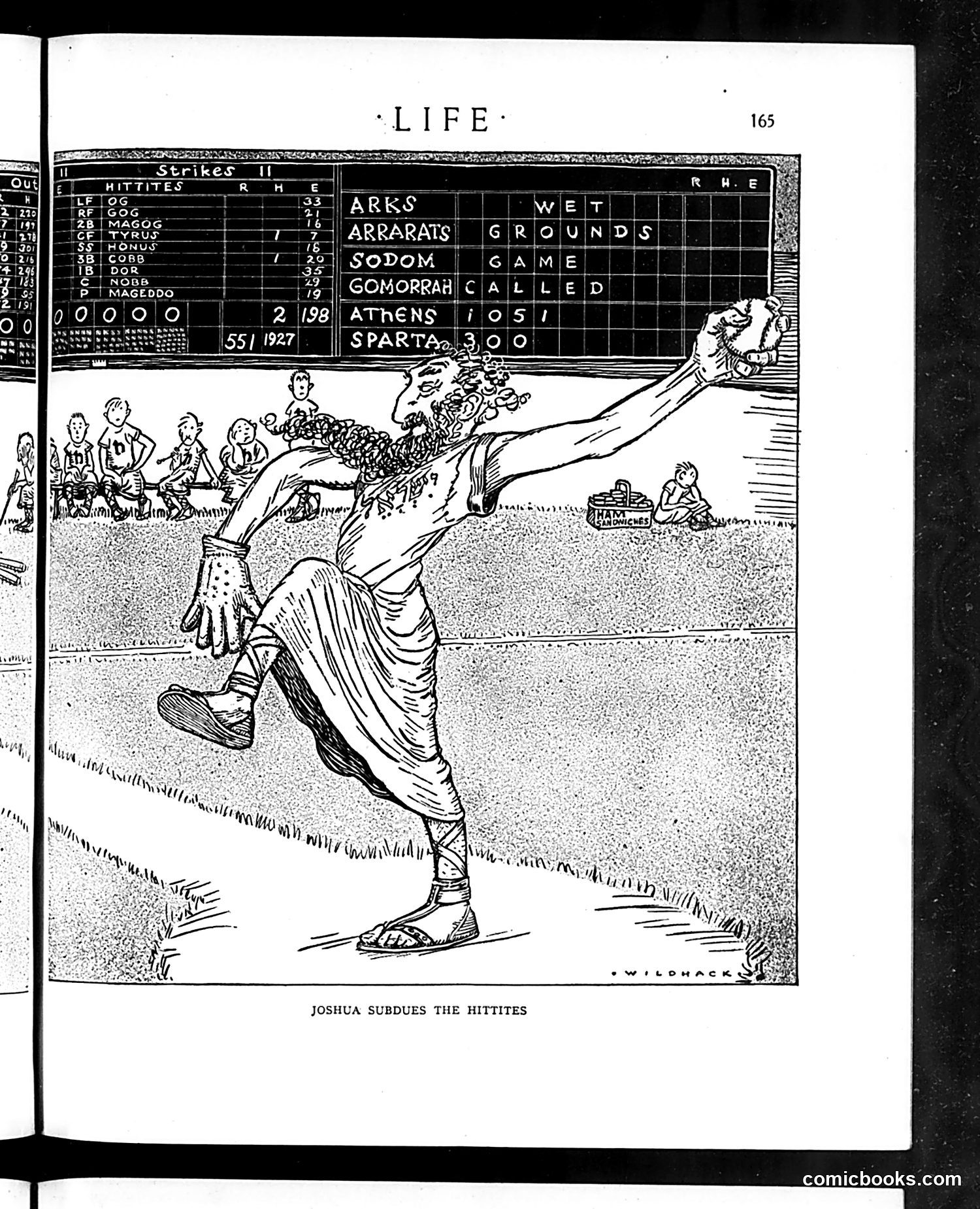
This is a satirical cartoon from Life magazine (1927) depicting the biblical account of Joshua's military victory. The scoreboard shows a baseball-style game between "Strikes" and "Hittites," with references to ancient cities (Arks, Sodom, Gomorrah, Athens, Sparta). The humor lies in treating a biblical military conquest as a modern baseball game. Joshua—depicted as an athlete mid-leap—is shown as a baseball player rather than an ancient general. This anachronistic presentation mocks either contemporary fascination with sports culture or perhaps religious narratives themselves by rendering them through the lens of 1920s American popular entertainment. The signed cartoonist (Wildhack) uses the familiar scoreboard format to create comic incongruity between sacred history and modern sport.
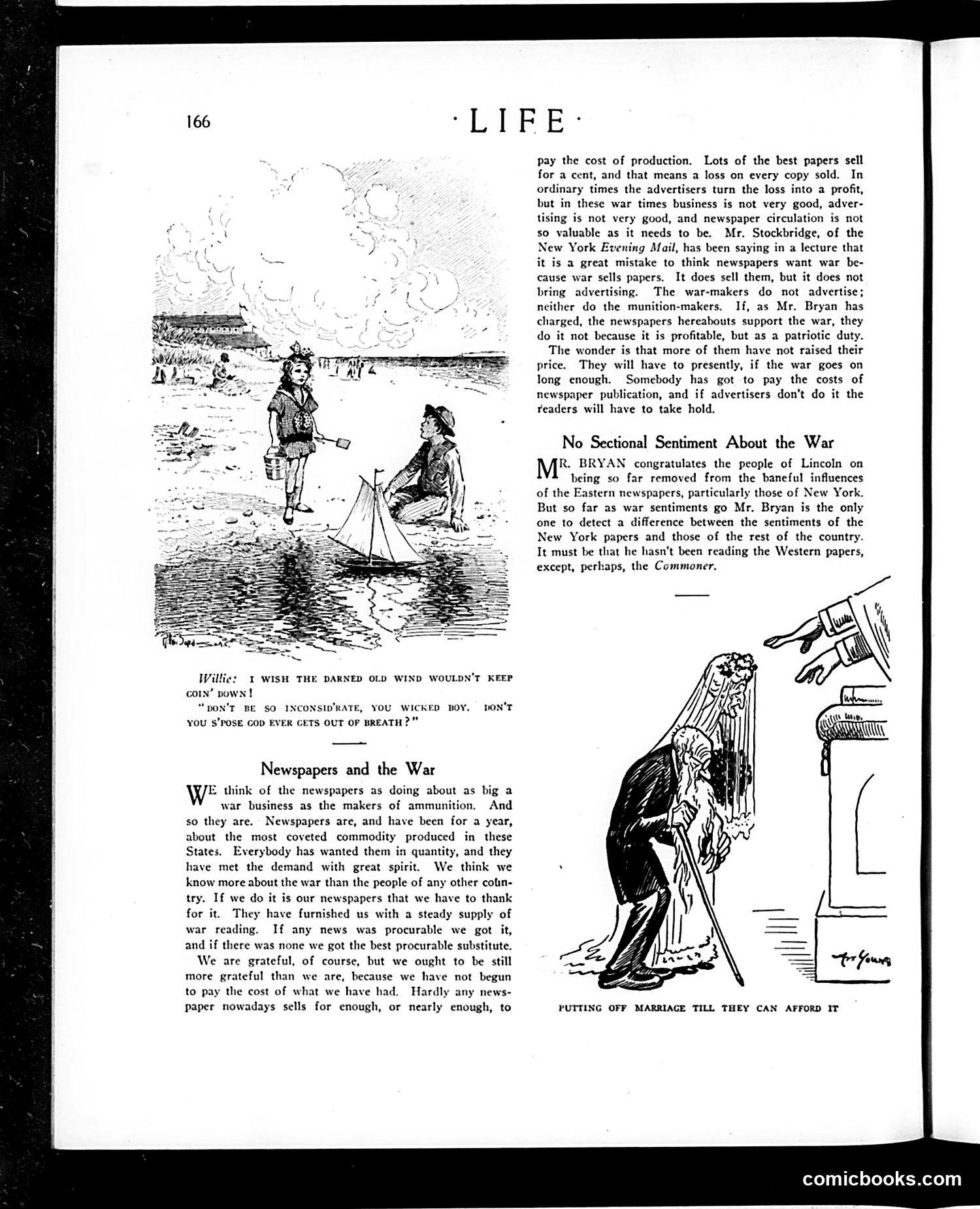
This page critiques American newspapers' economic struggles during World War I. The main text argues that while papers have profited from increased war readership, they've actually *lost* money because advertising revenue dried up—munition makers and war profiteers don't advertise. The author defends newspapers against accusations (apparently by William Jennings Bryan) that they support the war for profit, suggesting instead they do so patriotically despite financial hardship. The top cartoon shows two children by the shore; "Willis" complains about wind while his companion rebukes his selfishness, invoking God's exhaustion—likely a metaphor for wartime sacrifice and patience. The bottom cartoon depicts a couple postponing marriage due to financial strain, captioned "Putting Off Marriage Till They Can Afford It"—illustrating the economic hardship WWI inflicted on ordinary Americans.
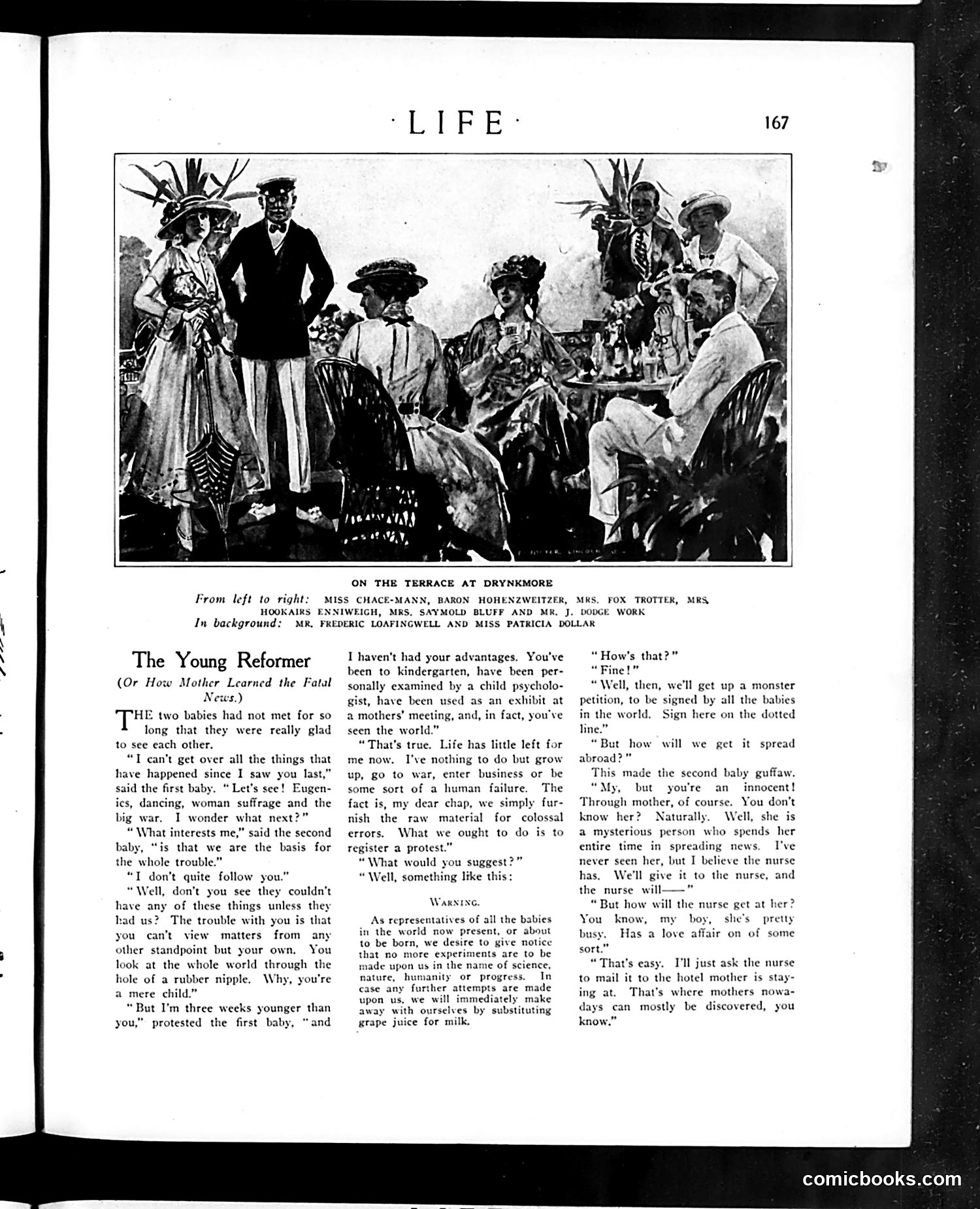
This satirical piece mocks progressive reform movements of the early 20th century through a conversation between two babies. The older baby—educated, examined by child psychologists, and exhibited at mothers' meetings—represents the new generation shaped by modern scientific and social reforms (eugenics, suffrage, women's education). The younger baby represents traditional childhood. The satire targets the irony that all these reforms ultimately produce only "colossal errors": war, business failure, and human misery. The babies' proposed "protest" threatening mass suicide via grape juice substitution for milk is absurdist humor mocking the earnestness of reformers. The final joke—that mothers are perpetually absent at "hotels"—adds social commentary on neglectful, pleasure-seeking modern mothers, suggesting that even well-intentioned reform cannot overcome deeper social dysfunction. Life magazine uses this to critique both progressive ideology and contemporary social behavior.
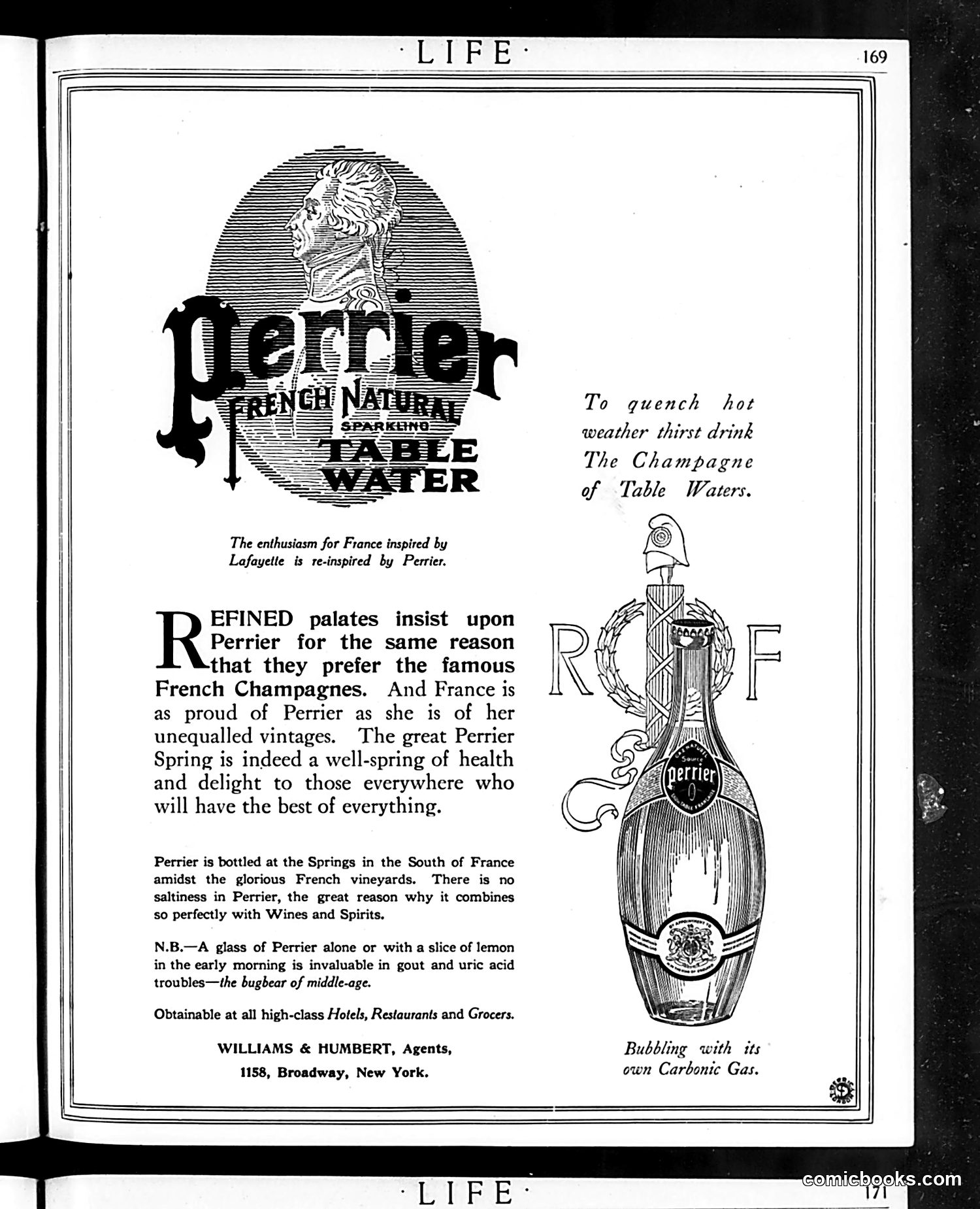
This is a **full-page advertisement**, not political satire. It promotes Perrier sparkling water to American consumers by leveraging French prestige and patriotic sentiment. The ad references **Lafayette**, the French Revolutionary War hero beloved by Americans, to associate Perrier with Franco-American goodwill. The bottle illustration shows a ornate design labeled "ROF" (likely "Roi de France"—King of France), emphasizing French aristocratic refinement. The marketing strategy positions Perrier as a luxury product for "refined palates" comparable to French champagne. It claims health benefits—particularly for "gout and uric acid troubles," common ailments among wealthy middle-aged men of the era—by suggesting morning consumption with lemon. The tagline "Champagne of Table Waters" elevates sparkling water to luxury status. The ad targets upscale establishments and wealthy consumers who could afford imported French goods and sought status markers through consumption choices.
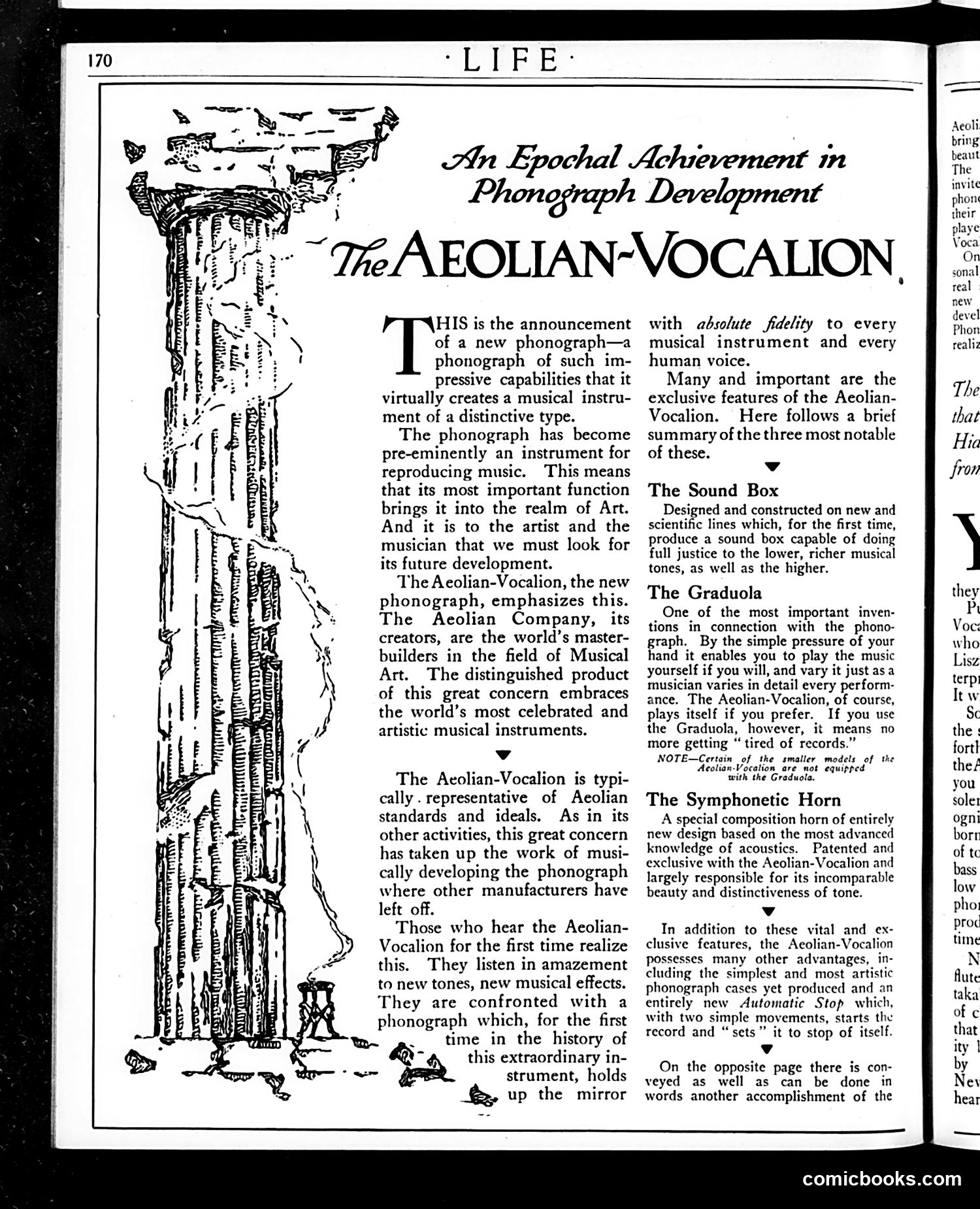
This page is **entirely an advertisement**, not satire or commentary. It promotes the Aeolian-Vocalion phonograph as a major technological and artistic achievement. The decorative illustration on the left shows a classical column, emphasizing that this product represents high art and culture—the company positions the phonograph as an instrument for serious musicians and artists, not mere entertainment. The text claims three innovative features: a superior sound box for rich tones, the "Graduola" (allowing manual control of playback), and a patented "Symphonetic Horn" for superior acoustics. The repeated emphasis on "absolute fidelity" and "artistic" qualities reflects early-20th-century marketing that positioned phonographs as legitimate musical instruments worthy of serious homes. For modern readers: this is vintage consumer advertising that uses appeals to artistic legitimacy and technical superiority to justify premium pricing—strategies still common today.
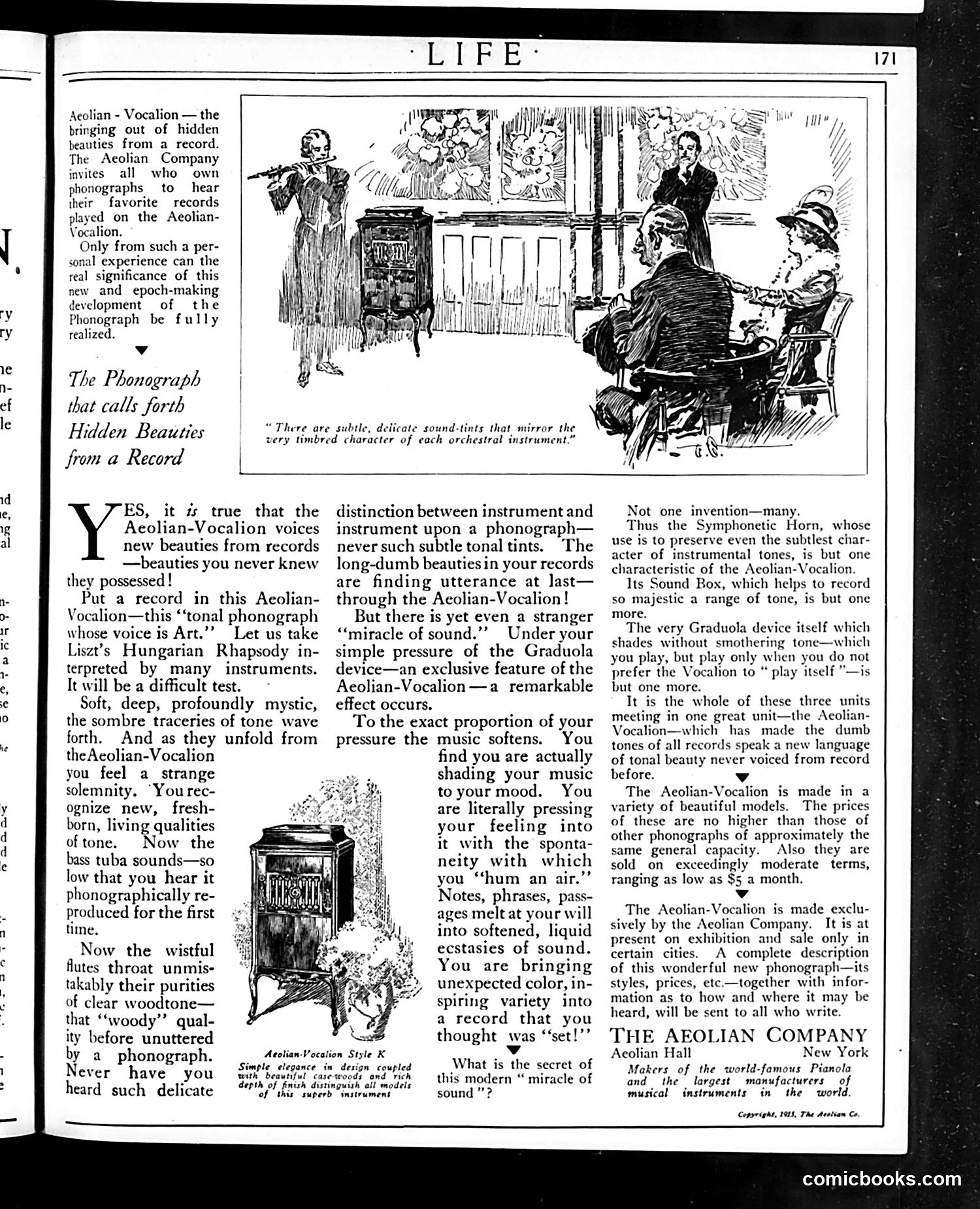
This page is primarily **advertising copy** for the Aeolian-Vocalion phonograph, not satire. The illustration shows a woman demonstrating the device to two men in what appears to be a showroom or salon setting. The advertisement emphasizes the phonograph's technical superiority—specifically its ability to reproduce subtle instrumental tones previously "lost" in recorded music. Key selling points include the "Symphonetic Horn," improved "Sound Box," and the exclusive "Graduola device," which allows listeners to manually control volume and create dynamic expression while playing records. The language is promotional hyperbole typical of early 20th-century advertising, calling the device a "miracle of sound" and claiming it brings "hidden beauties" to existing records. There is no political satire here—this is straightforward product marketing targeting phonograph owners seeking superior sound reproduction, with pricing information and availability details included.
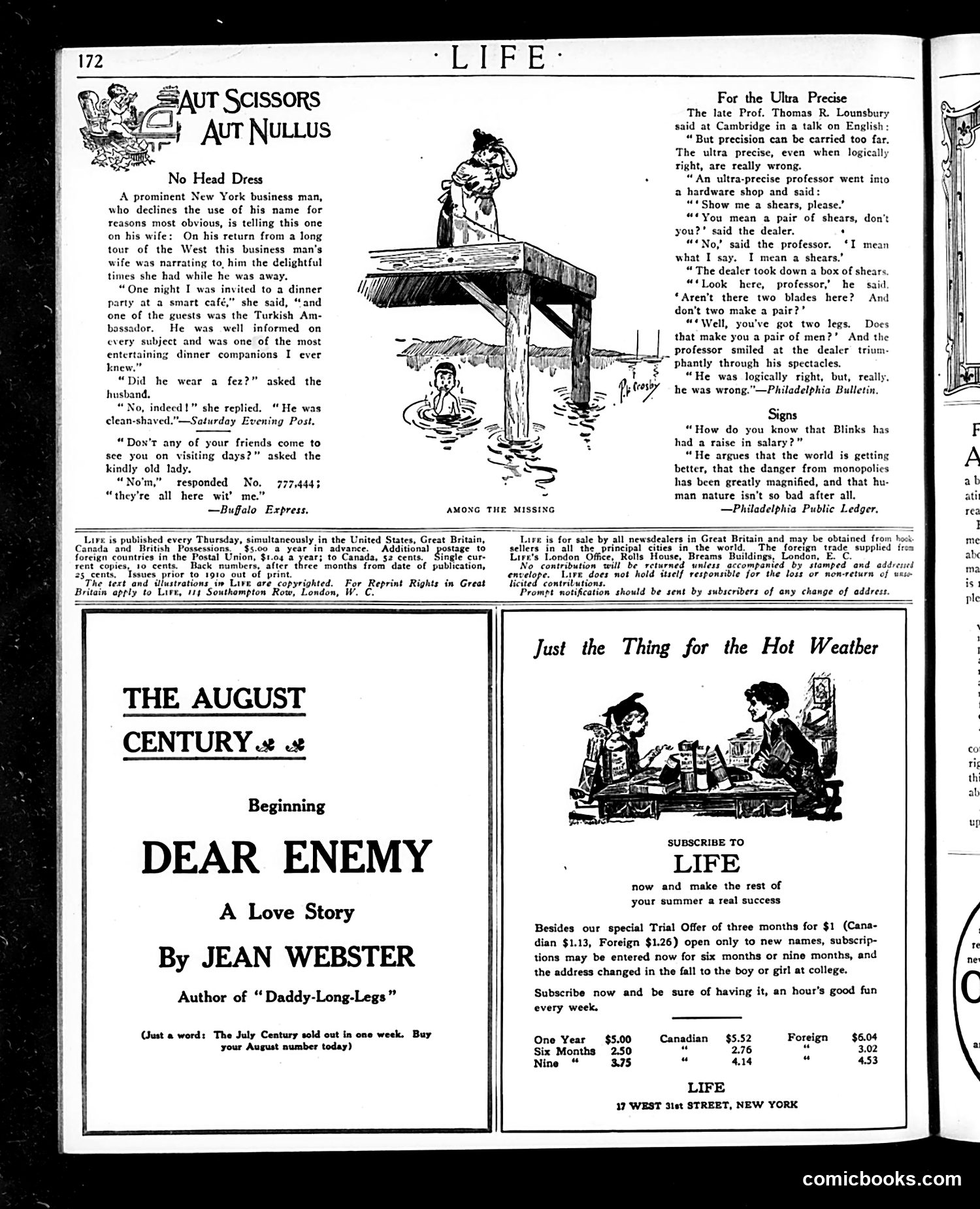
This page contains three humorous anecdotes and advertisements typical of early 20th-century Life magazine. **The Cartoons/Jokes:** 1. "No Head Dress" - A wife tells her husband about dining with the Turkish Ambassador, boasting he wore no fez (a traditional Turkish head covering). The humor relies on the wife misunderstanding "fez" as related to facial hair ("clean-shaved"). 2. "For the Ultra Precise" - A pedantic professor insists on grammatical exactness, arguing "shears" is singular. The hardware dealer proves him wrong logically: two legs don't make a person "a pair of men," so two blades don't make shears "a pair." Satirizes excessive linguistic precision divorced from common sense. 3. "Signs" - A brief joke suggesting someone claiming the world is improving and monopolies are dangerous must have received a salary raise, implying optimism correlates with personal gain. The page is primarily **advertisement space** promoting *Century* magazine's serialized love story "Dear Enemy" and subscription offers for *Life* itself—common magazine promotion tactics of the era.
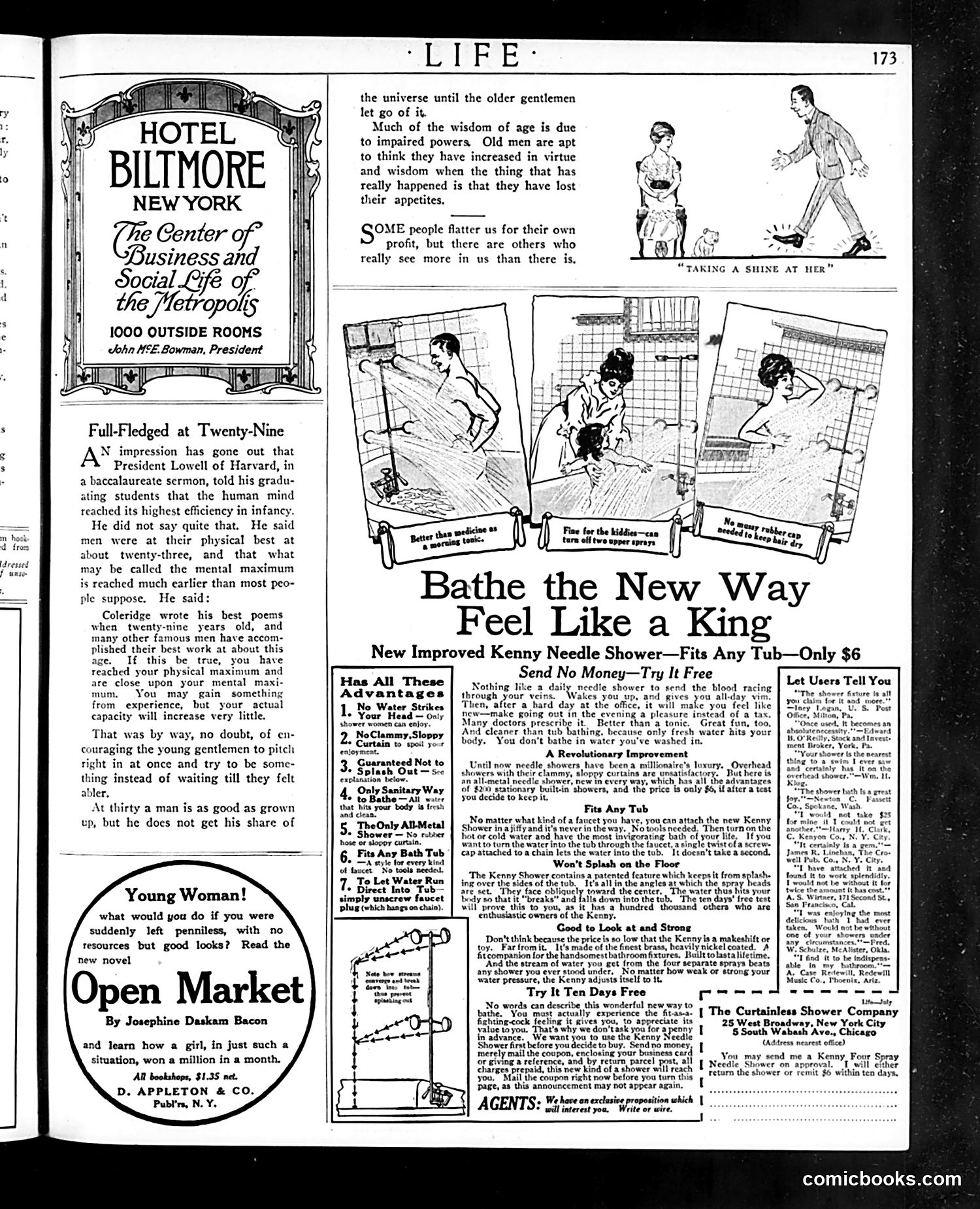
This page contains two main elements: ## Editorial Content The top half features a philosophical essay titled "Full-Fledged at Twenty-Nine," discussing President Lowell of Harvard's claim that human mental efficiency peaks in infancy. The writer argues that men reach physical peak around age 23 and mental maximum around 29, citing Coleridge as example. The satire targets the common assumption that older men possess greater wisdom—actually, the author suggests, they've simply lost their appetites and vigor, which they mistake for accumulated wisdom. ## Advertisement The bulk of the page promotes the "Kenny Needle Shower," a $6 shower attachment claiming revolutionary improvements over existing showers. The three cartoon panels show women enjoying its benefits ("Taking a shine at her," "Better than a bath," etc.), satirizing the product as a luxury item now available affordably. **Context:** This reflects early-20th-century American culture's obsession with modern conveniences and youthful vitality, while gently mocking both aging and consumer marketing claims.
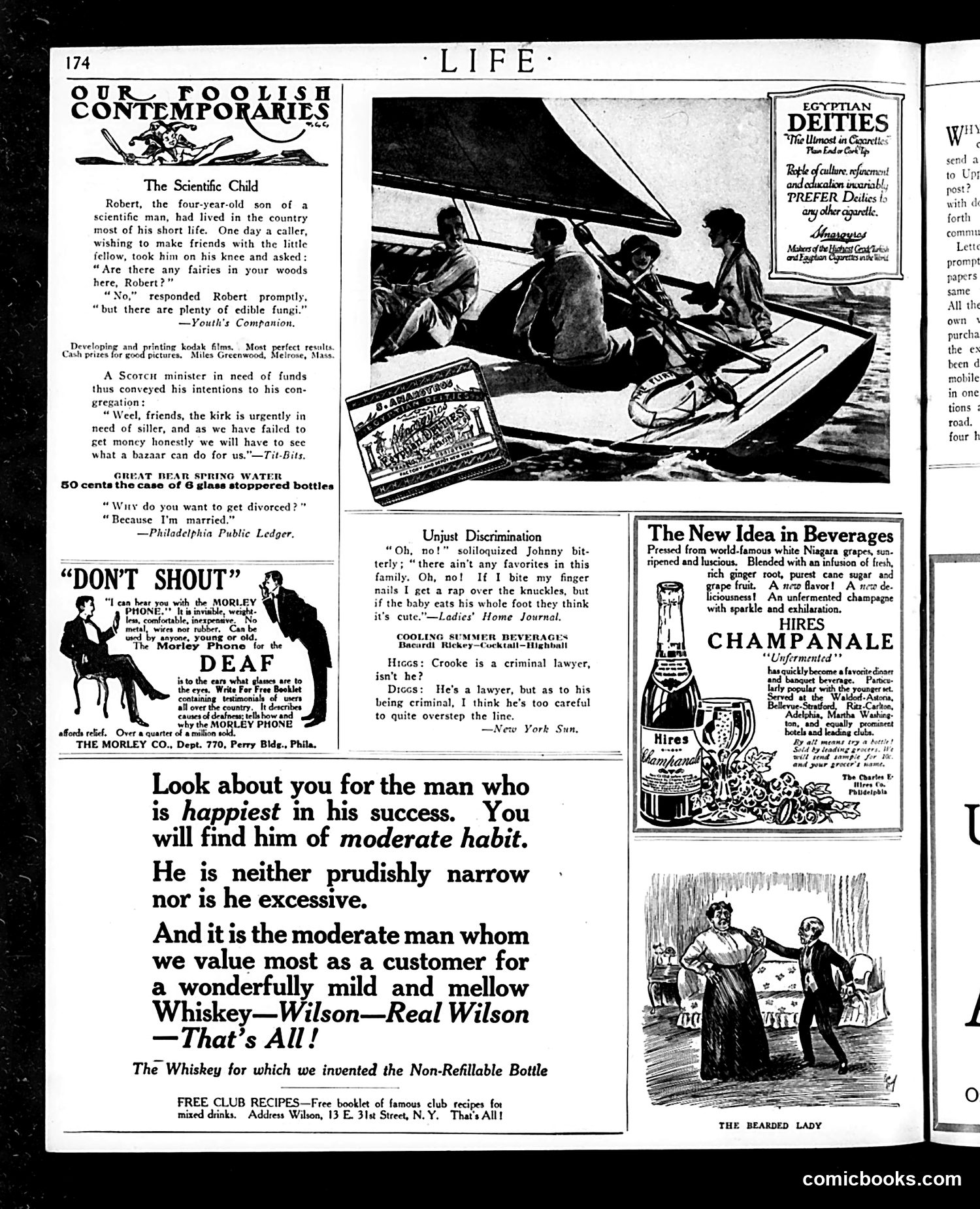
This page from *Life* magazine contains mostly **advertisements and brief humorous anecdotes**, rather than political cartoons requiring historical context. The main items of note: **"The Scientific Child"** depicts modern child-rearing: a four-year-old raised by a scientist responds to questions about fairies by discussing "edible fungi" instead—satire on overly rational, scientific parenting replacing imagination. **Other brief jokes** mock divorce culture, Scottish church fundraising desperation, and marital inequality (a baby eating its foot is "cute" while a child biting nails gets punished). **The advertisements**—for Wilson Whiskey, Hires Champanale, Egyptian Deities cigarettes, and the Morley Phone for the deaf—represent period consumer goods. The whiskey ad's emphasis on "moderate habit" is notable given Prohibition-era tensions (though the exact date is unclear from the page alone). **"The Bearded Lady"** cartoon at bottom appears to be a brief social joke, but details are illegible. The page is primarily a **commercial/advertising vehicle with light social satire**.
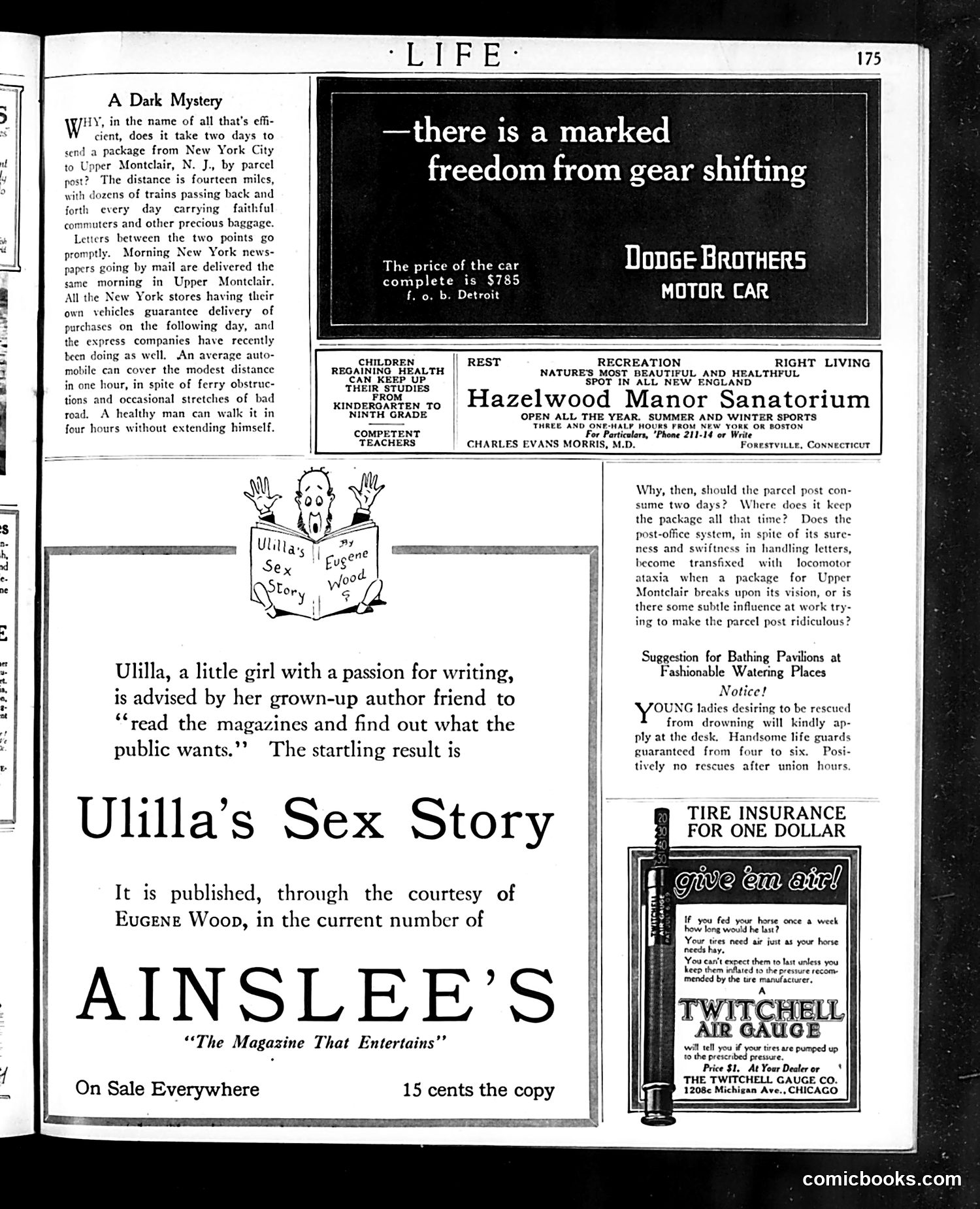
This page contains satirical commentary typical of Life magazine's format: **"A Dark Mystery"** critiques the inefficiency of the U.S. Parcel Post system. The article sarcastically questions why mail takes two days to travel fourteen miles from New York City to Upper Montclair, New Jersey—a distance easily covered by automobile in one hour or on foot in four hours. Letters and newspapers arrive the same day; private delivery services are faster. The satire mocks the parcel post's inexplicable slowness, suggesting the system is somehow deliberately sabotaged or incompetent. **"Ulilla's Sex Story"** is a humorous sidebar about a young girl who, following writing advice, reads magazines to learn what the public wants—with implied comedic results. The cartoon shows a child reading "Ulilla's Sex Story" and "My Eugenic Work," satirizing both popular magazine trends and contemporary obsessions with eugenics. The remaining content is primarily **advertising** (Dodge Brothers cars, Hazelwood Manor Sanatorium, tire gauges, bathing pavilion humor) interspersed with satirical notices about life guard unions and other period jokes.
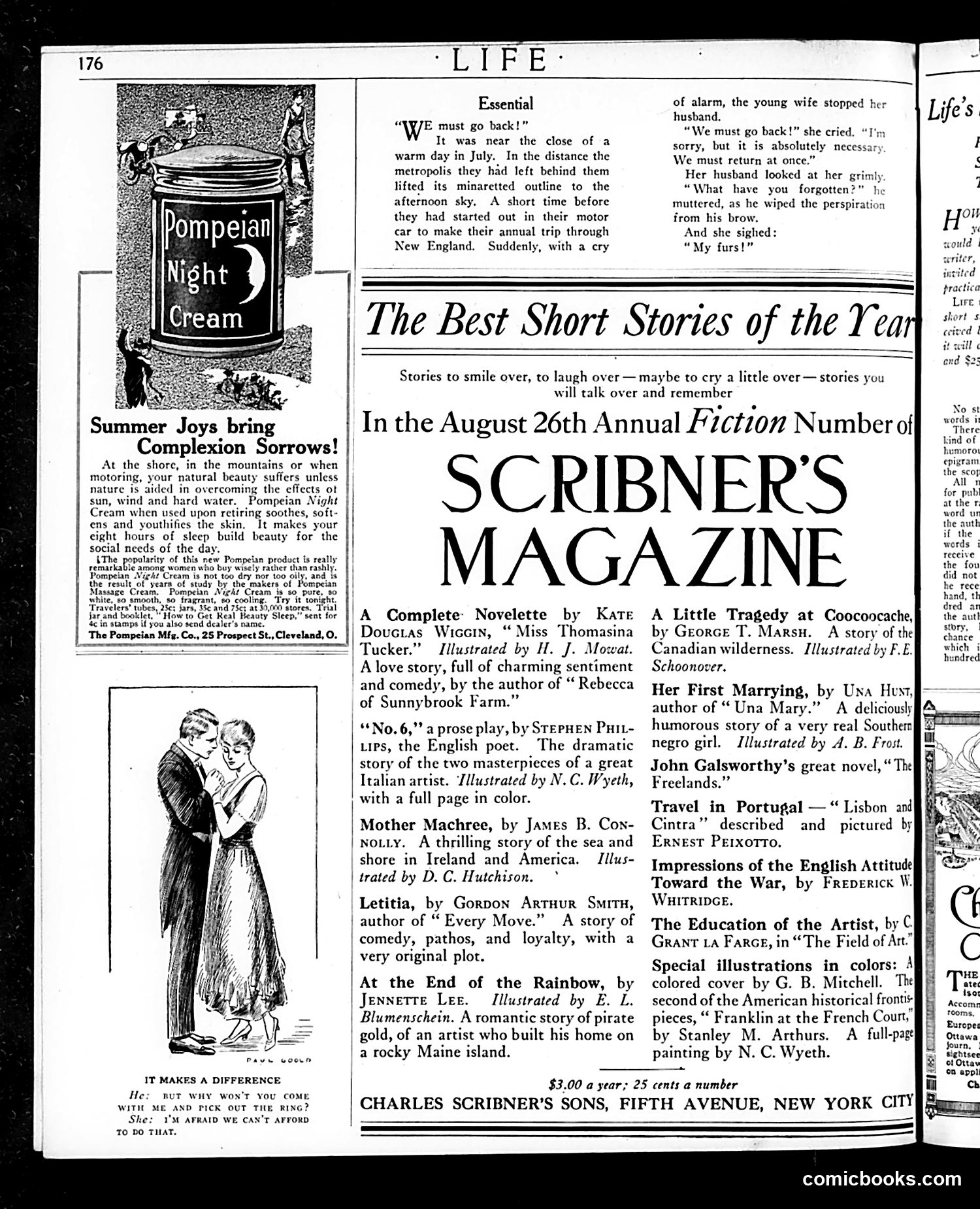
This page combines advertisements with promotional content for Scribner's Magazine's August 26th Fiction Number. **The Cartoon ("It Makes a Difference"):** A couple discusses engagement rings. The man asks why she won't pick one out; she replies they can't afford it. The joke satirizes economic anxiety during this period—even a seemingly straightforward romantic milestone is blocked by financial constraint. The title suggests their financial status fundamentally changes the nature of their relationship and life plans. **The Pompeian Night Cream Advertisement:** Markets complexion cream by playing on women's anxieties about sun damage from summer activities (beaches, mountains). It promises to restore beauty through nightly use, targeting middle-class women concerned with maintaining their appearance for "social needs." **Scribner's Magazine Promotion:** Lists short stories and novelettes by established authors (Kate Douglas Wiggin, James B. Connolly, John Galsworthy), emphasizing entertainment value and literary quality to attract readers.
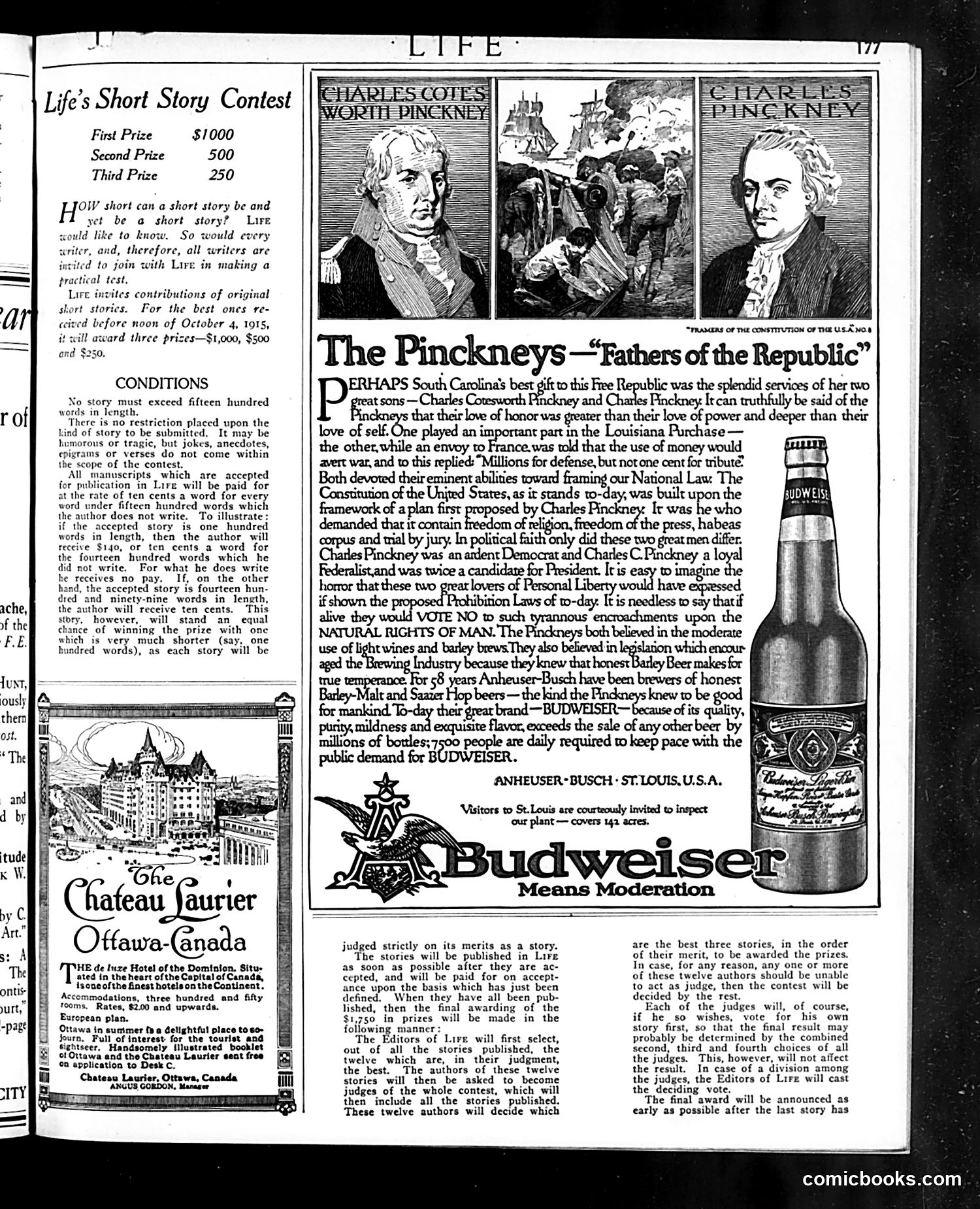
This page combines a **short-story contest announcement** with a **Budweiser advertisement** disguised as historical editorial content. ## The Main Advertisement (Budweiser) The large central feature celebrates the "Pinckney brothers—Fathers of the Republic," discussing Charles Cotesworth Pinckney and Charles Pinckney's roles in the Constitution and Louisiana Purchase. However, this is actually an alcohol advertisement. It argues the Pinckneys "both believed in the moderate use of light wines and barley brews," connecting historical American patriots to beer drinking. The satire works by using patriotic rhetoric and founding-father authority to legitimize alcohol consumption as an American value. The phrase "Means Moderation" attempts to position Budweiser as temperate, likely countering Prohibition-era criticism of alcohol. **The joke for modern readers:** This is nakedly propagandistic—appropriating American history to sell beer during an era of increasing anti-alcohol sentiment that would culminate in Prohibition (1920). The page also advertises the Chateau Laurier hotel in Ottawa and runs Life's short-story contest offering $1,000 first prize.
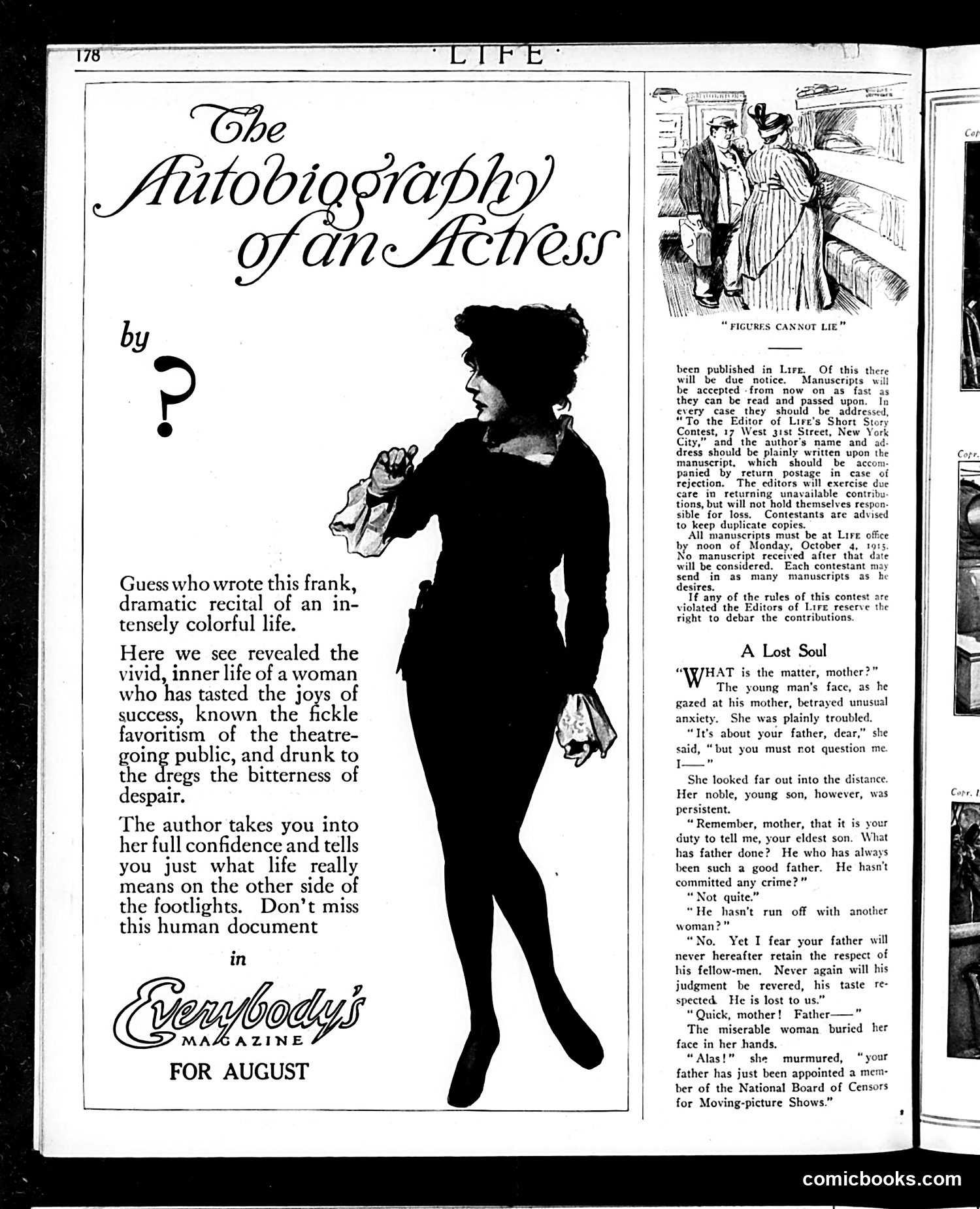
This page contains two distinct pieces of satire: **Left side:** An advertisement for *Everybody's Magazine* promoting "The Autobiography of an Actress." The mystery author (indicated by "?") is teased as revealing the "vivid, inner life" of a theatrical woman who experienced both success and despair. This appears to be genuine advertising exploiting readers' curiosity about theater world scandals. **Right side:** A short satirical story titled "A Lost Soul" mocking the newly-formed National Board of Censors for Moving-Picture Shows. The joke's punchline—that a father's appointment to this censorship board is a disgrace comparable to crime or infidelity—satirizes public anxiety about movie censorship. By having the mother treat censorship work as socially ruinous, the piece ridicules both the censors themselves and the era's intense debates over film regulation, which was a major cultural controversy in the 1910s.
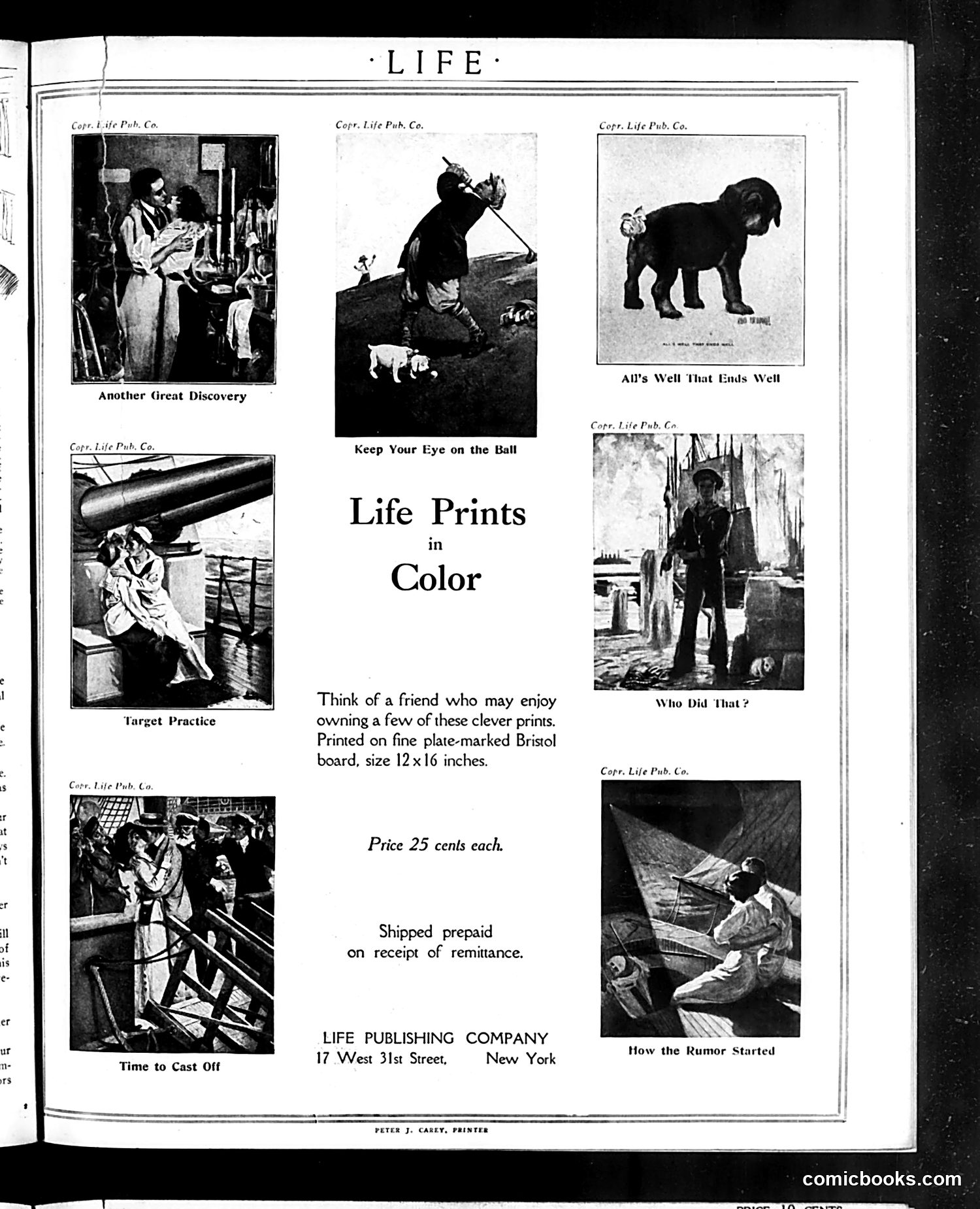
This page is primarily an **advertisement for Life magazine's color prints**, not political satire. The six images shown are humorous genre scenes offered for sale at 25 cents each on Bristol board (12x16 inches). The cartoon titles suggest everyday comedic situations: "Another Great Discovery" (domestic scene), "Keep Your Eye on the Ball" (a large figure swinging, implying distraction or miscalculation), "Target Practice" (appears to show someone shooting), "All's Well That Ends Well" (a dog), "Who Did That?" (appears to show someone caught), and "How the Rumor Started" (a boat scene). These are **generic humor vignettes without specific political references**—the "satire" is simply observational comedy about human behavior and social situations. The page functions as a mail-order catalog for consumers to purchase decorative prints, making it primarily a **commercial advertisement** rather than editorial content with historical or political significance.
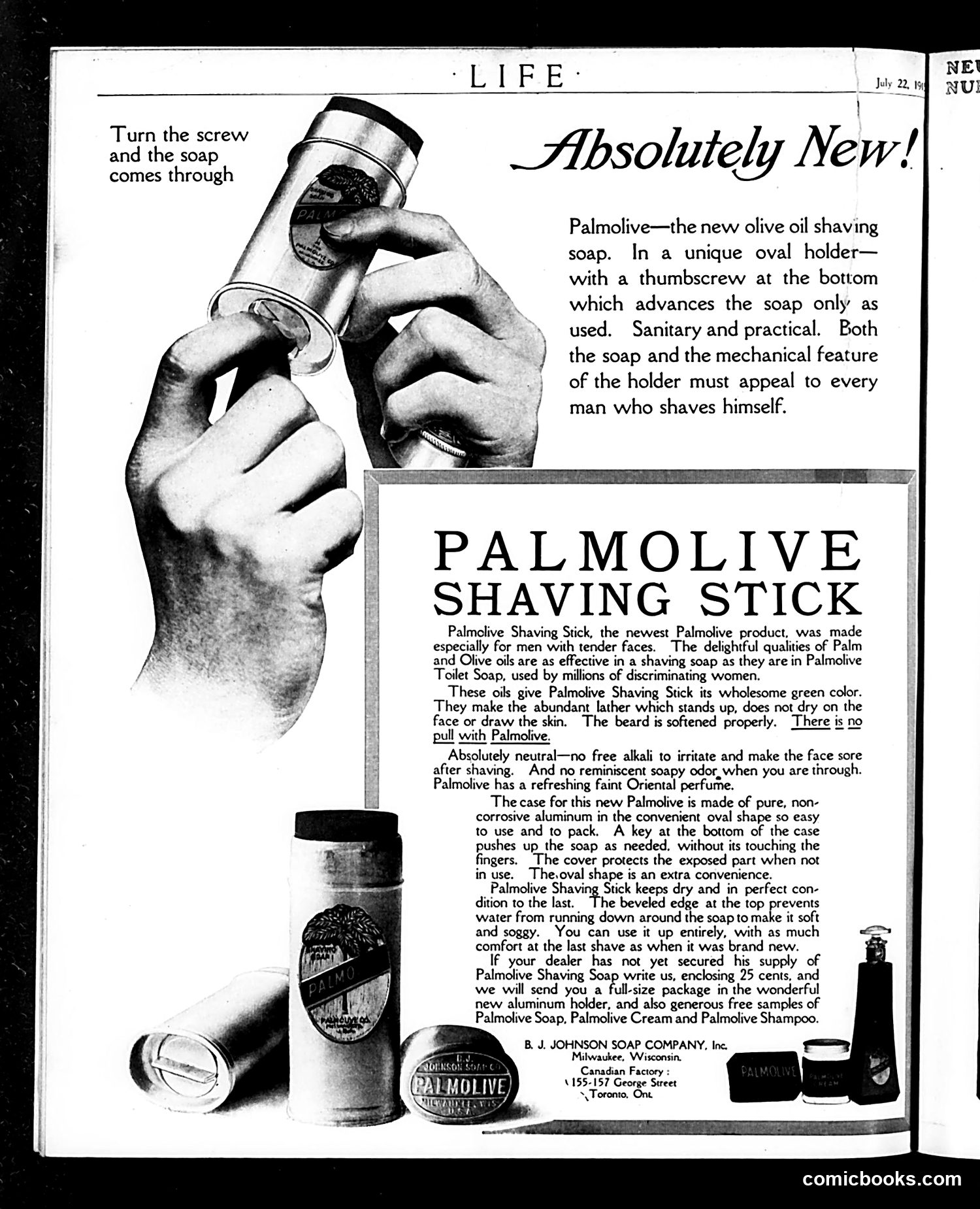
This page is a straightforward product advertisement, not political satire or humor. It promotes Palmolive's new shaving stick in an aluminum oval holder with a thumbscrew mechanism that dispenses soap as needed. The advertisement targets male shavers, emphasizing the product's practical features: the non-corrosive aluminum case, the mechanical advancement system, and the soap's gentle formula containing palm and olive oils. The copy stresses benefits like abundant lather, softened beard, neutral pH (no alkali irritation), and a faint Oriental perfume. The imagery shows hands demonstrating the screw mechanism. The ad appears in *Life* magazine, where paid advertisements were common alongside editorial content. This represents early 20th-century consumer marketing targeting men's grooming—positioning a new convenience product as modern and scientifically superior to previous shaving soaps.