
Life, 1915-07-22 · page 30 of 44
Life — July 22, 1915 — page 30: what you’re looking at
What you’re looking at
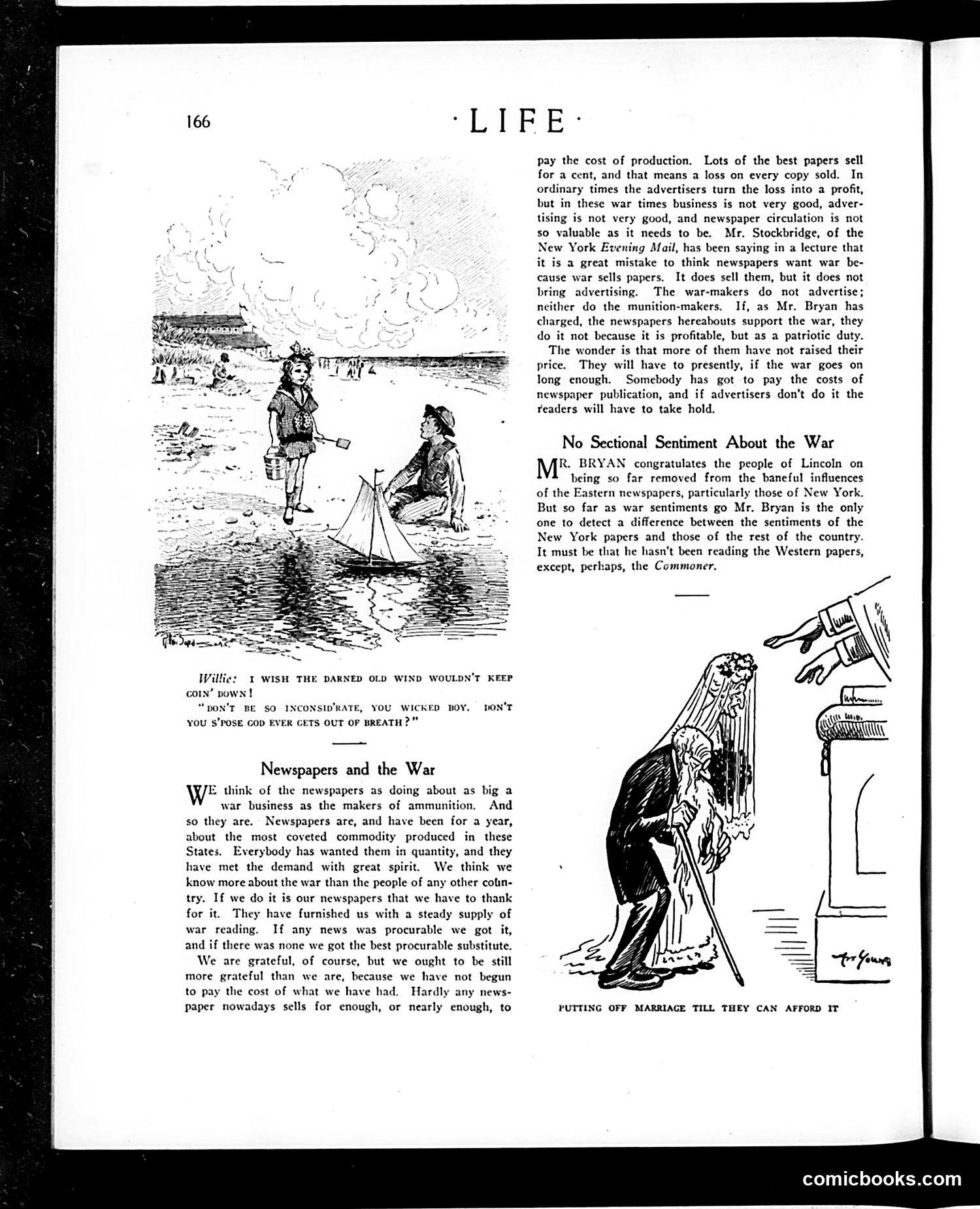
This page critiques American newspapers' economic struggles during World War I. The main text argues that while papers have profited from increased war readership, they've actually *lost* money because advertising revenue dried up—munition makers and war profiteers don't advertise. The author defends newspapers against accusations (apparently by William Jennings Bryan) that they support the war for profit, suggesting instead they do so patriotically despite financial hardship. The top cartoon shows two children by the shore; "Willis" complains about wind while his companion rebukes his selfishness, invoking God's exhaustion—likely a metaphor for wartime sacrifice and patience. The bottom cartoon depicts a couple postponing marriage due to financial strain, captioned "Putting Off Marriage Till They Can Afford It"—illustrating the economic hardship WWI inflicted on ordinary Americans.
📄 Transcribed text from this page (OCR, searchable)
Machine-transcribed from the original scan — historical spelling and the odd misread are preserved.
iL: pay the cost of production. Lots of the best papers sell for a cent, and that means a loss on every copy sold. In ordinary times the advertisers turn the loss into a profit, but in these war times business is not very good, adver- tising is not very good, and newspaper circulation is not so valuable as it needs to be. Mr, Stockbridge, of the New York Evening Mail, has been saying in a lecture that it is a great mistake to think newspapers want war be- cause war sells papers. It does sell them, but it does not bring advertising. The war-makers do not advertise; neither do the munition-makers, If, as Mr. Bryan has charged, the newspapers hereabouts support the war, they do it not because it is profitable, but as a patriotic duty. The wonder is that more of them have not raised their price. They will have to presently, if the war goes on long enough. Somebody has got to pay the costs of newspaper publication, and if advertisers don’t do it the readers will have to take hold. No Sectional Sentiment About the War M® BRYAN congratulates the people of Lincoln on being so far removed from the baneful influences of the Eastern newspapers, particularly those of New York. But so far as war sentiments go Mr. Bryan is the only one to detect a difference between the sentiments of the New York papers and those of the rest of the country. It must be that he hasn’t been reading the Western papers, except, perhaps, the Commoner, Willie: 1 WISH THE DARNED OLD WIND WOULDN'T KEEP corn’ powN | “DON'T BE SO INCONSID'RATE, YOU WICKED BOY, DON'T YOU S'POSE GOD EVER GETS OUT OF BREATH?” Newspapers and the War W think of the newspapers as doing about as big a war business as the makers of ammunition, And so they are. Newspapers are, and have been for a year, about the most coveted commodity produced in these States. Everybody has wanted them in quantity, and they have met the demand with great spirit. We think we know more about the war than the people of any other cotin- try. If we do it is our newspapers that we have to thank for it. They have furnished us with a steady supply of war reading. If any news was procurable we got it, and if there was none we got the best procurable substitute. We are grateful, of course, but we ought to be still more grateful than we are, because we have not begun to pay the cost of what we have had. Hardly any news- paper nowadays sells for enough, or nearly enough, to PUTTING OFF MARRIAGE TILL THEY CAN AFFORD IT comicbooks.com