
Life, 1915-07-22 · page 26 of 44
Life — July 22, 1915 — page 26: what you’re looking at
What you’re looking at
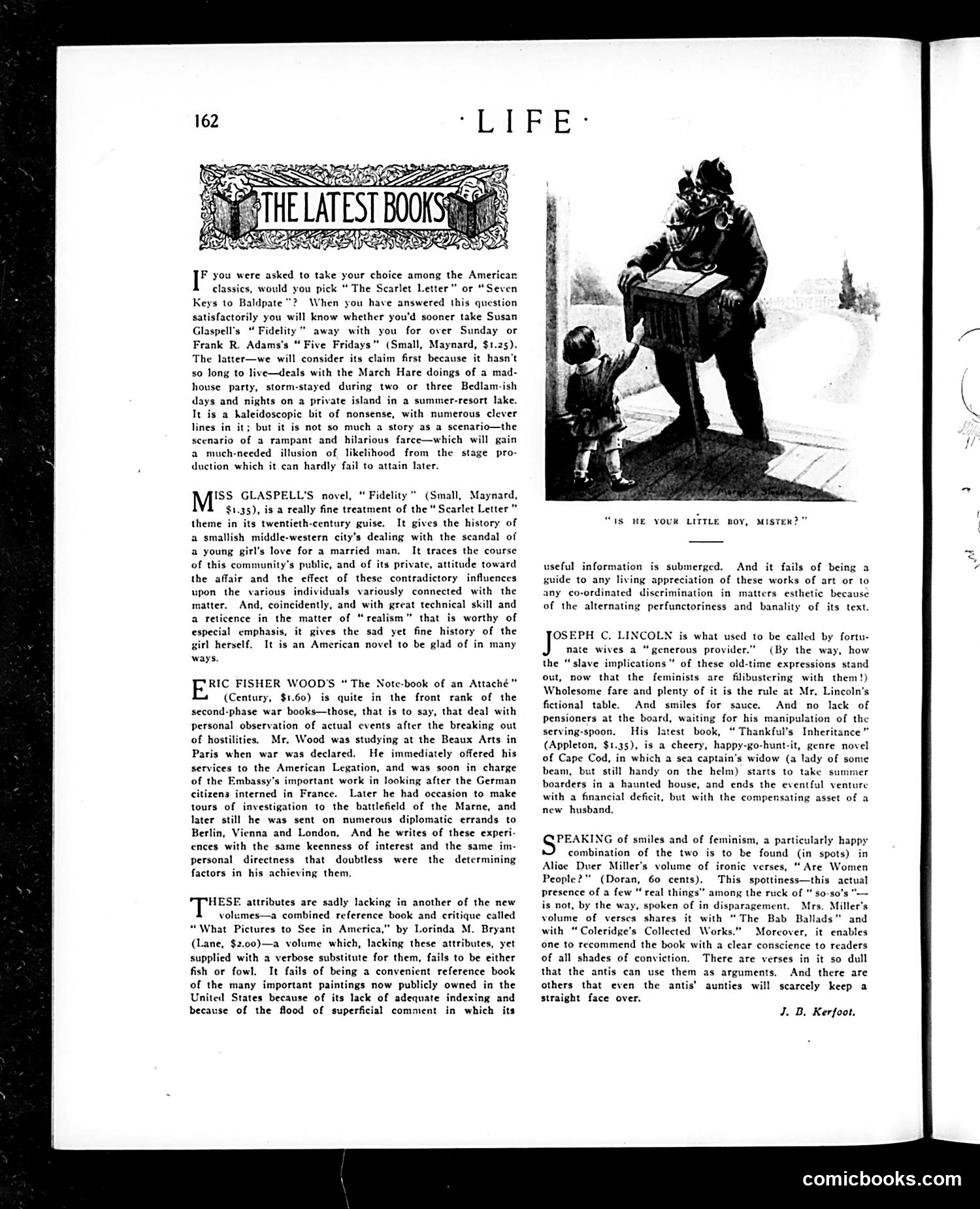
This page from *Life* magazine is a book review section titled "The Latest Books." The content consists of literary criticism rather than political satire or cartoons. The single illustration—captioned "Is he your little boy, mister?"—shows an adult and child in period clothing, likely accompanying a review of Frank R. Adams's novel *Five Fridays*, described as a "rampant and hilarious farce" set during a chaotic house party on a private island. The page reviews four books: Adams's *Five Fridays*, Susan Glaspell's *Fidelity* (compared favorably to *The Scarlet Letter*), Eric Fisher Wood's WWI-era *The Note-book of an Attaché*, and Lorinda M. Bryant's art guide *What Pictures to See in America* (criticized as poorly indexed). The brief aside about Joseph C. Lincoln contains period-specific social commentary—the reviewer humorously notes how outdated expressions like "generous provider" now seem to carry troubling implications in light of contemporary feminist activism.
📄 Transcribed text from this page (OCR, searchable)
Machine-transcribed from the original scan — historical spelling and the odd misread are preserved.
F you were asked to take your choice among the Americar classics, would you pick “The Scarlet Letter” or “Seven Keys to Baldpate”? When you have answered this question satisfactorily you will know whether you'd sooner take Susan Glaspell’s “ Fidelity” away with you for over Sunday or Frank R. Adams's “Five Fridays” (Small, Maynard, $1.25). The latter—we will consider its claim first because it hasn't so long to live—deals with the March Hare doings of a mad- house party, storm-stayed during two or three Bedlam-ish days and nights on a private island in a summer-resort lake. It is a kaleidoscopic bit of nonsense, with numerous clever lines in it; but it is not so much a story as a scenario—the scenario of a rampant and hilarious farce—which will gain a much-needed illusion of likelihood from the stage pro- duction which it can hardly fail to attain later. ISS GLASPELL’S novel, “ Fidelity” (Small, Maynard, $1.35), is a really fine treatment of the “ Scarlet Letter” theme in its twentieth-century guise. It gives the history of a smallish middle-western city’s dealing with the scandal of a young girl’s love for a married man. It traces the course of this community’s public, and of its private, attitude toward the affair and the effect of these contradictory influences upon the various individuals variously connected with the matter. And, coincidently, and with great technical skill and a reticence in the matter of “realism” that is worthy of especial emphasis, it gives the sad yet fine history of the girl herself, It is an American novel to be glad of in many ways. RIC FISHER WOOD'S “ The Note-book of an Attaché” (Century, $1.60) is quite in the front rank of the second-phase war books—those, that is to say, that deal with personal observation of actual events after the breaking out of hostilities. Mr. Wood was studying at the Beaux Arts in Paris when war was declared. He immediately offered his services to the American Legation, and was soon in charge of the Embassy's important work in looking after the German citizens interned in France. Later he had occasion to make tours of investigation to the battlefield of the Marne, and later still he was sent on numerous diplomatic errands to Berlin, Vienna and London, And he writes of these experi ences with the same keenness of interest and the same im- personal directness that doubtless were the determining factors in his achieving them. THESE attributes are sadly lacking in another of the new volumes—a combined reference book and critique called “What Pictures to See in America,” by Lorinda M. Bryant (Lane, $2.00)—a volume which, lacking these attributes, yet supplied with a verbose substitute for them, fails to be either fish or fowl. It fails of being a convenient reference book of the many important paintings now publicly owned in the United States because of its lack of adequate indexing and because of the flood of superficial comment in which its “18 ME YOUR LITTLE voy, MISTER?” ful information is submerged. And it fails of being a guide to any living appreciation of these works of art or to any co-ordinated discrimination in matters esthetic because of the alternating perfunctoriness and banality of its text. OSEPH C. LINCOLN is what used to be called by fortu- nate wives a “generous provider.” (By the way, how the “slave implications” of these old-time expressions stand out, now that the feminists are filibustering with them!) Wholesome fare and plenty of it is the rule at Mr. Lincoln's fictional table. And smiles for sauce. And no lack of pensioners at the board, waiting for his manipulation of the serving-spoon. His latest book, “Thankful’s Inheritance” (Appleton, $1.35), is a cheery, happy-go-bunt-it, genre novel of Cape Cod, in which a sea captain's widow (a lady of some beam, but still handy on the helm) starts to take summer boarders in a haunted house, and ends the eventful venture with a financial deficit, but with the compensating asset of a new husband. PEAKING of smiles and of feminism, a particularly happy combination of the two is to be found (in spots) in Alice Duer Miller's volume of ironic verses, “Are Women People?” (Doran, 60 cents This spottiness—this actual Presence of a few “ real things” among the ruck of “ so-so's "— is not, by the w. spoken of in disparagement. Mrs. Miller's volume of verses shares it with “The Bab Ballads” and with “Coleridge's Collected Works.’ Moreover, it enables one to recommend the book with a clear conscience to readers of all shades of conviction. There are verses in it so dull that the antis can use them as arguments. And there are others that even the antis’ aunties will scarcely keep a straight face over. J. B, Kerfoot, comicbooks.com a