
Life, 1915-07-22 · page 20 of 44
Life — July 22, 1915 — page 20: what you’re looking at
What you’re looking at
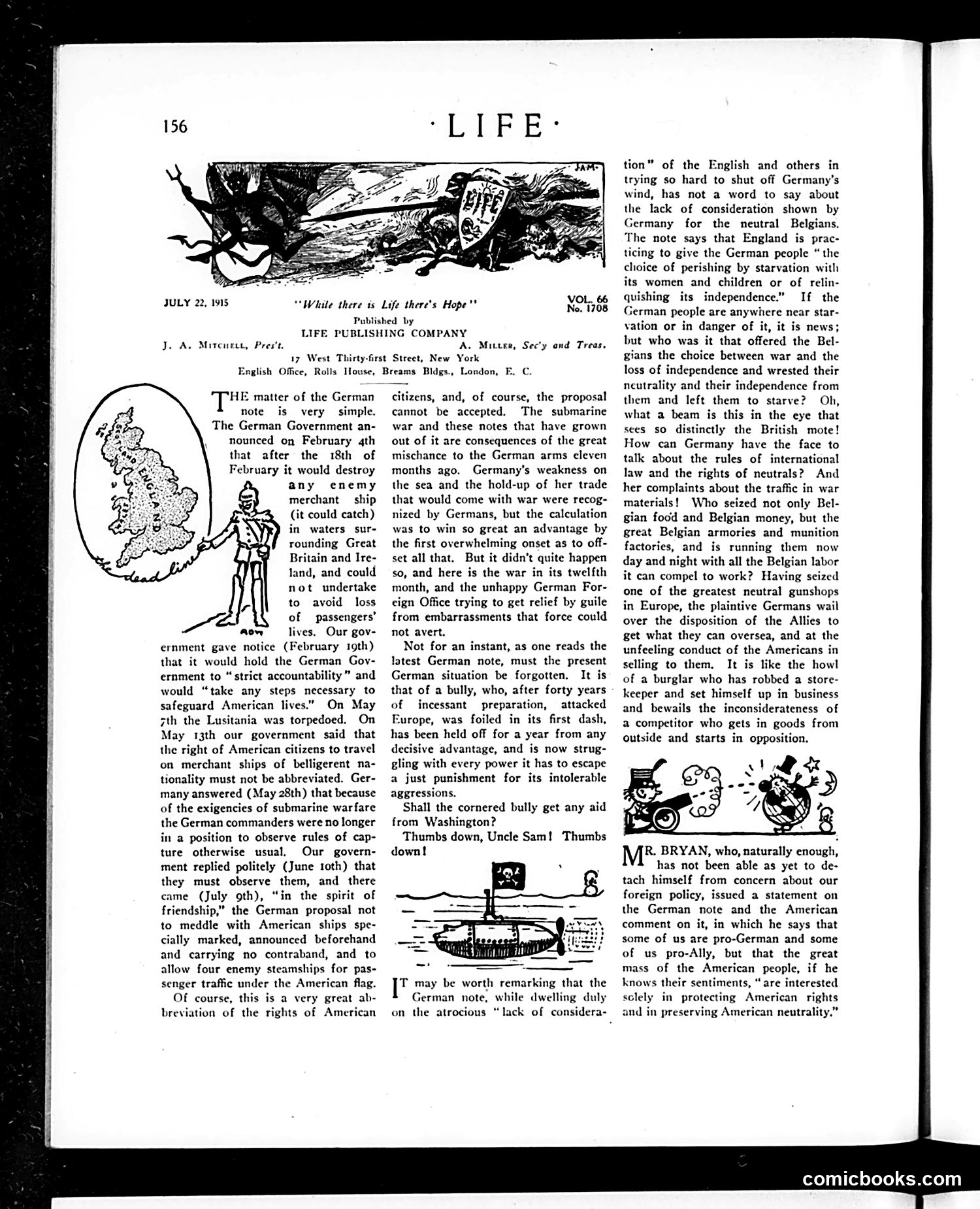
This page addresses the escalating diplomatic crisis between America and Germany over submarine warfare. The cartoon shows **Britain** (depicted as a soldier) trapping **Germany** (the trapped figure in the oval) while Uncle Sam watches. The text details Germany's February 1915 threat to sink merchant ships around Britain, the May sinking of the *Lusitania*, and subsequent diplomatic notes. Germany's latest proposal offers to spare American-marked ships if they carry no contraband—which Life's editors call an unacceptable "abbreviation of rights." The editorial characterizes Germany as **a bully who attacked Europe, failed in its initial assault, and now uses diplomatic "guile" to escape justified punishment**. The writer particularly criticizes Germany's hypocrisy: complaining about British treatment while ignoring its own violation of Belgian neutrality. The final verdict—"Thumbs down, Uncle Sam!"—urges American rejection of Germany's proposal, reflecting pre-1917 American debate over neutrality and maritime rights.
📄 Transcribed text from this page (OCR, searchable)
Machine-transcribed from the original scan — historical spelling and the odd misread are preserved.
JULY 22, 1915 ‘While there is Life there's Hope" VOL. 66 No, 1708 Published by LIFE PUBLISHING COMPANY J. A. Mitcwece, Pres't. A. Miter, Sec'y and Treas. 17 West Thirty-first Street, New York English Office, Rolls House, Breams Bldgs., London, FE. C. T* E matter of the German note is very simple. The German Government an- nounced on February 4th that after the 18th of February it would destroy any enemy merchant ship (it could catch) in waters sur- rounding Great Britain and Ire- land, and could not undertake to avoid loss of passengers’ lives. Our gov- ernment gave notice (February 19th) that it would hold the German Gov- ernment to “strict accountability” and would “take any steps necessary to safeguard American lives.” On May 7th the Lusitania was torpedoed. On May 13th our government said that the right of American citizens to travel on merchant ships of belligerent na- tionality must not be abbreviated. Ger- many answered (May 28th) that because of the exigencies of submarine warfare the German commanders were no longer in a position to observe rules of cap- ture otherwise usual. Our govern- ment replied politely (June toth) that they must observe them, and there came (July oth), “in the spirit of friendship,” the German proposal not to meddle with American ships spe- cially marked, announced beforehand and carrying no contraband, and to allow four enemy steamships for pas- senger traffic under the American flag. Of course, this is a very great ab- breviation of the rights of American citizens, and, of course, the proposal cannot be accepted. The submarine war and these notes that have grown out of it are consequences of the great mischance to the German arms eleven months ago. Germany’s weakness on the sea and the hold-up of her trade that would come with war were recog- nized by Germans, but the calculation was to win so great an advantage by the first overwhelming onset as to off- set all that. But it didn’t quite happen so, and here is the war in its twelfth month, and the unhappy German For- cign Office trying to get relief by guile from embarrassments that force could not avert. Not for an instant, as one reads the latest German note, must the present German situation be forgotten. It is that of a bully, who, after forty years of incessant preparation, attacked Europe, was foiled in its first dash, has been held off for a year from any decisive advantage, and is now strug- gling with every power it has to escape a just punishment for its intolerable aggressions, Shall the cornered bully get any aid from Washington? Thumbs down, Uncle Sam! Thumbs down! iid de [7 may be worth remarking that the German note, while dwelling duly on the atrocious “lack of considera- tion” of the English and others in trying so hard to shut off Germany's wind, has not a word to say about the lack of consideration shown by Germany for the neutral Belgians. The note says that England is prac- ticing to give the German people “the choice of perishing by starvation with its women and children or of relin- quishing its independence.” If the German people are anywhere near star- vation or in danger of it, it is news; but who was it that offered the Bel- gians the choice between war and the loss of independence and wrested their neutrality and their independence from them and left them to starve? Oh, what a beam is this in the eye that sees so distinctly the British mote! How can Germany have the face to talk about the rules of international law and the rights of neutrals? And her complaints about the traffic in war materials!’ Who seized not only Bel- gian food and Belgian money, but the great Belgian armories and munition factories, and is running them now day and night with all the Belgian labor it can compel to work? Having seized one of the greatest neutral gunshops in Europe, the plaintive Germans wail over the disposition of the Allies to get what they can oversea, and at the unfeeling conduct of the Americans in selling to them, It is like the howl of a burglar who has robbed a store- keeper and set himself up in business and bewails the inconsiderateness of a competitor who gets in goods from outside and starts in opposition. R. BRYAN, who, naturally enough, has not been able as yet to de- tach himself from concern about our foreign policy, issued a statement on the German note and the American comment on it, in which he says that some of us are pro-German and some of us pro-Ally, but that the great mass of the American people, if he knows their sentiments, “are interested sclely in protecting American rights and in preserving American neutrality.” comicbooks.com