
Life, 1915-07-22 · page 16 of 44
Life — July 22, 1915 — page 16: what you’re looking at
What you’re looking at
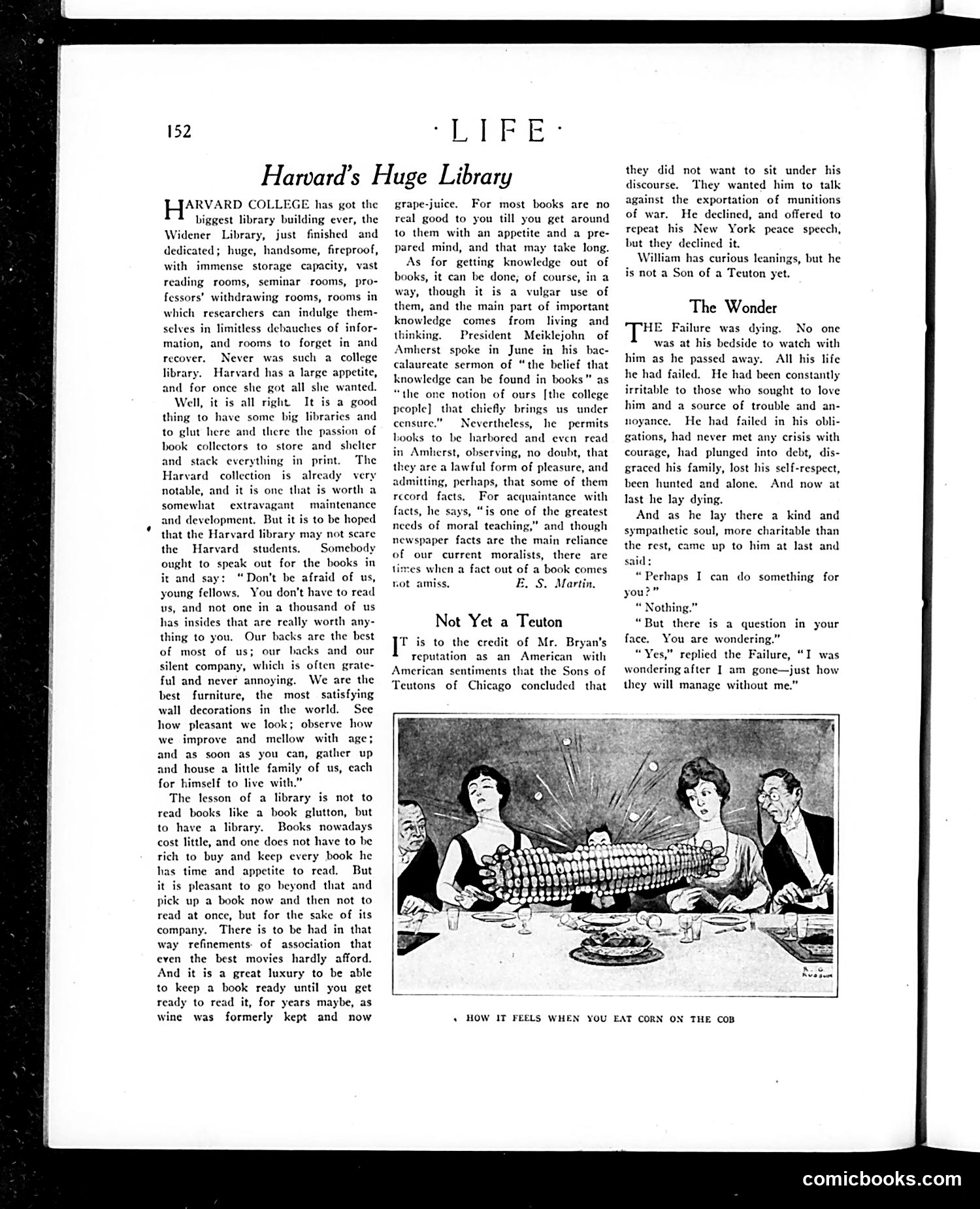
This page contains three distinct pieces of satirical commentary: **"Harvard's Huge Library"** mocks Harvard's massive new Widener Library by suggesting students shouldn't fear the books—they're merely decorative furniture. The satire critiques both academic pretension and the notion that simply owning books conveys knowledge. Author E.S. Martin argues books are best as companions and wall decorations rather than sources of practical learning. **"Not Yet a Teuton"** references William Bryan (likely William Jennings Bryan, the prominent political figure), who refused to speak against munitions exportation to Chicago's German-American ("Teuton") community. The satire mocks Bryan's inconsistency: he offered his New York peace speech instead, suggesting his pacifism was selective or performative. The title's pun—"not yet a Teuton"—implies he's not truly aligned with German-American interests. **The cartoon** illustrates "How It Feels When You Eat Corn on the Cob"—a humorous domestic scene showing the messy, awkward experience of eating corn.
📄 Transcribed text from this page (OCR, searchable)
Machine-transcribed from the original scan — historical spelling and the odd misread are preserved.
“LIFE” Harvard’s Huge Library ARVARD COLLEGE has got the biggest library building ever, the Widener Library, just finished and dedicated; huge, handsome, fireproof, with immense storage capacity, vast reading rooms, seminar rooms, pro- fessors’ withdrawing rooms, rooms in which researchers can indulge them- selves in limitless debauches of infor- mation, and rooms to forget in and recover. Never was such a college library. Harvard has a large appetite, and for once she got all she wanted. Well, it is all right It is a good thing to have some big libraries and to glut here and there the passion of book collectors to store and shelter and stack everything in print. The Harvard collection is already very notable, and it is one that is worth a somewhat extravagant maintenance and development. But it is to be hoped that the Harvard library may not scare the Harvard students. | Somebody ought to speak out for the books in it and say: “Don't be afraid of us, young fellows. You don’t have to read us, and not one in a thousand of us has insides that are really worth any- thing to you. Our backs are the best of most of us; our backs and our silent company, which is often grate- ful and never annoying. We are the best furniture, the most satisfying wall decorations in the world. See how pleasant we look; observe how we improve and mellow with age; and as soon as you can, gather up and house a little family of us, each for himself to live with.” The lesson of a library is not to read books like a book glutton, but to have a library. Books nowadays cost little, and one does not have to be rich to buy and keep every book he has time and appetite to read. But it is pleasant to go beyond that and pick up a book now and then not to read at once, but for the sake of its company, There is to be had in that way refinements: of association that even the best movies hardly afford. And it is a great luxury to be able to keep a book ready until you get ready to read it, for years maybe, as wine was formerly kept and now grape-juice. For most books are no real good to you till you get around to them with an appetite and a pre- pared mind, and that may take long. As for getting knowledge out of books, it can be done, of course, in a way, though it is a vulgar use of them, and the main part of important knowledge comes from living and thinking. President Meiklejohn of Amherst spoke in June in his bac- calaureate sermon of “the belief that knowledge can be found in books” as “the one notion of ours [the college people] that chiefly brings us under censure.” Nevertheless, he permits hooks to be harbored and even read in Amherst, observing, no doubt, that they are a lawful form of pleasure, and admitting, perhaps, that some of them record facts. For acquaintance with » “is one of the greatest needs of moral teaching,” and though newspaper facts are the main reliance of our current moralists, there are mes when a fact out of a book comes rot amiss. E, S. Martin, Not Yet a Teuton T is to the credit of Mr. Bry: reputation as an American w American sentiments that the Sons of Teutons of Chicago concluded that they did not want to sit under his discourse. They wanted him to talk against the exportation of munitions of war, He declined, and offered to repeat his New York peace speech, but they declined it. William has curious leanings, but he is not a Son of a Teuton yet. The Wonder HE Failure was dying. No one was at his bedside to watch with him as he passed away. All his life he had failed. He had been constantly irritable to those who sought to love him and a source of trouble and an- noyance. He had failed in his obli- gations, had never met any crisis with courage, had plunged into debt, dis- graced his family, lost his self-respect, been hunted and alone. And now at last he lay dying. And as he lay there a kind and sympathetic soul, more charitable than the rest, came up to him at last and “Perhaps I can do something for Nothing.” “But there is a question in your face, You are wondering.” “Yes,” replied the Failure, “I was wondering after I am gone—just how they will manage without me.” + HOW IT FEELS WHEN YOU EAT CORN ON THE COB comicbooks.com