
A complete issue · 44 pages · 1915
Life — July 8, 1915
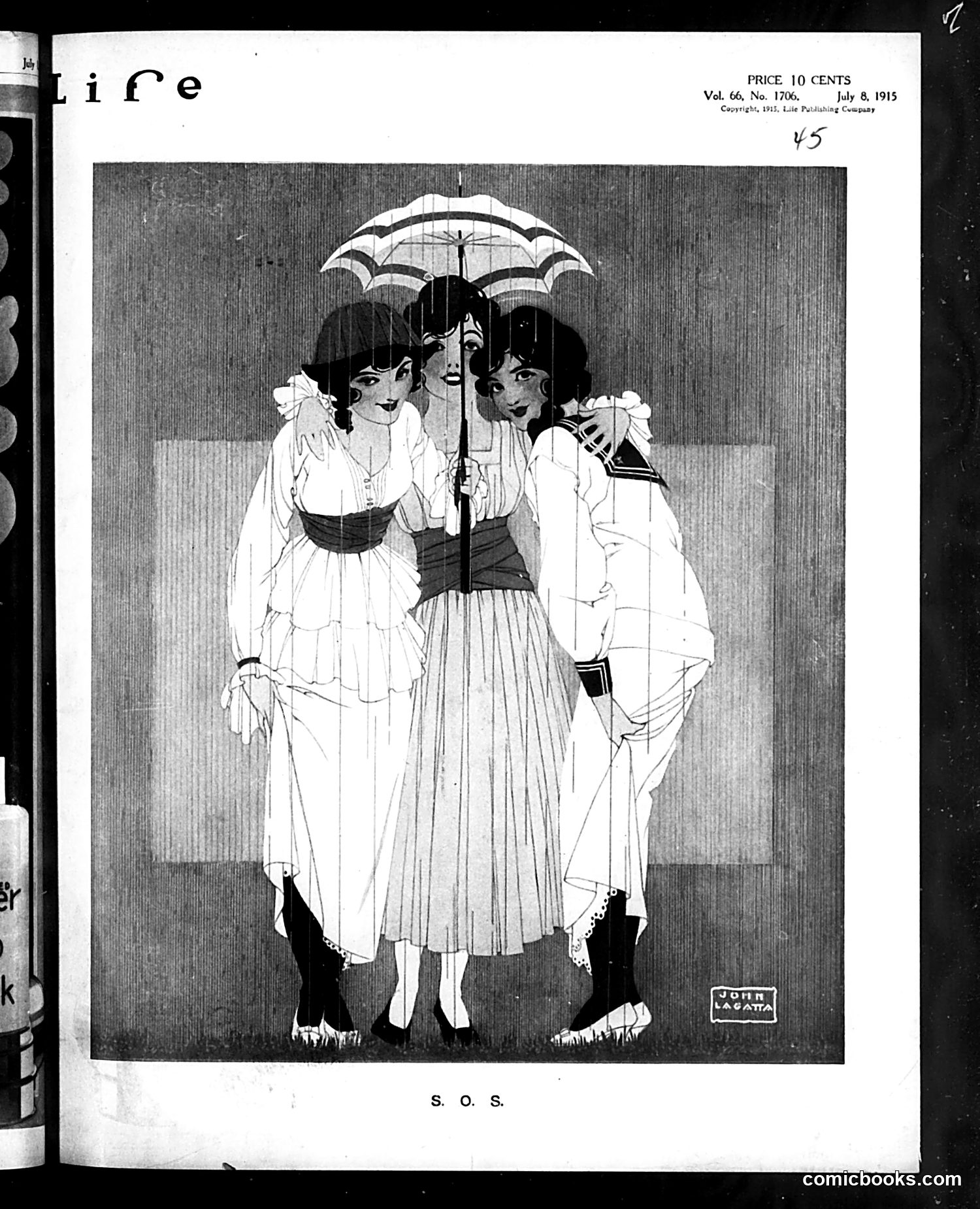
This illustration by John Lagatta depicts three young women huddled together under a shared umbrella during rain, with the caption "S.O.S." (the international distress signal). The satire likely comments on the precarious social or romantic situation of unmarried women in 1915. The umbrella—typically a protective measure—becomes ironic: while it shields them from rain, it cannot protect them from whatever "distress" they face. The intimate grouping and the distress signal suggest vulnerability, possibly referencing courtship anxieties, social instability during World War I (which the U.S. would enter in 1917), or the broader uncertainties facing young women of the era. The specific context remains somewhat unclear without additional text.
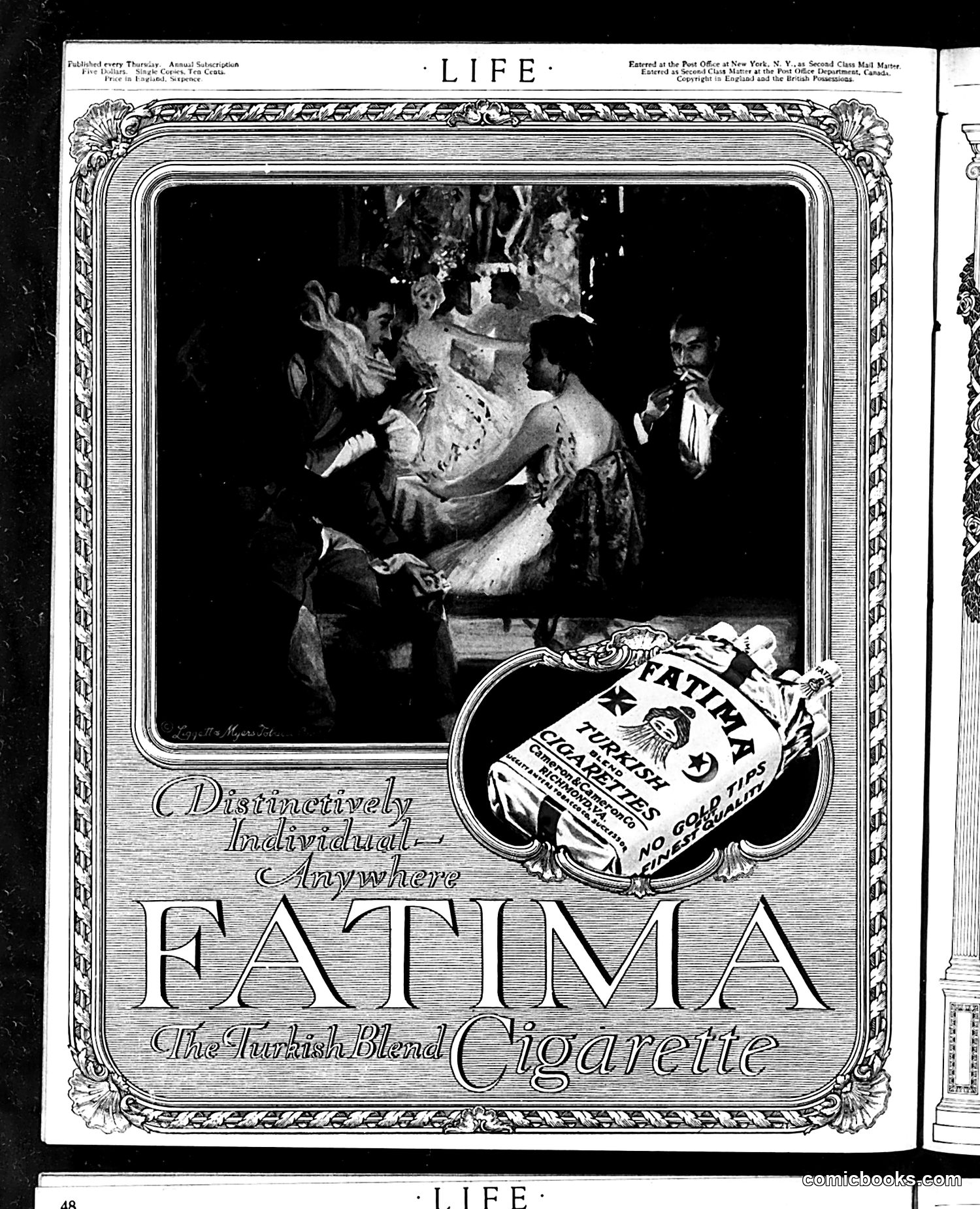
This is a vintage cigarette advertisement for "Fatima: The Turkish Blend Cigarette," described as "Distinctively Individual—Anywhere." The top image depicts what appears to be an exotic, orientalist scene—likely a harem or Turkish setting with multiple figures in dramatic lighting and period costume. This visual aligns with early 20th-century marketing that capitalized on Western fascination with "the Orient." The accompanying product packaging shows the Fatima cigarette box with decorative imagery. The advertisement's appeal relied on exoticism and romance associated with Turkish culture to market cigarettes as sophisticated and distinctive. Such orientalist imagery was common in early American advertising, though it reflects dated and stereotypical cultural attitudes. This represents tobacco marketing before modern health warnings or advertising restrictions.
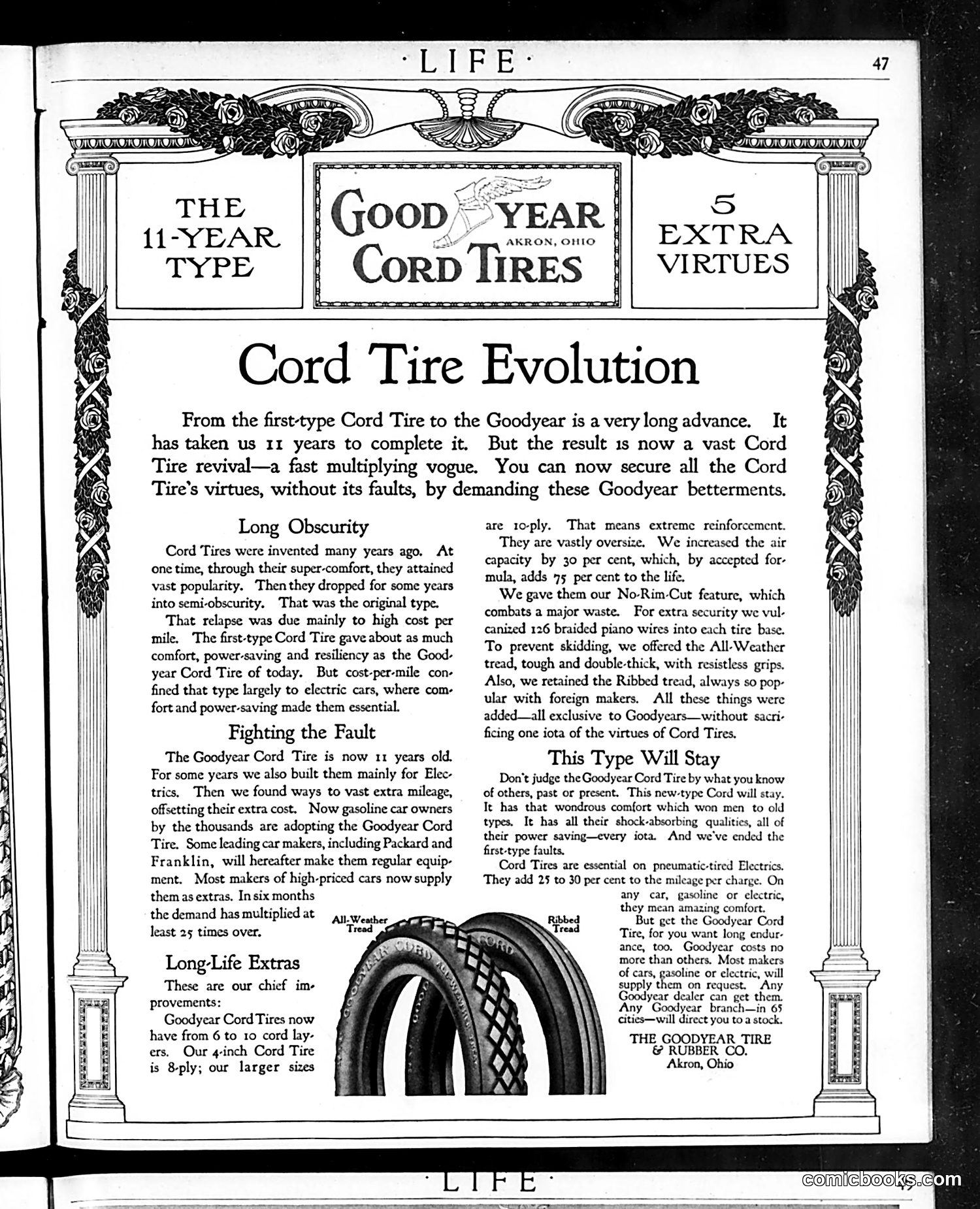
This is **not a political cartoon or satirical content** — it's a straightforward **automobile tire advertisement** for Goodyear Cord Tires, published in *Life* magazine. The page promotes Goodyear's 11-year development of cord tire technology. It claims innovations including increased air capacity (30% boost), a "No-Rim-Cut" feature, reinforced braiding, all-weather tread, and ribbed designs. The company positions these as essential improvements that add "21 to 30 per cent to the mileage" of any vehicle. The decorative classical columns frame the ad in *Life*'s typical high-design house style, but the content is purely commercial messaging emphasizing durability and value — a product pitch rather than satire or political commentary.
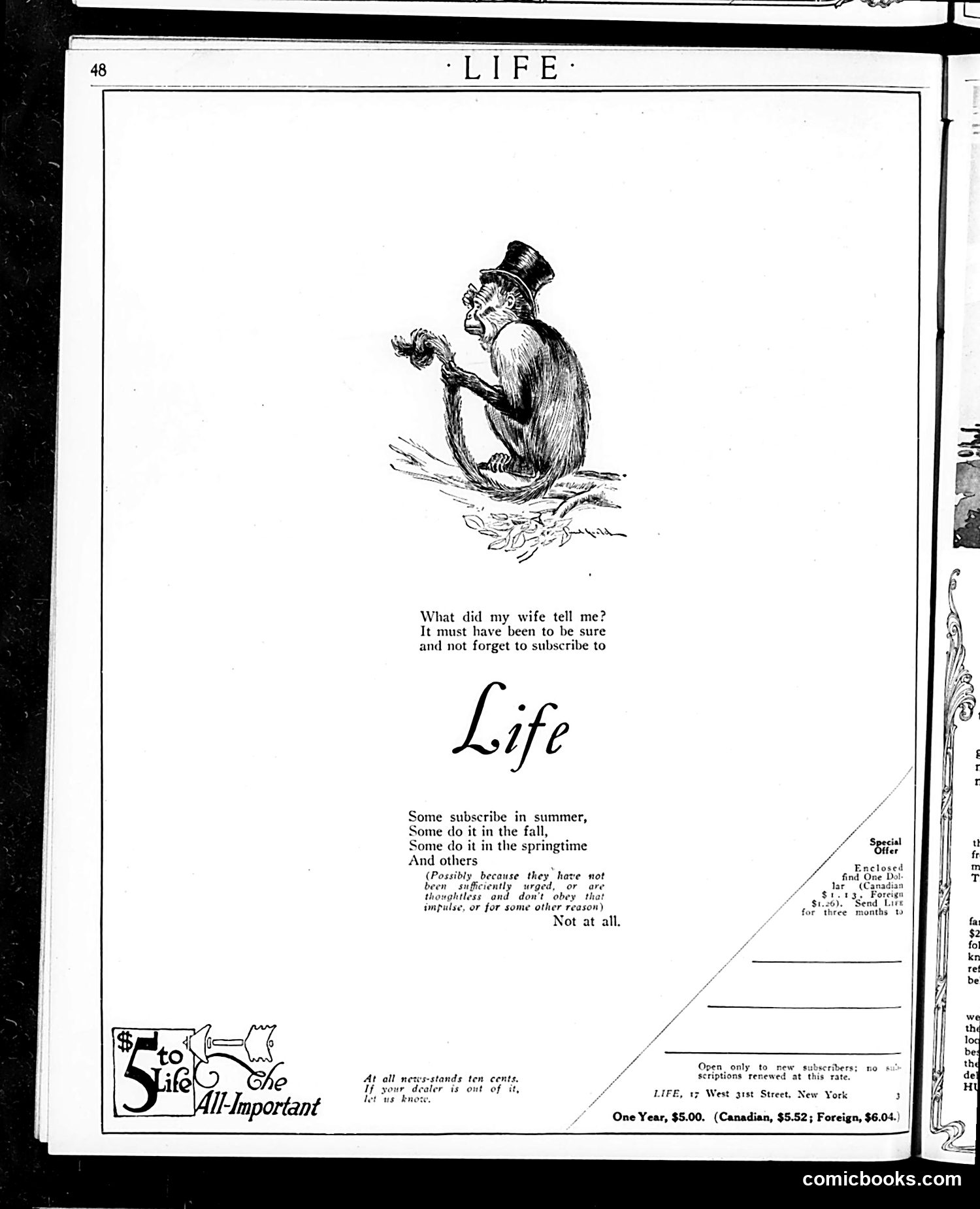
This page is primarily a **subscription advertisement for Life magazine** disguised as editorial content. The central cartoon depicts a monkey in a top hat examining something in its hand—a visual pun playing on the "monkey see, monkey do" concept. The ad's humor targets potential subscribers through mock-nagging: it references what "my wife told me" about subscribing, then lists reasons people procrastinate (summer, fall, springtime distractions), concluding "Not at all"—suggesting subscribers find excuses to avoid action. The monkey character likely represents the thoughtless reader who doesn't subscribe. The satire gently mocks human behavior and inertia while making Life's subscription pitch. Pricing shows this is early 20th century ($5 yearly). The ad uses self-aware humor about advertisement fatigue itself.
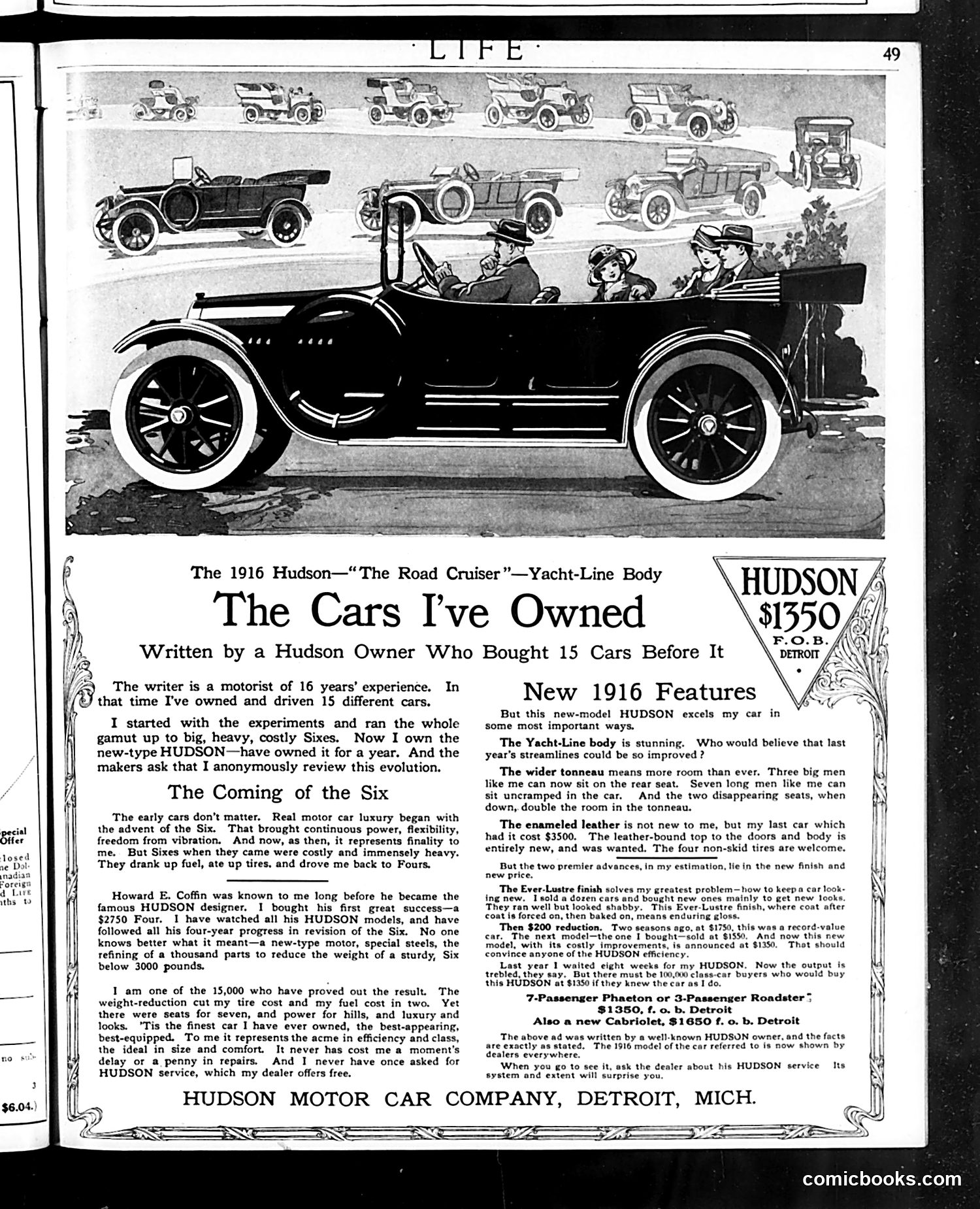
This is primarily **advertising content**, not satire or political commentary. The page features a 1916 Hudson automobile advertisement disguised as editorial content. The "cartoon" at top shows various car models in evolution, illustrating automotive progress. The main image depicts a 1916 Hudson "Road Cruiser" with well-dressed passengers, emphasizing luxury and comfort. The text is a first-person testimonial from a Hudson owner claiming 16 years of driving experience with 15 different cars. The writer argues the new Hudson surpasses previous vehicles through its "Yacht-Line Body," roomier interior, and improved leather upholstery. This represents early 20th-century **advertorial strategy**—marketing copy presented as personal consumer endorsement to appear more credible than direct advertising. The price listed is $1,350 (Detroit).
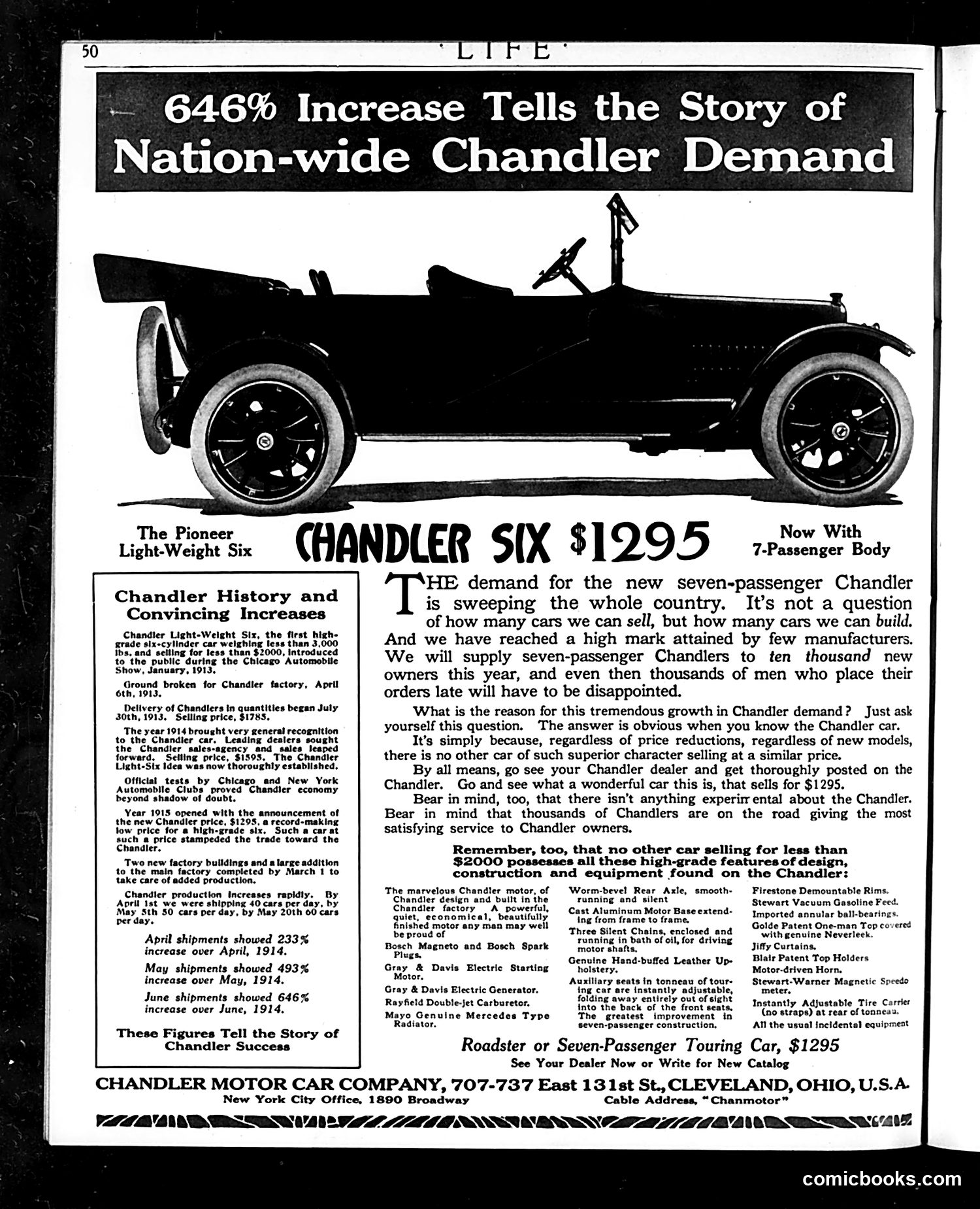
This is primarily **automobile advertising, not satire or political content**. It's a full-page advertisement for the Chandler Six automobile, priced at $1295. The headline claims a "646% Increase" in nationwide demand, supporting the company's assertion that they cannot build cars fast enough to meet consumer demand. The text emphasizes the vehicle's features—seven-passenger capacity, quality construction, and competitive pricing—to justify this claimed popularity. The only image is a side-view silhouette of the automobile itself, presented as an attractive product showcase rather than satirical commentary. This represents typical early-1900s American advertising rhetoric: emphasizing scarcity and demand to drive sales. There is no political cartoon or satirical content present on this page.
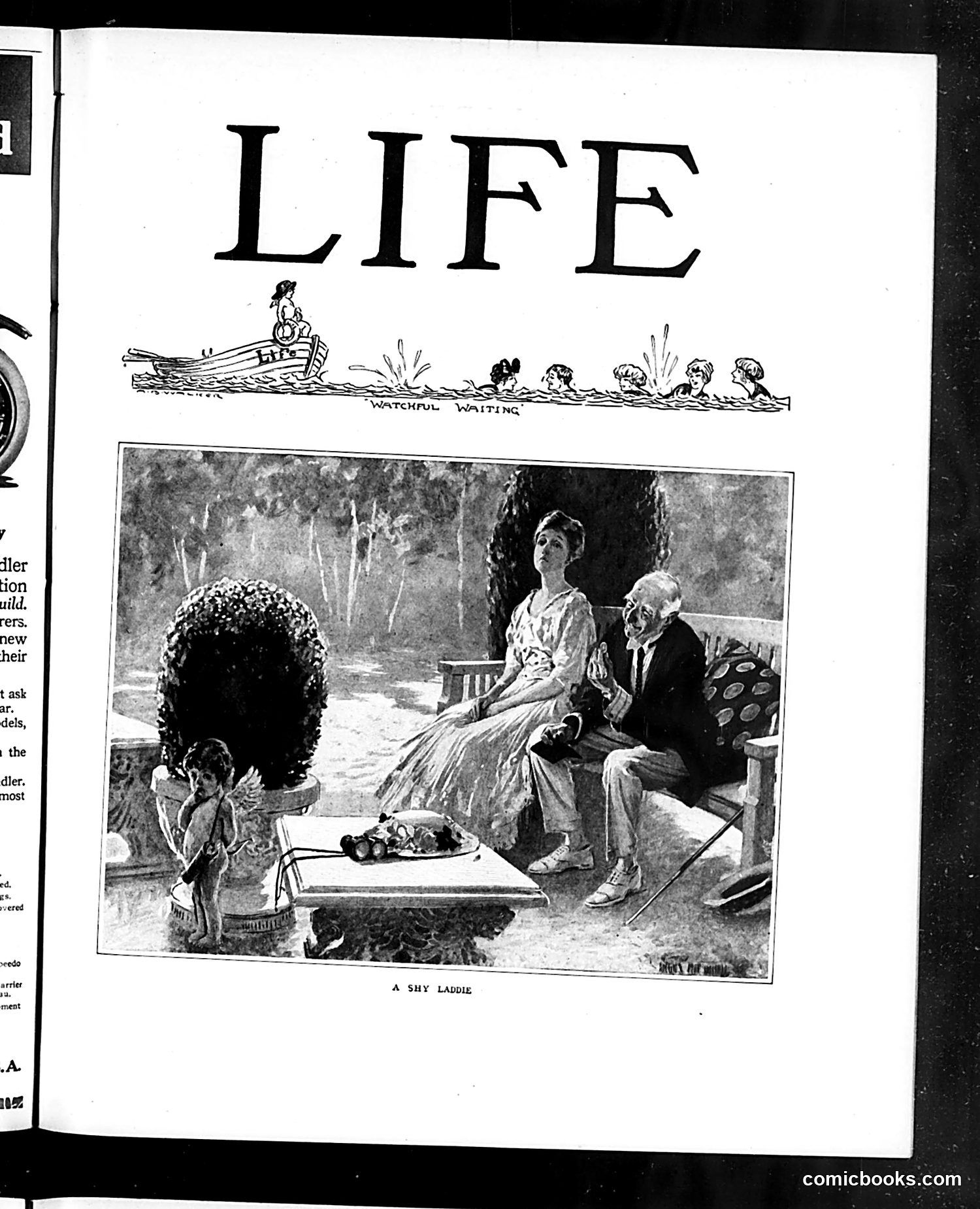
This page from *Life* magazine presents a humorous domestic scene captioned "A Shy Laddie." The illustration shows a small child hiding behind a large potted plant while two adults (appearing to be a woman and an older gentleman) sit conversing on a bench in what looks like a garden or park setting. The joke appears to play on the contrast between the child's extreme shyness—literally concealing himself behind vegetation—and the adults' oblivious socializing. The caption's term "laddie" suggests the child is a boy, and the humor derives from exaggerating typical childhood bashfulness or social anxiety. The accompanying header illustration depicts figures in water labeled "WATCHFUL WAITING," though its connection to the main cartoon remains unclear from this page alone.
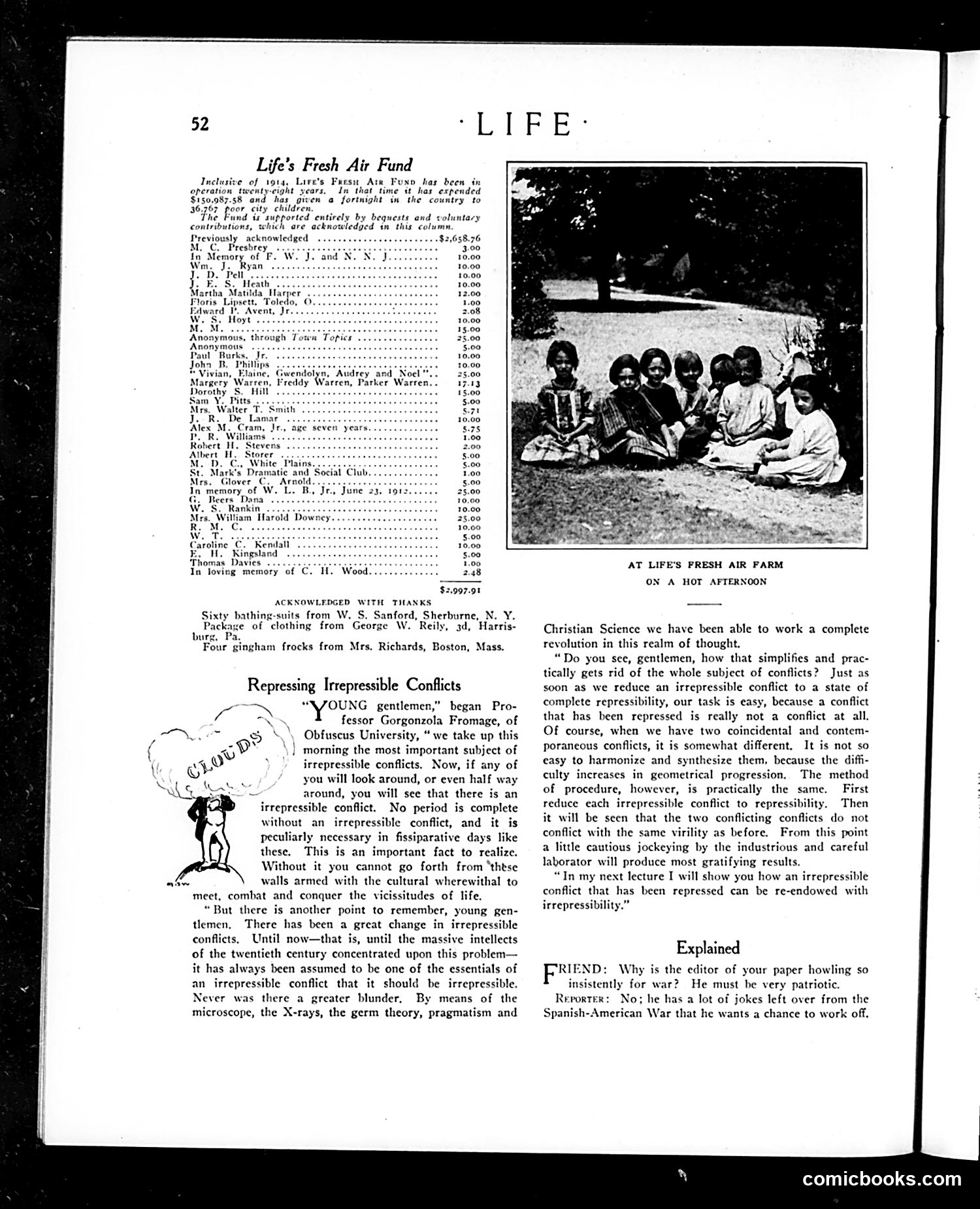
This page contains a satirical article titled "Repressing Irrepressible Conflicts" by Professor Everett Kimball of Obscurus University. The accompanying cartoon depicts a figure labeled "CLOUDS" standing atop a hill, illustrating the article's central argument: that in modern times (referencing scientific advances like microscopes, X-rays, and germ theory), society can supposedly resolve conflicts deemed "irrepressible" in earlier eras. The satire mocks both optimistic progressive thinking and academic pretension—suggesting that intellectuals overestimate science's ability to solve fundamental human disagreements. The cartoon's humor relies on the visual absurdity of literally standing above one's problems. A separate section titled "Explained" features a brief Q&A mocking editorial patriotism regarding the Spanish-American War.
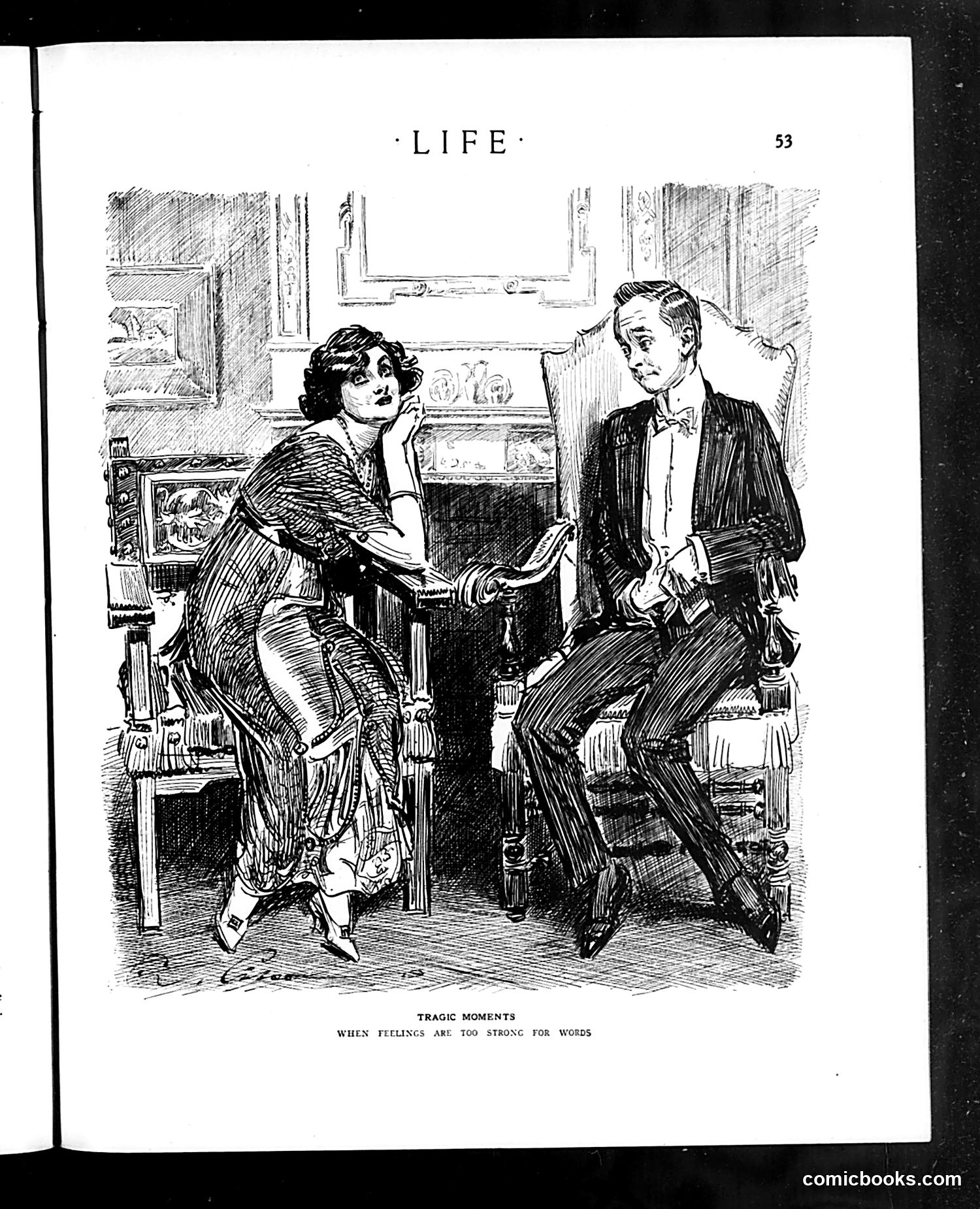
This is a satirical cartoon from *Life* magazine depicting an intimate domestic scene. A well-dressed man and woman sit facing each other in a parlor, with the woman appearing emotionally overwrought (hand to face, leaning forward) while the man looks away uncomfortably, holding what appears to be a newspaper or document. The caption's irony is the point: the cartoon mocks Victorian-era conventions where intense emotions supposedly rendered people speechless. The satire suggests that in reality, such "tragic moments" are often marked by awkward silence or avoidance rather than eloquent expression—a commentary on the gap between romantic ideals and actual human behavior, particularly regarding emotional vulnerability between couples.
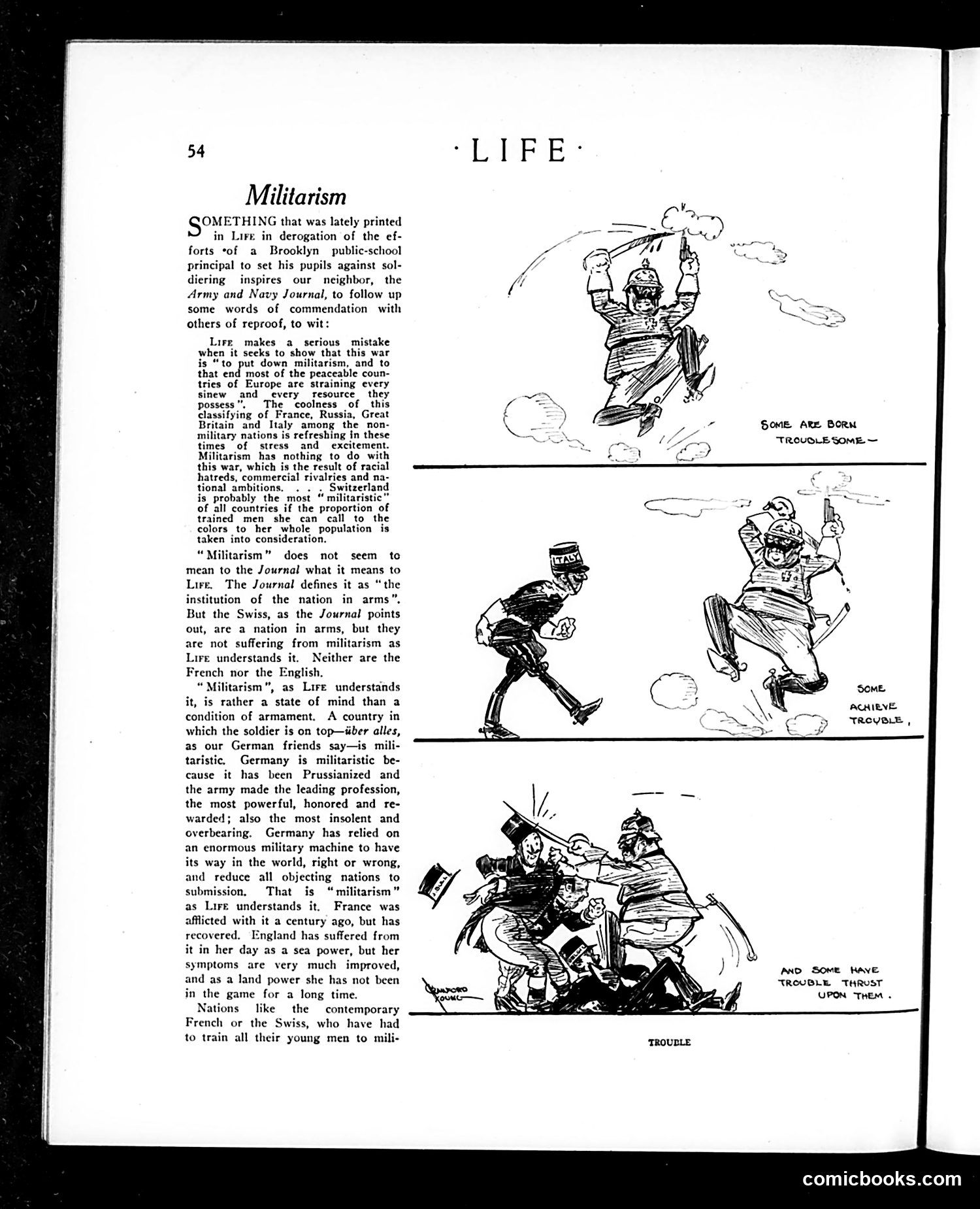
This editorial page critiques militarism in early 20th-century Europe. The text argues that militarism—not actual warfare—causes nations' problems, defining it as "a state of mind" where military values dominate society. The three cartoons illustrate this concept through soldiers experiencing escalating trouble: 1. "Some are born trouble-some" - a soldier struggling with his equipment 2. "Some achieve trouble" - another soldier causing chaos 3. "And some have trouble thrust upon them" - soldiers in violent conflict The captions parody Shakespeare's "All the world's a stage" speech, suggesting militarism inevitably creates conflict. The text specifically criticizes Germany's Prussian military culture as the worst example, while noting France and England have also suffered militarism's corrupting influence on their societies.
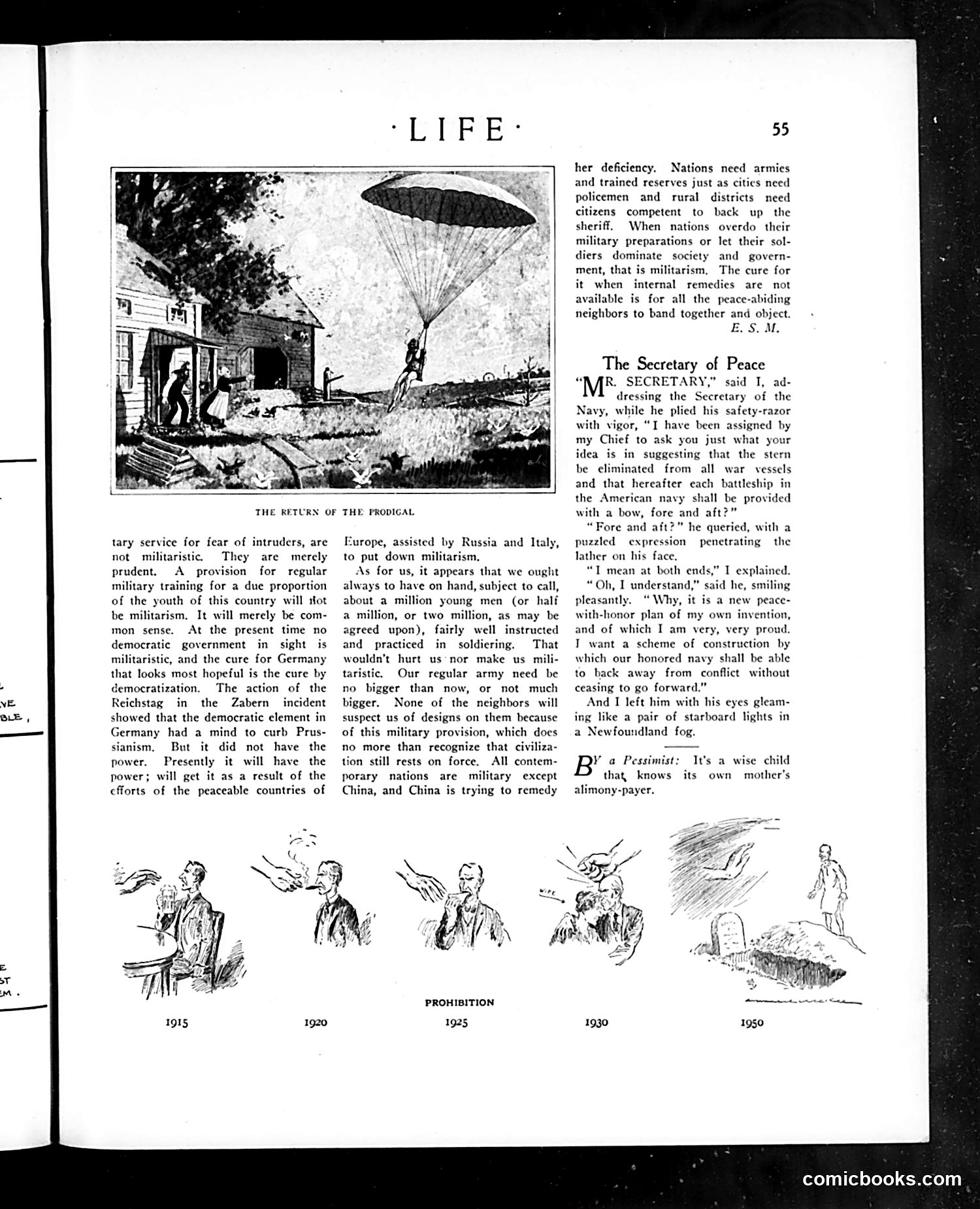
The upper illustration titled "The Return of the Prodigal" depicts a figure descending by parachute toward a house—likely representing a soldier returning home from World War I. The lower cartoon sequence labeled "Prohibition" shows a man's deteriorating condition across five decades (1915-1930). The satirical progression suggests how Prohibition (the constitutional ban on alcohol, 1920-1933) affected American society—the figure becomes increasingly disheveled and desperate over time, culminating in what appears to be death or grave circumstances by 1930. The accompanying text discusses military preparedness and democratic governance, critiquing excessive militarism while supporting reasonable defense measures. The page satirizes both post-war demobilization challenges and Prohibition's social consequences.
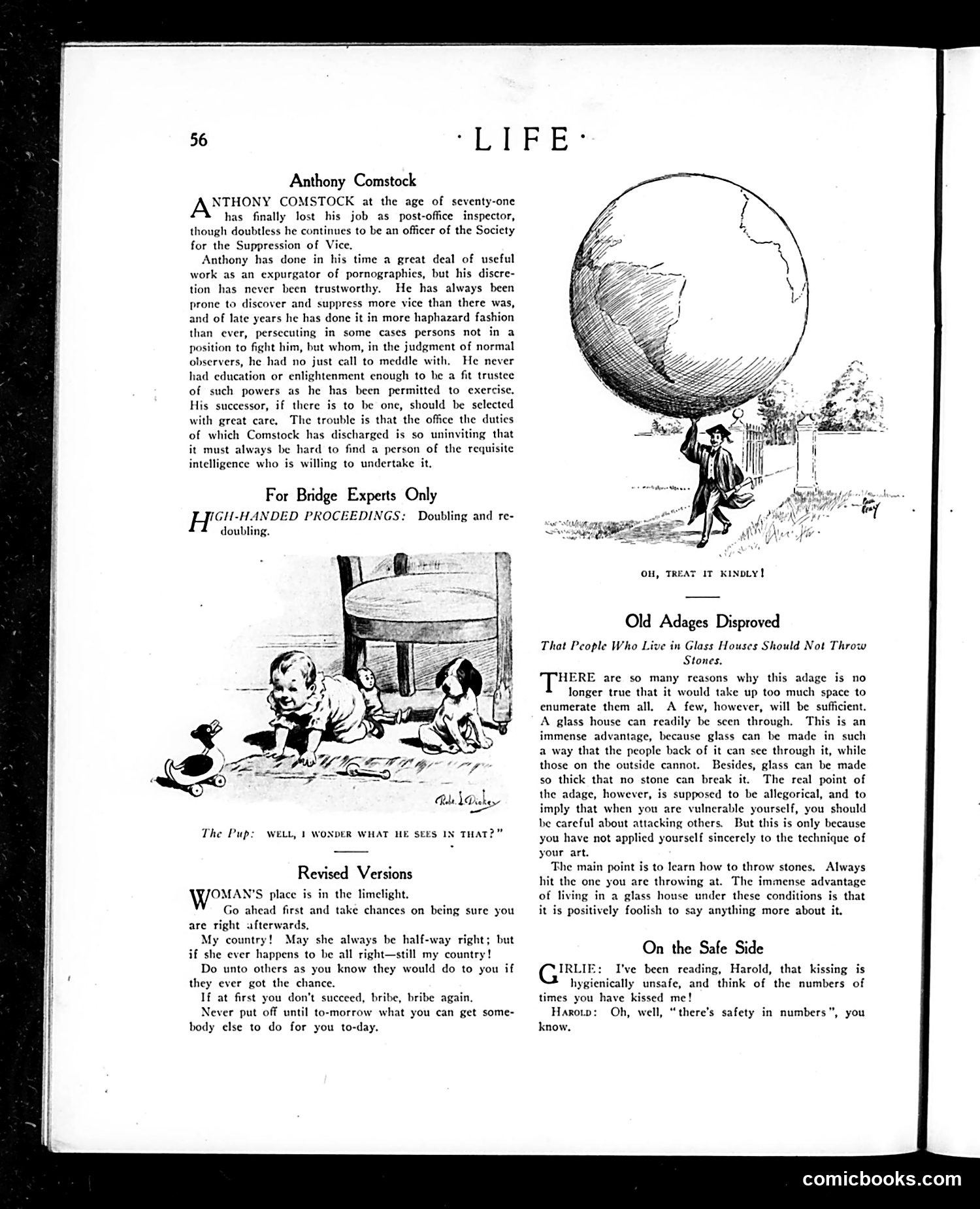
This page contains three distinct sections: **Anthony Comstock** (top): A biographical note on the aging post-office inspector and vice-suppression activist, criticizing his tendency to meddle in cases beyond his authority despite lacking proper education or legal standing. **"For Bridge Experts Only"** (middle): A cartoon about bridge-playing, showing a pup observing card players with the caption "Well, I wonder what he sees in that?"—a visual joke about the dog's perspective on the game. **"Old Adages Disproved"** (bottom): Satirizes the saying "people in glass houses shouldn't throw stones" by arguing glass houses actually offer advantages (transparency, durability), making the adage obsolete. The final section, "On the Safe Side," presents a humorous dialogue between Girlie and Harold about kissing's hygiene risks.
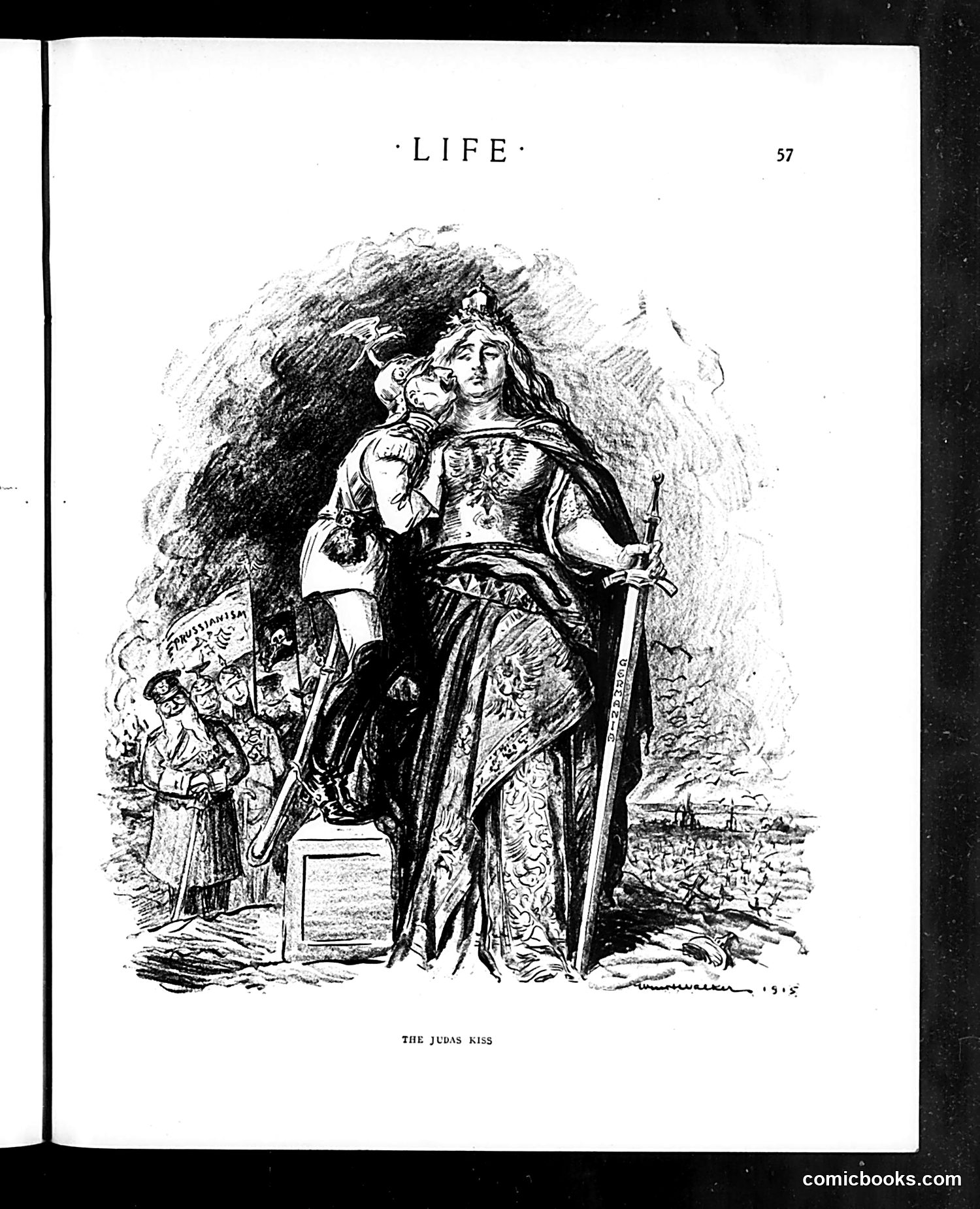
This illustration depicts a biblical allegory of betrayal. A woman in classical armor and robes—representing a nation or cause—holds a child while a figure approaches to kiss her, referencing Judas's betrayal of Jesus through a kiss. The smaller figures in the background appear to be observers or a crowd. The landscape suggests an epic or historical scene rather than a contemporary one. Without additional context about Life's publication date or the specific political moment, I cannot definitively identify which nation, leader, or historical event this satirizes. The image uses the archetypal "Judas kiss" to suggest treachery or a false ally—likely commentary on international relations or political betrayal—but the specific target remains unclear from the image and caption alone.
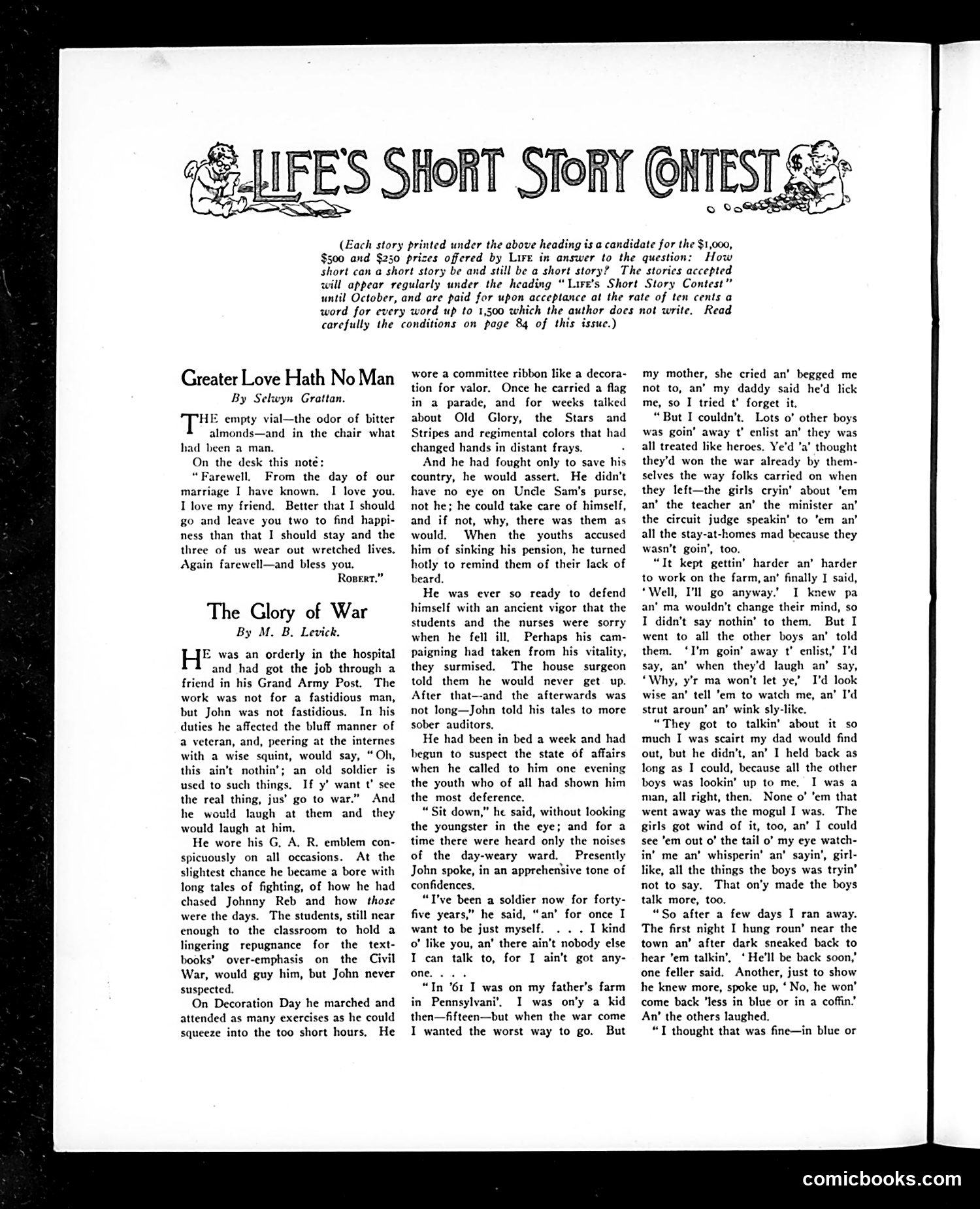
This page presents a literary contest announcement and two short stories, not political cartoons. **Contest Details:** Life magazine solicited short stories answering "How short can a short story be and still be a short story?" with prizes up to $1,000. Stories would be published regularly and paid at ten cents per word (up to 1,500 words). **Stories Shown:** 1. "Greater Love Hath No Man" by Stelgyn Grattan—a soldier's farewell letter 2. "The Glory of War" by W. H. Lewis—appears to contrast a wounded soldier's actual battlefield experience with patriotic mythology Both stories seem to engage with World War I themes, examining soldiers' real experiences versus idealized narratives. The page is primarily literary content, not satirical commentary.
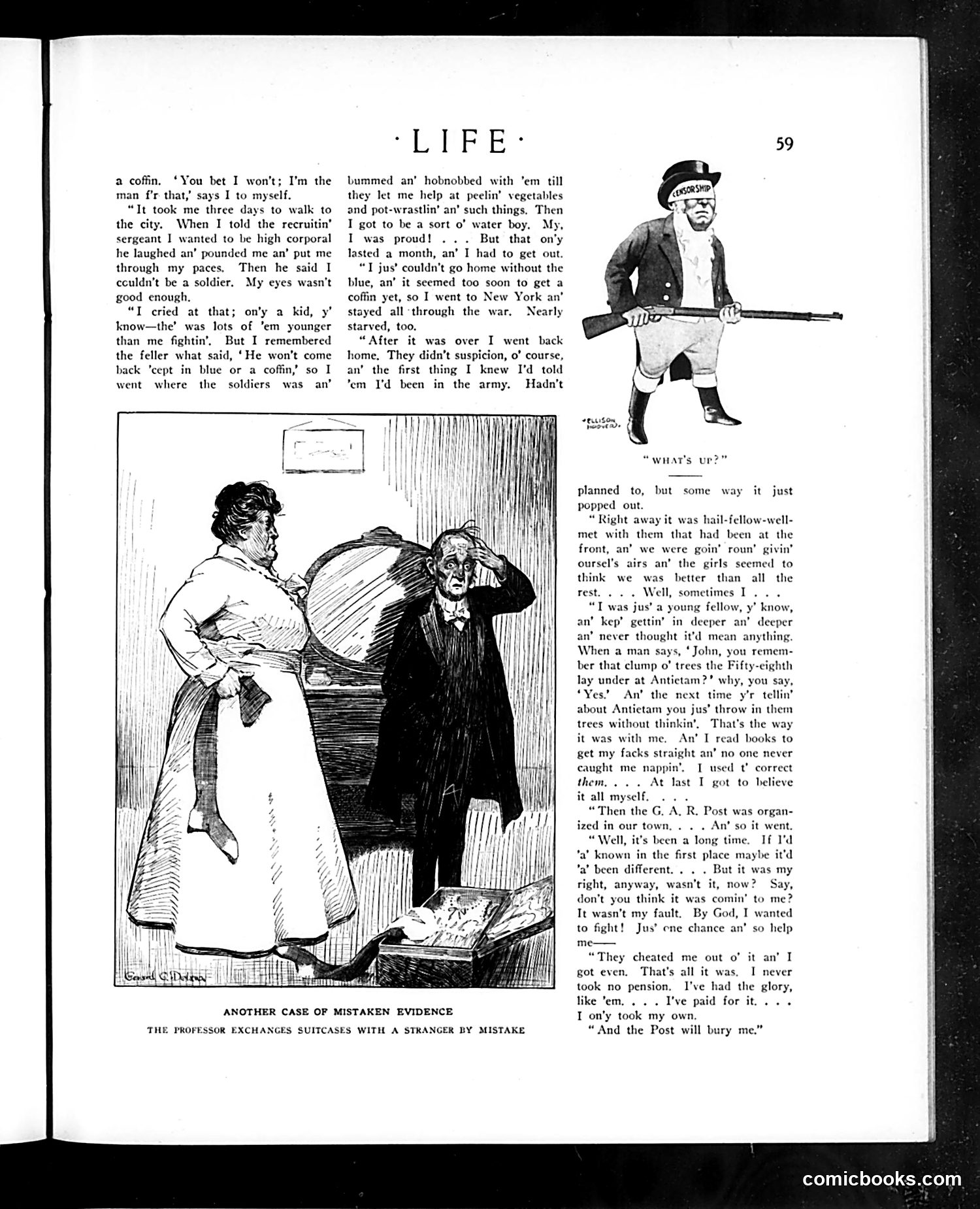
This page contains a first-person narrative account of a man explaining why he never served in WWI, despite societal pressure. The illustration titled "Another Case of Mistaken Evidence" shows a professor exchanging suitcases with a stranger by mistake—a visual joke about misidentification. The text describes how the narrator was rejected from military service due to poor eyesight, then worked various civilian jobs including as a "water boy." He later faced suspicion upon returning home that he'd shirked his duty. The narrative addresses post-war social anxieties about masculinity and patriotism—the tension between those who fought and those who didn't, and how civilians had to justify their wartime activities. The satire targets both unfounded suspicions of non-combatants and the narrator's own defensiveness.
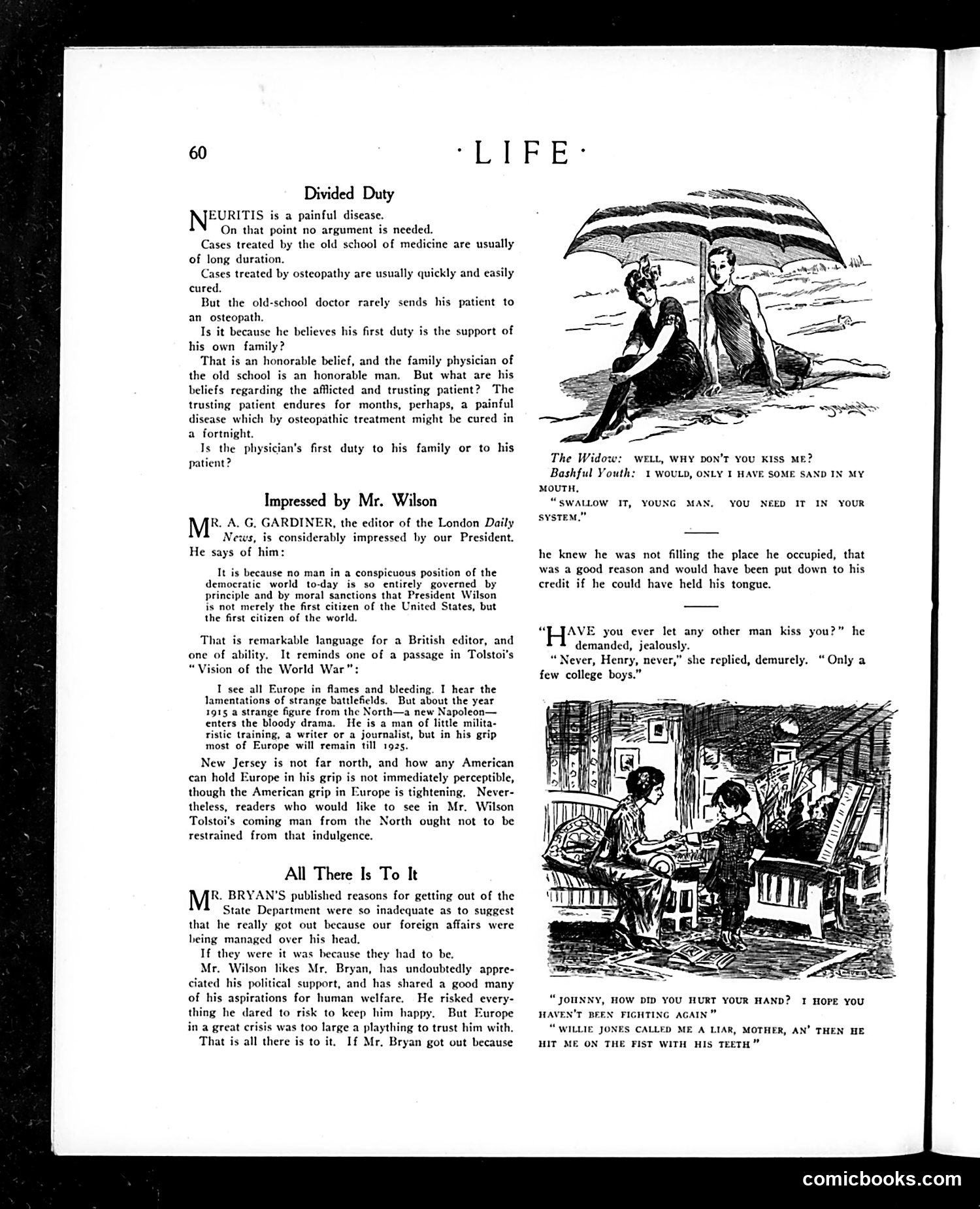
This page contains three satirical pieces typical of early 20th-century American humor: **"Divided Duty"** critiques old-school doctors' reluctance to refer patients to osteopaths, suggesting financial self-interest trumps patient welfare—a jab at professional protectionism. **"Impressed by Mr. Wilson"** mocks inflated praise for President Wilson by a British editor, contrasting it with Tolstoy's apocalyptic prophecy of a "new Napoleon" from the North. The satire suggests Americans are reading messianic grandiosity into Wilson's actual influence. **"All There Is To It"** addresses William Jennings Bryan's resignation as Secretary of State, implying he was sidelined on European affairs during WWI and lacked the competence to handle such matters—a dig at both Bryan's abilities and his subsequent silence about his departure. The accompanying cartoons are humorous domestic vignettes: a widow's flirtation and a child's explanation for a hand injury—light comic relief unrelated to the political commentary.
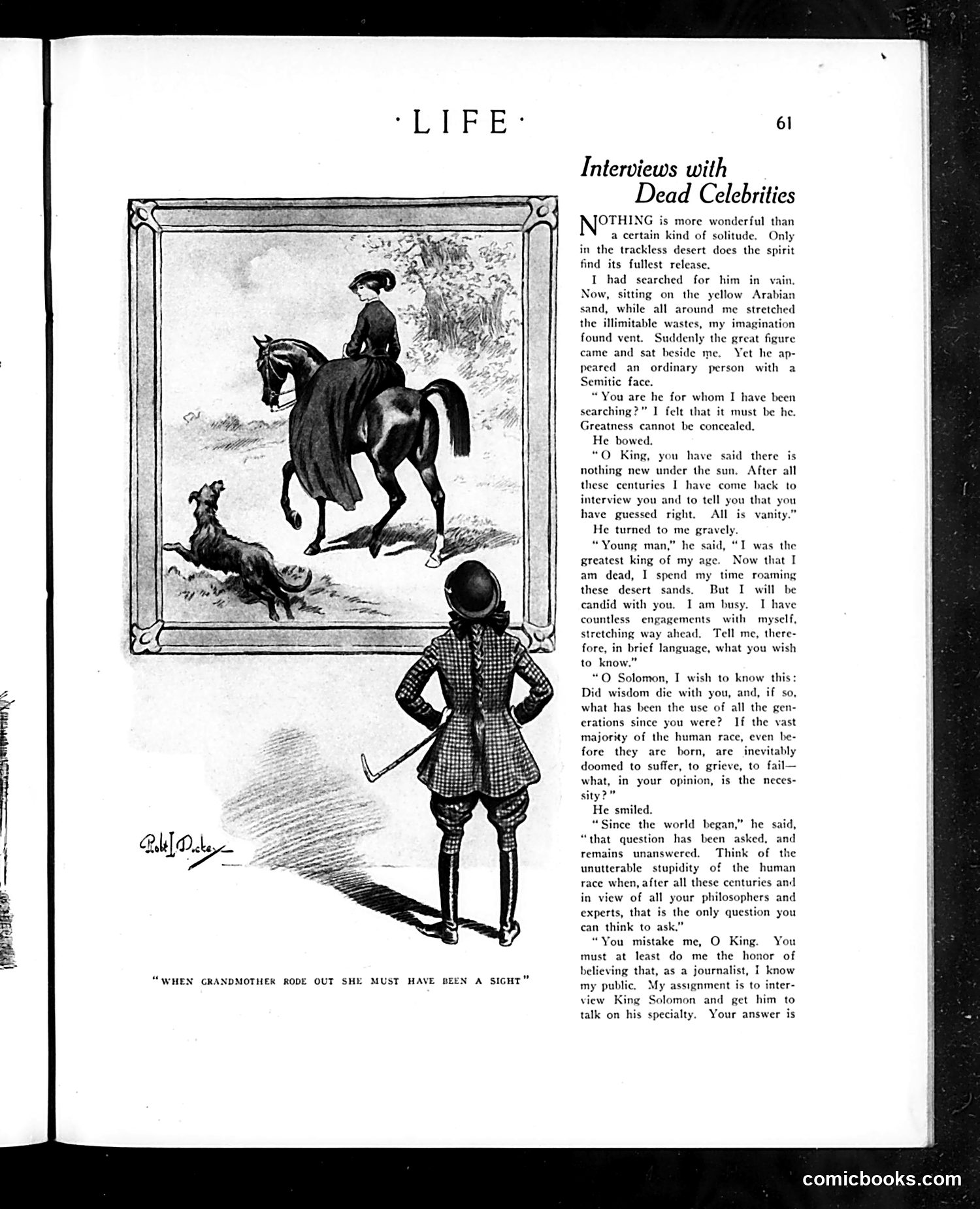
This satirical piece mocks both pretentious journalism and human philosophical futility. A modern reporter interviews the Biblical King Solomon in the desert, seeking wisdom about human suffering and life's purpose. The joke operates on multiple levels: Solomon dismisses the journalist's question as the same tired inquiry humanity has asked for millennia—unanswered. He then mocks the reporter for thinking his "public" cares about genuine wisdom, reducing serious inquiry to mere assignment-fulfilling. The cartoon caption jokes about outdated female propriety ("When Grandmother Rode Out She Must Have Been a Sight"), likely commenting on changing social standards. The satire critiques both journalism's superficiality (reducing philosophy to quotable soundbites for readers) and humanity's circular thinking—we ask the same unanswerable questions across centuries without progress. Solomon emerges as weary and cynical about human intelligence.
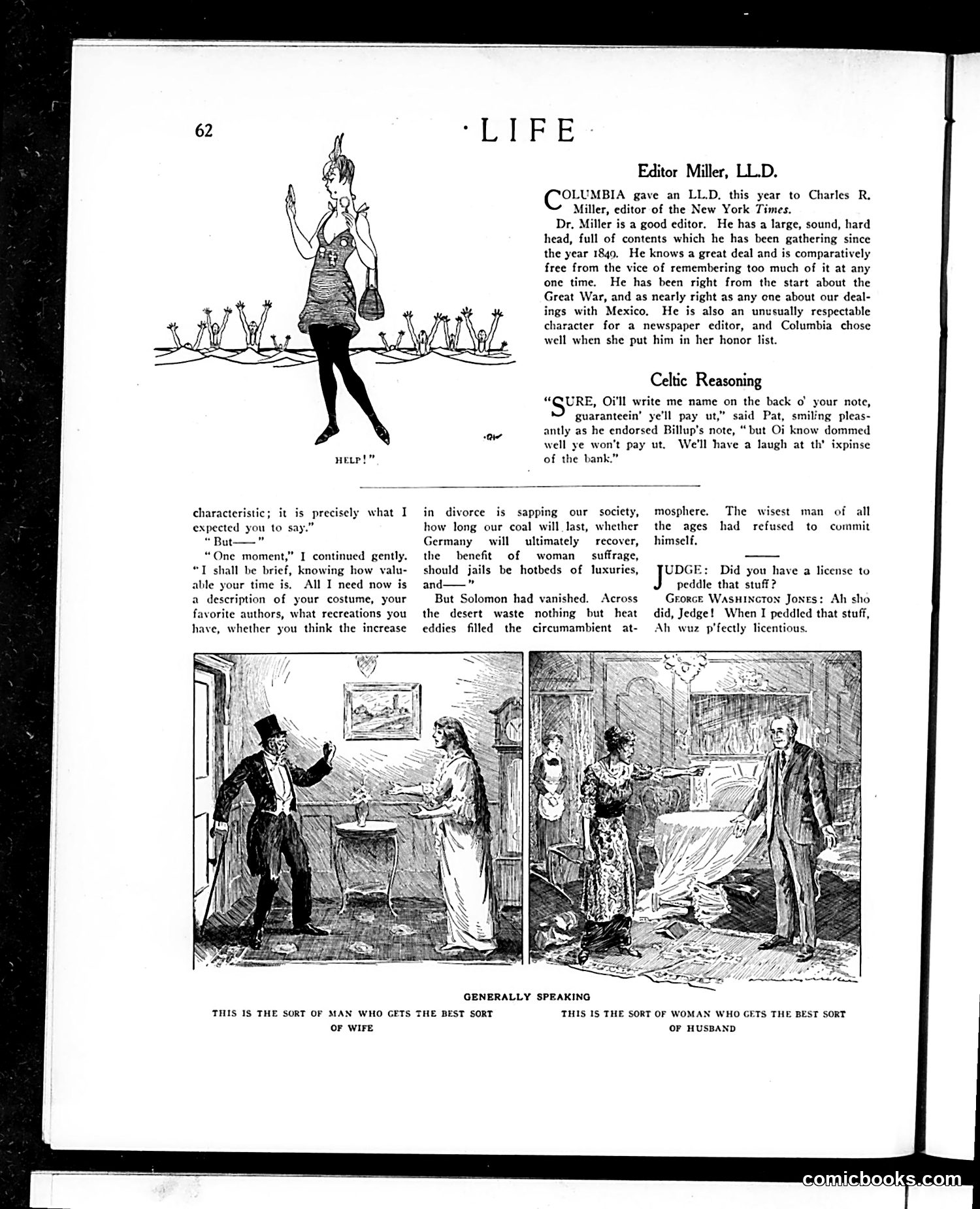
This page contains multiple satirical pieces typical of Life's humor: **Top section** honors Charles R. Miller, editor of the New York Times, for receiving an LL.D. from Columbia University—presented straightforwardly as legitimate recognition. **"Celtic Reasoning"** mocks Irish stereotypes through a character "Pat" who endorses a promissory note while openly admitting he knows it won't be paid, finding humor in defrauding a bank. This reflects period anti-Irish prejudice common in American satire. **Bottom cartoons** contrast marital types: the left shows a man interrogating his wife about her appearance and reading habits (satirizing intrusive husbands); the right shows a woman amid domestic chaos (satirizing wives who mismanage households). The captions suggest these represent "the sort" of people who "get" desirable spouses—ironic commentary on poor matches. The page exemplifies early 20th-century Life's blend of social commentary, ethnic humor, and gender satire now considered offensive.
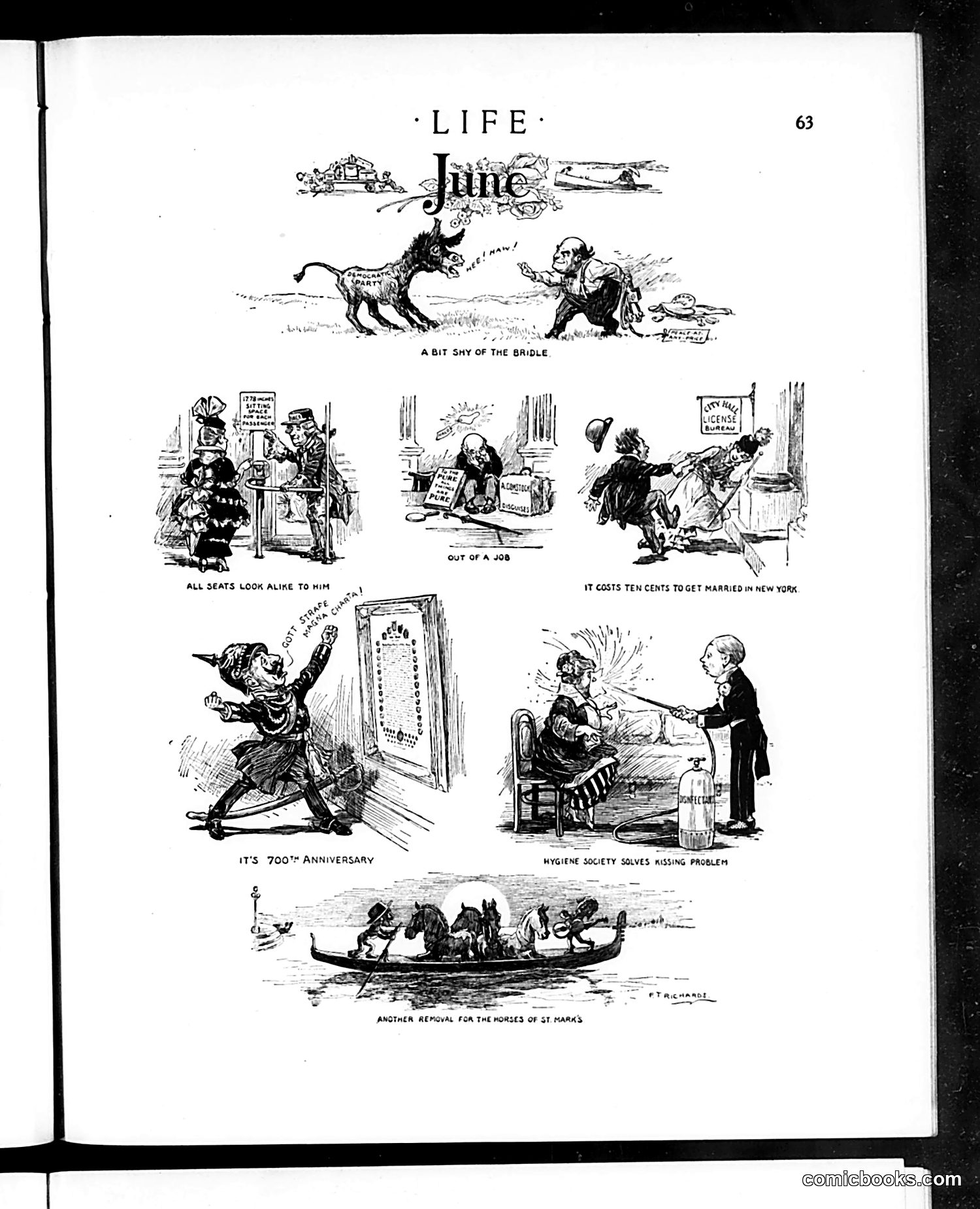
This page contains six separate satirical cartoons mocking contemporary social issues: 1. **"A Bit Shy of the Bridle"** - A man struggles with a stubborn horse, likely satirizing marital discord or difficult relationships. 2. **"All Seats Look Alike to Him"** - Appears to mock someone's poor judgment or perception. 3. **"Out of a Job"** - References unemployment or economic hardship. 4. **"It Costs Ten Cents to Get Married in New York"** - Satirizes the low cost/ease of marriage, suggesting trivial commitment. 5. **"It's 700th Anniversary"** - Unclear reference without additional context. 6. **"Hygiene Society Solves Missing Problem"** - Likely critiques ineffective public health measures. 7. **"Another Removal for the Horses of St. Marks"** - References Venice's famous St. Mark's Square horses, suggesting satirical commentary on cultural preservation or relocation. The cartoons collectively critique social conditions, relationships, employment, and civic institutions of the era.
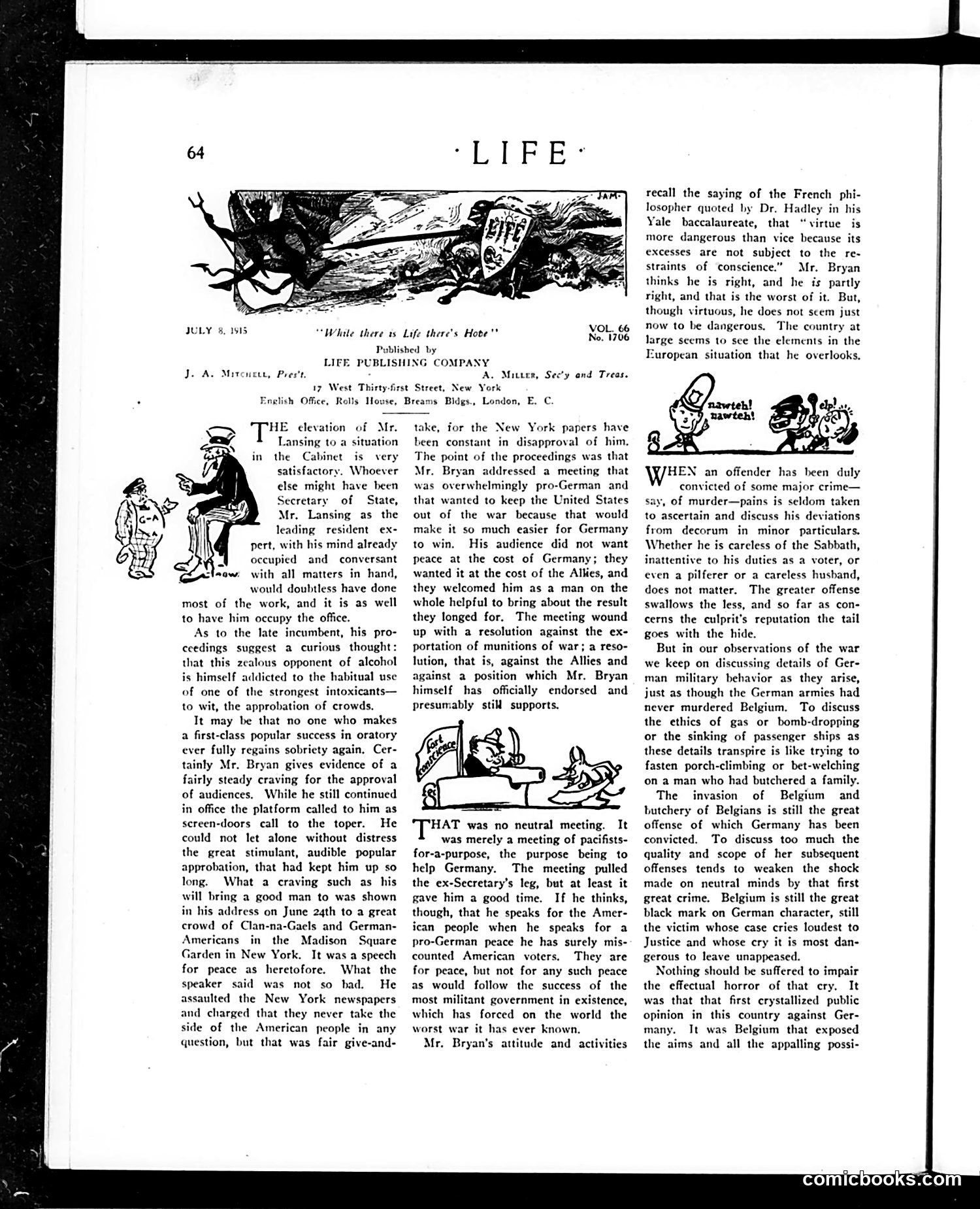
This page attacks **William Jennings Bryan**, former Secretary of State, for his pacifist activities. The text criticizes Bryan's recent speech at Madison Square Garden to a pro-German, anti-war crowd, despite World War I raging in Europe. The satire's key points: 1. **Bryan's "intoxication" with crowd approval**: The author mocks Bryan's addiction to audience applause, comparing it to alcoholism—ironic given Bryan's temperance advocacy. 2. **Pro-German sympathies**: Though Bryan claimed to support neutrality and peace, his audiences were overwhelmingly pro-German and opposed U.S. aid to the Allies. Life argues Bryan enabled German interests while claiming moral high ground. 3. **Hypocrisy**: The cartoon suggests Bryan's "virtue"—his pacifism—is actually dangerous because it lacks moral restraint, following a French philosophical quote. The cartoons (visible on the left) appear to satirize political figures, though specific identities are unclear from the image alone.
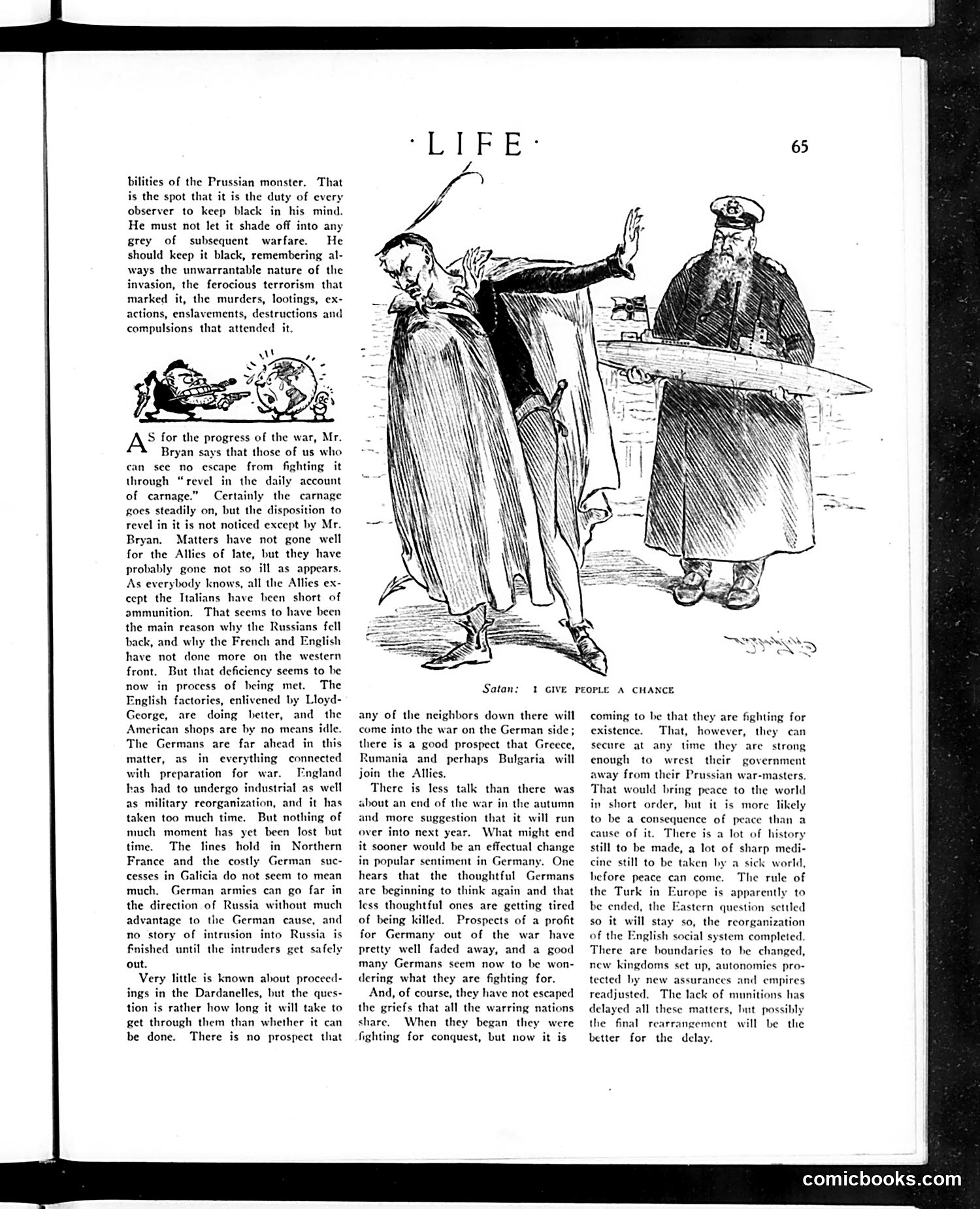
This page from *Life* magazine (likely 1915-1916, during World War I) contains political commentary and a satirical cartoon. **The Cartoon:** The illustration labeled "Satan: I Give People a Chance" depicts a demonic figure (Satan) gesturing toward a military officer, suggesting dark forces are manipulating the war. The caption implies Satan is "giving people a chance"—likely sardonic commentary that war itself is a devilish opportunity. **The Text:** The article discusses World War I's progress, referencing William Jennings Bryan's criticism of those who "revel" in casualty reports. It addresses Allied ammunition shortages, German military preparation advantages, and speculation about war's end. The author argues Germany's prospects have "faded away" and suggests peace might come if Germans overthrow their "Prussian war-masters." **Key Context:** This reflects American debate over potential entry into WWI, with criticism of "the Prussian monster" and hope that internal German opposition might end the conflict—perspectives common before America's 1917 entry.
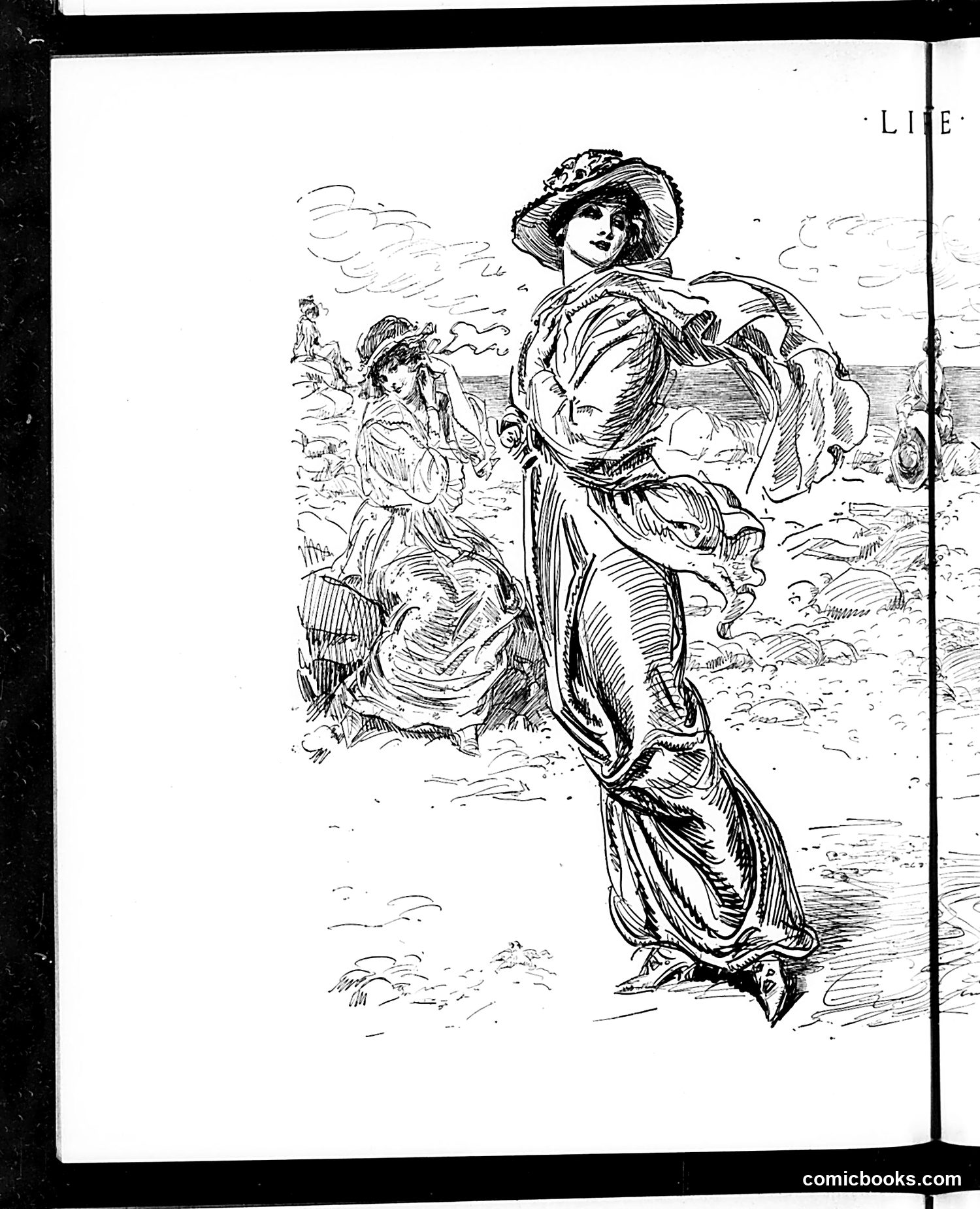
This page contains a sketch illustration rather than a political cartoon with clear satirical messaging. The OCR text appears to be corrupted or represents only page markers/formatting codes, providing no readable context. The image shows a Victorian-era pen-and-ink drawing of elegantly dressed women in period clothing (likely early 1900s based on the silhouettes and hats). The foreground features a woman in a fashionable coat and wide-brimmed hat, with additional figures visible in the background near what appears to be a beach or seaside setting. Without legible accompanying text, I cannot identify the specific satirical point, the individuals depicted, or the social commentary intended. This appears to be a fashion or society illustration rather than a political cartoon, though the full context is unclear from this page alone.
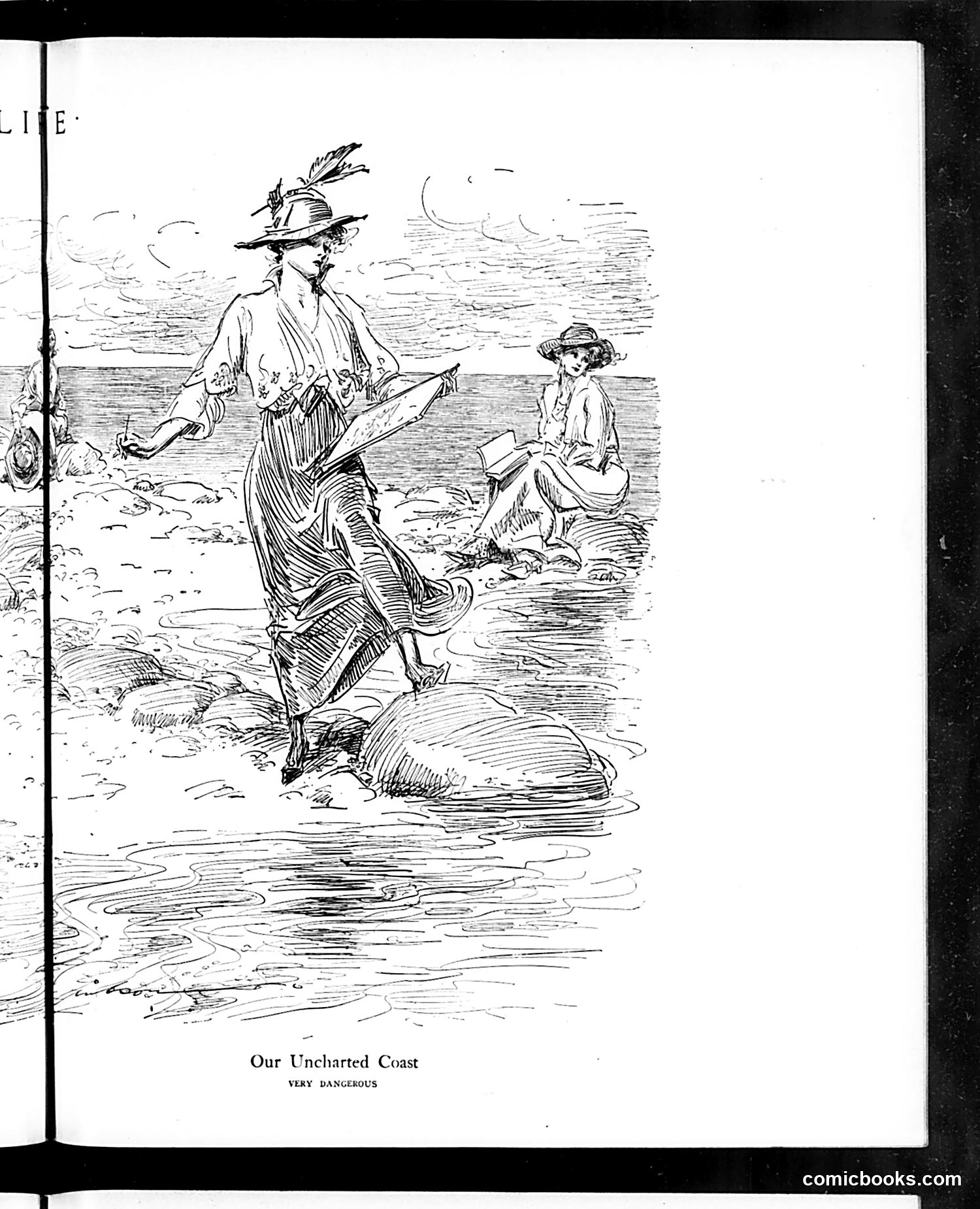
This illustration depicts two figures in early 20th-century dress on a beach or rocky shore. The standing woman holds a surveying instrument or map, while a seated figure observes. The subtitle "VERY DANGEROUS" suggests satirical commentary about uncharted or unknown territory—likely a metaphor for unexplored political, social, or economic matters. Without additional context about the specific Life magazine issue, the exact reference remains unclear. However, given the period's style, this could reference contemporary exploration themes, women's roles in surveying/mapmaking, or perhaps commentary on American foreign policy and unmapped territories. The "dangerous" designation suggests the subject posed risks or uncertainty that warranted public attention or caution.
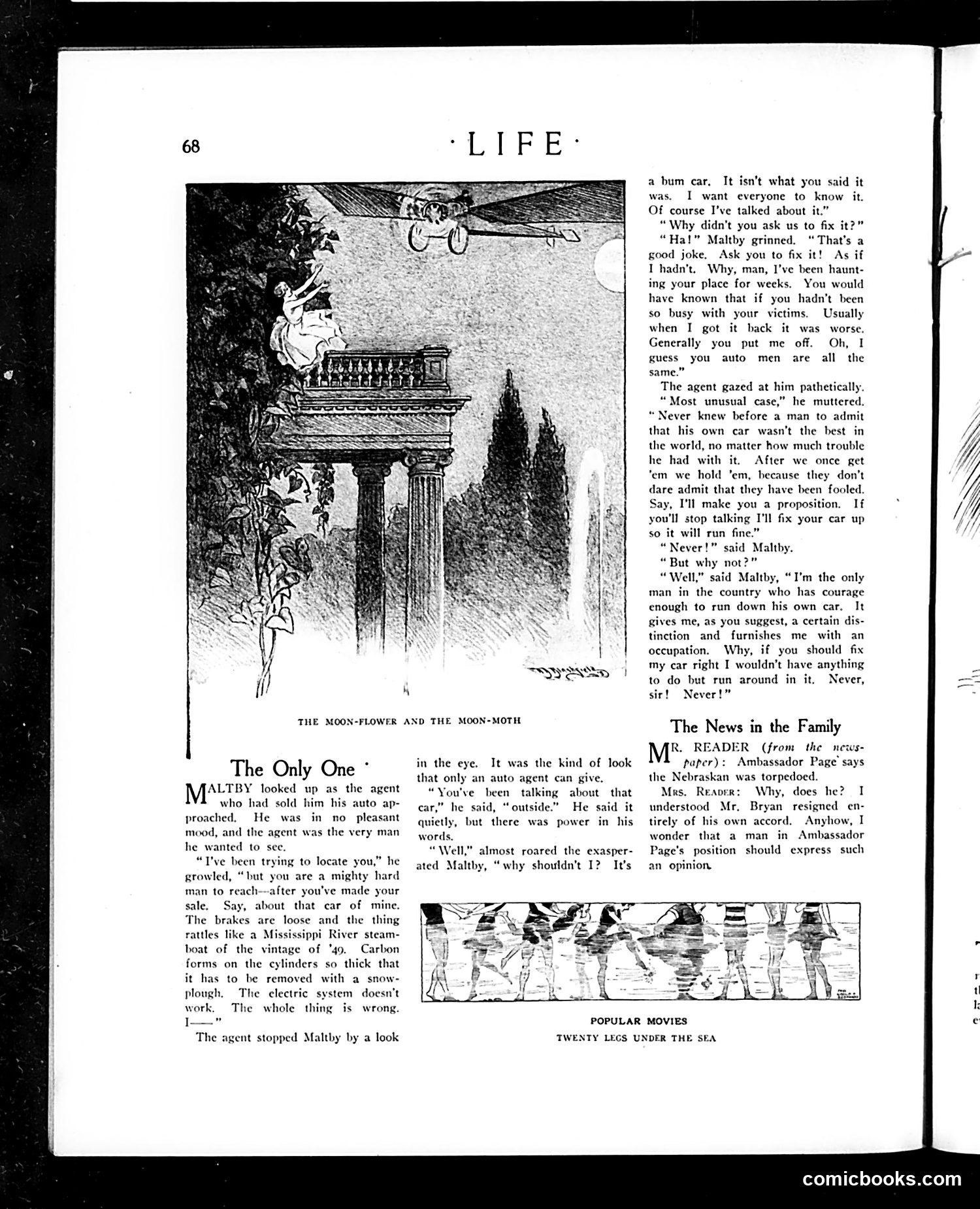
This story satirizes early automotive culture and masculine ego. Maltby, a car owner, publicly complains about his defective automobile—loose brakes, rattles, carbon buildup, faulty electrical systems. The auto agent confronts him, suggesting he's violated an unspoken social code: men don't admit their purchases are failures because it damages their pride. The humor lies in Maltby's absurd justification for *refusing* repairs: he claims being "the only man in the country" willing to criticize his own car gives him distinction and purpose. Rather than enjoy a working vehicle, he prefers complaining about it—his complaints have become his *identity*. The satire mocks both stubborn male vanity and the early auto industry's poor quality control, suggesting buyers preferred maintaining grievances over admitting they'd been swindled. The accompanying news item about Ambassador Page's statement on the Nebraskan appears unrelated filler content.
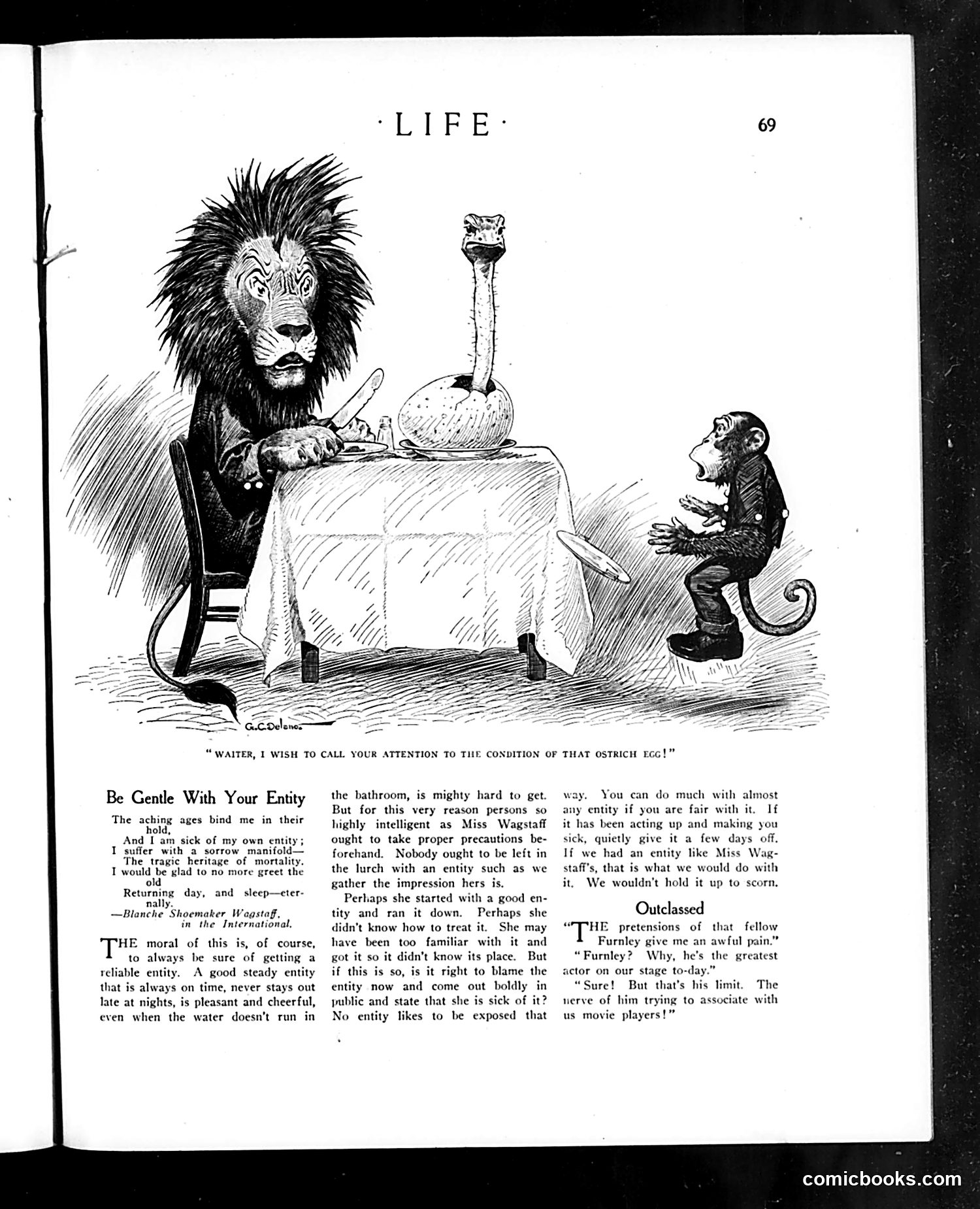
The main cartoon depicts a lion seated at a dining table with a monkey waiter, complaining about an ostrich egg. This is satirical social commentary using animal characters to represent class dynamics. The accompanying text article, "Be Gentle With Your Entity," uses "entity" as a euphemism for a servant or employee. The satire mocks wealthy employers (like the referenced "Miss Wagstaff") who mistreat their domestic help, then publicly complain about them. The article argues that reliable servants are difficult to maintain because employers don't treat them fairly—running them "down" through poor treatment, then blaming the servant for failing. The point: employers should treat their domestic staff with basic decency rather than exploit them and then expose their dissatisfaction publicly. The secondary item, "Outclassed," jokes about movie actors snubbing stage actors as inferior—a contemporary Hollywood versus theater rivalry reference.
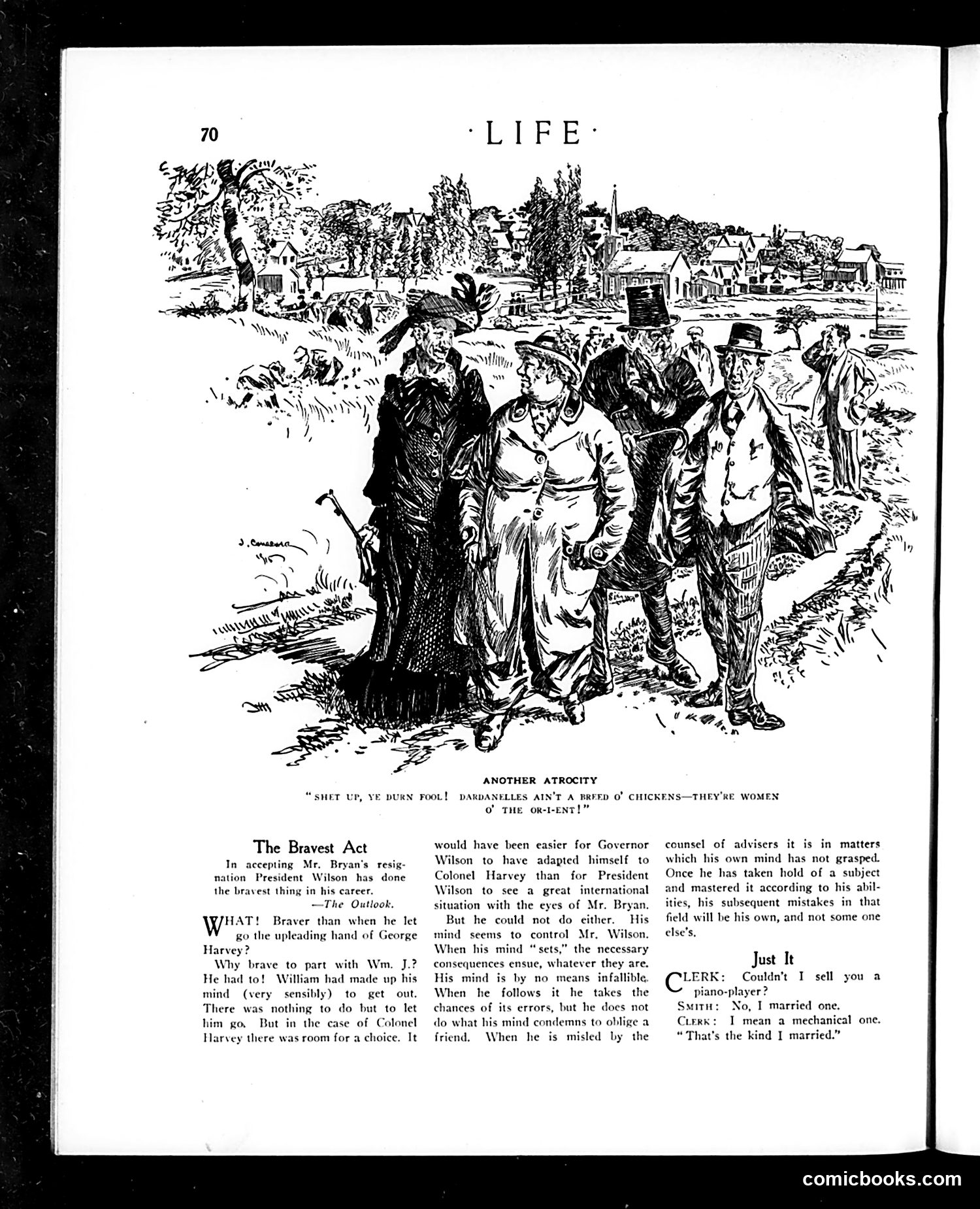
This page satirizes President Wilson's acceptance of William Jennings Bryan's resignation as Secretary of State. The cartoon depicts the incident as an "atrocity" involving the Dardanelles—a reference to the Ottoman Empire's control of this strategic strait during World War I, when American neutrality policy was contested. The article argues Wilson's decision to let Bryan go was actually *not* brave, since Bryan chose to resign over policy disagreements (likely regarding arms shipments and neutrality). The real test of courage, the piece suggests, was previously rejecting advisor George Harvey's influence. The satire mocks The Outlook magazine's praise of Wilson's "bravery," implying Wilson simply followed his own stubborn mind rather than making a difficult choice. The separate joke about the "mechanical" piano-player wife is unrelated wordplay.
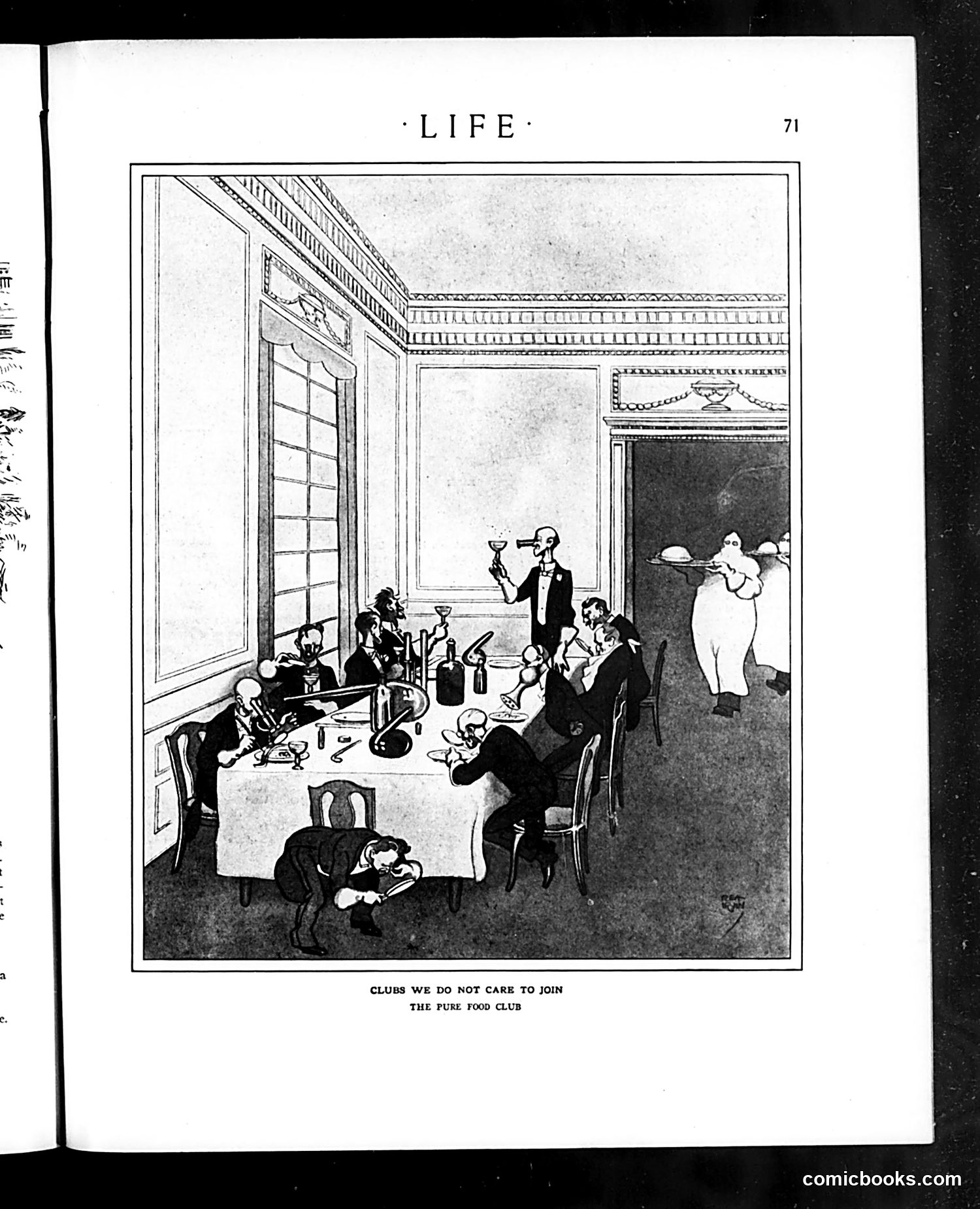
This satirical cartoon depicts a formal dinner where elegantly dressed men dine while a large, rotund figure (likely representing adulterated or impure food) looms ominously on the right. The caption reads "Clubs We Do Not Care to Join: The Pure Food Club." The satire targets food industry practices of the early 20th century, when food adulteration and contamination were widespread public concerns. The joke inverts expectations—the wealthy diners, despite their refined setting, ironically reject membership in a club promoting pure, unadulterated food. This suggests that business interests profited from food contamination and actively avoided food safety standards. This cartoon likely references early food regulation debates preceding or following the 1906 Pure Food and Drug Act, critiquing industrialists' resistance to safety measures.
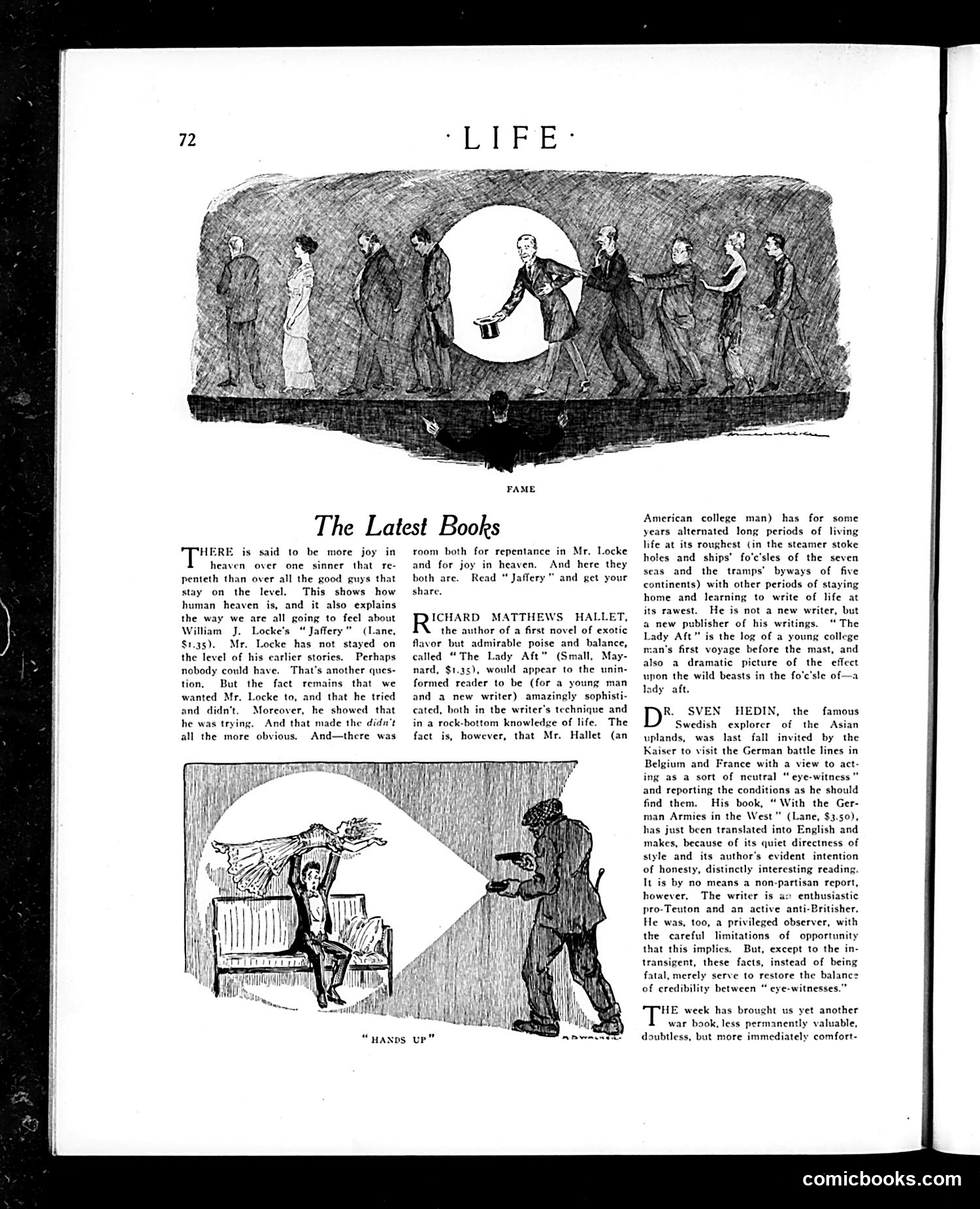
This is a **book review page** from Life magazine (an early 20th-century satirical publication), not primarily a political cartoon, though it includes illustrations. The top illustration titled "Fame" depicts a theatrical spotlight on a central figure while others stand in shadow—a visual metaphor for how success elevates one person while others remain obscure. The "Hands Up" cartoon below shows a figure surrendering to an armed soldier, likely referencing **World War I** combat. The text reviews contemporary war and adventure novels, including works by William J. Locke and Richard Matthews Hallet. Notably, it discusses Sven Hedin's "With the German Armies in the West"—a Swedish explorer's firsthand account of German WWI operations. The reviewer frankly acknowledges Hedin's pro-German bias and limited access, yet credits his "quiet directness" as valuable despite obvious partiality. This reflects how wartime accounts were evaluated for credibility even when openly partisan. The page captures an era when firsthand war reporting was relatively novel and eagerly consumed by the American public.
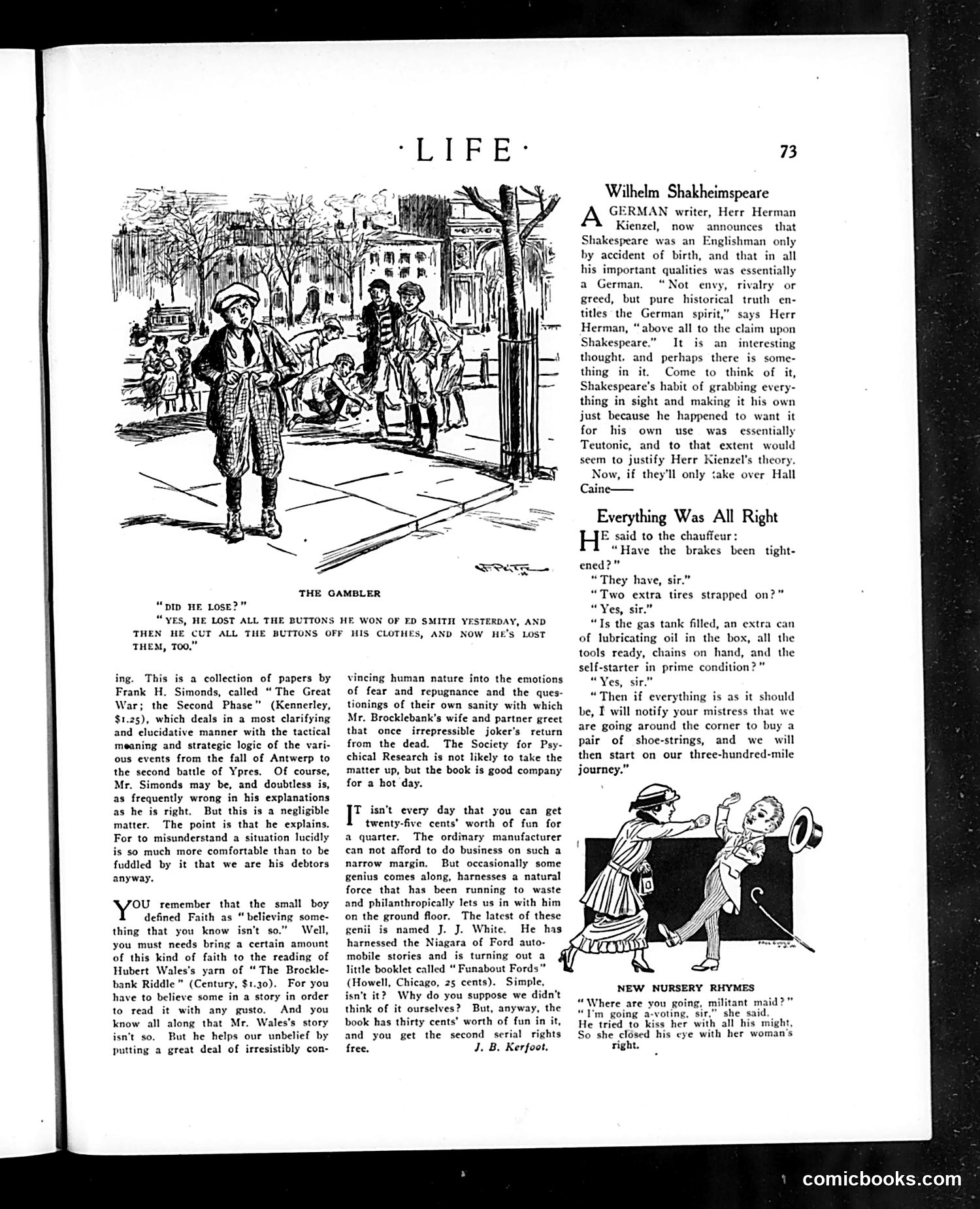
This page contains three satirical pieces typical of Life magazine's early 20th-century humor: **"Wilhelm Shakheimspeare"** mocks a German writer's (Herr Herman Kienzel) claim that Shakespeare was essentially German by birth accident. The satire suggests Germans grab everything in sight for their own use—a pointed jab at German imperial ambitions, likely written during or shortly after WWI when anti-German sentiment was high in America. **"The Gambler"** cartoon (top left) shows a street scene with the caption about someone losing buttons from Ed Smith's clothes—simple visual humor about gambling losses. **"Everything Was All Right"** depicts a car owner obsessively checking preparations with his chauffeur before a three-hundred-mile journey, satirizing wealthy anxious motorists. **"New Nursery Rhymes"** (bottom right) is a suffrage joke: a young woman declares she's "going a-voting," and when a man tries to kiss her, she "closed his eye with her woman's right"—a pun on voting rights and physical retaliation.
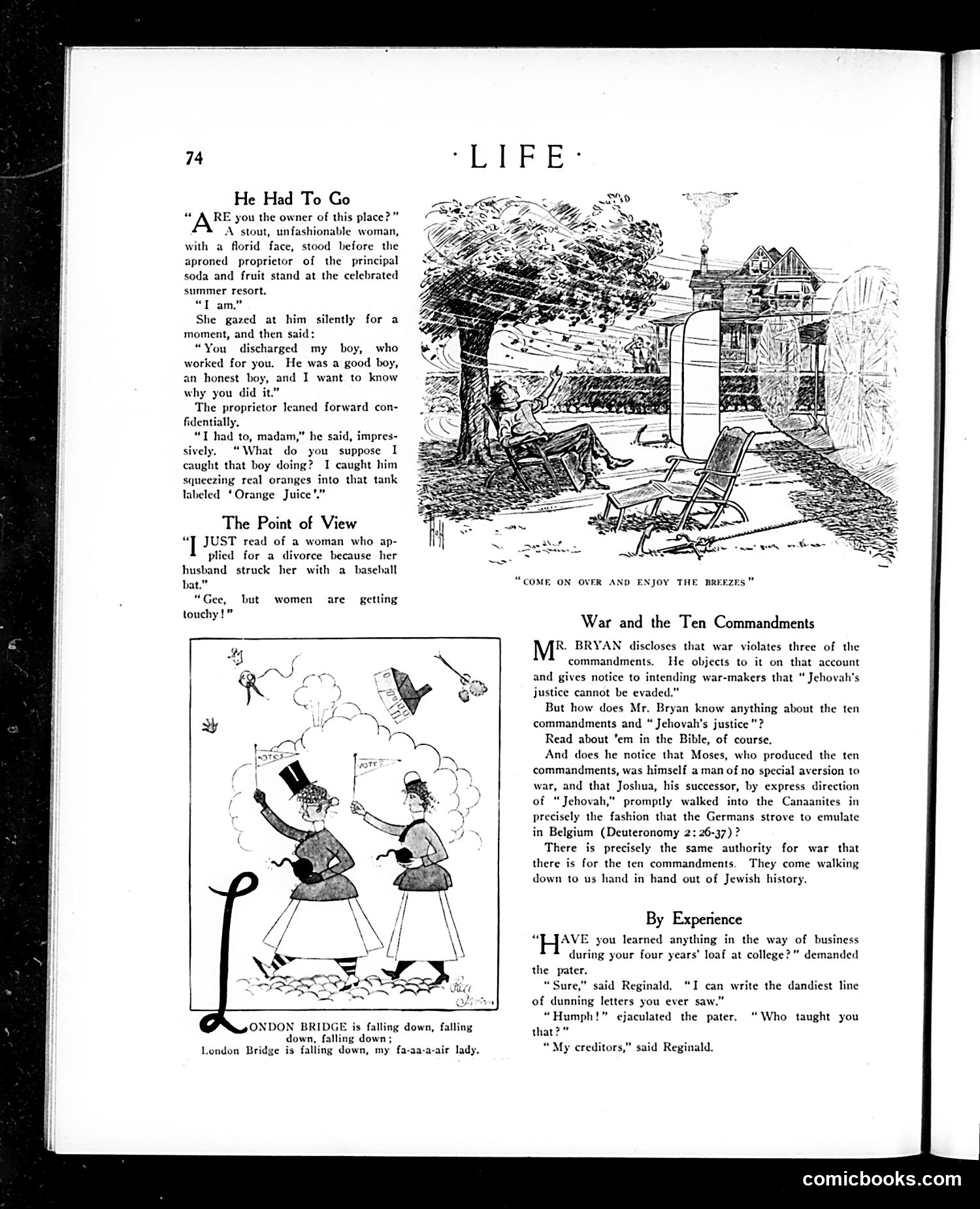
This page contains three satirical pieces typical of early 20th-century American humor: **"He Had To Go"** mocks false advertising at resorts. A mother confronts a soda stand owner about firing her son, only to learn he was caught committing fraud—squeezing real oranges into tanks labeled "Orange Juice," implying the resort typically uses fake juice. The joke satirizes consumer deception at vacation establishments. **"The Point of View"** is a two-panel joke critiquing changing social attitudes. A man expresses shock that a woman would divorce her husband for physical abuse ("getting touchy"), mocking the outdated dismissal of domestic violence. **"War and the Ten Commandments"** appears to reference William Jennings Bryan's pacifist arguments against war. The text sarcastically counters that the Bible itself condones warfare, citing Moses and Joshua's military campaigns. This likely addresses WWI-era debates about American intervention. **"By Experience"** is a college humor bit about a graduate who learned to write collection letters from creditors—suggesting college teaches practical (if dubious) financial skills. The page reflects early 1900s attitudes on consumer fraud, domestic relations, religious authority, and education.
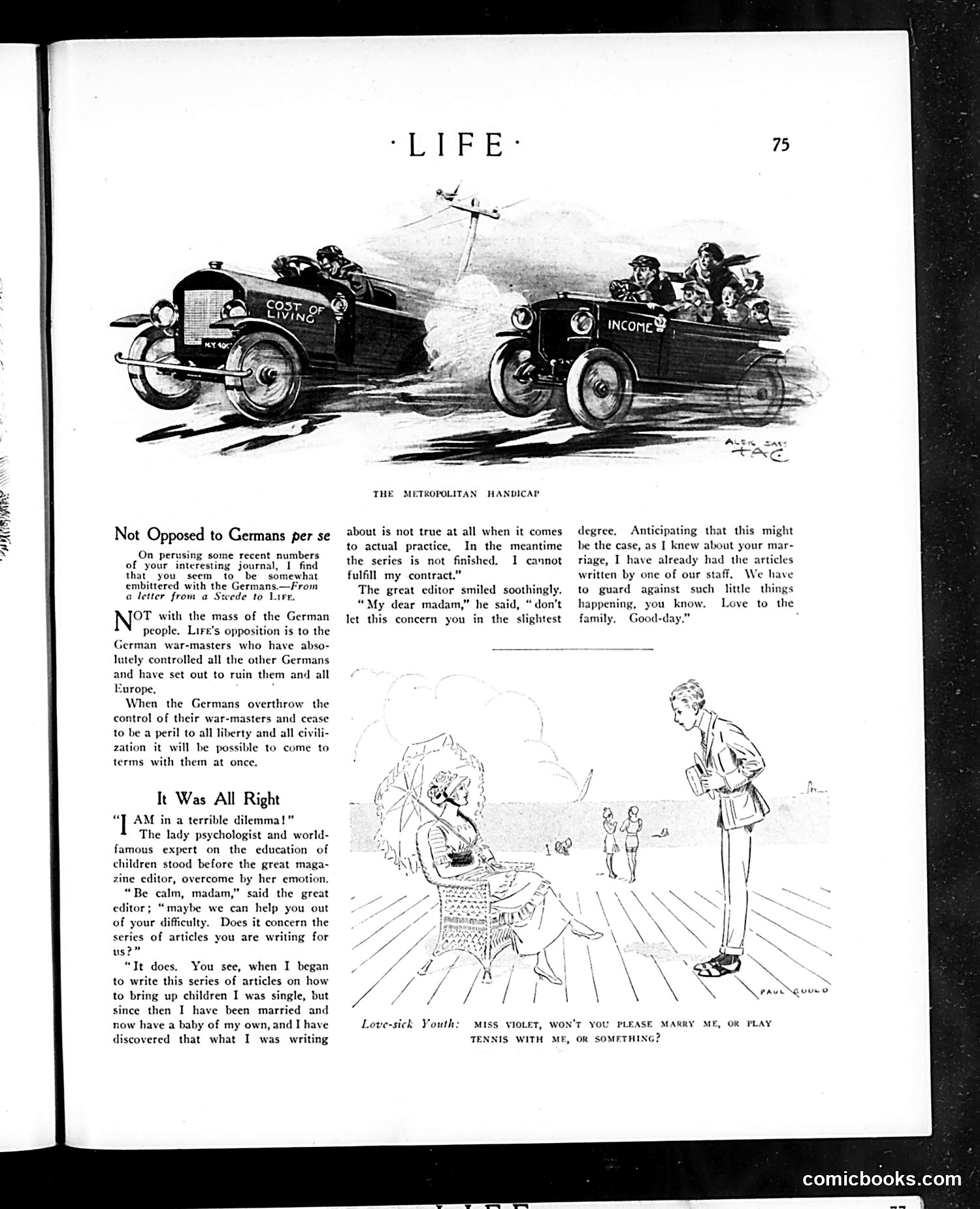
**Top Cartoon ("The Metropolitan Handicap"):** Shows two cars racing—one labeled "Cost of Living" and another labeled "Income." The joke satirizes the widening gap between rising expenses and stagnant wages, a common economic complaint of the era. "Handicap" references horse racing, suggesting income is artificially handicapped in this economic race. **Letter Section:** A Swedish reader defends Germans as a people while criticizing German "war-masters" (military leadership), reflecting WWI-era debates about collective versus leadership responsibility. *Life* responds that opposition targets warmongers, not ordinary Germans. **"It Was All Right" Story:** Satirizes expert hypocrisy—a famous child-rearing expert's published advice contradicts her actual parenting experience. The editor's solution (replacing her with ghostwritten articles) mocks both journalistic shortcuts and the gap between theoretical expertise and lived reality. **Bottom Cartoon:** A lovestruck youth awkwardly proposes to "Miss Violet," illustrating sentimental romantic earnestness, likely meant as light humor contrasting with the page's weightier content.
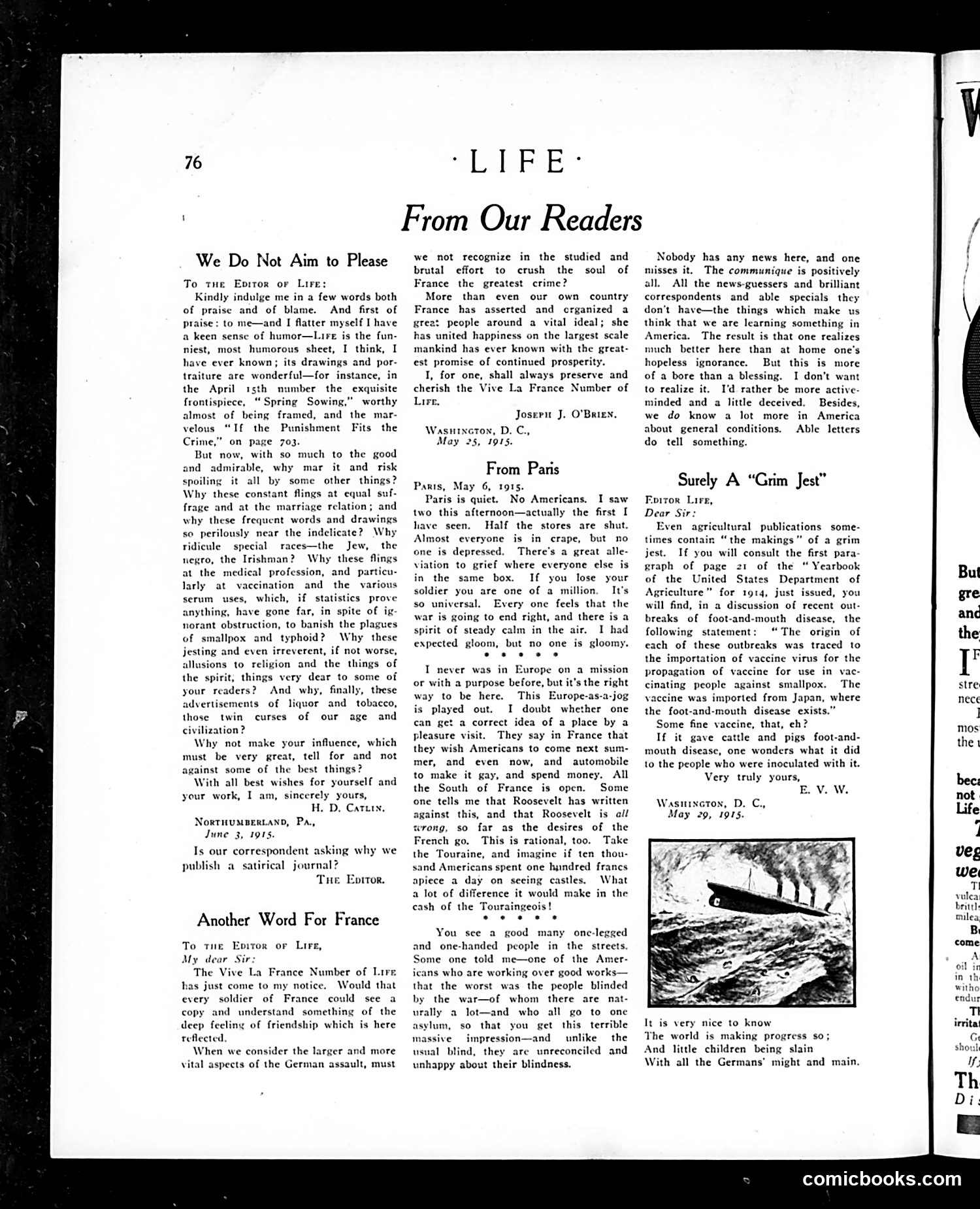
This is a "Letters to the Editor" section from *Life* magazine (May-June 1915), during World War I. The page contains reader responses to the magazine's content and editorial choices. **Key Points:** 1. **H.D. Catt's Letter**: A reader praises *Life*'s humor and artwork but criticizes it for mocking women's suffrage, marriage, ethnic groups (Jews, Black Americans, Irish), medical vaccination, religion, and carrying liquor/tobacco ads. The editor's sarcastic response ("Is our correspondent asking why we publish a satirical journal?") suggests *Life* unapologetically used satire to mock social institutions. 2. **French Support**: Joseph J. O'Brien thanks *Life* for a pro-France issue, celebrating France's ideals during WWI. 3. **Paris Correspondent**: A dispatch from Paris describes the city as calm but mourning, with widespread acceptance of wartime sacrifice among the French population. The page reveals *Life*'s controversial editorial stance: aggressive satire touching sensitive topics (race, religion, women's rights) that offended moralistic readers.
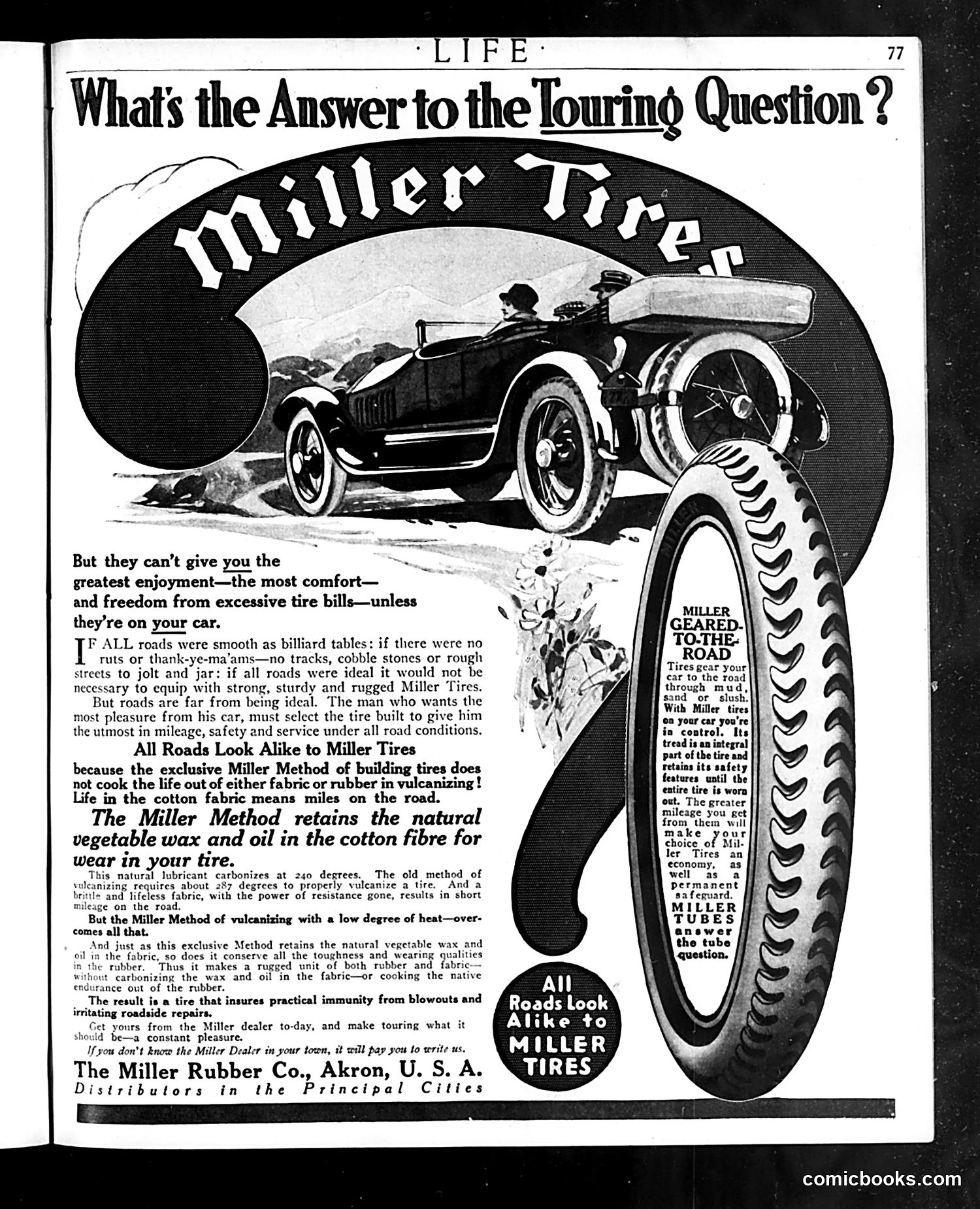
This is a **straightforward advertisement**, not satire or political commentary. The page promotes Miller Tires using a rhetorical question format: "What's the Answer to the Touring Question?" The ad features a vintage automobile on a country road with an oversized tire design forming a question mark. The sales pitch emphasizes that Miller Tires' exclusive manufacturing method (the "Miller Method") preserves natural oils and waxes in rubber and cotton fibers, providing superior durability, safety, and wear resistance compared to competitor tires using older vulcanization techniques. The ad targets touring motorists concerned about tire reliability on poor road conditions—a significant concern in the early automotive era when roads were rough and tire failure was common. It concludes by directing readers to find their local Miller dealer.
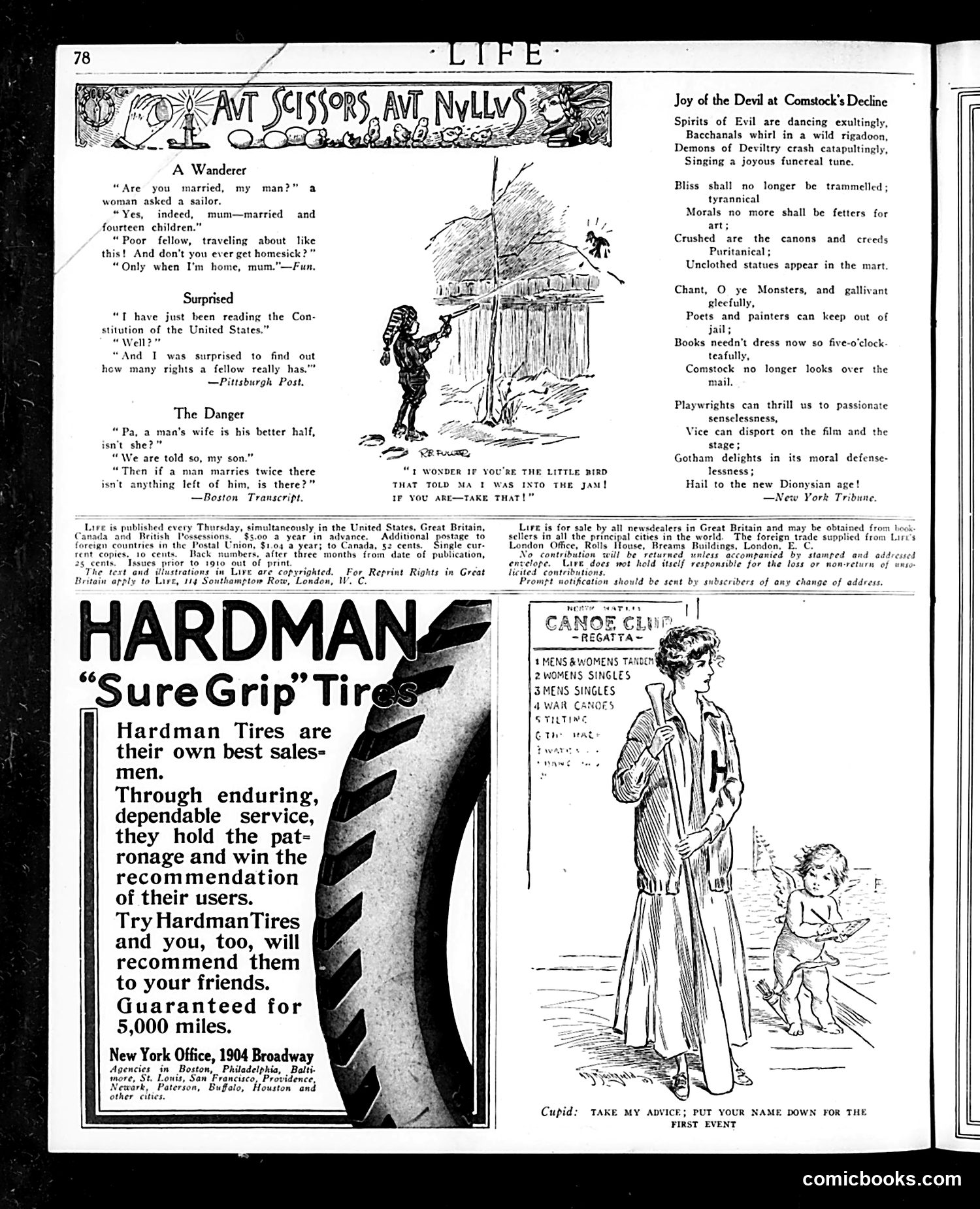
This page contains several short humorous anecdotes and a notable political poem titled "Joy of the Devil at Comstock's Decline." **The Political Content:** The poem celebrates the apparent decline of Anthony Comstock, the famous (or infamous) anti-obscenity crusader who led the New York Society for the Suppression of Vice. The poem satirizes Comstock's strict censorship by having "demons" and "spirits of evil" rejoice that morality will no longer constrain art, literature, theater, and film. References to "unclothed statues," books freed from prudish dress codes, and artists no longer fearing jail mock Comstock's aggressive suppression campaigns. **The Humor:** The three brief jokes above address marriage, constitutional rights, and wives' roles—typical Light Magazine fare of the era, using domestic situations for gentle comedy. The page also contains period advertisements (Hardman Tires) and a Canoe Club Regatta announcement, typical of Life's mixed-content format.
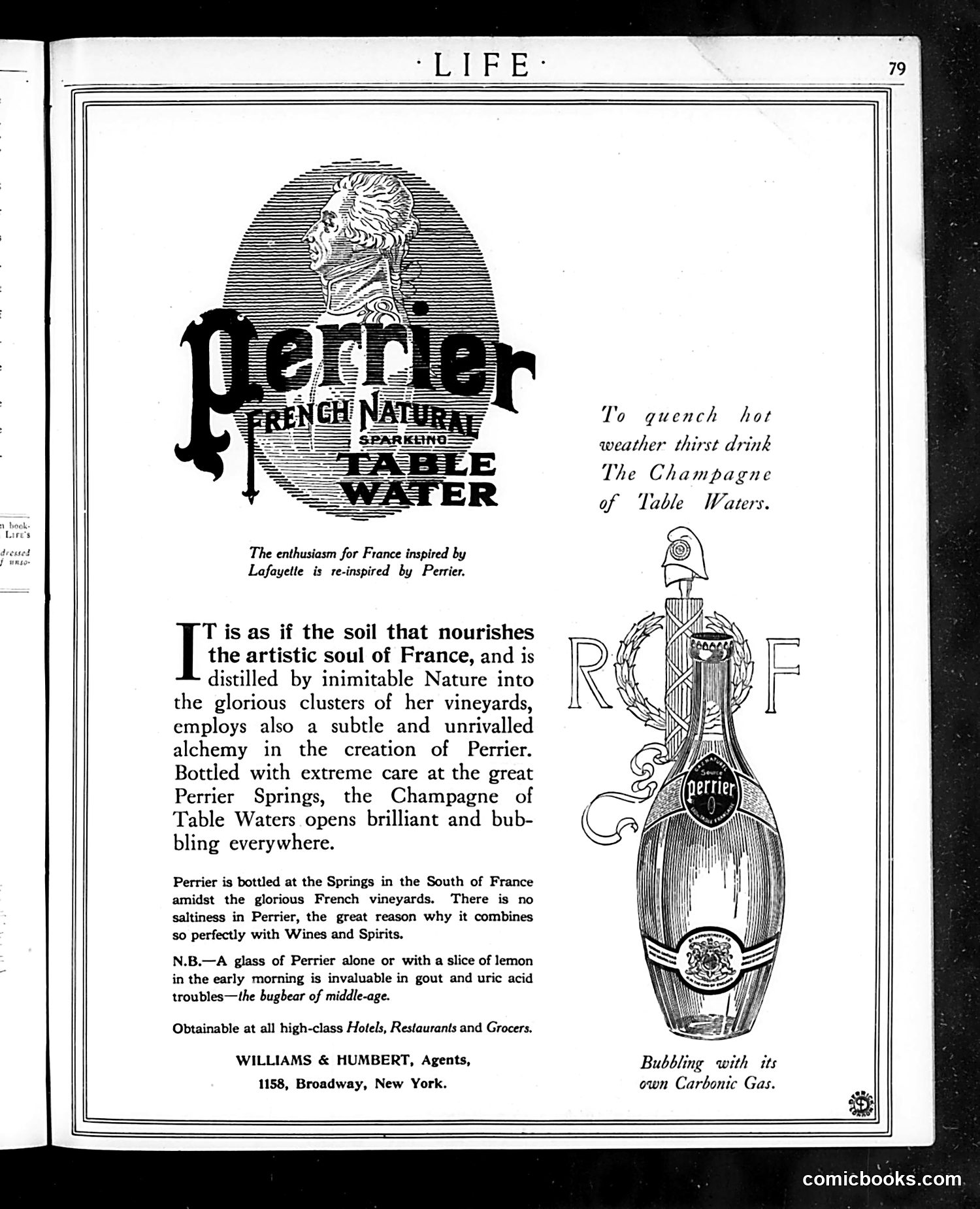
This is a **full-page advertisement**, not political satire. It promotes Perrier sparkling water to American readers. The ad cleverly invokes **Lafayette**—the French Revolutionary War hero beloved in America—to create patriotic associations with France and French products. By linking Perrier to Lafayette's legacy, the ad suggests that appreciating French goods is patriotic. The advertisement emphasizes Perrier's French origins ("South of France," "French vineyards") and positions it as a sophisticated, health-conscious alternative to plain water. A notable health claim states that Perrier with lemon treats gout and uric acid troubles—"the bugbear of middle-age," targeting affluent, aging gentlemen concerned with health. The decorative bottle illustrations and classical styling reinforce luxury and refinement. The agents, Williams & Humbert on Broadway, market this as an upscale product "obtainable at all high-class Hotels, Restaurants and Grocers."
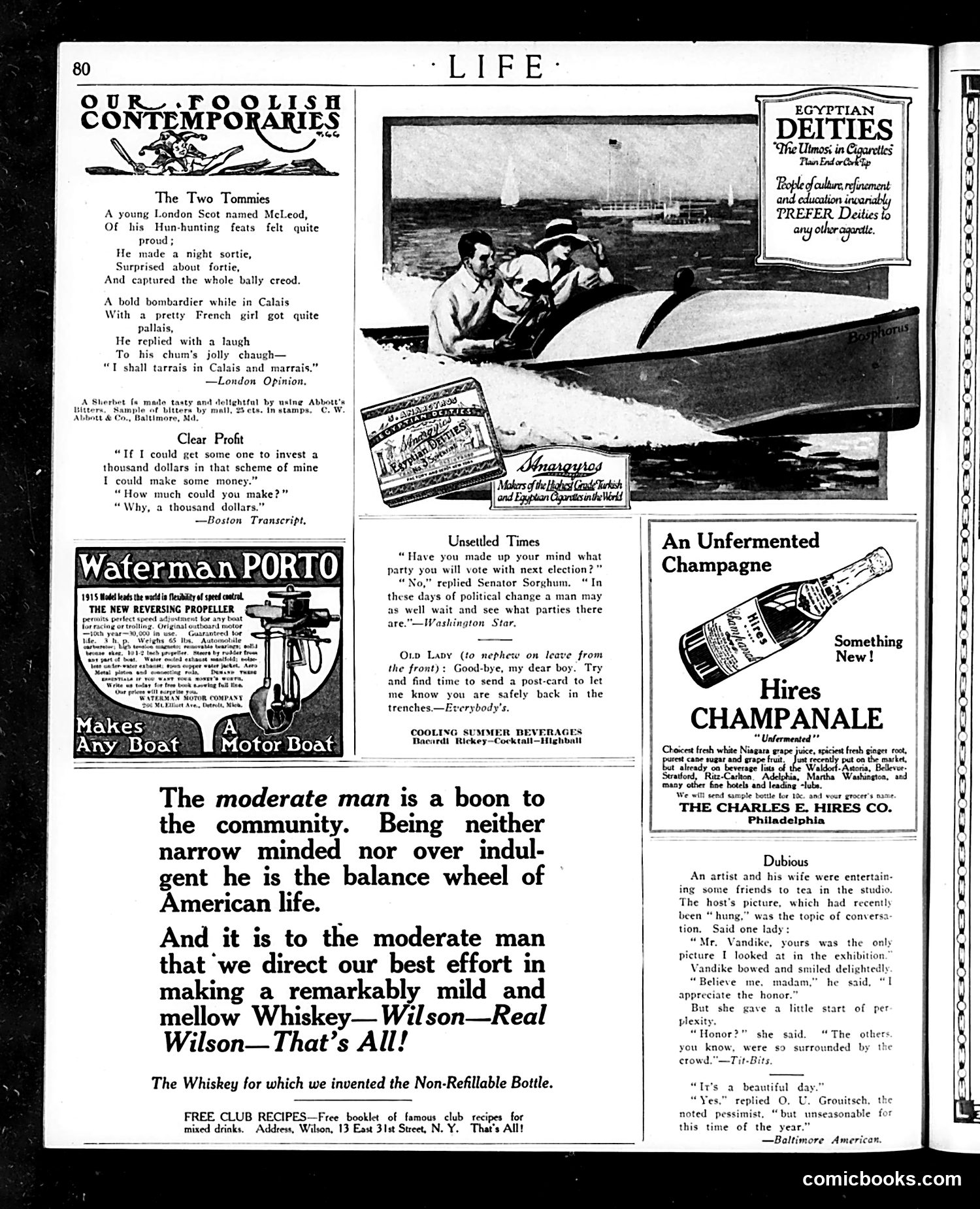
This page contains several brief satirical pieces typical of early 20th-century Life magazine humor: **"The Two Tommies"** presents WWI-era British soldiers' boasts in comic verse—a Scottish soldier proudly captures German troops during a night raid; a bombardier in Calais flirts with a French girl, joking he'll "tarry in Calais and marry" there. The humor relies on Scottish and French accent mimicry. **"Unsettled Times"** satirizes American political instability through Senator Sorghum's admission he won't commit to a party until he sees "what parties there are"—mocking politicians' opportunism during uncertain political periods. **"Old Lady"** presents dark WWI humor: an aunt's farewell to her soldier nephew asks him to send a postcard confirming he's safely back—*in the trenches*—a grim joke about trench warfare's deadliness. The remaining items are primarily **advertisements** for Wilson whiskey, Waterman Porto pens, and Champanale (unfermented grape juice), plus miscellaneous jokes about investment schemes and art exhibitions.
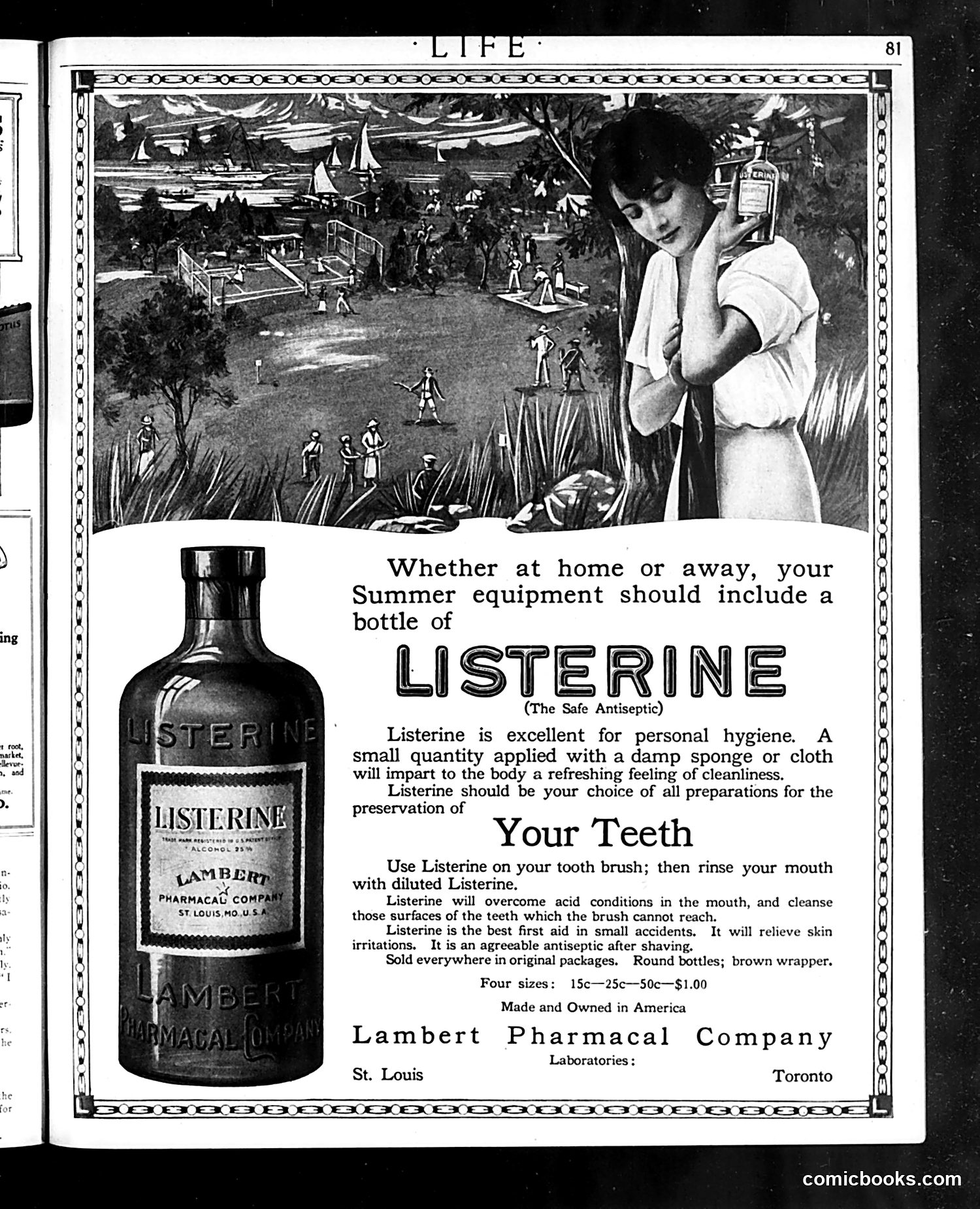
This page is primarily a **commercial advertisement**, not satire or political commentary. It promotes Listerine antiseptic mouthwash by the Lambert Pharmacal Company, with laboratories in St. Louis and Toronto. The illustration depicts a woman at a summer social gathering (picnic or outdoor party visible in background). The advertisement's pitch: Listerine is essential summer equipment for personal hygiene and dental care. The copy emphasizes multiple uses—mouthwash, body cleansing, wound care, and post-shaving antiseptic. Notably, the ad includes a patriotic appeal: "Made and Owned in America," likely reflecting early 20th-century American consumer preferences during a period of nationalist sentiment. The pricing (15¢–$1.00) and promise of broad availability suggest mass-market positioning. The "Safe Antiseptic" subtitle reflects era-appropriate marketing emphasizing safety and scientific credibility—common advertising strategies for patent medicines and toiletries of this period.
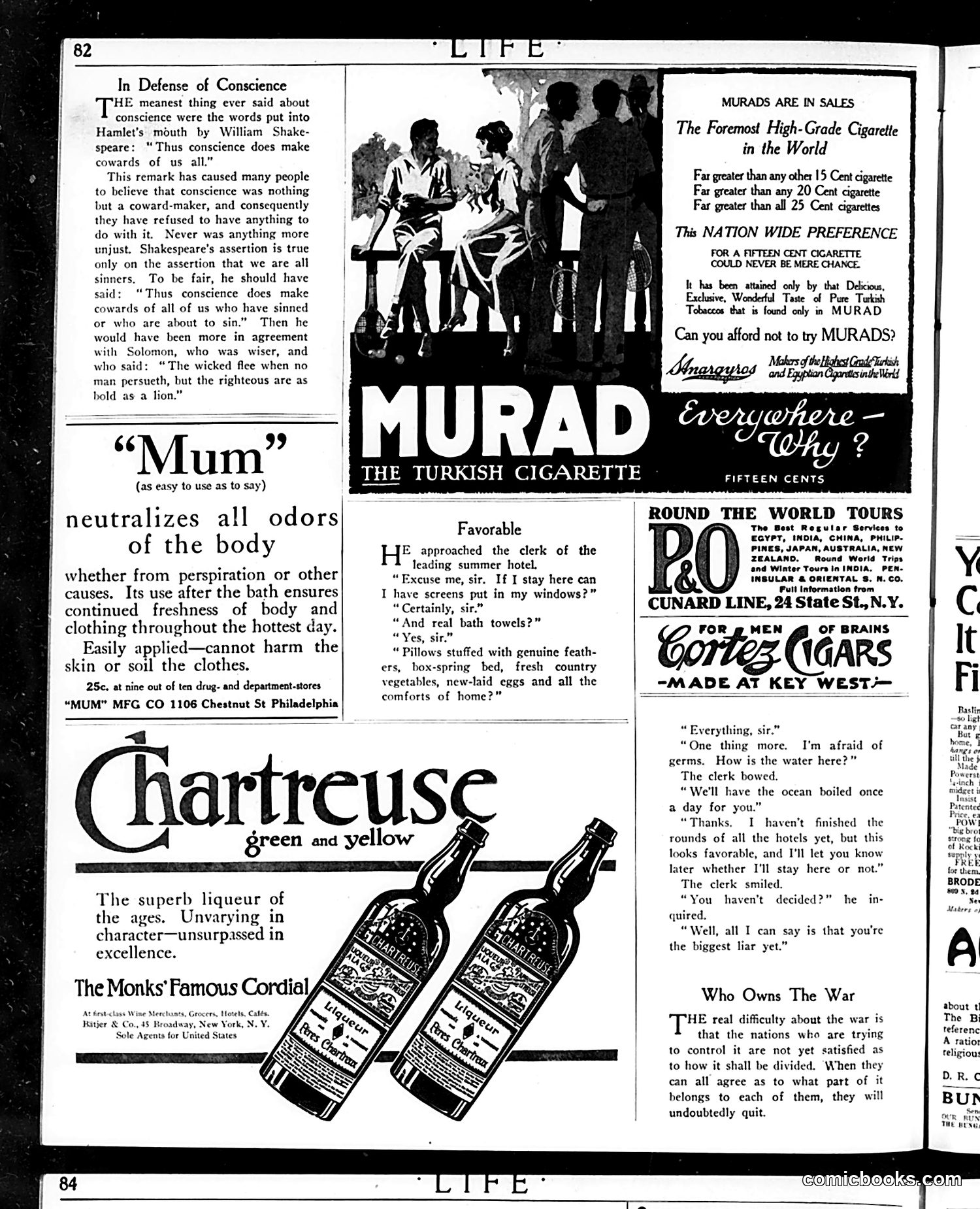
This page is primarily **advertisements and satirical content** from an American magazine (likely 1910s-1920s based on style). **The main cartoon** ("Favorable") satirizes hotel clerks' exaggerated promises to guests. A traveler asks increasingly absurd questions—about screens, towels, pillows, fresh vegetables, then germs and boiled ocean water. The clerk agreeably confirms everything until the guest reveals he knows the clerk is lying, calling him "the biggest liar yet." The satire mocks both tourist anxiety and hospitality industry dishonesty. **"Who Owns The War"** (text piece) cynically suggests nations fighting WWI aren't motivated by ideology but territorial division. It implies they'll only stop fighting once they've agreed how to partition conquered lands—a dark commentary on imperial war objectives. **The advertisements** (Murad cigarettes, Chartreuse liqueur, "Mum" deodorant, P&O tours) are period-typical luxury goods marketing, reflecting the magazine's affluent readership.
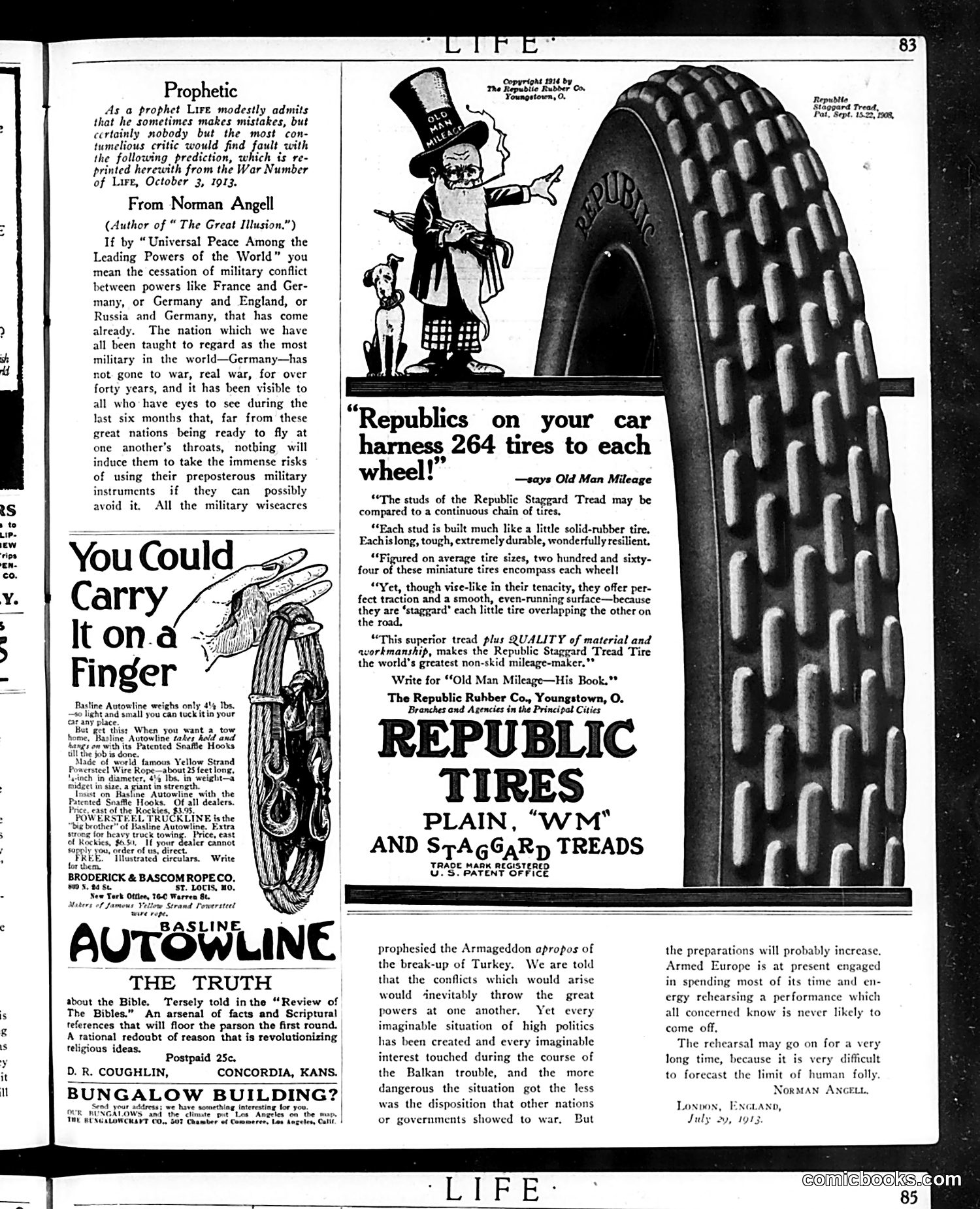
This page features a 1913 article by Norman Angell (author of *The Great Illusion*) predicting that major European powers—particularly Germany—would *not* go to war, arguing they had peacefully coexisted for decades and possessed too much to lose militarily. **The satire**: Life reprints this "prophetic" prediction in 1915, after World War I had erupted in 1914. The implicit joke is devastating: Angell's confident prediction of peace had been spectacularly wrong within months. Germany, supposedly the least warlike nation, had invaded Belgium and France. This is Life magazine's sardonic commentary on how completely unforeseen the Great War had been and how badly informed observers had misjudged European stability. The page's other advertisements are unrelated product marketing typical of the era.
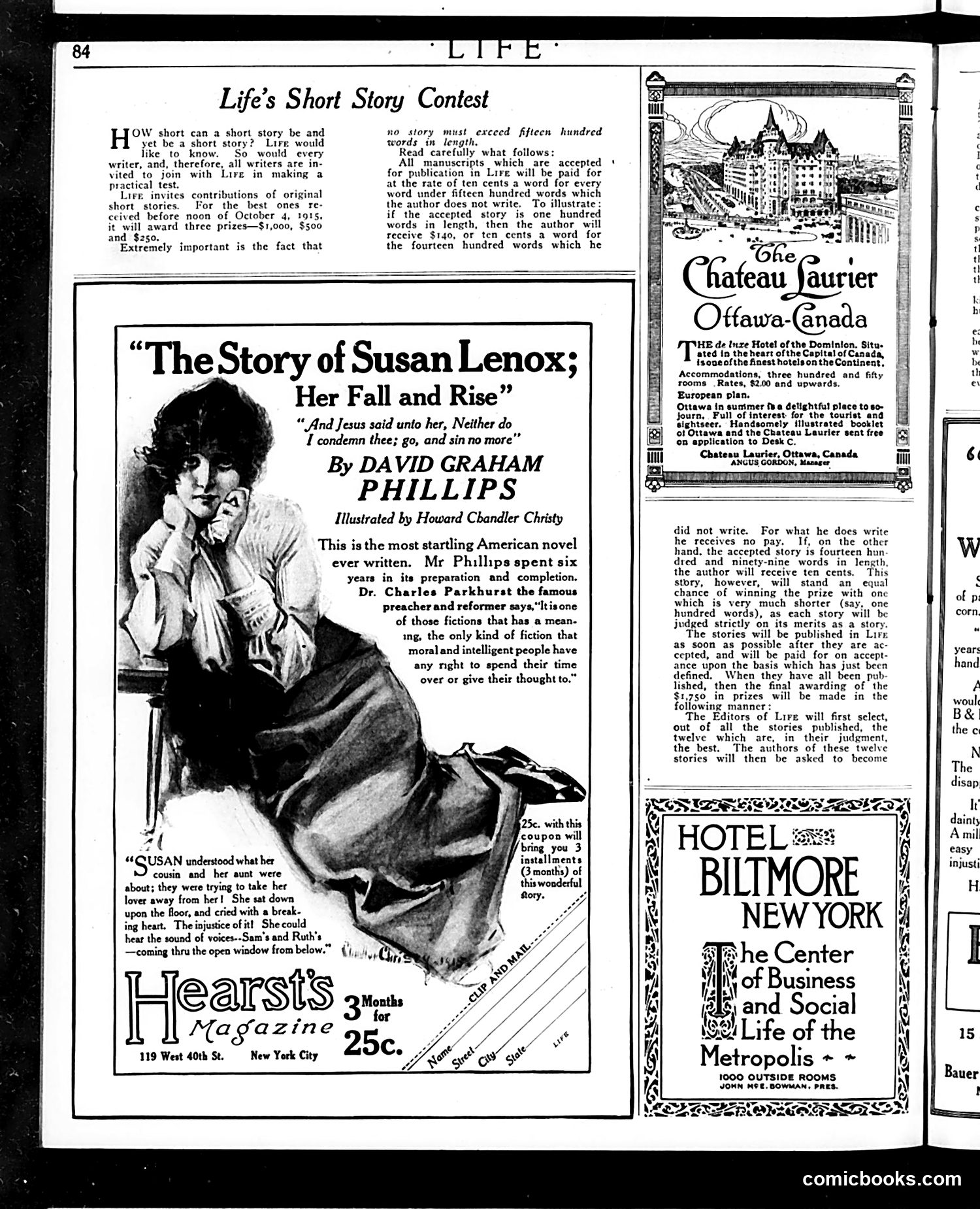
This page primarily advertises **Life's Short Story Contest** (1915), inviting writers to submit original fiction under 1,500 words for prizes totaling $1,750. The contest's unique incentive: authors are paid ten cents per word *not written*—so a 100-word story earns $140, while a 1,500-word story earns nothing, though both compete equally for prizes based on merit alone. This satirizes contemporary publishing economics and challenges writers to achieve maximum impact with minimum words. The page also features an advertisement for David Graham Phillips's novel "The Story of Susan Lenox: Her Fall and Rise," illustrated by Howard Chandler Christy. The quoted Bible verse ("Neither do I condemn thee") and plot excerpt suggest the novel addresses moral redemption, likely appealing to Progressive-era readers interested in social reform fiction. Additional advertisements promote *Hearst's Magazine* and the Hotel Biltmore in New York.
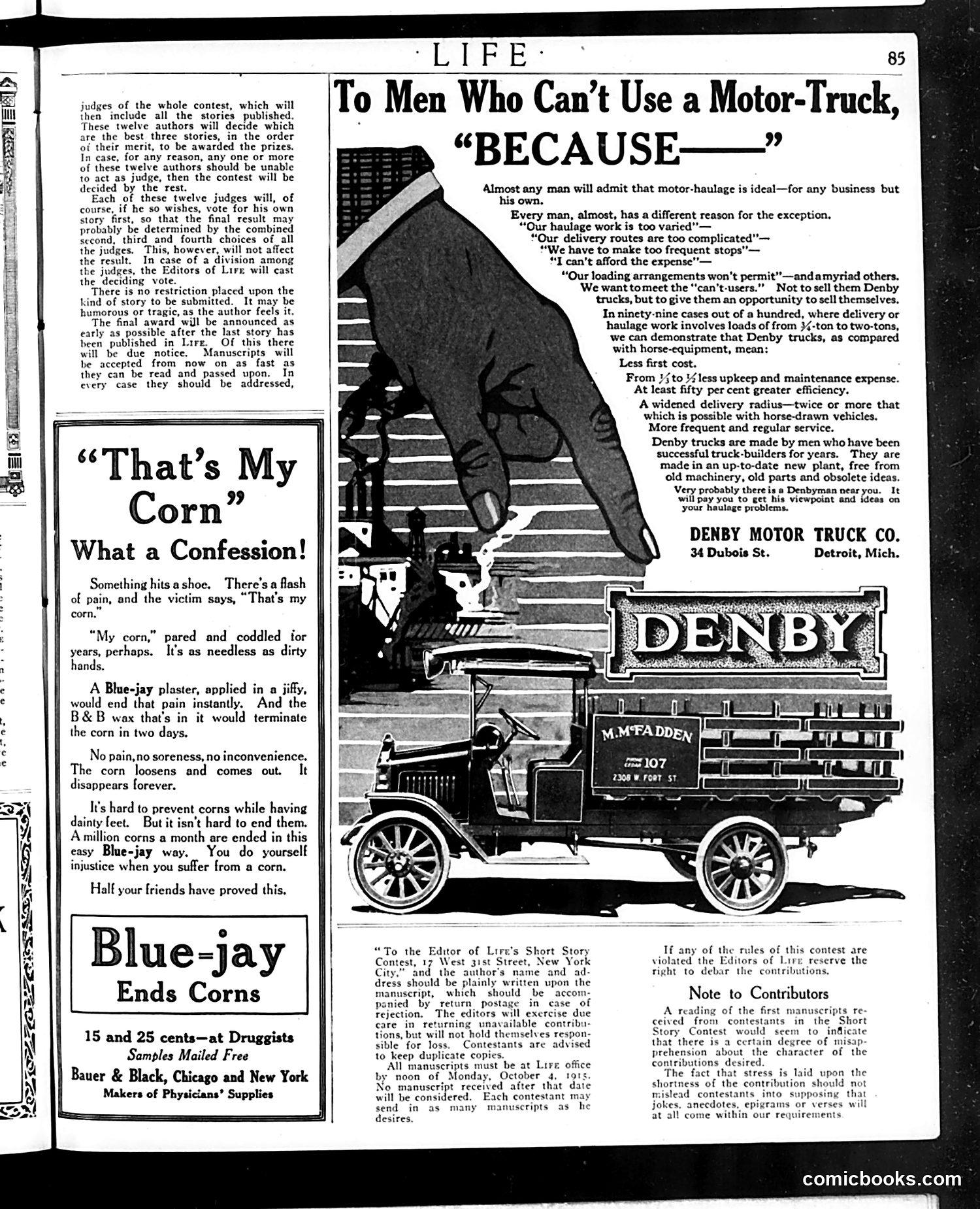
This page contains two distinct pieces of content: **Main Advertisement: Denby Motor Trucks** The headline addresses men who claim they *can't* use motor trucks for their business, listing common excuses ("our work is too varied," "routes too complicated," "can't afford expense"). The ad then directly challenges these objections, claiming that in 99 out of 100 cases involving deliveries of ½-2 tons, Denby trucks outperform horse-drawn equipment in cost, maintenance, efficiency, and service frequency. This is a straightforward sales pitch targeting business owners resistant to adopting new truck technology—likely from the early 1920s when motorized delivery was still competing with traditional horse transport. **Secondary Content: "Blue-jay Ends Corns"** A medical/pharmaceutical advertisement for a plaster treatment claiming to eliminate corns painlessly in two days. This reflects early-20th-century consumer product advertising common in magazines. The page also contains contest rules for Life's short-story competition. No political satire or caricature is present on this page—it is primarily advertising with administrative text.
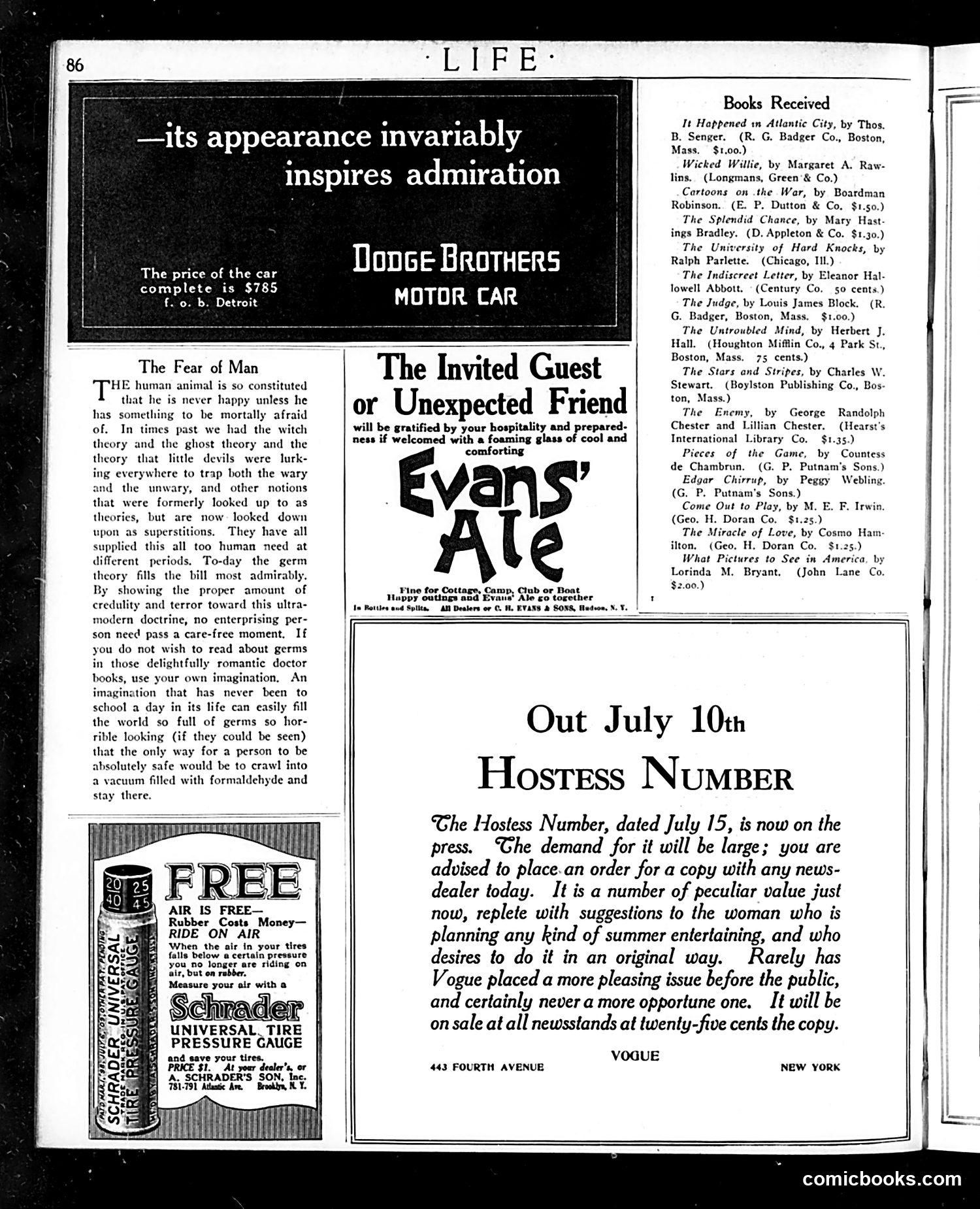
This page is primarily **advertising and announcements** rather than satirical content, though it includes one article. **"The Fear of Man"** article satirizes contemporary anxieties about germs and disease. It humorously argues that humans psychologically *need* something to fear—historically witches, devils, ghosts—and that modern "germ theory" has become the new focus of irrational terror. The satire lies in the exaggeration: the author suggests people obsess over invisible microbes to the point of absurdity, proposing that hiding in a formaldehyde-filled vacuum would be the only "safe" option. This reflects early 20th-century both genuine medical advances and widespread hypochondria about contamination. The rest of the page features: - **Dodge Brothers Motor Car advertisement** ($785 complete) - **Evans' Ale advertisement** (beverages for entertaining guests) - **Schrader tire pressure gauge ad** (safety product) - **Book announcements** and a **Vogue "Hostess Number" promotion** The page reflects 1910s consumer culture and leisure-class concerns about entertaining and automobile ownership.
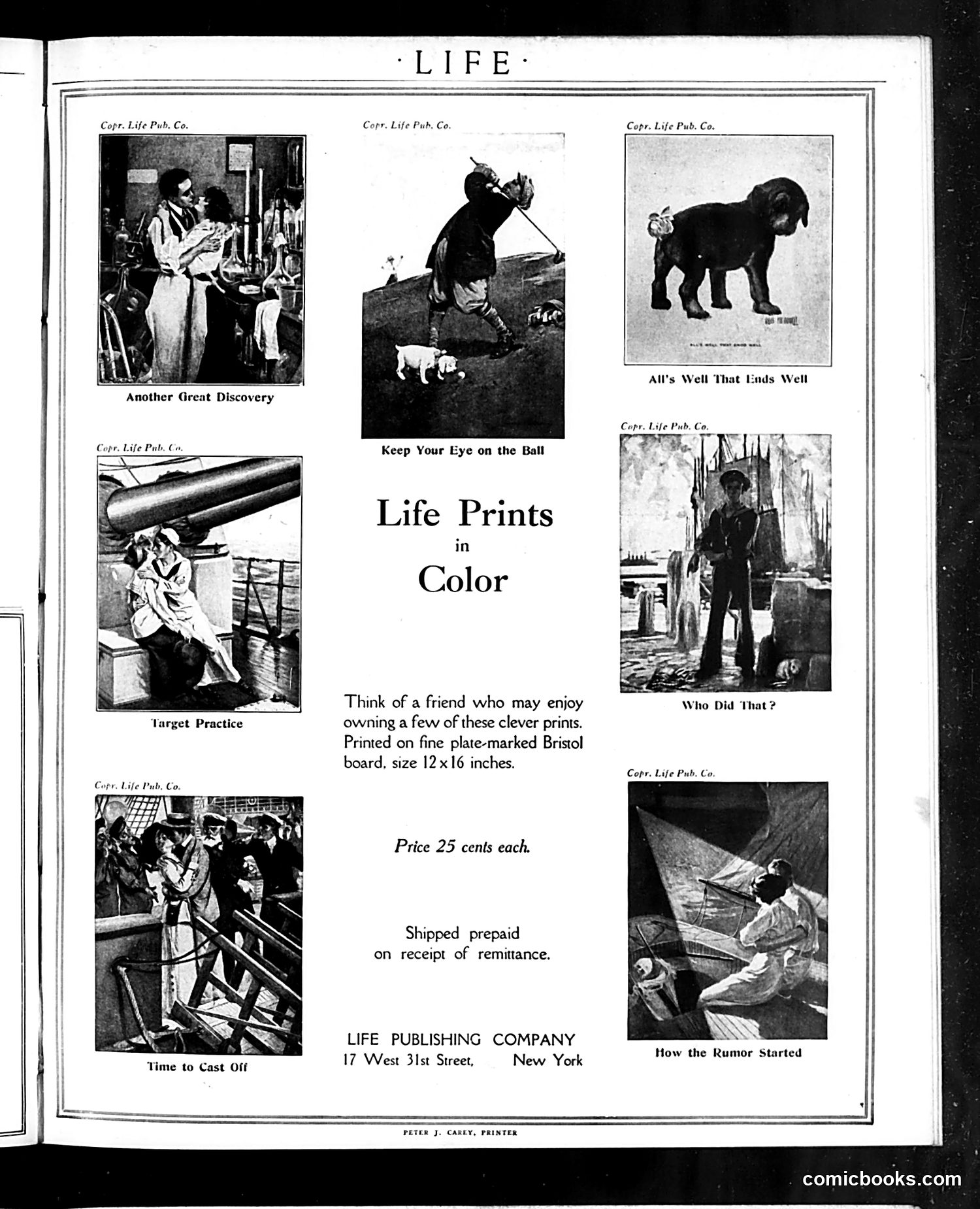
This is primarily an **advertisement for Life Publishing Company's colored prints**, not political satire. The page showcases six humorous illustrations available as 12x16-inch prints for 25 cents each. The titled scenes depict everyday comedic situations: "Another Great Discovery" (domestic scene), "Keep Your Eye on the Ball" (golf mishap), "All's Well That Ends Well" (dog-related humor), "Target Practice" (slapstick with a large pipe), "Who Did That?" (domestic awkwardness), "Time to Cast Off" (maritime scene), and "How the Rumor Started" (unclear but apparently humorous). These appear to be generic humor illustrations reflecting early 20th-century magazine comedy—simple visual gags without specific political references. The advertisement targets readers seeking affordable home décor or gifts, emphasizing the prints' "clever" appeal. No identifiable political figures or commentary are evident.
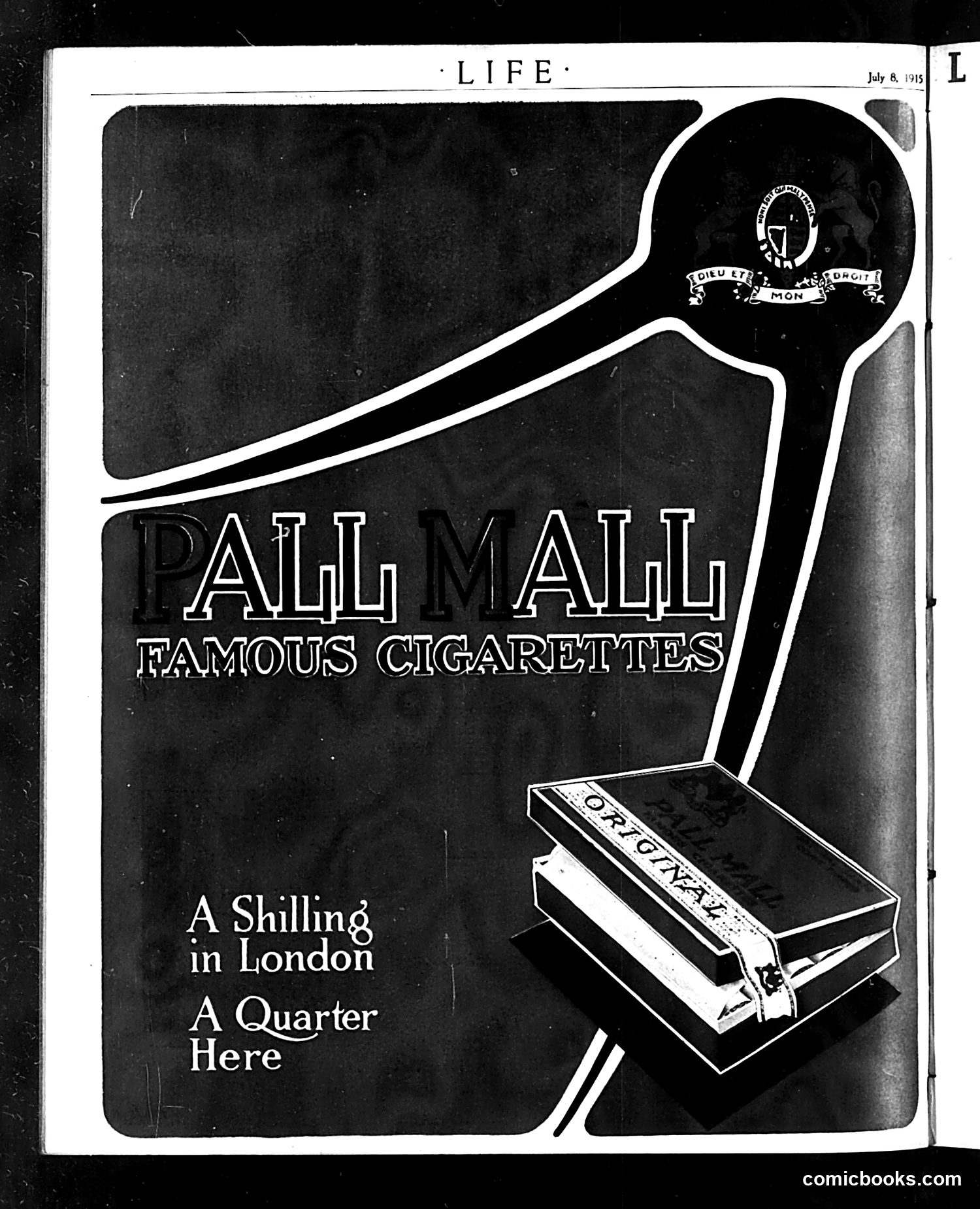
This is a **Pall Mall cigarette advertisement**, not political satire. The page dates to July 8, 1915, during World War I. The ad compares cigarette pricing between Britain and America: "A Shilling in London / A Quarter Here." A shilling and a quarter were roughly equivalent currency values at the time, suggesting Pall Mall offered comparable value on both sides of the Atlantic. The design features an elegant silhouette of a woman's head in profile, with a cigarette pack illustrated below. This was typical luxury cigarette advertising of the era, targeting affluent consumers. There is no political cartoon or satire present—this is straightforward commercial advertising using period design aesthetics.