
Life, 1915-07-08 · page 14 of 44
Life — July 8, 1915 — page 14: what you’re looking at
What you’re looking at
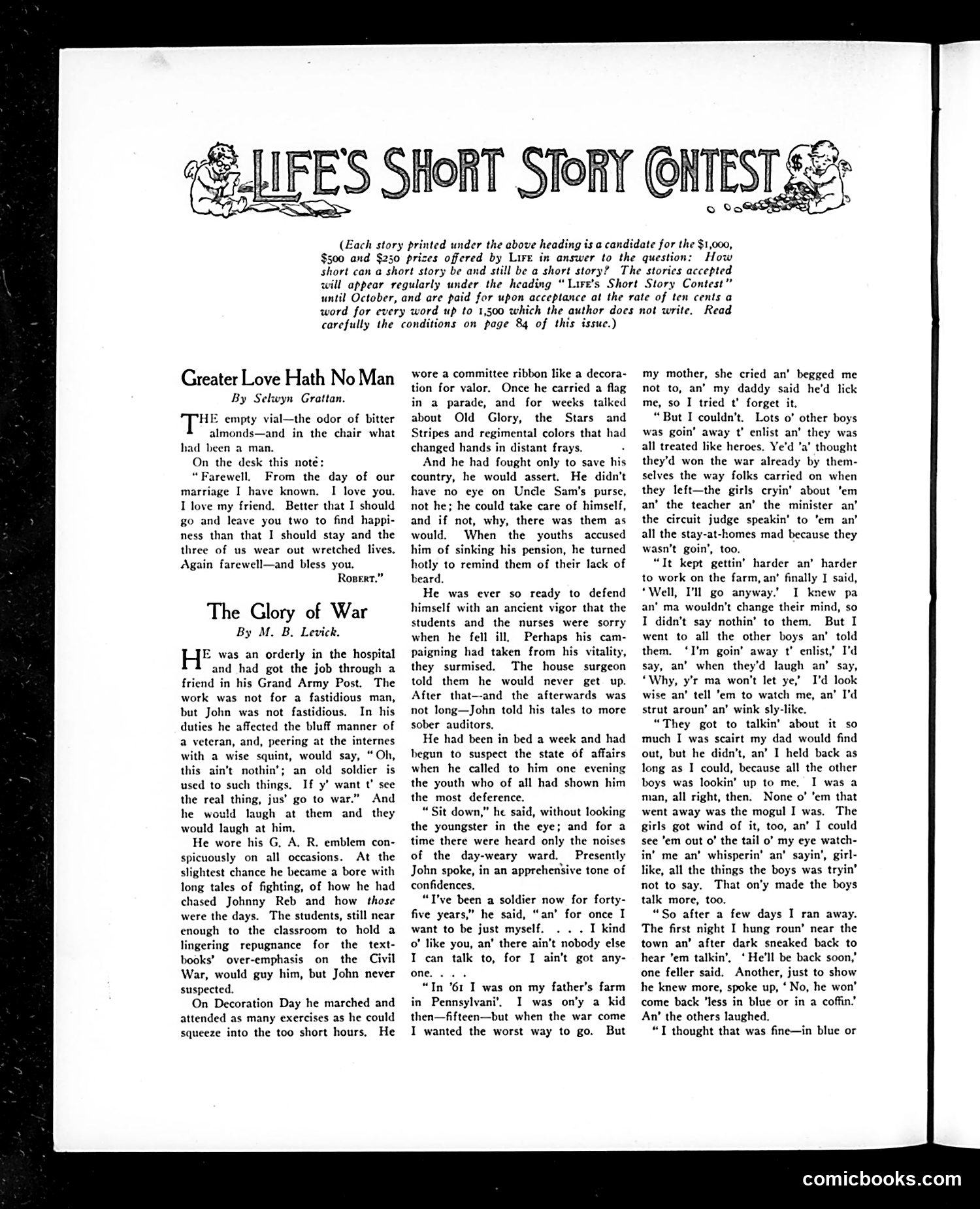
This page presents a literary contest announcement and two short stories, not political cartoons. **Contest Details:** Life magazine solicited short stories answering "How short can a short story be and still be a short story?" with prizes up to $1,000. Stories would be published regularly and paid at ten cents per word (up to 1,500 words). **Stories Shown:** 1. "Greater Love Hath No Man" by Stelgyn Grattan—a soldier's farewell letter 2. "The Glory of War" by W. H. Lewis—appears to contrast a wounded soldier's actual battlefield experience with patriotic mythology Both stories seem to engage with World War I themes, examining soldiers' real experiences versus idealized narratives. The page is primarily literary content, not satirical commentary.
📄 Transcribed text from this page (OCR, searchable)
Machine-transcribed from the original scan — historical spelling and the odd misread are preserved.
©. IIFES SHORT STORY GNTESTS o> © Sof (Each story printed under the above heading is a candidate for the $1,000, $300 and $250 prizes offered by LiFe in answer to the question: How short can a short story be and still be a short story? The stories accepted will appear regularly under the heading “Lire’s Short Story Contest” until October, and are paid for upon acceptance at the rate of ten cents a word for every word up to 1,300 which the author does not write, Read carefully the conditions on page 84 of this issue.) Greater Love Hath No Man By Selwyn Grattan. HE empty vial—the odor of bitter almonds—and in the chair what had been a man. On the desk this note: “Farewell. From the day of our marriage I have known. I love you. I love my friend, Better that I should go and leave you two to find happi- ness than that I should stay and the three of us wear out wretched lives. Again farewell—and bless you. Rosert.” The Glory of War By M. B. Levick. HE was an orderly in the hospital and had got the job through a friend in his Grand Army Post. The work was not for a fastidious man, but John was not fastidious. In his duties he affected the bluff manner of a veteran, and, peering at the internes with a wise squint, would say, “Oh, this ain't nothin’; an old soldier is used to such things. If y’ want t’ see the real thing, jus’ go to war.” And he would laugh at them and they would laugh at him. He wore his G, A, R. emblem con- spicuously on all occasions. At the slightest chance he became a bore with long tales of fighting, of how he had chased Johnny Reb and how those were the days. The students, still near enough to the classroom to hold a lingering repugnance for the text- books’ over-emphasis on the Civil War, would guy him, but John never suspected. On Decoration Day he marched and attended as many exercises as he could squeeze into the too short hours, He wore a committee ribbon like a decora- tion for valor. Once he carried a flag in a parade, and for weeks talked about Old Glory, the Stars and Stripes and regimental colors that had changed hands in distant frays. And he had fought only to save his country, he would assert. He didn’t have no eye on Uncle Sam’s purse, not he; he could take care of himself, and if not, why, there was them as would. When the youths accused him of sinking his pension, he turned hotly to remind them of their lack of beard. He was ever so ready to defend himself with an ancient vigor that the students and the nurses were sorry when he fell ill, Perhaps his cam- paigning had taken from his vitality, they surmised. The house surgeon told them he would never get up. After that—and the afterwards was not long—John told his tales to more sober auditors, He had been in bed a week and had begun to suspect the state of affairs when he called to him one evening the youth who of all had shown him the most deference. “Sit down,” he said, without looking the youngster in the eye; and for a time there were heard only the noises of the day-weary ward. Presently John spoke, in an apprehensive tone of confidences, “T’ve been a soldier now for forty- five years,” he said, “an’ for once I want to be just myself. . . . I kind o' like you, an’ there ain’t nobody else TI can talk to, for I ain’t got any- one... “In ’61 I was on my father’s farm in Pennsylvani’, I was on'y a kid then—fifteen—but when the war come I wanted the worst way to go. But my mother, she cried an’ begged me not to, an’ my daddy said he'd lick me, so I tried t’ forget it. “But I couldn’t. Lots o’ other boys was goin’ away t’ enlist an’ they was all treated like heroes. Ye'd ’a’ thought they’d won the war already by them- selves the way folks carried on when they left—the girls cryin’ about ‘em an’ the teacher an’ the minister an’ the circuit judge speakin’ to ‘em an’ all the stay-at-homes mad because they wasn’t goin’, too. “It kept gettin’ harder an’ harder to work on the farm, an’ finally I said, “Well, I'll go anyway.’ I knew pa an’ ma wouldn't change their mind, so I didn’t say nothin’ to them, But I went to all the other boys an’ told them. ‘I'm goin’ away t’ enlist,’ I'd say, an’ when they’d laugh an’ say, ‘Why, y’r ma won't let ye,’ I'd look wise an’ tell ‘em to watch me, an’ I'd strut aroun’ an’ wink sly-like. “They got to talkin’ about it so much I was scairt my dad would find out, but he didn’t, an’ I held back as long as I could, because all the other boys was lookin’ up to me, I was a man, all right, then. None o’ ’em that went away was the mogul I was. The girls got wind of it, too, an’ I could see 'em out o’ the tail o’ my eye watch- in’ me an’ whisperin’ an’ sayin’, girl- like, all the things the boys was tryin’ not to say. That on’y made the boys talk more, too. “So after a few days I ran away. The first night I hung roun’ near the town an’ after dark sneaked back to hear 'em talkin’, ‘He'll be back soon,’ one feller said, Another, just to show he knew more, spoke up, ‘ No, he won’ come back ‘less in blue or in a coffin.” An’ the others laughed. “T thought that was fine—in blue or comicbooks.com