
Life, 1915-07-08 · page 10 of 44
Life — July 8, 1915 — page 10: what you’re looking at
What you’re looking at
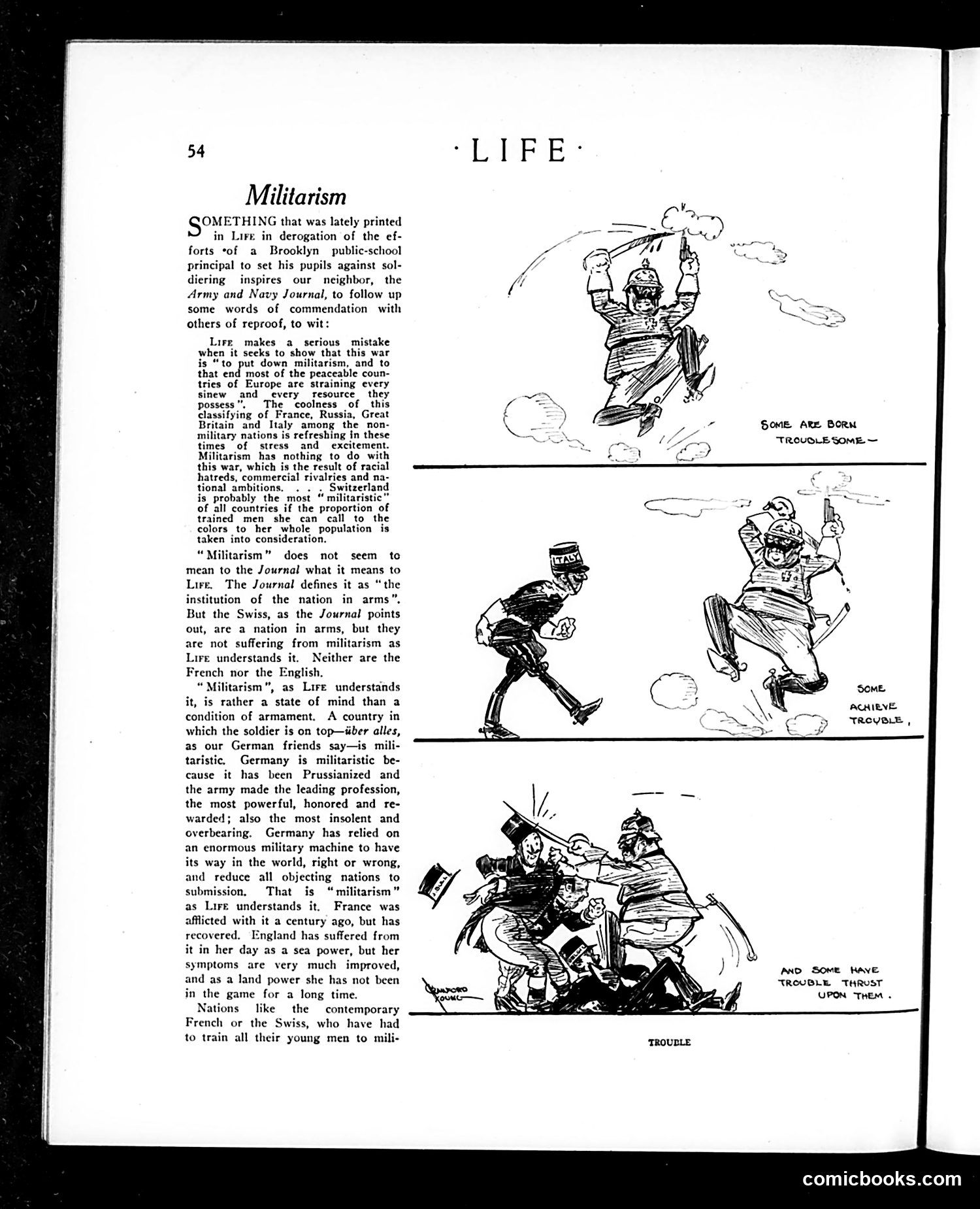
This editorial page critiques militarism in early 20th-century Europe. The text argues that militarism—not actual warfare—causes nations' problems, defining it as "a state of mind" where military values dominate society. The three cartoons illustrate this concept through soldiers experiencing escalating trouble: 1. "Some are born trouble-some" - a soldier struggling with his equipment 2. "Some achieve trouble" - another soldier causing chaos 3. "And some have trouble thrust upon them" - soldiers in violent conflict The captions parody Shakespeare's "All the world's a stage" speech, suggesting militarism inevitably creates conflict. The text specifically criticizes Germany's Prussian military culture as the worst example, while noting France and England have also suffered militarism's corrupting influence on their societies.
📄 Transcribed text from this page (OCR, searchable)
Machine-transcribed from the original scan — historical spelling and the odd misread are preserved.
Militarism OMETHING that was lately printed in Lire in derogation of the ef- forts eof a Brooklyn public-school Principal to set his pupils against sol- diering inspires our neighbor, the Army and Navy Journal, to follow up some words of commendation with others of reproof, to wit: Lire makes a_ serious mistake when it seeks to show that this war is “to put down militarism, and to that end most of the peaceable coun- tries of Europe are straining every sinew and every resource they possess”. The coolness of this classifying of France, Russia, Great Britain and Italy among the non- military nations is refreshing in these times of stress and excitement. Militarism has nothing to do with this war, which is the result of racial hatreds, commercial rivalries and na- tional ambitions. . . . zerland is probably the most “ militaristic” of all countries if the proportion of trained men she can call to the colors to her whole population is taken into consideration. “Militarism” does not seem to mean to the Journal what it means to Lire. The Journal defines it as “the institution of the nation in arms”, But the Swiss, as the Journal points out, are a nation in arms, but they are not suffering from militarism as Lire understands it. Neither are the French nor the English. “Militarism”, as Lire understands it, is rather a state of mind than a condition of armament. A country in which the soldier is on top—iiber alles, as our German friends say—is mili- taristic. Germany is militaristic be- cause it has been Prussianized and the army made the leading profession, the most powerful, honored and re- warded; also the most insolent and overbearing. Germany has relied on an enormous military machine to have its way in the world, right or wrong, and reduce all objecting nations to submission, That is “militarism” as Lire understands it. France was afflicted with it a century ago, but has recovered. England has suffered from it in her day as a sea power, but her symptoms are very much improved, and as a land power she has not been in the game for a long time. Nations like the — contemporary French or the Swiss, who have had to train all their young men to mili- Some Ake Born TROUOLE SOME. — ACHIEVE. TROYBLE , AND Some HAVE AROUBLE THRUST UPON THEM . comicbooks.com