
Life, 1915-07-08 · page 11 of 44
Life — July 8, 1915 — page 11: what you’re looking at
What you’re looking at
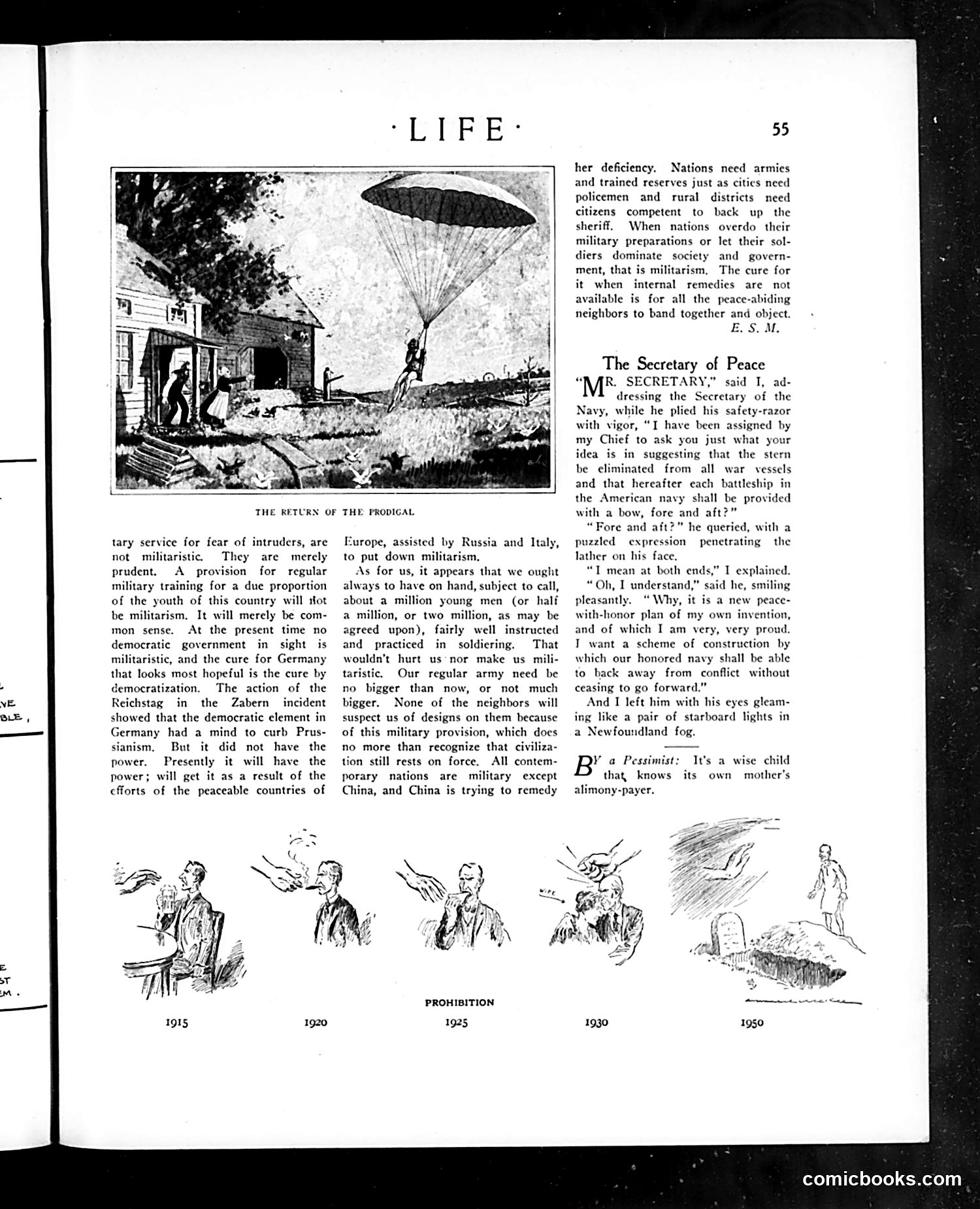
The upper illustration titled "The Return of the Prodigal" depicts a figure descending by parachute toward a house—likely representing a soldier returning home from World War I. The lower cartoon sequence labeled "Prohibition" shows a man's deteriorating condition across five decades (1915-1930). The satirical progression suggests how Prohibition (the constitutional ban on alcohol, 1920-1933) affected American society—the figure becomes increasingly disheveled and desperate over time, culminating in what appears to be death or grave circumstances by 1930. The accompanying text discusses military preparedness and democratic governance, critiquing excessive militarism while supporting reasonable defense measures. The page satirizes both post-war demobilization challenges and Prohibition's social consequences.
📄 Transcribed text from this page (OCR, searchable)
Machine-transcribed from the original scan — historical spelling and the odd misread are preserved.
THE RETURN OF tary service for fear of intruders, are not militaristic. They are merely prudent. A provision for regular military training for a due proportion of the youth of this country will tot be militarism. It will merely be com- mon sense. At the present time no democratic government in sight is militaristic, and the cure for Germany that looks most hopeful is the cure by democratization. The action of the Reichstag in the Zabern incident showed that the democratic element in Germany had a mind to curb Prus- sianism. But it did not have the power, Presently it will have the power; will get it as a result of the cfforts of the peaceable countries of THE PRODIGAL Europe, assisted by Russia and Italy, to put down militarism, As for us, it appears that we ought always to have on hand, subject to call, about a million young men (or half a million, or two million, as may be agreed upon), fairly well instructed and practiced in soldiering. That wouldn’t hurt us nor make us mili- taristi Our regular army need be no bigger than now, or not much bigger. None of the neighbors. will suspect us of designs on them because of this military provision, which doc no more than recognize that civiliza tion still rests on force, All contem- porary nations are military except China, and China is trying to remedy PROHIBITION 1925, 55 her deficiency. Nations need armies and trained reserves just as cities need policemen and rural districts need citizens competent to back up the sheriff. When nations overdo their military preparations or let their sol- diers dominate society and govern- ment, that is militarism, The cure for it when internal remedies are not available is for all the peace-abiding neighbors to band together and object. E.S. M. The Secretary of Peace “ME SECRETARY,” said I, ad- dressing the Secretary of the avy, while he plied his safety-razor with vigor, “I have been assigned by my Chief to ask you just what your idea is in suggesting that the stern be eliminated from all war vessels and that hereafter each battleship in the American navy shall be provided with a bow, fore and aft?” “Fore and aft?” he queried, with a puzzled expression penetrating the lather on his face, “T mean at both ends,” I explained. “Oh, I understand,” said he, smiling pleasantly. “Why, it is a new peace- with-honor plan of my own invention, and of which I am very, very proud. I want a scheme of construction by which our honored navy shall be able to back away from conflict without ceasing to go forward.” And I left him with his eyes gleam- ing like a pair of starboard lights in a Newfoundland fog. BY 2 Pessimist: Ws a wise chitd that knows its own mother’s alimony-payer. comicbooks.com