
Life, 1915-07-08 · page 32 of 44
Life — July 8, 1915 — page 32: what you’re looking at
What you’re looking at
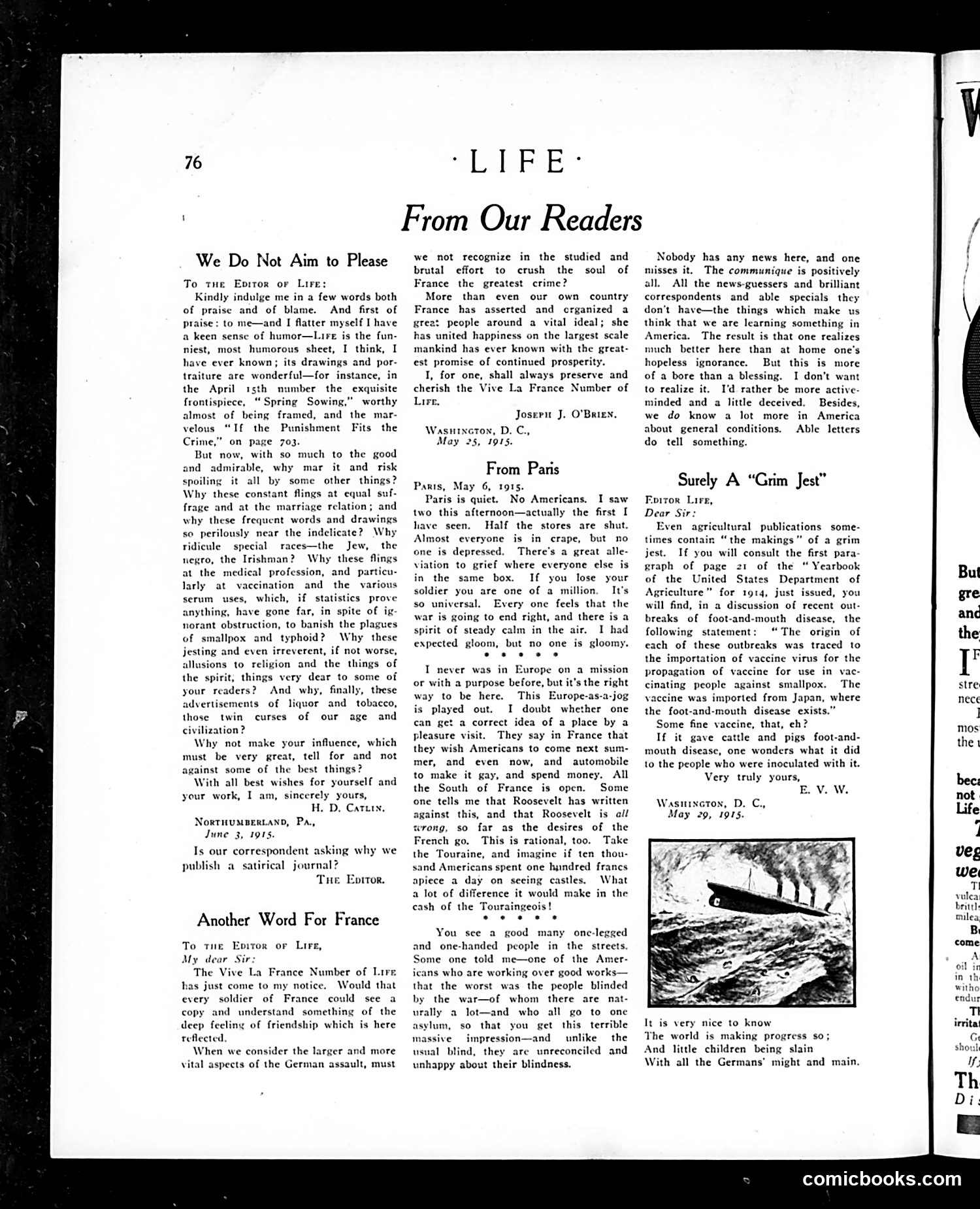
This is a "Letters to the Editor" section from *Life* magazine (May-June 1915), during World War I. The page contains reader responses to the magazine's content and editorial choices. **Key Points:** 1. **H.D. Catt's Letter**: A reader praises *Life*'s humor and artwork but criticizes it for mocking women's suffrage, marriage, ethnic groups (Jews, Black Americans, Irish), medical vaccination, religion, and carrying liquor/tobacco ads. The editor's sarcastic response ("Is our correspondent asking why we publish a satirical journal?") suggests *Life* unapologetically used satire to mock social institutions. 2. **French Support**: Joseph J. O'Brien thanks *Life* for a pro-France issue, celebrating France's ideals during WWI. 3. **Paris Correspondent**: A dispatch from Paris describes the city as calm but mourning, with widespread acceptance of wartime sacrifice among the French population. The page reveals *Life*'s controversial editorial stance: aggressive satire touching sensitive topics (race, religion, women's rights) that offended moralistic readers.
📄 Transcribed text from this page (OCR, searchable)
Machine-transcribed from the original scan — historical spelling and the odd misread are preserved.
We Do Not Aim to Please To tne Epitor or Lire: Kindly indulge me in a few words both of praise and of blame. And first of praise; to me—and I flatter myself I have a keen sense of humor—Lire is the fun- niest, most humorous sheet, I think, I have ever known; its drawings and por- traiture are wonderful—for instance, in the April 1sth number the exquisite frontispiece, “Spring Sowing,” worthy almost of being framed, and the mar- velous “If the Punishment Fits the Crime,” on page 703. But now, with so much to the good and admirable, why mar it and_ risk spoiling it all by some other things? Why these constant flings at equal suf- frage and at the marriage relation; and why these frequent words and drawings so perilously near the indelicate? Why ridicule special races—the Jew, the negro, the Irishman? Why these flings at the medical profession, and particu- larly at vaccination and the various serum uses, which, if statistics prove anything, have gone far, in spite of ig- norant obstruction, to banish the plagues of smallpox and typhoid? Why these jesting and even irreverent, if not worse, allusions to religion and the things of the spirit, things very dear to some of your readers? And why, finally, these advertisements of liquor and tobacco, those twin curses of our age and civilization? Why not make your influence, which must be very great, tell for and not against some of the best things? With all best wishes for yourself and your work, I am, sincerely yours, H. D. Catt, NorTHUMBERLAND, Pa, June 3, 1915. Is our correspondent asking why we publish a satirical journal? Tue Epritor. Another Word For France To te Epitor or Lire, My dear Sir: The Vive La France Number of Lire has just come to my notice, Would that every soldier of France could see a copy and understand something of the deep feeling of friendship which is here reflected, When we consider the larger and more vital aspects of the German assault, must AL ALBSE * From Our Readers we not recognize in the studied and brutal effort to crush the soul of France the greatest crime? More than even our own country France has asserted and organized a great people around a vital ideal; she has united happiness on the largest scale mankind has ever known with the great- est promise of continued prosperity. I, for one, shall always preserve and cherish the Vive La France Number of Lue. Josern J. O'Brien. Wasminctox, D. C., May 25, 1915. From Paris May 6, 1915. Paris is quiet. No Americans, I saw two this afternoon—actually the first I have seen. Half the stores are shut. Almost everyone is in crape, but no one is depressed, There's a great alle- viation to grief where everyone else is in the same box. If you lose your soldier you are one of a million, It’s so universal. Every one feels that the war is going to end right, and there is a spirit of steady calm in the air, I had expected gloom, but no one is gloomy. ceeee T never was in Europe on a mission or with a purpose before, but it’s the right way to be here. This Europe-as-a-jog is played out. I doubt whether one can get a correct idea of a place by a pleasure visit. They say in France that they wish Americans to come next sum- mer, and even now, and automobile to make it gay, and spend money. All the South of France is open. Some one tells me that Roosevelt has written against this, and that Roosevelt is all trong, so far as the desires of the French go. This is rational, too. Take the Touraine, and imagine if ten thou- sand Americans spent one hundred francs apiece a day on sceing castles, What a lot of difference it would make in the cash of the Touraingeois! You sce a good many one-legged and one-handed people in the streets. Some one told me—one of the Amer- icans who are working over good works— that the worst was the people blinded by the war—of whom there are nat- urally a lot—and who all go to one asyhim, so that you get this terrible massive impression—and unlike the usual blind, they are unreconciled and unhappy about their blindness. Nobody has any news here, and one misses it. The communique is positively all. All the news-guessers and brilliant correspondents and able specials they don't have—the things which make us think that we are learning something in America. The result is that one realizes tich better here than at home one’s hopeless ignorance. But this is more of a bore than a blessing. I don’t want to realize it. I'd rather be more active- minded and a little deceived. Besides, we do know a lot more in America about general conditions. Able letters do tell something. Surely A “Grim Jest” Foiror Lire, Dear Sir: Even agricultural publications some- times contain “the makings” of a grim jest. If you will consult the first para- graph of page 21 of the “ Yearbook of the United States Department of Agriculture” for 1914, just issued, you will find, in a discussion of recent out- breaks of foot-and-mouth disease, the following statement: “The origin of cach of these outbreaks was traced to the importation of vaccine virus for the propagation of vaccine for use in vac- cinating people against smallpox. The vaccine was imported from Japan, where the foot-and-mouth disease exists.” Some fine vaccine, that, eh? If it gave cattle and pigs foot-and- mouth disease, one wonders what it did to the people who were inoculated with it. Very truly yours, Vv. W. Wasuixctox, D. C., May 29, 1915. It is very nice to know The world is making progress so; And little children being slain With all the Germans’ might and main. vulea brittl: milea comicbooks.com