
Life, 1915-07-08 · page 29 of 44
Life — July 8, 1915 — page 29: what you’re looking at
What you’re looking at
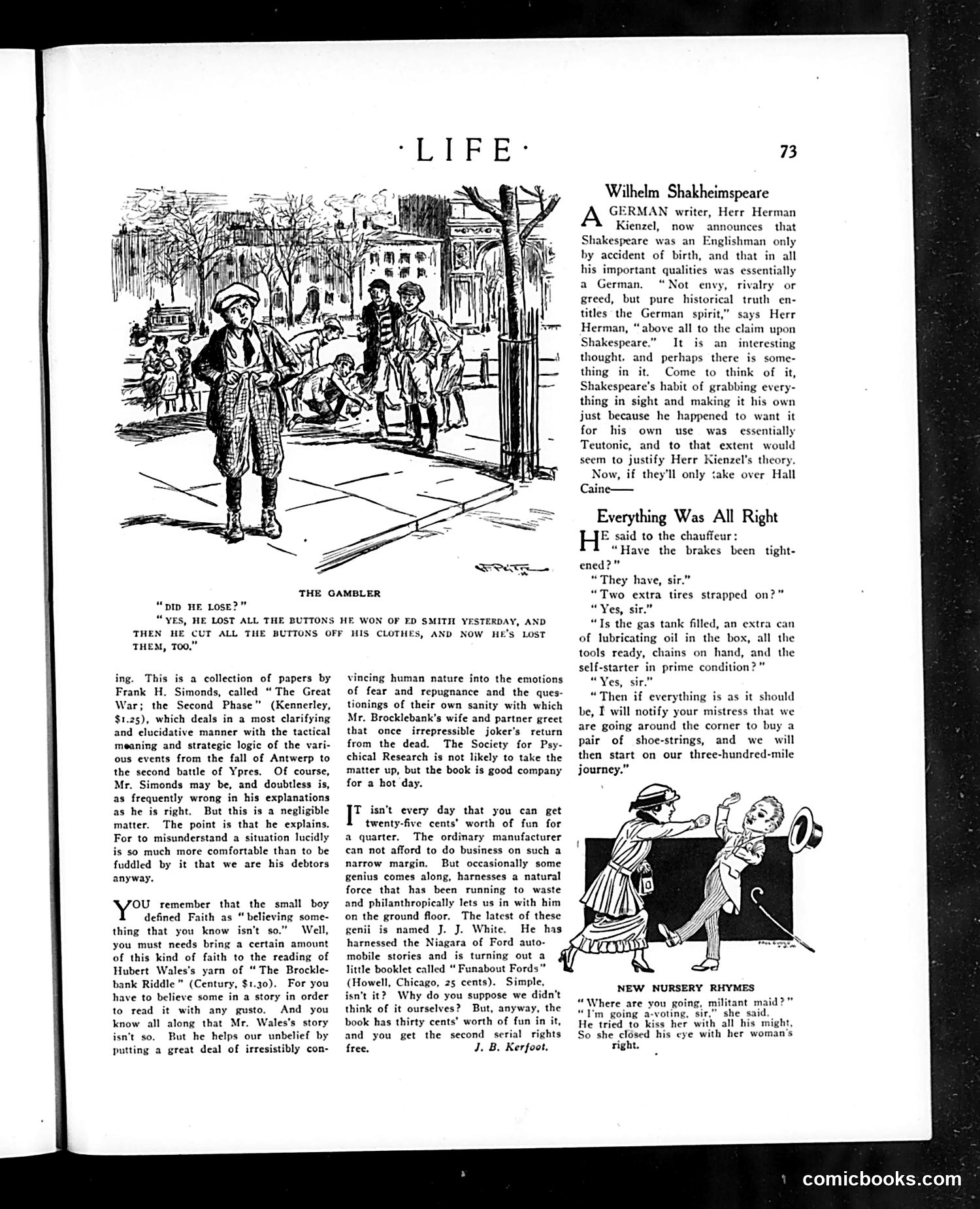
This page contains three satirical pieces typical of Life magazine's early 20th-century humor: **"Wilhelm Shakheimspeare"** mocks a German writer's (Herr Herman Kienzel) claim that Shakespeare was essentially German by birth accident. The satire suggests Germans grab everything in sight for their own use—a pointed jab at German imperial ambitions, likely written during or shortly after WWI when anti-German sentiment was high in America. **"The Gambler"** cartoon (top left) shows a street scene with the caption about someone losing buttons from Ed Smith's clothes—simple visual humor about gambling losses. **"Everything Was All Right"** depicts a car owner obsessively checking preparations with his chauffeur before a three-hundred-mile journey, satirizing wealthy anxious motorists. **"New Nursery Rhymes"** (bottom right) is a suffrage joke: a young woman declares she's "going a-voting," and when a man tries to kiss her, she "closed his eye with her woman's right"—a pun on voting rights and physical retaliation.
📄 Transcribed text from this page (OCR, searchable)
Machine-transcribed from the original scan — historical spelling and the odd misread are preserved.
aR TRU ise f ing. This is a collection of papers by Frank H. Simonds, called “The Great War; the Second Phase” (Kennerley, $1.25), which deals in a most clarifying and elucidative manner with the tactical meaning and strategic logic of the vari- ous events from the fall of Antwerp to the second battle of Ypres. Of course, Mr. Simonds may be, and doubtless is, as frequently wrong in his explanations as he is right, But this is a negli matter. The point is that he explains. For to misunderstand a situation lucidly is so much more comfortable than to be fuddled by it that we are his debtors anyway, OU remember that the small boy defined Faith as “believing some- thing that you know isn’t so.” Well, you must needs bring a certain amount of this kind of faith to the reading of Hubert Wales's yarn of “The Brockle- bank Riddle” (Century, $1.30). For you have to believe some in a story in order to read it with any gusto. And you know all along that Mr. Wales's story isn't so. But he helps our unbelief by putting a great deal of irresistibly con- vincing human nature into the emotions of fear and repugnance and the ques- tionings of their own sanity with which Mr. Brocklebank’s wife and partner greet that once irrepressible joker’s return from the dead. The Society for Psy- chical Research is not likely to take the matter up, but the book is good company for a hot day. T isn’t every day that you can get twenty-five cents’ worth of fun for a quarter. The ordinary manufacturer can not afford to do business on such a narrow margin. But occasionally some genius comes along, harnesses a natural force that has been running to waste and philanthropically lets us in with him on the ground floor. The latest of these genii is named J. J. White. He has harnessed the Niagara of Ford auto- mobile stories and is turning out a little booklet called “ Funabout Fords” (Howell, Chicago, 25 cents). Simple, isn’t it? Why do you suppose we didn’t think of it ourselves? But, anyway, the book has thirty cents’ worth of fun in it, and you get the second serial rights free. J. B. Kerfoot. 73 Wilhelm Shakheimspeare GERMAN writer, Herr Herman Kienzel, now announces that Shakespeare was an Englishman only by accident of birth, and that in all his important qualities was essentially a German. “Not envy, rivalry or greed, but pure historical truth en- titles the German spirit,” says Herr Herman, “above all to the claim upon Shakespeare.” It is an_ interesting thought. and perhaps there is some- thing in it. Come to think of it, Shakespeare's habit of grabbing ever. thing in sight and making it his own just because he happened to want it for his own use was essentially Teutonic, and to that extent would seem to justify Herr Kienzel’s theory. Now, if they'll only take over Hall Caine— Everything Was All Right said to the chauffeur: “Have the brakes been tight- ened?” “They have, sir.” “Two extra tires strapped on?” “Yes, sir.” “Ts the gas tank filled, an extra can of lubricating oil in the box, all the tools ready, chains on hand, and the self-starter in prime condition?” “Yes, sir.” “Then if everything is as it should be, I will notify your mistress that we are going around the corner to buy a pair of shoe-strings, and we will then start on our three-hundred-mile journey.” NEW NURSERY RHYMES “Where are you going, militant maid?” “I'm going a-voting, sir,” she said. He tried to kiss her with all his might, So she closed his eye with her woman's right. comicbooks.com