
Life, 1915-07-08 · page 15 of 44
Life — July 8, 1915 — page 15: what you’re looking at
What you’re looking at
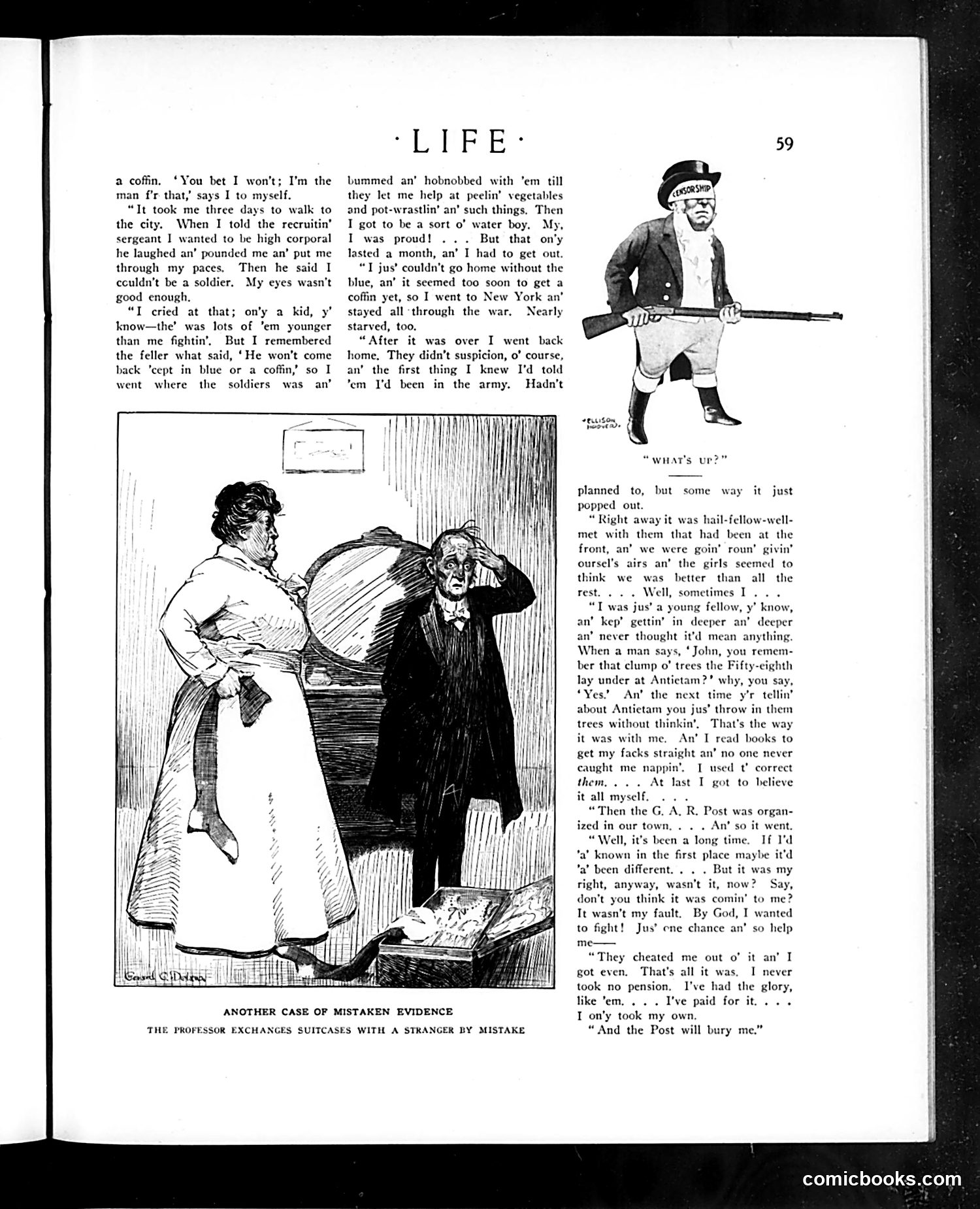
This page contains a first-person narrative account of a man explaining why he never served in WWI, despite societal pressure. The illustration titled "Another Case of Mistaken Evidence" shows a professor exchanging suitcases with a stranger by mistake—a visual joke about misidentification. The text describes how the narrator was rejected from military service due to poor eyesight, then worked various civilian jobs including as a "water boy." He later faced suspicion upon returning home that he'd shirked his duty. The narrative addresses post-war social anxieties about masculinity and patriotism—the tension between those who fought and those who didn't, and how civilians had to justify their wartime activities. The satire targets both unfounded suspicions of non-combatants and the narrator's own defensiveness.
📄 Transcribed text from this page (OCR, searchable)
Machine-transcribed from the original scan — historical spelling and the odd misread are preserved.
a coffin, ‘You bet I won't; I’m the man f'r that, says I to myself. “It took me three days to walk to the city. When I told the recruitin’ sergeant 1 wanted to be high corporal he laughed an’ pounded me an’ put me through my paces, Then he said I couldn’t be a soldier, My eyes wasn't good enough, “I cried at that; on'y a kid, y’ know—the’ was lots of ’em younger than me fightin’, But I remembered the feller what said, ‘He won't come hack ‘cept in blue or a coffin’ so I went where the soldiers was an’ “LIFE - bummed an’ hobnobbed with 'em till they let me help at peelin’ vegetables and pot-wrastlin’ an’ such things, Then I got to be a sort o’ water boy. My, I was proud! But that on'y lasted a month, an’ I had to get out. “T jus’ couldn't go home without the blue, an’ it seemed too soon to get a coffin yet, so I went to New York an’ stayed all through the war. Nearly starved, too, “After it was over I went back home, They didn’t suspicion, 0’ course, an’ the first thing I knew I'd told ‘em I'd been in the army, Hadn't ANOTHER CASE OF MISTAKEN EVIDENCE. THE PROFESSOR EXCHANGES SUITCASES WITH A STRAN ER BY MISTAKE “wiar's ur?” planned to, but some popped out. “Right away it was hail-fellow-well- met with them that had been at the front, an’ we were goin’ roun’ givin’ oursel’s airs an’ the girls seemed to think we was better than all the rest. . . . Well, sometimes I. . . “T was jus’ a young fellow, y’ know, an’ kep’ gettin’ in deeper an’ deeper an’ never thought it'd mean anything. When a man says, ‘John, you remem- ber that clump o trees the Fifty-eighth lay under at Antictam?’ why, you say, “Yes! An’ the next time tellin’ about Antietam jus’ throw in them trees without thinkin’, That's the way it was with me. An’ I read books to get my facks straight an’ no one never caught me nappin', I used t' correct them, . . . At last I got to believe it all myself. “Then the G, A. R. Post was organ- ized in our town, . . . An’ so it went. “Well, it's been a long time. If I'd known in the first place maybe it'd been different. . . . But it was my right, anyway, wasn't it, now? Say, don’t you think it was comin’ to me? Tt wasn’t my fault. By God, I wanted to fight! Jus’ ene chance an’ so help me— “They cheated me out o’ it an’ I got even, That's all it was, I never took no pension. I’ve had the glory, like ’em, . . . I've paid for it... . I on'y took my own, “And the Post will bury me.” way it just comicbooks.com