
Life, 1915-07-08 · page 16 of 44
Life — July 8, 1915 — page 16: what you’re looking at
What you’re looking at
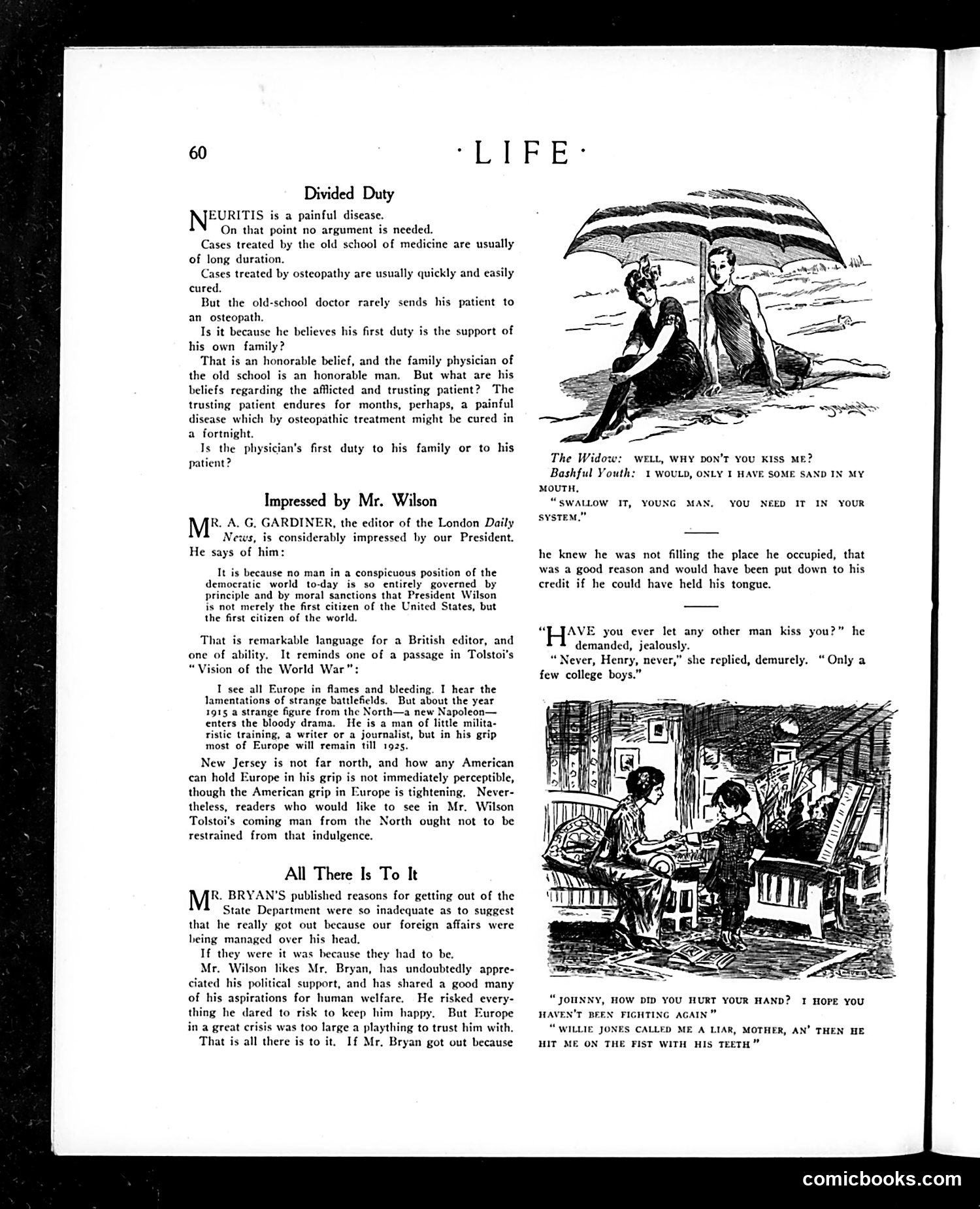
This page contains three satirical pieces typical of early 20th-century American humor: **"Divided Duty"** critiques old-school doctors' reluctance to refer patients to osteopaths, suggesting financial self-interest trumps patient welfare—a jab at professional protectionism. **"Impressed by Mr. Wilson"** mocks inflated praise for President Wilson by a British editor, contrasting it with Tolstoy's apocalyptic prophecy of a "new Napoleon" from the North. The satire suggests Americans are reading messianic grandiosity into Wilson's actual influence. **"All There Is To It"** addresses William Jennings Bryan's resignation as Secretary of State, implying he was sidelined on European affairs during WWI and lacked the competence to handle such matters—a dig at both Bryan's abilities and his subsequent silence about his departure. The accompanying cartoons are humorous domestic vignettes: a widow's flirtation and a child's explanation for a hand injury—light comic relief unrelated to the political commentary.
📄 Transcribed text from this page (OCR, searchable)
Machine-transcribed from the original scan — historical spelling and the odd misread are preserved.
Divided Duty EURITIS is a painful disease. On that point no argument is needed. Cases treated by the old school of medicine are usually of long duration. Cases treated by osteopathy are usually quickly and easily cured, But the old-school doctor rarely sends his patient to an osteopath. Is it because he believes his first duty is the support of his own family? That is an honorable belief, and the family physician of the old school is an honorable man. But what are his beliefs regarding the afflicted and trusting patient? The trusting patient endures for months, perhaps, a painful disease which by osteopathic treatment might be cured in a fortnight. Is the physician's first duty to his family or to his patient? Impressed by Mr. Wilson R. A. G, GARDINER, the editor of the London Daily News, is considerably impressed by our President. He says of him: It is because no man in a conspicuous position of the democratic world to-day is so entirely governed by principle and by moral sanctions that President Wilson is not merely the first citizen of the United States, but the first citizen of the world. That is remarkable language for a British editor, and one of ability, It reminds one of a passage in Tolstoi’s “Vision of the World War”: I see all Europe in flames and bleeding. I hear the lamentations of strange battlefields. But about the year 1915 a strange figure from the North—a new Napoleon— enters the bloody drama. He is a man of little milita- ristic training, a writer or a journalist, but in his grip most of Europe will remain till 1925. New Jersey is not far north, and how any American can hold Europe in his grip is not immediately perceptible, though the American grip in Europe is tightening, Never- theless, readers who would like to see in Mr. Wilson Tolstoi’s coming man from the North ought not to be restrained from that indulgence. All There Is To It R. BRYAN'’S published reasons for getting out of the State Department were so inadequate as to suggest that he really got out because our foreign affairs were heing managed over his head. If they were it was because they had to be. Mr. Wilson likes Mr, Bryan, has undoubtedly appre- ciated political support, and has shared a good many of his aspirations for human welfare. He risked every- thing he dared to risk to keep him happy. But Europe in a great crisis was too large a plaything to trust him with. That is all there is to it. If Mr. Bryan got out because The Widow: WELL, WHY DON'T YoU KIss ME? Bashful Youth: 1 woutp, ONLY I HAVE SOME SAND IN MY MOUTH, “SWALLOW IT, YOUNG MAN, YOU NEED IT IN YOUR SYSTEM,” he knew he was not filling the place he occupied, that was a good reason and would have been put down to his credit if he could have held his tongue. “LIJAVE you ever let any other man kiss you?” he demanded, jealously. “Never, Henry, never,” she replied, demurely. “Only a few college boys.” “JOUNNY, HOW DID YOU HURT YOUR HAND? HAVEN'T BEEN FIGHTING AGAIN” “WILLIE Jo CALLED ME A LIAR, MOTHER, AN’ THEN HE HIT ME ON THE FIST WITH HIS TEETH” I HOPE You comicbooks.com