
A complete issue · 44 pages · 1915
Life — May 20, 1915
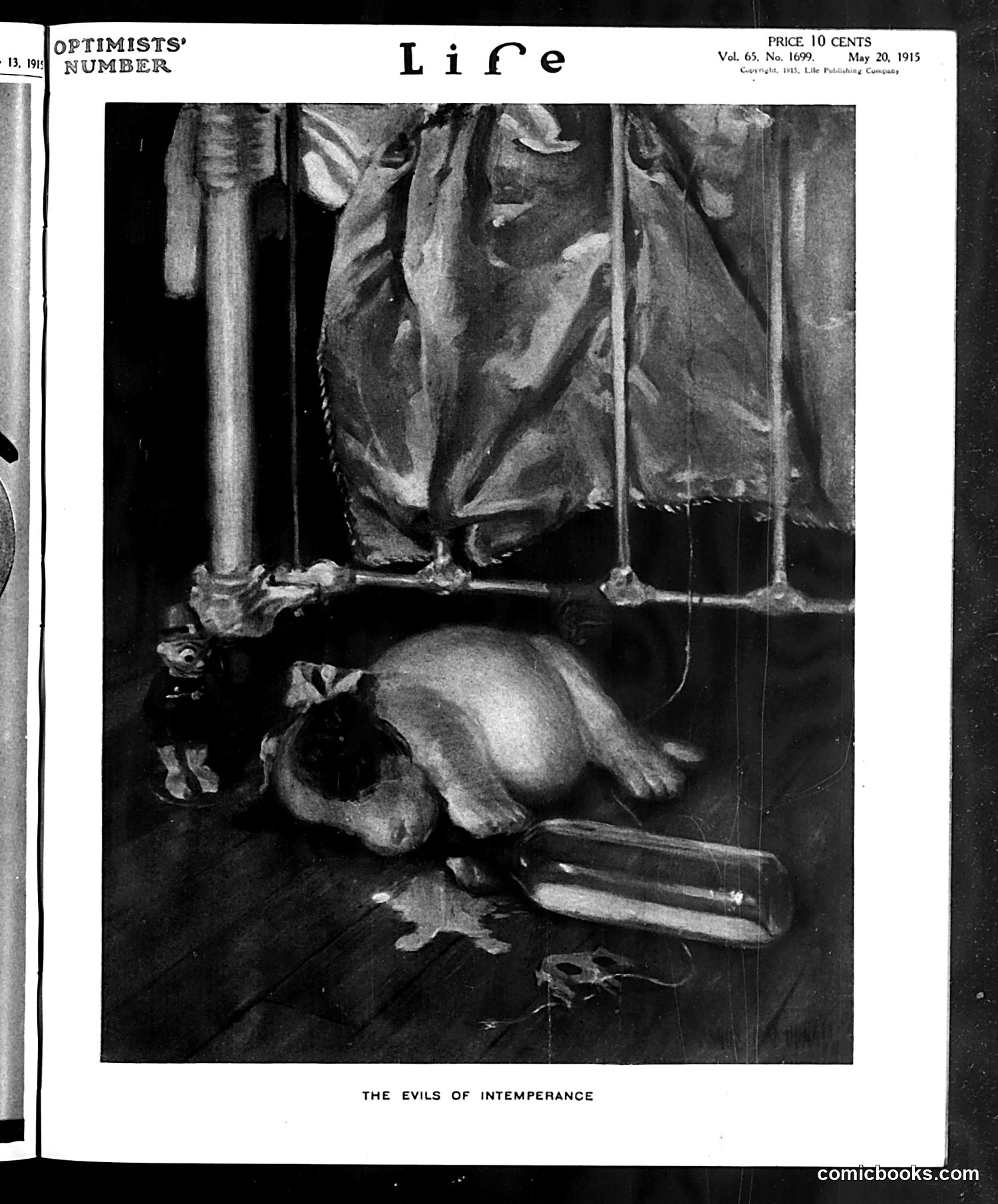
This is a temperance propaganda image from May 1915, during the final push before Prohibition's passage (1920). The illustration depicts the social consequences of alcohol abuse through a stark domestic scene: a drunken figure lies collapsed on the floor with an empty bottle nearby, while clothed figures above (likely family members) appear distressed or angry. The caption "The Evils of Intemperance" makes the moral message explicit—alcohol destroys families and homes. This was standard American reform rhetoric of the era, used by temperance advocates to justify banning alcohol entirely. The image appeals to middle-class anxieties about moral degradation and family breakdown caused by drinking.
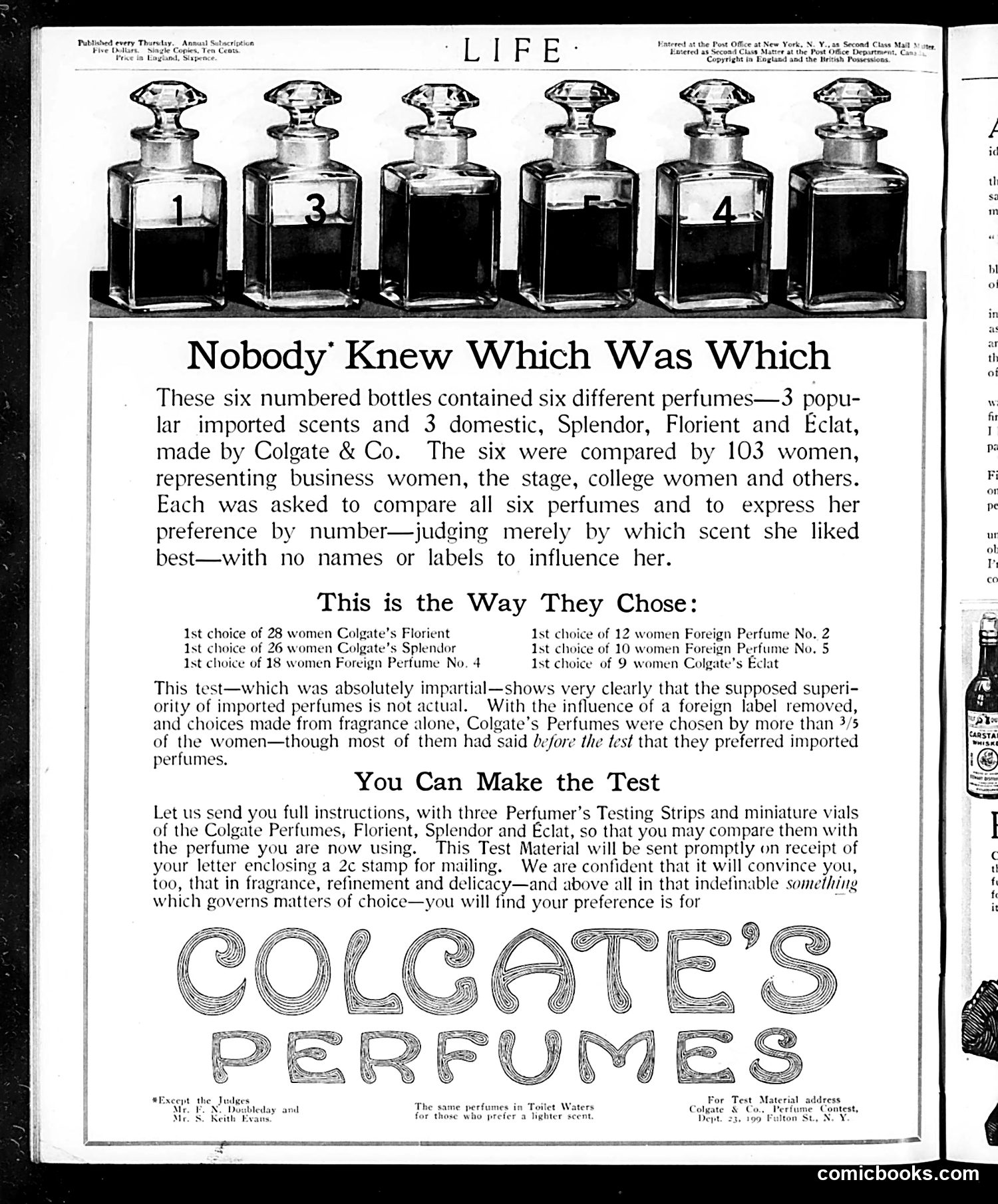
This is **not a political cartoon or satire—it's a product advertisement** for Colgate's Perfumes, appearing in Life magazine. The ad describes a blind taste-test conducted with 103 women comparing six numbered perfume bottles. Three were imported foreign scents; three were domestic Colgate products (Florient, Splendor, Eclat). The advertisement's rhetorical point: when women judged fragrances by scent alone—without brand labels influencing them—Colgate's domestic perfumes outperformed expensive imports. This was a common early-20th-century advertising strategy: claiming scientific objectivity to challenge consumers' assumptions that foreign luxury goods were inherently superior to American products. The ad invites readers to conduct their own test using provided materials for 2 cents postage.
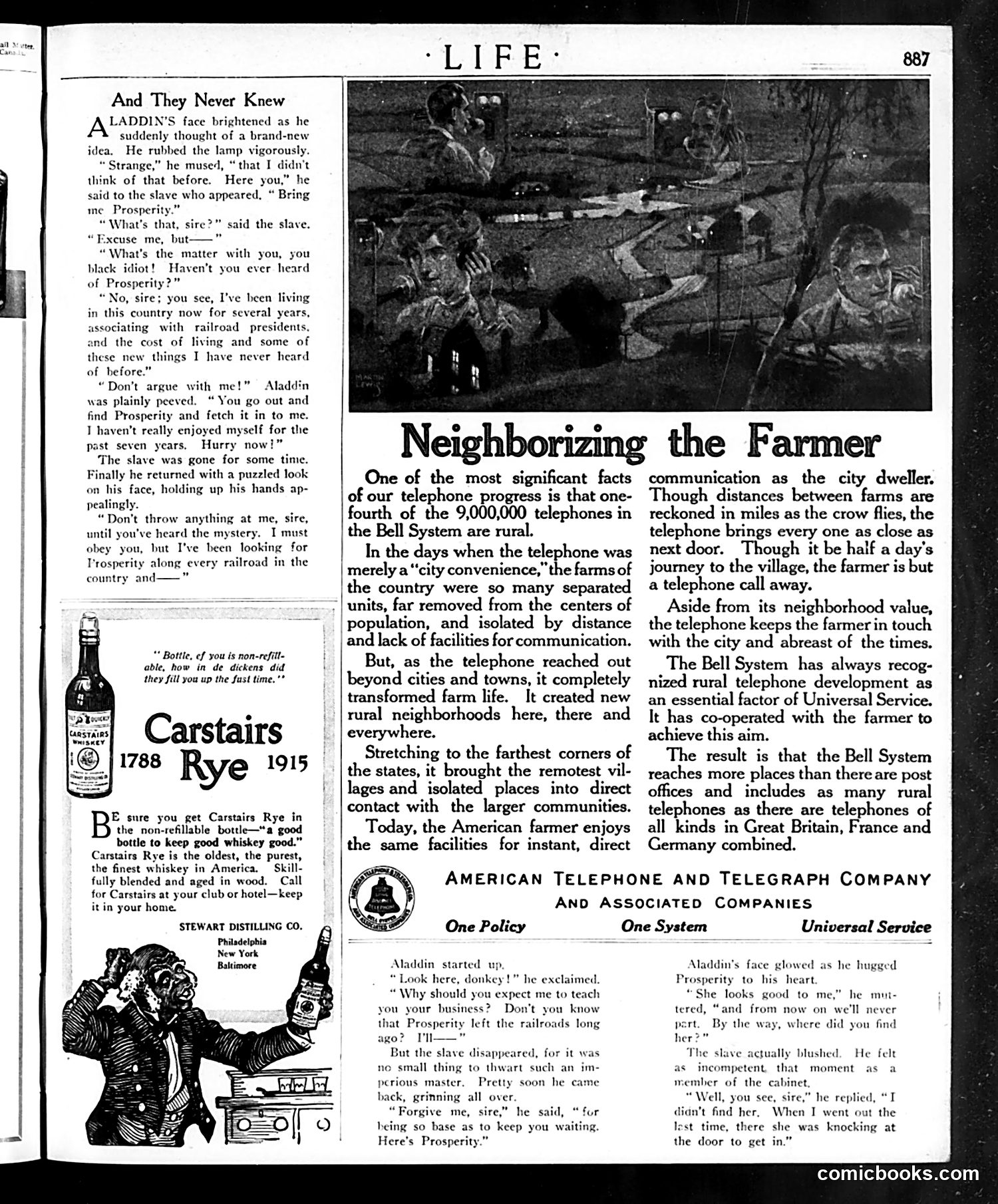
This page combines fiction with advertising rather than political satire. The main content, "And They Never Knew," depicts a story about Aladdin and a slave, illustrated with what appears to be a theatrical scene. The narrative involves Aladdin seeking "Prosperity" along railroad lines. The significant portion is the Bell System advertisement titled "Neighborizing the Farmer," which uses the fictional story as a frame. The ad's message is straightforward corporate promotion: it celebrates telephone infrastructure reaching rural America, arguing that Bell's rural telephone network provides farmers with the same communication access as city dwellers. This represents early 20th-century infrastructure marketing rather than satire—promoting modernization's benefits to agricultural communities through technological connectivity.
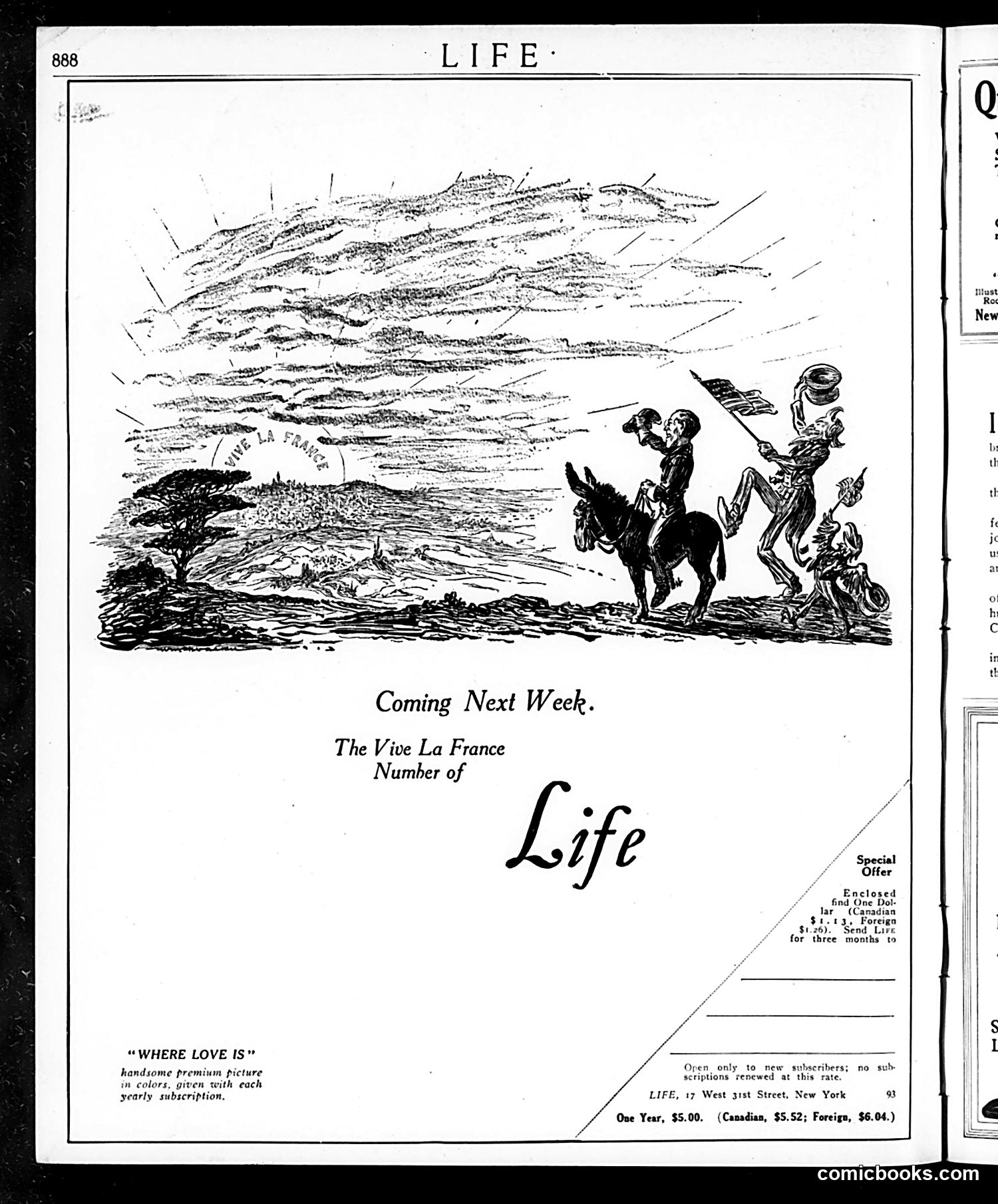
This page is primarily **advertising and promotion** rather than editorial content. It advertises the upcoming "Vive La France" issue of *Life* magazine, featuring a satirical illustration showing figures on horseback and on foot in a landscape labeled "Vive La France." The image appears to reference **French culture or Franco-American relations**, though the specific figures are unclear. The scene depicts what seems to be a comedic or allegorical representation, possibly satirizing French sensibilities or American perceptions of France. Below, text promotes a subscription offer and mentions a premium color picture called "Where Love Is" included with yearly subscriptions ($5.00 domestic). The page functions as a teaser for next week's issue rather than presenting standalone political commentary.
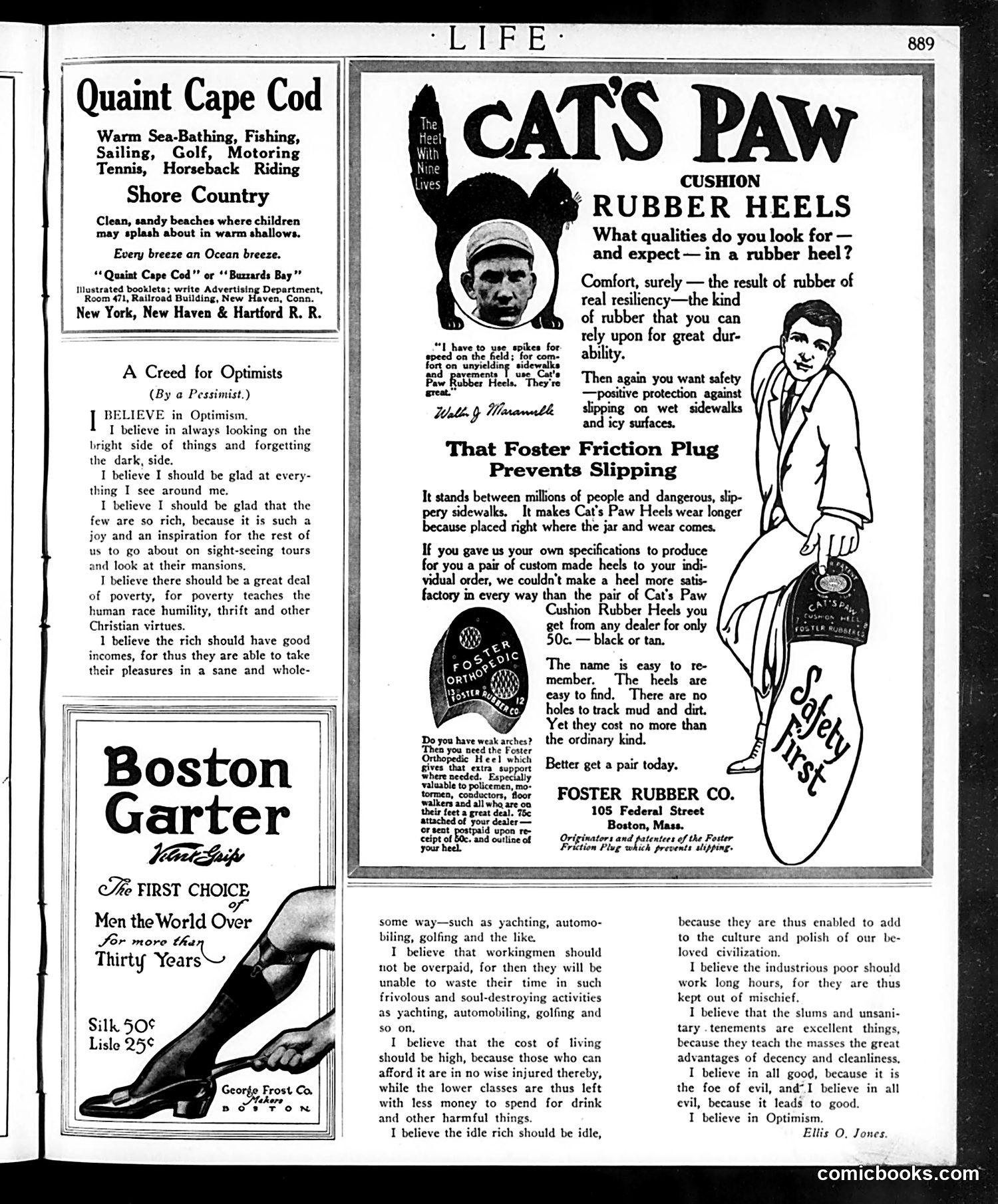
This page contains primarily **advertisements** rather than satirical content. The main items are: 1. **Quaint Cape Cod** – a tourism ad promoting seaside recreational activities 2. **Cat's Paw Cushion Rubber Heels** – the dominant advertisement featuring an endorsement by what appears to be a baseball player (likely Honus Wagner, based on the visible signature style), promoting durable rubber heels with a "friction plug" to prevent slipping 3. **Boston Garter** – a hosiery ad 4. **"A Creed for Optimists"** – a brief philosophical poem The Cat's Paw ad uses a sports figure testimonial, a common early 20th-century marketing technique. The page reflects typical Life magazine content of this era: a mix of light social commentary and commercial advertising aimed at middle-class readers.
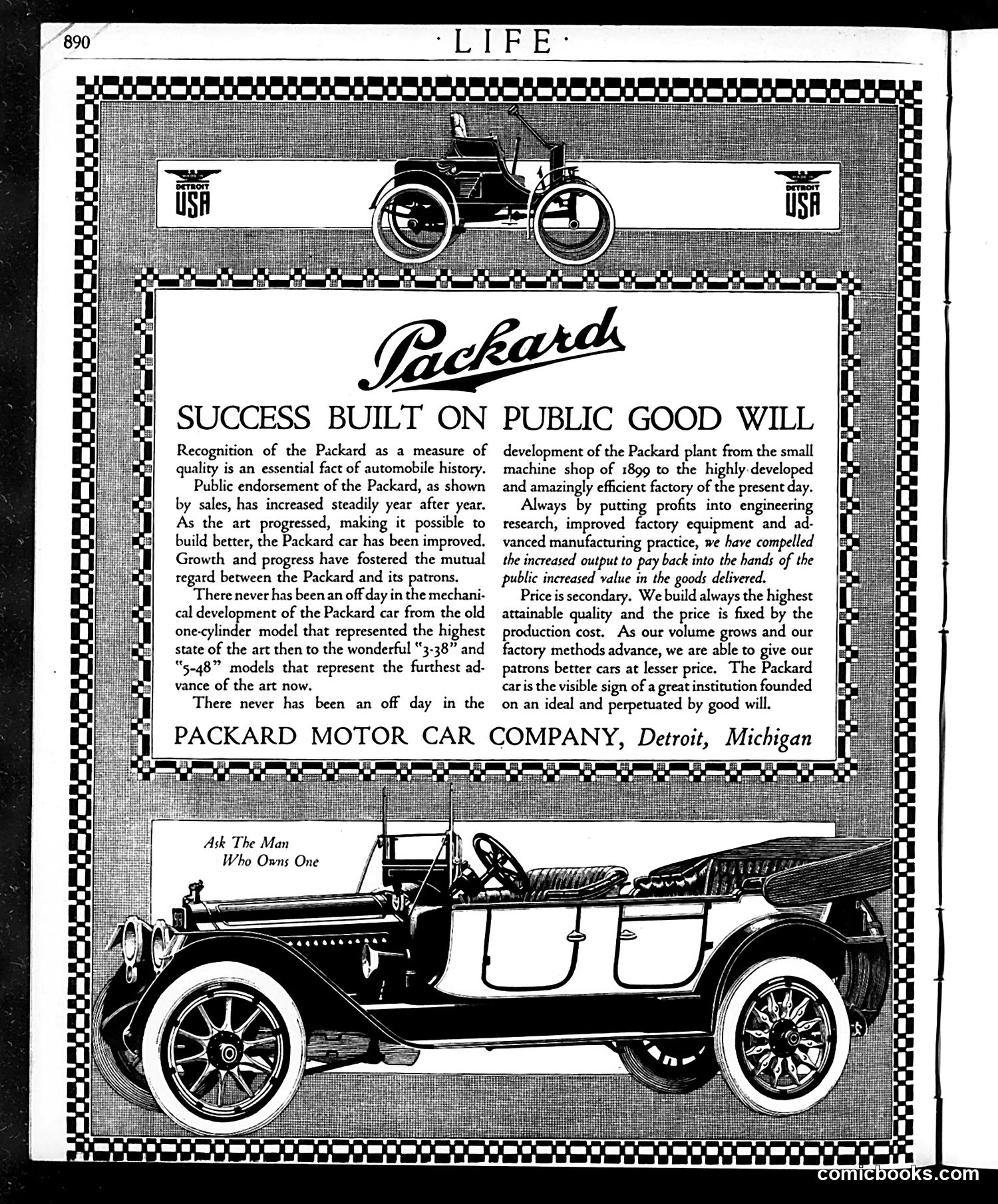
This page is **primarily an advertisement**, not satire or cartoon content. It's a Packard Motor Car Company ad from *Life* magazine (page 890). The ad features two car illustrations and argues that Packard's success stems from "public good will" rather than just marketing. The company claims it reinvests profits into engineering improvements, allowing them to offer quality vehicles at competitive prices. The headline "Ask The Man Who Owns One" (visible beneath the larger car illustration) was Packard's actual advertising slogan, positioning owner testimonials as proof of quality. There is **no political satire here**—this is straightforward early-20th-century automotive advertising emphasizing manufacturing innovation and customer satisfaction as competitive advantages. The decorative border and layout are typical of period magazine advertising design.
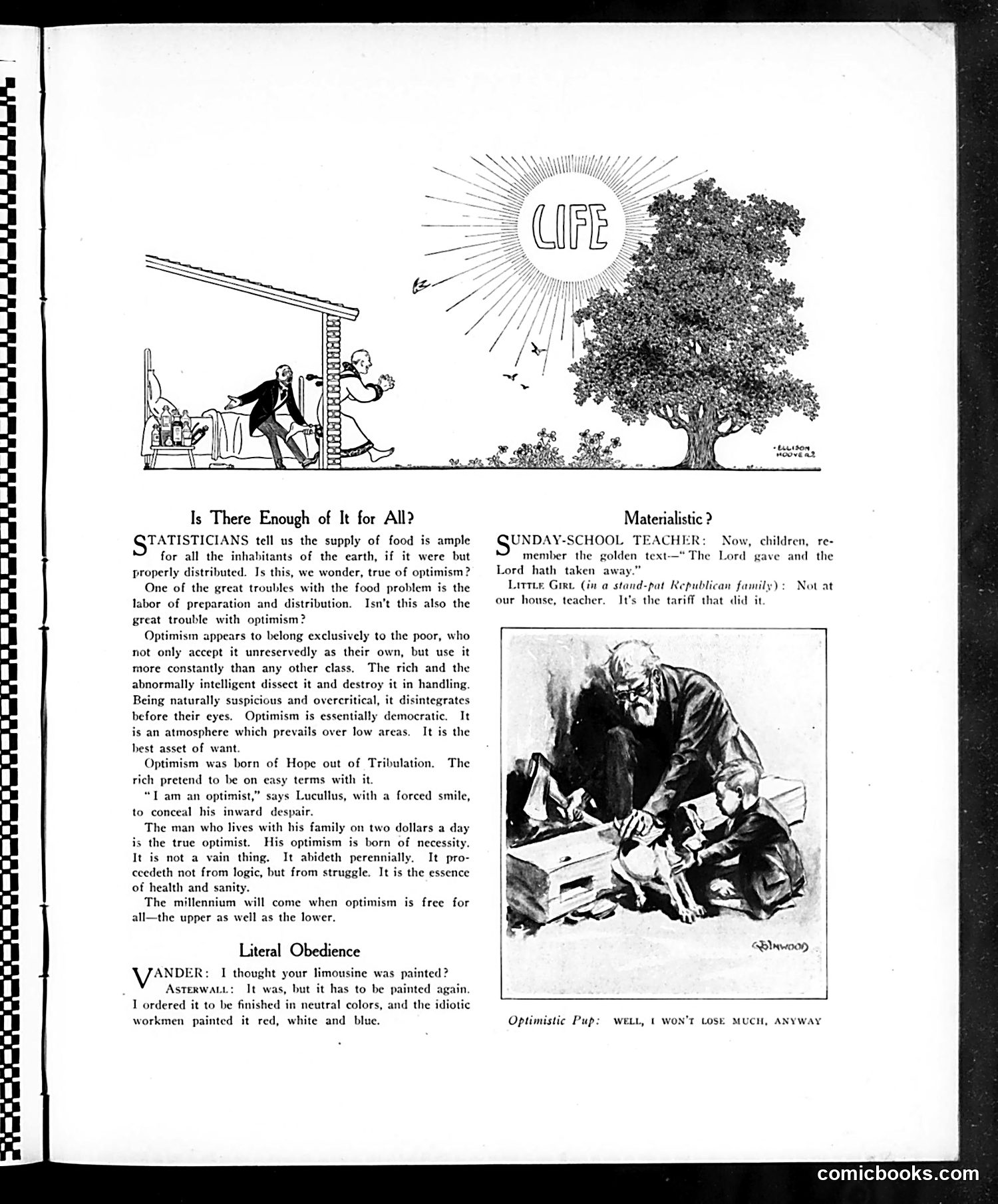
**Main Cartoon ("Is There Enough of It for All?"):** The illustration shows figures climbing a ladder toward a glowing sun labeled "LIFE," with a large tree in the distance. It satirizes optimism about food distribution and wealth. The accompanying text argues that optimism belongs primarily to the poor—who accept hardship without complaint—rather than the wealthy, and suggests true optimism comes from necessity and struggle rather than privilege. **Secondary Content:** A brief comedic exchange ("Literal Obedience") between characters Vander and Asterwall jokes about a limousine being repeatedly repainted in neutral colors, then red, white, and blue—likely mocking indecision or bureaucratic absurdity. The "Materialistic?" section features a Sunday-school lesson with an "Optimistic Pup" photograph about accepting loss philosophically.
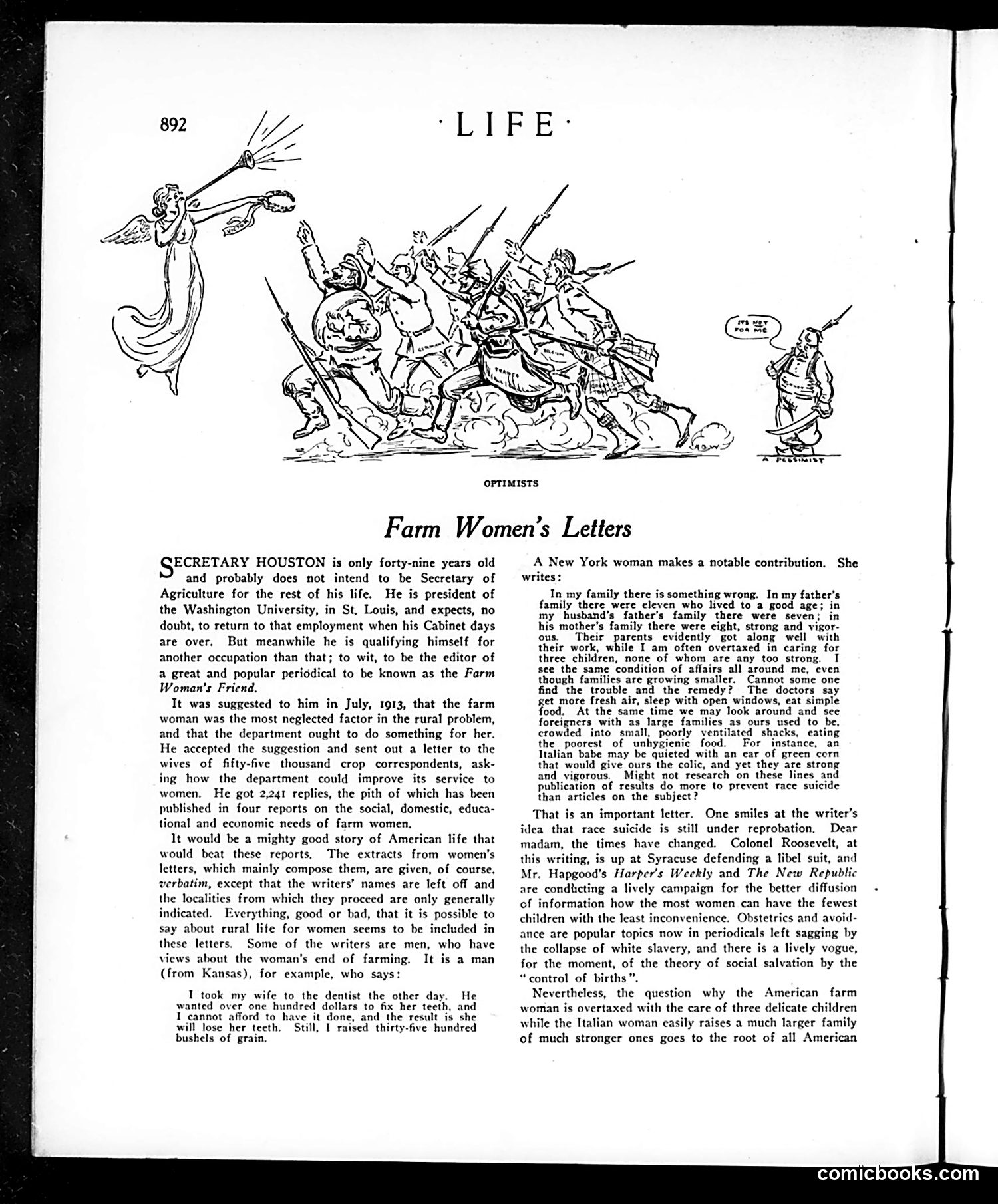
This cartoon depicts a chaotic military scene labeled "OPTIMISTS"—soldiers engaged in fierce combat with bayonets, surrounded by smoke and violence. On the left, a winged female figure (likely Lady Liberty or Victory) radiates light optimistically. On the right, a single soldier stands apart, seemingly oblivious to the carnage, with a speech bubble saying "I'm doing well." The satire targets unrealistic optimism about war. While one figure remains cheerfully detached, the bulk of soldiers face brutal, deadly combat. The cartoon critiques those maintaining blind faith or false hope during wartime, contrasting their naive optimism against the grim reality soldiers experience. This likely references WWI, given the historical period and bayonet-focused imagery.
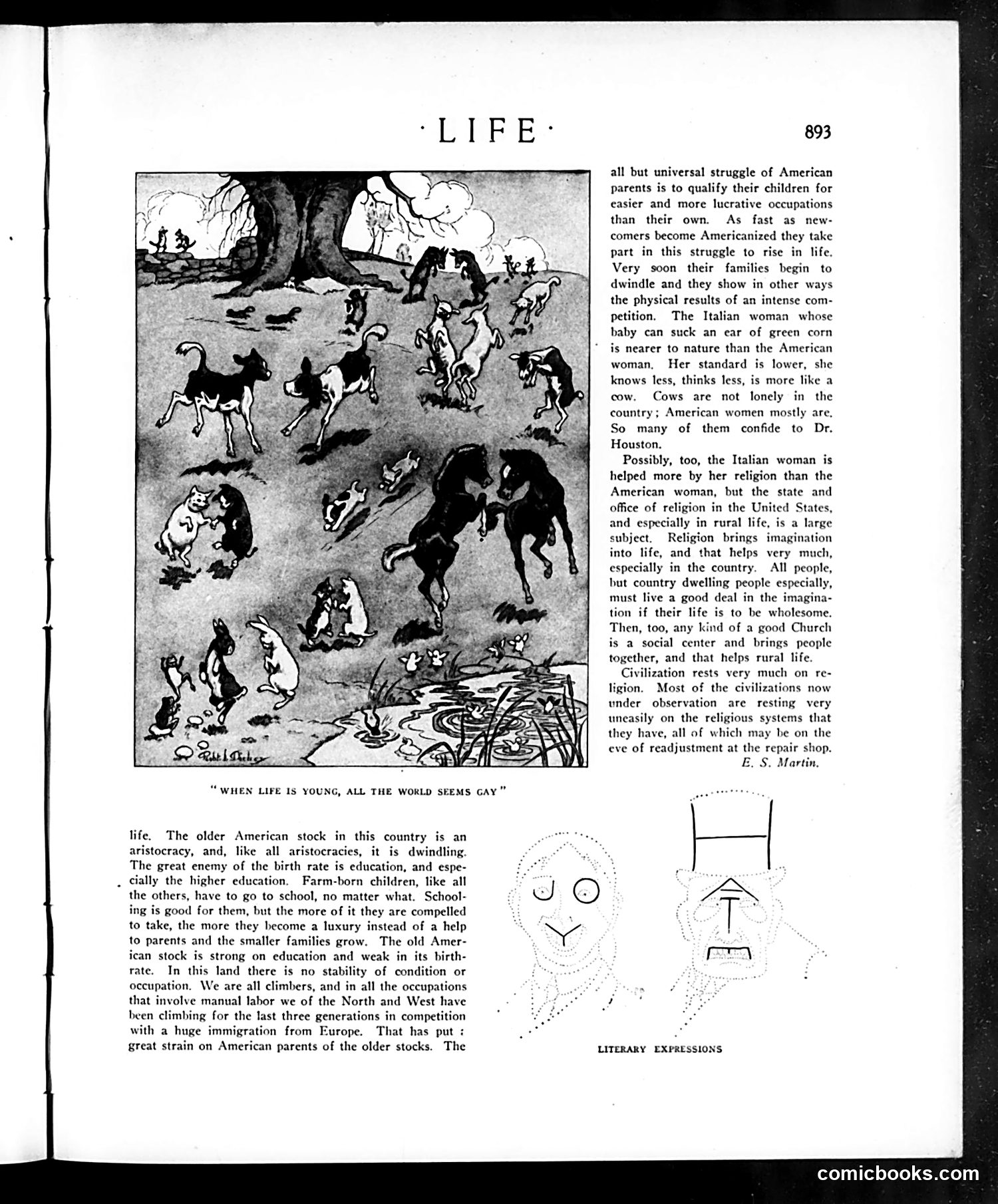
This page features a whimsical illustration of young animals (puppies, kittens, and other creatures) playing freely beneath a large tree. The accompanying text by E.S. Marin discusses American social attitudes, particularly comparing Italian immigrant women favorably to native-born American women regarding family size and childbearing. The article argues that education discourages American women from having children, while religion and lower social expectations enable Italian immigrant women to maintain larger families. The cartoon illustrates carefree youth, contrasting with the text's broader commentary on birth rates, immigration, and the perceived decline of "older American stock" due to education and social climbing aspirations among native-born Americans.
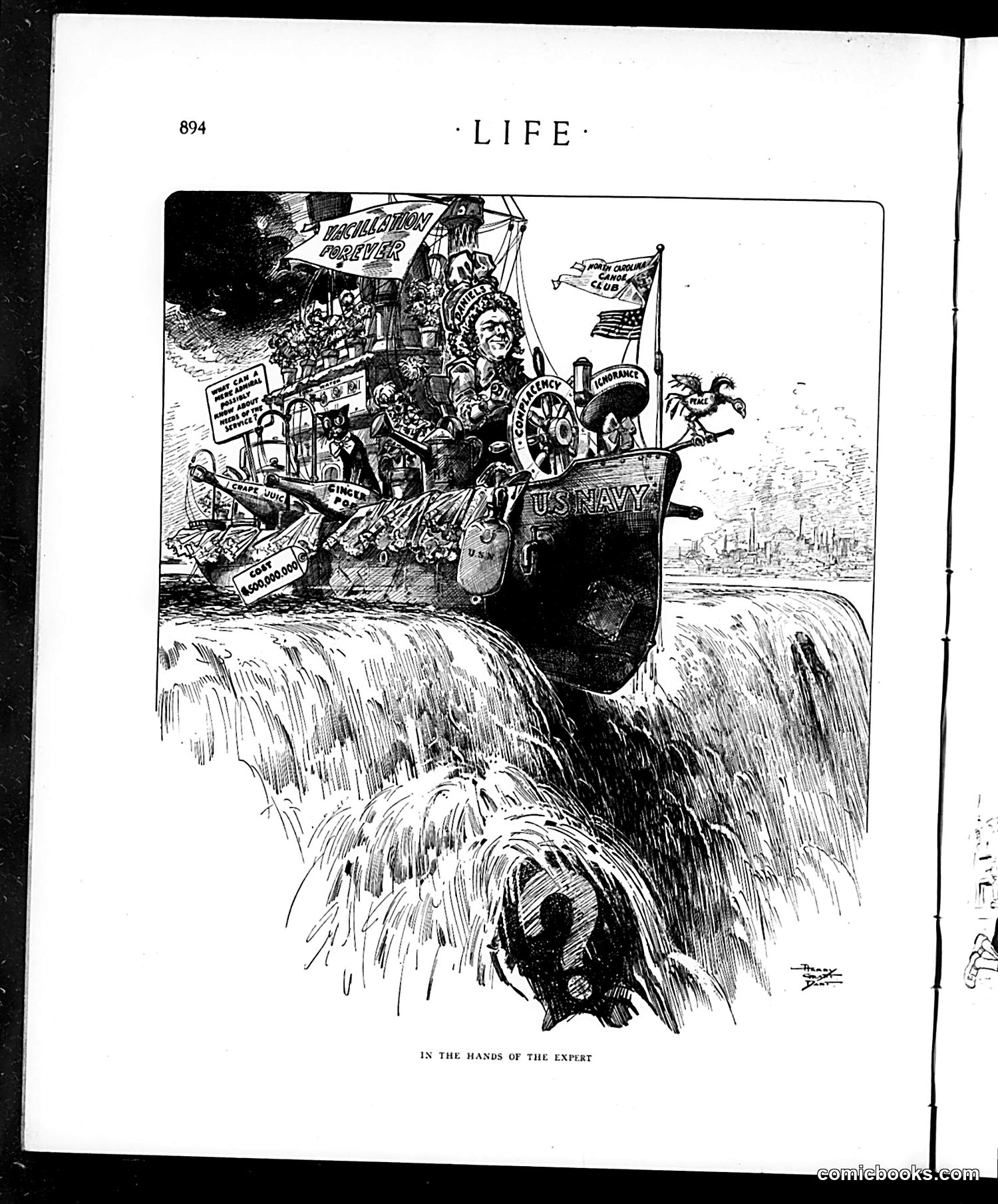
This satirical cartoon depicts the U.S. Navy as a heavily laden vessel navigating dangerous waters—represented by large waves below. The ship carries numerous passengers and flags representing various organizations and interests (visible text includes references to clubs and causes). The title "In the Hands of the Expert" suggests commentary on naval leadership or military administration during what appears to be the early 20th century. The overcrowded, chaotic nature of the ship—with its various competing interests and passengers—satirizes either mismanagement or the challenge of balancing multiple stakeholder demands within the Navy. The skilled pilot navigating these treacherous waters represents institutional expertise being tested by complex pressures.
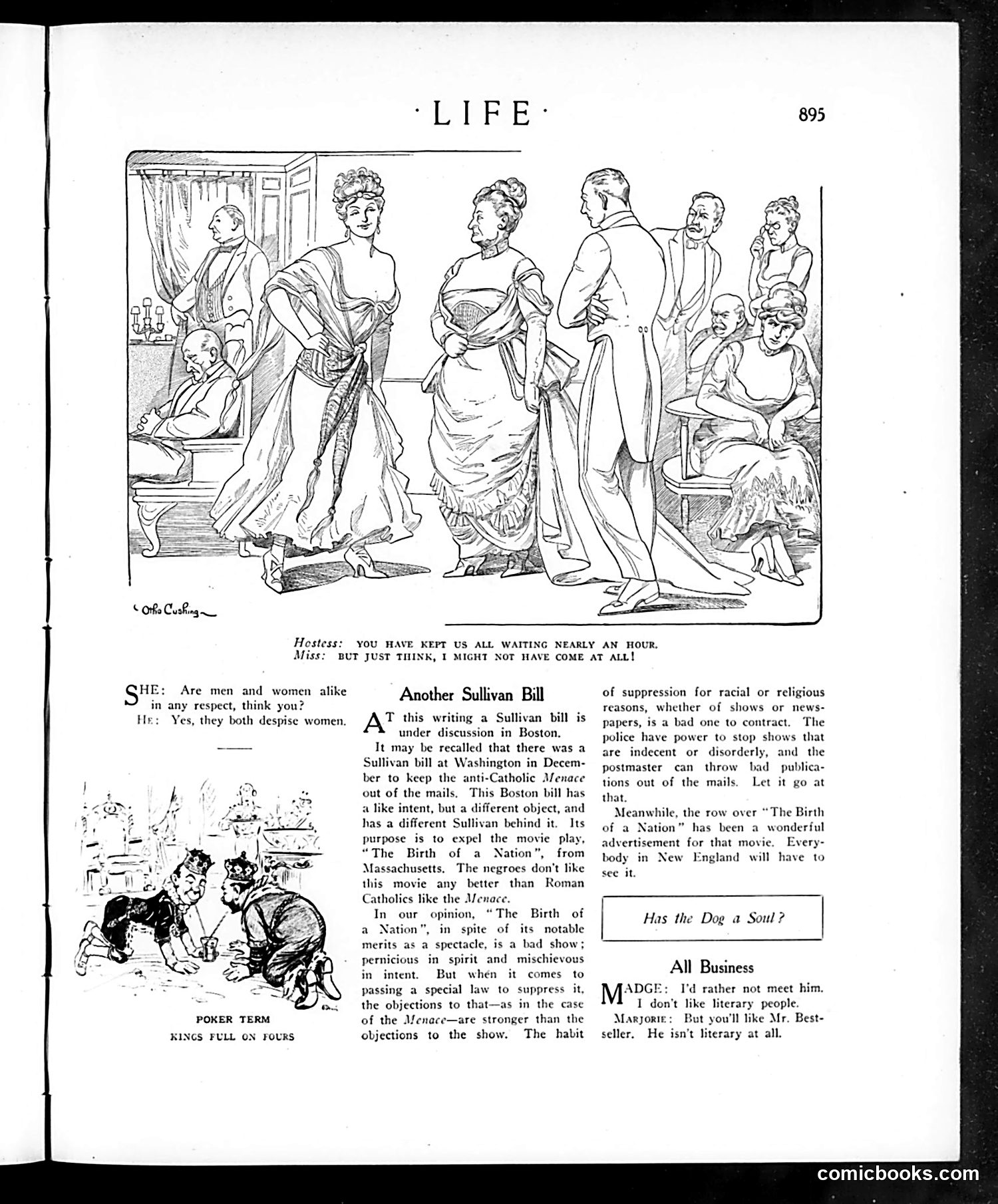
This page contains two unrelated items: **Top cartoon**: Shows a social gathering where a hostess complains guests arrived nearly an hour late. The joke plays on gender dynamics—a man claims men and women are alike in that both "despise women," suggesting misogynistic attitudes were common enough to be satirized. **"Another Sullivan Bill" article**: Discusses a Boston bill to suppress the film "The Birth of a Nation." The piece argues against censorship laws, noting that objections to this film (which depicts Black people negatively and glorifies the KKK) are actually *stronger* than previous objections to anti-Catholic films like "The Menace." The satire critiques selective moral outrage while defending free speech principles. **Bottom section**: An unrelated brief joke about literary people.
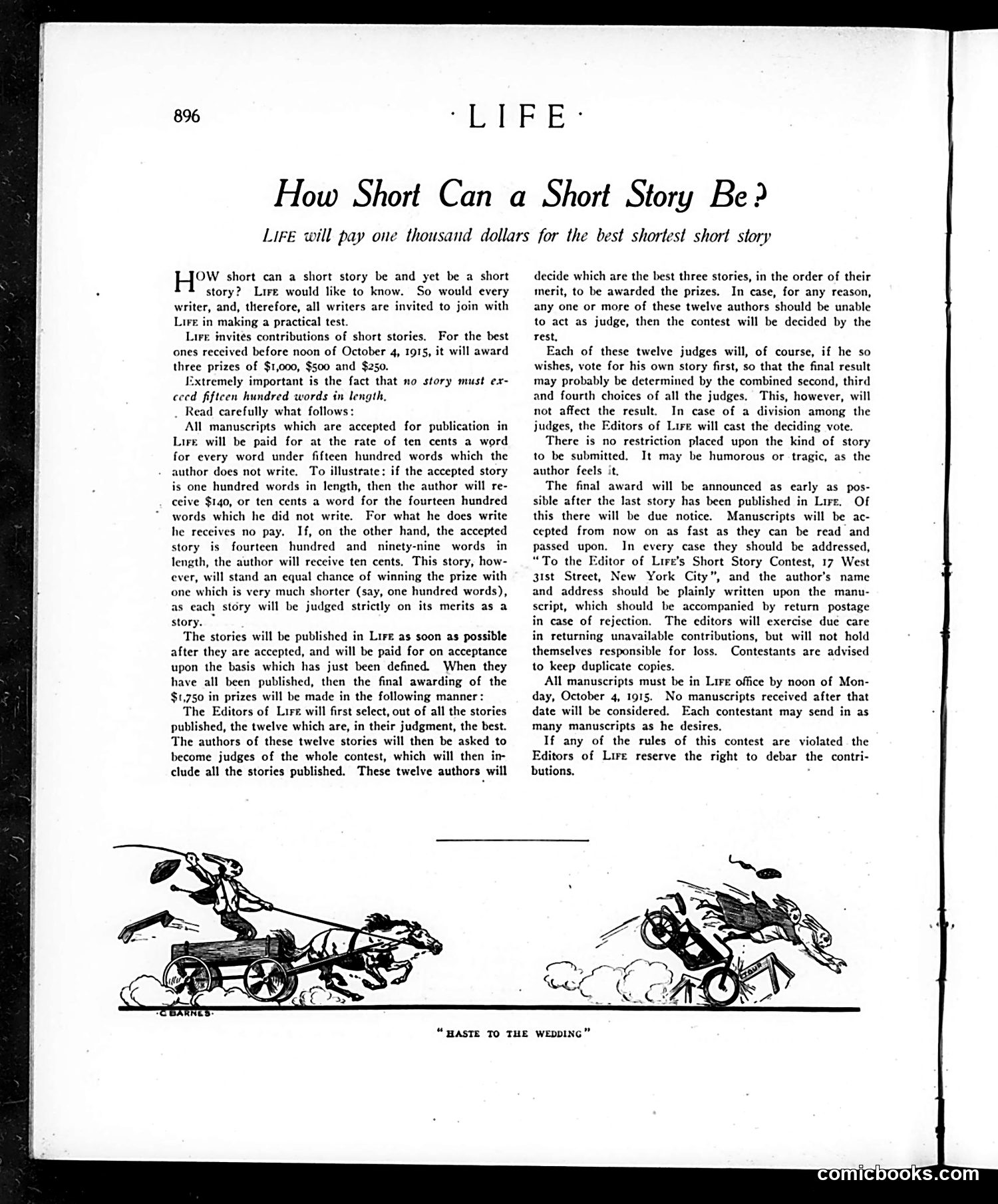
This page announces Life magazine's short-story contest offering $1,000 for the best entry (maximum 1,500 words). The cartoon at the bottom, titled "Haste to the Wedding," depicts a comedic scene of chaotic transportation—a horse-drawn carriage on the left and what appears to be an early automobile on the right, both in frenzied motion with dust clouds. The humor likely plays on the contrast between traditional and modern transportation methods, both racing urgently. The "haste to the wedding" caption suggests the cartoon satirizes the hurried, somewhat ridiculous nature of wedding preparations or the competitive rush to reach important events—a timeless social commentary about human priorities and the absurdity of ceremonial urgency.
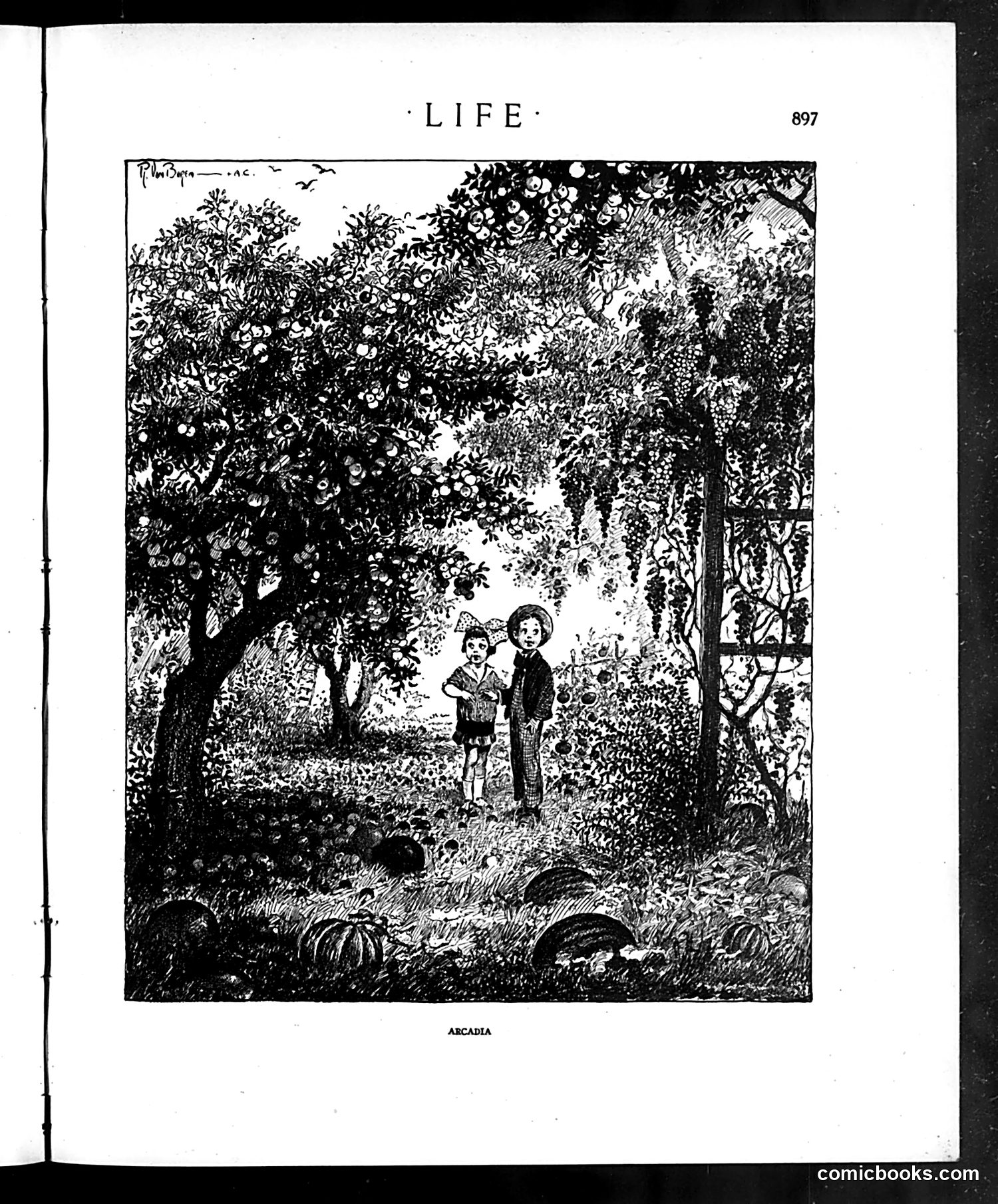
This illustration depicts two figures—a boy and girl—standing in an idyllic garden or orchard setting, surrounded by lush vegetation, fruit trees, and flowering vines. The title "Arcadia" references the classical Greek region symbolizing pastoral paradise and innocent simplicity. The satire likely comments on **idealized rural or natural life** versus modern urban reality. The detailed, almost overwhelming vegetation suggests either nostalgia for an imagined perfect past or ironic commentary on the gap between romantic pastoral ideals and actual experience. Without additional context or byline visible, the specific target remains unclear, though Life magazine frequently satirized social pretensions and false romanticism during this era.
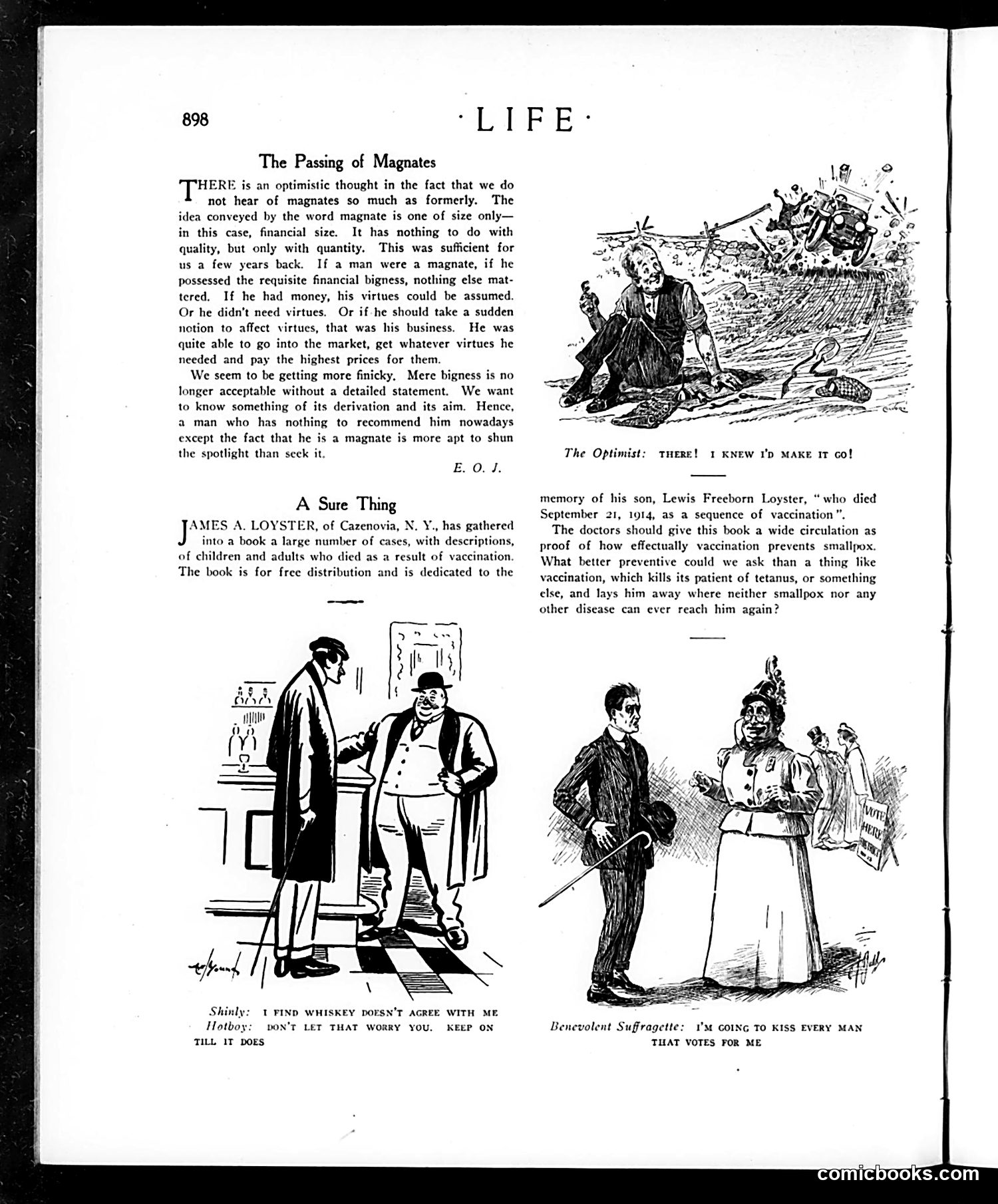
This page contains two satirical cartoons commenting on early 20th-century social issues: **"A Sure Thing"** (left): Shows a man consulting a doctor about vaccination. The dialogue references James A. Loyster's book on vaccination cases. The satire criticizes anti-vaccination skepticism, suggesting vaccination is foolproof protection against disease—a serious public health debate of that era. **"Benevolent Suffragette"** (right): Depicts a woman suffragist promising to kiss every man who votes for her. This mocks women's suffrage activism, suggesting female voters would use improper methods to gain political power—a common anti-suffrage argument from the early 1900s. Both cartoons use humor to satirize contemporary reform movements.
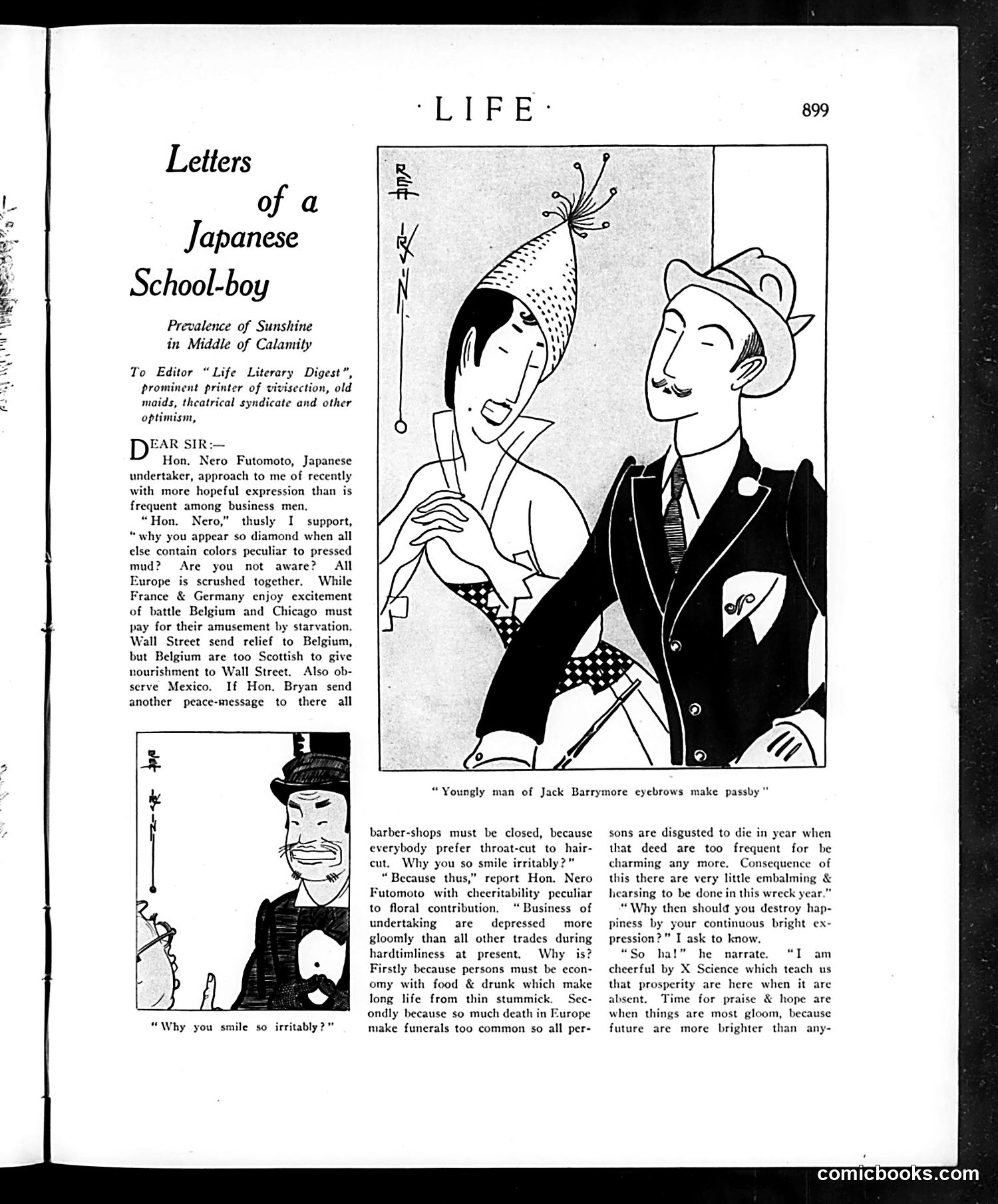
This page satirizes American optimism during World War I by presenting a dialogue between a Japanese undertaker (Hon. Nero Futomoto) and a Western correspondent. The humor relies on deliberately broken English and stereotypical caricature to mock both Japanese business culture and American naïveté. The satire's point: While Europe suffers catastrophic warfare, starvation spreads across Belgium and France, and Mexico faces instability, American financiers remain cheerfully detached—even profiting indirectly. The undertaker ironically notes his own business is *depressed* because death has become too common and frequent to be "charming." The cartoon mocks American sentimentality and selective compassion (sending relief to Belgium while ignoring Mexico). The broken English and exaggerated Asian features were typical of early 20th-century American magazine racism, but here serve to highlight Western hypocrisy through an outsider's perspective. The subtitle "Prevalence of Sunshine in Middle of Calamity" underscores the absurdity of American optimism amid global suffering.
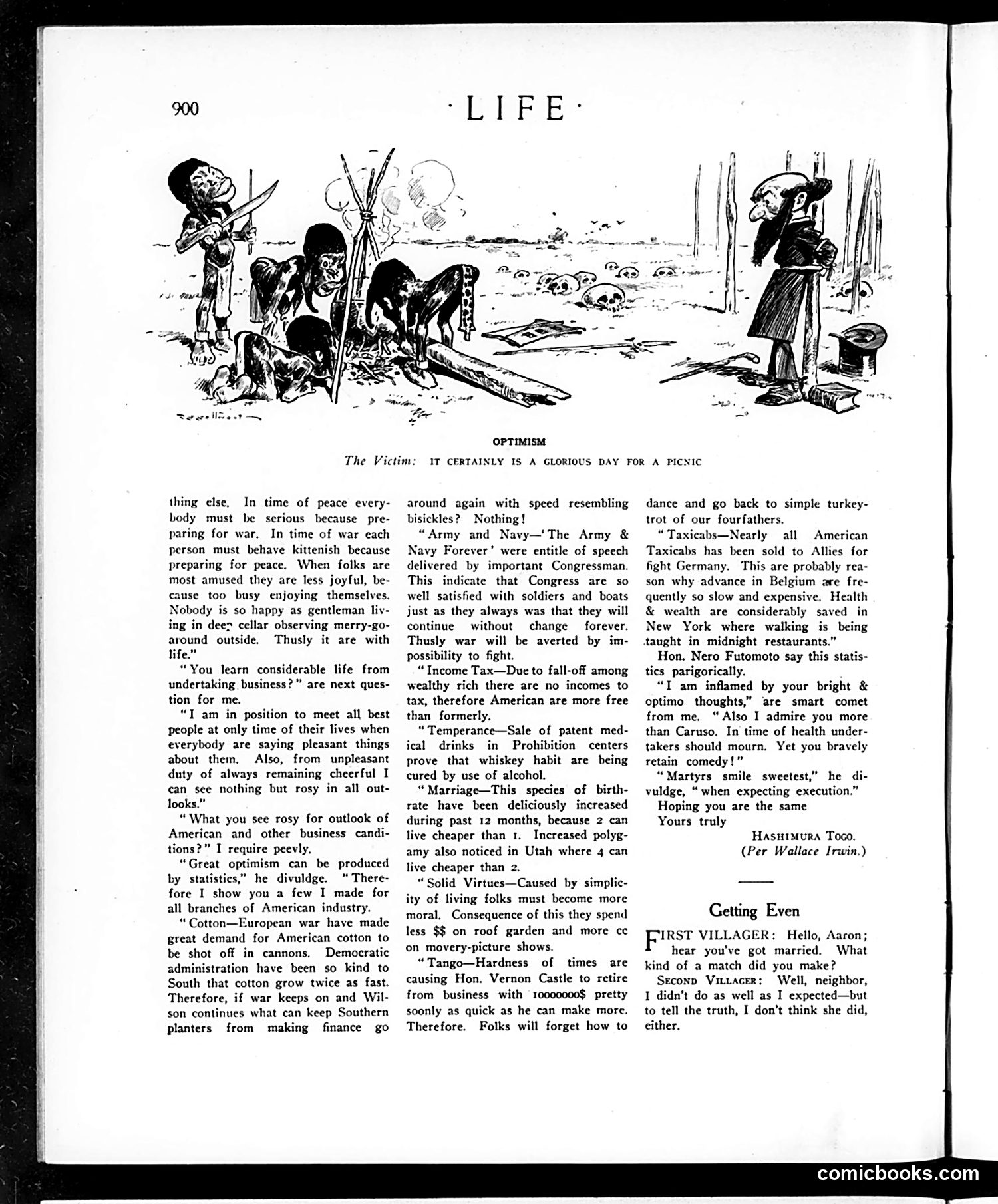
This page satirizes blind optimism during WWI era America through a dialogue between a cynical observer and "Hon. Nero Futomoto" (a character with a deliberately absurd Japanese-sounding name, typical of period ethnic humor). Futomoto offers "statistics" proving America's rosy future by twisting current events into false positives: cotton profits from war ammunition, military satisfaction ensuring peace through "impossibility to fight," income tax decline as "freedom," Prohibition-era patent medicines as proof of sobriety, and lower tango dancing as moral improvement. The cartoon depicts observers amid wartime desolation—a beggar, abandoned equipment—while one figure optimistically gestures, highlighting the disconnect between cheerful propaganda and grim reality. **The satire's target:** American politicians and business leaders peddling misleading statistics to justify war profiteering and mask genuine hardship. The author (likely Wallace Irwin) mocks how statistics manipulate public perception during crisis.
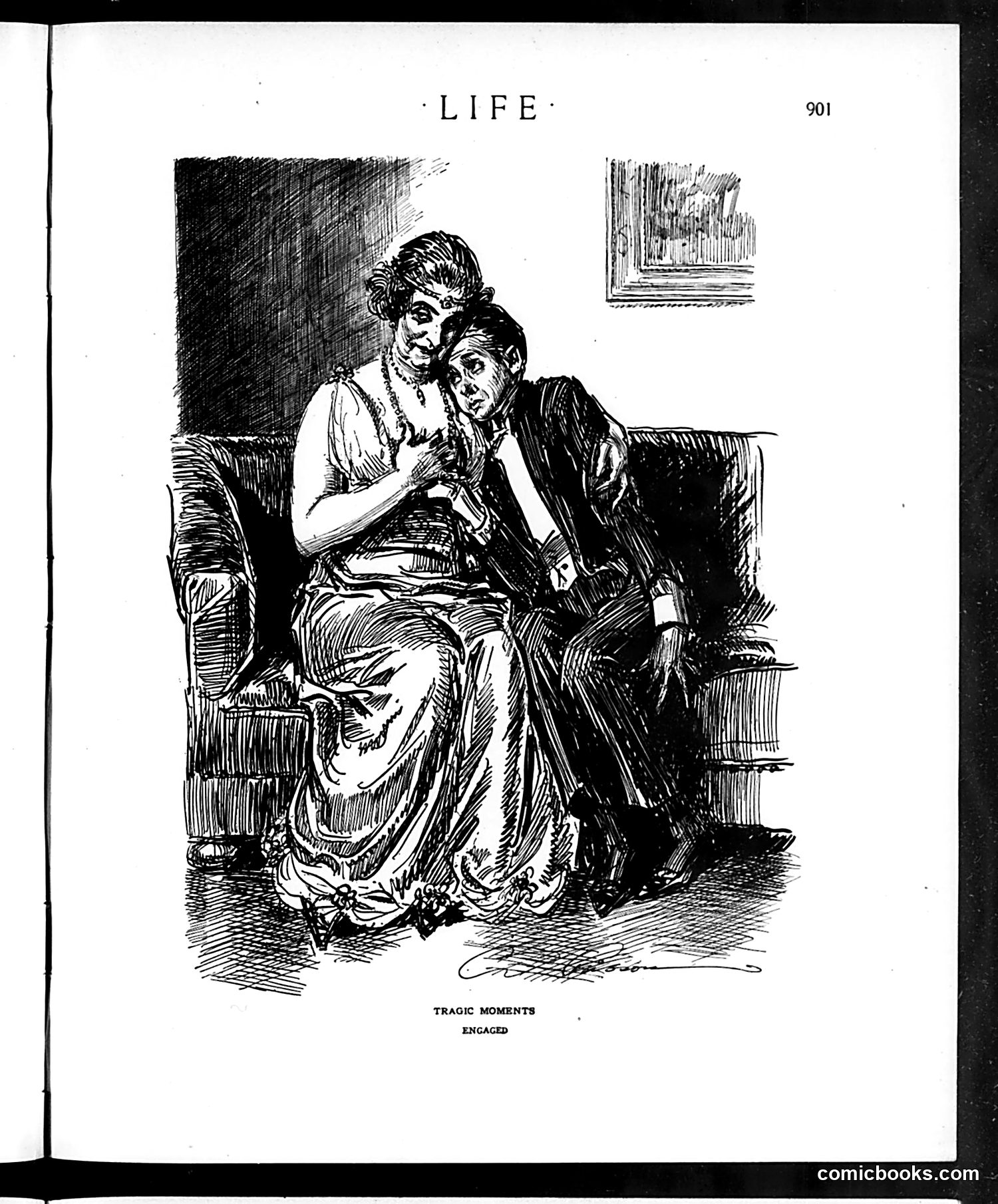
This illustration depicts a domestic scene titled "Tragic Moments: Engaged." The drawing shows two figures seated together on a couch—a woman in a light dress and a man in dark clothing leaning close to her. Their body language and facial expressions suggest an intimate or romantic moment. The satire appears to target Victorian-era courtship customs. The caption "Tragic Moments" treats engagement as something regrettable rather than joyful, likely mocking the social conventions and constraints of marriage in the period. The ironic tone suggests *Life* magazine is critiquing either the artificiality of romantic rituals or the loss of freedom engagement represented, particularly for women. The precise historical context or specific couple referenced remains unclear.
This page addresses the sinking of the RMS Lusitania (May 7, 1915), where a German U-boat torpedoed the British passenger ship, killing nearly 1,200 people, including 128 Americans. The editorial attacks Kaiser Wilhelm II as personally responsible for the attack, characterizing it as an act of "frightfulness"—deliberate terrorism against civilians to force submission. It frames the war as absolutism versus democracy, arguing the German government (not its people) wages this war. The page criticizes President Wilson's earlier statement that America could be "too proud to fight," interpreting it as insufficient response to German aggression. The accompanying letter from a gentleman sailing to France sarcastically requests the President merely "protest" if his ship is torpedoed—mocking what the writer sees as inadequate diplomatic responses to German atrocities. The satire pushes for stronger American action against Germany, suggesting passive diplomacy fails against force-driven adversaries.
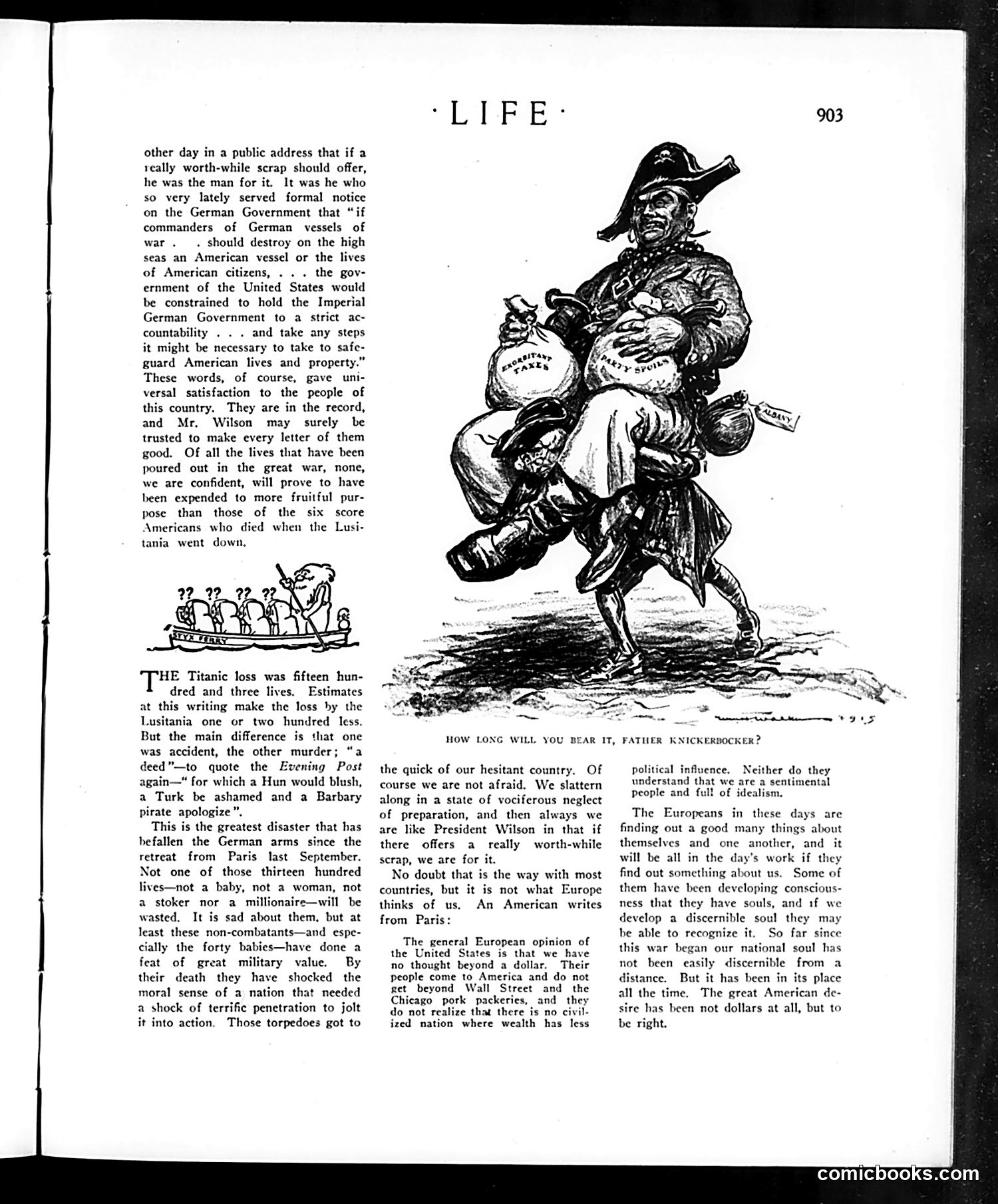
This page discusses the 1915 sinking of the RMS Lusitania by German U-boat, in which approximately 1,200 civilians died, including many Americans. The large political cartoon depicts "Father Knickerbocker" (personification of America) as a rotund, somewhat foolish figure laden with goods, asking "How long will you bear it, Father Knickerbocker?"—urging American intervention in World War I. The text argues that the Lusitania disaster, though tragic, represents a "feat of great military value" because it has finally shocked America's conscience into action. The author criticizes American passivity and perceived focus on commerce rather than idealism, while defending that America does possess moral principles beneath its materialist reputation. The satirical point: Americans needed this atrocity to awaken their national conscience and cease hesitant neutrality.
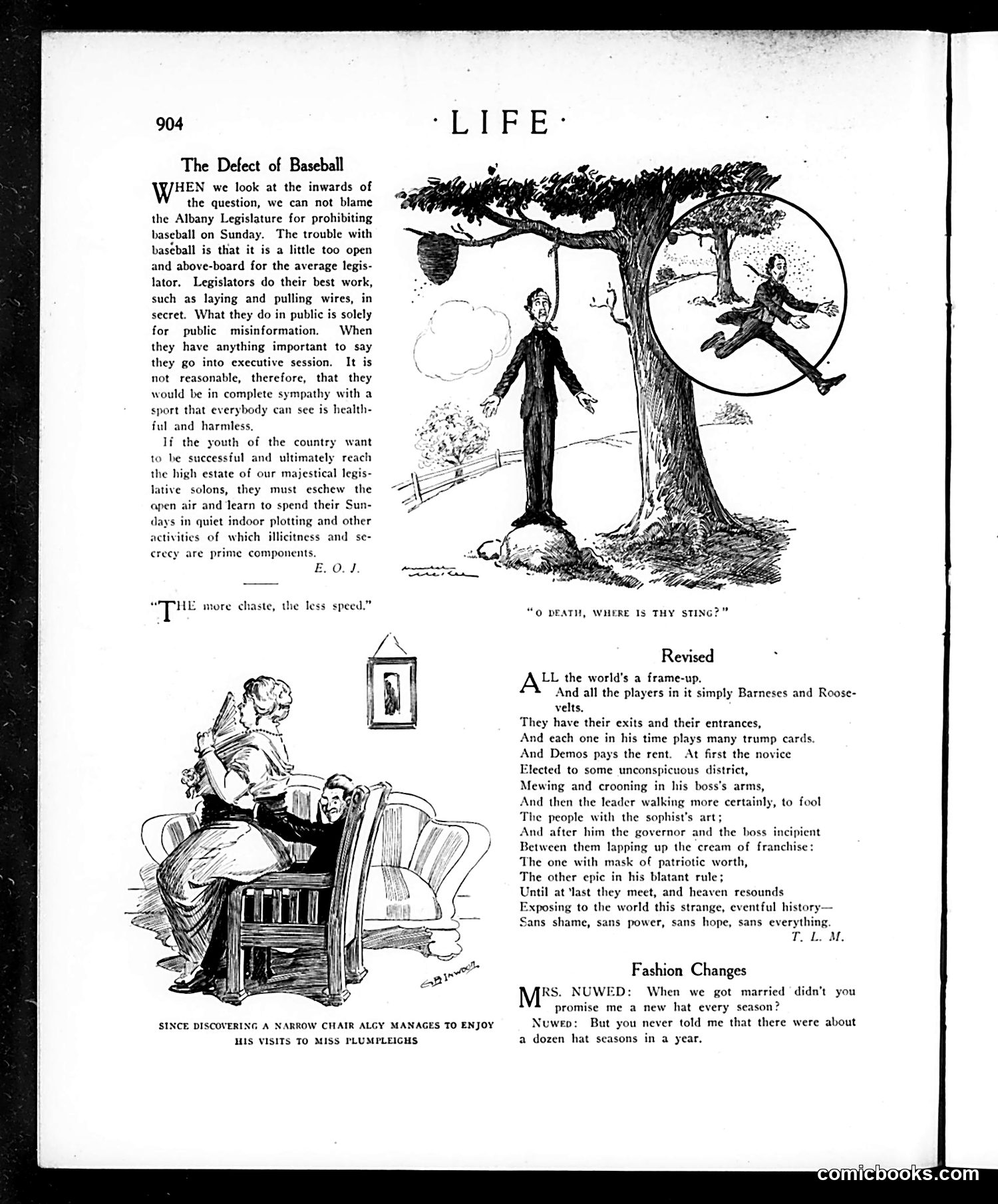
This *Life* magazine page contains three satirical pieces mocking American politics and society circa early 1900s. **"The Defect of Baseball"** criticizes the Albany Legislature's Sunday baseball ban by sarcastically suggesting legislators oppose it because baseball is too transparent and honest—unlike their own secret "wire-pulling" (backroom deals). The satire suggests politicians couldn't sympathize with a wholesome public sport since they conduct important business in secrecy. **"Revised"** is a Shakespeare parody (reworking "All the world's a stage") that mocks political corruption. It references "Barneses and Roosevelts"—likely political figures of the era—and depicts politicians as corrupt players manipulating elections and franchise deals, ultimately exposed "sans shame, sans power, sans hope." **"Fashion Changes"** jokes about rapidly changing women's hat fashions, with a husband complaining there are "a dozen hat seasons in a year," mocking the fashion industry's constant trend cycles. The cartoons throughout satirize legislative corruption, political maneuvering, and consumer culture.
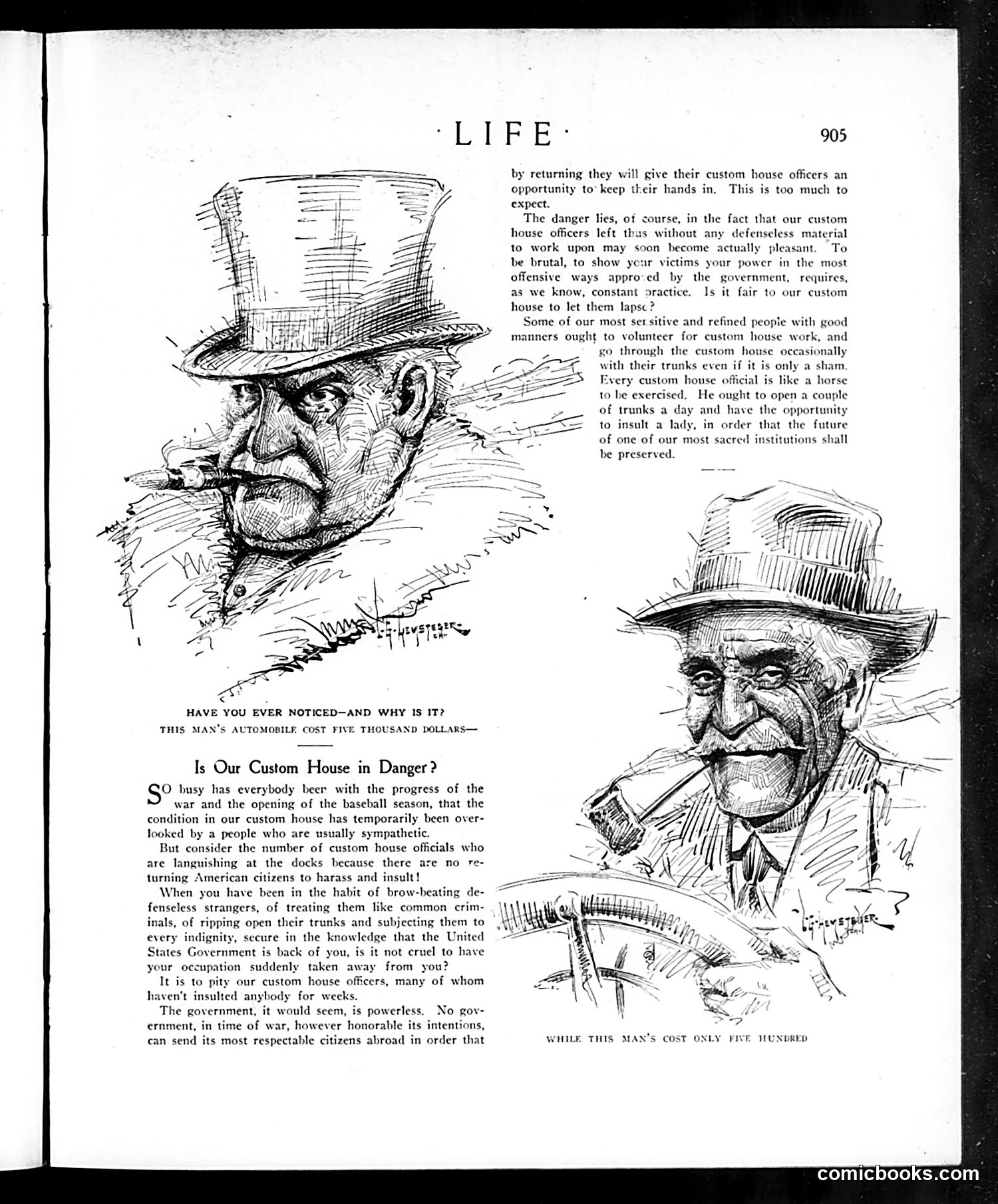
This satirical article mocks U.S. Customs House officials during wartime (appears to be WWI era, given the baseball season reference). The cartoon contrasts a wealthy man with a $5,000 automobile against a poor man with only $500—illustrating the hypocrisy Life identifies. The satire argues that customs officers, deprived of returning American travelers to inspect during wartime, are suffering from lack of "exercise"—i.e., they miss the opportunity to harass, insult, and brutalize defenseless people. Life sarcastically suggests refined citizens should volunteer to have their trunks searched, letting officials practice their abusive behavior on ladies to keep the "sacred institution" of the customs house functional. The joke: customs officials are portrayed as thugs who *need* victims for practice, implying the system itself is corrupt and predatory rather than genuinely serving security purposes. The contrast between the wealthy and poor travelers suggests customs officers target ordinary citizens while the truly wealthy escape scrutiny.

I can see this is a page from *Life* magazine with "LIFE" visible in the upper right corner. However, the image itself is almost entirely black or severely underexposed, making it impossible to discern any cartoon figures, caricatures, text, or satirical content. The page appears to be a photograph or illustration, but the details are not legible. Without being able to see the actual cartoon or content clearly, I cannot identify the figures, political references, or the intended satire. To provide an accurate explanation for a modern reader, I would need a clearer image where the visual elements and any accompanying text are visible.
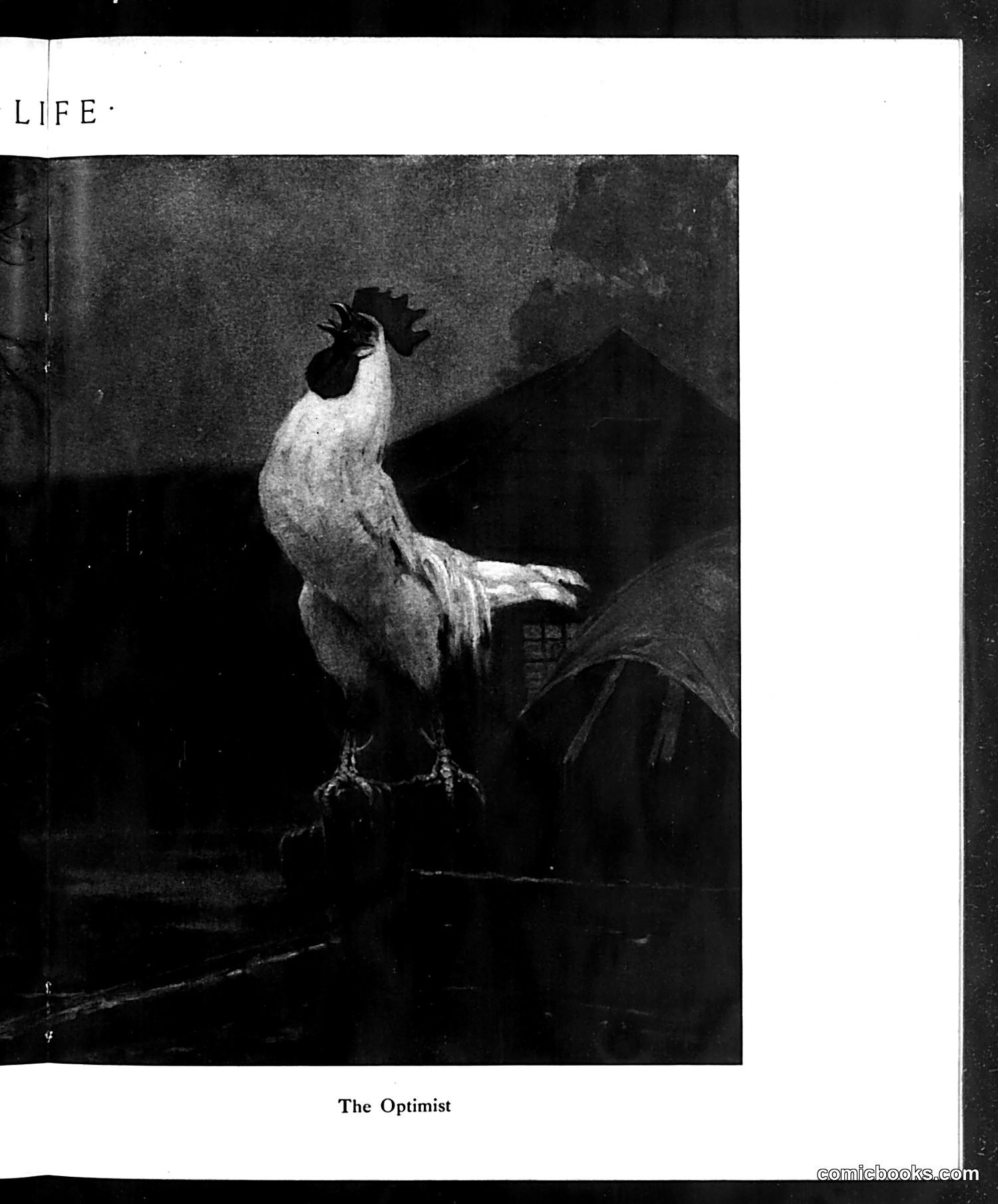
This black and white photograph shows a rooster in profile, positioned prominently against a dark background. The bird's white plumage contrasts sharply with the shadowy setting. The caption "The Optimist" appears to be satirical commentary using the rooster as a symbolic figure. Roosters traditionally crow at dawn, suggesting hope and new beginnings. The dark, somewhat ominous background may suggest that despite circumstances (unclear from this image alone), the rooster—representing "the optimist"—remains upright and vocal, maintaining its characteristic optimistic posture and call. The satire likely comments on maintaining hope or positive outlook during difficult times, though the specific historical context requiring this message is not evident from the image alone.
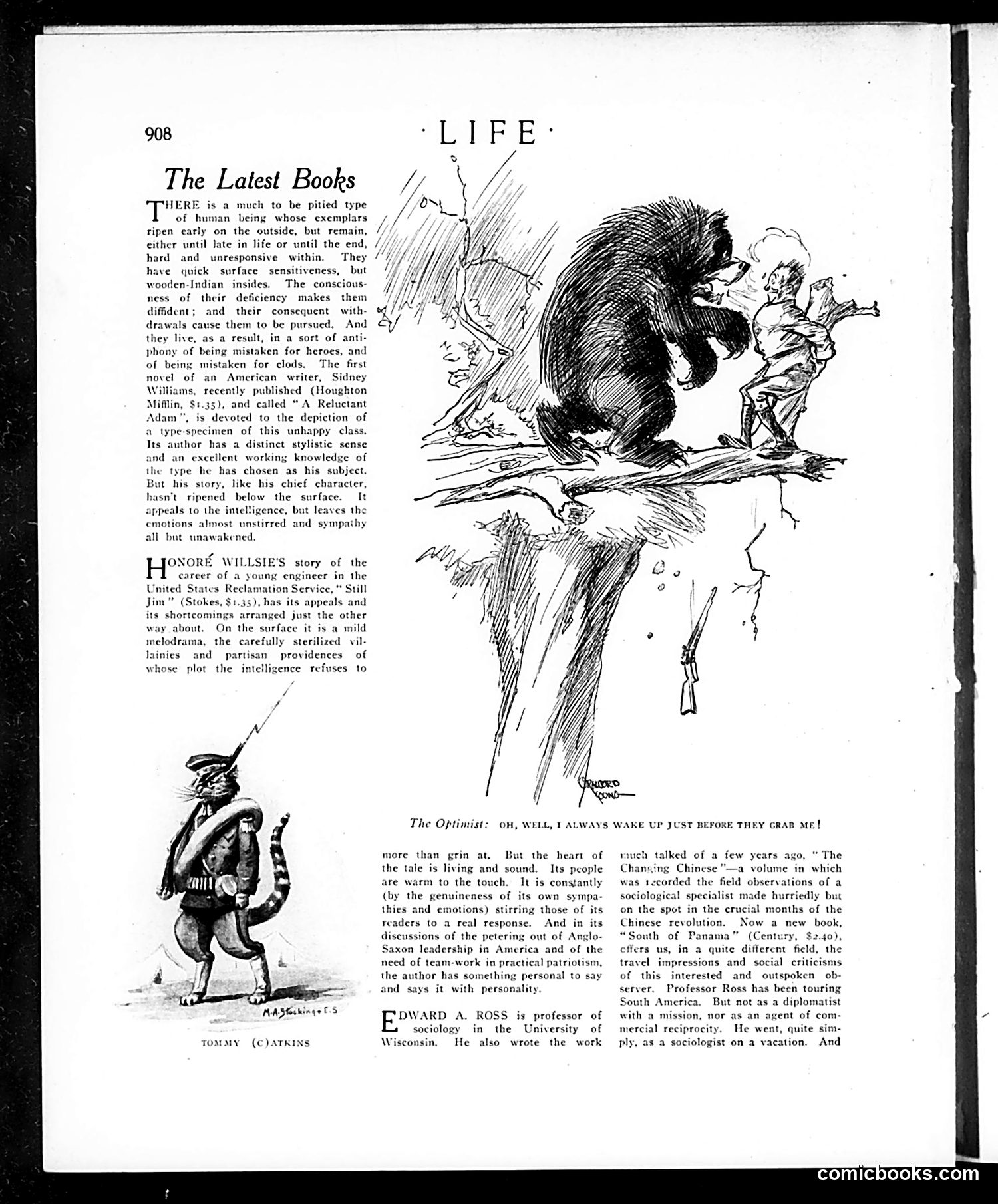
This is a book review section featuring three novel critiques. The main cartoon shows "The Optimist"—a figure lounging contentedly while danger (depicted as a pursuing figure with a weapon) approaches. The caption reads: "OH, WELL, I ALWAYS WAKE UP JUST BEFORE THEY GRAB ME!" The satire mocks willful self-deception and complacency. The optimist represents someone who ignores or minimizes genuine threats by retreating into false comfort—assuming problems will conveniently resolve before they materialize. The accompanying reviews discuss three American literary works: Sidney Williams's "A Reluctant Adam," Honoré Willsie's "Still Jim," and Edward A. Ross's "South of Panama." The page critiques their respective merits and weaknesses as social commentary and emotional narratives. The secondary cartoon labeled "Tommy (C)atkins" appears to reference British military stock characters, though its specific context on this page is unclear.
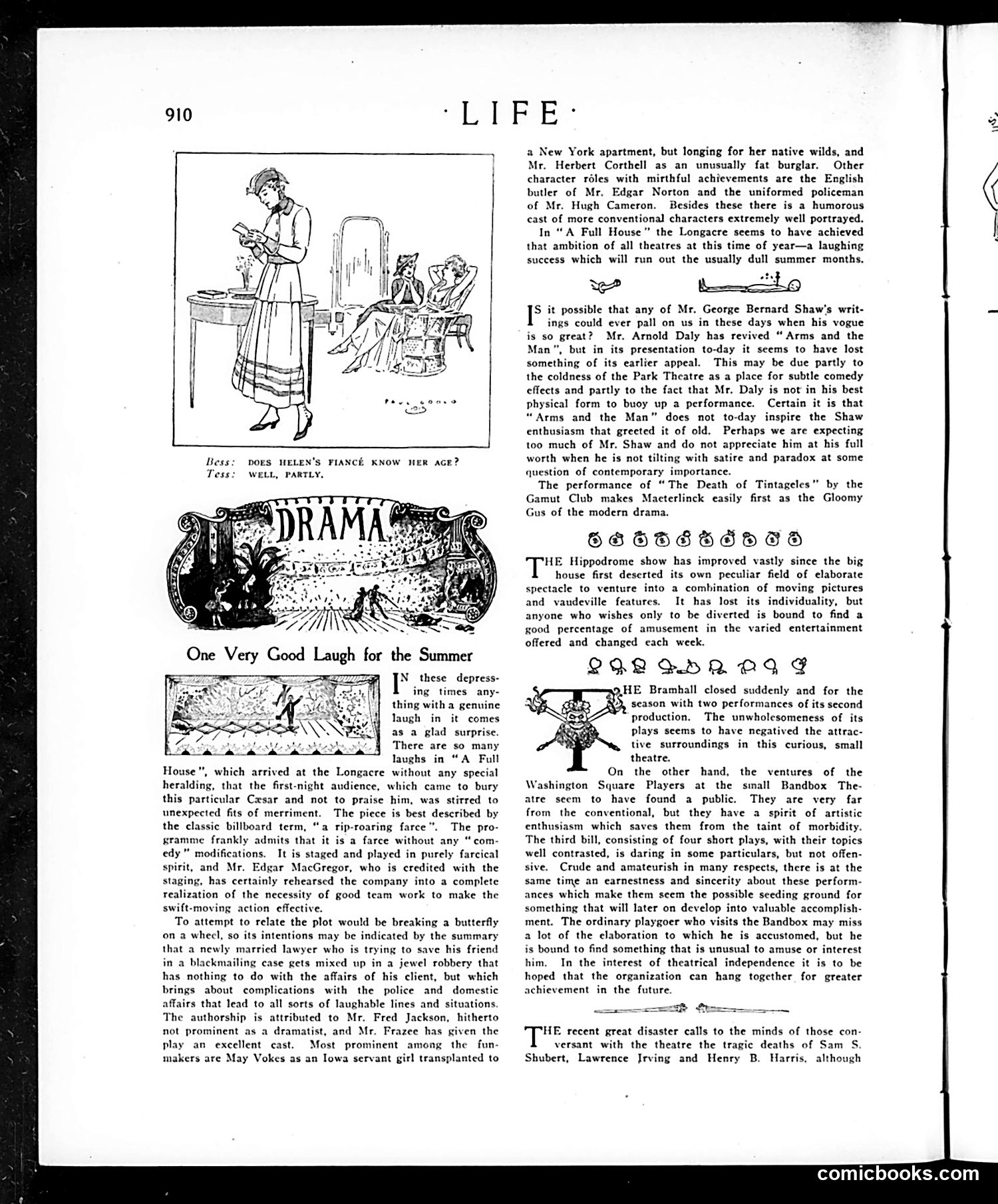
This page reviews summer theatrical productions. The cartoon at top depicts a domestic scene with the caption "DOES HELEN'S FIANCÉ KNOW HER AGE? / WELL, PARTLY"—a joke about a woman concealing her age from her betrothed, playing on period anxieties about women's vanity and marriage deception. The main review discusses "A Full House," a farce at the Longacre Theatre, praising its ability to deliver genuine laughs during depressing times (likely WWI era, given the reference). The play concerns a lawyer entangled in blackmail and jewel-theft complications. Critics highlight May Vokes as an Iowa servant in New York and Herbert Corthell as an overweight burglar. Subsequent reviews assess Shaw's "Arms and the Man" (finding it diminished), a Maeterlinck play, and vaudeville at the Hippodrome. The Bramhall theatre closed mid-season. The satire is gentle—focused on theatrical quality rather than political commentary, reflecting Life's entertainment coverage during this period.
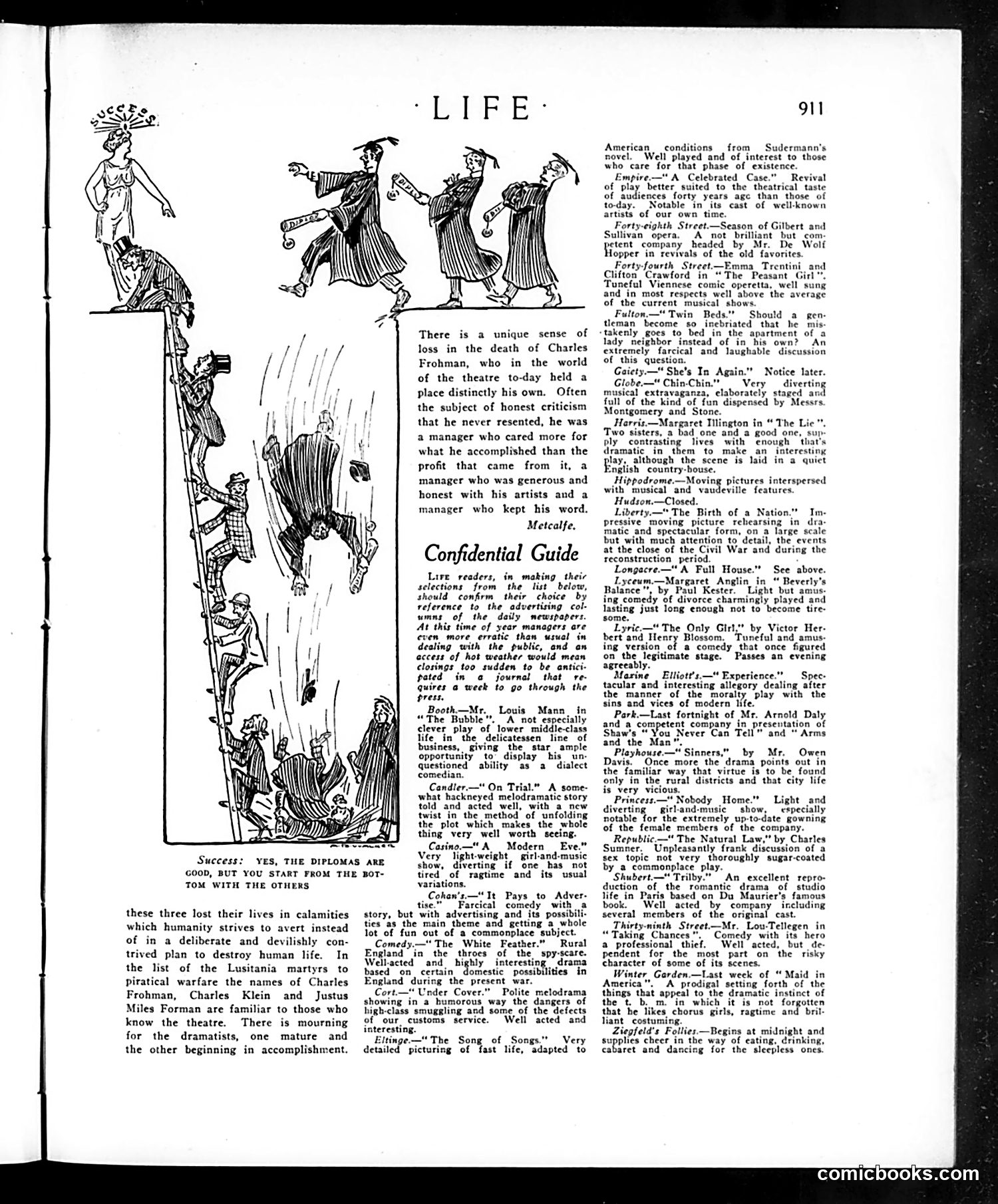
This page from Life magazine commemorates **Charles Frohman**, a prominent theater impresario who died in the 1915 sinking of the RMS Lusitania. The left illustration depicts figures falling—referencing the maritime disaster that killed him alongside playwrights Charles Klein and Justus Miles Forman. The editorial tribute emphasizes Frohman's integrity: he prioritized artistic accomplishment over profit and honored his commitments to performers—unusual virtues for theater managers of that era. The "Confidential Guide" section reviews current Broadway productions, warning readers that theater schedules are unpredictably subject to summer closings. The cartoon joke about diplomas appears unrelated to the Frohman memorial, likely satirizing something about graduation season or credentials. This page reflects early 20th-century American mourning for a cultural figure lost to wartime tragedy, positioned alongside entertainment criticism.
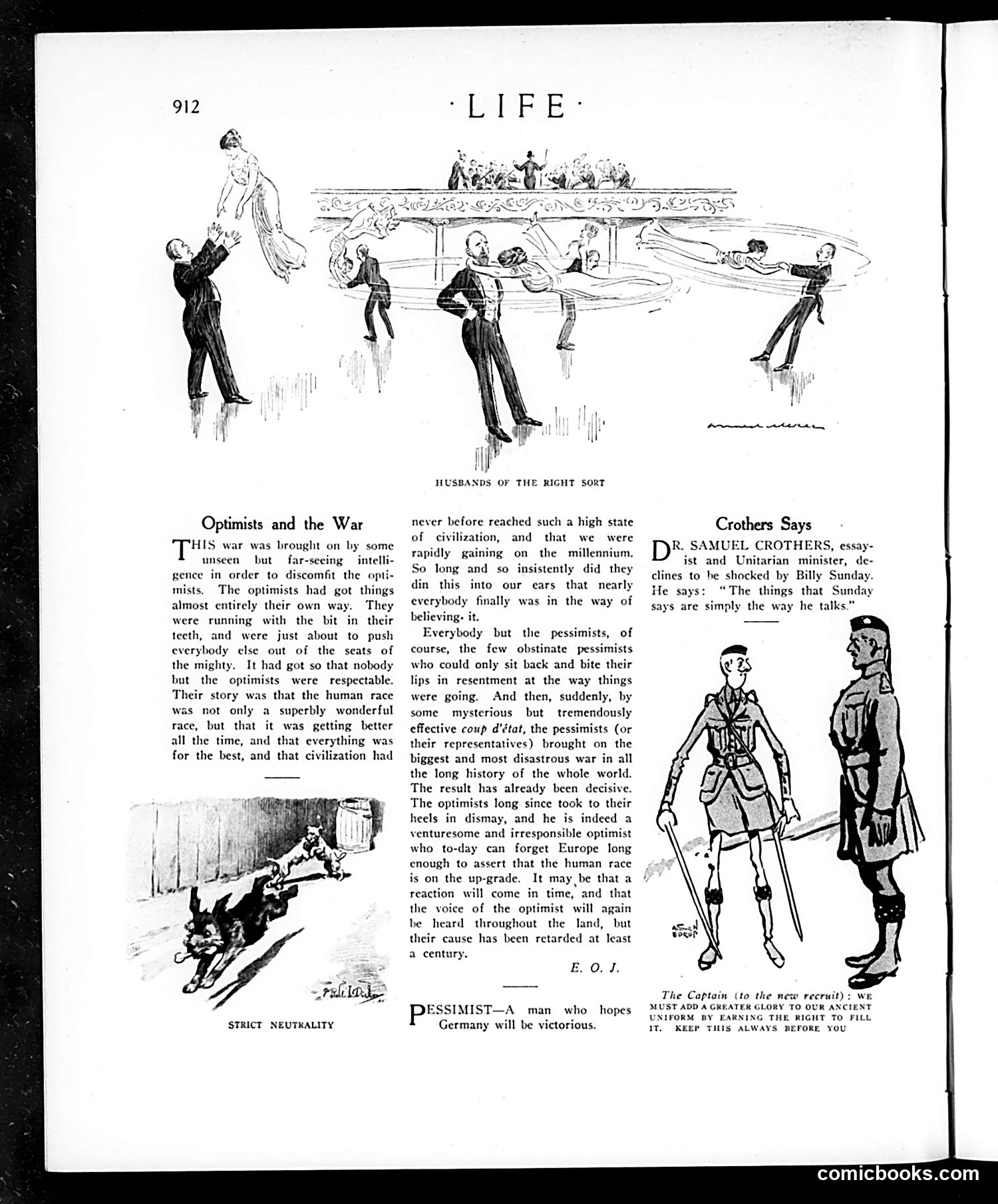
This page satirizes early-WWI attitudes toward the conflict (likely 1914-1915). The main article "Optimists and the War" mocks pre-war optimists who believed humanity was progressing inevitably toward perfection. The author argues that pessimists deliberately triggered the war to prove optimists wrong—a darkly ironic commentary suggesting the catastrophic conflict has vindicated the pessimists' gloomier worldview and silenced naive progress-believers "for a century." The cartoon "Husbands of the Right Sort" (top) depicts men swimming/lounging while women watch from above—likely mocking men avoiding military service or satirizing gender dynamics during wartime. "Strict Neutrality" (lower left) shows a dog evading conflict, referencing America's non-combatant status at this date. The "Crothers Says" item references evangelist Billy Sunday, a controversial public figure, quipping that his inflammatory rhetoric is simply how he naturally speaks. The bottom cartoon shows a military captain instructing a recruit about earning honor through service.
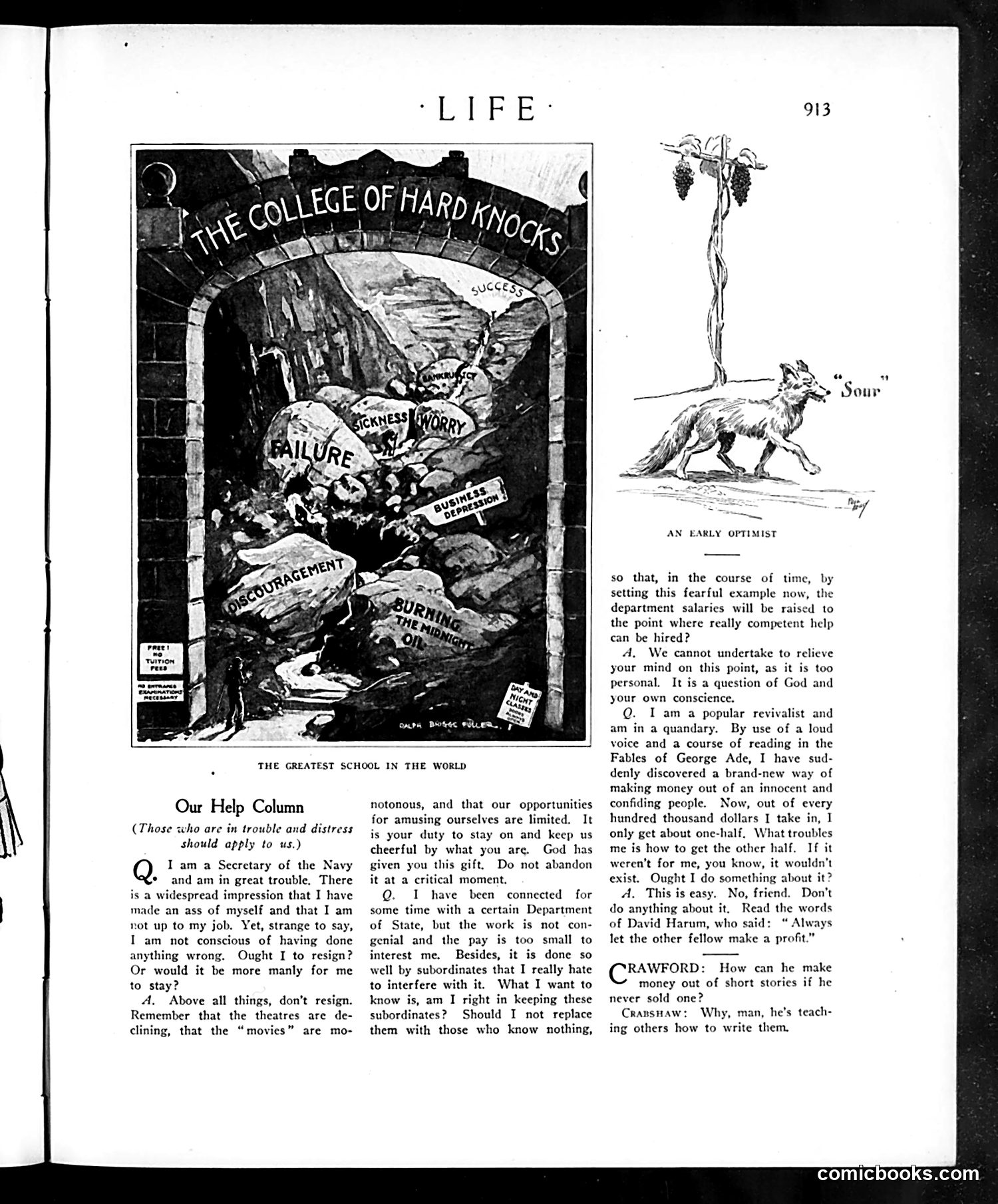
This page satirizes government incompetence and moral hypocrisy through a fake "advice column" format. The main cartoon, "The College of Hard Knocks," depicts a dungeon-like institution where various failures and misfortunes (labeled "Failure," "Discouragement," "Burning the Midnight Oil," etc.) are taught, with "Success" visible only distantly through a window—suggesting that struggle and hardship are inevitable paths to success. The advice column mocks three figures: a Navy Secretary aware he's made "an ass of himself" but unqualified; a State Department official who admits his subordinates do the work better, yet proposes replacing them with incompetent people to justify higher salaries; and a revivalist preacher who devises schemes to profit from "innocent and confiding people." The satire targets government bloat, bureaucratic incompetence, and the moral bankruptcy of those exploiting public trust. The cynical "advice" encouraging them to stay in positions they're unfit for amplifies the mockery.
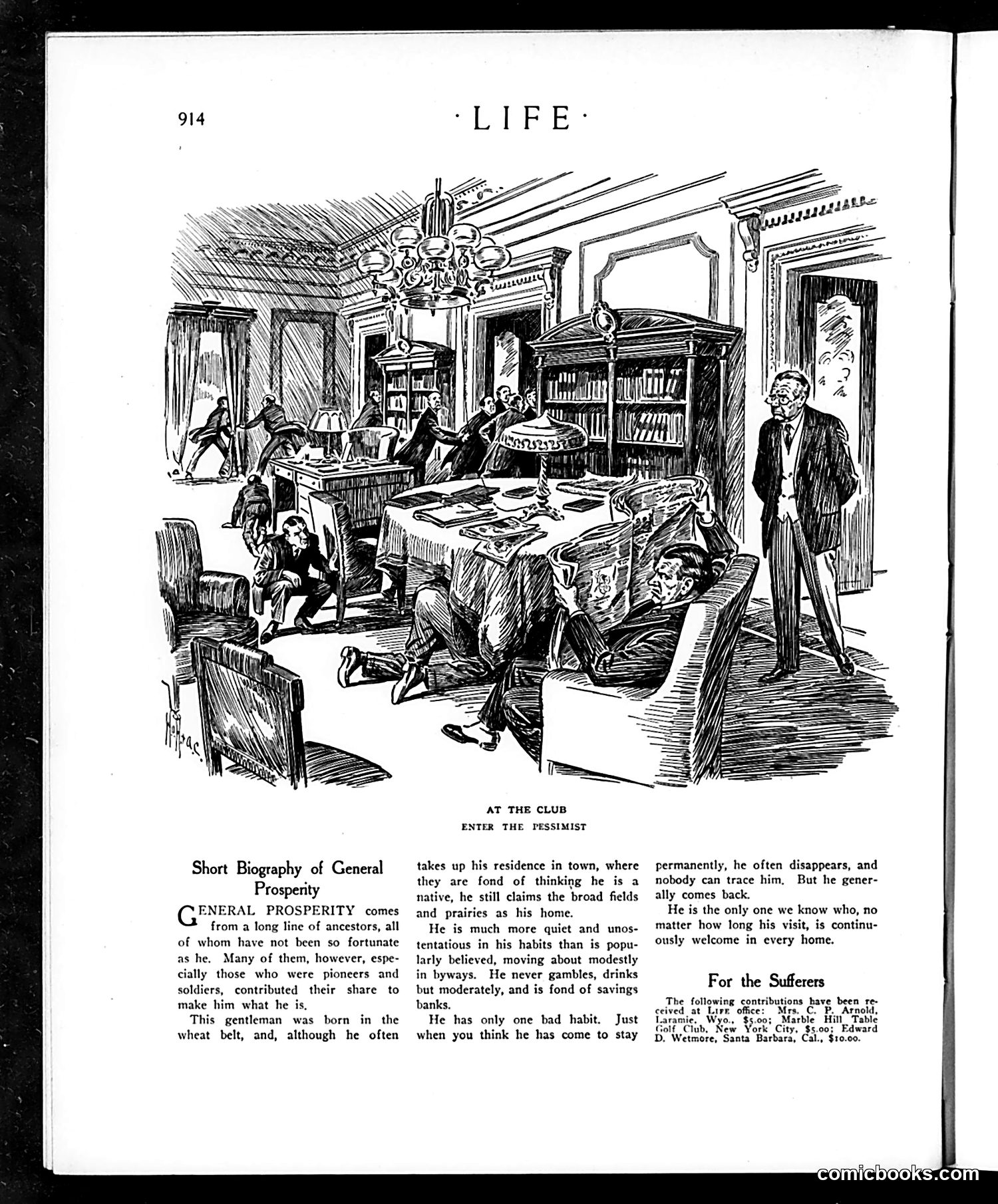
This page satirizes "General Prosperity" as a personified character—a commentary on American economic cycles during the early 20th century. The biographical sketch treats prosperity like a visiting gentleman: born in agricultural America ("the wheat belt"), modest in habits, fond of savings banks, but with one critical flaw: he disappears unpredictably and cannot be reliably traced. The accompanying illustration shows an exclusive club where prosperity is welcome, with the subtitle "Enter the Pessimist"—suggesting that pessimism or doubt about economic stability disrupts this comfortable scene. The satire's point: prosperity in America is unreliable and temporary, arriving and departing without warning, yet always welcomed back optimistically. This likely reflects concerns about economic booms and busts typical of the pre-1920s American economy. The section "For the Sufferers" lists charitable contributions, indicating the page appeared during economic hardship.
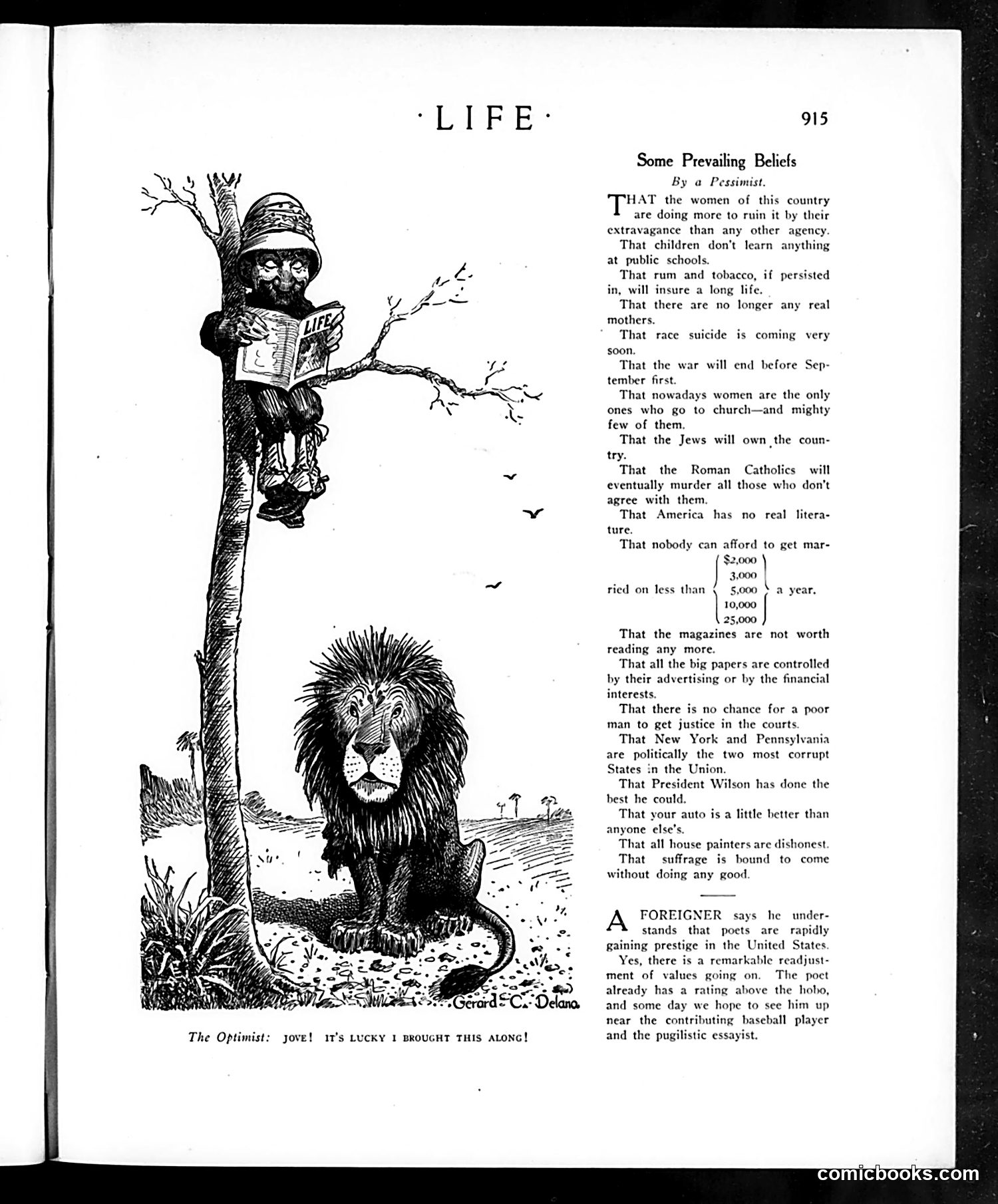
This satirical page from *Life* magazine features two distinct pieces critiquing American attitudes. **The Cartoon:** An "Optimist" figure in a tree reads *Life* magazine while a lion sits below. The joke plays on the phrase "The Optimist"—the character is ironically pleased to have brought the magazine along, suggesting it's his only comfort or distraction from danger. This mocks blind optimism in the face of real threats. **"Some Prevailing Beliefs":** A "Pessimist" lists common American anxieties and prejudices circa 1915. These range from gender complaints (women's extravagance, church attendance) to ethnic fears (Jews owning the country, Catholics persecuting others), economic worries, and cynicism about institutions. The final exchange mocks the low social status of poets, suggesting American society ranks them just above hobos but below baseball players—critiquing cultural priorities. Together, the pieces satirize both unfounded American optimism and its flip side: widespread pessimism fueled by prejudices, conspiracy theories, and social anxiety.
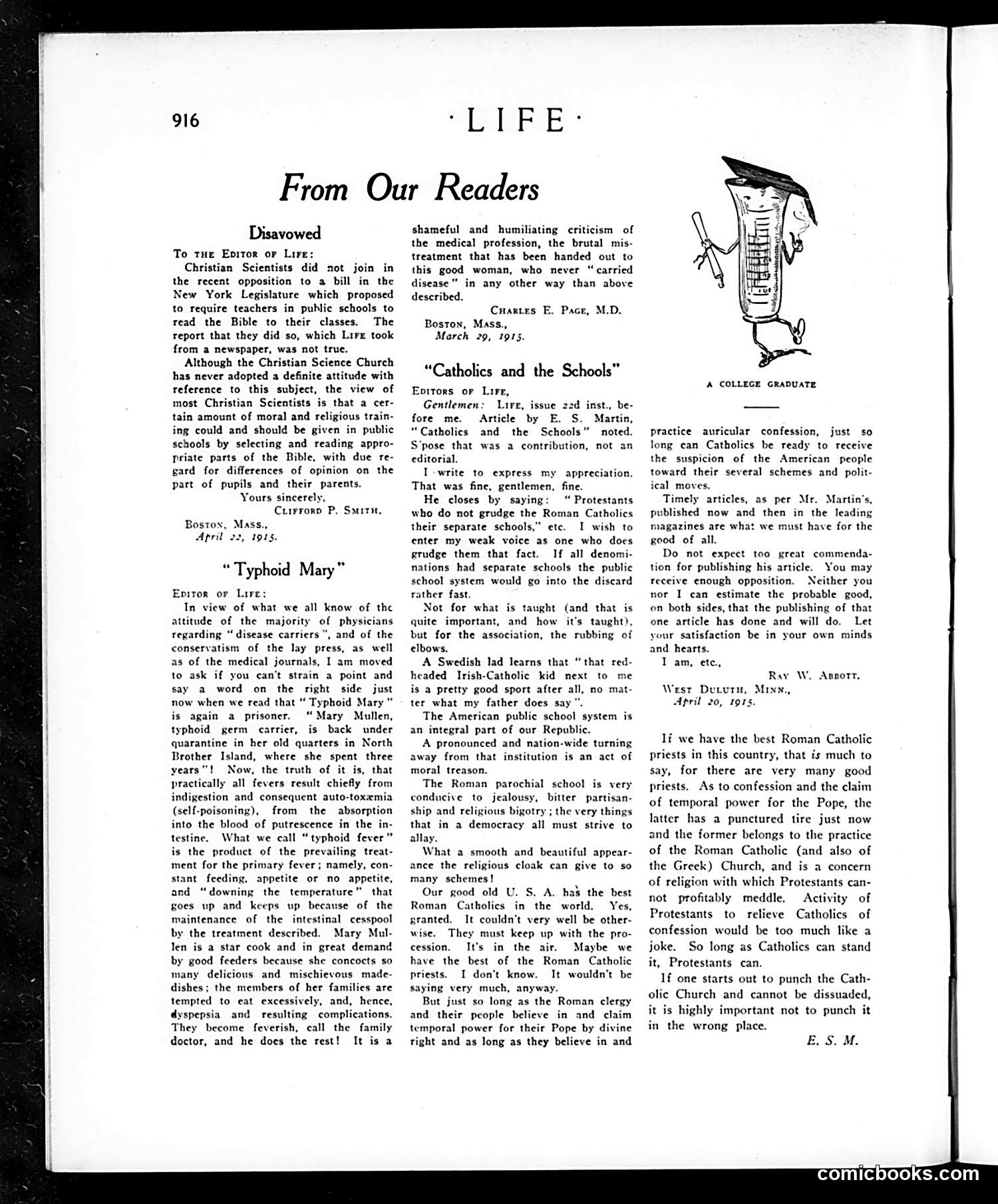
This page contains reader letters, not political cartoons. The single illustration—labeled "A College Graduate"—shows a diploma-holding figure, likely satirizing overconfident or unprepared graduates. The substantive content comprises three letters debating major 1915 social issues: 1. **"Disavowed"**: Christian Scientists deny opposing Bible-reading in public schools, clarifying their actual position. 2. **"Typhoid Mary"**: A physician defends Mary Mallen (the famous typhoid carrier), blaming doctors' treatment methods rather than her for disease transmission—a radical critique of medical practice. 3. **"Catholics and the Schools"**: A reader praises E.S. Martin's article on Catholic education, then argues against parochial schools, viewing them as divisive. He champions public education as essential to American democracy and national unity, fearing separate religious schools breed "jealousy, bitter partisanship and religious bigotry." The page reflects early-20th-century tensions: religious freedom versus secular nationalism, medical authority, and public versus private education.
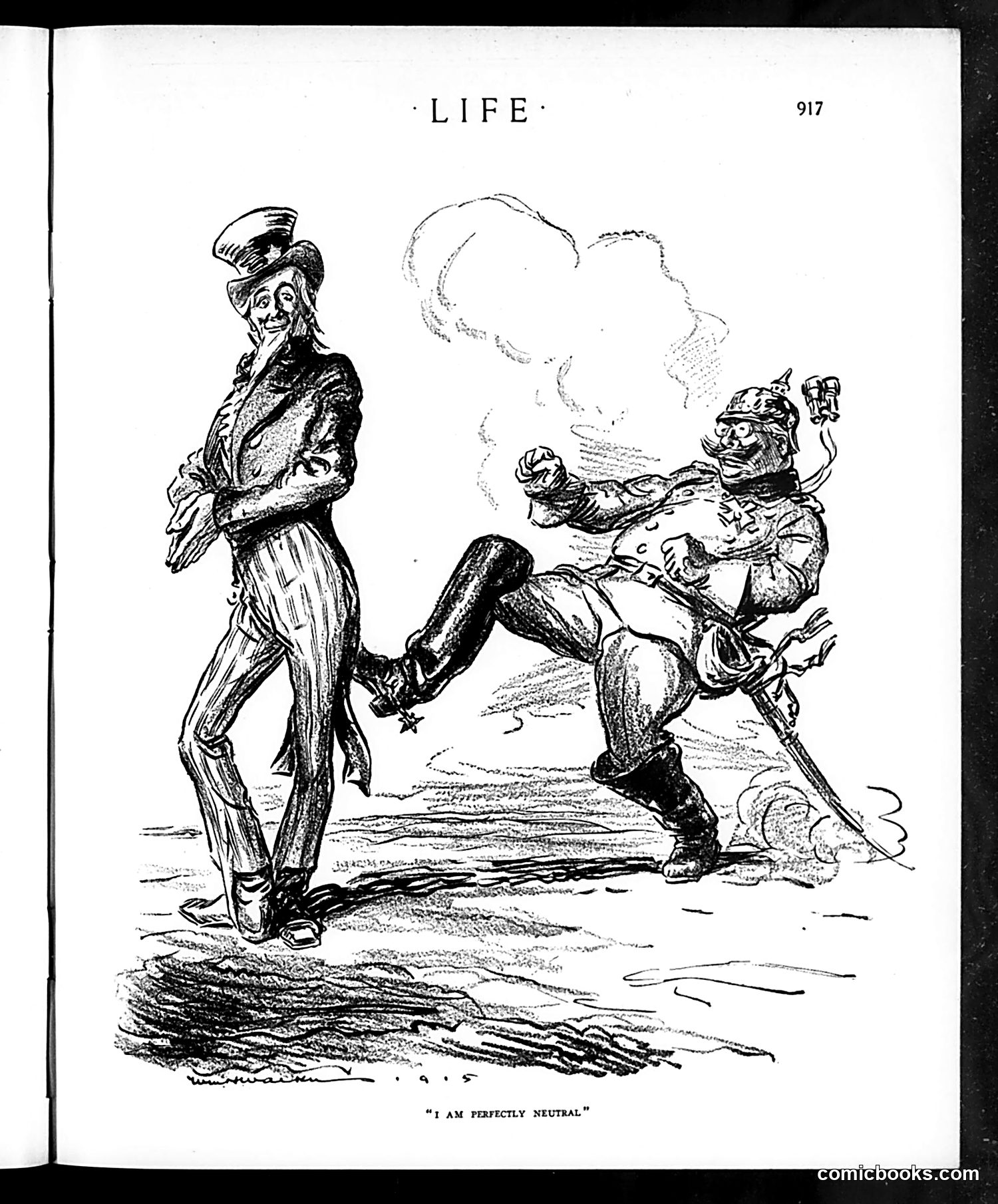
This political cartoon depicts two contrasting figures. On the left stands a thin, elegant man in formal attire with a top hat, appearing composed and refined. On the right, a portly military officer or diplomat gestures dramatically while creating or controlling a large cloud of smoke. The caption "I AM PERFECTLY NEUTRAL" is ironic—the elegant figure claims neutrality while the aggressive character beside him clearly engages in turbulent action. This likely satirizes diplomatic hypocrisy during a period of international conflict, where nations claimed neutrality while their officials or military leaders actively interfered or provoked. The contrast between the claimed stance and visible turmoil suggests the cartoon mocks politicians who professed impartiality while their actions contradicted such claims. The specific historical context remains unclear without additional dating information.
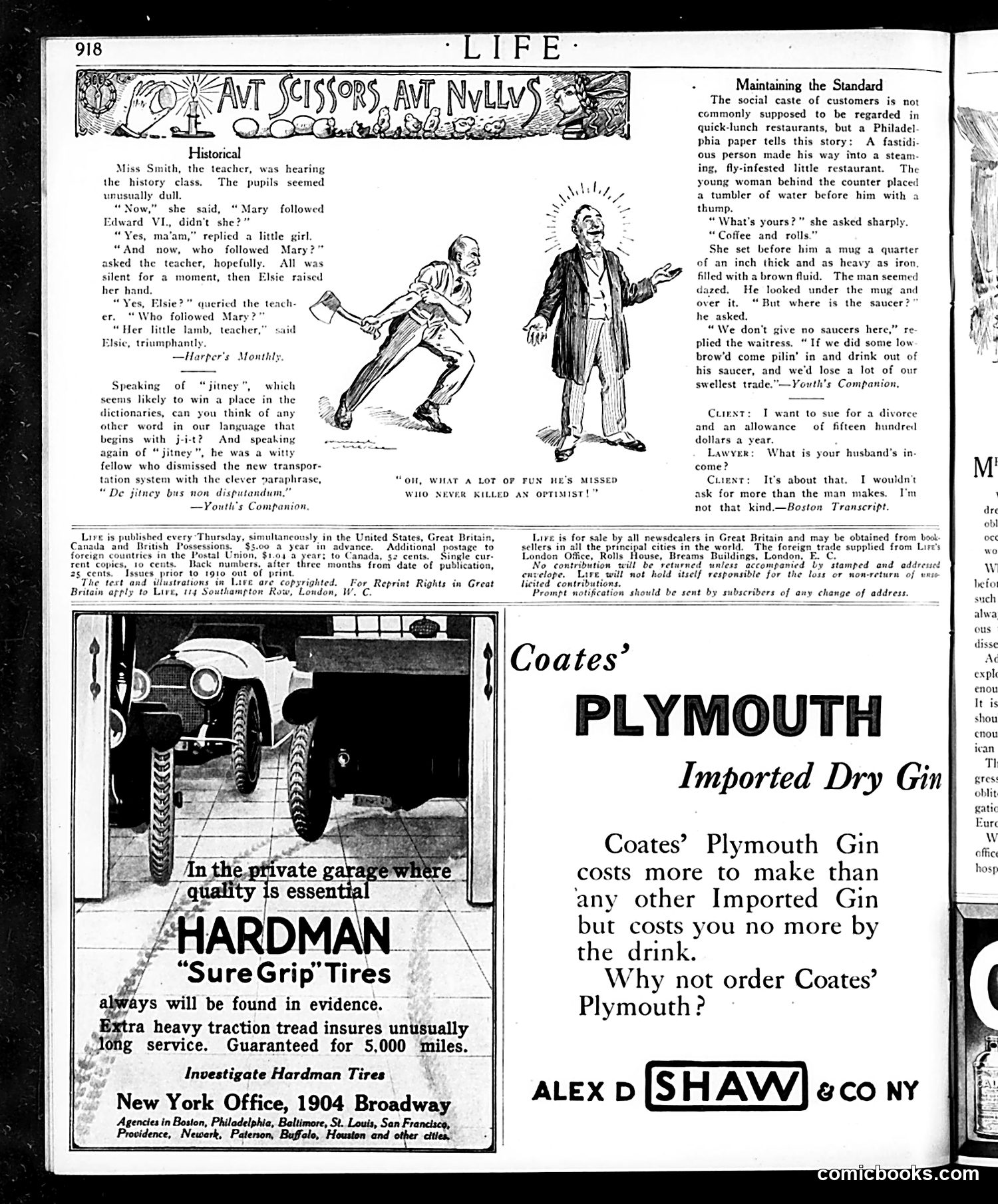
This page contains three humor pieces and advertisements from an early 20th-century Life magazine issue. **The "Aut Scissors, Aut Nullus" cartoons** present classroom humor. The first shows a teacher asking which monarch followed Edward VI; a student answers "Mary followed Edward VI" (mixing up Mary Queen of Scots with the historical succession). The second joke depicts a student answering "her little lamb" when asked who followed Mary—a pun on the nursery rhyme "Mary Had a Little Lamb." **The "Jitney" commentary** jokes about the newly popularized jitney buses (cheap public transportation), playing on the word's unusual spelling with a Latin pun. **The restaurant anecdote** satirizes working-class establishments maintaining standards by *discouraging* refined customers—the waitress deliberately withholds saucers to prevent "low-brow" patrons from drinking directly from them, thus preserving "swellest trade." **The legal joke** features a wife seeking divorce with modest alimony demands, noting she wouldn't ask for more than her husband actually makes—a dig at her low opinion of him. The page is largely advertisements for Hardman tires and Plymouth gin.
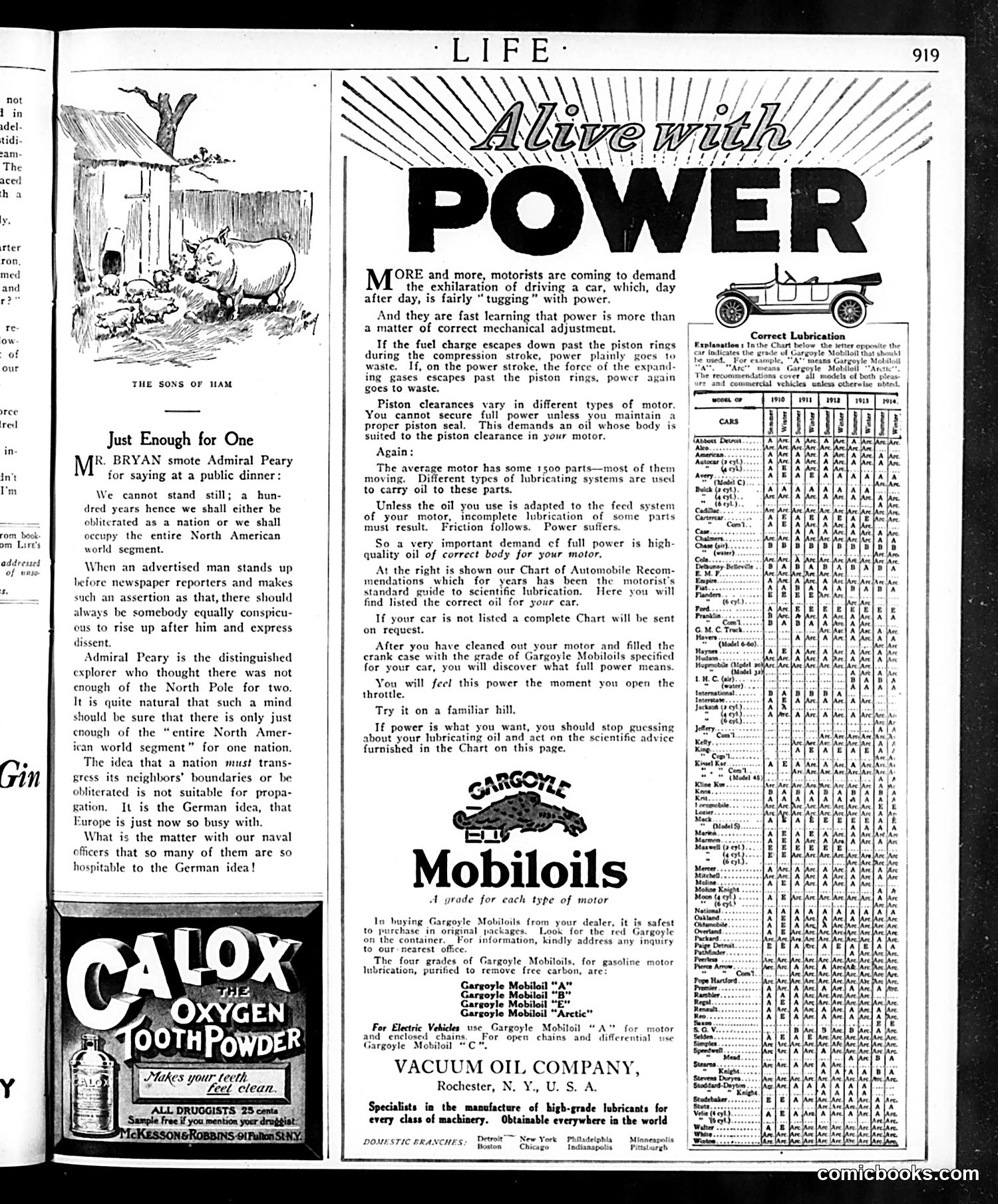
This page mixes political satire with automobile advertising. The left column contains a brief opinion piece where William Jennings Bryan criticizes Admiral Robert Peary's expansionist statement—that America must either grow to occupy "the entire North American world segment" or be obliterated. Bryan argues this ideology mirrors dangerous German imperial ambitions driving World War I. The satire questions why American naval officers endorse such aggressive nationalism. The bulk of the page advertises Gargoyle Mobiloils motor lubricant, with a detailed chart recommending specific oil grades for different car models. An unrelated Calox tooth powder ad also appears. The cartoon "The Sons of Ham" (upper left) is unclear from the image quality but appears to be a separate sketch. The page juxtaposes geopolitical debate about American expansionism with consumer marketing—a typical Life magazine blend of serious commentary and commerce.
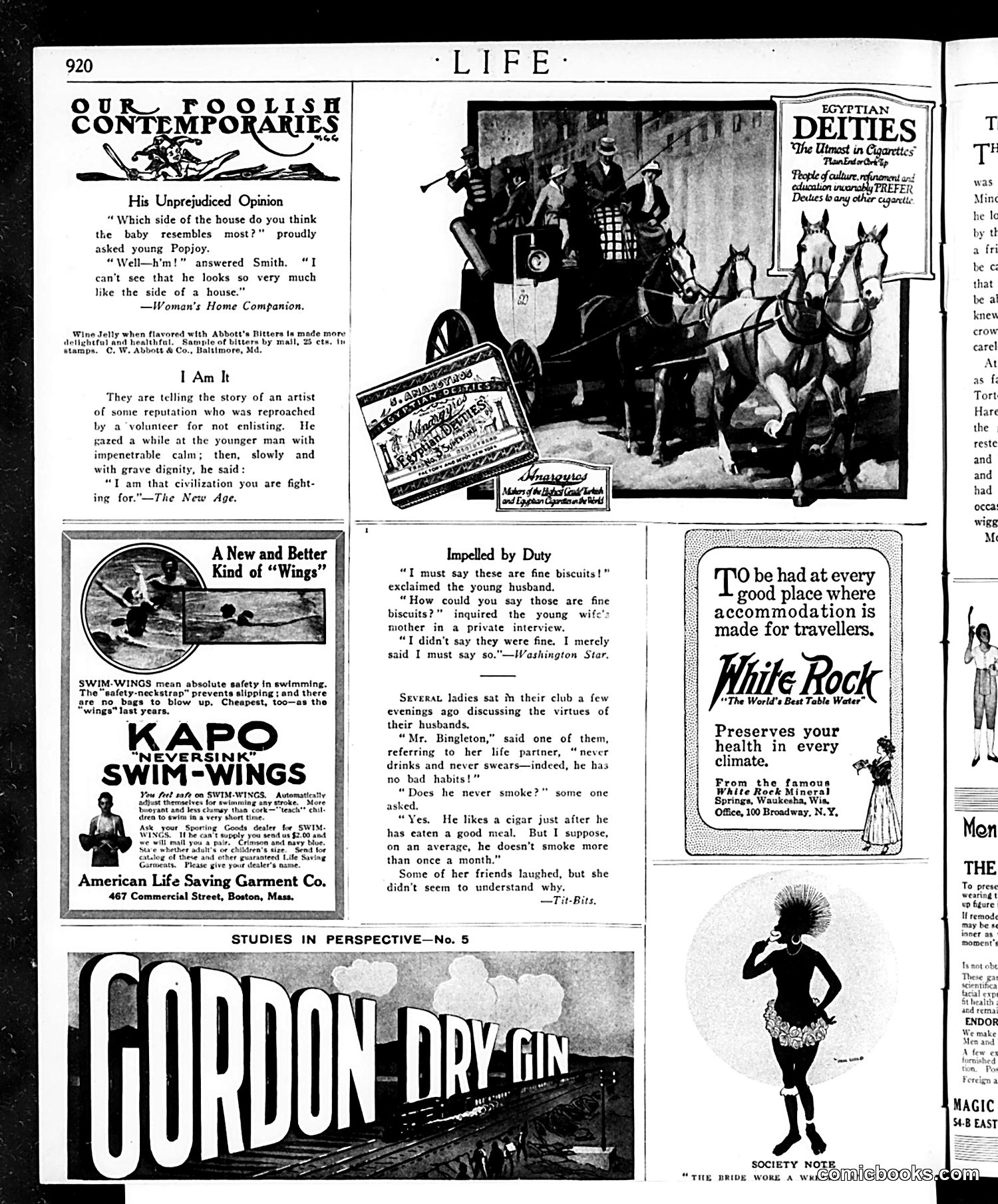
This page contains humorous short anecdotes and advertisements typical of Life magazine's satirical format. **"His Unprejudiced Opinion"**: A joke about a new father asking which side of the house his baby resembles. The humor relies on the respondent's diplomatic deflection—he avoids saying the baby is ugly by pretending to misunderstand, suggesting the infant resembles neither parent favorably. **"I Am It"**: Satirizes artistic pretension. When criticized for not enlisting during wartime, an artist claims he *is* civilization itself—a pompous assertion mocking self-important artists who justify non-service through abstract notions of cultural contribution. **The remaining anecdotes** play on misunderstandings and marital dynamics—a husband's insincere compliment about biscuits, a wife's bewilderment at this polite lie, and a woman's obliviousness to her husband's moderate smoking habit. The page primarily offers gentle, domestic humor rather than sharp political satire, alongside period advertisements for swimming gear and gin.
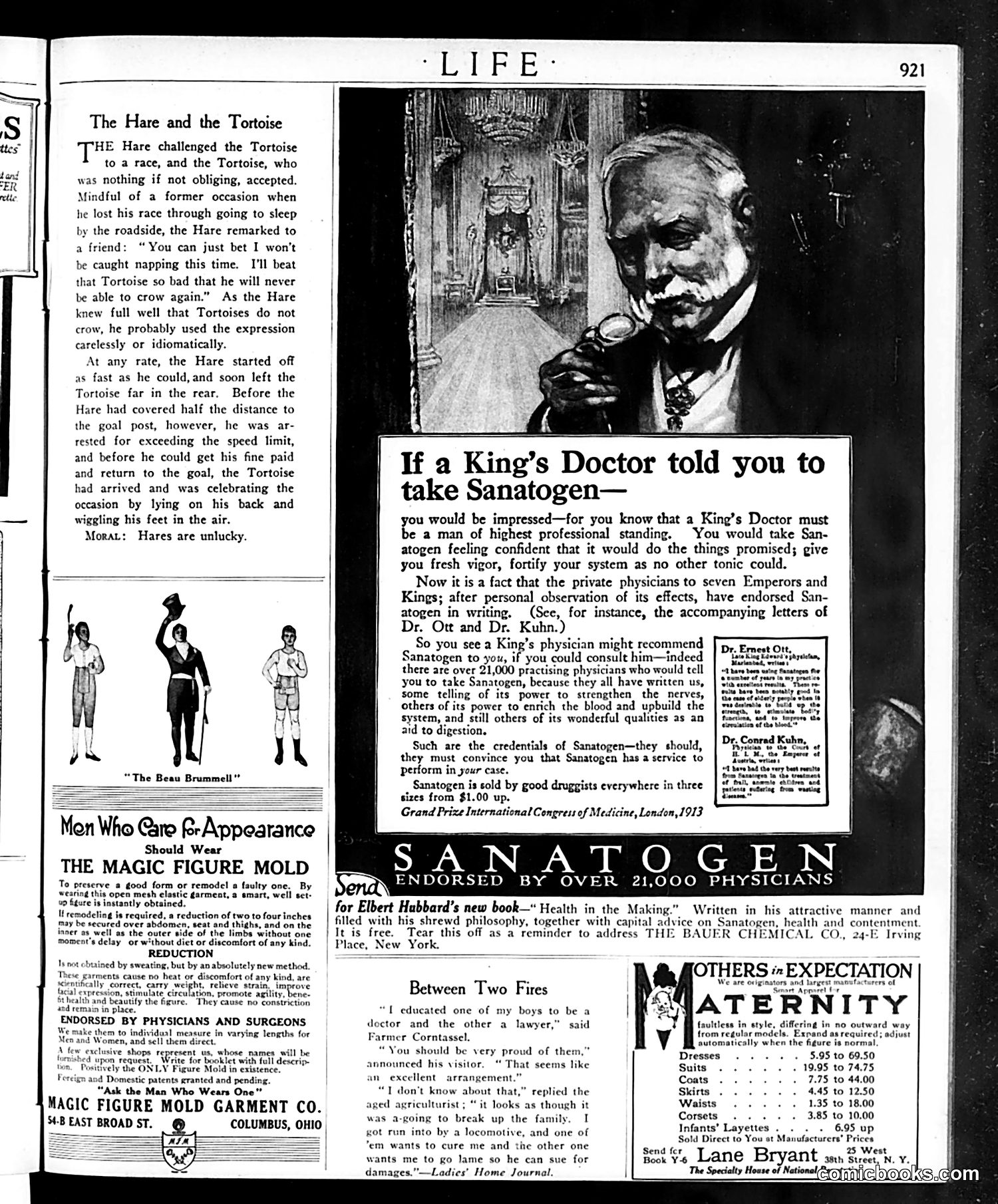
This page contains a classic Aesop's fable adaptation ("The Hare and the Tortoise") with a modern twist: the Hare loses the race not through laziness but by being arrested for speeding violations. The moral—"Hares are unlucky"—is a wry comment on how even natural advantages don't guarantee success in a regulated society. The page is dominated by advertisements, particularly for Sanatogen, a tonic marketed by citing endorsements from royal physicians and 21,000 practicing doctors. This represents early 20th-century patent medicine advertising, which relied heavily on medical authority claims to sell products of dubious efficacy. Additional ads include the "Magic Figure Mold" corset and Lane Bryant maternity wear. The fable's ironic update about modern speed limits reflects contemporary concerns about automobile regulation in the early automotive era.
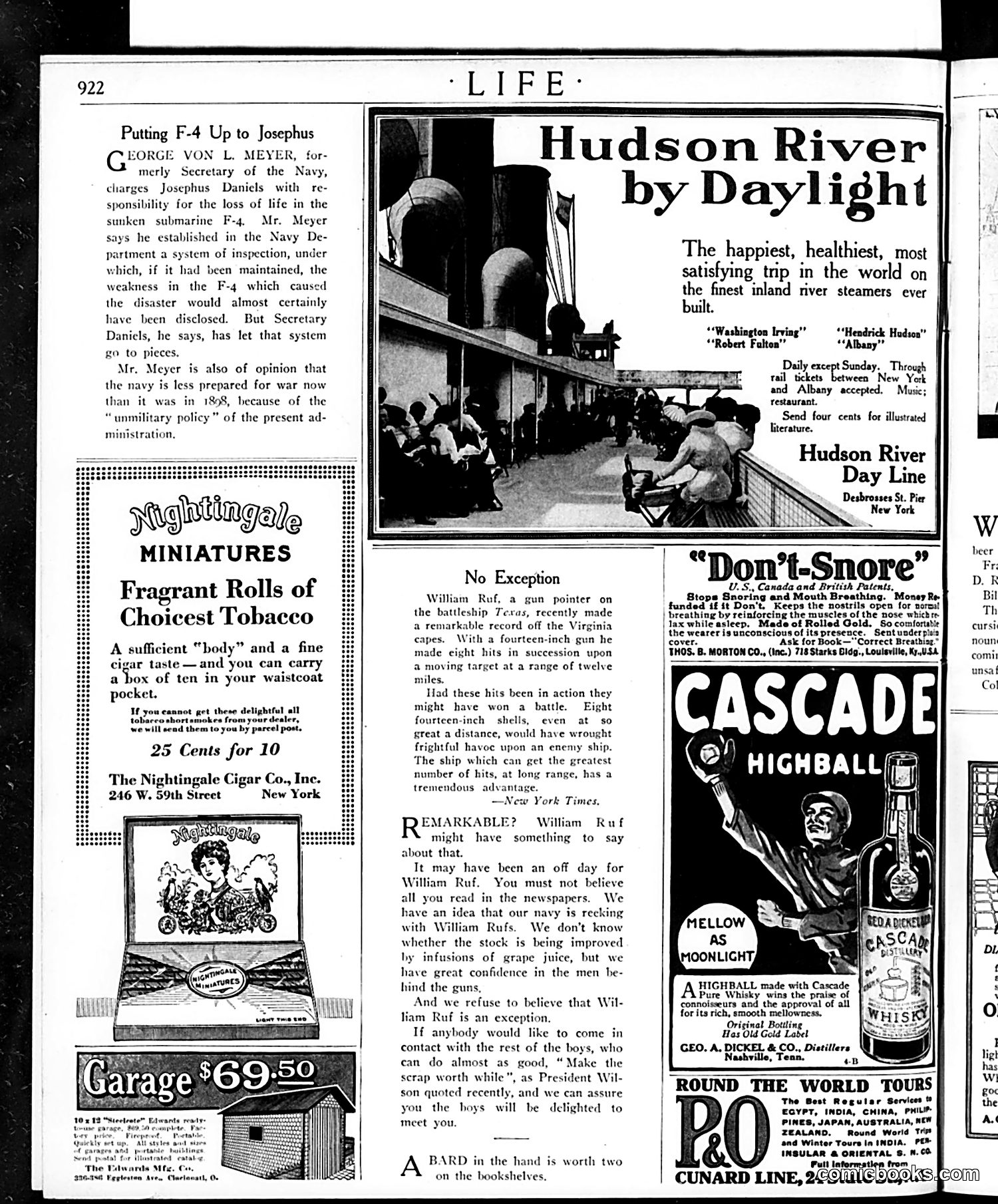
This page contains **political criticism of Navy Secretary Josephus Daniels** wrapped in a satirical article titled "No Exception." The main article mocks a newspaper report crediting gunner William Ruf with exceptional marksmanship (eight consecutive hits on a moving target). Life's satirists argue Ruf is *not* exceptional—the Navy is full of competent marksmen, and readers shouldn't believe everything in newspapers. The underlying point: they're defending the Navy's competence against the administration's policies. The framing article above attacks Daniels directly, citing **former Navy Secretary George von L. Meyer's** charge that Daniels bears responsibility for the F-4 submarine disaster and has dismantled inspection systems. Meyer also claims the Navy is less prepared for war than in 1898. This reflects **pre-WWI American debate** over Navy readiness and whether President Wilson's administration was adequately militarizing the Navy. Life uses Ruf's "remarkable" shooting record as a vehicle to defend Navy professionalism against broader political attacks on Daniels' leadership. The remainder of the page contains vintage advertisements (cigars, Hudson River steamboat tours, snoring remedies, whisky).
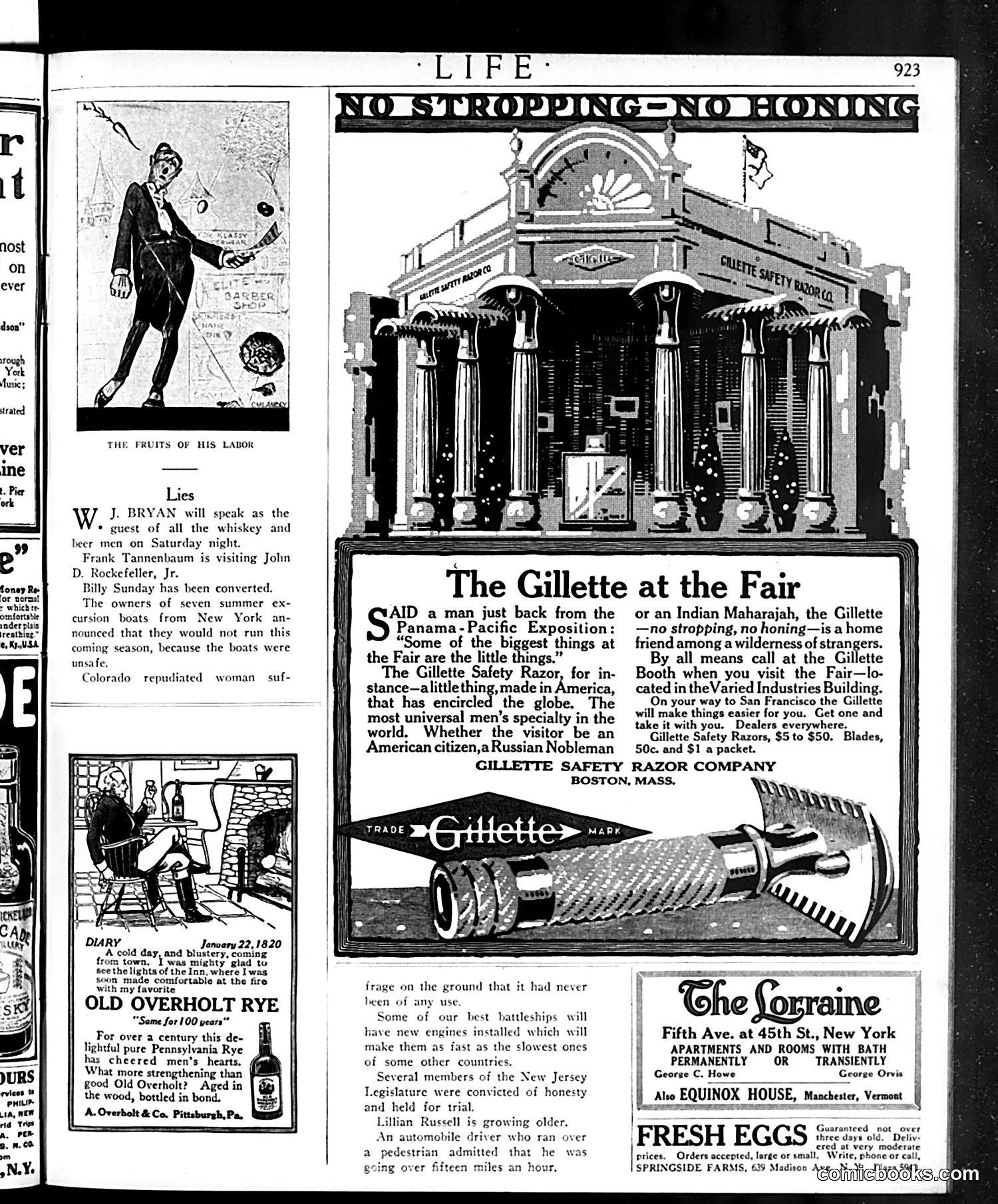
This page combines satirical commentary with advertisements. The cartoon "The Fruits of His Labor" (top left) depicts a juggler—likely representing a public figure managing contradictions—surrounded by ironic "lies" or hypocrisies of the era. The satirical items mock contemporary figures and events: W.J. Bryan (politician/orator) being guest of brewers; Billy Sunday's religious conversion; boat owners claiming unsafety; and Colorado rejecting women's suffrage as "never of any use"—a jab at anti-suffrage arguments. The right page features a large Gillette Safety Razor advertisement promoting the product's global reach, ironically placed among satire about American contradictions and incompetence (corrupt legislators, dangerous drivers, slow battleships). The "Old Overholt Rye" ad and diary excerpt create additional irony—whiskey advertising appears on a page criticizing Bryan's association with the alcohol industry. Overall, the page satirizes American political hypocrisy, corruption, and technological advancement coexisting with moral failure, circa 1915.
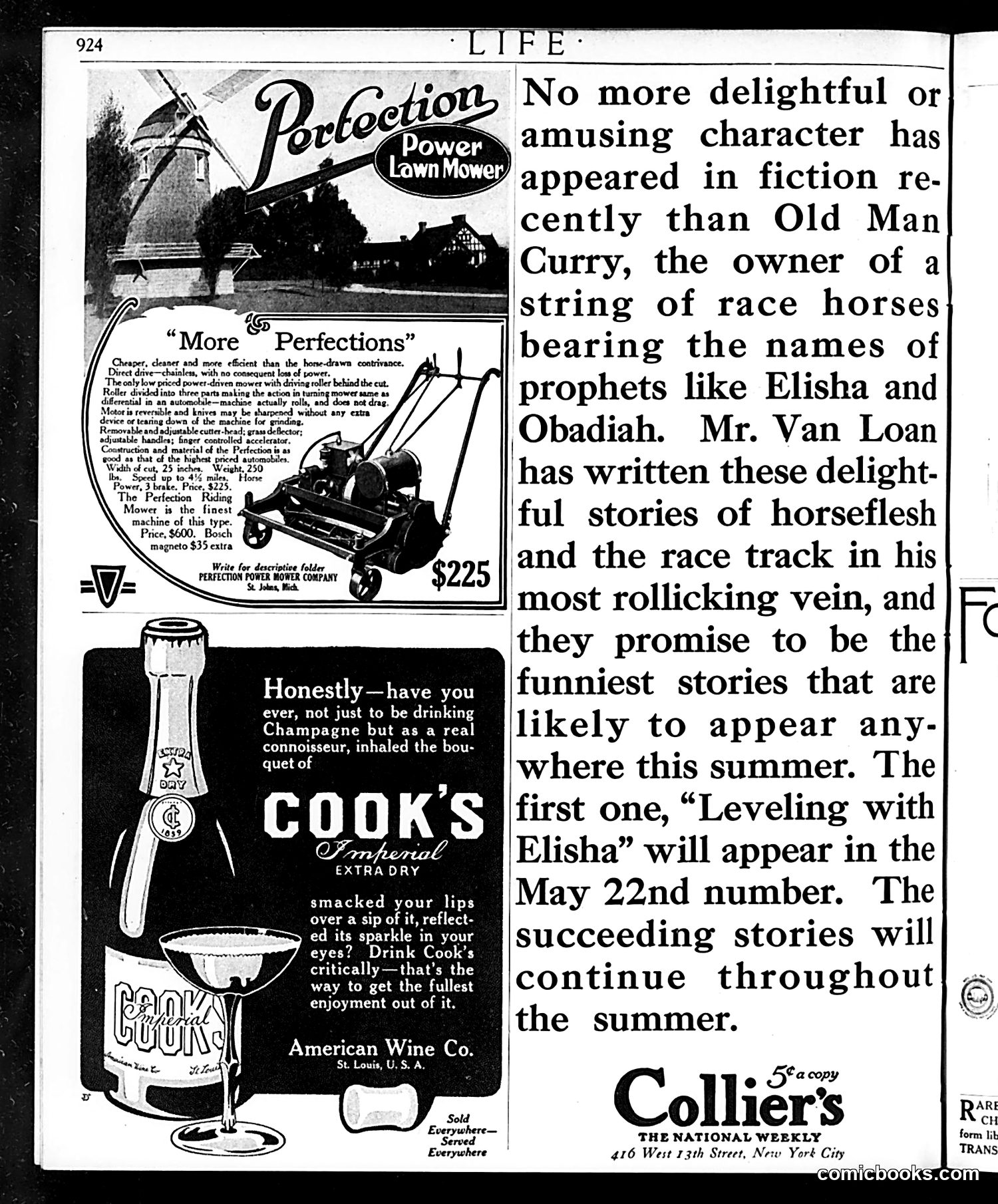
This page combines advertisements with an editorial announcement. The left side features ads for a Perfection power lawn mower ($225) and Cook's Champagne. The right side promotes an upcoming fiction series by author Van Loan featuring "Old Man Curry," a humorous character who owns racehorses named after biblical prophets (Elisha, Obadiah). The piece describes these stories as "rollicking" tales about "horseflesh and the race track," promising entertainment for summer readers. The first installment, titled "Leveling with Elisha," will appear May 22nd in Collier's magazine. The humor likely derives from the incongruity of sacred biblical names applied to racing animals, playing on period reader expectations of both sport and propriety.
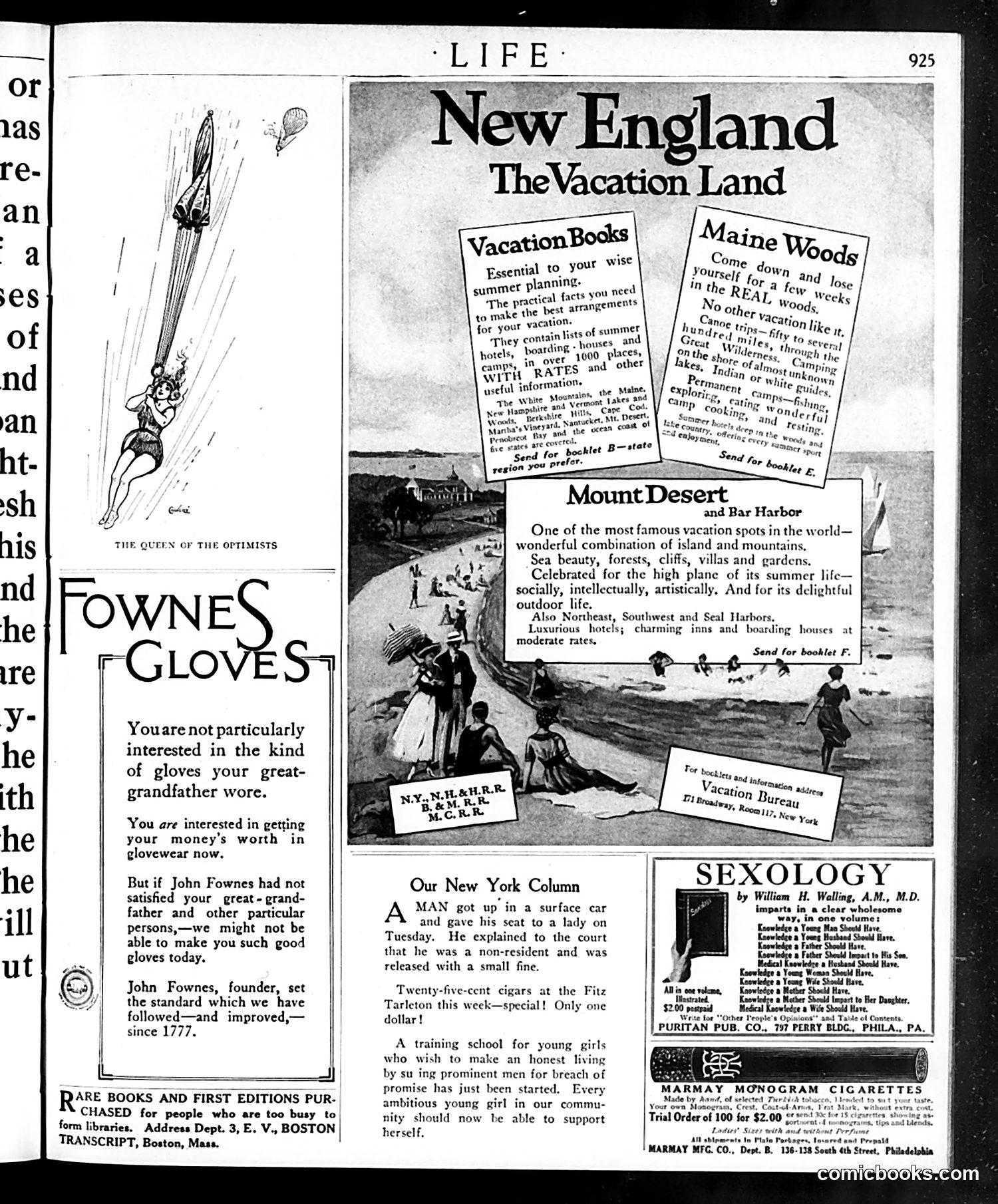
This page contains **advertisements and social satire** rather than a unified cartoon. The **Fownes Gloves ad** uses heritage marketing—appealing to modern consumers by invoking the founder's 1777 standards, suggesting quality continuity justifies higher prices today. **"The Queen of the Optimists"** (left illustration) shows a figure falling or diving, likely satirizing excessive optimism or reckless confidence—a common Life theme. The **"New York Column"** contains three brief satirical vignettes mocking contemporary behavior: a man escaping a traffic violation by claiming non-residency; cigars marketed at inflated prices; and—most pointedly—a "training school" teaching young women to pursue breach-of-promise lawsuits against prominent men. This last item ridicules both the legal trend of such suits and the women pursuing them, reflecting era attitudes toward gold-digging and litigation. The remaining content is **vacation advertising** (Maine Woods, Mount Desert) and a **medical/sexual education book ad**, typical period magazine filler.
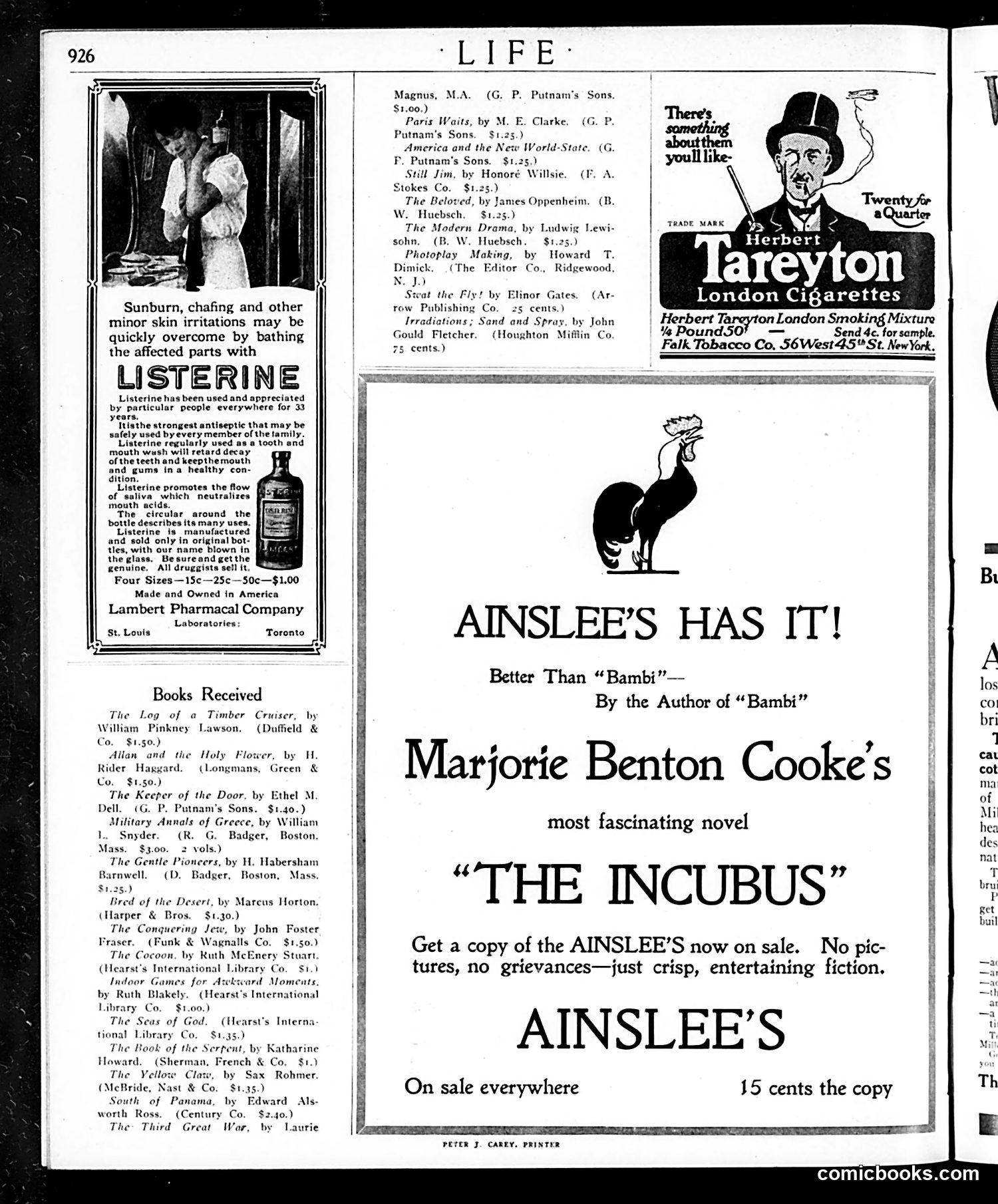
This page consists primarily of **book advertisements and reviews**, not political cartoons. The main content includes: 1. **Listerine advertisement** (left): A hygiene product marketed to families as an antiseptic for oral care, reflecting early 20th-century concerns about sanitation and dental health. 2. **Herbert Tareyton cigarettes advertisement** (top right): Shows a caricatured gentleman in top hat promoting London cigarettes—typical consumer advertising of the era. 3. **Ainslee's magazine advertisement** (center): Promotes a novel called "The Incubus" by Marjorie Benton Cooke, claiming it surpasses her previous work "Bambi." The rooster illustration is merely decorative branding. 4. **Books Received** section (left): Lists recent publications with prices, representing literary culture of the period. The page reflects 1920s consumer culture and publishing industry, with no political satire or commentary evident.
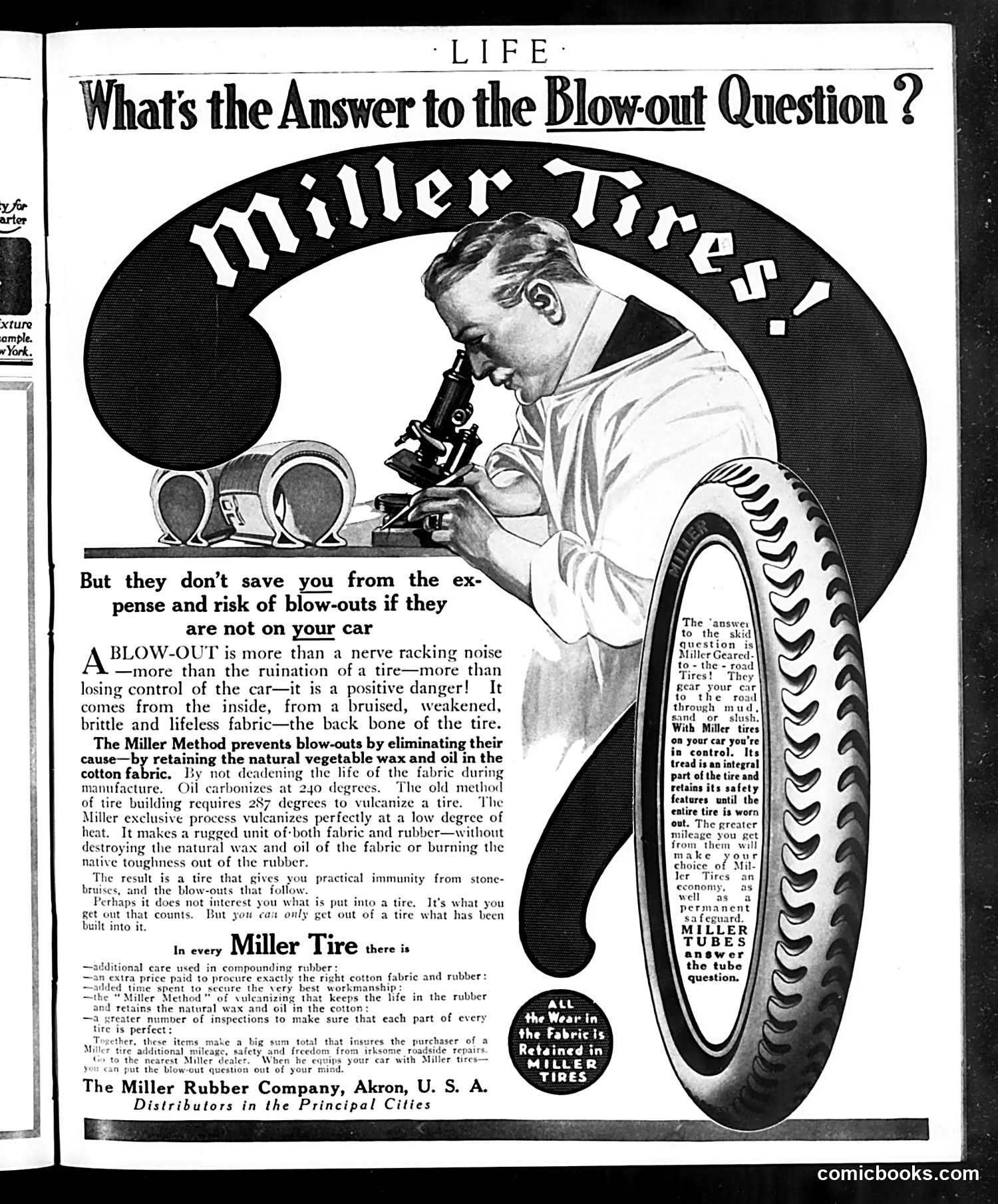
This is **not a political cartoon or satire**, but rather a **product advertisement** for Miller Tires, positioned as educational content in Life magazine. The page addresses tire "blow-outs" (sudden tire failures)—a genuine safety concern in early automotive history. A scientist or engineer examines a tire under a microscope, establishing authority. The ad explains that Miller's manufacturing process preserves natural oils and wax in tire fabric by using lower vulcanization temperatures (low heat) compared to competitors' methods (287 degrees). This supposedly prevents the brittleness that causes blow-outs. The "blow-out question" framing suggests competitors' tires might include blow-out protection features, but Miller argues only their internal manufacturing method truly prevents failures. The multiple inspection checkpoints and careful material selection are presented as reasons to trust the brand. This reflects the early 20th-century auto industry, when tire reliability was a serious marketing issue and a genuine technical concern.
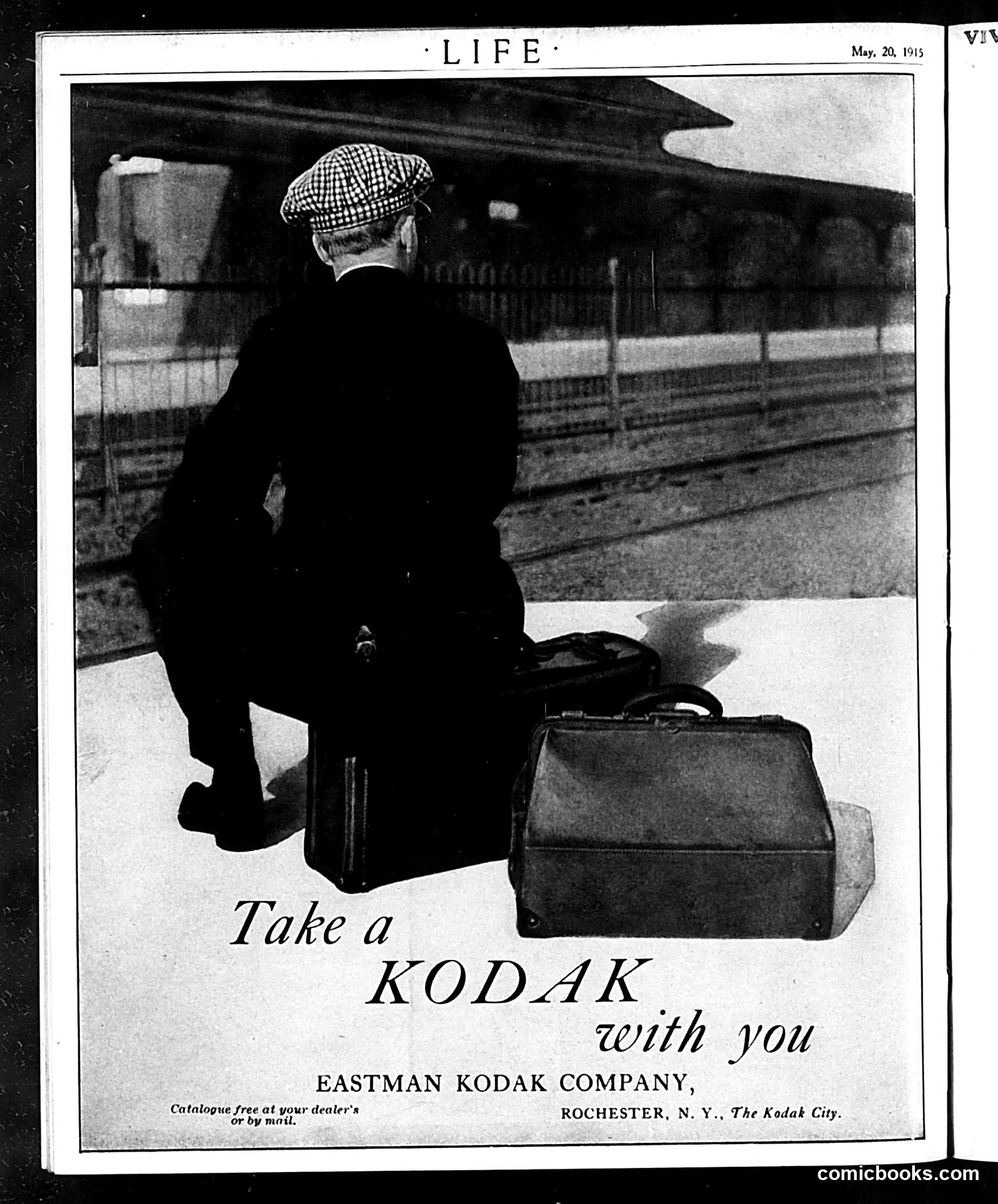
This is a **Kodak advertisement**, not political satire. The image shows a man from behind, sitting with luggage, gazing toward what appears to be a racetrack or sporting venue in the background. The ad's message is straightforward: when traveling or attending events (like the races suggested by the fencing visible behind him), bring a Kodak camera to document your experiences. The man's contemplative pose and luggage suggest leisure travel—a growing middle-class activity in 1915. This represents early consumer advertising positioning cameras as essential travel accessories, encouraging amateur photography as a leisure pursuit. The tagline "Take a Kodak with you" became a famous Eastman Kodak marketing slogan of that era.