
Life, 1915-05-20 · page 8 of 44
Life — May 20, 1915 — page 8: what you’re looking at
What you’re looking at
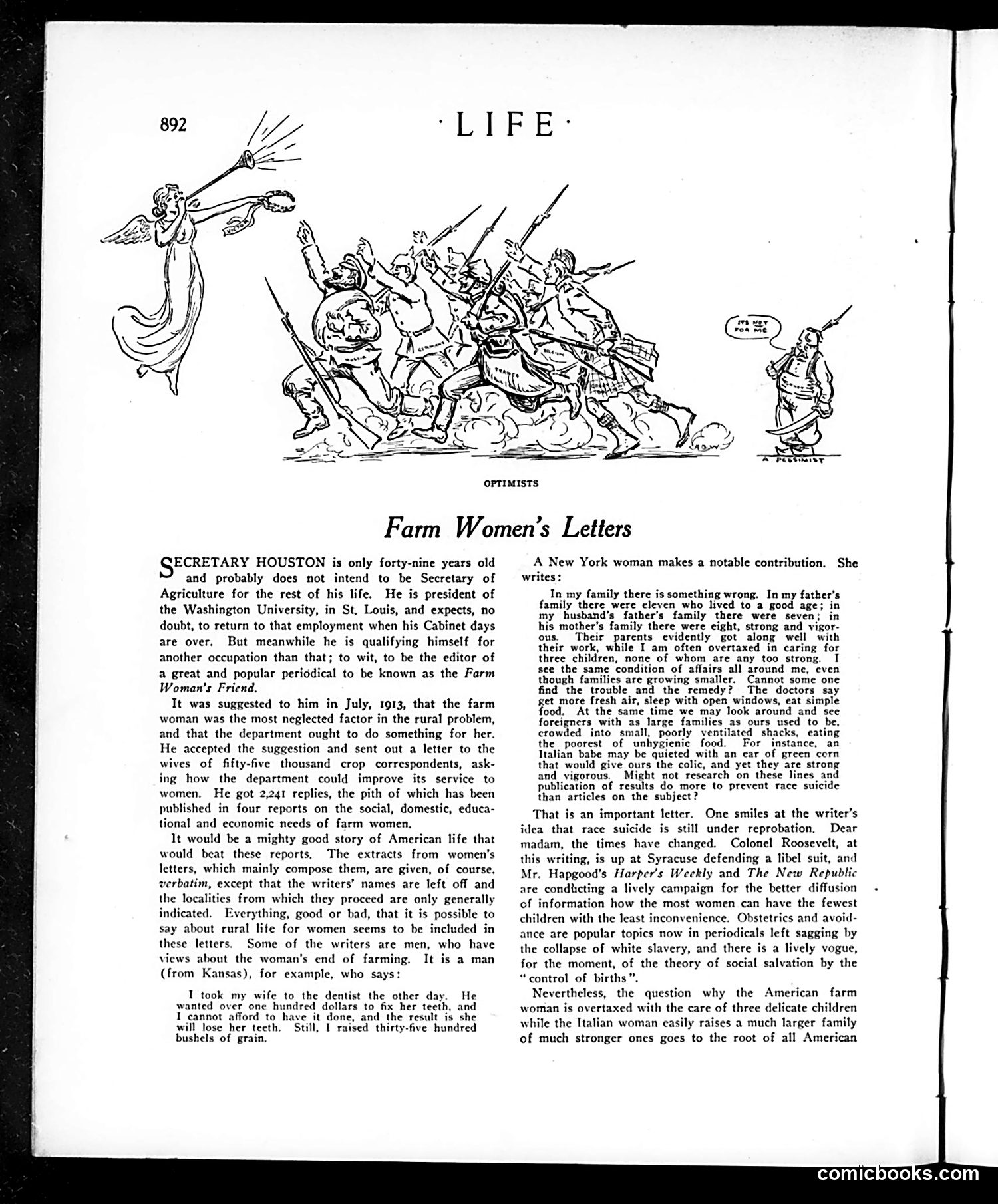
This cartoon depicts a chaotic military scene labeled "OPTIMISTS"—soldiers engaged in fierce combat with bayonets, surrounded by smoke and violence. On the left, a winged female figure (likely Lady Liberty or Victory) radiates light optimistically. On the right, a single soldier stands apart, seemingly oblivious to the carnage, with a speech bubble saying "I'm doing well." The satire targets unrealistic optimism about war. While one figure remains cheerfully detached, the bulk of soldiers face brutal, deadly combat. The cartoon critiques those maintaining blind faith or false hope during wartime, contrasting their naive optimism against the grim reality soldiers experience. This likely references WWI, given the historical period and bayonet-focused imagery.
📄 Transcribed text from this page (OCR, searchable)
Machine-transcribed from the original scan — historical spelling and the odd misread are preserved.
OPTIMISTS Farm Women’s Letters ECRETARY HOUSTON is only forty-nine years old and probably does not intend to be Secretary of Agriculture for the rest of his life. He is president of the Washington University, in St. Louis, and expects, no doubt, to return to that employment when his Cabinet days are over. But meanwhile he is qualifying himself for another occupation than that; to wit, to be the editor of a great and popular periodical to be known as the Farm Woman's Friend. It was suggested to him in July, 1913, that the farm woman was the most neglected factor in the rural problem, and that the department ought to do something for her. He accepted the suggestion and sent out a letter to the wives of fifty-five thousand crop correspondents, ask- ing how the department could improve its service to women. He got 2,241 replies, the pith of which has been published in four reports on the social, domestic, educa- tional and economic needs of farm women. It would be a mighty good story of American life that would beat these reports, The extracts from women’s letters, which mainly compose them, are given, of course, verbatim, except that the writers’ names are left off and the localities from which they proceed are only generally indicated. Everything, good or bad, that it is possible to say about rural life for women seems to be included in these letters. Some of the writers are men, who have views about the woman’s end of farming. It is a man (from Kansas), for example, who says: I took my wife to the dentist the other day. He wanted over one hundred dollars to fix her teeth, and I cannot afford to have it done, and the result is she will lose her teeth. Still, I raised thirty-five hundred bushels of grain. A New York woman makes a notable contribution. She writes: In my family there is something wrong. In my father’s family there were cleven who lived to a good age; in my husband’s father’s family there were seven; in his mother’s family there were eight, strong and vigor- ous, Their parents evidently got along well with their work, while I am often overtaxed in caring for three children, none of whom are any too strong. I see the same condition of affairs all around me, even though families are growing smaller. Cannot some one find the trouble and the remedy? The doctors say get more fresh air, sleep with open windows, eat simple food. At the same time we may look around and see foreigners with as large families as ours used to be, crowded into small, poorly ventilated shacks, eating the poorest of unhygienic food. For instance, an Italian babe may be quieted with an ear of green corn that would give ours the colic, and yet they are strong and vigorous. Might not research on these lines and publication of results do more to prevent race suicide than articles on the subject? That is an important letter. One smiles at the writer’s idea that race suicide is still under reprobation, Dear madam, the times have changed. Colonel Roosevelt, at this writing, is up at Syracuse defending a libel suit, and Mr. Hapgood’s Harper's Weekly and The New Republic are condicting a lively campaign for the better diffusion of information how the most women can have the fewest children with the least inconvenience. Obstetrics and avoid- ance are popular topics now in periodicals left sagging by the collapse of white slavery, and there is a lively vogue, for the moment, of the theory of social salvation by the “control of births”. Nevertheless, the question why the American farm woman is overtaxed with the care of three delicate children while the Italian woman easily raises a much larger family of much stronger ones goes to the root of all American comicbooks.com