
Life, 1915-05-20 · page 27 of 44
Life — May 20, 1915 — page 27: what you’re looking at
What you’re looking at
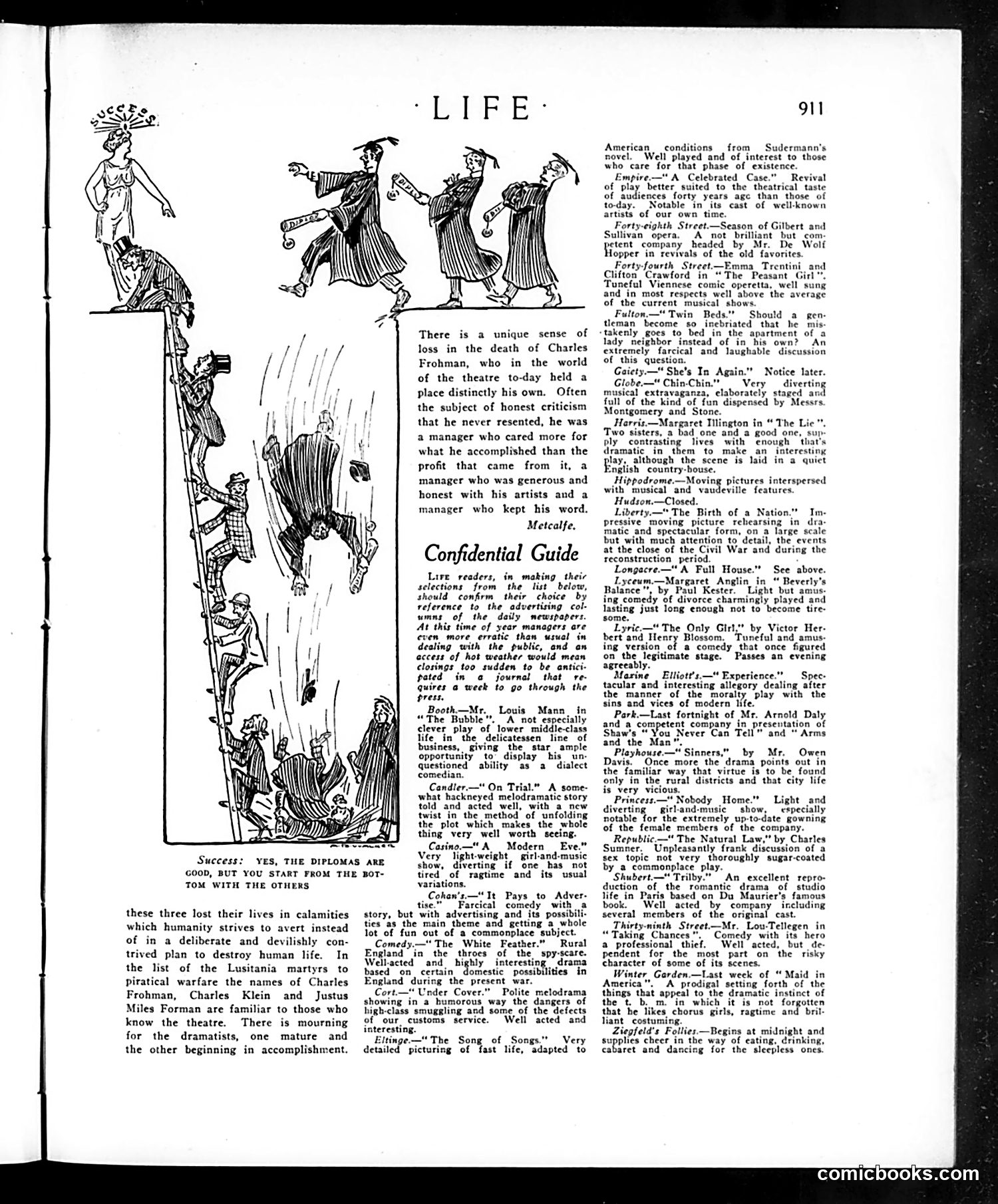
This page from Life magazine commemorates **Charles Frohman**, a prominent theater impresario who died in the 1915 sinking of the RMS Lusitania. The left illustration depicts figures falling—referencing the maritime disaster that killed him alongside playwrights Charles Klein and Justus Miles Forman. The editorial tribute emphasizes Frohman's integrity: he prioritized artistic accomplishment over profit and honored his commitments to performers—unusual virtues for theater managers of that era. The "Confidential Guide" section reviews current Broadway productions, warning readers that theater schedules are unpredictably subject to summer closings. The cartoon joke about diplomas appears unrelated to the Frohman memorial, likely satirizing something about graduation season or credentials. This page reflects early 20th-century American mourning for a cultural figure lost to wartime tragedy, positioned alongside entertainment criticism.
📄 Transcribed text from this page (OCR, searchable)
Machine-transcribed from the original scan — historical spelling and the odd misread are preserved.
There is a unique sense of loss in the death of Charles Frohman, who in the world of the theatre to-day held a place distinctly his own. Often the subject of honest criticism that he never resented, he was a manager who cared more for what he accomplished than the profit that came from it, a manager who was generous and honest with his artists and a manager who kept his word. Metcalfe, Success: Good, BUT YOU START FROM THE BOT- TOM WITH THE OTHERS these three lost their lives in calamities which humanity strives to avert instead of in a deliberate and devilishly con- trived plan to destroy human life. In the list of the Lusitania martyrs to piratical warfare the names of Charles Frohman, Charles Klein and Justus Miles Forman are familiar to those who know the theatre. There is mourning for the dramatists, one mature and the other beginning in accomplishment. YES, THE DIPLOMAS ARE Confidential Guide Lire readers, in making. their selections from the list below, Should confirm their choice by reference to the advertising col- umns_ of the daily mewspapers. At this time of year managers are even more erratic than usual in dealing with the public, and on eccess of hot weather would mean closings too sudden to be antici- pated in a journal that re- quires a week to go through the press. Booth.. Louis Mann in “The Bul . A not especially clever play of lower middle-class life. in the delicatessen line of business, giving the star ample opportunity to” display bis un- questioned ability asa dialect comedian. Candler. —" On Trial.” A some- what hackneyed melodramatic story told and acted well, with a new twist in the method’ of unfolding the plot which makes the whole thing very well worth seeing. Casino—" A Modern Eve.” Very light-weight girl-and-music show, diverting if one bas not tired’ of ragtime and its usual variations. Pays to Adver- comedy with a story, but with advertising and its possibili- ties as the main theme and getting a whole lot of fun out of a commonplace subject. Comedy.—" The White Feather.” Rural England in the throes of the spy-scare. Welkacted and. highly interesting drama based on certain domestic possibilities in England during the present war. Cort.—" Under Cover.” Polite melodrama showing in a humorous way the dangers of high-class smuggling and some of the defects of our customs service. Well acted and interesting. Eltinge—" The Song of Songs." Very detailed g of fast life, adapted to ol American conditions from — Sudermann’s novel. Well played and of interest to those who care for that phase of existence. Empire-—" A Celebrated Case.” _ Revival of play better suited to the theatrical taste of audiences forty years age than those of today. Notable in its cast of well-known, artists of our own time. Forty-eighth Street.—Season of Gilbert and Sullivan opera. A not brilliant but co Petent company headed by Mr. De Wolf Hopper in revivals of the old favorites. Forty-fourth Street—Emma_ Trentini_ and Clifton Crawford in “The Peasant Girl”. Tuneful Viennese comic operetta, well sung and in most respects well above the average of the current musical shows. Fulton.—" Twin Beds." Should a gen- tleman become so inebriated that he mis. stakenly goes to bed in the apartment of a lady neighbor instead of in his own? An. extremely farcical and laughable discussion of this question. Goiety.—" She's In Again.” Notice later. Globe.—* Chin-Chin.” Very divert musical extravaganza, elaborately staged full of the kind of fun dispensed by Mes Montgomery and Stone. Harris.—Margaret Illington in “ The Lie". Two sisters, a bad one and a good one, sup. ply contrasting lives with enough ‘that’s dramatic in them to make an interesting Play; although the scene is laid in a quiet English country-house. Hippodrome.—Moving pictures interspersed with fusteal and vaudeville features Hudson.—Closed. Liberty—" The Birth of a Nation.” Im- pressive moving picture rehearsing in dra- matic and spectacular form, on a large scale but with much attention to’ detail, the events at the close of the Civil War and during the reconstruction period. Longacre.—" A Full House.” See above. Margaret Anglin in“ Beverly's , by Paul Kester. Light but amus- ing comedy of divorce charmingly played and lasting just long enough not to become tire- some. Lyric. — The Only Girl,” by Victor Her- bert and Henry Blossom. Tuneful and amus- ing version of comedy that once figured on the legitimate stage. agreeably. Marine | Eltiott's.—" Experience.” Spec- tacular and interesting allegory dealing after the manner of the moralty play with the sins and vices of modern life. Park.—Last fortnight of Mr. Arnold Daly and a competent company in presentation of Shaw’s “ You Never Can Tell" and “ Arms and the Man”. Playhouse.—" Sinners," by Mr. Owen Davis. Once more the drama points out in the familiar way that virtue is to be found only in the rural districts and that city life is very vicious. Princess.—" Nobody Home.” Light and diverting" girland-music show, especially notable for the extremely up-to-date gowning of the female members of the company. Republic.—" The Natural Law," by Charles Sumner. Unpleasantly frank discussion of a sex topic not very thoroughly sugar-coated by a commonplace play. Shubert.—" Trilby.” An excellent repro- duction of the romantic drama of studio life in Paris based on Du Maurier’s famous book. Well acted by company including several members of the original cast. Thirty-ninth Street—Mr. Lou-Tellegen in “Taking Chances”. Comedy with its hero a professional thief. Well acted, but de- pendent for the most part on the risky character of some of its scenes. Winter Garden.—Last week of “M in America A prodigal setting forth of the things that appeal to the dramatic instinct of the tb. m. in which it is not forgotten that he likes chorus girls, ragtime and bril- liant costuming. Ziegfeld’s Follies.—Begins at midnight and supplies cheer in the way of eating, drinking, cabaret and dancing for the sleepless ones. Passes an evening comicbooks.com