
Life, 1915-05-20 · page 24 of 44
Life — May 20, 1915 — page 24: what you’re looking at
What you’re looking at
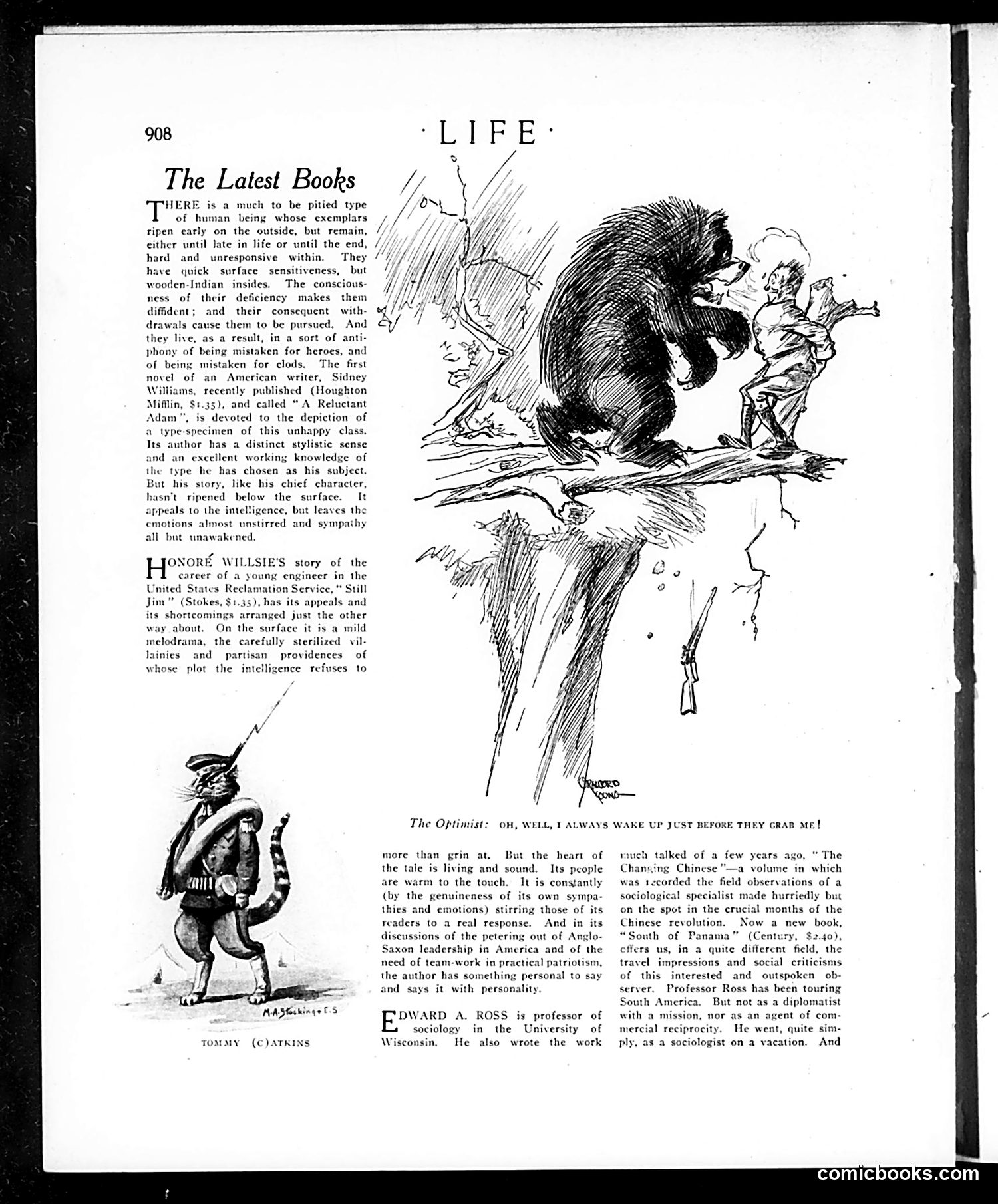
This is a book review section featuring three novel critiques. The main cartoon shows "The Optimist"—a figure lounging contentedly while danger (depicted as a pursuing figure with a weapon) approaches. The caption reads: "OH, WELL, I ALWAYS WAKE UP JUST BEFORE THEY GRAB ME!" The satire mocks willful self-deception and complacency. The optimist represents someone who ignores or minimizes genuine threats by retreating into false comfort—assuming problems will conveniently resolve before they materialize. The accompanying reviews discuss three American literary works: Sidney Williams's "A Reluctant Adam," Honoré Willsie's "Still Jim," and Edward A. Ross's "South of Panama." The page critiques their respective merits and weaknesses as social commentary and emotional narratives. The secondary cartoon labeled "Tommy (C)atkins" appears to reference British military stock characters, though its specific context on this page is unclear.
📄 Transcribed text from this page (OCR, searchable)
Machine-transcribed from the original scan — historical spelling and the odd misread are preserved.
908 The Latest Books HERE is a much to be pitied type of human being whose exemplars ripen early on the outside, but remain, cither until late in life or until the end, hard and unresponsive within. They have quick surface sensitiveness, but wooden-Indian insides. The conscious- ness of their deficiency makes them diffident; and their consequent with- drawals cause them to be pursued. And they live, as a result, in a sort of anti- phony of being mistaken for heroes, and of being mistaken for clods. The first novel of an American writer, Sidney Williams, recently published (Houghton Mifilin, $1.35), and called “A Reluctant Adam”, is devoted to the depiction of a type-specimen of this unhappy class. Its author has a distinct stylistic sense and an excellent working knowledge of the type he has chosen as his subject. But his story, like his chief character, hasn't ripened below the surface. It appeals to the intelligence, but leaves the cmotions almost unstirred and sympathy all but unawakened. ONORE WILLS story of the career of a young engineer in the United States Reclamation Service, “ Still Jim” (Stokes its shortcomings arranged just the other way about. On the surface it is a mild melodrama, the carefully sterilized vil- and partisan providences of plot the intelligence refuses to lainies whose MASfockinge 5 TOMMY (C)ATKINS The Optimist: more than grin at, But the heart of the tale is living and sound. Its people to the touch. It is constantly (by the genuineness of its own sympa- thies and emotions) stirring those of its readers to a real response. And in its discussions of the petering out of Anglo- Saxon leadership in America and of the need of team-work in practical patriotis the author has something personal to s: and says it with personality are wa: DWARD A, ROSS sociology in the Wisconsin. He also wrote the is professor of University of work OH, WELL, T ALWAYS WAKE UP JUST BEFORE THEY GRAB ME! viueh talked of a few years ago, “ The Changing Chinese "—a volume in which was recorded the field observations of a sociological specialist made hurriedly but on the spot in the crucial months of the Chinese revolution. Now a new book, “South of Panama” (Century, $2.40), cfiers us, in a quite different field, the travel impressions and social criticisms of this interested and outspoken ob- server, Professor Ross has been touring South America. But not as a diplomatist with a mission, nor as an agent of com- mercial reciprocity. He went, quite sim- ply, as a sociologist on a vacation. And comicbooks.com