
Life, 1915-05-20 · page 26 of 44
Life — May 20, 1915 — page 26: what you’re looking at
What you’re looking at
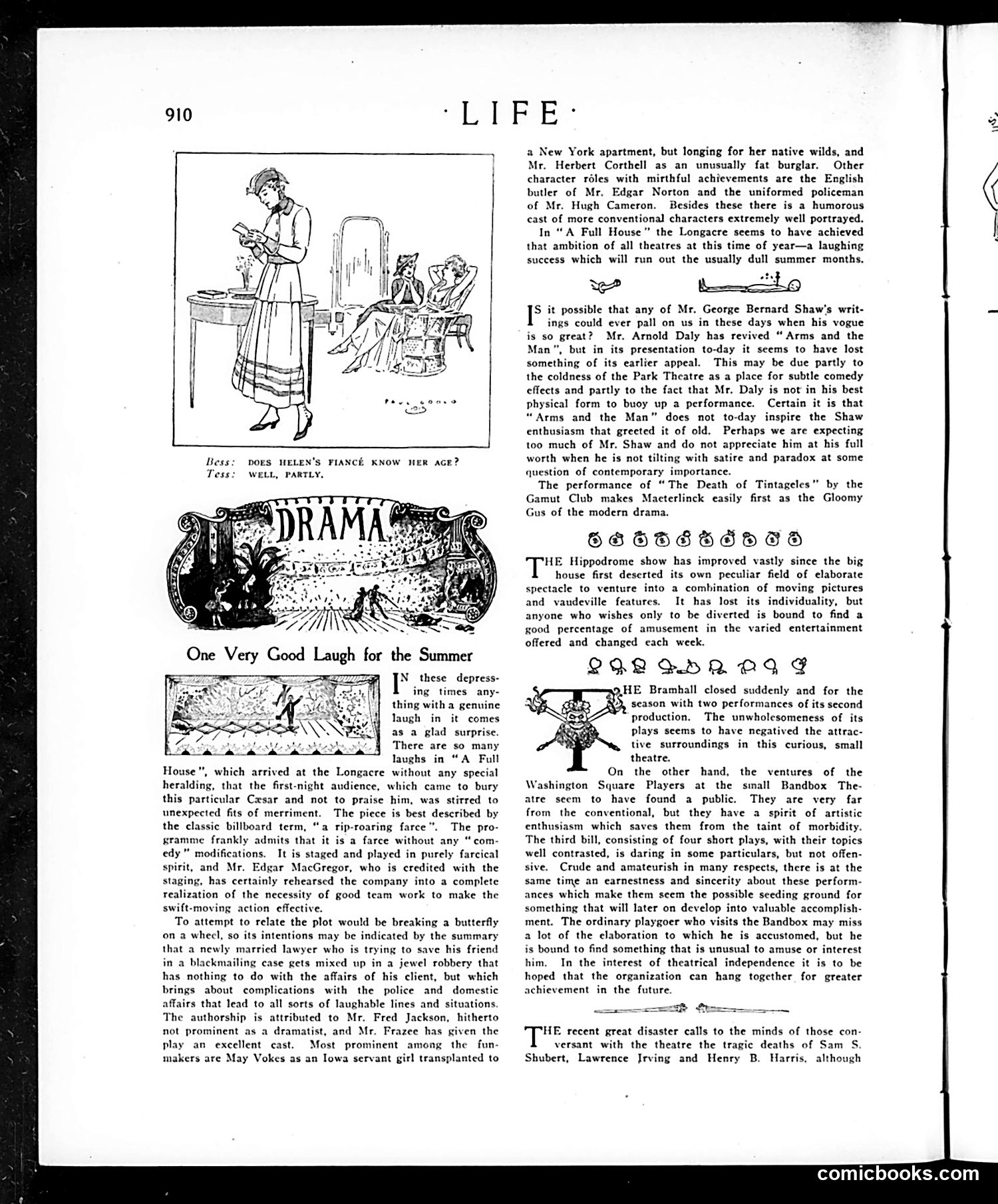
This page reviews summer theatrical productions. The cartoon at top depicts a domestic scene with the caption "DOES HELEN'S FIANCÉ KNOW HER AGE? / WELL, PARTLY"—a joke about a woman concealing her age from her betrothed, playing on period anxieties about women's vanity and marriage deception. The main review discusses "A Full House," a farce at the Longacre Theatre, praising its ability to deliver genuine laughs during depressing times (likely WWI era, given the reference). The play concerns a lawyer entangled in blackmail and jewel-theft complications. Critics highlight May Vokes as an Iowa servant in New York and Herbert Corthell as an overweight burglar. Subsequent reviews assess Shaw's "Arms and the Man" (finding it diminished), a Maeterlinck play, and vaudeville at the Hippodrome. The Bramhall theatre closed mid-season. The satire is gentle—focused on theatrical quality rather than political commentary, reflecting Life's entertainment coverage during this period.
📄 Transcribed text from this page (OCR, searchable)
Machine-transcribed from the original scan — historical spelling and the odd misread are preserved.
aE oa oy DOES HELEN'S FIANCE KNOW HER AGE? WELL, PARTLY, Good Laugh for the Summer sans z IX these depress- ¢ ing times any- thing with a genuine laugh in it comes as a glad surprise. There are so many laughs in “A Full House", which arrived at the Longacre without any special heralding, that the first-night audience, which came to bury this particular Cxsar and not to praise him, was stirred to unexpected fits of merriment. The piece is best described by the classic billboard term, “a rip-roaring farce”. The pro- gramme frankly admits that it is a farce without any “com- edy” modifications. It is staged and played in purely farcical spirit, and Mr. Edgar MacGregor, who is credited with the staging, has certainly rehearsed the company into a complete realization of the necessity of good team work to make the swift-moving action effective. To attempt to relate the plot would be breaking a butterfly on a wheel, so its intentions may be indicated by the summary that a newly married lawyer who is trying to save his friend in a blackmailing case gets mixed up in a jewel robbery that has nothing to do with the affairs of his client, but which brings about complications with the police and domestic affairs that lead to all sorts of laughable lines and situations. The authorship is attributed to Mr. Fred Jackson, hitherto not prominent as a dramatist, and Mr. Frazee has given the play an excellent cast. Most prominent among the fun- makers are May Vokes as an Iowa servant girl transplanted to a New York apartment, but longing for her native wilds, and Mr. Herbert Corthell as an unusually fat burglar. Other character réles with mirthful achievements are the English butler of Mr. Edgar Norton and the uniformed policeman of Mr. Hugh Cameron. Besides these there is a humorous cast of more conventional characters extremely well portrayed. In “A Full House” the Longacre seems to have achieved that ambition of all theatres at this time of year—a laughing success which will run out the usually dull summer months. ad = S it possible that any of Mr. George Bernard Shaw's writ- ings could ever pall on us in these days when his vogue is so great?) Mr. Arnold Daly has revived “Arms and the Man”, but in its presentation to-day it seems to have lost something of its earlier appeal. This may be due partly to the coldness of the Park Theatre as a place for subtle comedy effects and partly to the fact that Mr. Daly is not in his best physical form to buoy up a performance. Certain it is that “Arms and the Man” does not to-day inspire the Shaw enthusiasm that greeted it of old. Perhaps we are expecting too much of Mr. Shaw and do not appreciate him at his full worth when he is not tilting with satire and paradox at some question of contemporary importance. The performance of “The Death of Tintageles” by the Gamut Club makes Macterlinck easily first as the Gloomy Gus of the modern drama. SEBEBEKBSDGS HE Hippodrome show has improved vastly since the big house first deserted its own peculiar field of elaborate spectacle to venture into a combination of moving pictures and vaudeville features. It has lost its individuality, but anyone who wishes only to be diverted is bound to find a good percentage of amusement in the varied entertainment offered and changed cach week. OBk® PDR AGG HE Bramhall closed suddenly and for the $5, season with two performances of its second a n. The unwholesomeness of its plays seems to have negatived the attrac- tive surroundings in this curious, small theatre. On the other hand, the ventures of the Washington Square Players at the small Bandbox The- atre seem to have found a public. They are very far from the conventional, but they have a spirit of artistic enthusiasm which saves them from the taint of morbidity. The third bill, consisting of four short plays, with their topics well contrasted, is daring in some particulars, but not offen- sive. Crude and amateurish in many respects, there is at the same time an earnestness and sincerity about these perform- ances which make them seem the possible seeding ground for something that will later on develop into valuable accomplish- ment. The ordinary playgoer who visits the Bandbox may miss a lot of the elaboration to which he is accustomed, but he is bound to find something that is unusual to amuse or interest him. In the interest of theatrical independence it is to be hoped that the organization can hang together for greater achievement in the future. T = recent great disaster calls to the minds of those con- versant with the theatre the tragic deaths of Sam S Shubert, Lawrence Irving and Henry B. Harris, although comicbooks.com ays, Oe