
Life, 1915-05-20 · page 19 of 44
Life — May 20, 1915 — page 19: what you’re looking at
What you’re looking at
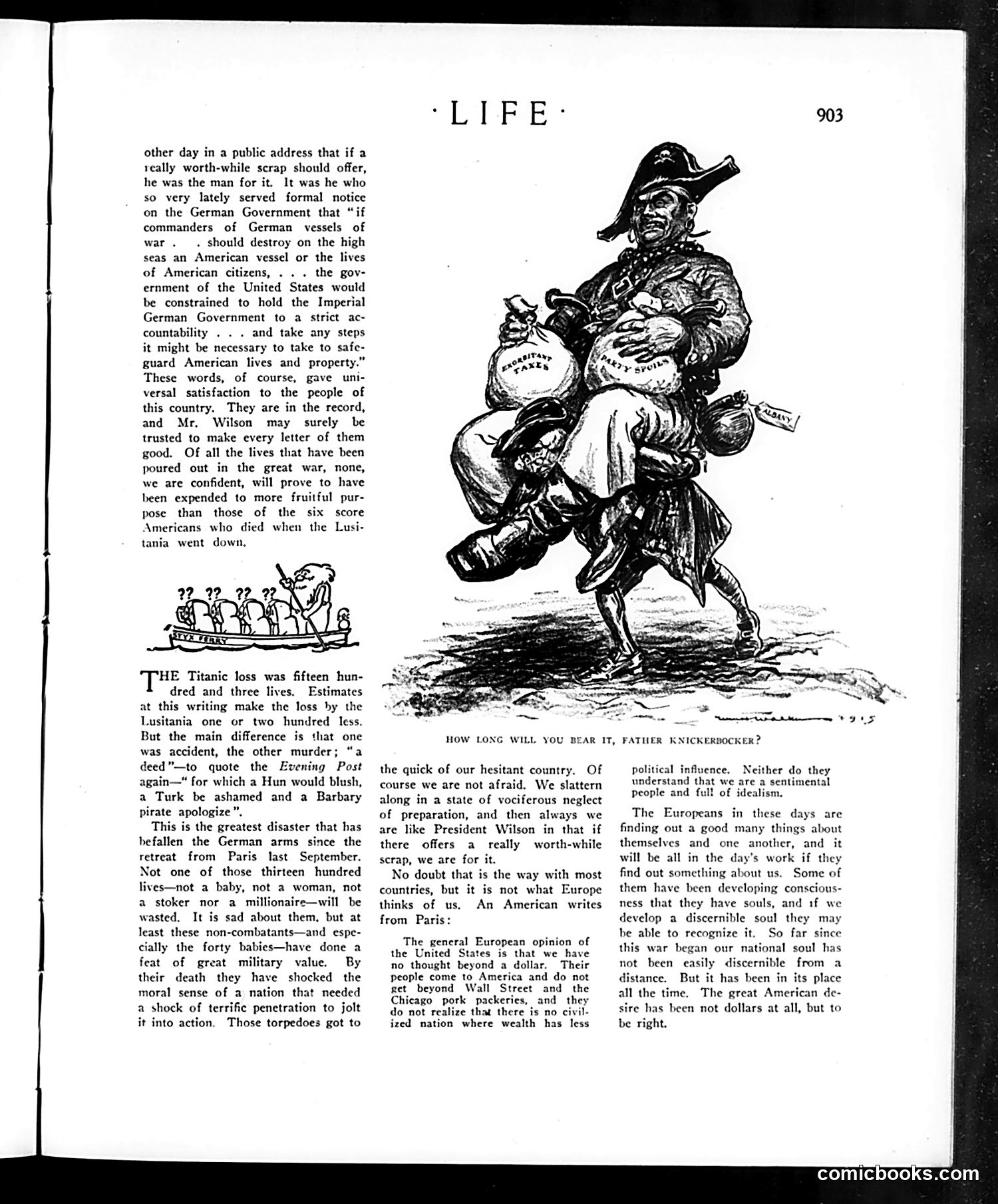
This page discusses the 1915 sinking of the RMS Lusitania by German U-boat, in which approximately 1,200 civilians died, including many Americans. The large political cartoon depicts "Father Knickerbocker" (personification of America) as a rotund, somewhat foolish figure laden with goods, asking "How long will you bear it, Father Knickerbocker?"—urging American intervention in World War I. The text argues that the Lusitania disaster, though tragic, represents a "feat of great military value" because it has finally shocked America's conscience into action. The author criticizes American passivity and perceived focus on commerce rather than idealism, while defending that America does possess moral principles beneath its materialist reputation. The satirical point: Americans needed this atrocity to awaken their national conscience and cease hesitant neutrality.
📄 Transcribed text from this page (OCR, searchable)
Machine-transcribed from the original scan — historical spelling and the odd misread are preserved.
other day in a public address that if a really worth-while scrap should offer, he was the man for it. It was he who so very lately served formal notice on the German Government that “if commanders of German vessels of war. . should destroy on the high seas an American vessel or the lives of American citizens, . . . the gov- ernment of the United States would be constrained to hold the Imperial German Government to a strict ac- countability . . . and take any steps it might be necessary to take to safe- guard American lives and property.” These words, of course, gave uni. versal satisfaction to the people of this country. They are in the record, and Mr. Wilson may surely be trusted to make every letter of them good. Of all the lives that have been poured out in the great war, none, we are confident, will prove to have been expended to more fruitful pur- pose than those of the six score Americans who died when the Lusi- tania went down, 'HE Titanic loss was fifteen hun- dred and three lives. Estimates at this writing make the loss by the Lusitania one or two hundred less. But the main difference is that one was accident, the other murder; “a deed"—to quote the Evening Post again—" for which a Hun would blush, a Turk be ashamed and a Barbary pirate apologize”. This is the greatest disaster that has befallen the German arms since the retreat from Paris last September. Not one of those thirteen hundred lives—not a baby, not a woman, not a stoker nor a_ millionaire—will be wasted. It is sad about them, but at least these non-combatants—and espe- cially the forty babies—have done a feat of great military value. By their death they have shocked the moral sense of a nation that needed a shock of terrific penetration to jolt it into action. Those torpedoes got to HOW LONG WILL YOU BEAR IT, FATHER KNICKERBOCKER? the quick of our hesitant country. Of course we are not afraid. We slattern along in a state of vociferous neglect of preparation, and then always we are like President Wilson in that if there offers a really worth-while scrap, we are for it. No doubt that is the way with most countries, but it is not what Europe thinks of us. An American writes from Paris: The general European opinion of the United States is that we have no thought beyond a dollar. Their people come to America and do not get beyond Wall Street and the Chicago pork packeries, and they do not realize that there is no civil- ized nation where wealth has less political influence, Neither do they understand that we are a sentimental people and full of idealism. The Europeans in these days are finding out a good many things about themselves and one another, and it will be all in the day’s work if they find out something about us. Some of them have been developing conscious- ness that they have souls, and 1f we develop a discernible soul they may be able to recognize it. So far since this war began our national soul has not been easily discernible from a distance. But it has been in its place all the time, The great American de- sire has been not dollars at all, but to be right. comicbooks.com