
Life, 1915-05-20 · page 18 of 44
Life — May 20, 1915 — page 18: what you’re looking at
What you’re looking at
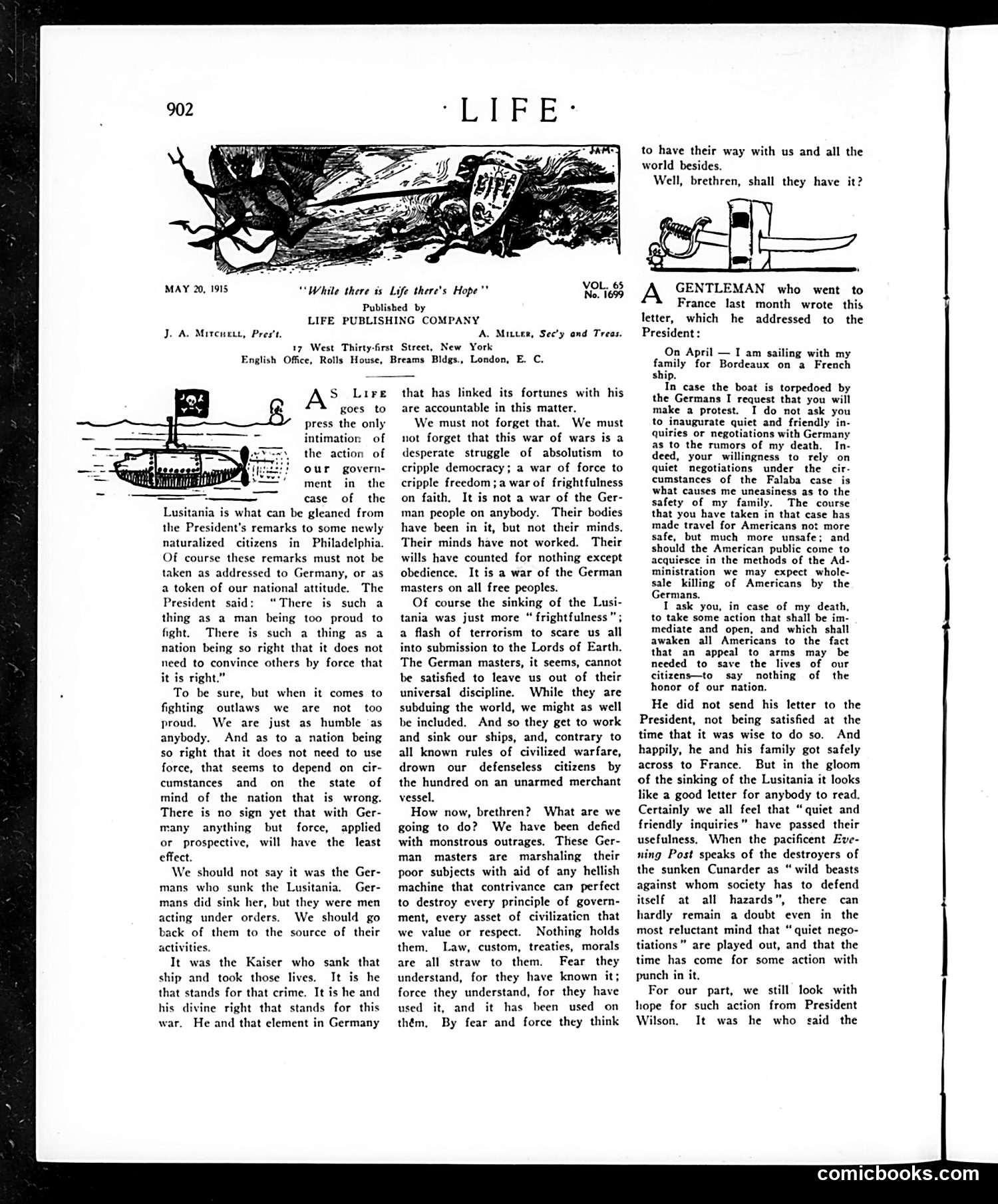
This page addresses the sinking of the RMS Lusitania (May 7, 1915), where a German U-boat torpedoed the British passenger ship, killing nearly 1,200 people, including 128 Americans. The editorial attacks Kaiser Wilhelm II as personally responsible for the attack, characterizing it as an act of "frightfulness"—deliberate terrorism against civilians to force submission. It frames the war as absolutism versus democracy, arguing the German government (not its people) wages this war. The page criticizes President Wilson's earlier statement that America could be "too proud to fight," interpreting it as insufficient response to German aggression. The accompanying letter from a gentleman sailing to France sarcastically requests the President merely "protest" if his ship is torpedoed—mocking what the writer sees as inadequate diplomatic responses to German atrocities. The satire pushes for stronger American action against Germany, suggesting passive diplomacy fails against force-driven adversaries.
📄 Transcribed text from this page (OCR, searchable)
Machine-transcribed from the original scan — historical spelling and the odd misread are preserved.
MAY 20, 1915 “While there is: Life there's Hope" Published by LIFE PUBLISHING COMPANY J. A. Mircuett, Pres’t. A. Mitte, Sec’y ond Treas. 17 West Thirty-first Street, New York English Office, Rolls House, Breams Bldgs., London, E. C. S Lire goes to press the only intimation of the action of our = govern- ment in the . case of the Lusitania is what can be gleaned from the President's remarks to some newly naturalized citizens in Philadelphia. Of course these remarks must not be taken as addressed to Germany, or as a token of our national attitude. The President said: “There is such a thing as a man being too proud to fight. There is such a thing as a nation being so right that it does not need to convince others by force that it is right.” To be sure, but when it comes to fighting outlaws we are not too proud. We are just as humble as anybody. And as to a nation being so right that it does not need to use force, that seems to depend on cir- cumstances and on the state of mind of the nation that is wrong. There is no sign yet that with Ger- many anything but force, applied or prospective, will have the least effect. We should not say it was the Ger- mans who sunk the Lusitania. Ger- mans did sink her, but they were men acting under orders. We should go back of them to the source of their activities, It was the Kaiser who sank that ship and took those lives. It is he that stands for that crime. It is he and his divine right that stands for this war. He and that element in Germany that has linked its fortunes with his are accountable in this matter, We must not forget that. We must not forget that this war of wars is a desperate struggle of absolutism to cripple democracy; a war of force to cripple freedom; a war of frightfulness on faith. It is not a war of the Ger- man people on anybody. Their bodies have been in it, but not their minds. Their minds have not worked. Their wills have counted for nothing except obedience. It is a war of the German masters on all free peoples. Of course the sinking of the Lusi- tania was just more “ frightfulness”; a flash of terrorism to scare us all into submission to the Lords of Earth. The German masters, it seems, cannot be satisfied to leave us out of their universal discipline. While they are subduing the world, we might as well be included. And so they get to work and sink our ships, and, contrary to all known rules of civilized warfare, drown our defenseless citizens by the hundred on an unarmed merchant vessel. How now, brethren? What are we going to do? We have been defied with monstrous outrages. These Ger- man masters are marshaling their poor subjects with aid of any hellish machine that contrivance can perfect to destroy every principle of govern- ment, every asset of civilization that we value or respect. Nothing holds them, Law, custom, treaties, morals are all straw to them. Fear they understand, for they have known it; force they understand, for they have used it, and it has been used on thém, By fear and force they think to have their way with us and all the world besides. Well, brethren, shall they have it? GENTLEMAN who went to France last month wrote this letter, which he addressed to the President: On April — I am sailing with my family for Bordeaux on a French ship. In _case the boat is torpedoed by the Germans I request that you will make a protest. I do not ask you to inaugurate quiet and friendly in- quiries or negotiations with Germany as to the rumors of my death. In- deed, your willingness to rely on quiet negotiations under the cir- cumstances of the Falaba case is what causes me uneasiness as to the safety of my family. The course that you have taken in that case has made travel for Americans not more safe, but much more unsafe; and should the American public come to acquiesce in the methods of the Ad- ministration we may expect whole- sale killing of Americans by the Germans. I ask you, in case of my death, to take some action that shall be im- mediate and open, and which shall awaken all Americans to the fact that an appeal to arms may be needed to save the lives of our citizens—to say nothing of the honor of our nation. He did not send his letter to the President, not being satisfied at the time that it was wise to do so. And happily, he and his family got safely across to France. But in the gloom of the sinking of the Lusitania it looks like a good letter for anybody to read. Certainly we all feel that “quiet and friendly inquiries” have passed their usefulness, When the pacificent Eve- ning Post speaks of the destroyers of the sunken Cunarder as “ wild beasts against whom society has to defend itself at all hazards”, there can hardly remain a doubt even in the most reluctant mind that “quiet nego- tiations” are played out, and that the time has come for some action with punch in it, For our part, we still look with hope for such action from President Wilson. It was he who said the comicbooks.com