
A complete issue · 48 pages · 1915
Life — March 4, 1915
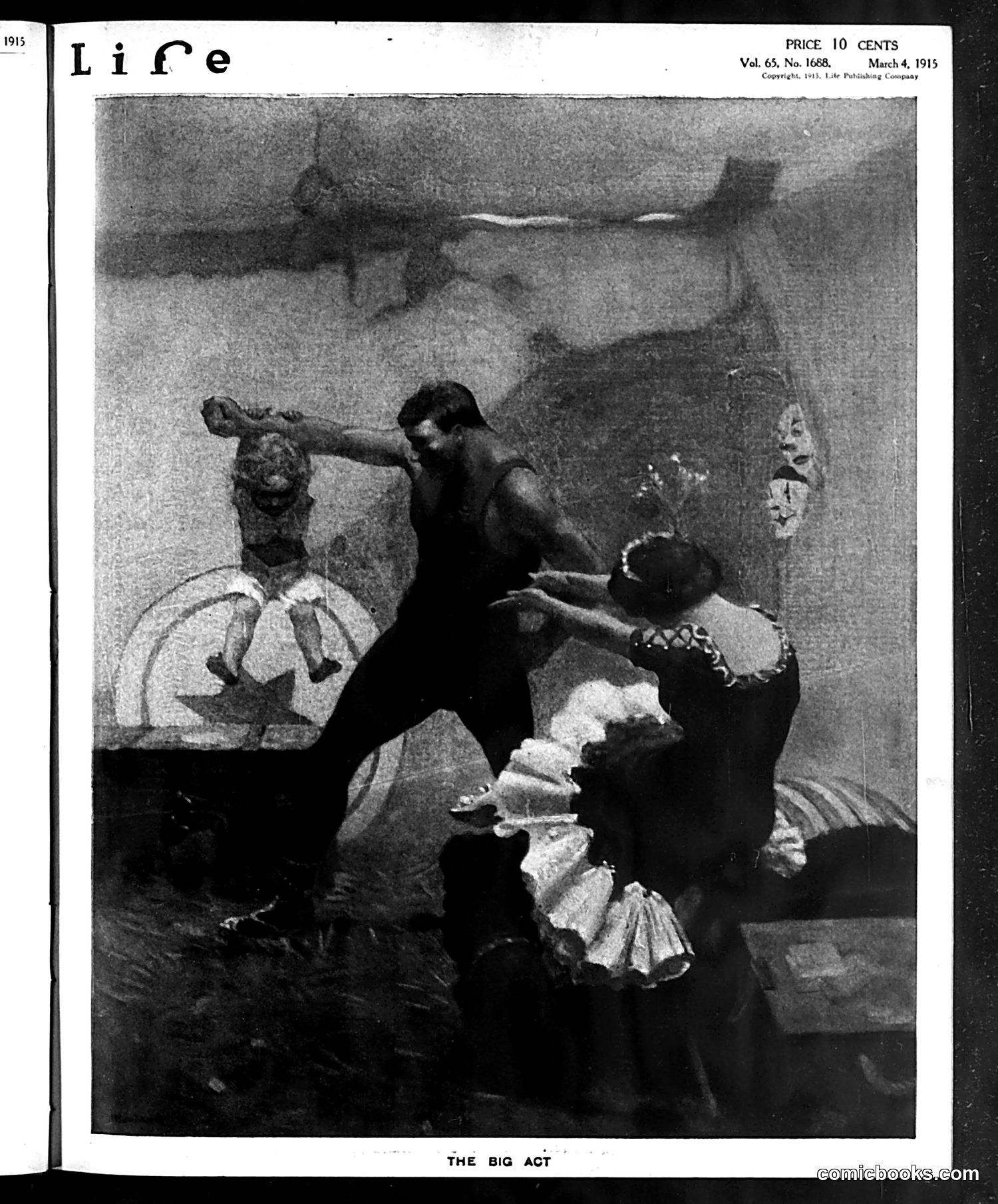
This appears to be a theatrical or vaudeville scene titled "The Big Act." The image shows performers in what looks like a stage performance: a central male figure in dark clothing performs an exaggerated physical act (possibly a slapstick or acrobatic move) while other costumed performers react around him. One figure wears what appears to be a clown or theatrical makeup on the right. Without additional caption text visible in this image, the specific satirical or political meaning is unclear. It may be commenting on popular entertainment of 1915, or possibly using theatrical performance as metaphor for political events, but the exact reference cannot be determined from what's shown.
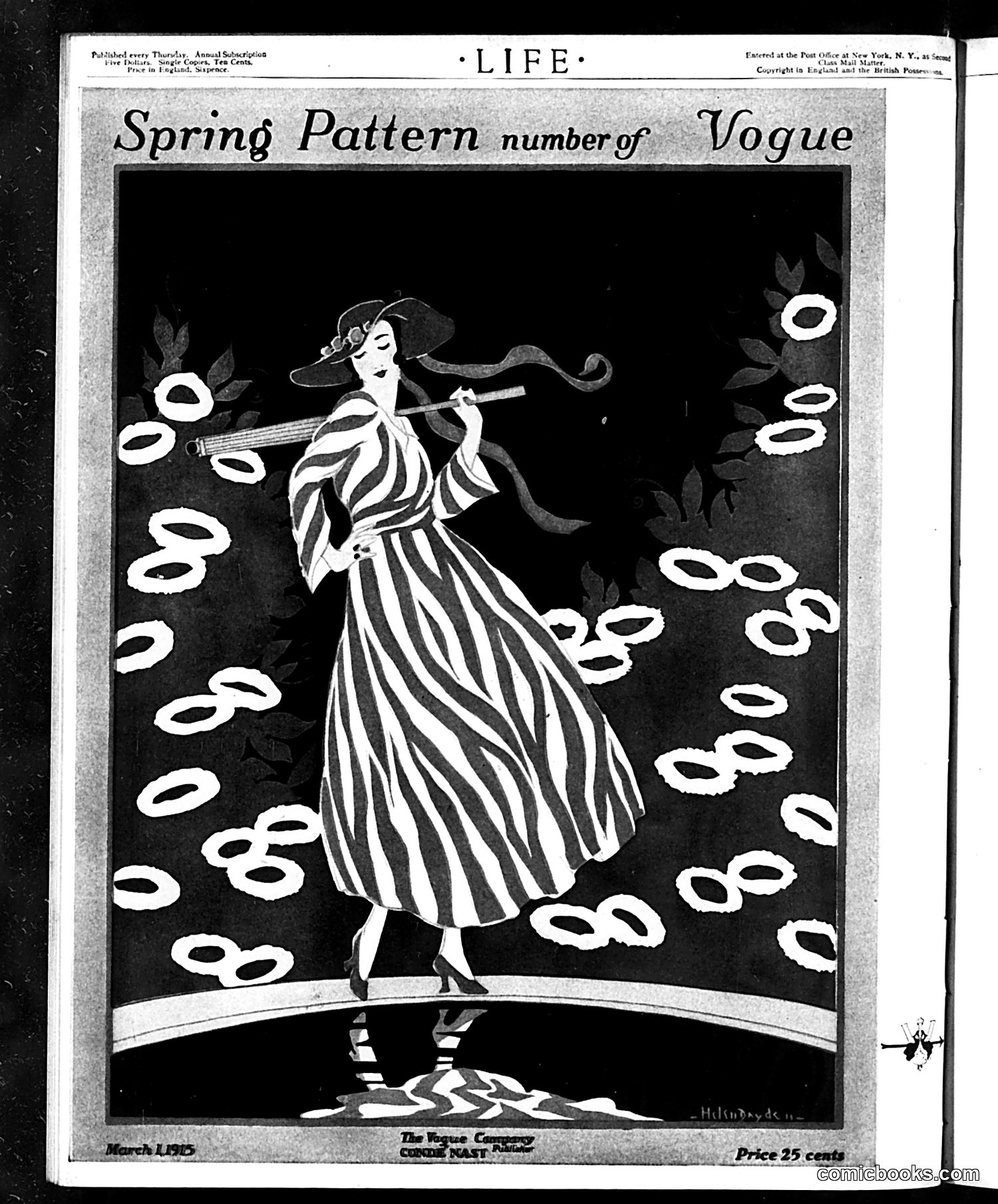
This is a **Vogue fashion advertisement** disguised as satirical art, not a political cartoon. The illustration shows a stylized woman in a striped spring dress, holding a telescope, surrounded by floating price numbers (appearing to be "00" or similar figures). The satire appears to target **fashion industry pricing**—the woman gazes through a telescope as if searching for affordable clothing, while prices float around her like distant stars. This mocks the expense of high fashion during this period (March 1915, based on the date visible). The striped dress demonstrates Vogue's spring patterns while the comic framing suggests ironic commentary on fashion's pretensions and cost to consumers. It's advertising that simultaneously jokes about the product's luxury pricing.
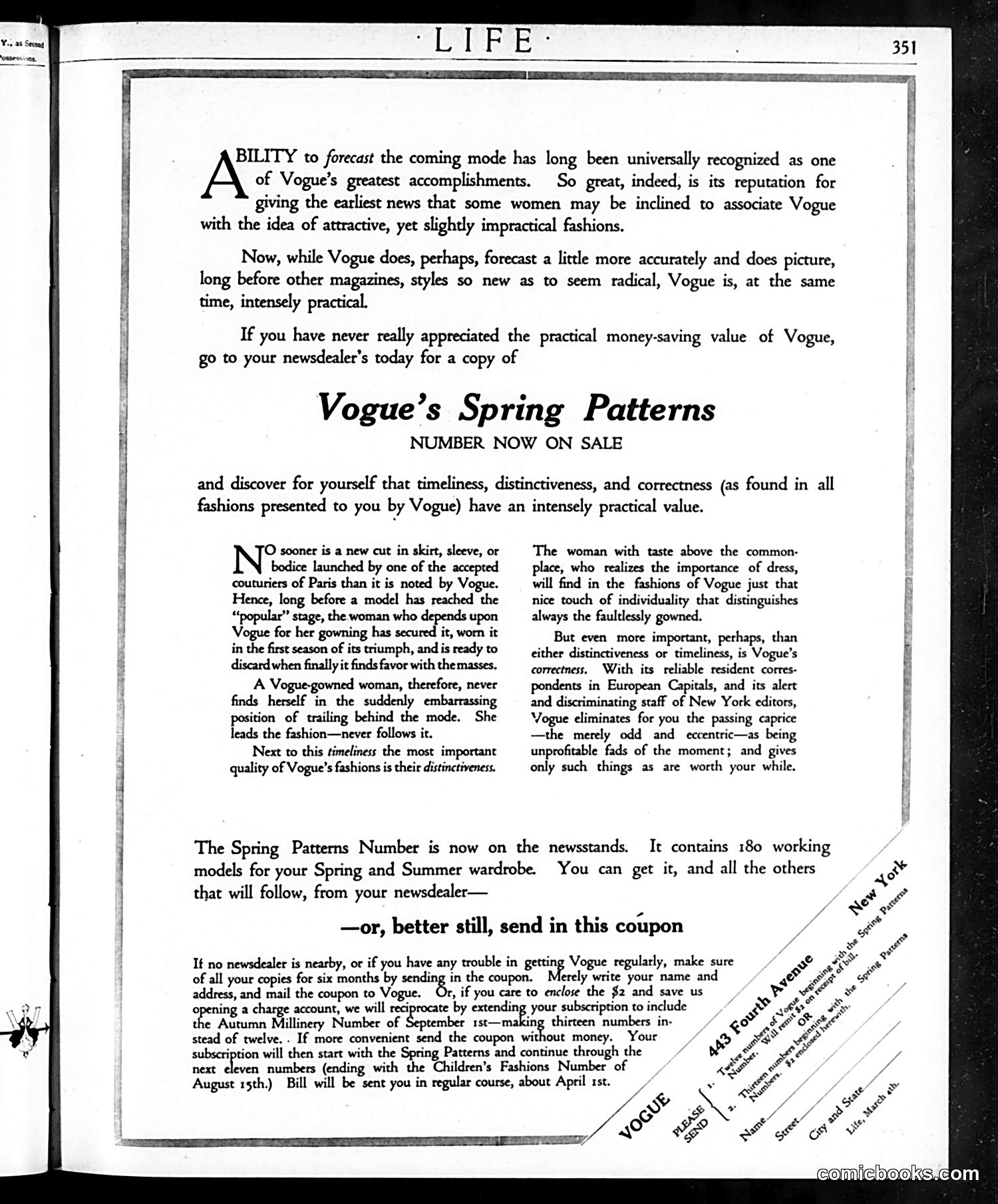
This page is primarily **advertising copy for Vogue magazine**, not satirical content. It promotes Vogue's Spring Patterns issue and argues that Vogue has practical value beyond fashion—claiming the magazine helps women stay ahead of trends while avoiding embarrassing fashion mistakes. The text emphasizes Vogue's reputation for forecasting fashion trends before other publications, and asserts that following Vogue prevents women from appearing unfashionable or trailing behind current modes. There is no political satire here. The only small cartoon element visible is a bee illustration in the lower left corner, which appears to be a decorative publisher's mark rather than commentary. This is essentially a **subscription solicitation** disguised as editorial content, typical of 1920s magazine advertising.
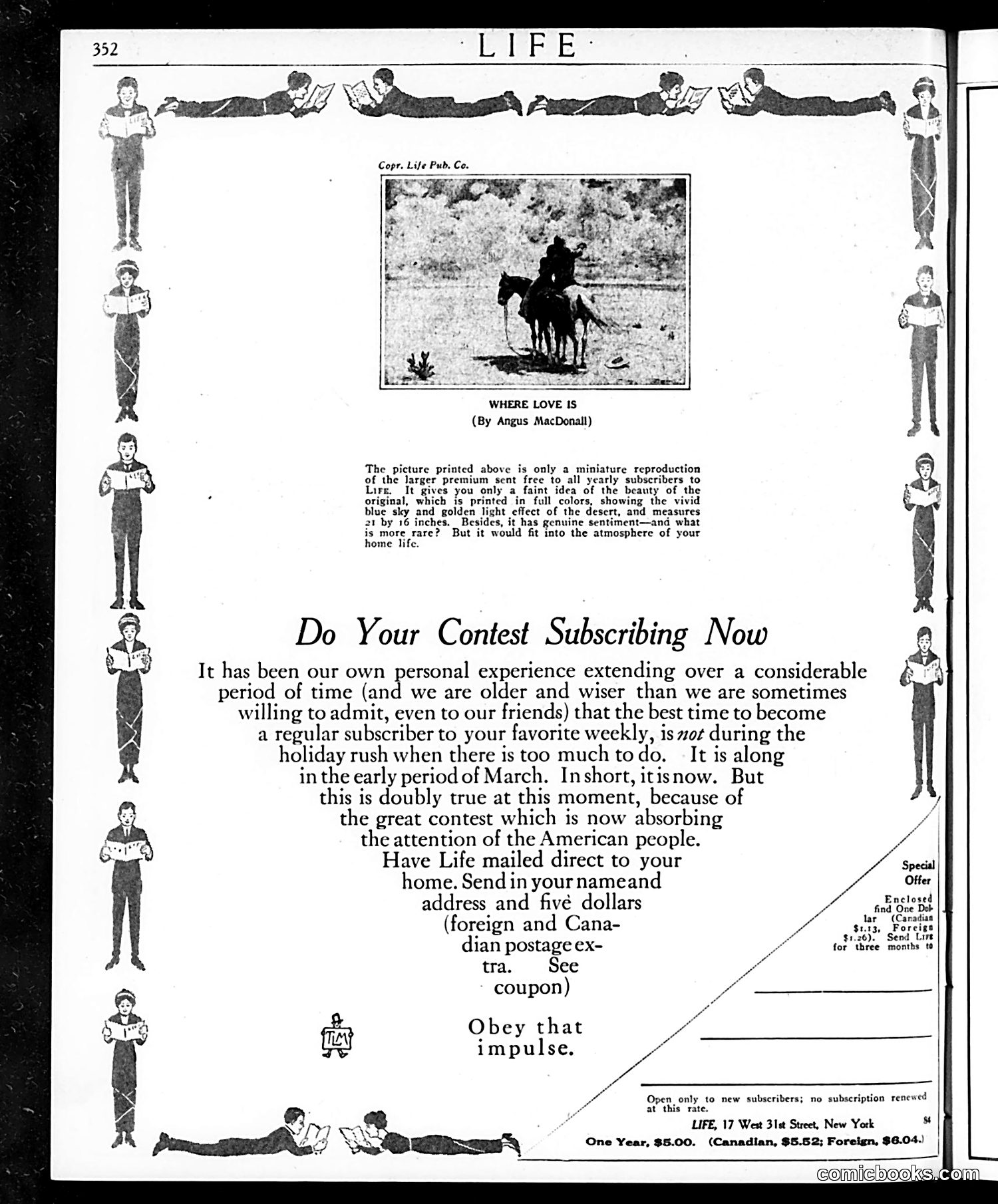
This page is primarily **subscription advertising** for *Life* magazine rather than political satire. The decorative border features illustrated figures in various poses, but these appear to be generic fashion illustrations or design elements rather than specific caricatures. The main content promotes subscribing to *Life*, emphasizing that early March is an ideal time to become a regular subscriber—notably before "the great contest which is now absorbing the attention of the American people." This reference is vague but likely alludes to a contemporary political event or competition, though the specific context is unclear from this page alone. The featured artwork, "Where Love Is" by Angus MacDonall, depicts a figure on horseback in a desert landscape. This appears to be decorative rather than satirical content.
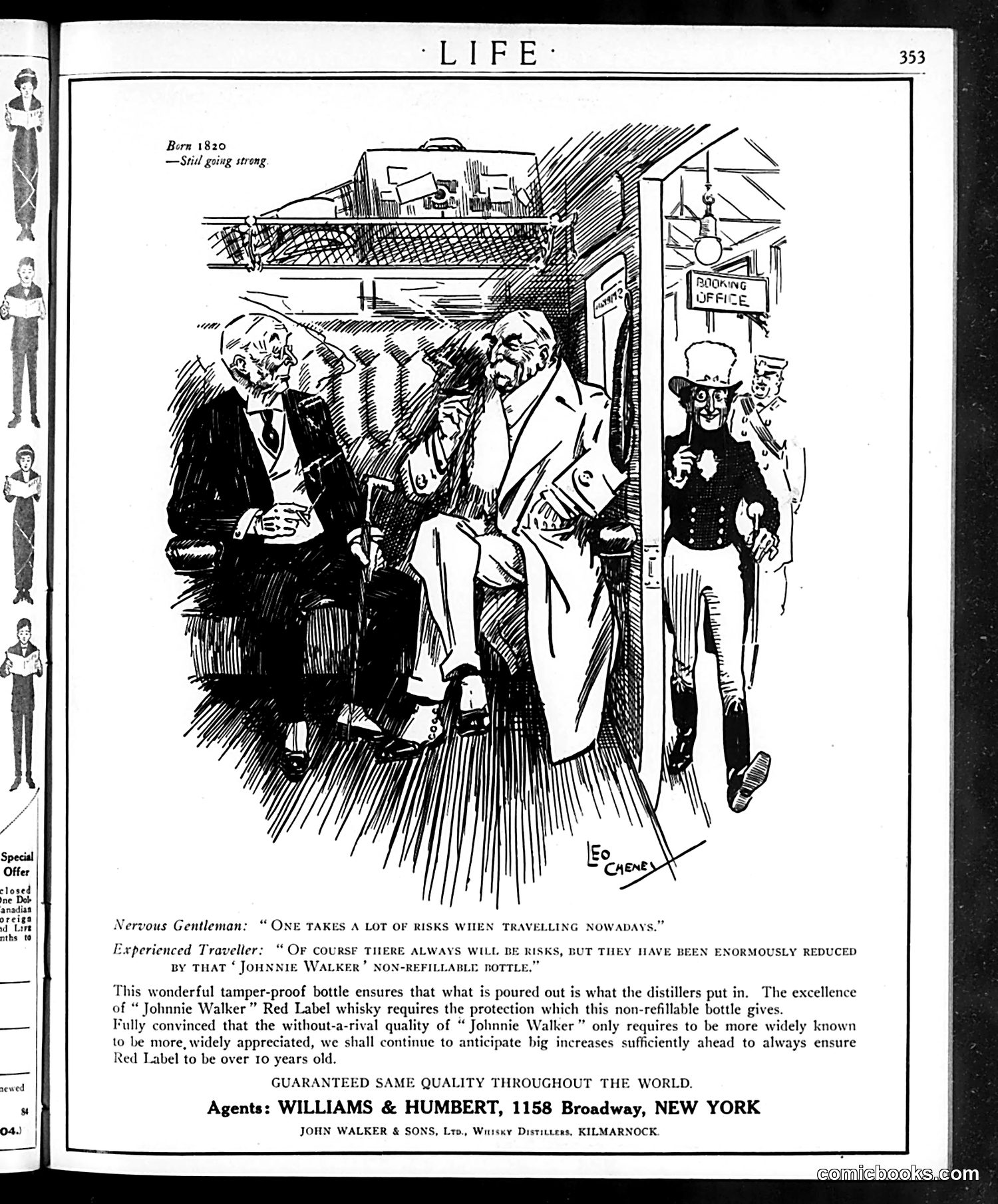
This page is primarily a **Johnnie Walker whisky advertisement** masquerading as editorial content in Life magazine. The cartoon depicts two well-dressed gentlemen in what appears to be a ship's cabin, discussing travel risks. A uniformed officer (possibly a ship's captain or porter) stands nearby. The "Nervous Gentleman" warns about travel dangers; the "Experienced Traveller" responds that risks exist but are "enormously reduced" by using Johnnie Walker's non-refillable bottles—implying the tamper-proof design ensures product authenticity and safety. The satire conflates **product reliability with personal security during travel**—a marketing strategy playing on early-20th-century anxieties about adulterated spirits and travel hazards. The advertisement claims the bottle's design guarantees quality consistency "throughout the world," positioning the whisky as trustworthy and sophisticated for the discerning traveler.
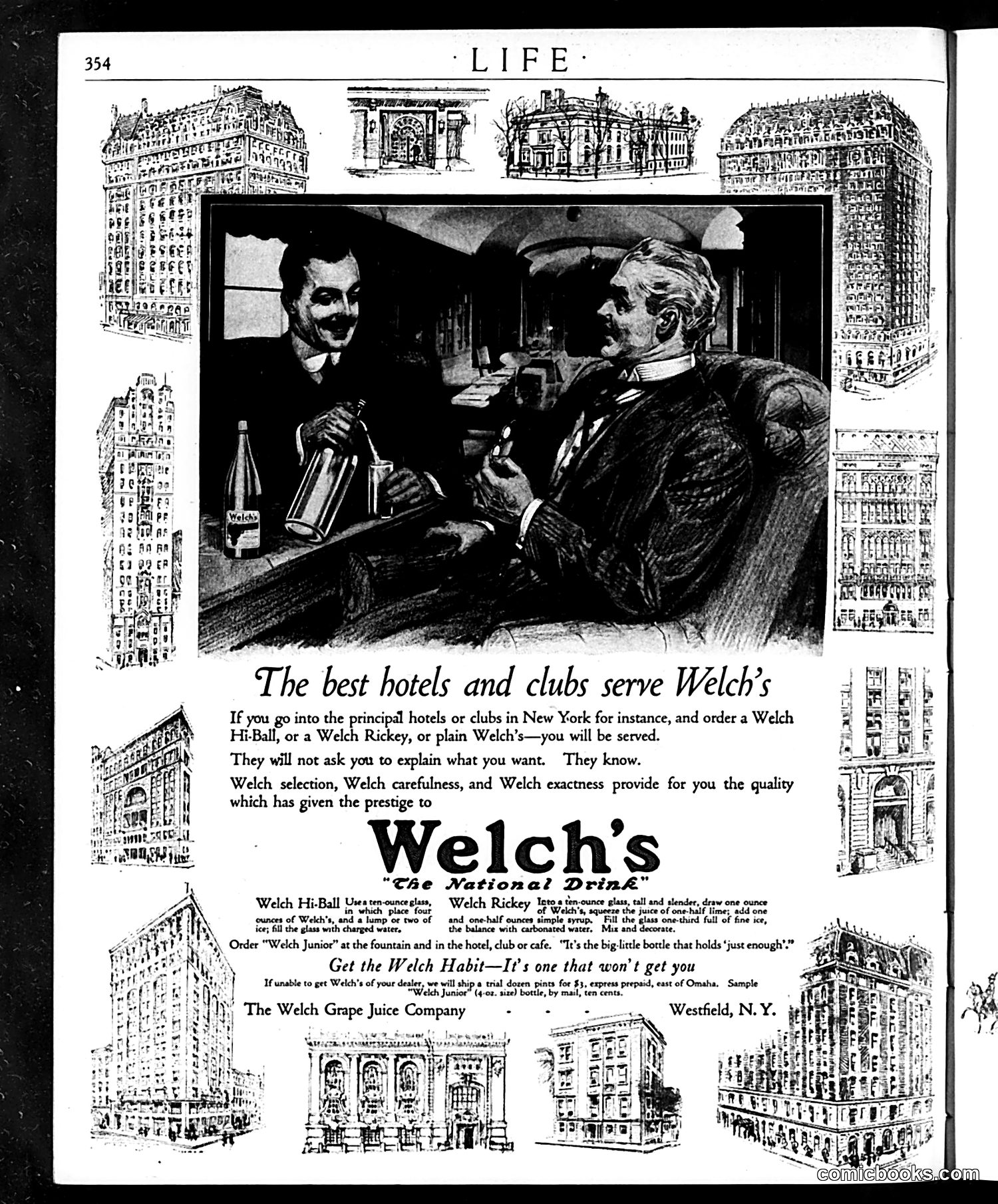
This page is primarily **advertising, not satire or political commentary**. It's a full-page advertisement for Welch's grape juice beverages from The Welch Grape Juice Company in Westfield, New York. The central image shows two men in what appears to be a hotel or club setting, with bottles of Welch's products visible. The ad claims that "the best hotels and clubs serve Welch's," listing specific drinks like "Welch Hi-Ball" and "Welch Rickey." The surrounding illustrations depict various New York buildings and hotels, establishing the upscale venues where Welch's products are supposedly served. The tagline promises that ordering Welch's at fine establishments requires no explanation—staff will already know what you want. This is a prestige-based marketing strategy targeting affluent consumers.
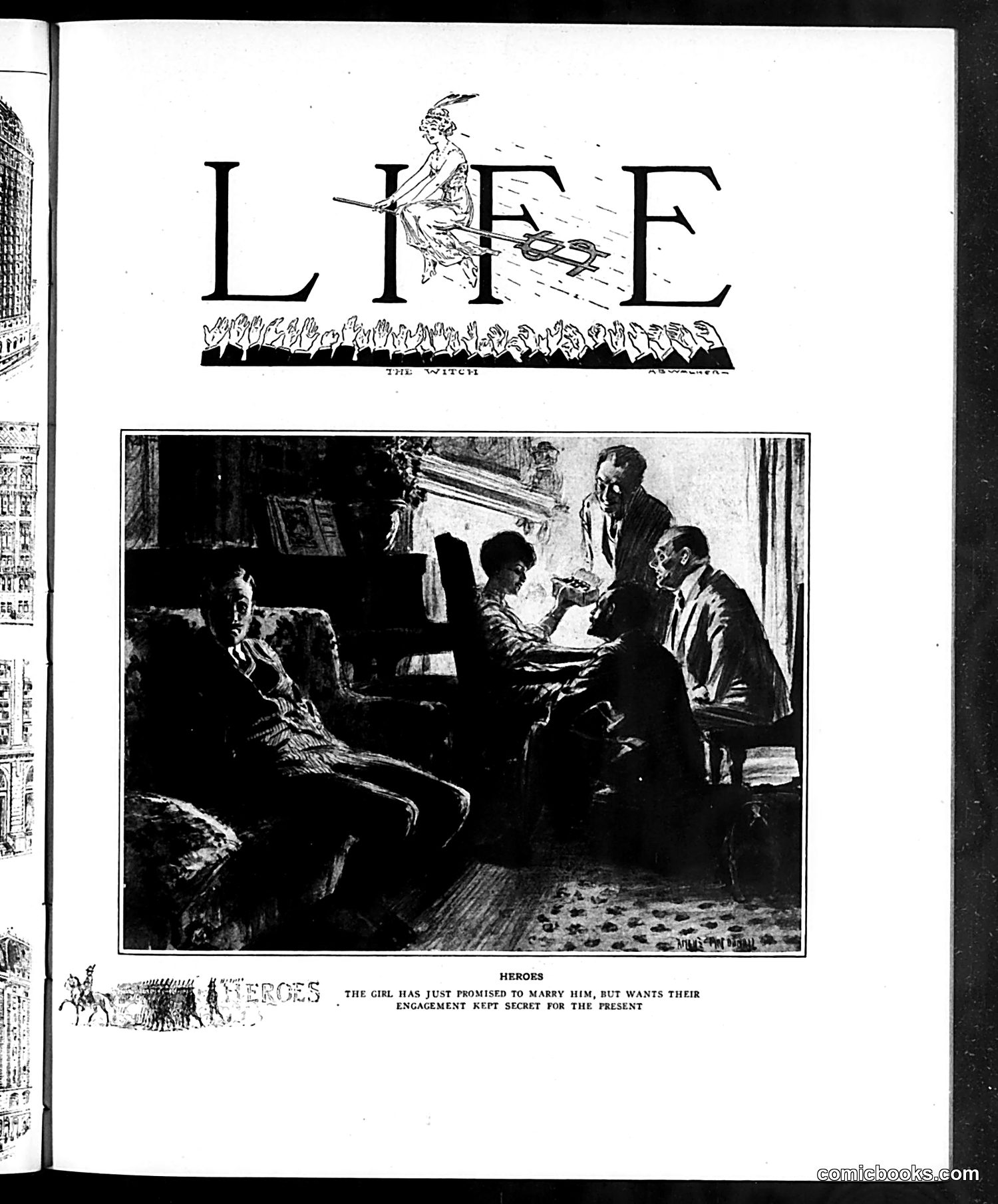
This page presents a serialized story titled "Life" featuring a narrative section labeled "Heroes." The dramatic black-and-white illustration shows an interior scene with several men gathered around a seated woman, appearing to be in conversation or confrontation. The caption explains the plot: "The girl has just promised to marry him, but wants their engagement kept secret for the present." This appears to be melodramatic fiction rather than political satire. The scene depicts a common early-20th-century narrative trope—a secret engagement creating social tension. The composition and clothing suggest this is from Life's serialized fiction content rather than its satirical commentary sections. The witch figure in the masthead header is Life's traditional logo.
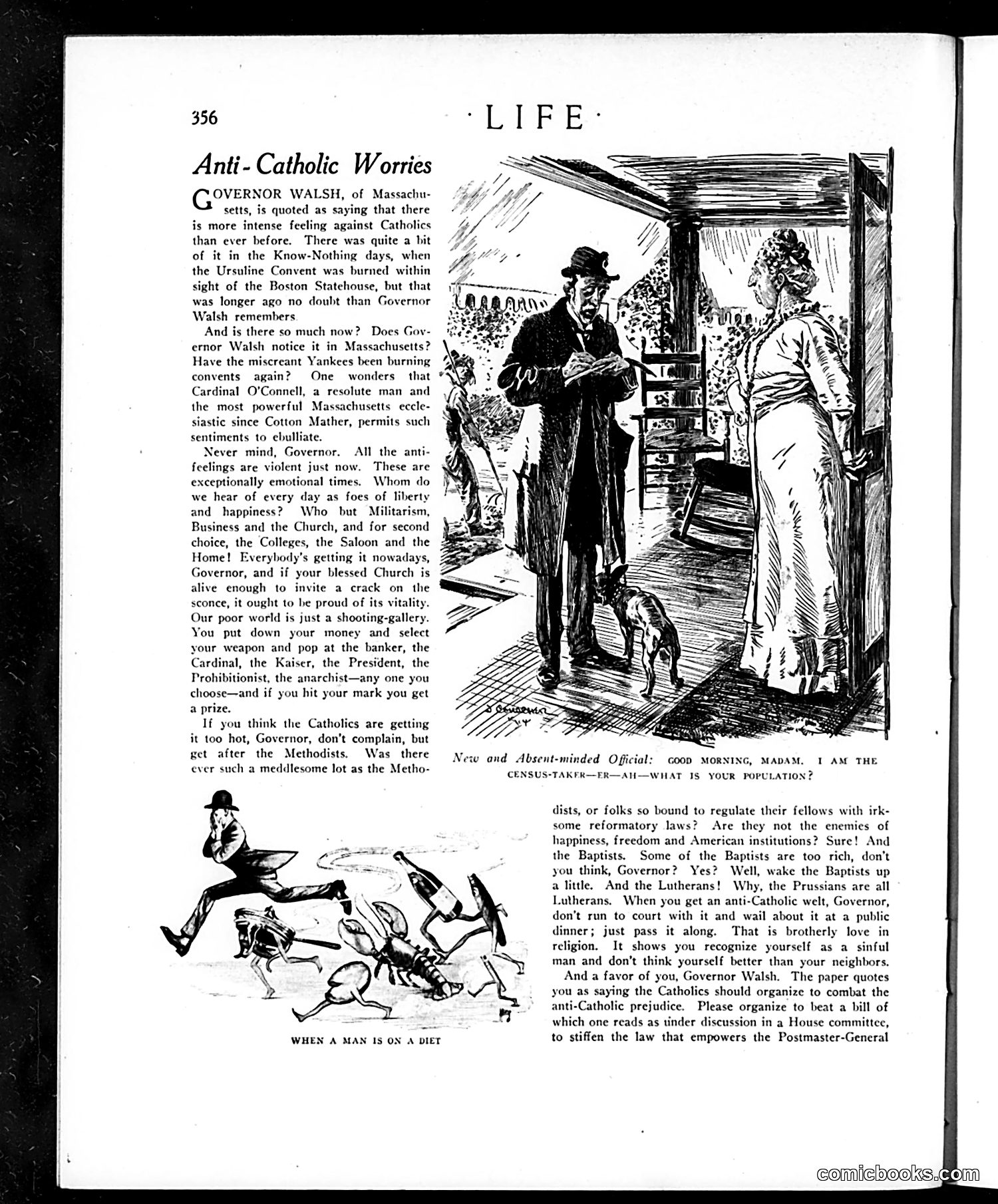
This satirical article attacks Governor Walsh of Massachusetts for expressing concern about anti-Catholic sentiment, comparing such worries unfavorably to historical Know-Nothing prejudice. The author argues Walsh should instead target Methodists and other Protestant groups. The accompanying cartoons illustrate the satire: one depicts an official questioning someone about census data (suggesting bureaucratic scrutiny), while another shows a man losing control while on a diet (metaphorically representing loss of restraint). The piece mocks Walsh's calls for Catholic advocacy, sarcastically suggesting he should "organize to beat a bill" combating anti-Catholic prejudice. The satire implies that anti-Catholic sentiment is justified or at least not worth addressing, positioning Catholicism as a threat comparable to other American institutions the author lists dismissively.
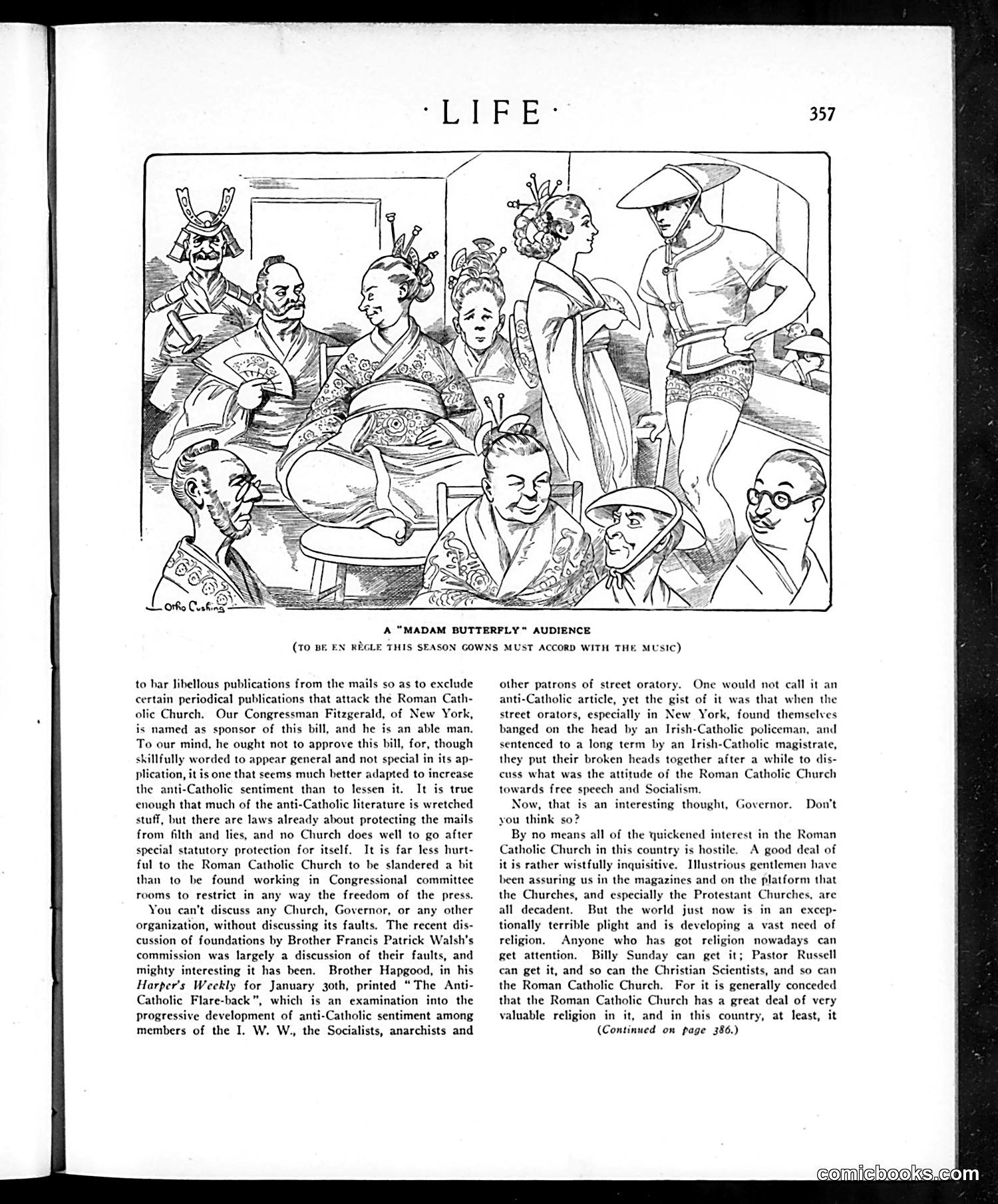
This cartoon satirizes early 20th-century theatrical fashion. The caption notes that "Règle this season gowns must accord with the music," referencing Puccini's opera *Madama Butterfly* (1904). The sketch shows audience members dressed in elaborate Japanese kimonos and traditional clothing while attending what appears to be the opera. The satire targets the fashionable trend of adopting "Oriental" dress—particularly Japanese styles—to match theatrical productions, reflecting the period's fascination with Japonisme. The cartoon mocks this performative exoticism: attendees are essentially costuming themselves as characters from the show rather than simply watching it. The mixed group of well-dressed patrons—some wearing eyeglasses, some in Western hybrid dress—illustrates how thoroughly this fashion craze had permeated high society's entertainment culture.
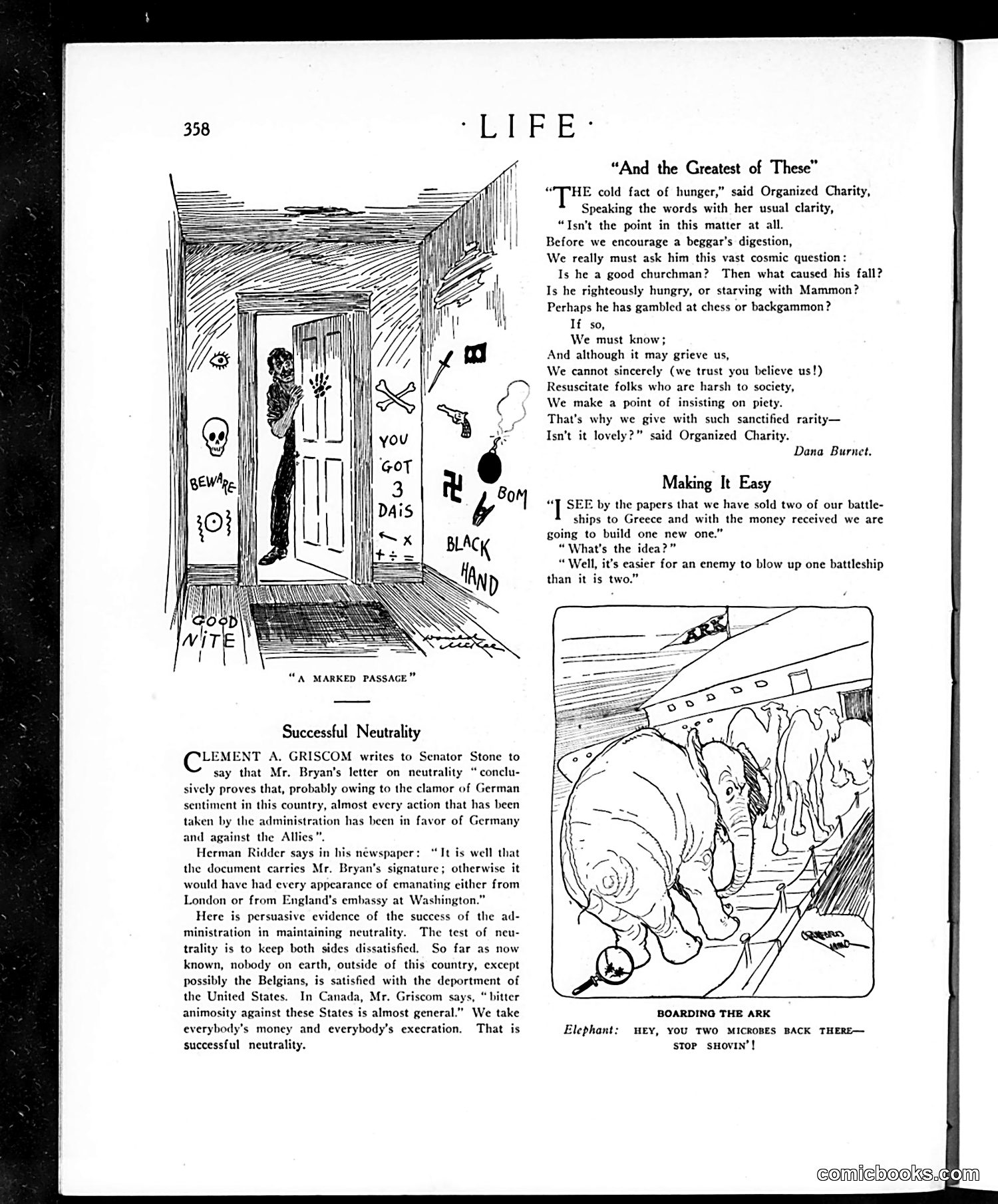
The cartoon depicts a skeletal, death-like figure standing in a doorway marked with ominous warnings: "BEWARE," "YOU GOT 3 DAIS," "BOM," "BLACK HAND," and "GOOD NITE." The phrase "A MARKED PASSAGE" suggests someone under threat of assassination. This appears to reference Mafia or anarchist violence in early 20th-century America, where the "Black Hand" was a known extortion threat (marked with skull symbols and crosses), and "marked passage" meant a person targeted for death. The three days countdown and threatening messages were typical intimidation tactics of criminal organizations operating during Prohibition era. The cartoon likely satirizes organized crime's grip on American society or immigrant criminal syndicates.
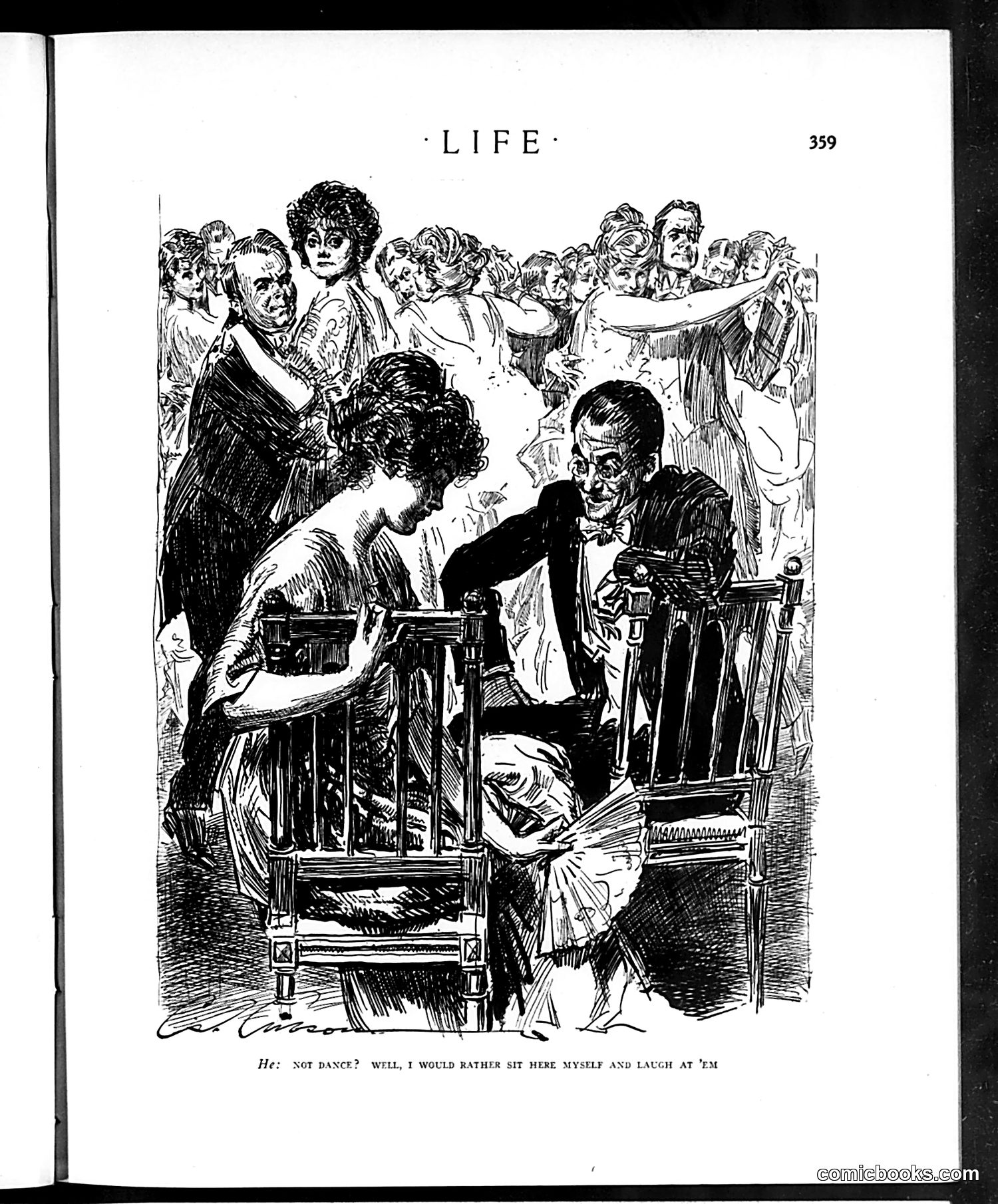
This is a single satirical illustration depicting a social scene at what appears to be a formal dance or party. A well-dressed man seated with a woman declines to dance, stating he would "rather sit here myself and laugh at 'em." The cartoon satirizes the social dynamics of upper-class entertainment in the early 20th century. The crowded background shows numerous figures engaged in dancing and socializing, while the central couple represents those who prefer observation and mockery to participation. The humor targets the pretensions and absurdities of formal social gatherings—suggesting that the spectacle of others' behavior provides more entertainment value than actual participation. The artist's signature appears at the bottom left, though it's not entirely legible in this reproduction.
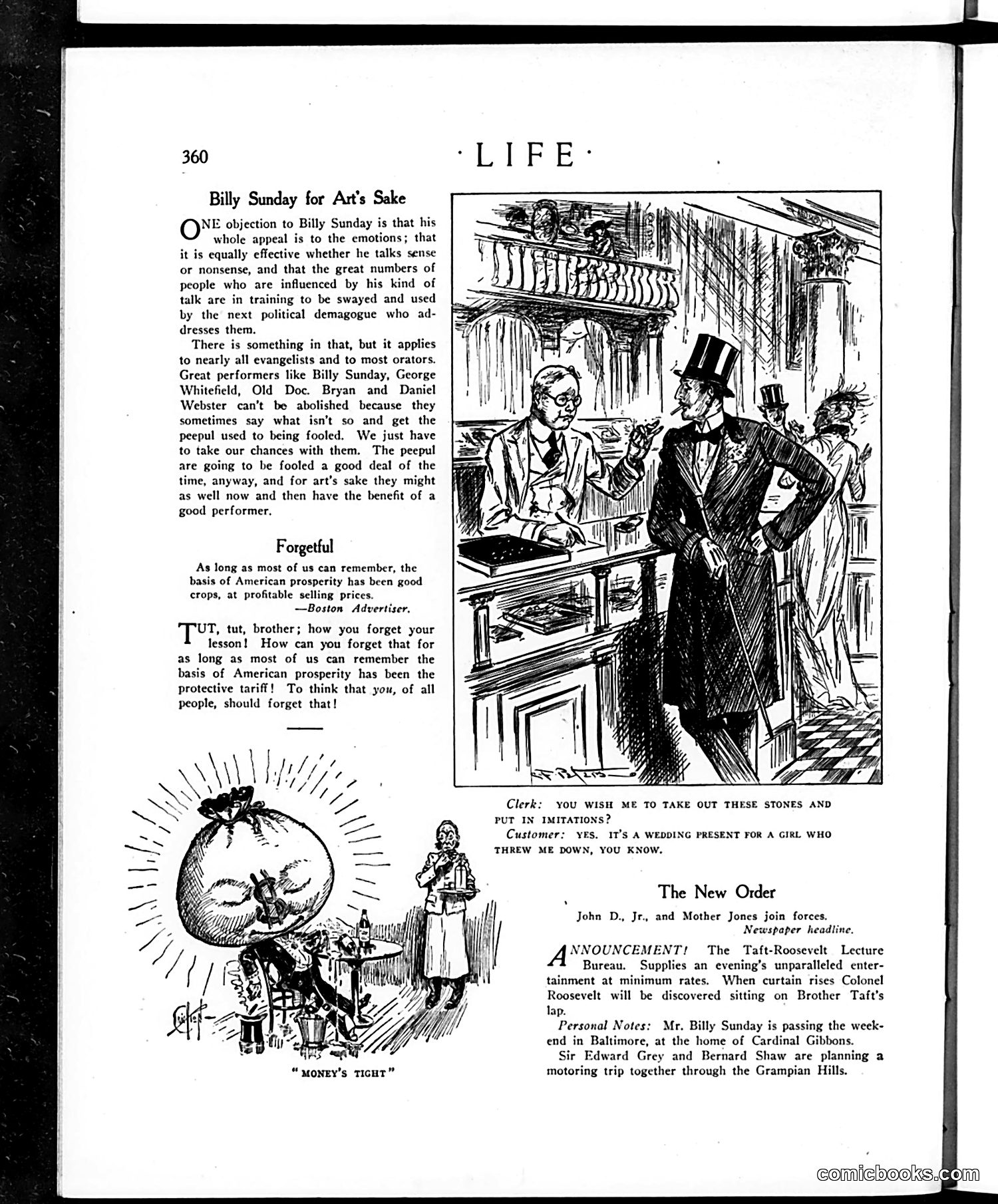
This page contains two separate pieces: **"Billy Sunday for Art's Sake"** (top left): A defense of evangelist Billy Sunday's inflammatory speaking style. The author argues that while Sunday's emotional appeals may seem crude, they're effective—and great performers have always used similar techniques. The piece advocates tolerating his methods "for art's sake." **"Forgetful"** (bottom left): A political cartoon showing a figure appearing to forget the protective tariff's historical role in American prosperity. The accompanying text sarcastically chides this "forgetfulness," suggesting someone is ignoring established economic policy. **The store scene** (right): A humorous exchange between a clerk and customer about imitation gemstones as a wedding gift—a man who "threw me down." The page reflects early 20th-century American debates about protectionism and evangelicalism.
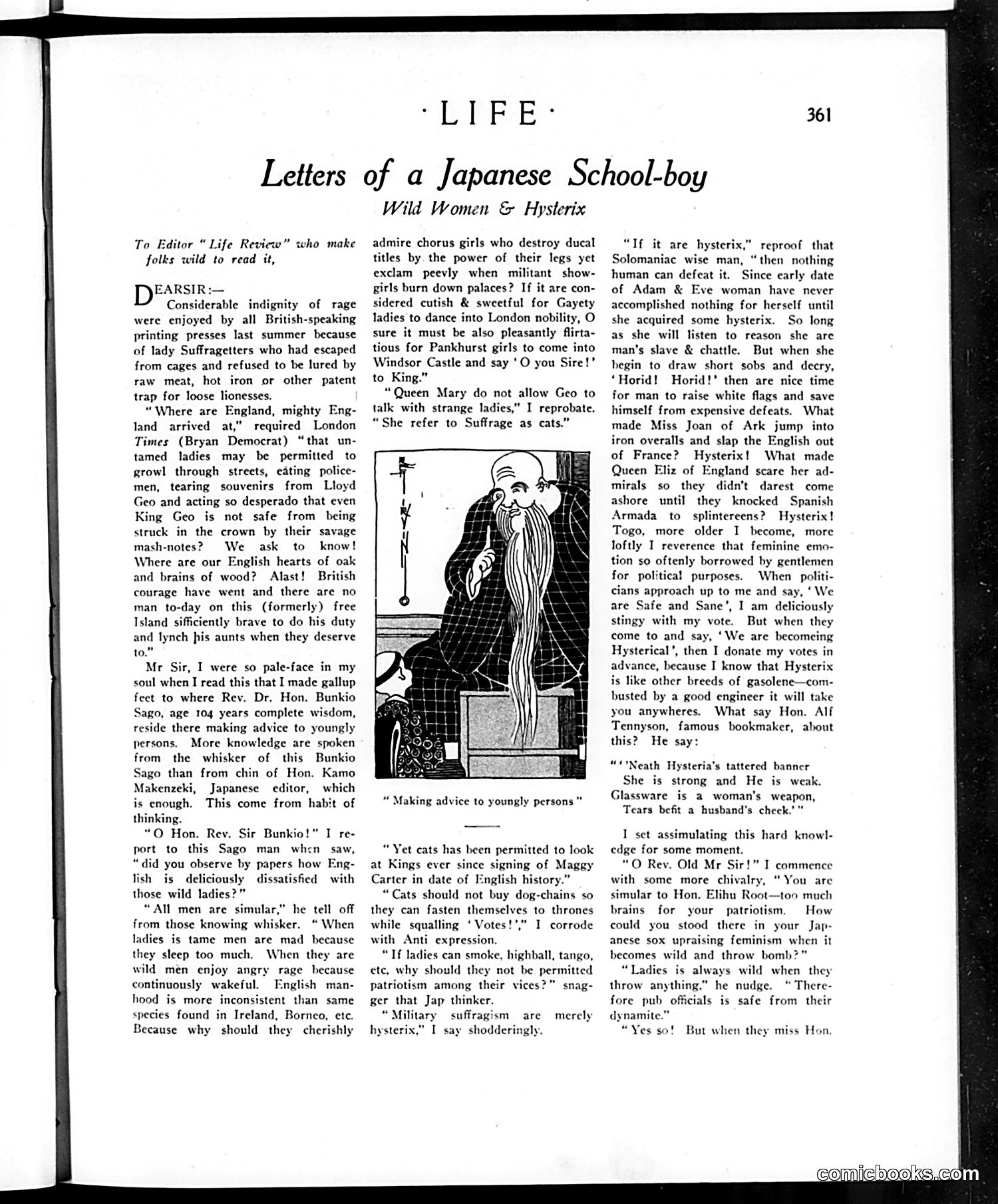
This page satirizes early 20th-century feminism and women's suffrage through a mock letter from a "Japanese School-boy." The unnamed cartoon figure (appearing to be an elderly Asian man with a long beard) represents a foreign observer commenting on British and American women's activism. The satire targets "wild women" and what the writer calls "hysteria"—attributing women's suffrage activism, smoking, dancing, and political engagement to emotional instability rather than legitimate grievance. References include suffragettes destroying property, Joan of Arc, and Queen Elizabeth, used dismissively to mock women's historical claims to authority. The piece argues women are naturally suited to domestic roles and that their activism undermines national stability. This represents *Life* magazine's conservative opposition to women's suffrage through orientalist satire—using a "foreign perspective" to mock contemporary feminist movements as absurd and dangerous.
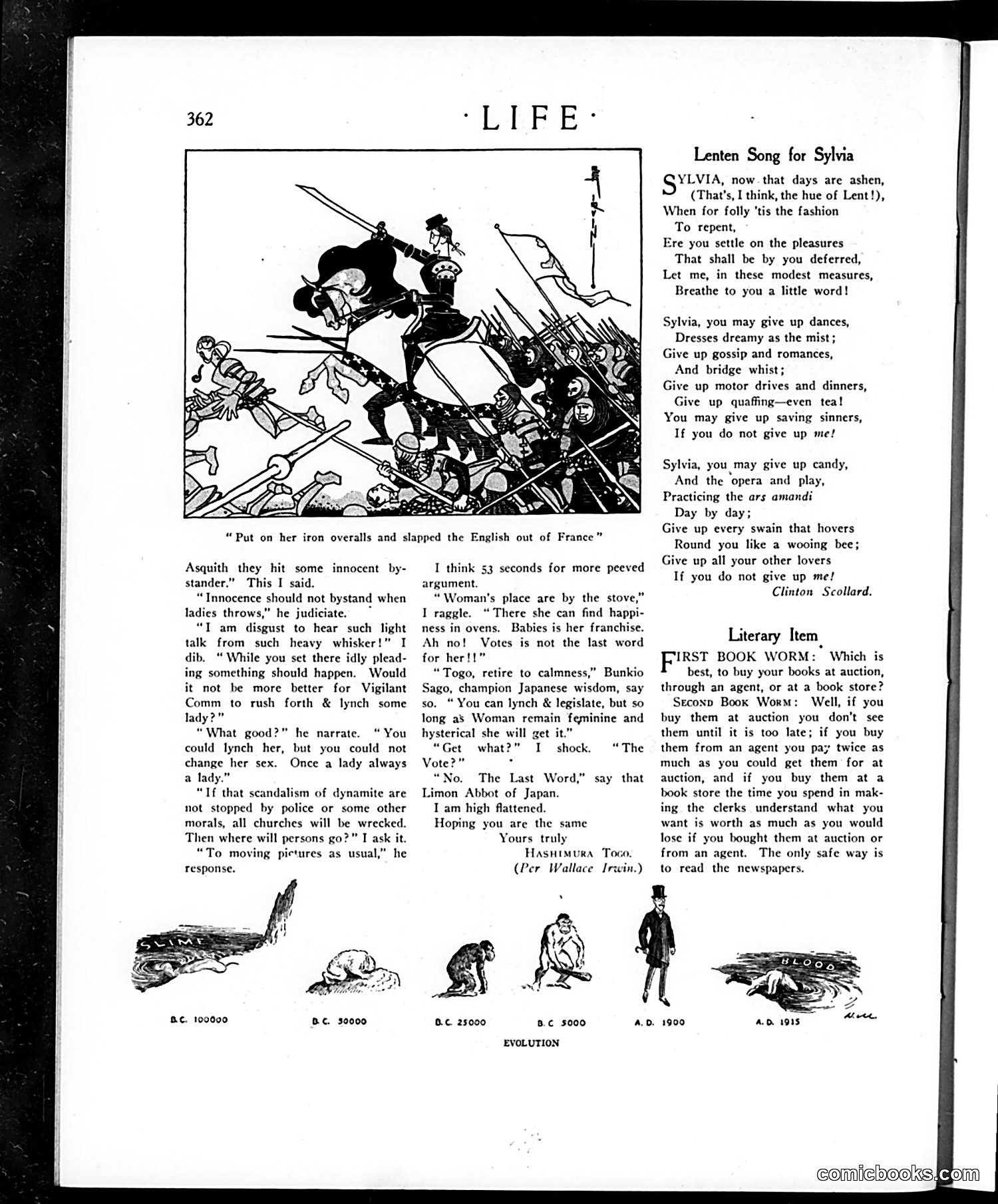
The main illustration shows a chaotic battle scene with figures in military attire wielding swords and flags. The caption reads: "Put on her iron overalls and slapped the English out of France," which appears to reference Joan of Arc—the medieval French military leader who fought the English. The accompanying dialogue satirizes a debate about women's roles during wartime. Characters argue whether women should engage in military combat versus domestic duties ("Woman's place are by the stove"). The satire mocks both pacifist and militarist positions regarding female participation. The "Evolution" diagram at bottom humorously traces human development from prehistoric times to 1915, likely commenting on contemporary social progress debates. The "Lenten Song for Sylvia" poem offers religious/moral commentary on Lenten sacrifice, unrelated to the military satire above.
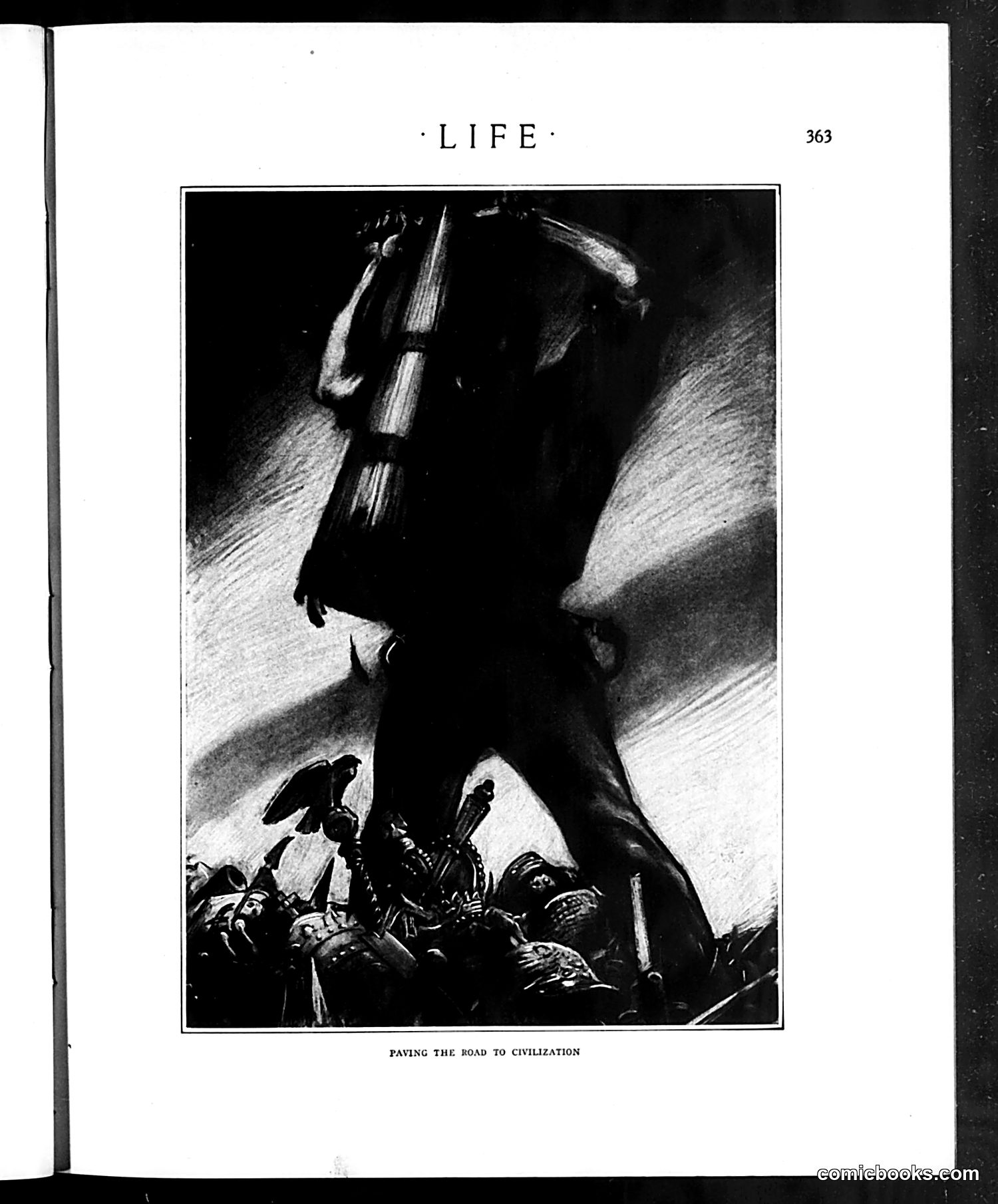
This satirical illustration depicts a massive figure wielding what appears to be a club or sledgehammer, crushing smaller figures beneath its feet. The caption "Paving the Road to Civilization" employs heavy irony—suggesting that the violent subjugation shown represents "progress" or "civilization." This likely critiques imperial or colonial violence, portraying how powerful nations or groups justified brutal conquest as bringing "civilization" to conquered peoples. The crushed figures at the base represent those being violently subjugated, while the towering aggressor symbolizes imperial authority. The image's dark, dramatic woodcut style emphasizes the brutality being mocked. Early Life magazine frequently used such satirical imagery to critique American imperialism, militarism, and the violent rhetoric surrounding "civilizing missions."
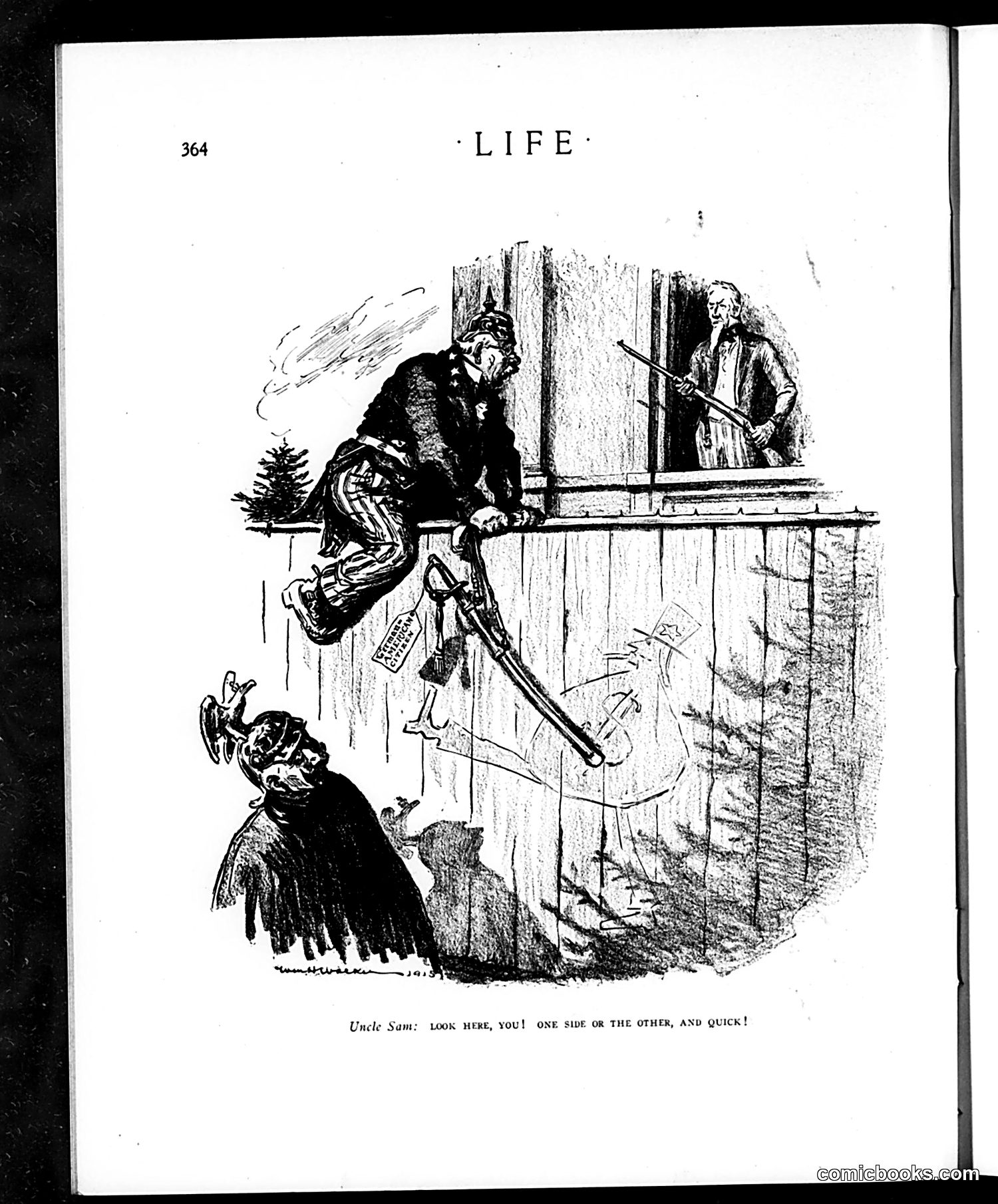
This is a satirical cartoon featuring **Uncle Sam** (identifiable by his characteristic appearance and top hat) wielding a rifle, demanding that figures below choose a side "or the other, and quick!" The cartoon appears to reference a **political or military pressure situation**, likely from the Civil War era or a period of national conflict requiring citizens to declare allegiance. Uncle Sam is positioned aggressively above, while figures below—appearing to include civilians and possibly soldiers—face his ultimatum. The satire suggests **forced patriotism or coercion into political/military commitment**. The "look here, you!" tone conveys impatience and authoritarianism, mocking the pressure placed on citizens to take sides quickly without deliberation. The exact historical moment remains unclear from the image alone, but the cartoon criticizes aggressive nationalism or military conscription tactics.
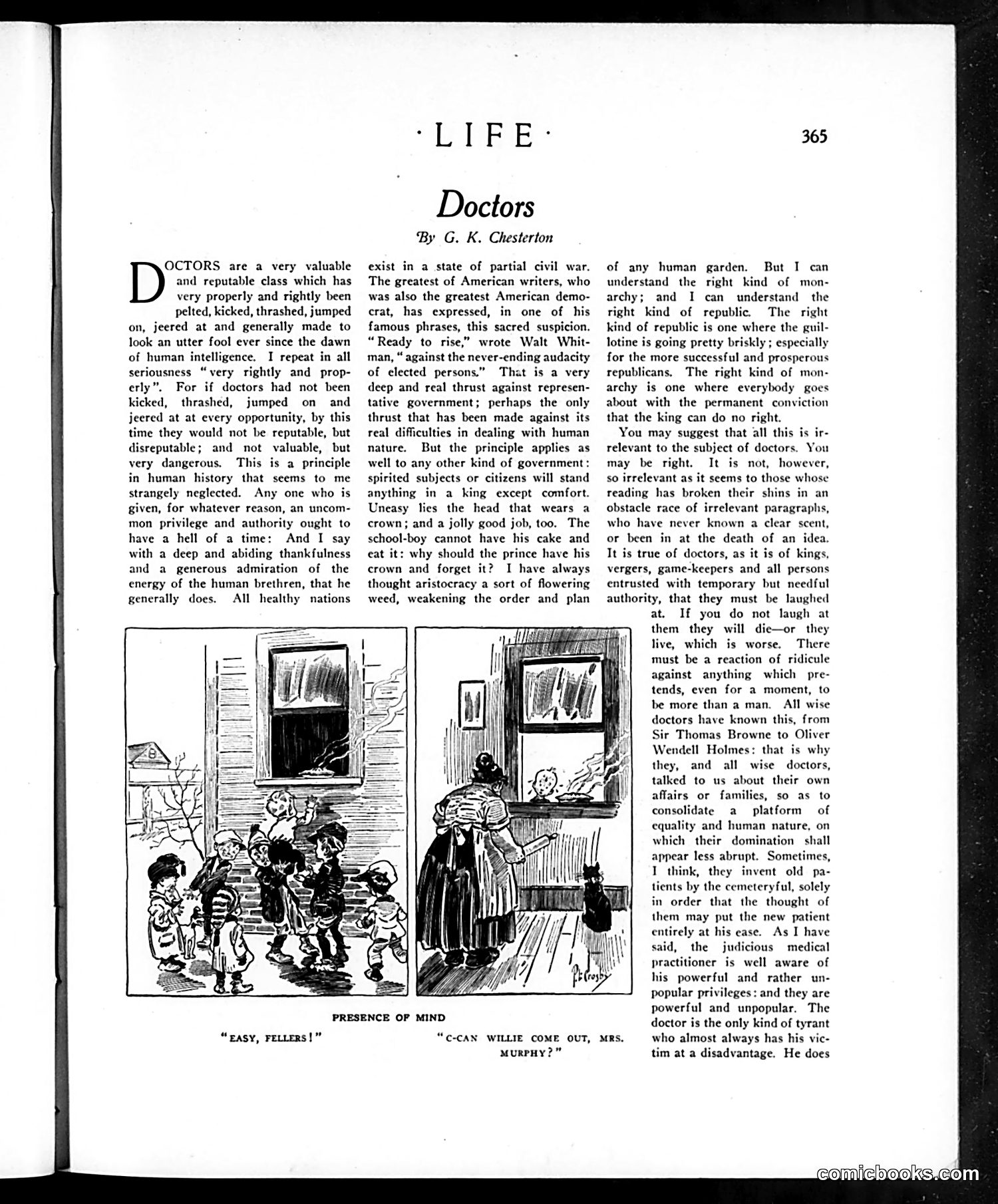
This is G.K. Chesterton's essay "Doctors" accompanied by two cartoon panels illustrating the concept of "Presence of Mind." **The Cartoons:** The left panel shows children cheerfully greeting a doctor with "Easy, Fellers!" The right panel depicts a woman at her door asking "C-can Willie come out, Mrs. Murphy?" — likely a child asking permission from the doctor's wife. **The Satire:** Chesterton argues that doctors, like all authority figures (kings, aristocrats), need to be regularly mocked and kept humble to remain respectable. He cites Walt Whitman's democratic suspicion of "elected persons" and suggests that without ridicule, those with power become dangerous tyrants. The cartoons illustrate this principle: showing doctors as approachable figures who interact with ordinary children suggests successful doctors maintain humanity and relatability rather than distant authority. **Modern Context:** This reflects early-20th-century anxieties about professional expertise and power—the tension between respecting expertise while resisting authoritarianism through humor and familiarity.
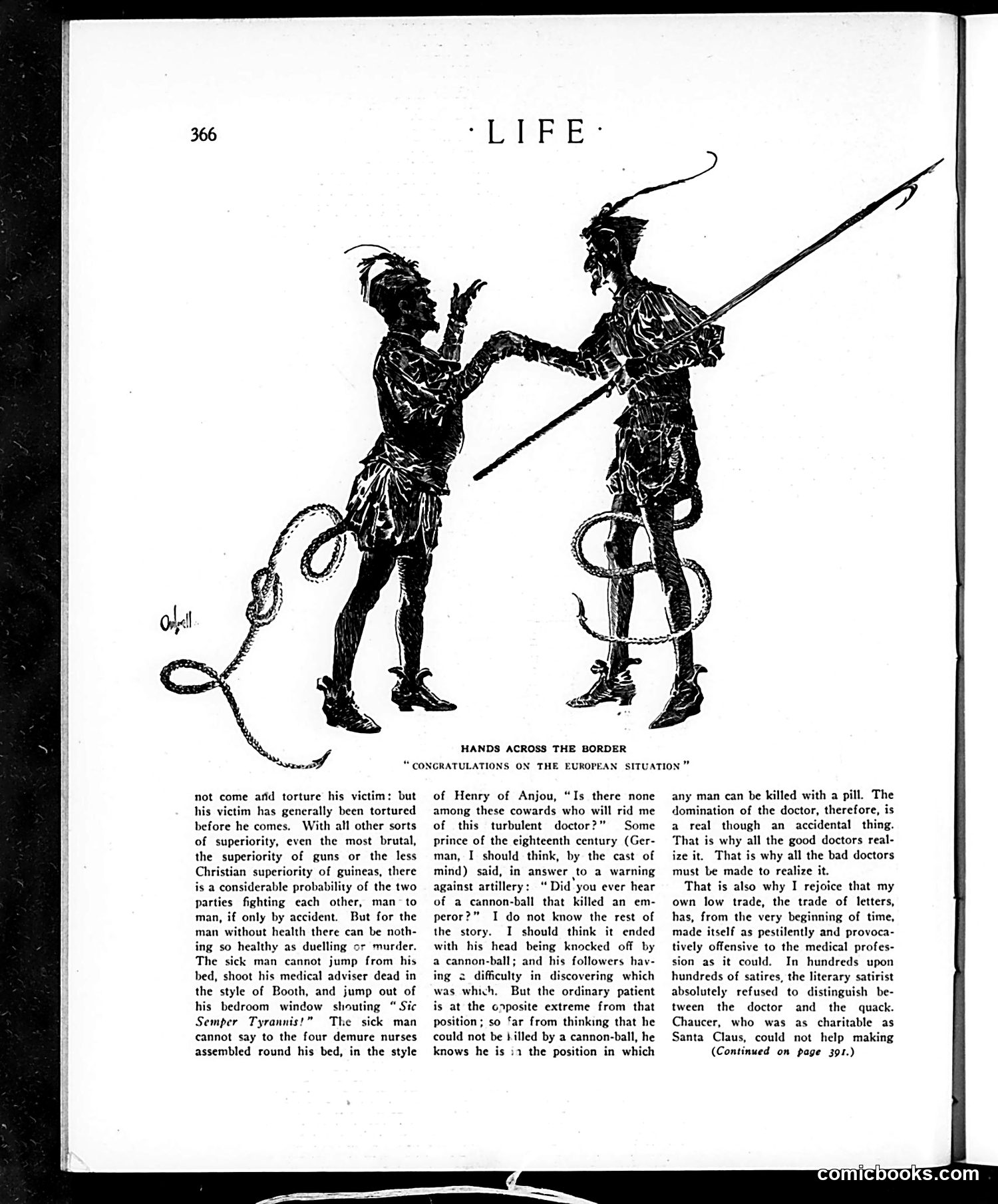
This political cartoon depicts two figures shaking hands across a border, likely representing European nations congratulating each other—though the specific nations aren't labeled in the visible portion. The figures wear period military/formal dress with ornate details and are bound together by rope, suggesting they are metaphorically "tied" or connected despite being on opposite sides of a border. Given the caption's reference to "European situation" and the date context (Life magazine), this likely satirizes diplomatic relations during a period of European tension or conflict. The binding imagery suggests ironic commentary: the handshake appears friendly on the surface, but the restraining ropes imply the nations are actually constrained, trapped, or hypocritically bound together despite apparent division. The accompanying text discusses medical authority and quackery, suggesting the page may be making broader points about deception and false civility in relationships—possibly between nations or institutions.
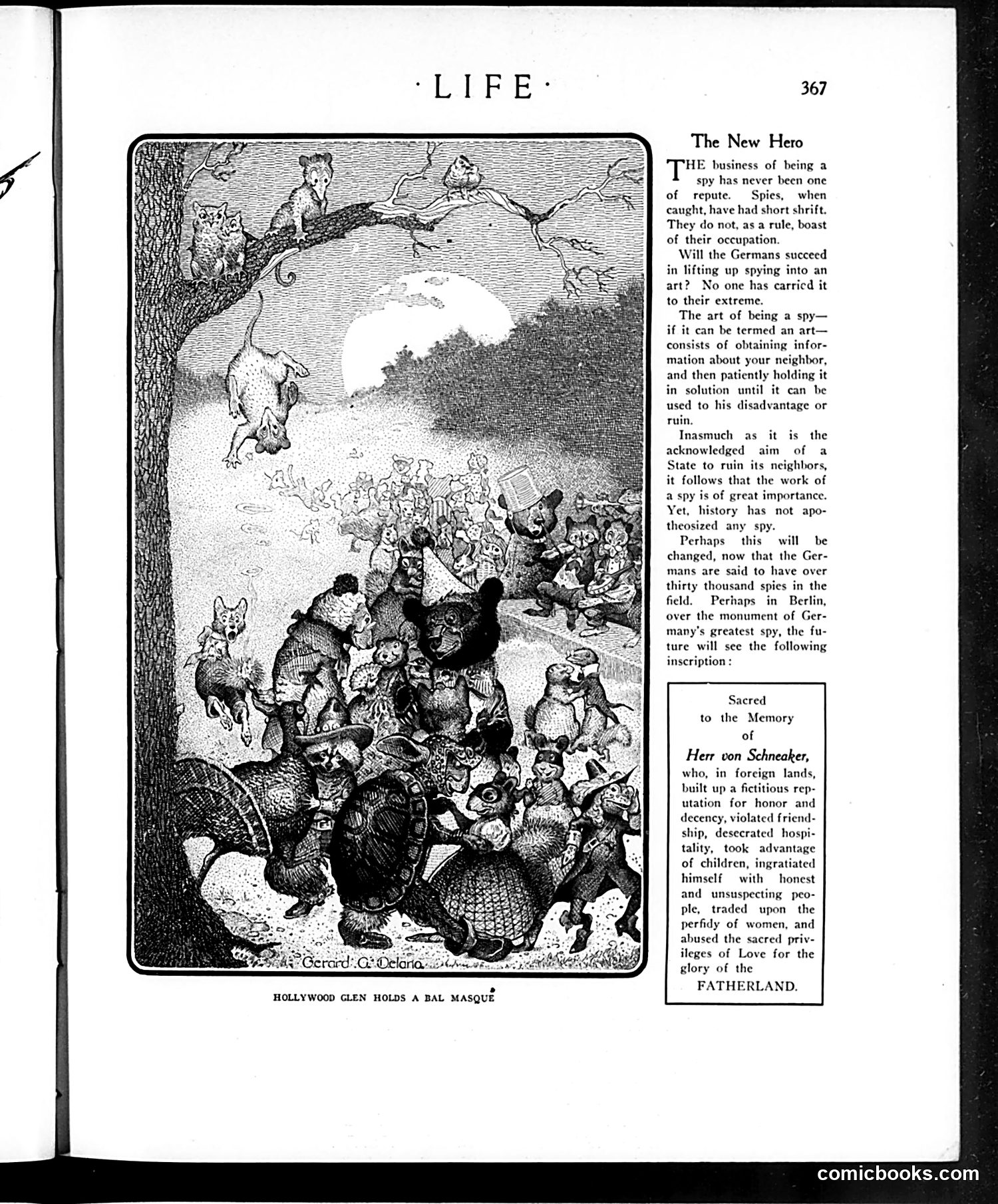
This World War I-era piece satirizes Germany's extensive spy network (reportedly 30,000 agents) by ironically celebrating espionage as a "new" heroic profession. The text mocks the German elevation of spying to an art form, contrasting this with history's usual disdain for spies. The mock epitaph for "Herr von Schneaker" is the satirical centerpiece: it catalogs the dishonorable tactics German spies allegedly employed—exploiting hospitality, manipulating women and children, abusing trust—all "for the glory of the Fatherland." The portrait of a masked ball at Hollywood Glen (left) visually reinforces themes of deception and hidden identities. The satire cuts both ways: it condemns German espionage practices while questioning whether a nation willing to venerate such dishonor deserves respect. The inscription's sardonic tone suggests the author finds both the spy work and Germany's willingness to celebrate it morally repugnant.
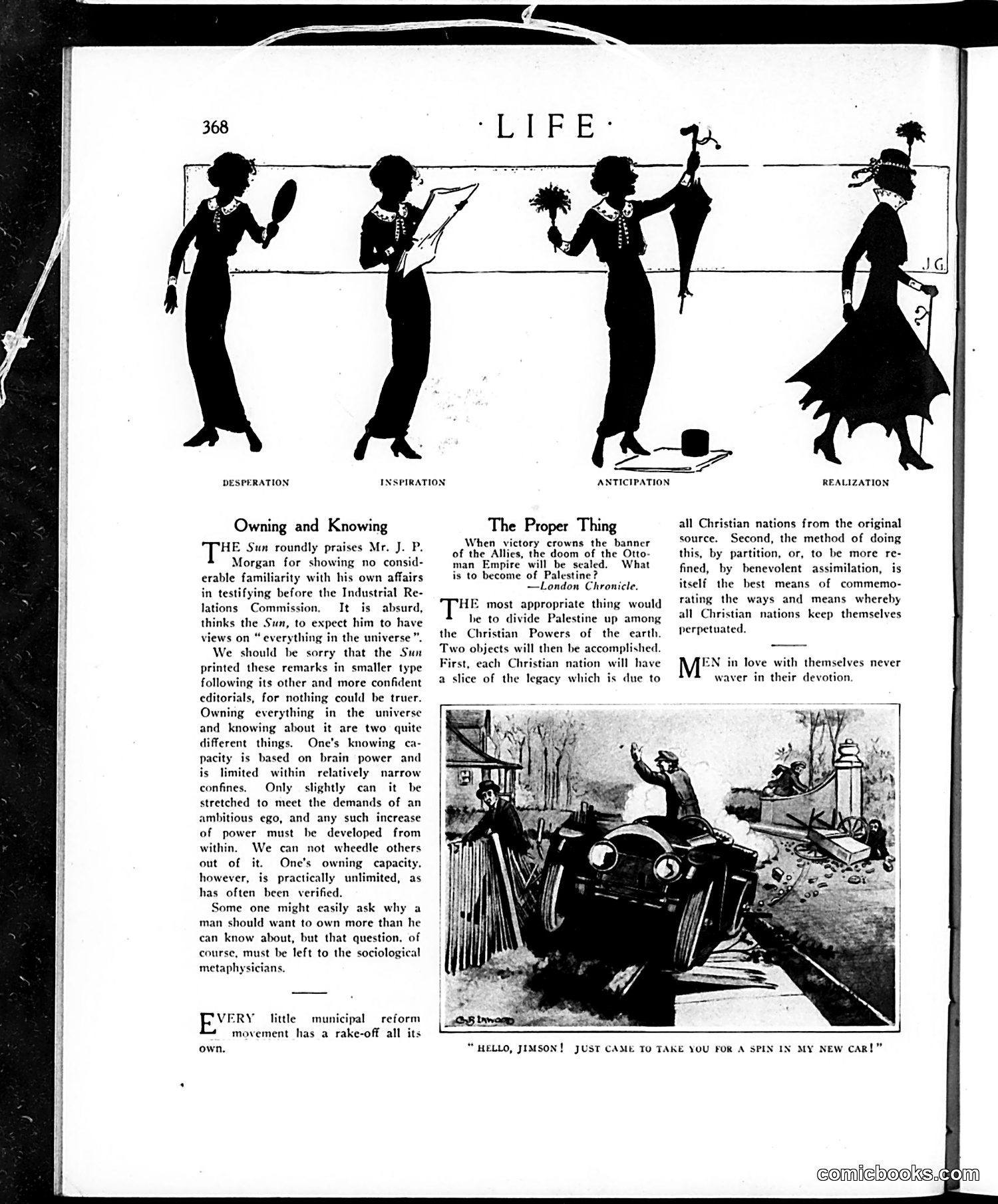
**Top Section - Four Silhouettes:** These illustrations labeled "Desperation," "Inspiration," "Anticipation," and "Realization" appear to satirize women's emotional states or behavior, shown through exaggerated poses (mirror-checking, gesturing dramatically, holding flowers, dancing). This reflects period stereotypes about female emotionalism. **"Owning and Knowing" Article:** Satirizes J.P. Morgan's testimony before the Industrial Relations Commission, where he claimed ignorance about his own vast business affairs. Life's point: one can own enormous wealth without understanding it—and this gap between ownership and knowledge reveals something absurd about unchecked accumulation of power. **"The Proper Thing" Article:** Sarcastically proposes dividing Palestine among Christian powers after the Ottoman Empire's expected defeat in World War I. The satire attacks Western imperialism and hypocrisy: dividing colonized territory while claiming "benevolent assimilation" and Christian virtue—mocking how imperial powers justify territorial conquest as civilization or charity. **Bottom Illustration:** Shows a car accident scene with caption "Hello, Jimson! Just came to take you for a spin in my new car!"—likely satirizing dangerous new automobile culture or reckless wealthy behavior.
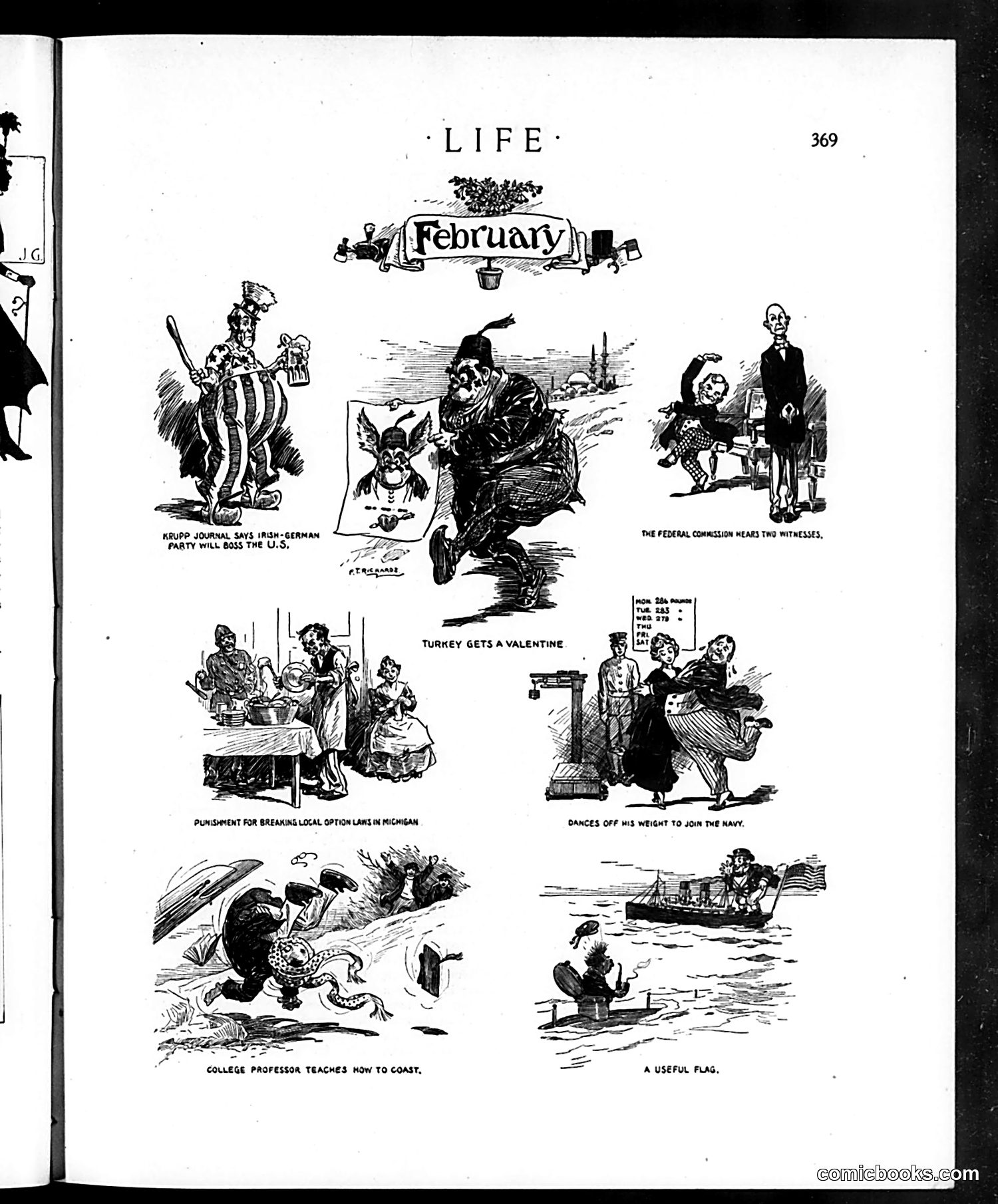
This page contains satirical cartoons addressing early 20th-century American concerns: **Top left**: References Krupp Journal (German military-industrial interests) warning of Irish-German political influence in U.S. politics—reflecting nativist anxieties about immigrant political power. **Center**: "Turkey Gets a Valentine" appears to reference Ottoman politics or international diplomacy of the era. **Other cartoons** mock: local Michigan politics (breaking liquor laws during Prohibition), naval recruitment ("dances off his weight to join the Navy"), and coastal safety ("college professor teaches how to coast," "a useful flag"). The satire targets political corruption, Prohibition enforcement, immigrant influence, and social follies of the period. The artwork uses exaggerated caricature typical of early Life magazine's pointed political commentary.
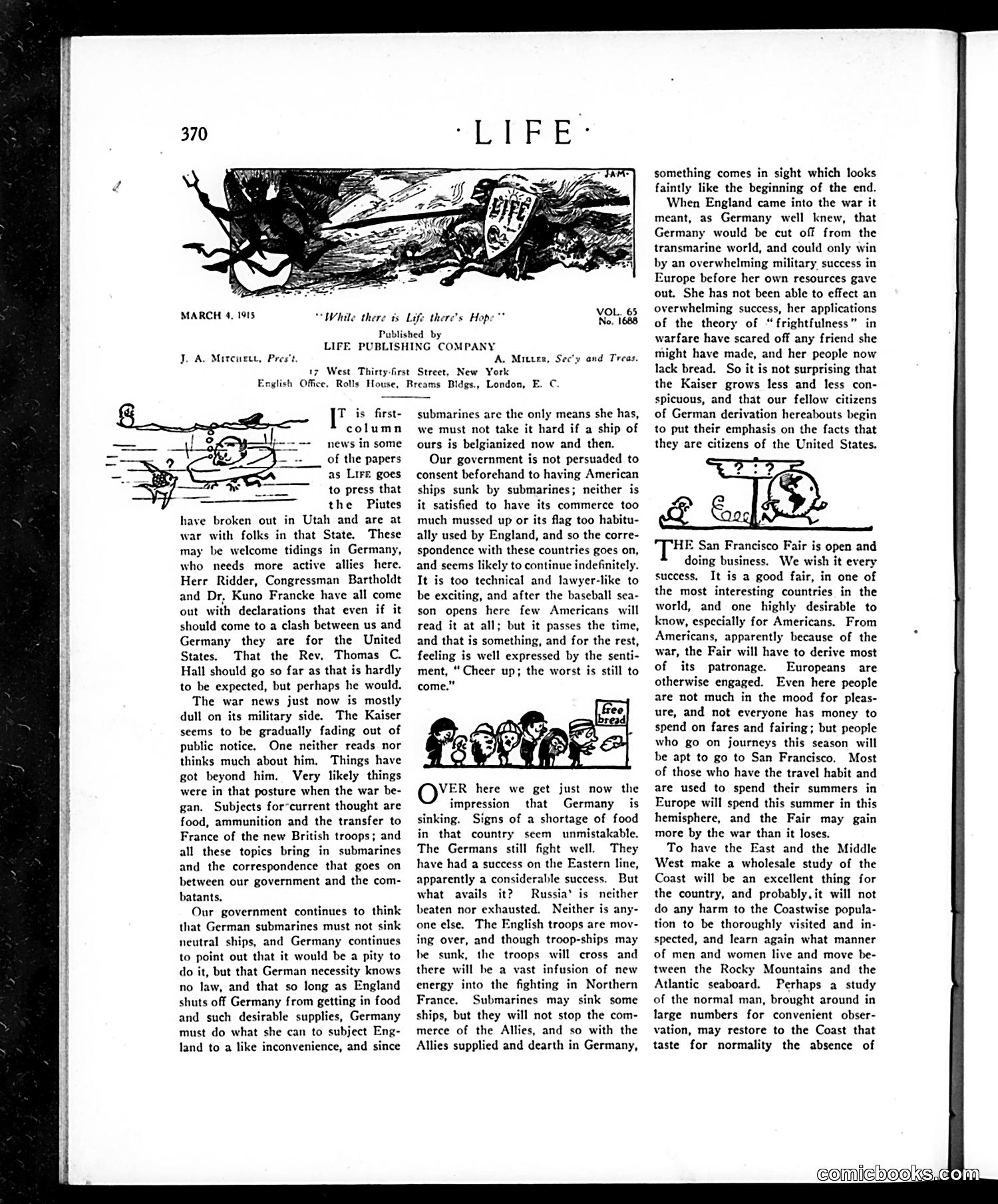
This page contains editorial commentary on World War I, written when America remained neutral. The editor discusses Germany's military situation and submarine warfare against neutral shipping. **Key satirical points:** 1. **The "Piutes" reference**: A joke suggesting Native American uprisings in Utah would be welcome news to Germany as it would distract American allies. 2. **The Kaiser fading from notice**: The editor sardonically observes that Kaiser Wilhelm II has become less prominent in American public consciousness—"things have got beyond him"—suggesting his relevance is diminishing. 3. **"Belgianized" ships**: A dark reference to Germany's invasion and occupation of Belgium (1914), used here as a verb meaning "sunk without warning." 4. **The core argument**: Germany faces inevitable defeat because the British naval blockade starves her economy while Allied forces (especially arriving British troops) receive supplies. The editor predicts Germany cannot win without immediate overwhelming military success in Europe. The tone is confident in Allied victory despite current military stalemate, reflecting American editorial opinion in early 1915.
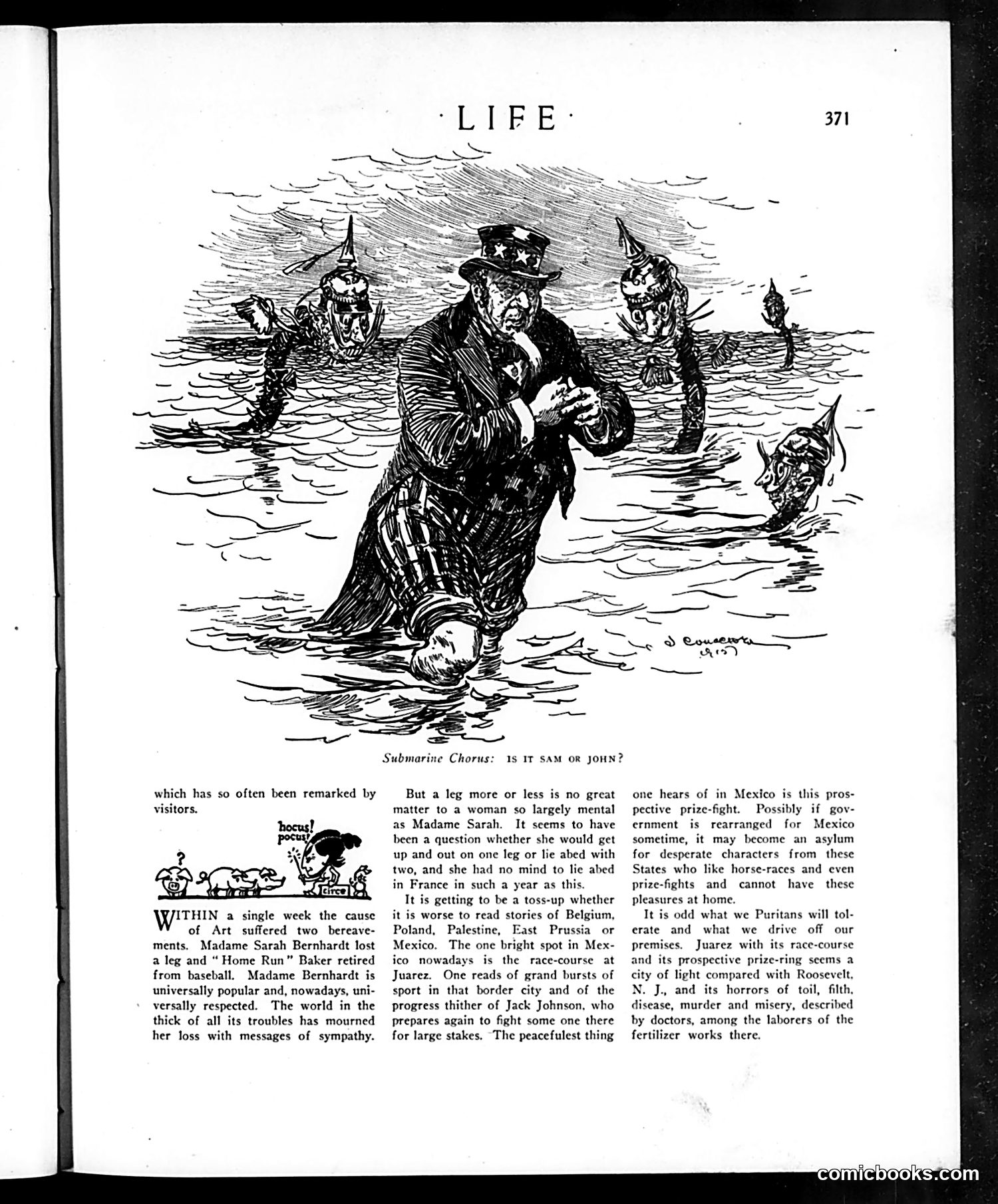
This satirical illustration depicts underwater figures (likely German U-boats personified as demonic creatures) asking "IS IT SAM OR JOHN?"—a reference to the contemporaneous boxing rivalry between Jack Johnson and Sam Langford during World War I era. The accompanying text uses this boxing comparison as social commentary. It contrasts Mexico's relative "peacefulness" (hosting Jack Johnson's prize fights in Juarez) with the actual horrors of American industrial life—specifically Roosevelt, New Jersey's fertilizer factories, where workers endure "toil, filth, disease, murder and misery." The satire critiques American Puritanism: society tolerates brutal working conditions at home while condemning boxing entertainment. The "submarine chorus" suggests dark forces observing American hypocrisy. The page also notes Madame Sarah Bernhardt's amputation and "Home Run" Baker's retirement from baseball as cultural losses.
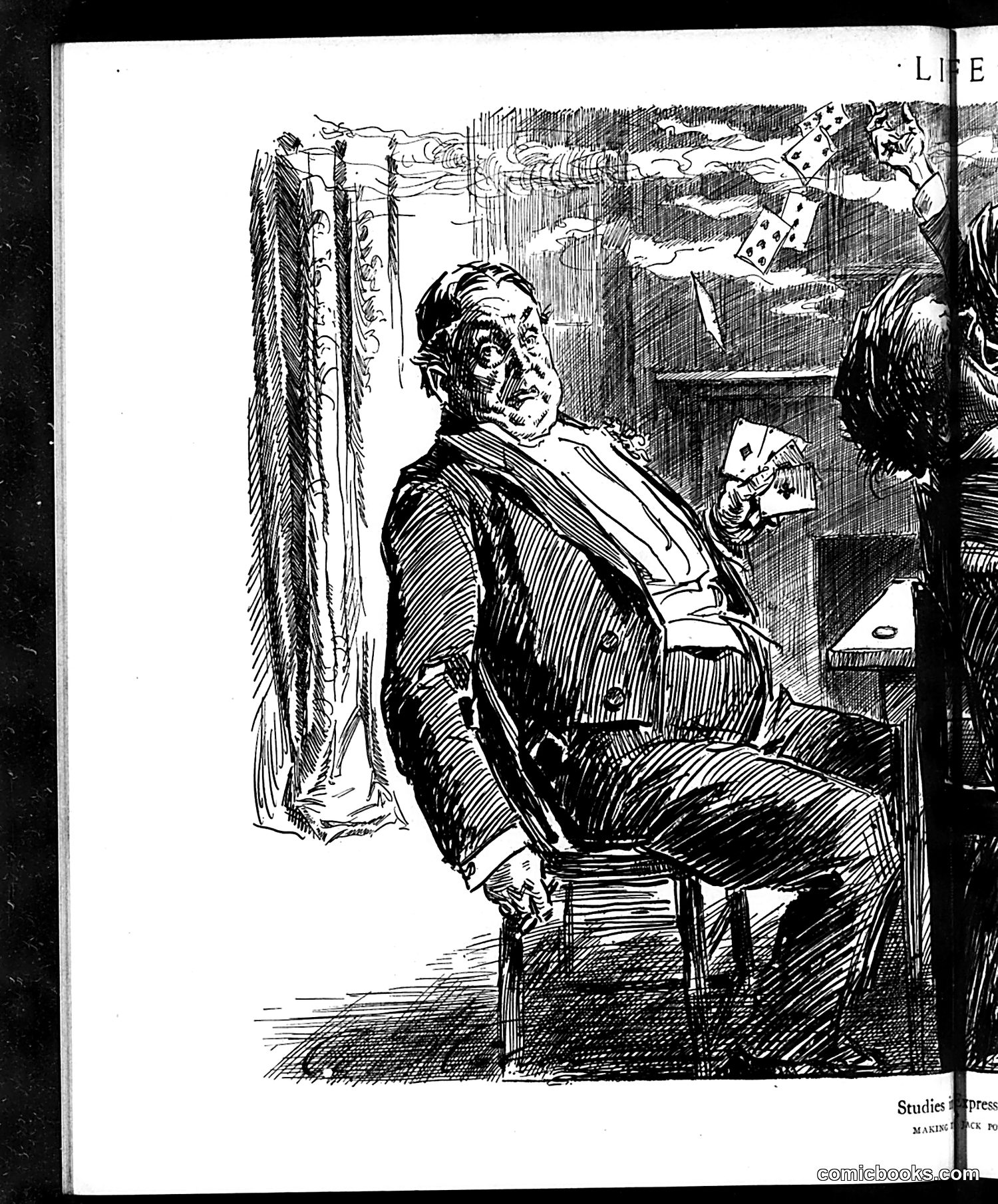
This is a satirical illustration from *Life* magazine showing a portly gentleman seated in a chair, looking back over his shoulder with a somewhat guilty or anxious expression. Playing cards are visible floating in the background, and other figures appear in the scene. The cartoon likely satirizes gambling or financial speculation—the scattered cards and the man's uncomfortable demeanor suggest he's been caught or is worried about being discovered engaging in such activities. The formal dress and indoor setting indicate this concerns a respectable gentleman, making the humor stem from the contrast between his appearance of propriety and his apparent secret vice. Without visible text identifying the specific figure or date, I cannot determine which historical or political scandal this references.
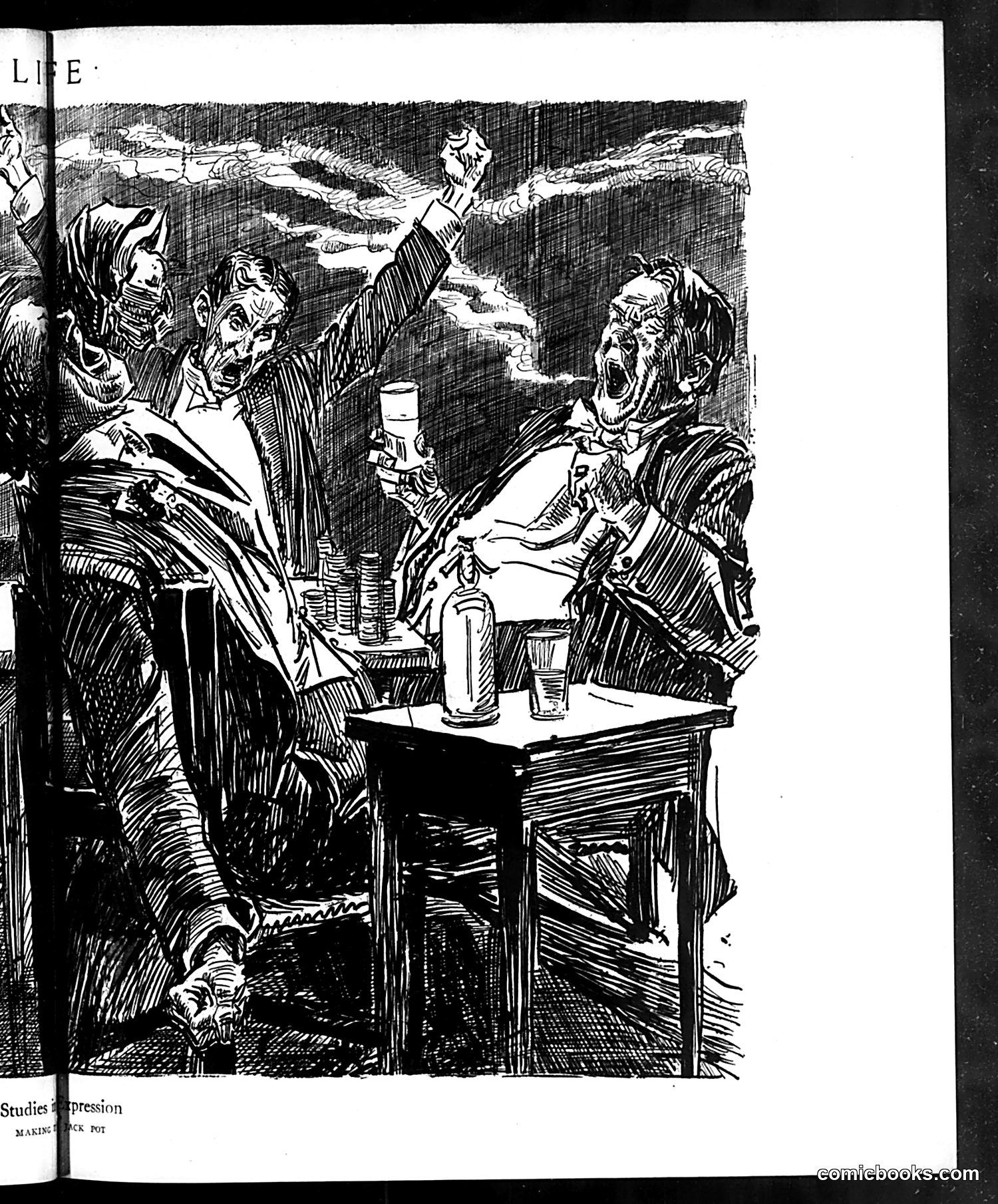
This satirical cartoon depicts a group of men in late 19th or early 20th-century dress gathered around a table with bottles and glasses, appearing to be gambling or drinking. The title "Making a Jack Pot" suggests they're pooling stakes in a card game. The exaggerated facial expressions and caricatured features convey mockery of the participants' behavior—their animated, grotesque faces suggest drunkenness, greed, or foolishness. The "Studies in Expression" heading indicates Life magazine is satirizing human behavior and vices through visual caricature. The cartoon likely critiques gambling, drinking culture, or financial speculation among men of that era, using exaggeration and unflattering portraiture as comedic weapons against these social behaviors.
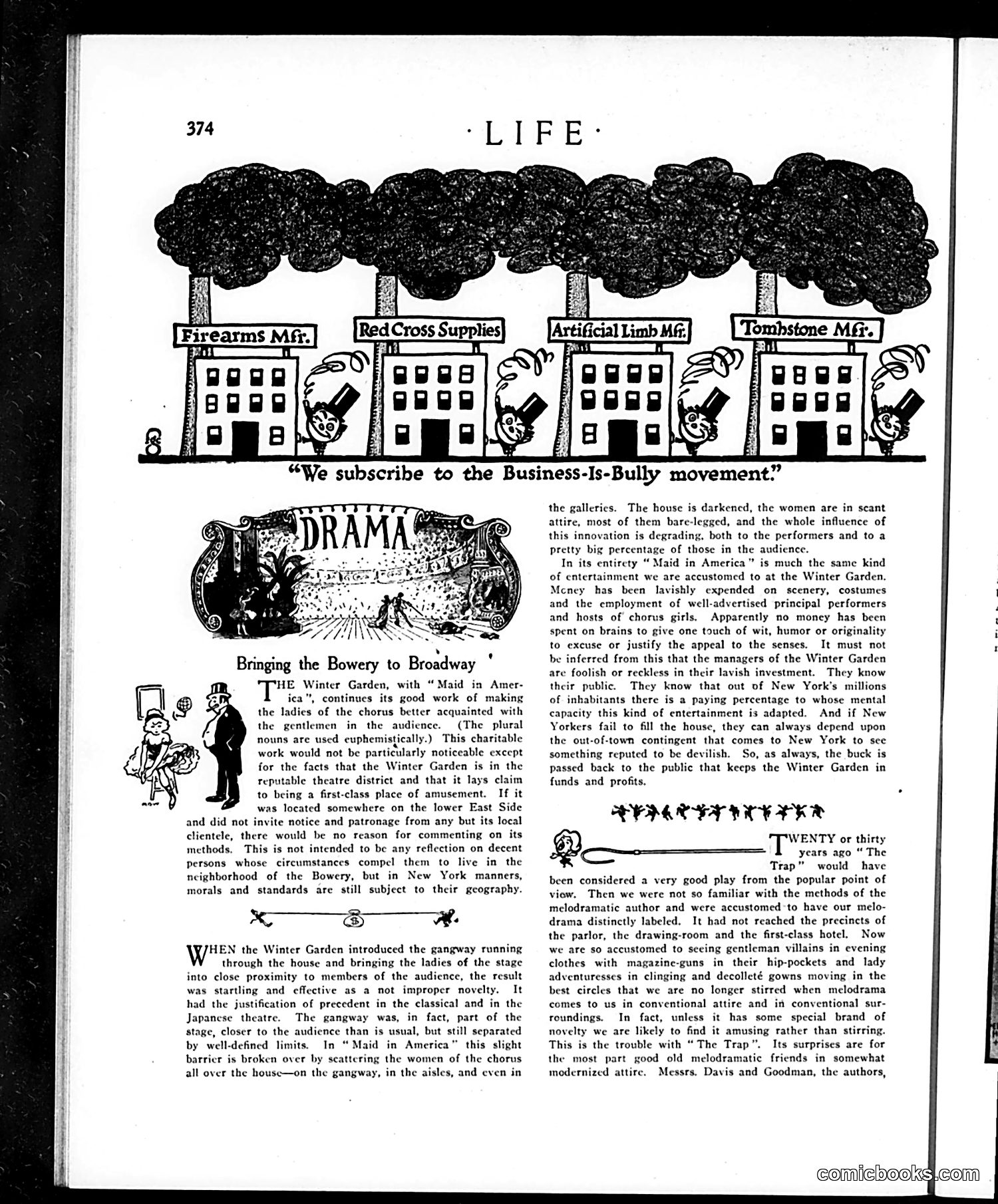
The top cartoon satirizes corporate behavior during the early 20th century. Four identical factory buildings—labeled Firearms Mfr., Red Cross Supplies, Artificial Limb Mfg., and Tombstone Mfg.—stand in a row, each operated by the same businessman character (shown in the windows). The joke exposes cynical wartime profiteering: the same businessman profits from every stage of conflict, from weapons and medical supplies to prosthetics and coffins. The caption mocks the "Business-Is-Bully movement"—likely referring to Theodore Roosevelt's "strenuous life" philosophy or corporate triumphalism—by demonstrating how businessmen benefit from human suffering and death regardless of which products they sell. Below, the text critiques the Winter Garden theater's "Maid in America" for its degrading treatment of chorus girls scattered throughout the darkened house in minimal clothing, conflating theatrical "innovation" with exploitation.
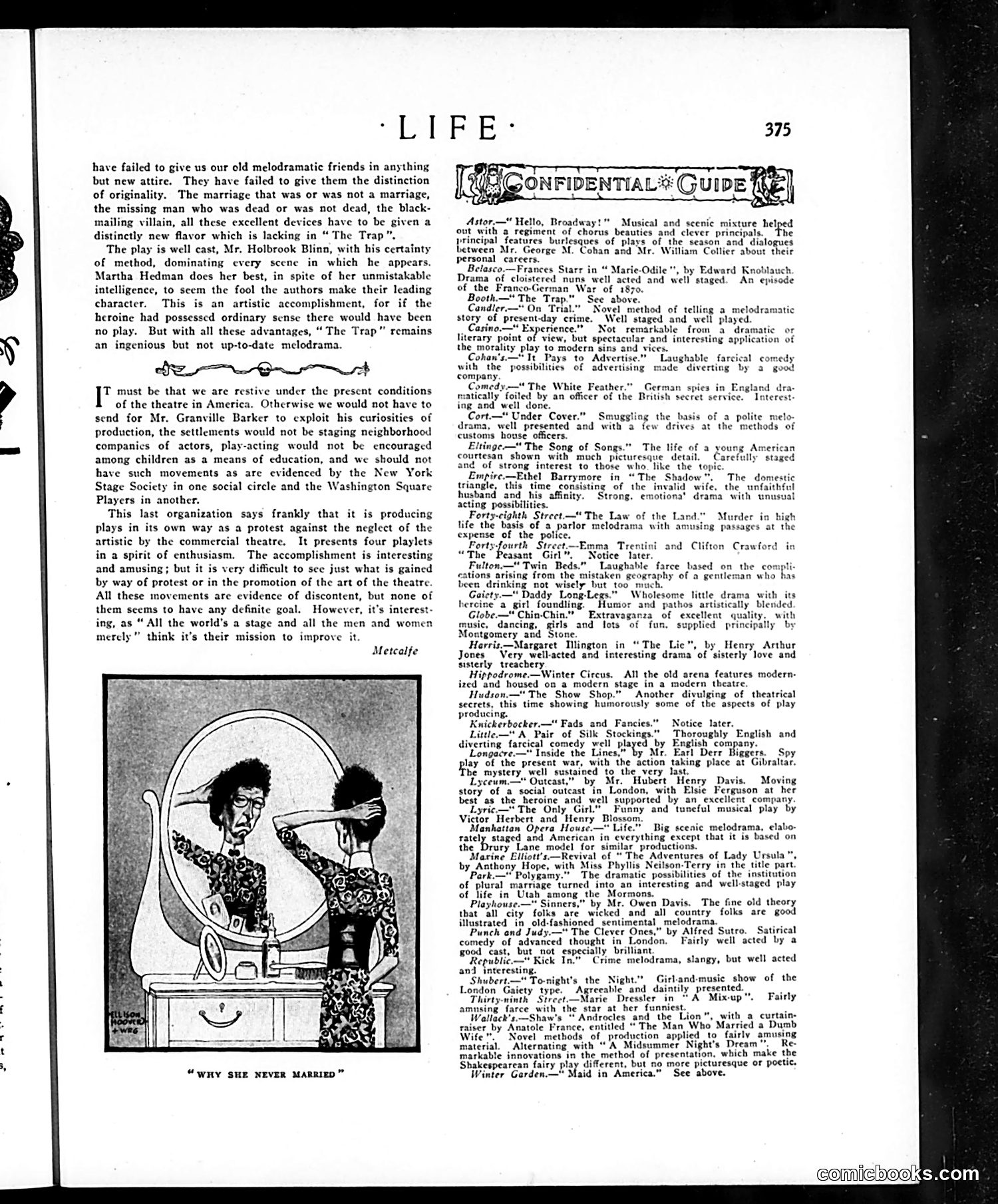
This cartoon depicts a woman in an elaborate, ornate dress looking at her reflection in a mirror—but the reflection shows a man in similarly decorative clothing. The satire appears to comment on theatrical excess and artificiality in early 20th-century Broadway productions. The page surrounding it reviews contemporary plays, noting that the theater has become overly reliant on spectacle ("chorus beauties," "picturesque detail") rather than genuine artistic innovation. The caption "Why She Never Married" likely suggests the joke: the woman is so consumed by theatrical vanity and ornamental self-regard that she has no room for genuine human connection. This reflects broader criticism in the text about American commercial theater prioritizing visual spectacle and melodramatic conventions over substantive dramatic art—a concern mentioned throughout the "Confidential Guide" reviews on the page.
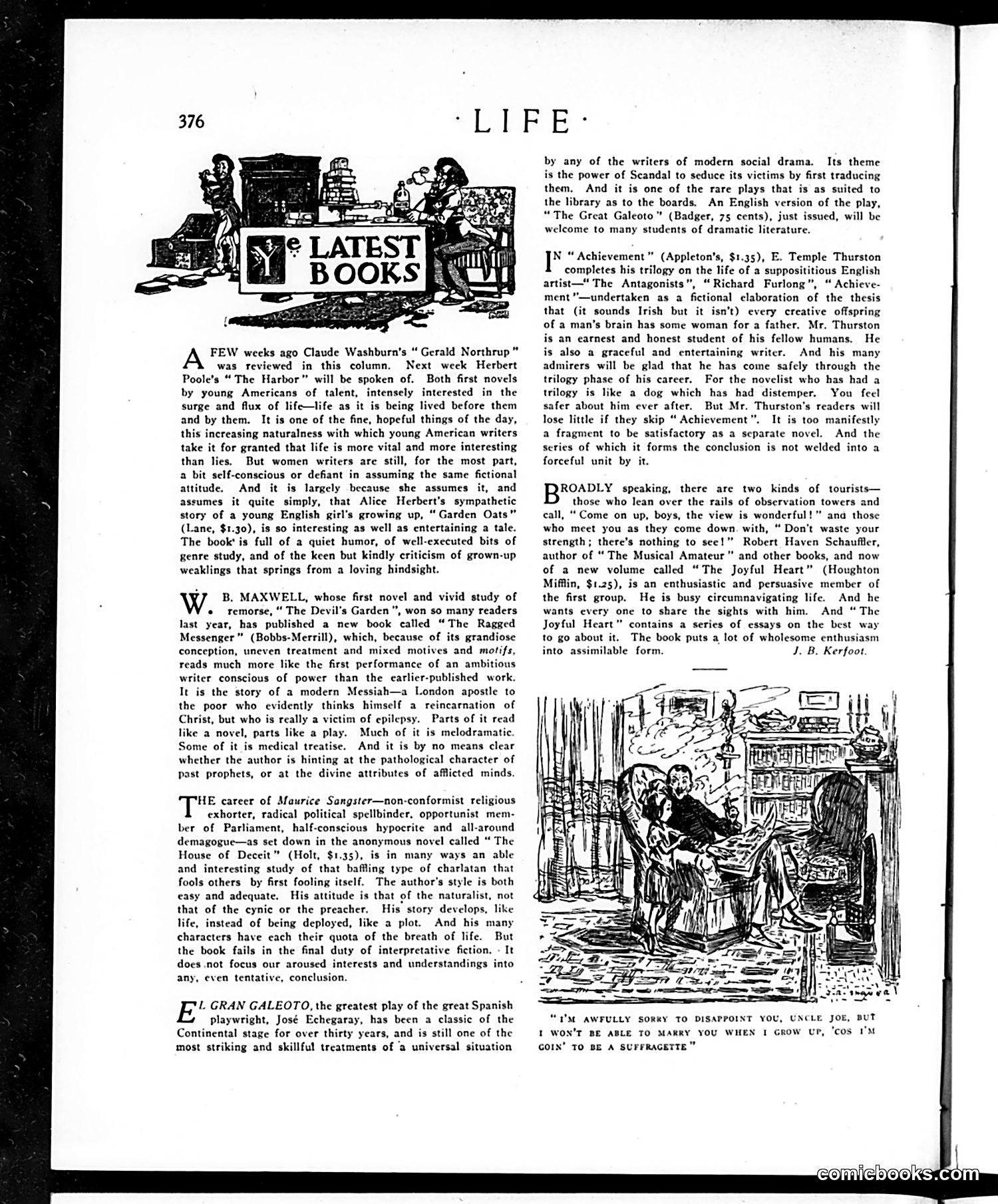
This page is a **book review column**, not a political cartoon. It discusses several contemporary novels and plays, likely from the early 1900s based on publication details. The reviews cover works exploring social themes: a novel about a "modern Messiah" figure afflicted with epilepsy; a study of a charlatan religious/political demagogue ("Maurice Sangster") who deceives others; and commentary on how scandal corrupts innocence. The illustration on the right appears to be a **domestic scene** from one of the reviewed works, showing an interior with figures and accompanying dialogue: "I'M AWFULLY SORRY TO DISAPPOINT YOU, UNCLE JOE, BUT I WON'T BE ABLE TO MARRY YOU WHEN I GROW UP, 'COS I'M GOIN' TO BE A SUFFRAGETTE." This joke references the **women's suffrage movement**, mocking it by having a child reject a (humorous) marriage proposal to join suffragettes instead—reflecting contemporary satirical dismissal of women's political activism.
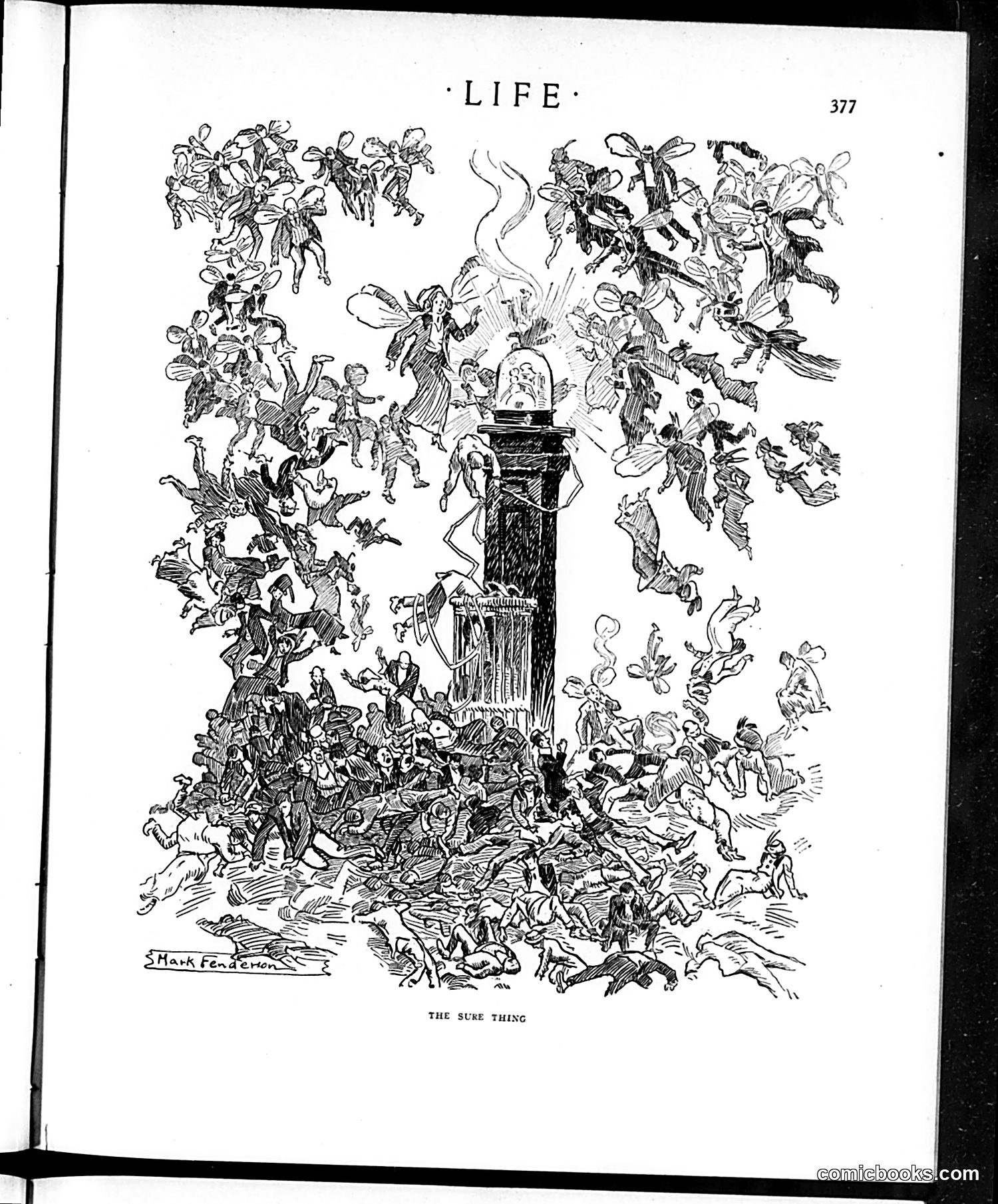
This satirical cartoon depicts a lighthouse as the central focal point, surrounded by masses of chaotic figures swarming upward and outward. The composition suggests themes of **social chaos, crowd behavior, or mass movement around a symbol of stability or authority**. The lighthouse—traditionally representing safety, guidance, and certainty—is ironically titled "The Sure Thing," implying that what appears dependable is actually surrounded by disorder and instability. The swirling masses of people appear frenzied and uncontrolled, suggesting skepticism about certainty itself or criticism of blind faith in institutions. The artist is **S. Mark Forsychen** (visible in signature). Without the magazine's date, the specific political event referenced remains unclear, though the imagery suggests early 20th-century social anxiety about stability, leadership, or public institutions.
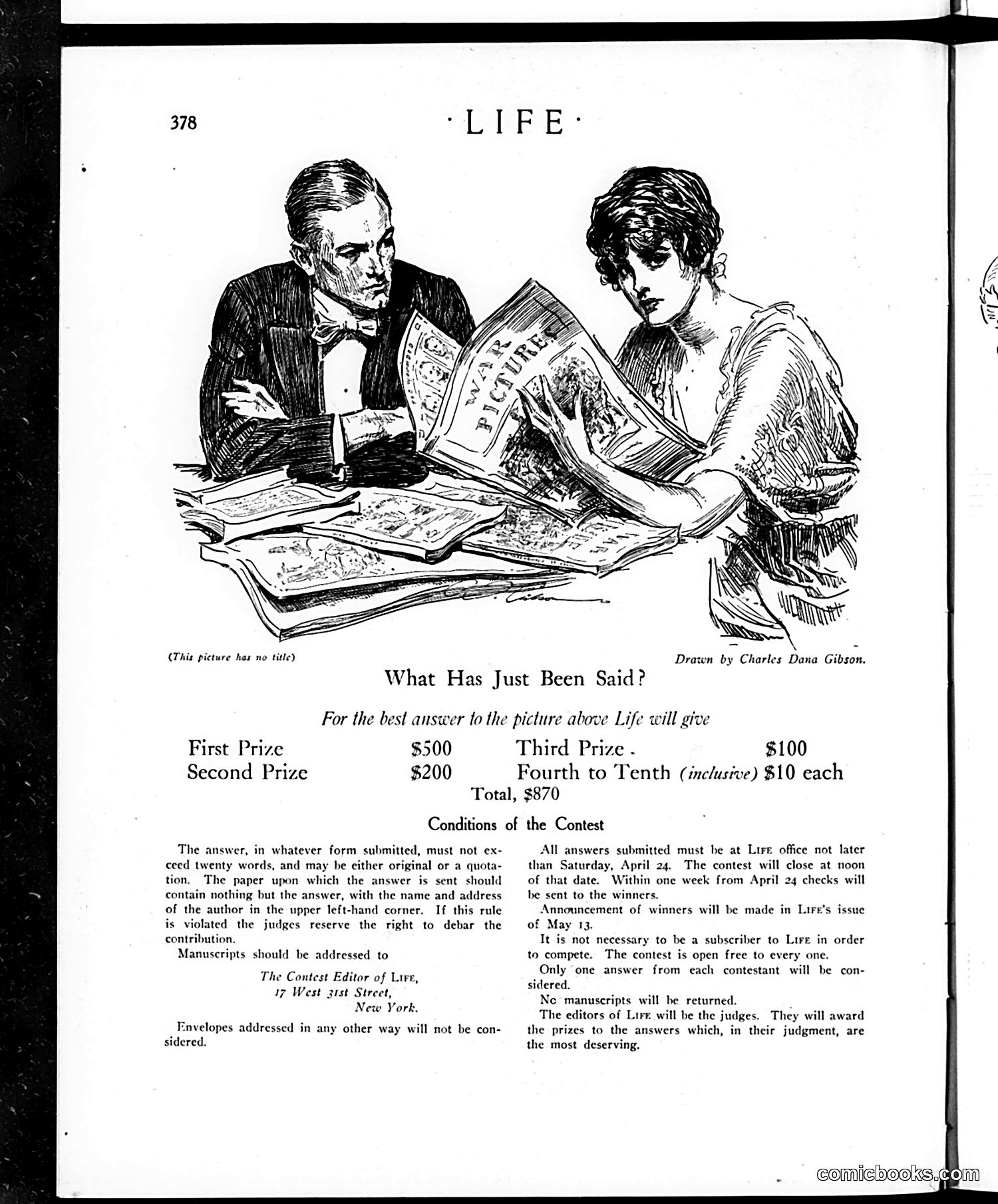
This is a **caption contest** page from *Life* magazine, drawn by the famous illustrator Charles Dana Gibson. The untitled illustration shows a well-dressed man in formal attire and a woman examining magazines or publications together, presumably having just had a conversation. The contest asks readers to supply a witty caption of twenty words or fewer—either original or a quotation—imagining what was "just said" between these two figures. The prize structure ($500 for first place, down to $10 for fourth through tenth) reflects this was a significant contest for the era. This format was typical of *Life's* satirical humor: rather than delivering a completed joke, the magazine invited readers to complete it, turning readers into collaborators. The Gibson illustration's genteel domestic setting suggests the humor likely involves middle-class social observations or mild romantic/marital wit—typical of early 20th-century *Life* magazine's demographic and sensibilities.
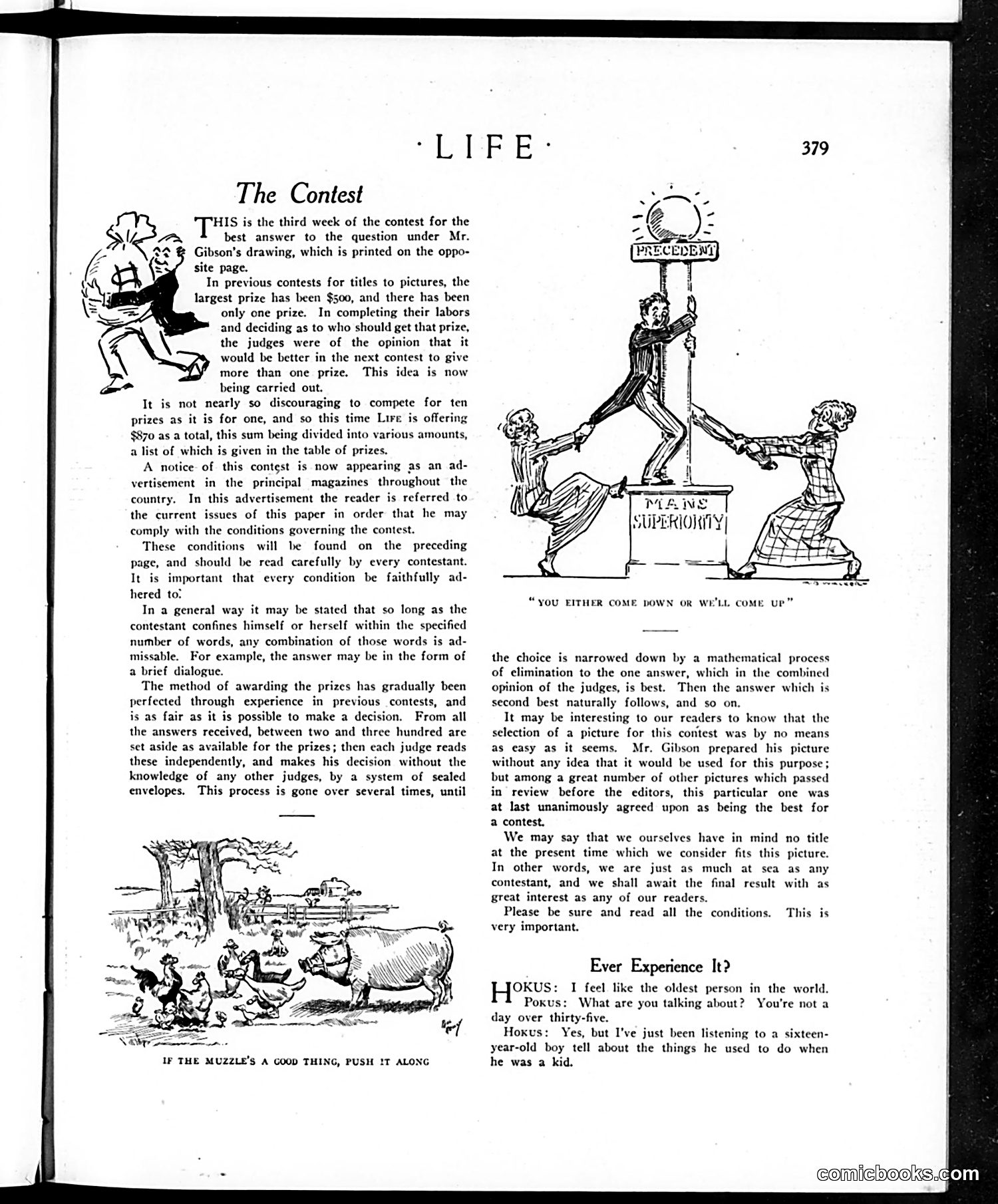
This page announces the third week of a caption-writing contest for a Charles Dana Gibson drawing (visible opposite). Readers submit answers competing for $870 in prizes—a deliberate change from previous contests offering only one $300 prize, intended to encourage broader participation. The main cartoon depicts a seesaw labeled "Male Superiority" with a woman and man in opposition, captioned "You Either Come Down or We'll Come Up"—likely satirizing contemporary debates over women's rights and gender equality during the Progressive Era. Below, a brief comic dialogue titled "Ever Experience It?" satirizes generational perception: a man feeling ancient after hearing a teenager reminisce about his childhood—poking fun at how rapidly cultural norms and childhood experiences change, making older generations feel outdated.
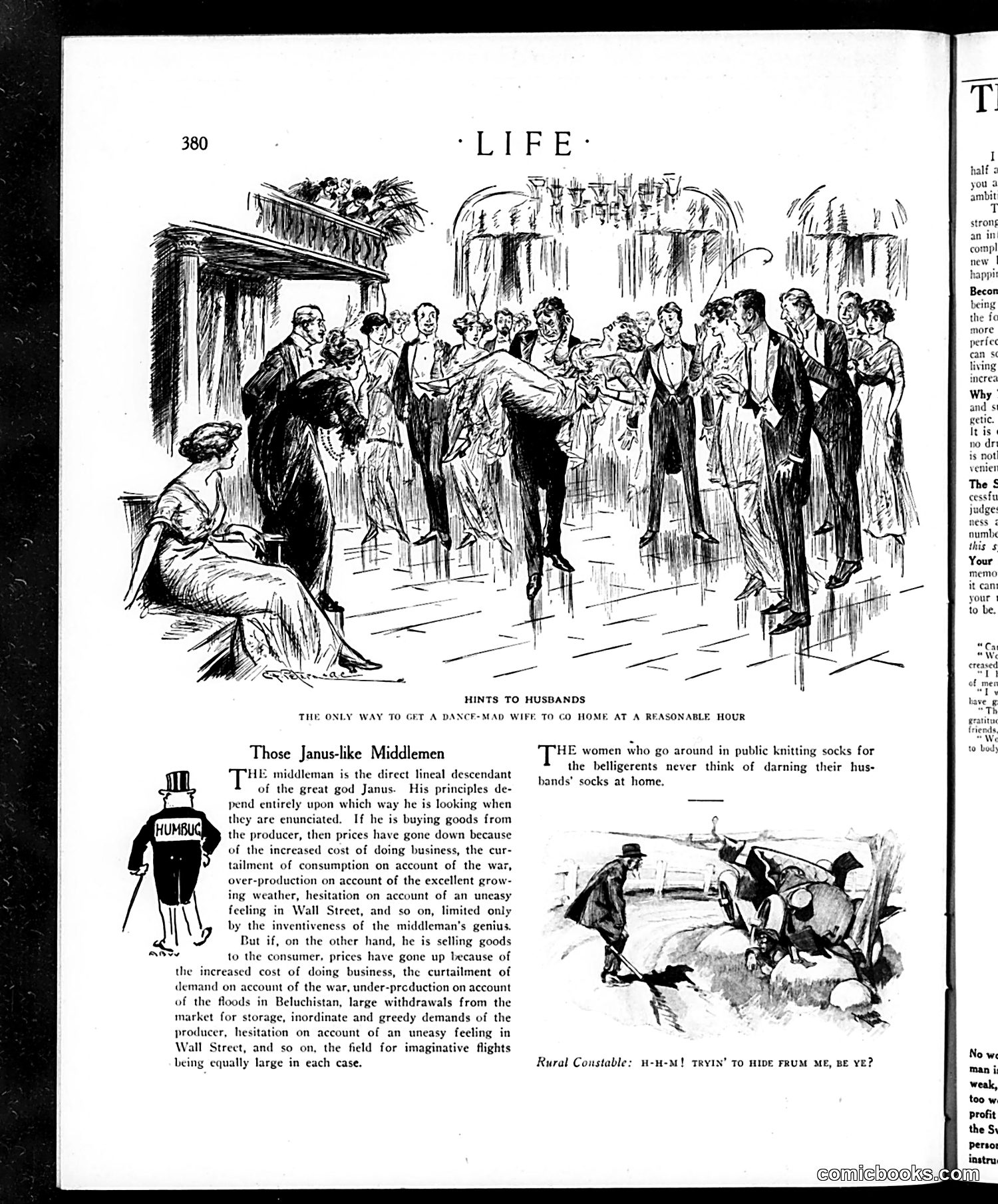
**Top Cartoon - "Hints to Husbands":** Depicts a wife enthusiastically dancing at a social gathering while her husband appears frustrated. The joke critiques women's newfound social independence—wives attending public dances and staying out late, defying husbands' expectations for domestic schedules. **Middle Article - "Those Janus-like Middlemen":** Satirizes commodity traders and wholesalers for their hypocrisy. Using the two-faced Roman god Janus as metaphor, the piece mocks middlemen who justify *low* prices when buying (citing war costs, overproduction) and *high* prices when selling (citing identical reasons). It's a critique of economic dishonesty and profiteering. **Bottom Cartoon - "Rural Constable":** Contrasts patriotic knitting—women publicly knitting socks for soldiers fighting ("the belligerents")—with neglecting domestic duties like darning their own husbands' socks. It satirizes performative patriotism and women's selective priorities. **Context:** These appear WWI-era, reflecting tensions over women's changing social roles, wartime economics, and market manipulation.
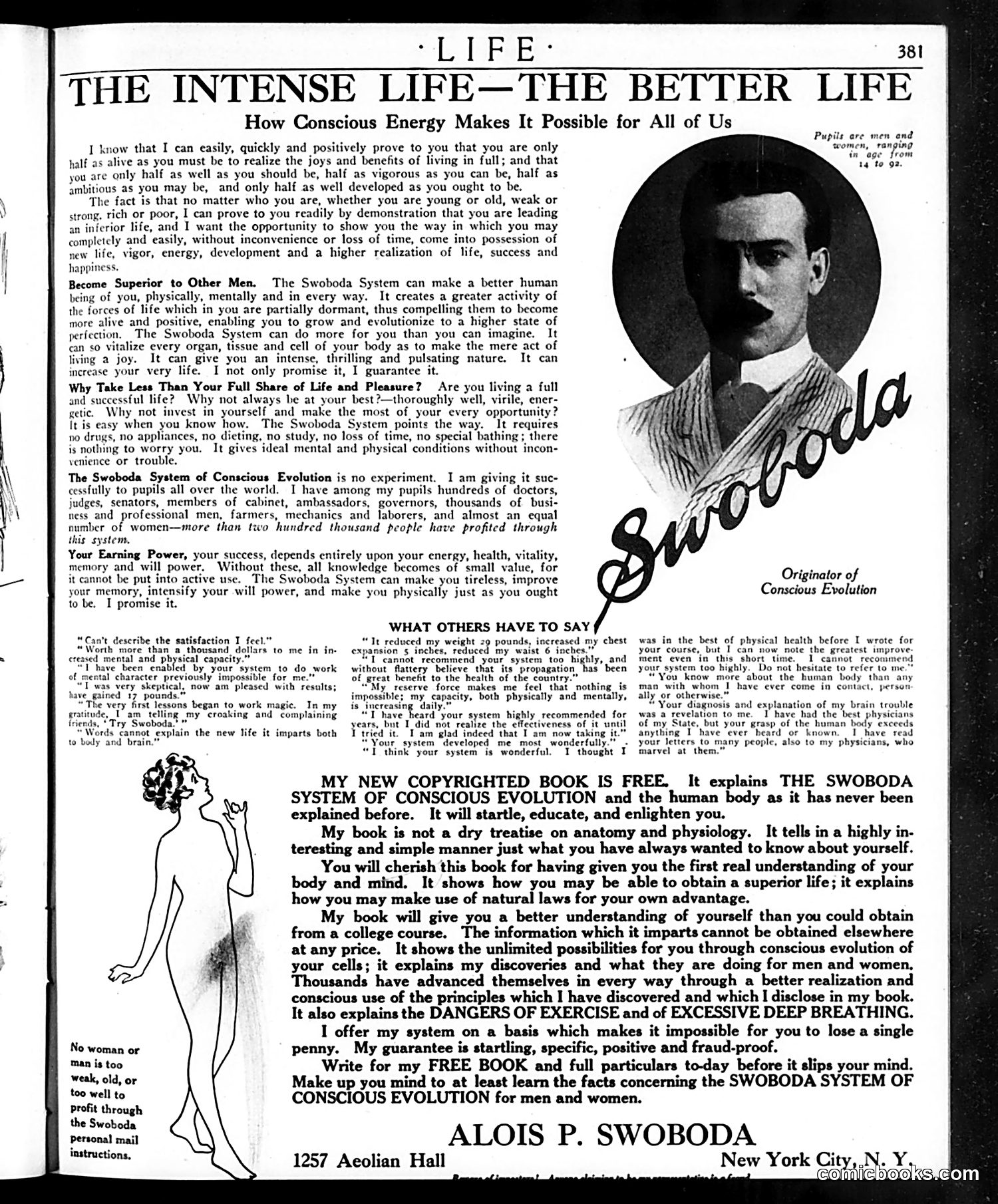
This page is primarily **advertising disguised as editorial content**—a common practice in early 20th-century magazines. It promotes "The Swoboda System of Conscious Evolution," a mail-order self-improvement scheme offered by Alois P. Swoboda. The pitch exploits anxieties about inadequacy: you're living only "half" your potential life. The system promises enhanced physical vitality, mental power, and earning capacity through unspecified methods requiring "no drugs," "no dieting," "no study." The testimonials (presented as objective endorsements) claim the system benefits doctors, senators, businessmen, and laborers—lending false authority. The simple line drawings of a slim female figure reinforce the era's obsession with body "vitalization." **For modern readers**: This exemplifies pseudoscientific self-help marketing that uses vague promises, testimonials, and appeals to self-doubt to sell an unproven product. The "Conscious Evolution" framing mimics legitimate science while delivering nothing concrete.
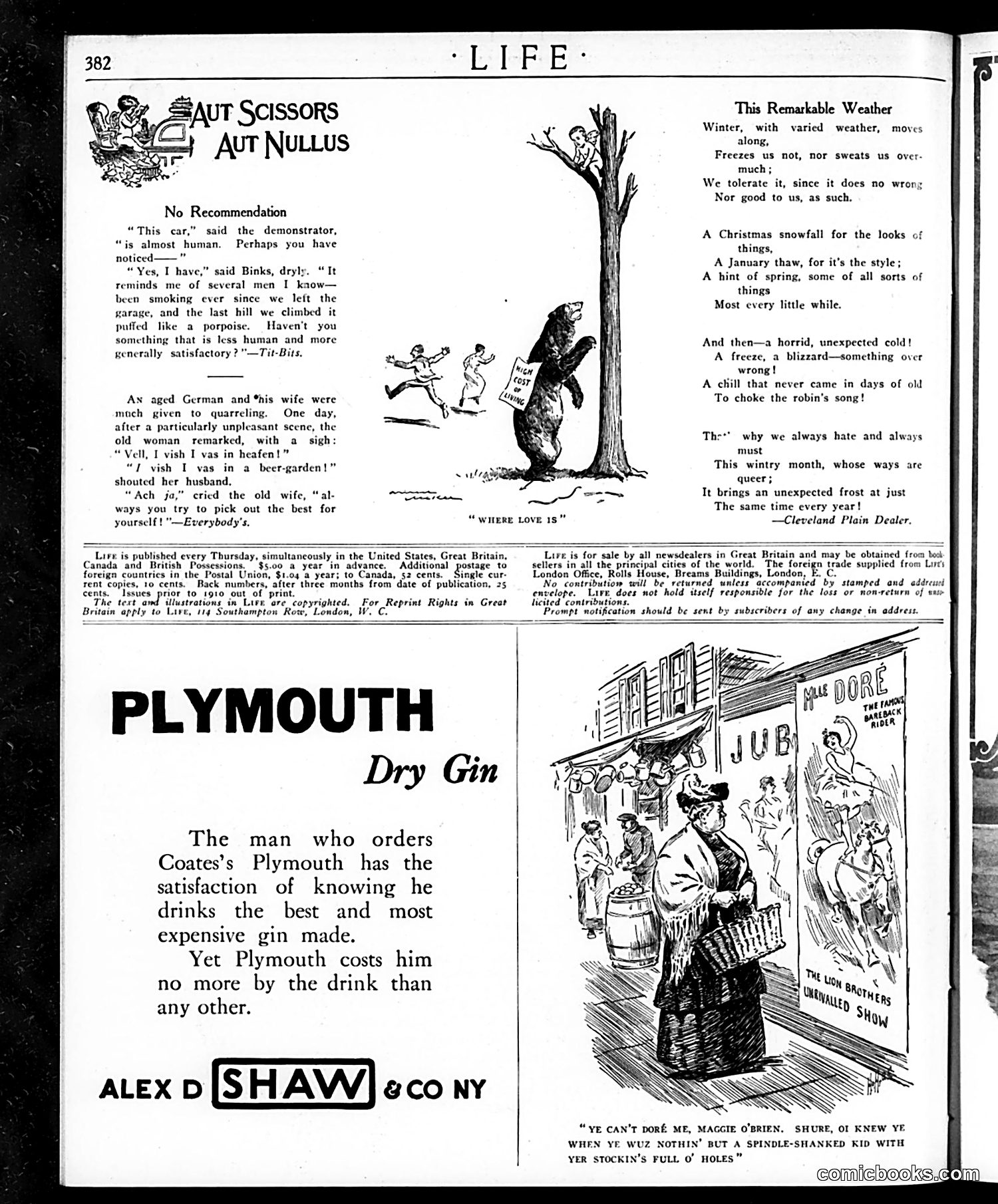
This page contains satirical humor pieces and advertisements typical of early 20th-century Life magazine. **"Aut Scissors" Section:** Two brief jokes mocking human behavior. The first ridicules a car salesman's claim that an automobile is "almost human"—the buyer responds it's too human, behaving badly (smoking, puffing uphill). The second joke features an aged German couple quarreling; when the wife wishes she were in heaven, the husband retorts he'd prefer a beer garden—satirizing marital discord and male priorities. **"Where Love Is" Poem:** A weather complaint poem that personifies winter as unpredictably temperamental, arriving with varied conditions and unexpected freezes that harm nature (killing the robin's song). It's satirizing the frustration of an unreliable season that lacks consistent character. **Advertisements:** Plymouth Gin and what appears to be a music hall or theatrical venue advertisement occupy the lower half. The page exemplifies Life's formula: brief satirical jokes about everyday life, romantic/domestic situations, and interspersed advertising.
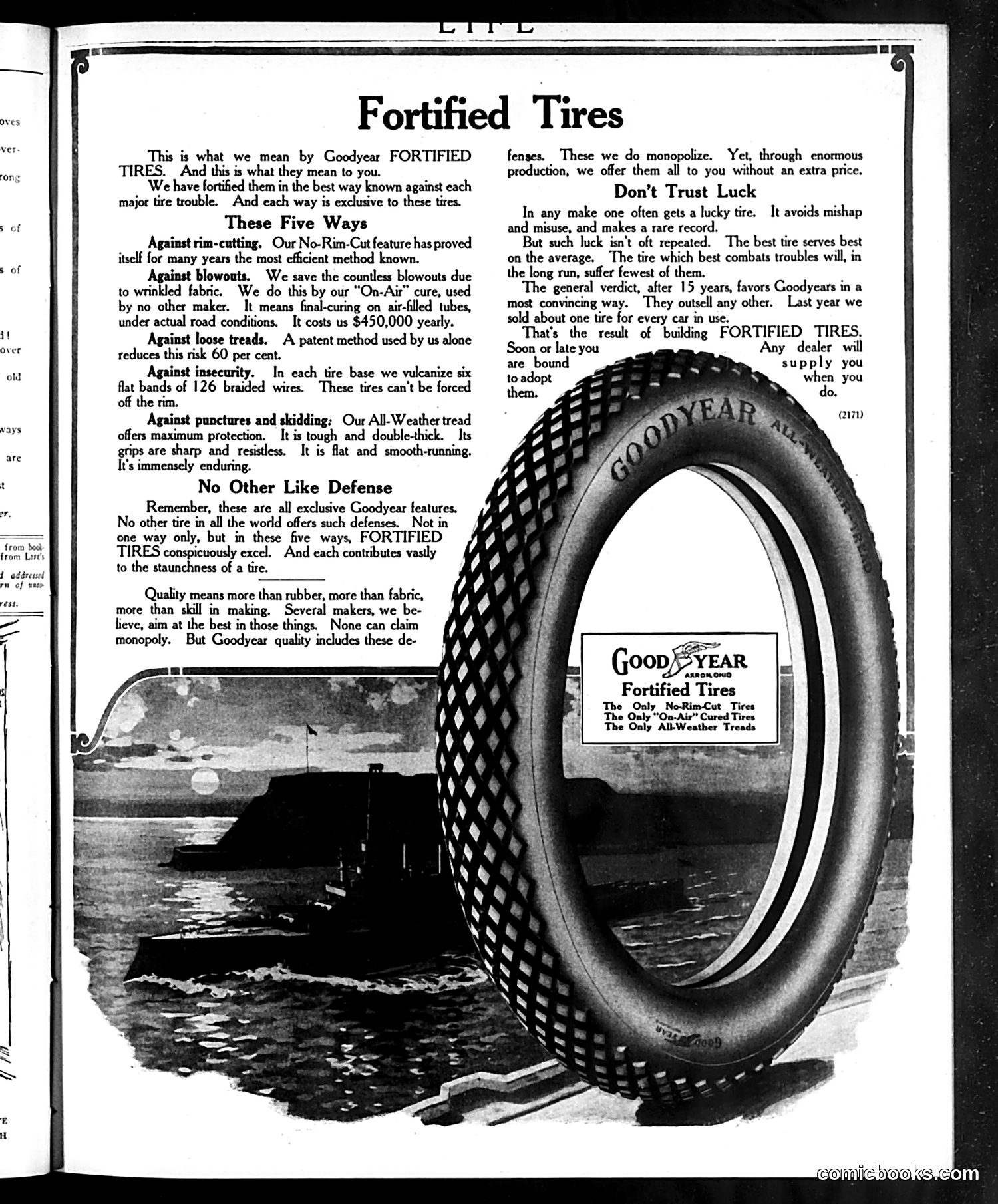
This is a **full-page advertisement**, not political satire. It promotes Goodyear's tire line by claiming five exclusive safety features: no-rim-cut design, air-cured construction, secure treads, reinforced bases, and all-weather tread patterns. The ad's rhetorical strategy emphasizes **monopolistic superiority**—repeatedly asserting these defenses are "exclusive to these tires" and "no other tire in all the world offers such defenses." Notably, the text acknowledges competitors aim for quality but claims only Goodyear achieves this combination. The large tire image and smaller car photograph establish the product's reliability for early automotive users. The closing argument appeals to statistics: "Last year we sold about one tire for every car in use"—presenting market dominance as proof of superiority. For modern readers: this reflects early 20th-century marketing emphasizing technical innovation and manufacturing exclusivity, before modern regulatory standards or widespread consumer skepticism about monopoly claims.
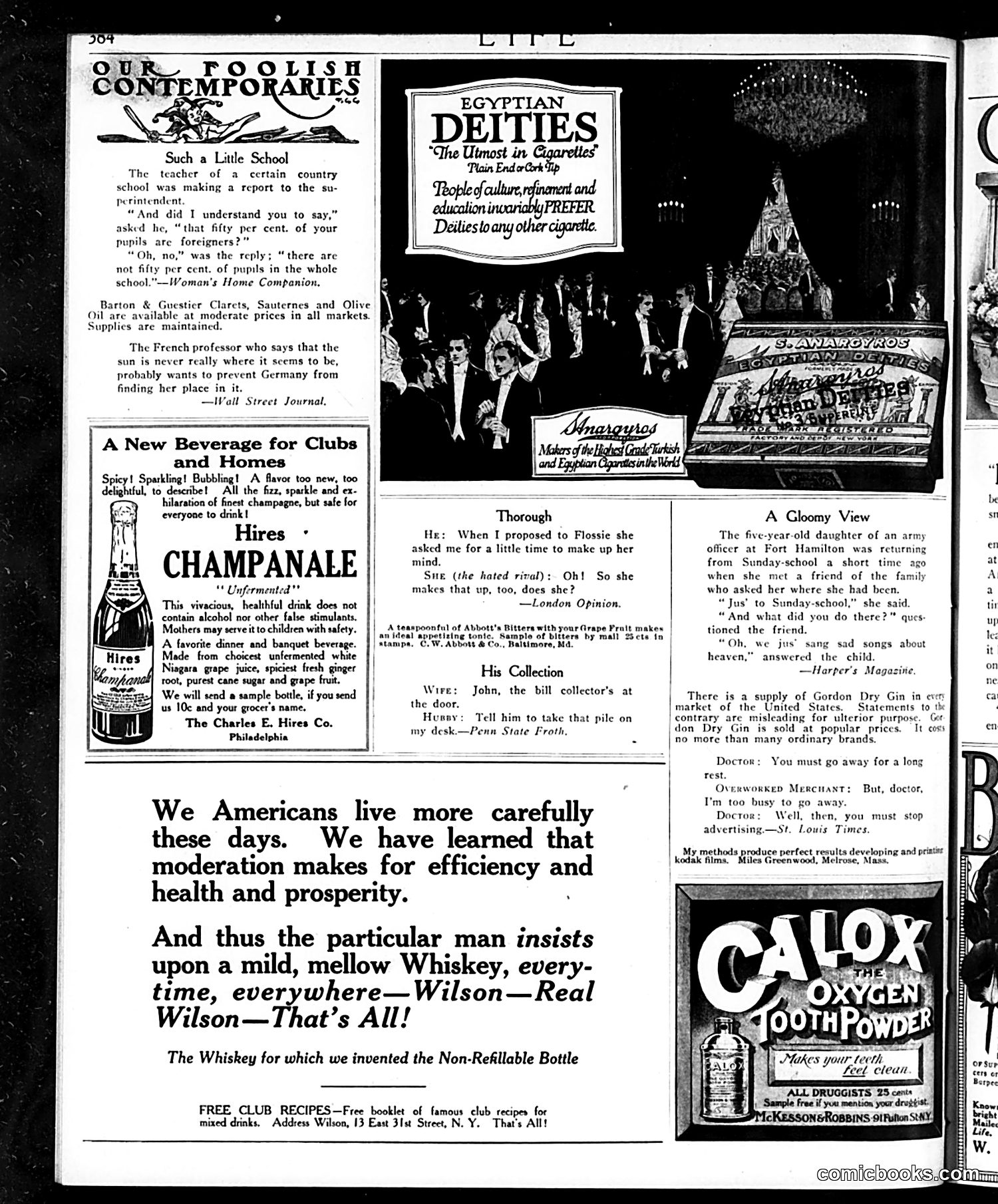
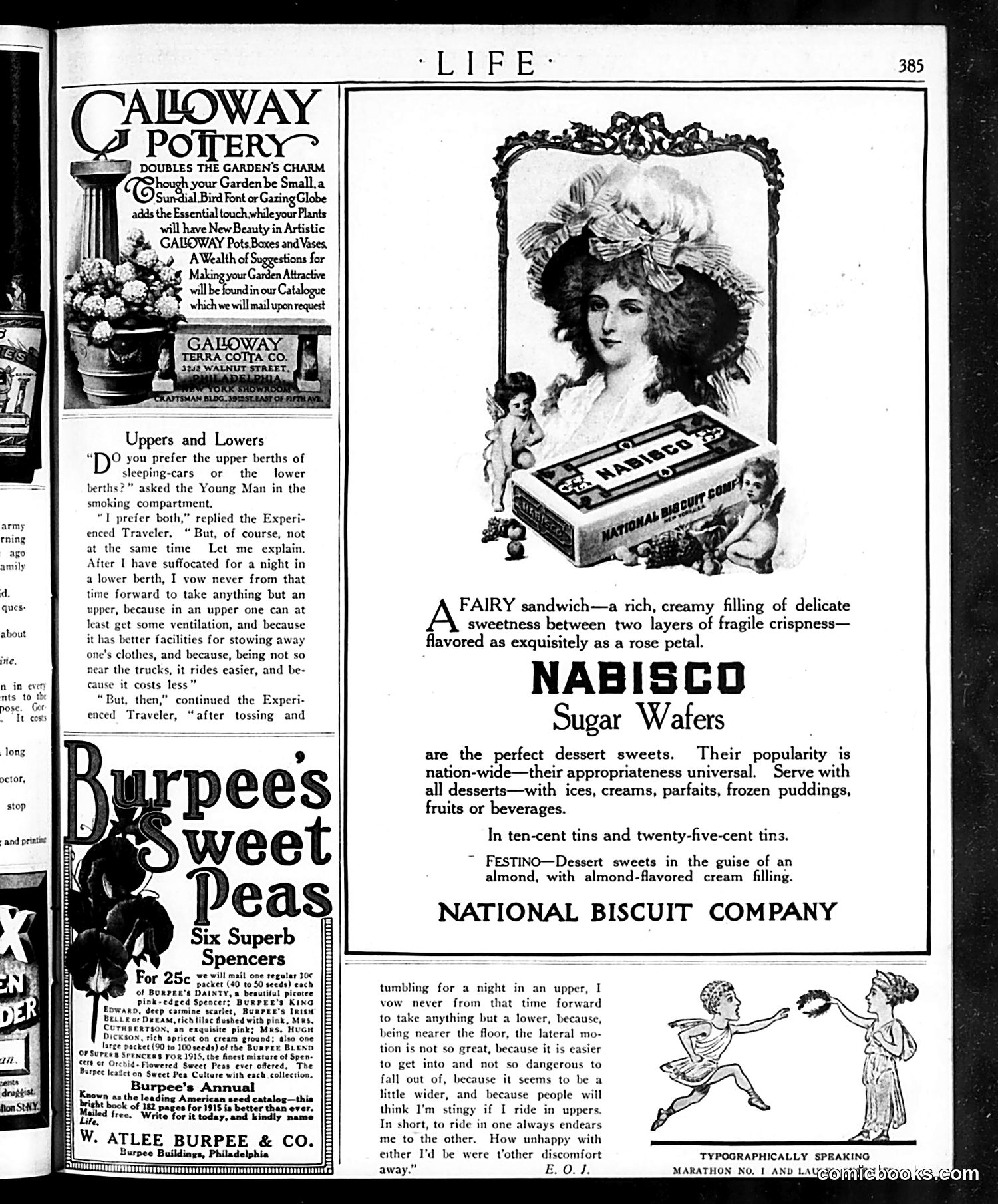
This is primarily an **advertising page** from Life magazine, not a political cartoon. The main content consists of commercial advertisements for consumer goods. The small editorial humor piece titled "Uppers and Lowers" is a gentle joke about railroad sleeping-car preferences. An "Experienced Traveler" explains his contradictory preference for both upper and lower berths by revealing his logic: after suffering in a lower berth one night (poor ventilation, noise from trucks), he swears never to take anything but an upper. But after tossing sleeplessly in an upper, he vows never to take anything but a lower. The joke is that his experience makes him equally miserable in either position, trapping him in perpetual dissatisfaction—a mild commentary on human inconsistency. The page also advertises **Nabisco Sugar Wafers**, **Burpee's Sweet Peas** seeds, and **Galloway Pottery** garden goods. These represent typical early 20th-century consumer advertising targeting middle-class households.
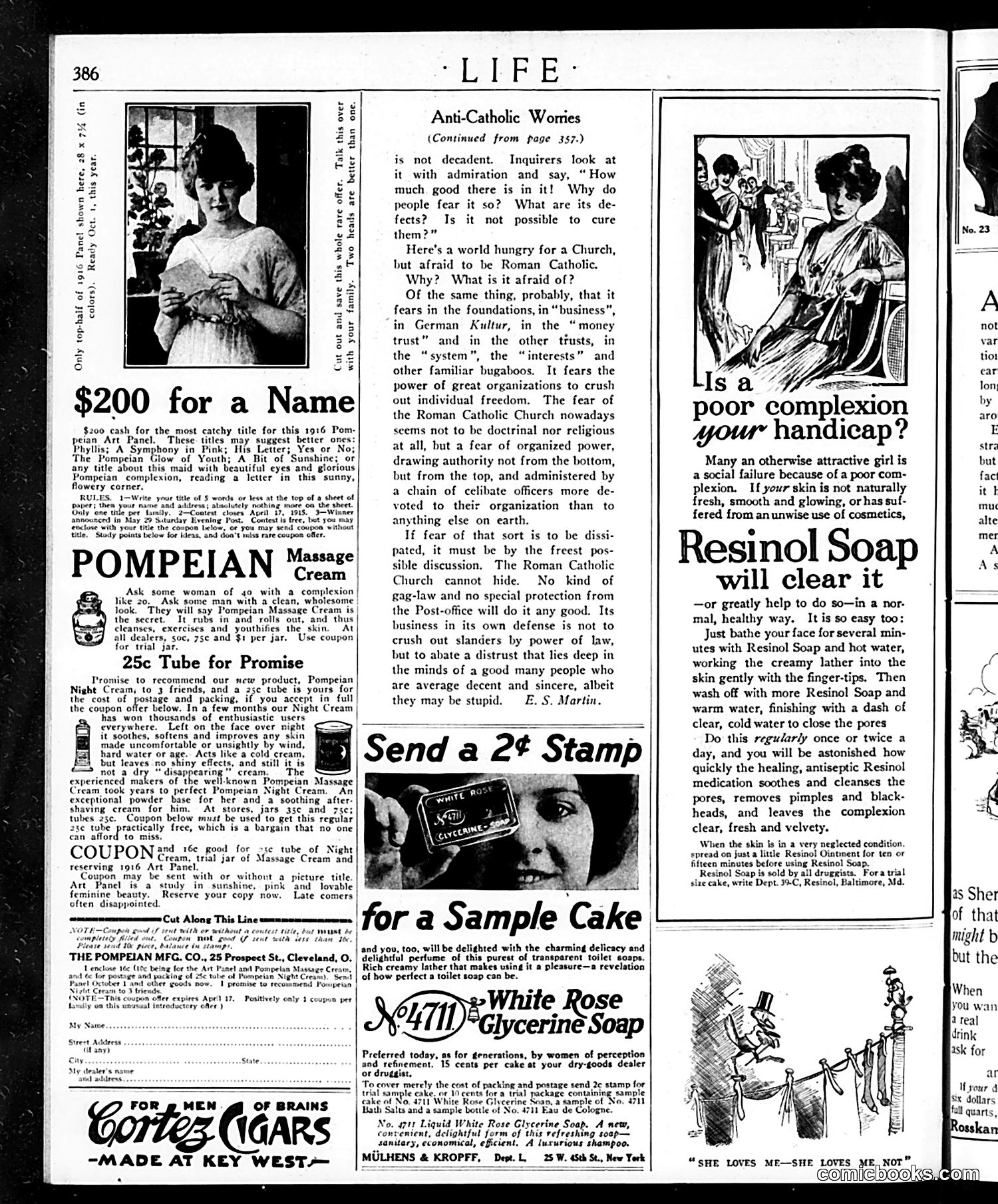
This page mixes advertising with editorial content. The dominant feature is a lengthy article titled "Anti-Catholic Worries" addressing fears about the Roman Catholic Church's organizational power rather than its doctrine. The author argues that public anxiety stems from concerns about institutional control crushing individual freedom—fears paralleling those directed at business trusts and monopolies of the era. The page is heavily populated with beauty product advertisements (Pompeian creams, Resinol Soap, White Rose Glycerine Soap) and a contest offering $200 for naming a 1916 art panel featuring an attractive woman. A Cortez Cigars ad appears at bottom. This reflects early 1900s print culture: editorial content subsidizes advertising space, and women's beauty anxieties are exploited commercially while serious political-religious debates occupy the same pages.
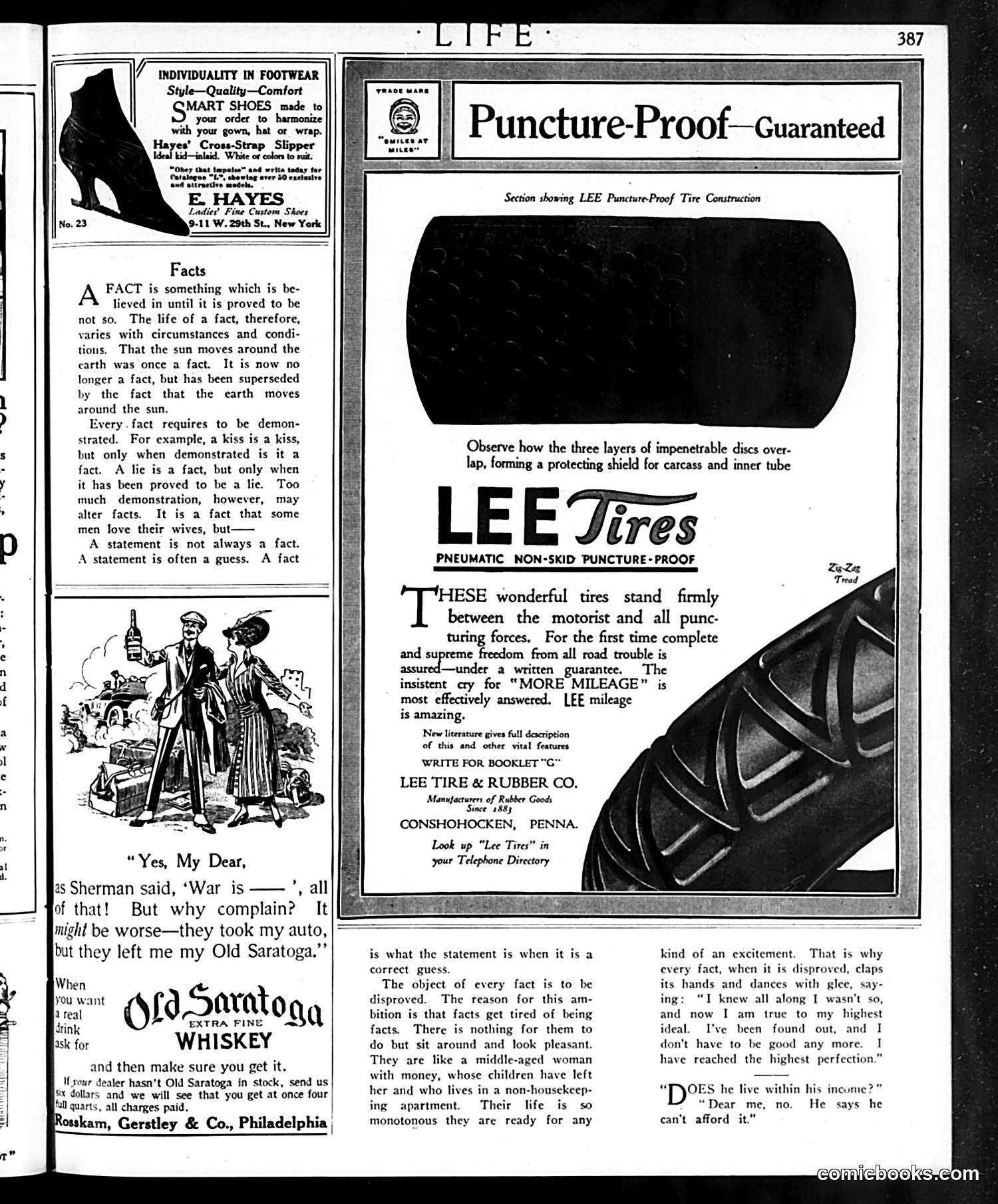
This page combines advertisements with satirical editorial content typical of Life magazine's format. ## The "Facts" Column The central text is philosophical satire mocking how "facts" are established and discarded. It uses absurdist logic—comparing facts to middle-aged women with money who "are ready for any kind of an excitement"—to argue that facts are unreliable and actually *want* to be disproven so they can "reach the highest perfection." This appears to be gentle mockery of how people cling to outdated beliefs or how "facts" shift with scientific progress. ## The Sherman Quote The brief dialogue references General William Tecumseh Sherman's famous statement "War is hell," framing it as a response to wartime inconveniences (cars being requisitioned). The joke plays on understated complaint during wartime sacrifice. ## Advertisements The page includes typical period ads: E. Hayes custom shoes, Lee Tires (emphasizing puncture-proof technology), Old Saratoga whiskey, and Old Saratoga Extra Fine whiskey. The satirical content suggests this is from the WWI or post-WWI era when such wartime references were current.
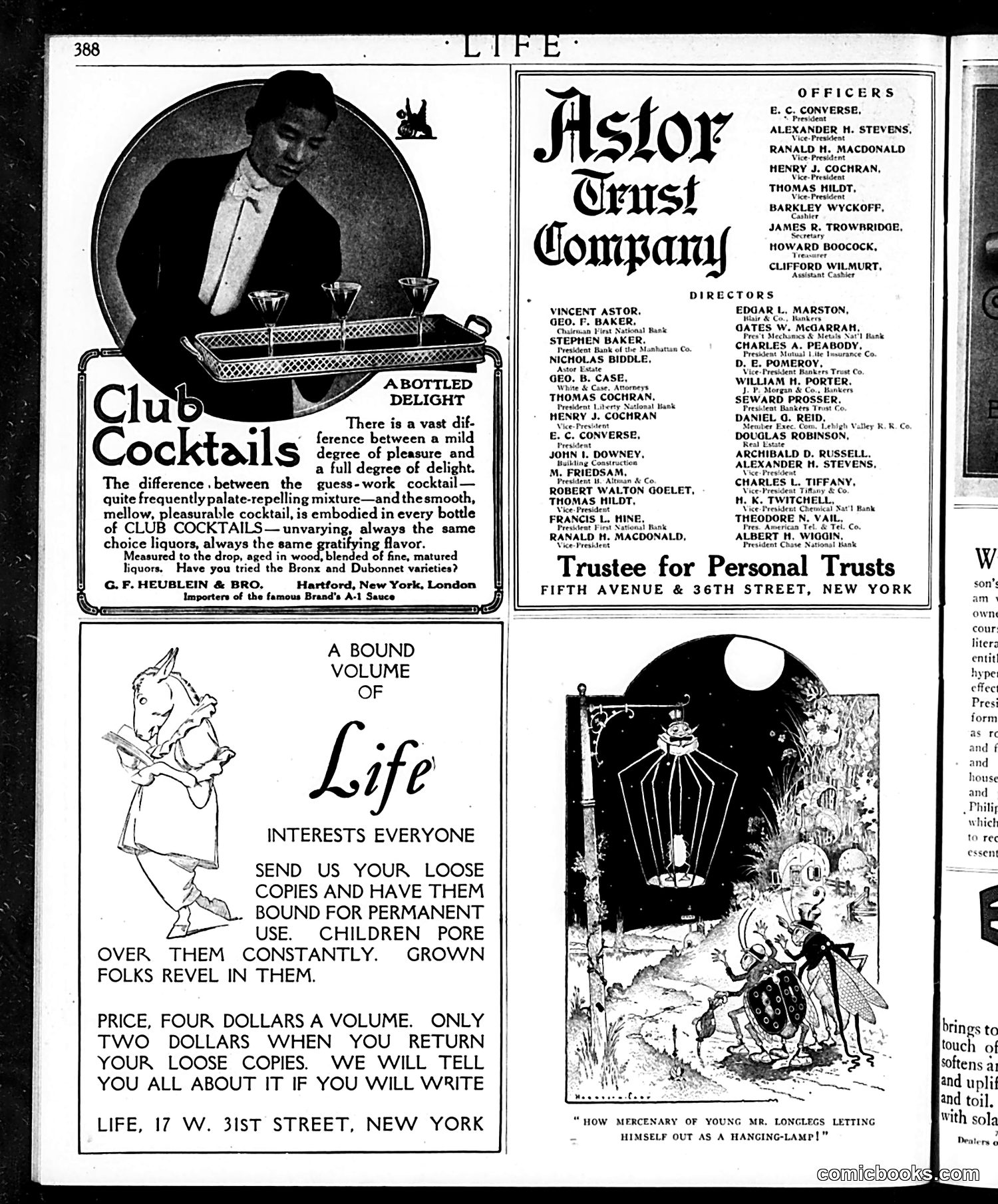
This page is primarily **advertisements and corporate directory listings** rather than satirical content. The top features a **Club Cocktails ad** contrasting "guess-work" inferior cocktails with their superior brand—typical early-20th-century product marketing emphasizing consistency and quality. The center-right shows the **Astor Trust Company** directory, listing prominent New York financiers and society figures (Astors, Vanderbilts, Tiffanys)—essentially a business card for wealthy trustees. The bottom-left advertises **Life magazine's bound volumes**, appealing to families and collectors. The only actual cartoon appears bottom-right: a whimsical drawing titled "How mercenary of young Mr. Longlegs letting himself out as a hanging-lamp!" The humor is visual rather than political—a tall, gangly character functioning as a decorative lamp, joking about monetizing one's awkward appearance. This is genteel, domestic satire typical of Life's lighter content.
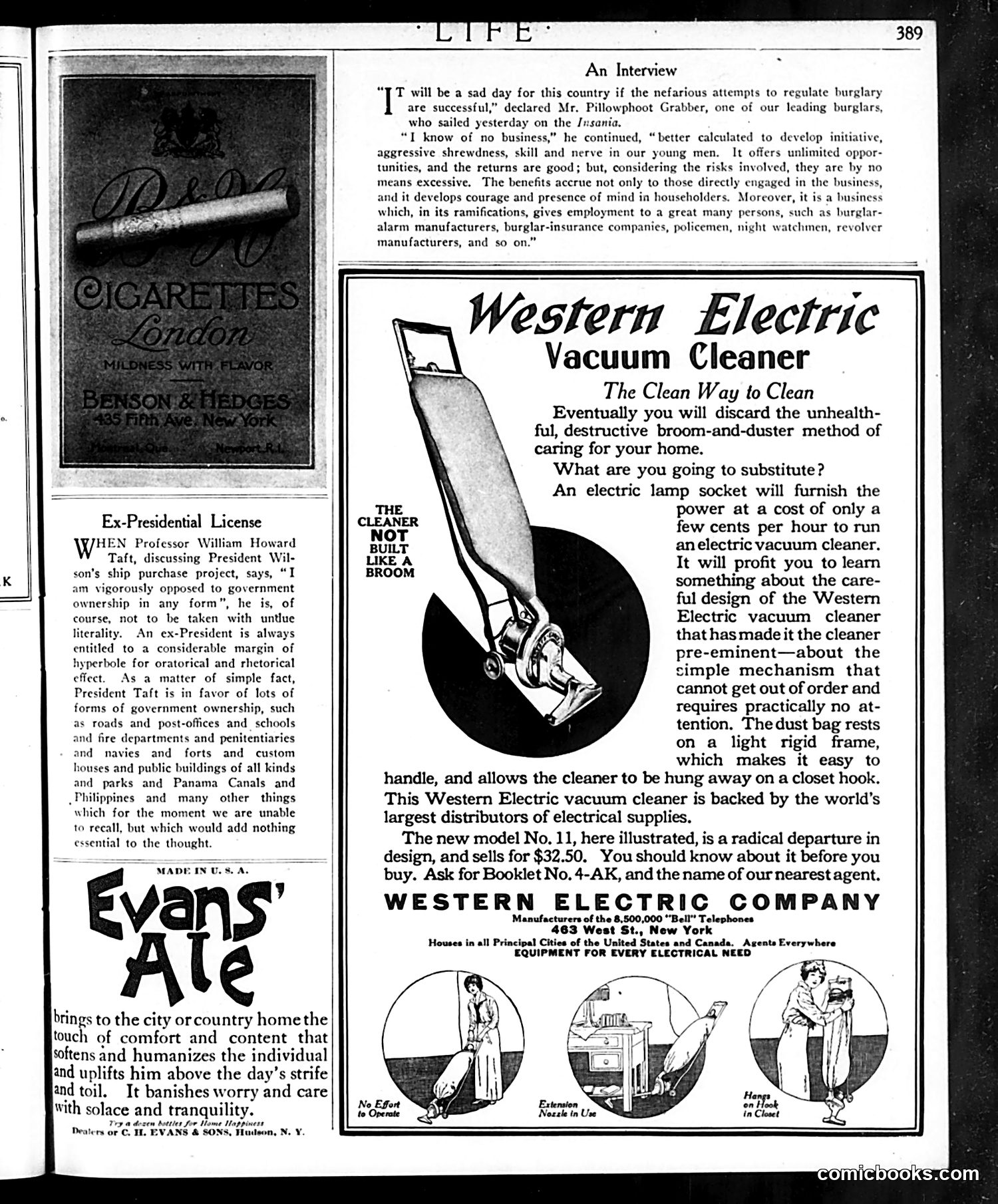
This page contains two distinct satirical pieces: **"Ex-Presidential License"** mocks former President William Howard Taft's stated opposition to government ownership of ships while ignoring his support for numerous other government-owned institutions (roads, schools, fire departments, Panama Canal, Philippines). The satire exposes rhetorical hypocrisy—Taft receives an "ex-President's margin" to contradict himself without accountability. **"An Interview"** features fictional burglar "Mr. Pillowphoot Grabber" defending burglary as legitimate business. This parodies arguments made by wealthy businessmen defending their practices by claiming such work develops character, creates employment (for alarm manufacturers, police, revolver makers), and benefits society. The satire suggests that justifications offered by privileged economic actors (like ship-purchase advocates) mirror those a criminal would use—exposing the moral relativism in such arguments. Both pieces critique how power and rhetoric shield certain groups from scrutiny. The remaining content is straightforward advertising for cigarettes, vacuum cleaners, and ale.
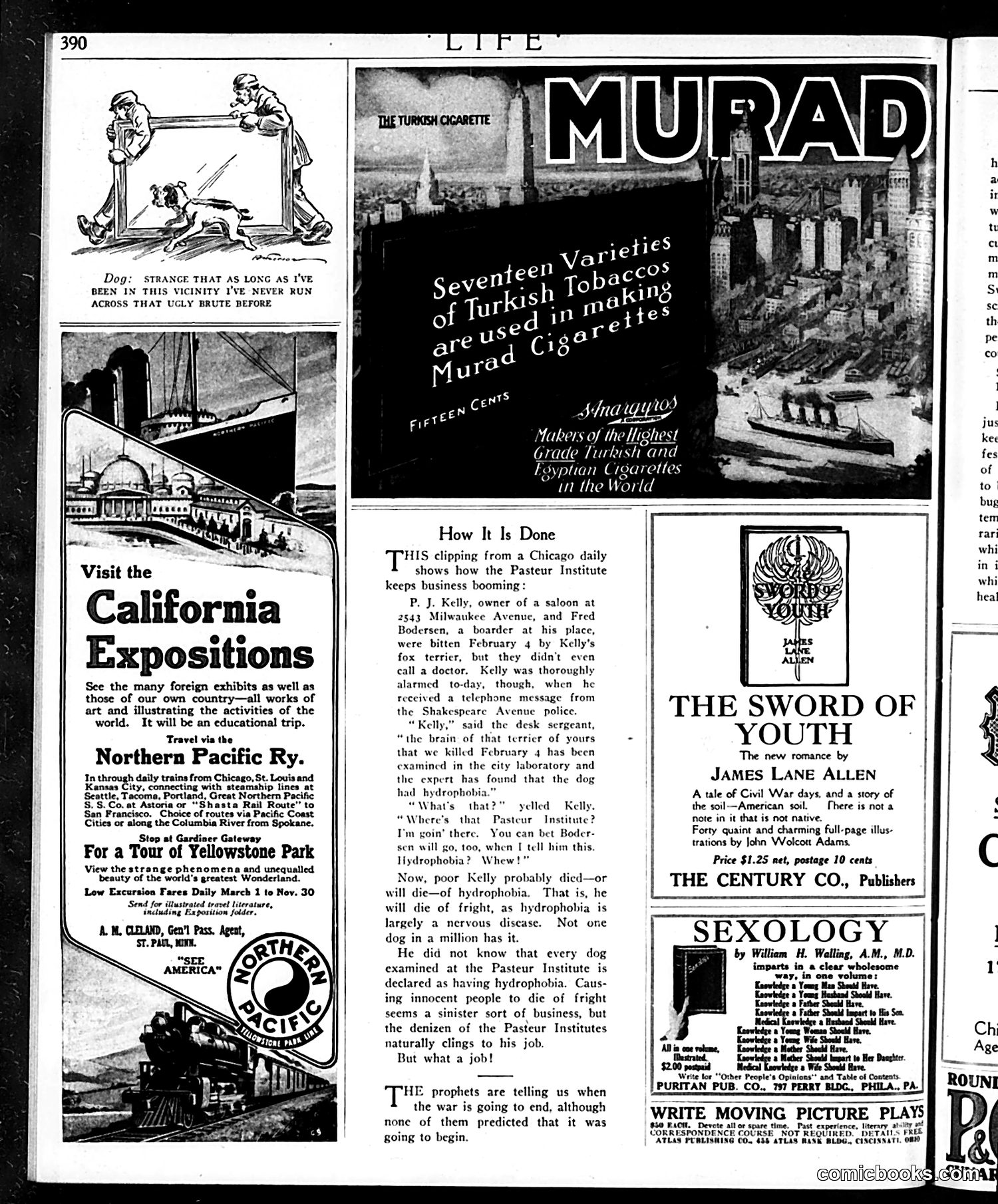
The top cartoon depicts two men examining a dog, with one saying he's never seen "that ugly brute" despite living in the vicinity—a simple visual gag about an unfamiliar, unattractive dog. The main satirical piece, "How It Is Done," mocks the Pasteur Institute's business practices. The joke: a Chicago saloon owner's dog bites people, but when police inform him the dog tested positive for hydrophobia (rabies), the man panics and likely dies of *fright* rather than actual disease. The satire targets the Pasteur Institute's apparent policy of declaring *all* examined dogs as having hydrophobia—creating fear that keeps the institution's business thriving. The piece suggests this is ethically questionable: "Causing innocent people to die of fright seems a sinister sort of business," yet the institute "naturally clings to his job." It's a critique of institutional self-interest and fear-mongering disguised as public health.
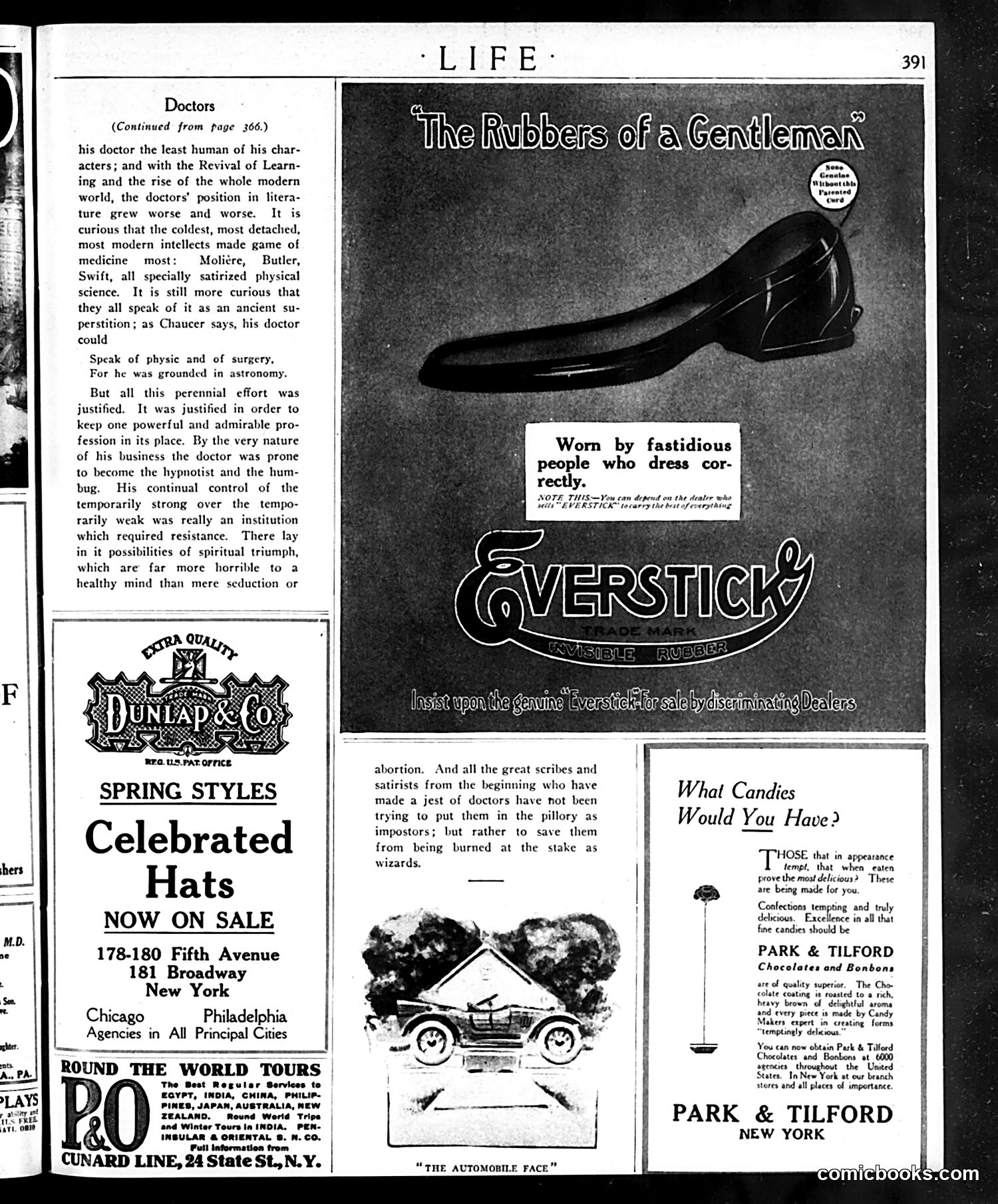
This page mixes editorial content with period advertising. The main text discusses the historical satirization of doctors in literature—noting that writers like Molière, Butler, and Swift criticized medicine as superstition, though this criticism paradoxically helped preserve the profession's integrity by keeping it accountable. The advertisements are era-appropriate: Dunlap & Co. promotes spring hat styles; P&O advertises world tours; and Cunard Line offers ocean voyages. The most prominent advertisement features **Everstick**, a rubber heel product marketed to "fastidious people who dress correctly"—emphasizing fashionable appearance for the well-dressed gentleman. Below this, **Park & Tilford** advertises chocolates and bonbons as delicious confections available nationwide. A small cartoon titled **"The Automobile Face"** appears at bottom—likely a visual joke about how automobile driving affects one's facial appearance, though the specific satire isn't fully clear from this reproduction. The page reflects early 20th-century consumer culture and gentlemen's lifestyle concerns.
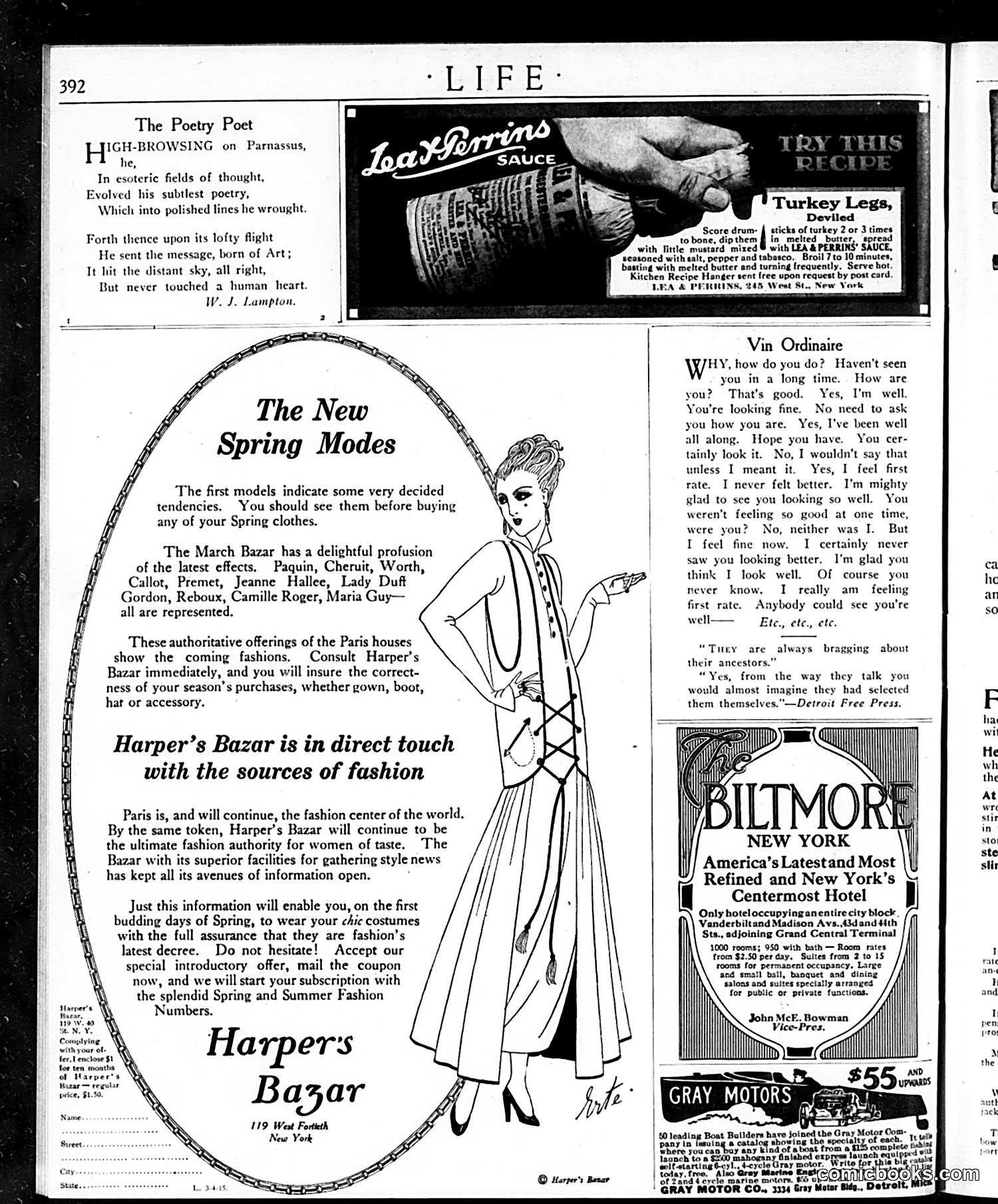
This page consists primarily of **advertisements and fashion content** rather than political satire or comics. The main elements are: 1. **"The Poetry Poet"** — A brief humorous verse by W. J. Lampton mocking pretentious intellectuals. It satirizes poets who craft elaborate, "high-minded" work that soars intellectually but fails to connect with ordinary people or move their hearts. The joke: artistic purity without human relevance. 2. **"The New Spring Modes"** — A fashion advertisement for Harper's Bazaar, promoting Paris couture designers (Paquin, Worth, etc.) and positioning the publication as the authority on women's fashion. 3. **"Vin Ordinaire"** — A dialogue satirizing the clichéd pleasantries of polite society—two people exchanging identical, hollow compliments about looking well, never saying anything genuine. 4. **Other advertisements** for Lea & Perrins sauce, the Biltmore hotel, and Gray Motors. The page reflects early 20th-century magazine culture: light satire mixed with luxury brand advertising targeting affluent readers.
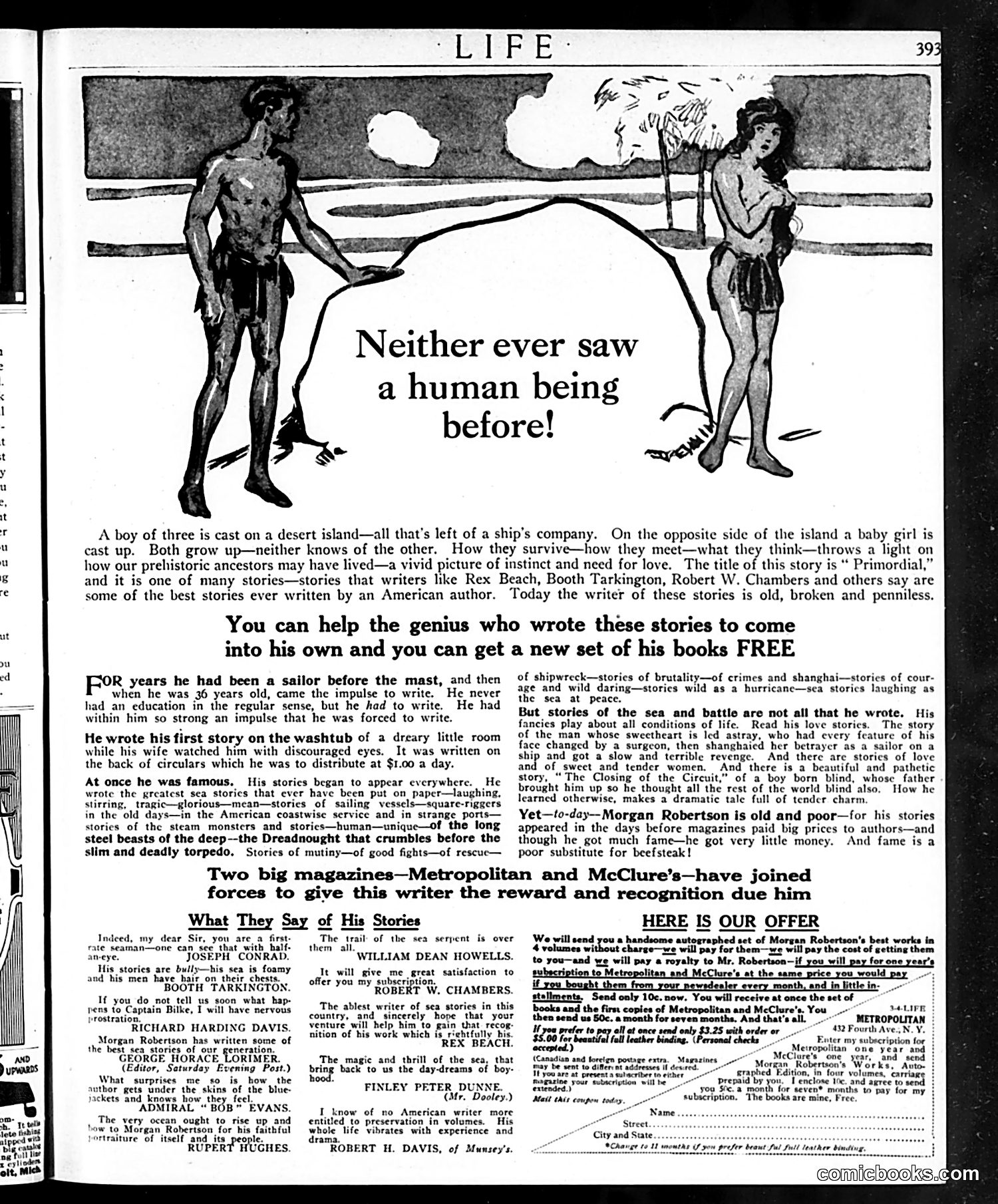
This page is primarily **advertising/promotional content** disguised as editorial endorsement. It publicizes Morgan Robertson, a writer of sea stories who is portrayed as a tragic figure—once famous but now "old, broken and penniless." The cartoon at top depicts two naked figures (a boy and girl) who've never seen humans before, illustrating Robertson's story "Primordial." This visual emphasizes the story's theme of instinctive attraction between innocents. The bulk of the page comprises a fundraising pitch: Metropolitan and McClure's magazines are offering Robertson's collected books for free to subscribers, presenting this as reward for an underappreciated genius. Testimonials from celebrated authors (Joseph Conrad, Booth Tarkington, Richard Harding Davis) validate his literary worth. **The satire/message**: Life is critiquing how American markets rewarded writers—Robertson gained fame but not fortune, since he published before magazines paid substantial rates. The page advocates for recognizing literary merit through subscription support, positioning the magazines as patrons of neglected talent.
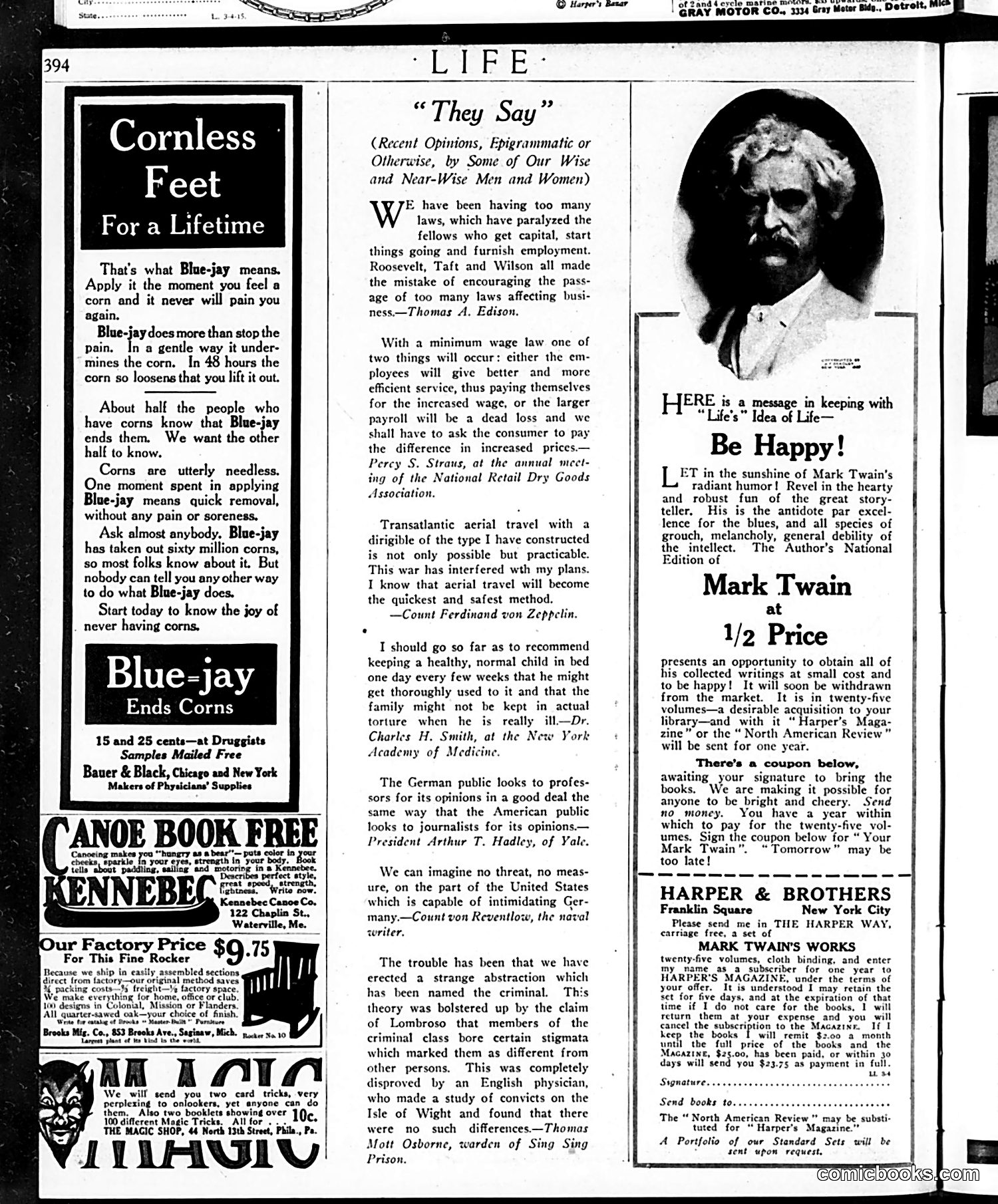
This page presents a satirical column featuring provocative quotes from prominent figures of the era, likely the 1910s-1920s based on references to Roosevelt, Taft, and Wilson. **Key figures and context:** - **Thomas A. Edison** criticizes excessive business regulation - **Count Ferdinand von Zeppelin** discusses transatlantic airship travel (his dirigibles were cutting-edge technology) - **Percy S. Straus** debates minimum wage law consequences - Various other academics and officials weigh in on child health, criminal theory, and German-American relations **The satire's point:** By juxtaposing these "wise men's" often contradictory or questionable pronouncements, *Life* magazine ridicules expert overconfidence. The column's title—"They Say"—suggests skepticism toward authority. Edison's anti-regulation stance contrasts with progressive labor advocates; debates over minimum wages and criminology reflect genuine policy disagreements of the period. The surrounding advertisements (corn remedies, canoe kits, magic tricks) create an ironic counterpoint: practical consumer solutions versus abstract expert opinion.
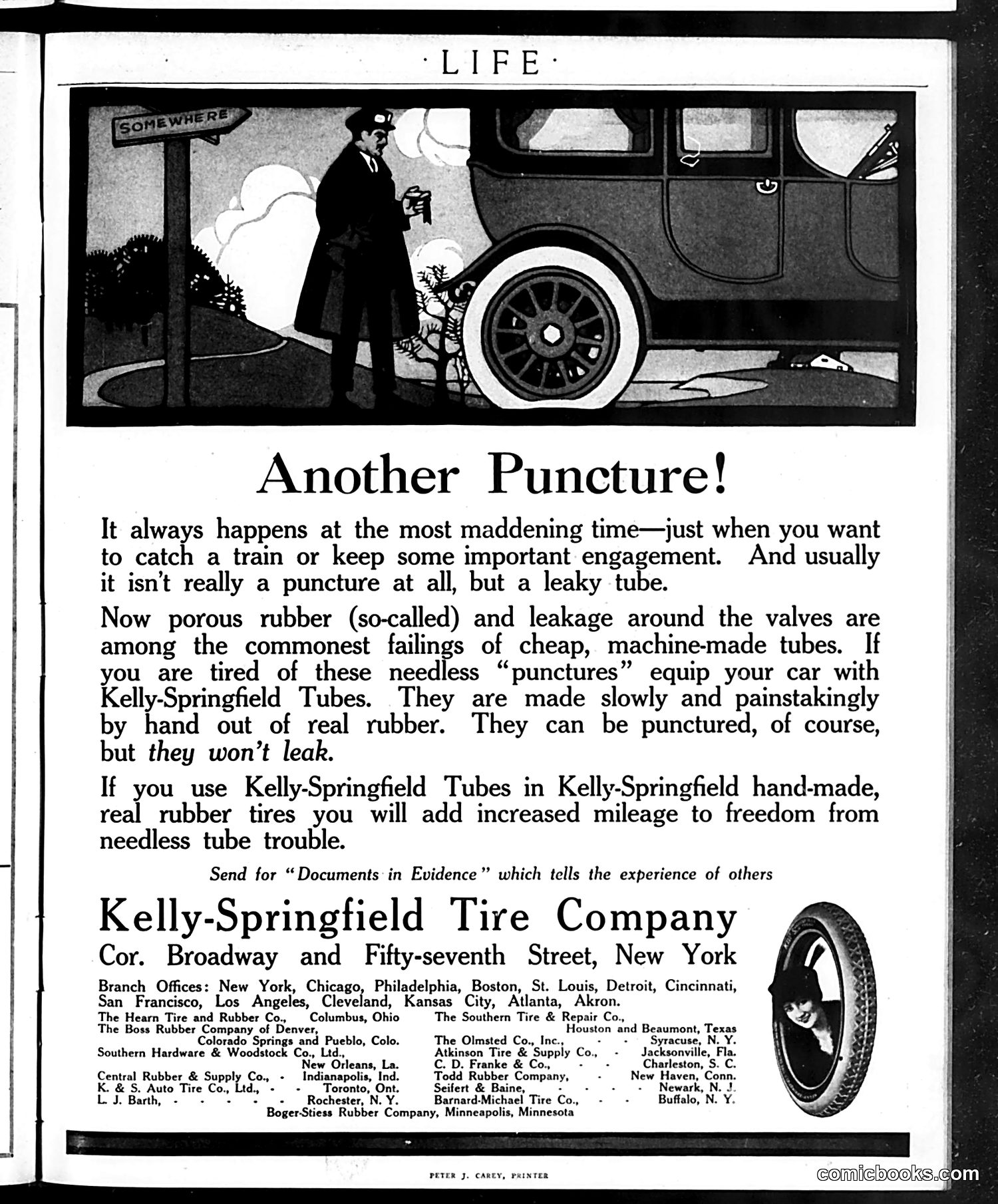
This is a **product advertisement**, not political satire. It promotes Kelly-Springfield brand automobile tubes to early 20th-century motorists. The illustration depicts a common frustration of the era: a well-dressed man standing beside his car at a "Somewhere" road sign, apparently stranded with a flat tire when he needs to catch a train or attend an important appointment. The advertisement's pitch exploits this relatable anxiety. It claims that most "punctures" aren't actually punctures but rather **leaky tubes**—a failure of cheap, machine-made rubber. Kelly-Springfield's solution: hand-crafted tubes made from real rubber that won't leak, even if punctured. The humor is gentle: the ad acknowledges the maddening timing of tire failures while offering a premium product as salvation. This reflects early automotive culture when tire reliability was a genuine, widespread problem and buying quality tubes was a practical luxury concern for car owners.
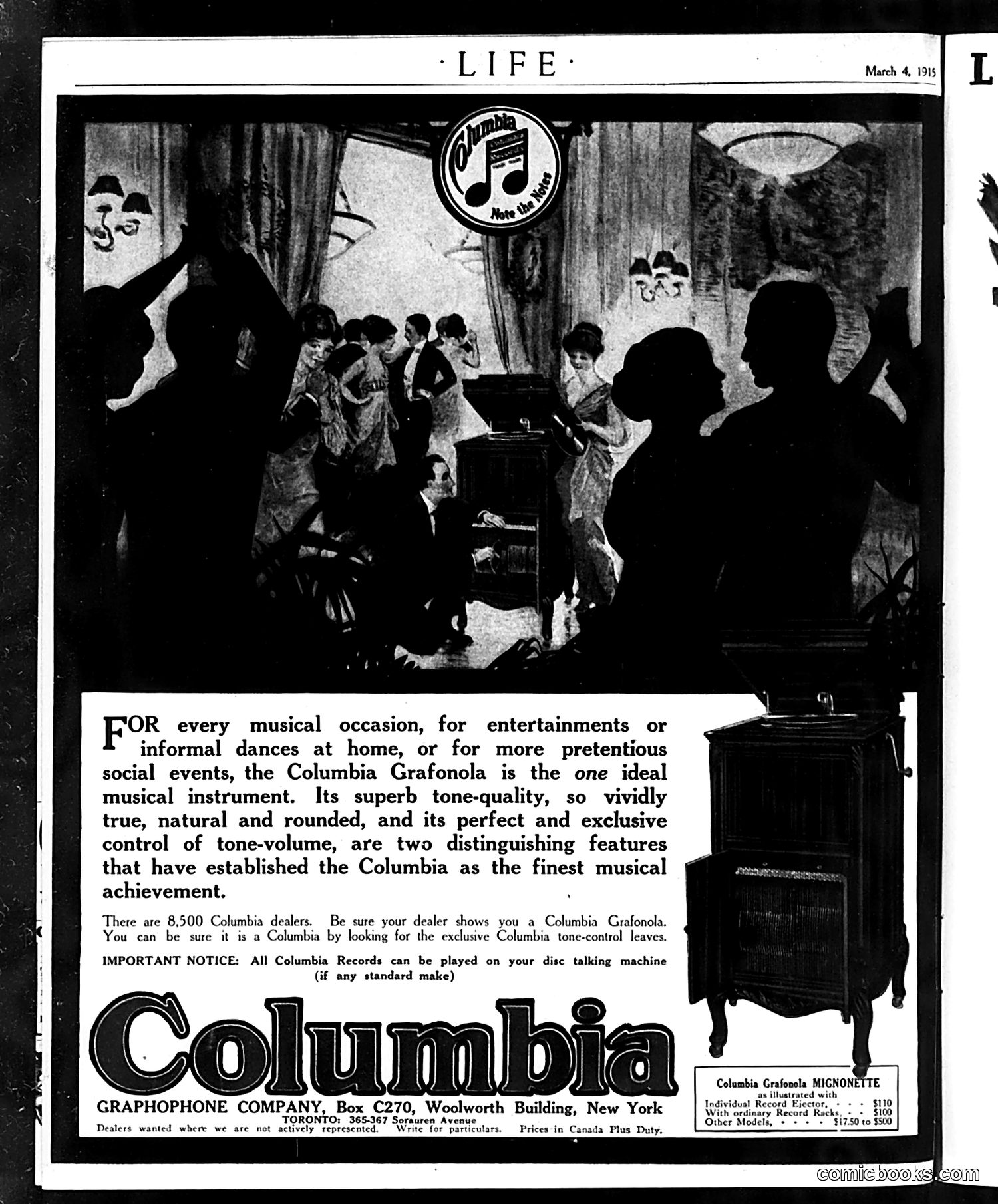
This page is primarily a **full-page advertisement**, not political satire. It promotes the Columbia Grafonola—an early gramophone/phonograph device for home music playback. The illustration depicts a fashionable early-20th-century social gathering: well-dressed guests in an elegant interior enjoy music from the Columbia machine, positioned as essential for "every musical occasion" from informal home dances to "pretentious social events." The ad emphasizes the device's "superb tone-quality" and exclusive "tone-control" features as markers of superiority. It stresses there are 8,500 authorized dealers and notes that Columbia records play on any standard phonograph—a competitive selling point in the nascent recording industry. The decorative theatrical masks and period styling reflect the machine's association with cultured entertainment and refined home life—aspirational marketing for an emerging consumer technology. This is straightforward product advertising, not satirical commentary.