
Life, 1915-03-04 · page 17 of 48
Life — March 4, 1915 — page 17: what you’re looking at
What you’re looking at
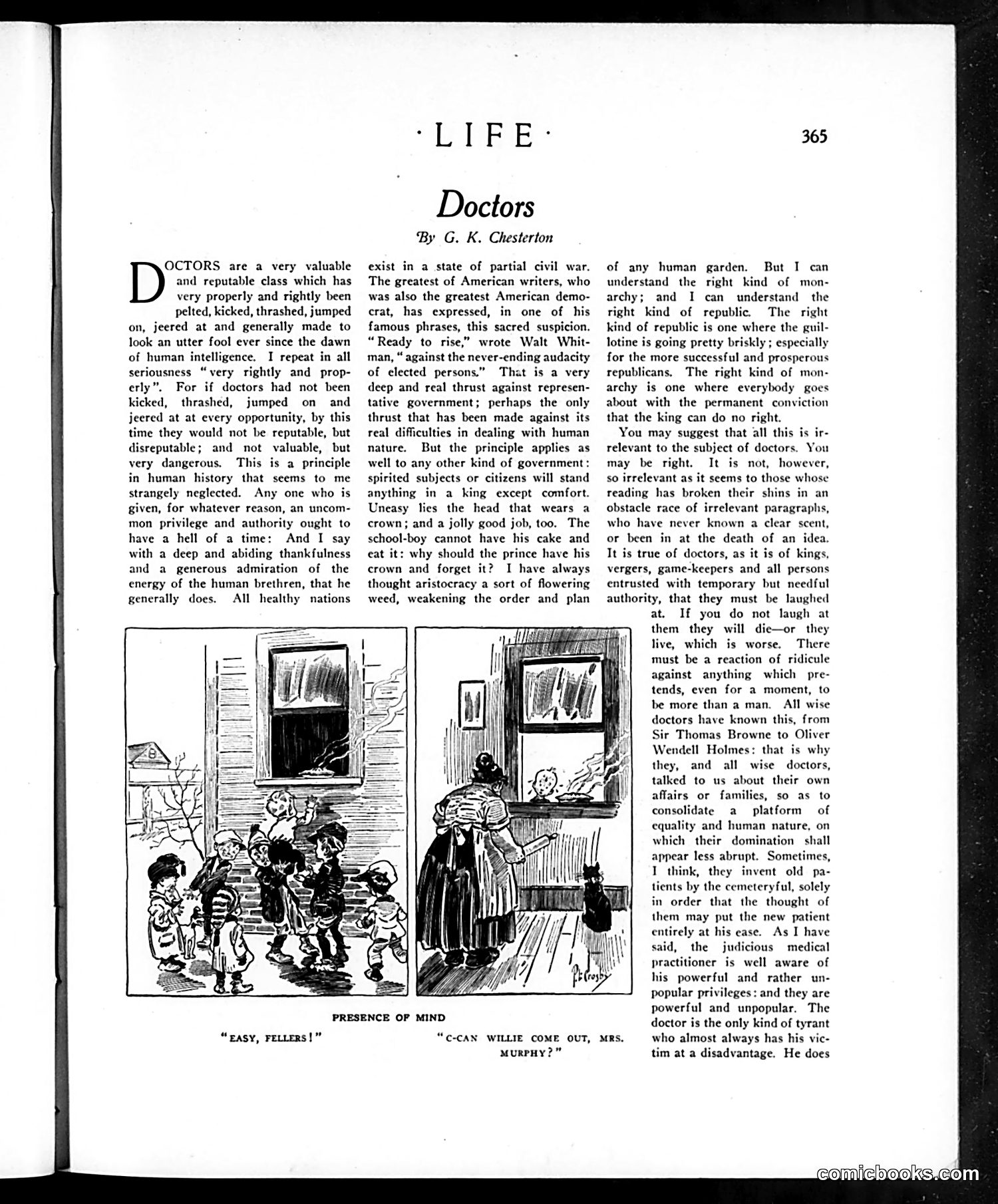
This is G.K. Chesterton's essay "Doctors" accompanied by two cartoon panels illustrating the concept of "Presence of Mind." **The Cartoons:** The left panel shows children cheerfully greeting a doctor with "Easy, Fellers!" The right panel depicts a woman at her door asking "C-can Willie come out, Mrs. Murphy?" — likely a child asking permission from the doctor's wife. **The Satire:** Chesterton argues that doctors, like all authority figures (kings, aristocrats), need to be regularly mocked and kept humble to remain respectable. He cites Walt Whitman's democratic suspicion of "elected persons" and suggests that without ridicule, those with power become dangerous tyrants. The cartoons illustrate this principle: showing doctors as approachable figures who interact with ordinary children suggests successful doctors maintain humanity and relatability rather than distant authority. **Modern Context:** This reflects early-20th-century anxieties about professional expertise and power—the tension between respecting expertise while resisting authoritarianism through humor and familiarity.
📄 Transcribed text from this page (OCR, searchable)
Machine-transcribed from the original scan — historical spelling and the odd misread are preserved.
OCTORS are a very valuable D and reputable class which has very properly and rightly been pelted, kicked, thrashed, jumped on, jeered at and generally made to look an utter fool ever since the dawn of human intelligence, I repeat in all seriousness “very rightly and prop- erly”. For if doctors had not been ki thrashed, jumped on and jeered at at every opportunity, by this time they would not be reputable, but disreputable; and not valuable, but very dangerous. This is a principle in human history that seems to me strangely neglected. Any one who is given, for whatever reason, an uncom- mon privilege and authority ought to have a hell of a time: And I say with a deep and abiding thankfulness and a generous admiration of the energy of the human brethren, that he generally does. All healthy nations “EE: Doctors ‘By G. K. Chesterton exist in a state of partial civil war. The greatest of American writers, who was also the greatest American demo- crat, has expressed, in one of his famous phrases, this sacred suspicion. “Ready to rise,” wrote Walt Whit- man, “ against the never-ending audacity of elected persons.” That is a very deep and real thrust against represen- tative government; perhaps the only thrust that has been made against its real difficulties in dealing with human nature. But the principle applies as well to any other kind of government: spirited subjects or citizens will stand anything in a king except comfort. Uneasy lies the head that wears a crown; and a jolly good job, too. The school-boy cannot have his cake and eat it: why should the prince have his crown and forget it? I have always thought aristocracy a sort of flowering weed, weakening the order and plan PRESENCE OF MIND “EASY, FELLERS!” “C-CAN WILLIE COME OUT, MRS. MURPHY?” of any human garden. But I can understand the right kind of mon- archy; and I can understand the right kind of republic. The right kind of republic is one where the guil- lotine is going pretty briskly ; especially for the more successful and prosperous republicans, The right kind of mon- archy is one where everybody goes about with the permanent conviction that the king can do no right. You may suggest that all this is ir- relevant to the subject of doctors. You may be right. It is not, however, so irrelevant as it seems to those whose reading has broken their shins in an obstacle race of irrelevant paragraphs, who have never known a clear scent, or been in at the death of an idea. It is true of doctors, as it is of kings, vergers, game-keepers and all persons entrusted with temporary but needful authority, that they must be laughed at. If you do not laugh at them they will die—or they live, which is worse. There must be a reaction of ridicule against anything which pre- tends, even for a moment, to be more than a man. All wise doctors have known this, from Sir Thomas Browne to Oliver Wendell Holmes: that is why they, and all wise doctors, talked to us about their own affairs or families, so as to consolidate a platform of equality and human nature, on which their domination shall appear less abrupt. Sometimes, I think, they invent old pa- tients by the cemeteryful, solely in order that the thought of them may put the new patient entirely at his ease. As I have said, the judicious medical practitioner is well aware of his powerful and rather un- popular privileges: and they are powerful and unpopular. The doctor is the only kind of tyrant who almost always has his vic- tim at a disadvantage. He does