
Life, 1915-03-04 · page 18 of 48
Life — March 4, 1915 — page 18: what you’re looking at
What you’re looking at
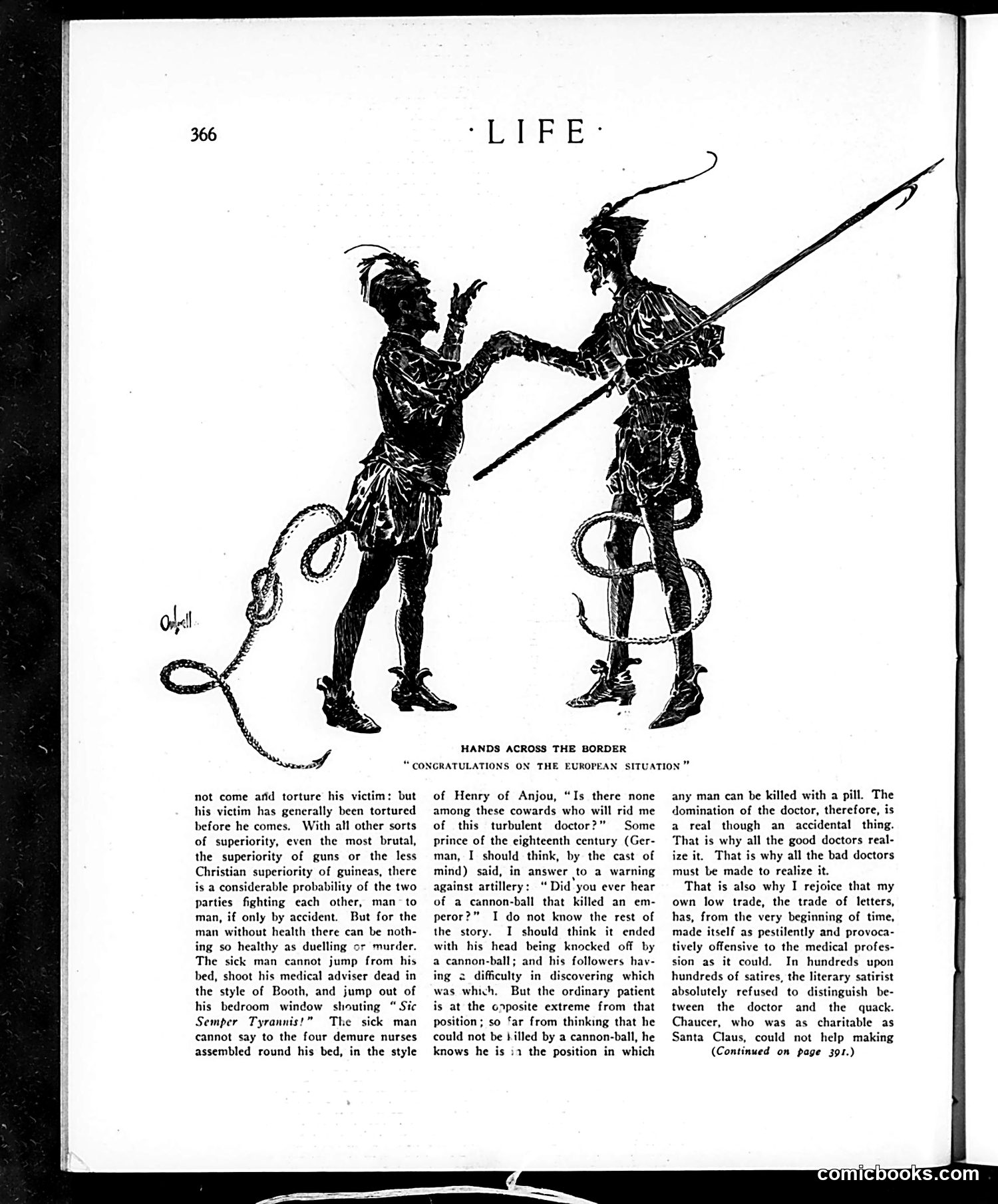
This political cartoon depicts two figures shaking hands across a border, likely representing European nations congratulating each other—though the specific nations aren't labeled in the visible portion. The figures wear period military/formal dress with ornate details and are bound together by rope, suggesting they are metaphorically "tied" or connected despite being on opposite sides of a border. Given the caption's reference to "European situation" and the date context (Life magazine), this likely satirizes diplomatic relations during a period of European tension or conflict. The binding imagery suggests ironic commentary: the handshake appears friendly on the surface, but the restraining ropes imply the nations are actually constrained, trapped, or hypocritically bound together despite apparent division. The accompanying text discusses medical authority and quackery, suggesting the page may be making broader points about deception and false civility in relationships—possibly between nations or institutions.
📄 Transcribed text from this page (OCR, searchable)
Machine-transcribed from the original scan — historical spelling and the odd misread are preserved.
ent not come afid torture his victim: but his victim has generally been tortured before he comes. With all other sorts of superiority, even the most brutal, the superiority of guns or the less Christian superiority of guineas, there is a considerable probability of the two parties fighting each other, man to man, if only by accident. But for the man without health there can be noth- ing so healthy as duelling or murder. The sick man cannot jump from his bed, shoot his medical adviser dead in the style of Booth, and jump out of his bedroom window shouting “ Sic Semper Tyrannis!” The sick man cannot say to the four demure nurses assembled round his bed, in the style “ CONGRATULATIONS ON THE EUROP! HANDS ACROSS THE BORDER of Henry of Anjou, “Is there none among these cowards who will rid me of this turbulent doctor?” Some prince of the eighteenth century (Ger- man, I should think, by the cast of mind) said, in answer to a warning against artillery: “ Did you ever hear of a cannon-ball that killed an em- peror?” I do not know the rest of the story. I should think it ended with his head being knocked off by a cannon-ball; and his followers hav- ing < difficulty in discovering which was which, But the ordinary patient is at the onposite extreme from that position; so far from thinking that he could not be billed by a cannon-ball, he knows he is :1 the position in which SITUATION ” any man can be killed with a pill. The domination of the doctor, therefore, is a real though an accidental thing. That is why all the good doctors real- ize it. That is why all the bad doctors must be made to realize it. That is also why I rejoice that my own low trade, the trade of letters, has, from the very beginning of time, made itself as pestilently and provoca- tively offensive to the medical profes- sion as it could. In hundreds upon hundreds of satires, the literary satirist absolutely refused to distinguish be- tween the doctor and the quack. Chaucer, who was as charitable as Santa Claus, could not help making (Continued on page 391.)