
Life, 1915-03-04 · page 22 of 48
Life — March 4, 1915 — page 22: what you’re looking at
What you’re looking at
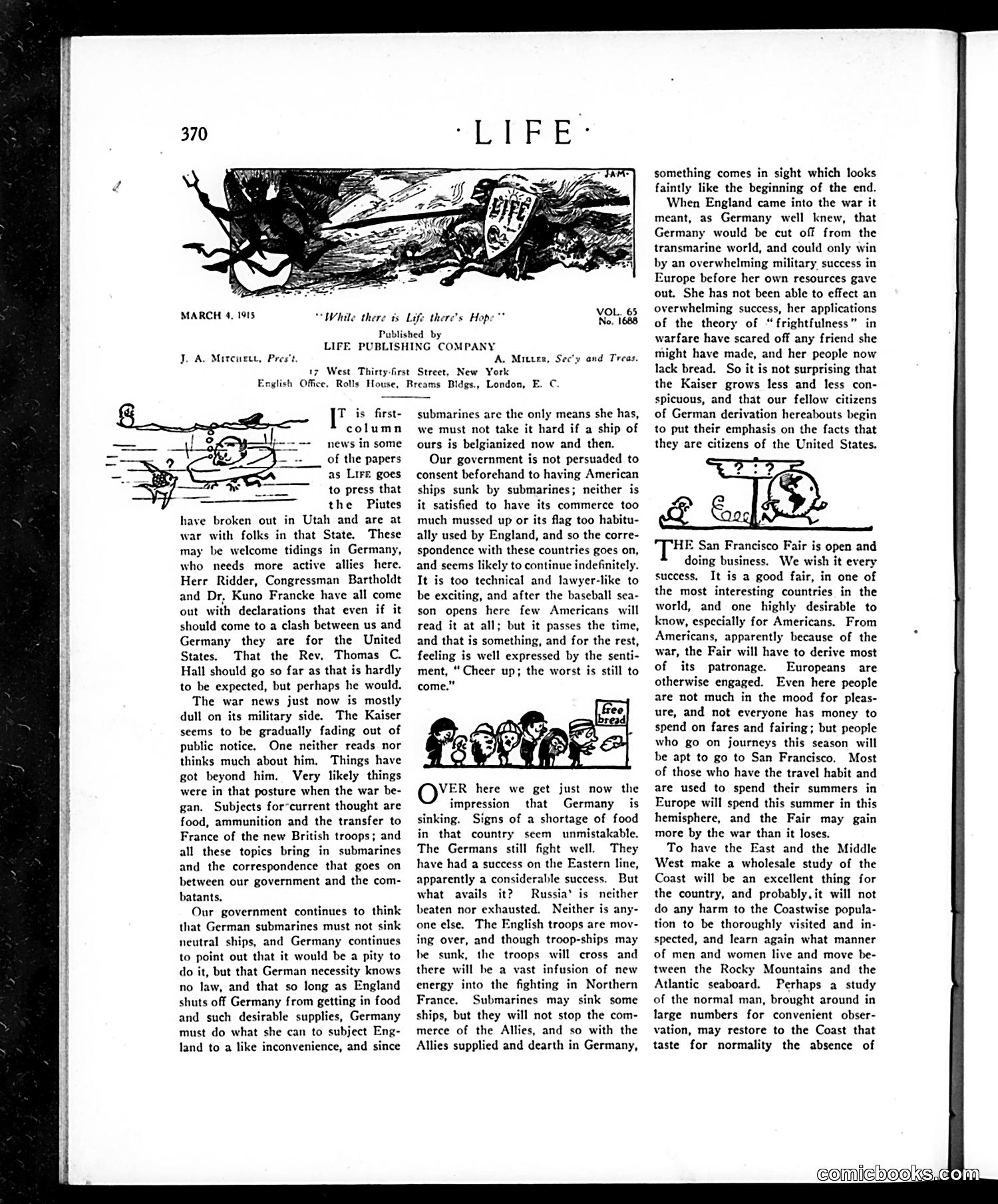
This page contains editorial commentary on World War I, written when America remained neutral. The editor discusses Germany's military situation and submarine warfare against neutral shipping. **Key satirical points:** 1. **The "Piutes" reference**: A joke suggesting Native American uprisings in Utah would be welcome news to Germany as it would distract American allies. 2. **The Kaiser fading from notice**: The editor sardonically observes that Kaiser Wilhelm II has become less prominent in American public consciousness—"things have got beyond him"—suggesting his relevance is diminishing. 3. **"Belgianized" ships**: A dark reference to Germany's invasion and occupation of Belgium (1914), used here as a verb meaning "sunk without warning." 4. **The core argument**: Germany faces inevitable defeat because the British naval blockade starves her economy while Allied forces (especially arriving British troops) receive supplies. The editor predicts Germany cannot win without immediate overwhelming military success in Europe. The tone is confident in Allied victory despite current military stalemate, reflecting American editorial opinion in early 1915.
📄 Transcribed text from this page (OCR, searchable)
Machine-transcribed from the original scan — historical spelling and the odd misread are preserved.
MARCH 4, 1915 J. A. Mercuett, Pres’t. news in some of the papers as Lire goes to press that the Piutes have broken out in Utah and are at war with folks in that State. These may be welcome tidings in Germany, who needs more active allies here. Herr Ridder, Congressman Bartholdt and Dr, Kuno Francke have all come out with declarations that even if it should come to a clash between us and Germany they are for the United States. That the Rev. Thomas C. Hall should go so far as that is hardly to be expected, but perhaps he would. The war news just now is mostly dull on its military side. The Kaiser seems to be gradually fading out of public notice. One neither reads nor thinks much about him. Things have got beyond him. Very likely things were in that posture when the war be- gan. Subjects for-current thought are food, ammunition and the transfer to France of the new British troops; and all these topics bring in submarines and the correspondence that goes on between our government and the com- batants. Our government continues to think that German submarines must not sink neutral ships, and Germany continues to point out that it would be a pity to do it, but that German necessity knows. no law, and that so long as England shuts off Germany from getting in food and such desirable supplies, Germany must do what she can to subject Eng- land to a like inconvenience, and since “While there is Life there's Hope Published by LIFE, PUBLISHING COMPANY A. Mitura, Sec'y and Treas. 17 West Thirty-first Street, New York English Office, Rotls House, Breams Bldgs., London, E. C. submarines are the only means she has, we must not take it hard if a ship of ours is belgianized now and then. Our government is not persuaded to consent beforehand to having American ships sunk by submarines; neither is it satisfied to have its commerce too much mussed up or its flag too habitu- ally used by England, and so the corre- spondence with these countries goes on, and seems likely to continue indefinitely. It is too technical and lawyer-like to be exciting, and after the baseball sea- son opens here few Americans will read it at all; but it passes the time, and that is something, and for the rest, feeling is well expressed by the senti- ment, “Cheer up; the worst is still to VER here we get just now the impression that Germany is sinking. Signs of a shortage of food in that country seem unmistakable. The Germans still fight well. They have had a success on the Eastern line, apparently a considerable success. But what avails it? Russia’ is neither beaten nor exhausted. Neither is any- one else. The English troops are mov- ing over, and though troop-ships may be sunk, the troops will cross and there will be a vast infusion of new energy into the fighting in Northern France. Submarines may sink some ships, but they will not stop the com- merce of the Allies, and so with the Allies supplied and dearth in Germany, something comes in sight which looks faintly like the beginning of the end. When England came into the war it meant, as Germany well knew, that Germany would be cut off from the transmarine world, and could only win by an overwhelming military success in Europe before her own resources gave out. She has not been able to effect an overwhelming success, her applications of the theory of “frightfulness” in warfare have scared off any friend she might have made, and her people now lack bread. So it is not surprising that the Kaiser grows less and less con- spicuous, and that our fellow citizens of German derivation hereabouts begin to put their emphasis on the facts that they are citizens of the United States. 'HE San Francisco Fair is open and doing business. We wish it every success, It is a good fair, in one of the most interesting countries in the world, and one highly desirable to know, especially for Americans. From Americans, apparently because of the war, the Fair will have to derive most of its patronage. Europeans are otherwise engaged. Even here people are not much in the mood for pleas- ure, and not everyone has money to spend on fares and fairing; but people who go on journeys this season will be apt to go to San Francisco. Most of those who have the travel habit and are used to spend their summers in Europe will spend this summer in this hemisphere, and the Fair may gain more by the war than it loses. To have the East and the Middle West make a wholesale study of the Coast will be an excellent thing for the country, and probably, it will not do any harm to the Coastwise popula- tion to be thoroughly visited and in- spected, and learn again what manner of men and women live and move be- tween the Rocky Mountains and the Atlantic seaboard. Perhaps a study of the normal man, brought around in large numbers for convenient obser- vation, may restore to the Coast that taste for normality the absence of