
Life, 1915-03-04 · page 28 of 48
Life — March 4, 1915 — page 28: what you’re looking at
What you’re looking at
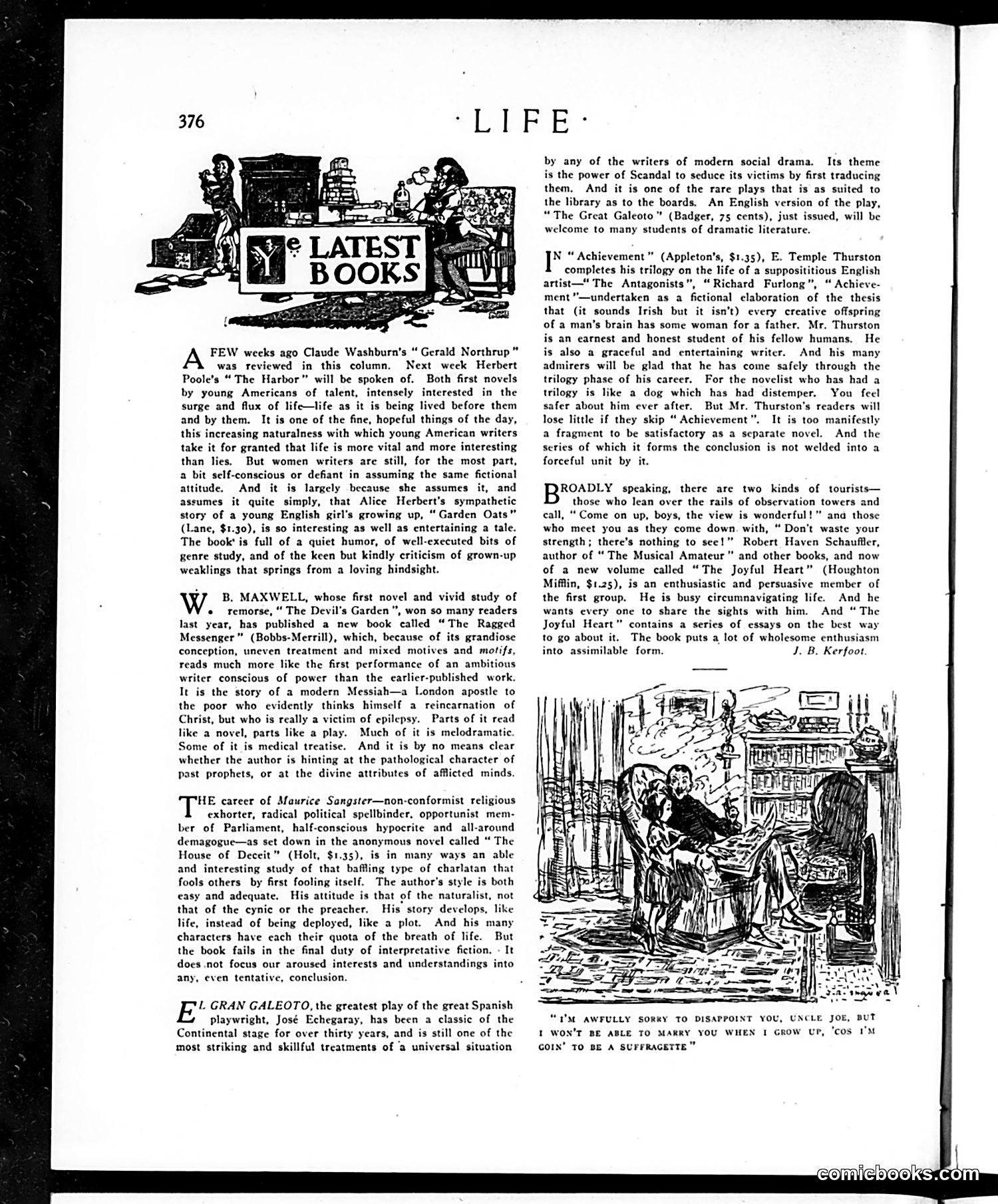
This page is a **book review column**, not a political cartoon. It discusses several contemporary novels and plays, likely from the early 1900s based on publication details. The reviews cover works exploring social themes: a novel about a "modern Messiah" figure afflicted with epilepsy; a study of a charlatan religious/political demagogue ("Maurice Sangster") who deceives others; and commentary on how scandal corrupts innocence. The illustration on the right appears to be a **domestic scene** from one of the reviewed works, showing an interior with figures and accompanying dialogue: "I'M AWFULLY SORRY TO DISAPPOINT YOU, UNCLE JOE, BUT I WON'T BE ABLE TO MARRY YOU WHEN I GROW UP, 'COS I'M GOIN' TO BE A SUFFRAGETTE." This joke references the **women's suffrage movement**, mocking it by having a child reject a (humorous) marriage proposal to join suffragettes instead—reflecting contemporary satirical dismissal of women's political activism.
📄 Transcribed text from this page (OCR, searchable)
Machine-transcribed from the original scan — historical spelling and the odd misread are preserved.
RENE.” FEW wecks ago Claude Washburn’s “ Gerald Northrup” was reviewed in this column. Next week Herbert Poole’s “ The Harbor” will be spoken of. Both first novels by young Americans of talent, intensely interested in the surge and flux of life—life as it is being lived before them and by them. It is one of the fine, hopeful things of the day, this increasing naturalness with which young American writers take it for granted that life is more vital and more interesting than lies, But women writers are still, for the most part, a bit self-conscious or defiant in assuming the same fictional attitude, And it is largely because she assumes it, and assumes it quite simply, that Alice Herbert's sympathetic story of a young English girl's growing up, “Garden Oats” (Lane, $1.30), is so interesting as well as entertaining a tale. The book’ is full of a quiet humor, of well-executed bits of genre study, and of the keen but kindly criticism of grown-up weaklings that springs from a loving hindsight. B, MAXWELL, whose first novel and vivid study of «remorse, “ The Devil’s Garden ”, won so many readers last year, has published a new book called “The Ragged Messenger” (Bobbs-Merrill), which, because of its grandiose conception, uneven treatment and mixed motives and motifs, reads much more like the first performance of an ambitious writer conscious of power than the earlier-published work. It is the story of a modern Messiah—a London apostle to the poor who evidently thinks himself a reincarnation of Christ, but who is really a victim of epilepsy. Parts of it read like a novel, parts like a play. Much of it is melodramatic. Some of it is medical treatise. And it is by no means clear whether the author is hinting at the pathological character of past prophets, or at the divine attributes of afflicted minds. HE career of Maurice Sangster—non-conformist religious exhorter, radical political spellbinder, opportunist mem- ber of Parliament, half-conscious hypocrite and all-around demagogue—as set down in the anonymous novel called “ The House of Deceit” (Holt, $1.35), is in many ways an able and interesting study of that baffling type of charlatan that fools others by first fooling itself. The author's style is both easy and adequate. His attitude is that of the naturalist, not that of the cynic or the preacher. His story develops, like life, instead of being deployed, like a plot. And his many characters have each their quota of the breath of life. But the book fails in the final duty of interpretative fiction, - It does not focus our aroused interests and understandings into any, even tentative, conclusion. L GRAN GALEOTO, the greatest play of the great Spanish playwright, José Echegaray, has been a classic of the Continental stage for over thirty years, and is still one of the most striking and skillful treatments of ‘a universal situation by any of the writers of modern social drama. Its theme is the power of Scandal to seduce its victims by first traducing them, And it is one of the rare plays that is as suited to the library as to the boards, An English version of the play, “The Great Galeoto” (Badger, 75 cents), just issued, will be welcome to many students of dramatic literature. [X Achievement” (Appleton’s, $1.35), E. Temple Thurston completes his trilogy on the life of a supposit i artist" The Antagonists”, “Richard Furlong”, “ ment "—undertaken as a fictional claboration of the thesis that (it sounds Irish but it isn’t) every creative offspring of a man’s brain has some woman for a father. Mr, Thurston is an earnest and honest student of his fellow humans. He is also a graceful and entertaining writer. And his many admirers will be glad that he has come safely through the trilogy phase of his career. For the novelist who has had a trilogy is like a dog which has had distemper. You feel safer about him ever after. But Mr. Thurston's readers will lose little if they skip “Achievement”. It is too manifestly a fragment to be satisfactory as a separate novel. And the series of which it forms the conclusion is not welded into a forceful unit by it. ROADLY speaking, there are two kinds of tourists— those who lean over the rails of observation towers and call, “Come on up, boys, the view is wonderful!” ana those who meet you as they come down with, “Don't waste your strength; there's nothing to see!" Robert Haven Schaufiler, author of “ The Musical Amateur” and other books, and now of a new volume called “The Joyful Heart” (Houghton Mifflin, $1.25), is an enthusiastic and persuasive member of the first group. He is busy circumnavigating life. And he wants every one to share the sights with him. And “The Joyful Heart” contains a series of essays on the best way to go about it. The book puts a lot of wholesome enthusiasm into assimilable form. J. B. Kerfoot. “I'M AWFULLY SORRY TO DISAPPOINT YOU, UNCLE JOE, BUT 1 WON'T BE ABLE TO MARRY YOU WHEN I GROW UP, ‘Cos I'M GOIN’ TO BE A SUFFRAGETTE”