
Life, 1915-03-04 · page 26 of 48
Life — March 4, 1915 — page 26: what you’re looking at
What you’re looking at
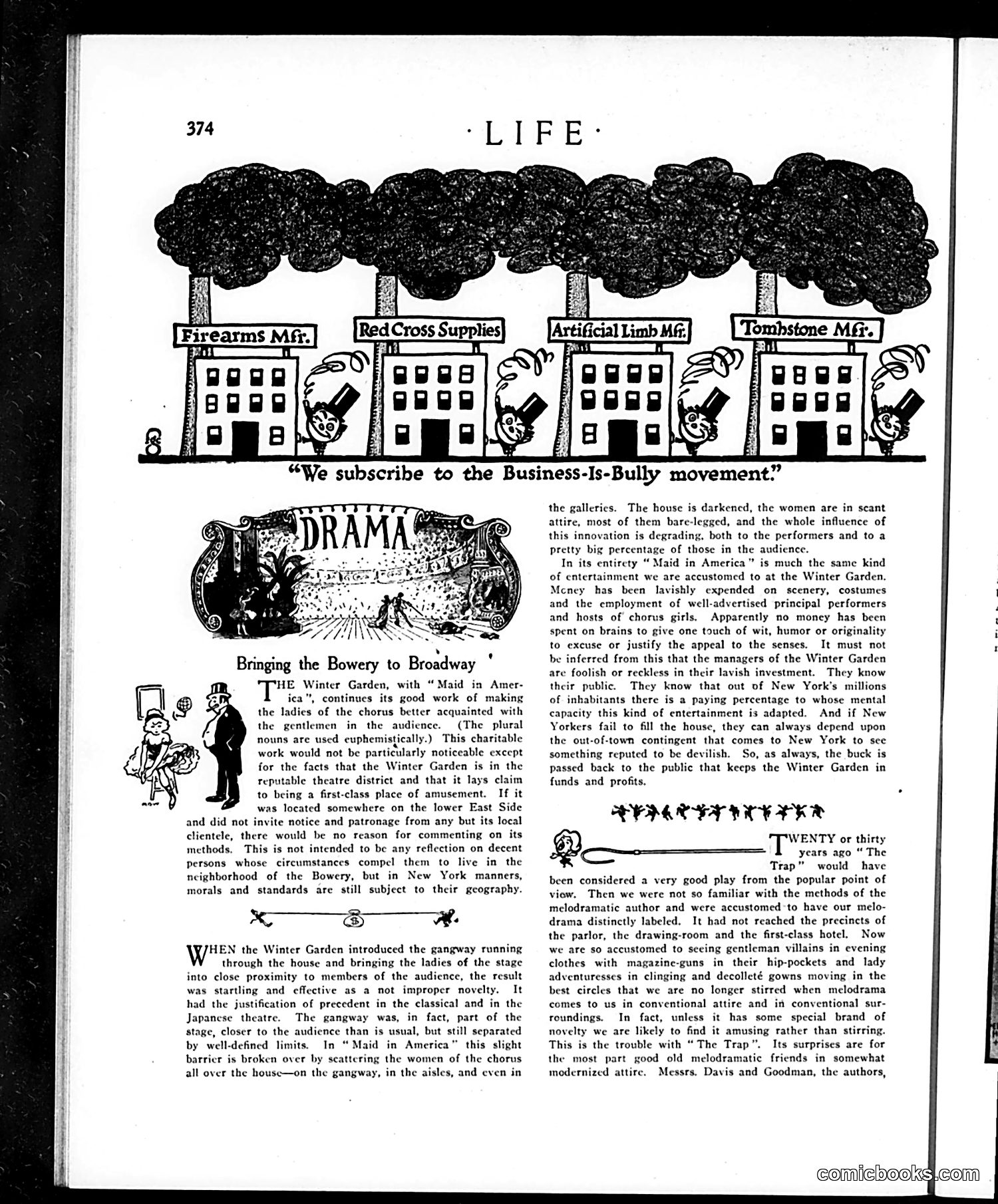
The top cartoon satirizes corporate behavior during the early 20th century. Four identical factory buildings—labeled Firearms Mfr., Red Cross Supplies, Artificial Limb Mfg., and Tombstone Mfg.—stand in a row, each operated by the same businessman character (shown in the windows). The joke exposes cynical wartime profiteering: the same businessman profits from every stage of conflict, from weapons and medical supplies to prosthetics and coffins. The caption mocks the "Business-Is-Bully movement"—likely referring to Theodore Roosevelt's "strenuous life" philosophy or corporate triumphalism—by demonstrating how businessmen benefit from human suffering and death regardless of which products they sell. Below, the text critiques the Winter Garden theater's "Maid in America" for its degrading treatment of chorus girls scattered throughout the darkened house in minimal clothing, conflating theatrical "innovation" with exploitation.
📄 Transcribed text from this page (OCR, searchable)
Machine-transcribed from the original scan — historical spelling and the odd misread are preserved.
SOONG S 77! |\ WS Bringing the Bowery to Broadway HE Winter Garden, with “Maid in Amer- ica", continues its good work of making of the chorus better acquainted with the las the gentlemen in the audience. (The plural nouns are used cuphemistically.) This charitable work would not be particularly noticeable except for the facts that the Winter Garden is in the reputable theatre district and that it lays claim to being a first-class place of amusement. If it was located somewhere on the lower East Side and did not invite notice and patronage from any but its local clientele, there would be no reason for commenting on its methods, This is not intended to be any reflection on decent persons whose circumstances compel them to live in the neighborhood of the Bowery, but in New York manners, morals and standards are still subject to their geography. cr) ve. HEN the Winter Garden introduced the gangway running through the house and bringing the ladies of the stage into close proximity to members of the audience, the result was startling and effective as a not improper novelty. It had the justification of precedent in the classical and in the Japanese theatre. The gangway was, in fact, part of the ¢, closer to the audience than is usual, but still separated M-defined limits. In “Maid in America” this slight barrier is broken over by scattering the women of the chorus all over the housc—on the gangway, in the aisles, and even in the galleries. The house is darkened, the women are in scant attire, most of them bare-legged, and the whole influence of this innovation is degrading, both to the performers and to a pretty big percentage of those in the audience. In its entirety “ Maid in America” is much the same kind of entertainment we are accustomed to at the Winter Garden. Mcney has been lavishly expended on scenery, costumes and the employment of well-advertised principal performers and hosts of’ chorus girls. Apparently no money has been spent on brains to give one touch of wit, humor or originality to excuse or justify the appeal to the senses. It must not be inferred from this that the managers of the Winter Garden are foolish or reckless in their lavish investment. They know their public. They know that out of New York's millions of inhabitants there is a paying percentage to whose mental capacity this kind of entertainment is adapted. And if New Yorkers fail to fill the house, they can always depend upon the out-of-town contingent that comes to New York to see something reputed to be devilish. So, as always, the buck is passed back to the public that keeps the Winter Garden in funds and profits. SEGRE OEE KR D WENTY or thirty as years ago “ The Trap” would have been considered a very good play from the popular point of view. Then we were not so familiar with the methods of the melodramatic author and were accustomed to have our melo- drama distinctly labeled, It had not reached the precincts of the parlor, the drawing-room and the first-class hotel, Now we are so accustomed to seeing gentleman villains in evening clothes with magazine-guns in their hip-pockets and lady adventuresses in clinging and decolleté gowns moving in the best circles that we are no longer stirred when melodrama comes to us in conventional attire and in conventional sur- roundings. In fact, unless it has some special brand of novelty we are likely to find it amusing rather than stirring. This is the trouble with “The Trap”. Its surprises are for the most part good old melodramatic friends in somewhat modernized attire. Messrs. Davis and Goodman, the authors, comichookg.com