
Life, 1915-03-04 · page 27 of 48
Life — March 4, 1915 — page 27: what you’re looking at
What you’re looking at
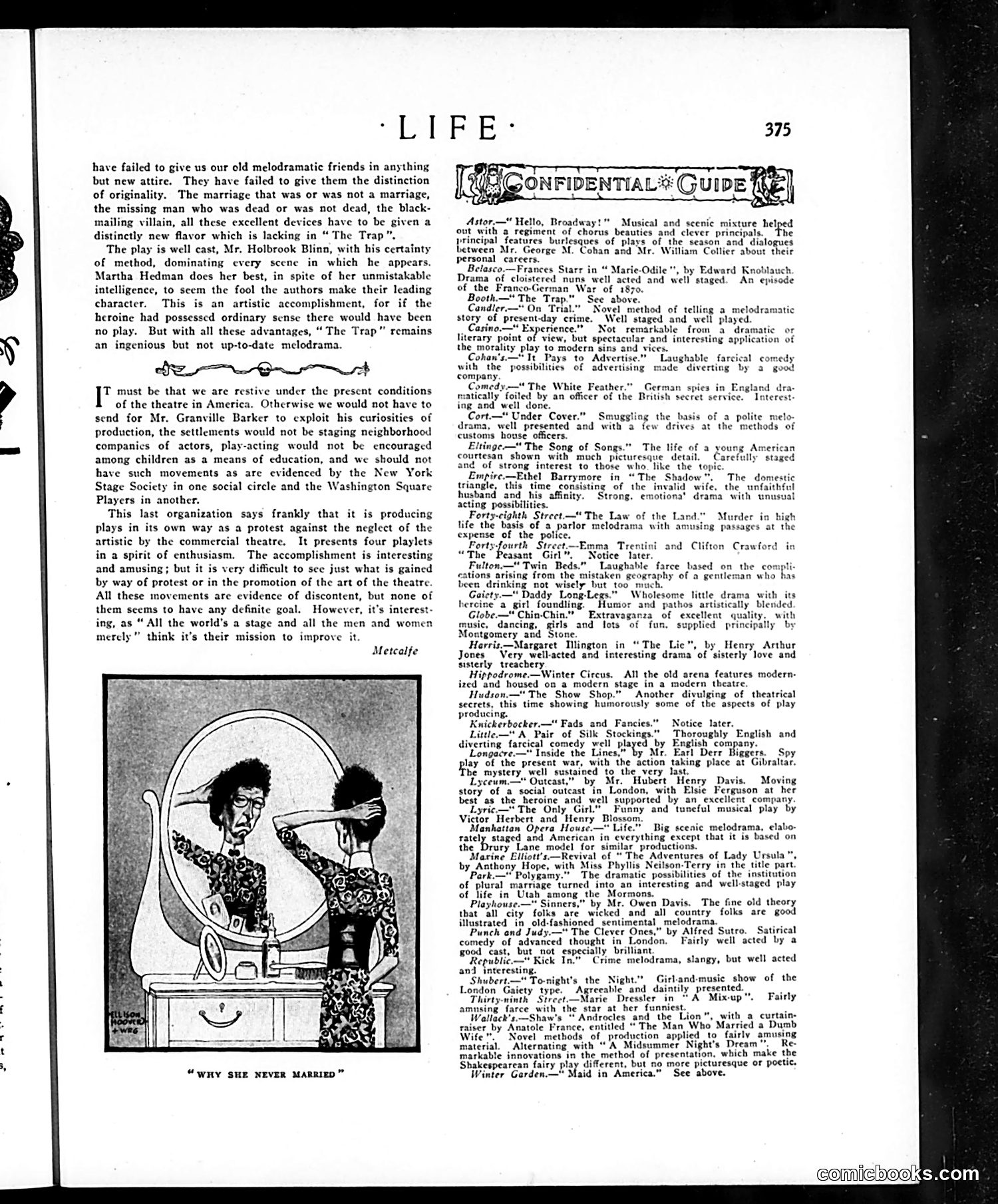
This cartoon depicts a woman in an elaborate, ornate dress looking at her reflection in a mirror—but the reflection shows a man in similarly decorative clothing. The satire appears to comment on theatrical excess and artificiality in early 20th-century Broadway productions. The page surrounding it reviews contemporary plays, noting that the theater has become overly reliant on spectacle ("chorus beauties," "picturesque detail") rather than genuine artistic innovation. The caption "Why She Never Married" likely suggests the joke: the woman is so consumed by theatrical vanity and ornamental self-regard that she has no room for genuine human connection. This reflects broader criticism in the text about American commercial theater prioritizing visual spectacle and melodramatic conventions over substantive dramatic art—a concern mentioned throughout the "Confidential Guide" reviews on the page.
📄 Transcribed text from this page (OCR, searchable)
Machine-transcribed from the original scan — historical spelling and the odd misread are preserved.
have failed to give us our old melodramatic friends in anything but new attire. They have failed to give them the distinction of originality. The marriage that was or was not a marriage, the missing man who was dead or was not dead, the black- mailing villain, all these excellent devices have to be given a distinctly new flavor which is lacking in “ The Trap”. The play is well cast, Mr. Holbrook Blinn, with his certainty of method, dominating every scene in which he appears. Martha Hedman does her best, in spite of her unmistakable intelligence, to seem the fool the authors make their leading character. This is an artistic accomplishment, for if the heroine had possessed ordinary sense there would have been no play. But with all these advantages, “ The Trap" remains an ingenious but not up-to-date melodrama. SR Ie Bt T must be that we are restive under the present conditions of the theatre in America. Otherwise we would not have to send for Mr. Granville Barker to exploit his curiosities of production, the settlements would not be staging neighborhood companies of actors, play-acting would not be encouraged among children as a means of education, and we should not have such movements as are evidenced by the New York Stage Society in one social circle and the Washington Square Players in another. This last organization says frankly that it is producing plays in its own way as a protest against the neglect of the artistic by the commercial theatre, It presents four playlets in a spirit of enthusiasm. The accomplishment is interesting and amusing; but it is very difficult to see just what is gained by way of protest or in the promotion of the art of the theatre. All these movements are evidence of discontent, but none of them scems to have any definite goal. However, it’s interest- ing, as “All the world’s a stage and all the men and women merely” think it’s their mission to improve it. Metcalfe “WHY SHE NEVER MARRIED” a Ce Ol ch) Se ONFIDENTIAL* GUIDE “Hello, Broadway!” Musical and scenic mixture helped out with a regiment of chorus beauties and clever principals. The principal features burlesques of plays of the season and dialogues between Mr. George M. Cohan and Mr. William Collier about their personal carcers. Belasco.—Frances Starr in “ Marie-Odile", by Edward Knoblauch Drama of cloistered nuns well acted and well staged. An episode of the Franco-German War of 1870. Booth.—" The Trap.” See abov Candler.—" On Trial.” Novel method of telling a melodramatic story of present-day crime. Well staged and well played. “Experience.” Not remarkable from a dramatic or Casino.— literary point of view, but spectacular and interesting application of the morality play to modern sins and vices. Cohan's.—" It Pays to Advertise.” Laughable farcical comedy with the possibilities of advertising made diverting by a good company. Comedy.—" The White Feather.” German spies in England dra- ically’ foiled by an officer of the British secret service. Interes ing and well done. Cort—" Under Cover.” Smuggling the basis of a polite melo- drama, well presented and with a few drives at the methods of customs house officers. Eltinge-—" The Song of Songs.” The life of a young American courtesan shown with much picturesque detail. Carefully staged and of strong interest to those who. like the topic Empire.—Ethel Barrymore in “The Shadow". The domestic triangle, this time consisting of the invalid wife, the unfaithful husband and his affinity. Strong. emotiona’ drama with unusual acting possibilities. Forty-cighth Strect—“ The Law of the Lard.” Murder in high life the basis of a parlor melodrama with amusing passages at the expense of the police. Pers fours Street—Emma_ Trentini “The Peasant Girl”. “Notice later. ‘ulton.—" Twin Beds.” Laughable farce based on the compl ions arising from the mistaken geography of a gentleman who has cen drinking not wisely but too much. Gaiety.—" Daddy Long-Legs.” Wholesome little drama with its hercine’ a git! foundling. Hume pathos artistically blended Globe.—" Chin-Chin.” Extravaganza of excellent quality, with music, dancing, gitls and lots of fun, supplied principally by Montgomery and Stone. Herris Margaret Illington in “The Lie”, by Henry Arthur Jones Very well-acted and interesting drama of sisterly love and sisterly treachery. Hippodrome.—Winter Circus. All the old arena features modern- ized and housed on a modern stage in a modern theatre. Hudson.—" The Show Shop.” Another divulging of theatrical secrets, this time showing humorously some of the aspects of play producing. Knickerbocker.—" Fads and Fancies. Notice later. Littl.—""A_ Pair of Silk Stockings." Thoroughly English and diverting farcical comedy well played by English company. Longacre.—" Inside the Lines,” by Mr. Earl Derr Biggers lay of the present war, with the action taking place at he mystery well sustained to the very last. , : Lyceum.—" Outcast,” by Mr. Hubert Henry Davis. Moving story of a social outcast in London, with Elsie Ferguson at her best as the heroine and well supported by an excellent company. Lyric.—" The Only Girl.” Funny and tuneful musical play by Victor Herbert and Henry Blossom. . Manhattan Opera House.—" Life.” Big scenic melodrama, elabo- rately staged and American in everything except that it is based on the Drury Lane model for similar productions. Marine Elliott’s—Revival of “ The Adventures of Lady Ursula”, by Anthony Hope, with Miss Phyllis Neilson-Terry in the title part. Park.—" Polygamy.” The dramatic possibilities of the institution of plural marriage turned into an interesting and well-staged play of life in Utah among the Mormons. Playhouse.—" Sinners,” by Mr. Owen Davis. The fine old theory that all city folks are wicked and all country folks are good illustrated in old-fashioned sentimental, melodrama. z Punch and Judy.—" The Clever Ones,” by Alfred Sutro. Satirical comedy of advanced thought in London. Fairly well acted by a good cast, but not especially brilliant. Republic.—" Kick In.” Crime melodrama, slangy, but well acted and interesting. 7 Shubert—" To-night’s the Night.” Girl-and-music show of the London Gaiety type. Agreeable and daintily presented. | Thirty-ninth Strect—Marie Dressler in “A Mix-up". amusing farce with the star at her funniest. | Wallack's.—Shaw's “ Androcles and the Lion”, with a curtaine raiser by Anatole France, entitled “ The Man Who Married a Dumb Wife.” Novel methods of production applied to fairly a material. Alternating with “A Midsummer Night's Dream". Re- markable innovat ¢ method of presentation, which make the Shakespearean fairy ferent, but no more picturesque or poetic. Winter Garden. Maid in America.” See above. i and Clifton Crawford in irly comicbookexeenn