
Life, 1915-03-04 · page 9 of 48
Life — March 4, 1915 — page 9: what you’re looking at
What you’re looking at
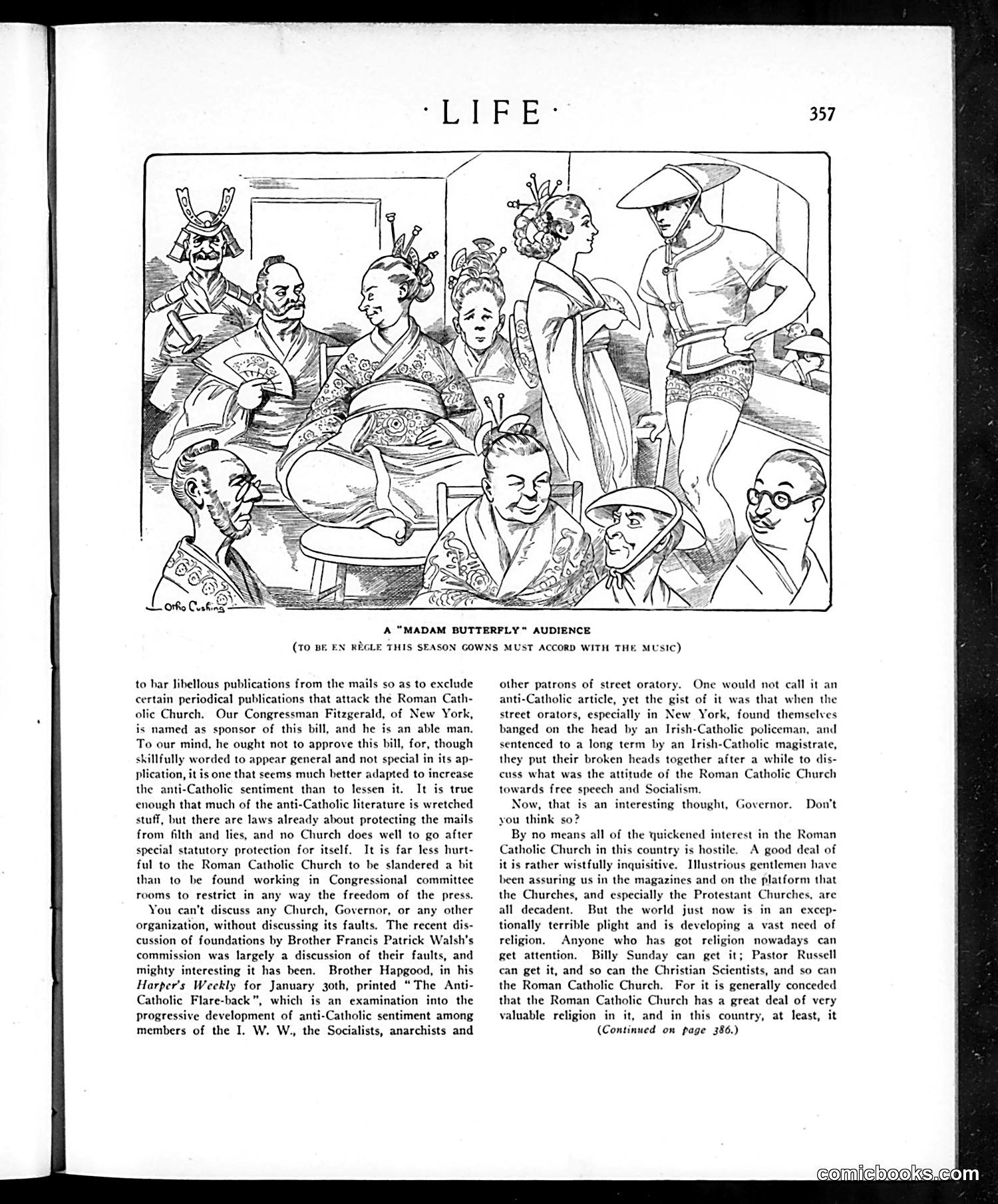
This cartoon satirizes early 20th-century theatrical fashion. The caption notes that "Règle this season gowns must accord with the music," referencing Puccini's opera *Madama Butterfly* (1904). The sketch shows audience members dressed in elaborate Japanese kimonos and traditional clothing while attending what appears to be the opera. The satire targets the fashionable trend of adopting "Oriental" dress—particularly Japanese styles—to match theatrical productions, reflecting the period's fascination with Japonisme. The cartoon mocks this performative exoticism: attendees are essentially costuming themselves as characters from the show rather than simply watching it. The mixed group of well-dressed patrons—some wearing eyeglasses, some in Western hybrid dress—illustrates how thoroughly this fashion craze had permeated high society's entertainment culture.
📄 Transcribed text from this page (OCR, searchable)
Machine-transcribed from the original scan — historical spelling and the odd misread are preserved.
A “MADAM BUTTERFLY” AUDIENCE (To BE EN REGLE THIS SEASON GOWNS MUST ACCORD WITH THE MUSIC) to har libellous publications from the mails so as to exclude certain periodical publications that attack the Roman Cath- olic Church. Our Congressman Fitzgerald, of New York, is named as sponsor of this bill, and he is an able man. To our mind, he ought not to approve this bill, for, though skillfully worded to appear general and not special in its ap- plication, it is one that seems much better adapted to increase the anti-Catholic sentiment than to lessen it. It is true enough that much of the anti-Catholic literature is wretched stuff, but there are laws already about protecting the mails from filth and lies, and no Church does well to go after special statutory protection for itself. It is far less hurt- ful to the Roman Catholic Church to be slandered a bit than to be found working in Congressional committee rooms to restrict in any way the freedom of the press. You can't discuss any Church, Governor, or any other organization, without discussing its faults. The recent dis- cussion of foundations by Brother Francis Patrick Walsh's commission was largely a discussion of their faults, and mighty interesting it has been. Brother Hapgood, in his Harper's Weekly for January 30th, printed “The Anti- Catholic Flare-back”, which is an examination into the Progressive development of anti-Catholic sentiment among members of the I, W. W., the Socialists, anarchists and other patrons of street oratory. One would not call it an anti-Catholic article, yet the of it was that when the street orators, especially in New York, found themselves banged on the head by an Irish-Catholic policeman, and sentenced to a long term by an Irish-Catholic magistrate, they put their broken heads together after a while to dis- cuss what was the attitude of the Roman Catholic Church towards free speech and Socialism. Now, that is an interesting thought, Governor. you think so By no means all of the quickened interest in the Roman Catholic Church in this country is hostile. A good deal of it is rather wistfully inquisitive. Ilustrious gentlemen have been assuring us in the magazines and on the platform that the Churches, and especially the Protestant Churches, are all decadent. But the world just now is in an excep- tionally terrible plight and is developing a vast need of religion. Anyone who has got religion nowadays can get attention. Billy Sunday can get it; Pastor Russell can get it, and so can the Christian Scientists, and so can the Roman Catholic Church. For it is generally conceded that the Roman Catholic Church has a great deal of very valuable religion in it, and in this country, at least, it (Continued on page 386.) Don't