
A complete issue · 44 pages · 1915
Life — February 11, 1915
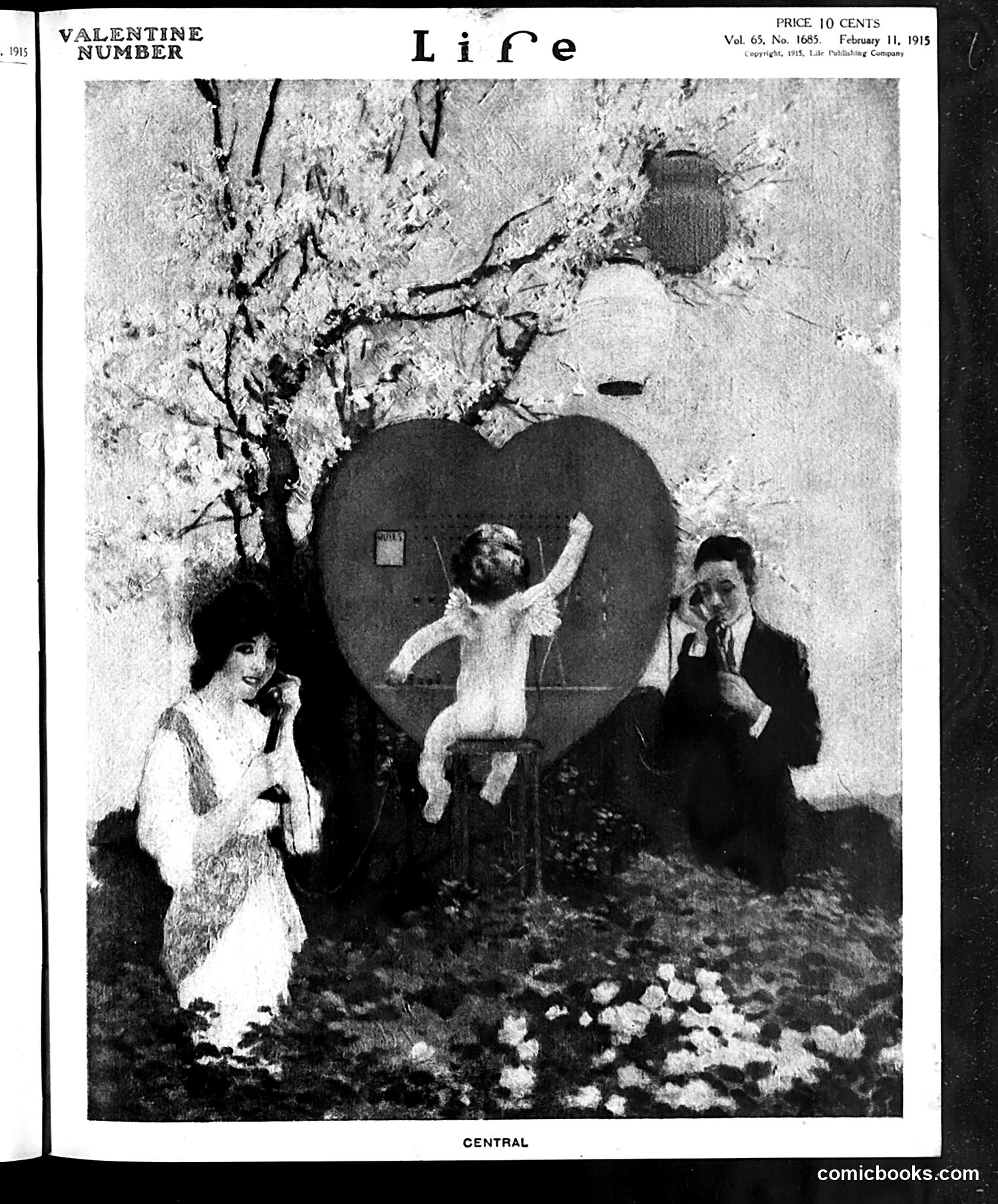
This is a Valentine's Day-themed cover illustration for Life's satirical magazine. The image depicts two figures in formal attire flanking a large heart symbol, positioned beneath a blooming tree. A woman on the left and a man on the right both appear to be offering flowers or gestures toward the heart. The satire likely comments on romantic conventions or courtship rituals of the 1915 era, using the exaggerated heart imagery and formal poses to mock sentimentality or dating customs. The symmetrical composition emphasizes the parallel, almost ritualistic nature of their romantic gestures. Without additional caption text visible, the specific social critique remains somewhat unclear, though it appears to lampoon conventional Valentine's Day romance performances.
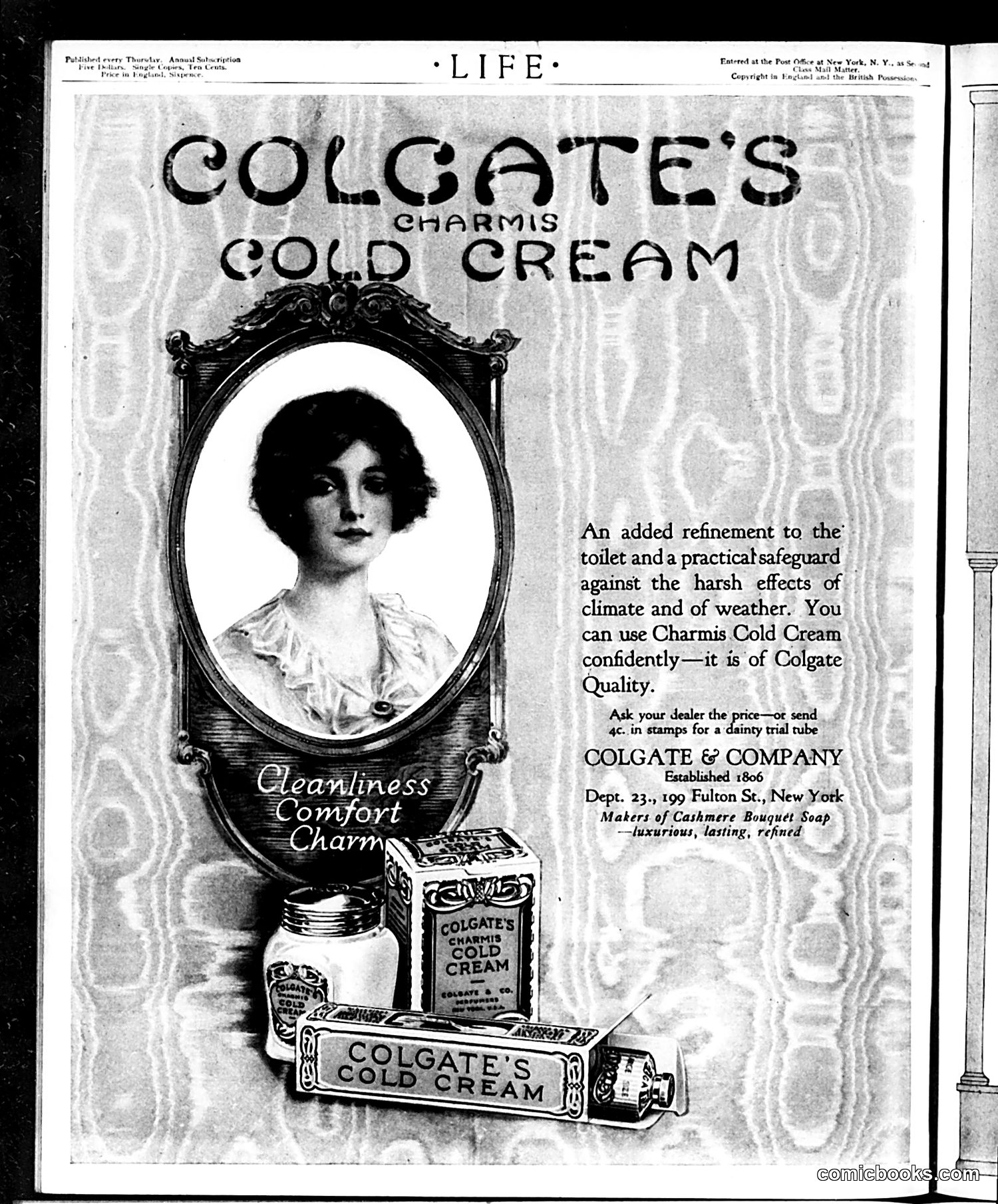
This page is **not a cartoon or satirical content**—it's a straightforward advertisement for Colgate's Charmis Cold Cream, published in *Life* magazine. The ad features a portrait of an elegant woman framed in an ornate oval, with text emphasizing the product as "an added refinement to the toilet" that protects skin from harsh weather and climate. The messaging appeals to early 20th-century beauty standards and concerns about maintaining a refined appearance. The ad includes product images and purchasing information (4¢ for a trial tube via mail). The tagline "Cleanliness Comfort Charm" connects the cold cream to broader Victorian-era values of gentility. This represents typical *Life* magazine content from this era—quality advertisements placed alongside satirical material.
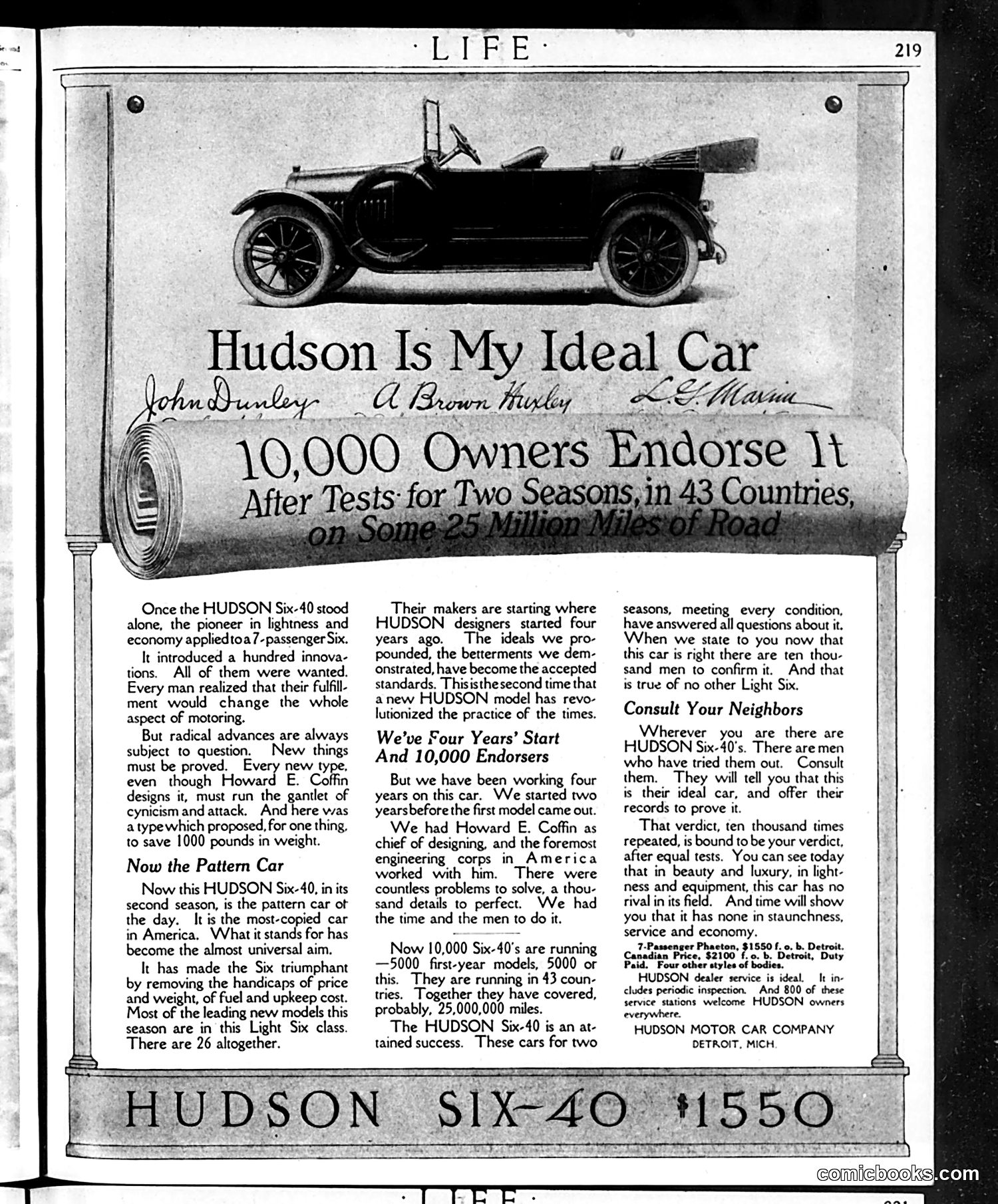
This is a **straightforward automobile advertisement**, not satire or political commentary. It appears in *Life* magazine (page 219) and promotes the Hudson Six-40 car for $1,550. The page features three signatures endorsing the vehicle—identifiable names include "John Dunley" and what appears to be "L.E. Maxim"—representing satisfied owners. The ad claims 10,000 Hudson owners endorsed the car after testing it across 43 countries over two seasons, covering approximately 25 million miles. The advertisement emphasizes reliability, design innovation, and practical value. Rather than satire, this represents typical early 20th-century automotive marketing: using testimonials and performance claims to establish consumer trust and differentiate the Hudson brand in a competitive market.
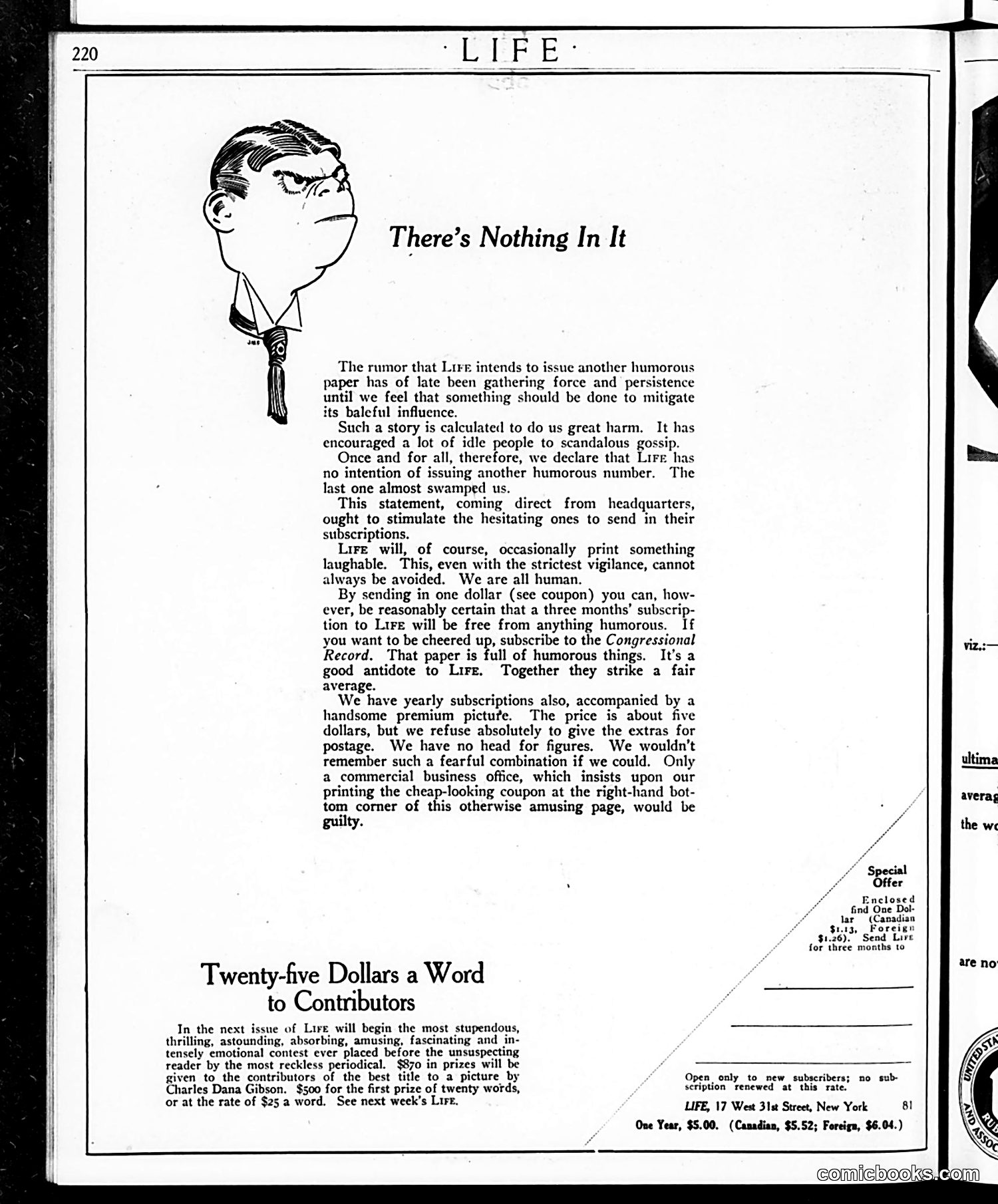
This page contains a satirical editorial titled "There's Nothing In It," addressing rumors that Life planned to launch a humorous competitor publication. The editorial denies this, calling such rumors harmful and conducive to "idle people to scandalous gossip." The accompanying caricature shows an angry, scowling face—likely representing either a competitor publication or the rumor itself personified as an antagonistic force. The editorial emphasizes Life's commitment to humor while offering subscription deals, and concludes with a contest announcement offering $970 in prizes for contributions at twenty-five dollars per word, mentioning Charles Dana Gibson as a judge. This appears to be internal damage control, using satire to dismiss business competition rumors while simultaneously promoting the magazine's own offerings.
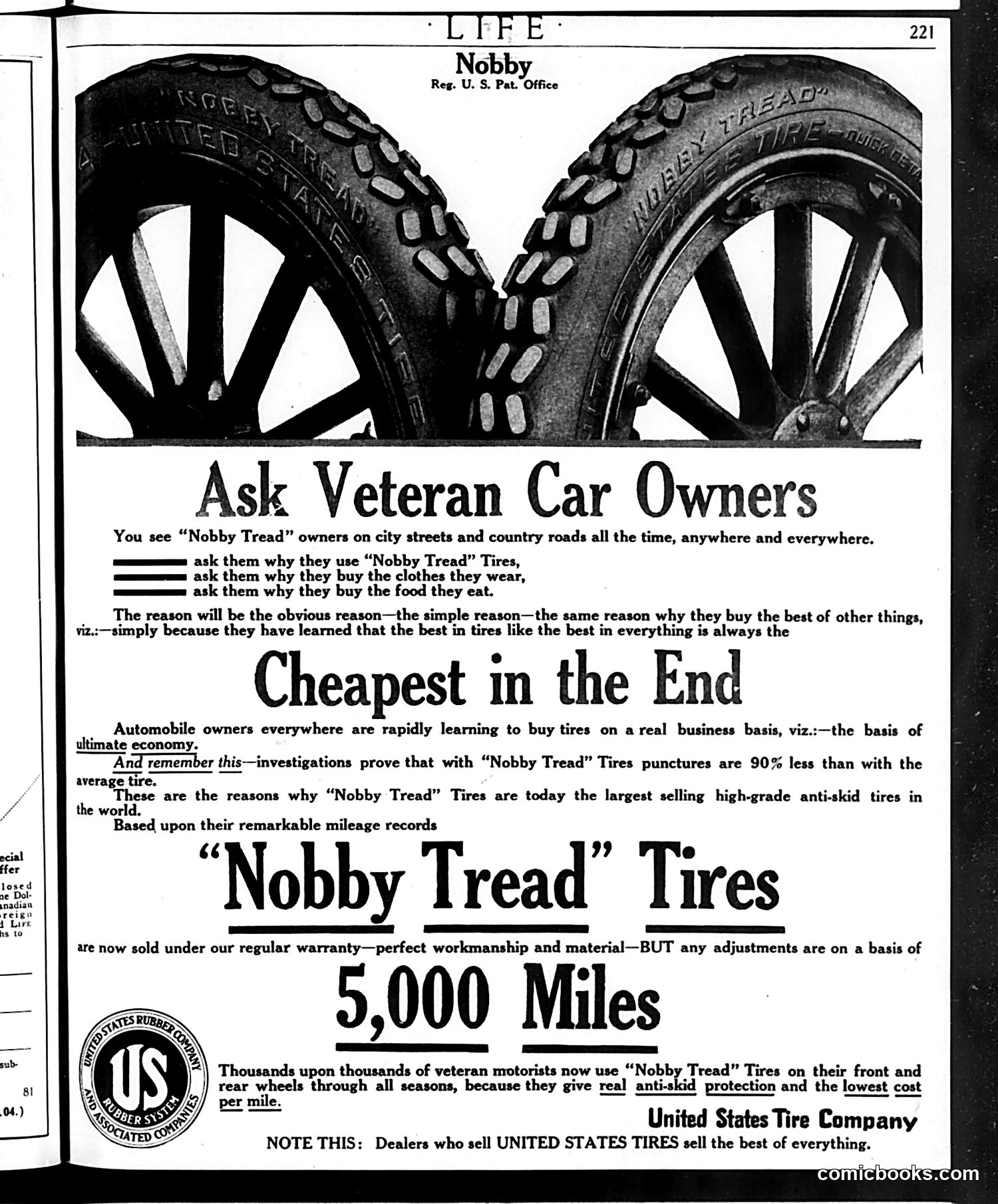
This is not a political cartoon or satire—it's a straightforward **advertisement** for "Nobby Tread" automobile tires, published in Life magazine (page 221). The ad uses testimonial marketing, urging readers to "Ask Veteran Car Owners" about the tire's reliability. Two tire images are displayed prominently. The advertisement emphasizes practical benefits: durability, resistance to punctures (claimed 90% fewer than average tires), and long mileage warranty (5,000 miles). The tagline "Cheapest in the End" frames the product as economical through longevity rather than initial price—a common early-20th-century sales pitch. The United States Rubber Company logo appears at the bottom. This represents standard commercial advertising rather than satirical content.
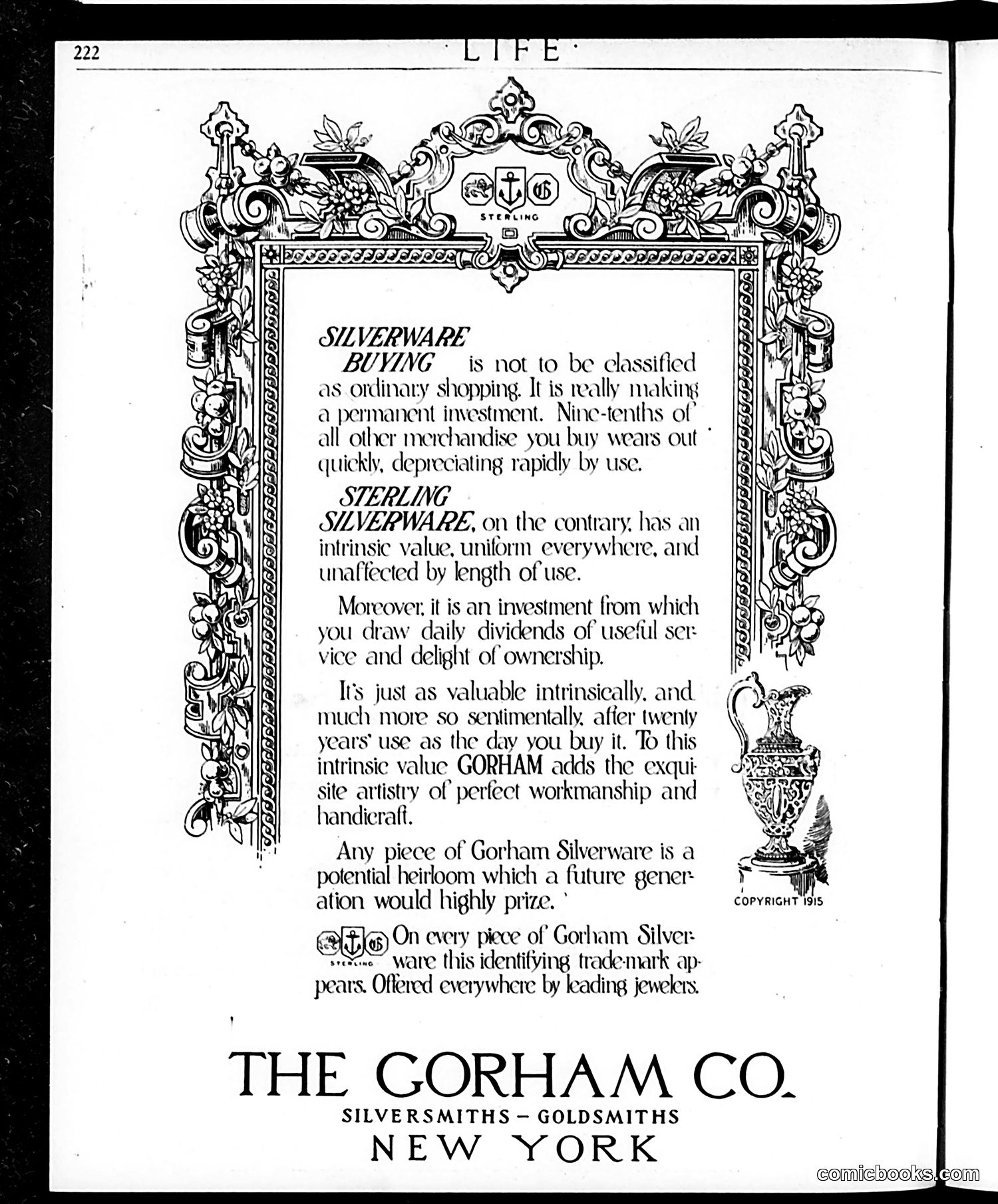
This is **not a cartoon or satire page** — it's a **sterling silverware advertisement** for The Gorham Company (silversmiths-goldsmiths, New York). The ornate decorative border and classical imagery are purely aesthetic, designed to evoke luxury and tradition. The text argues that sterling silverware is a sound financial investment, unlike ordinary merchandise that depreciates. It claims Gorham pieces gain sentimental and intrinsic value over time, become family heirlooms, and represent "perfect workmanship and handicraft." The copyright mark "1915" dates this to the World War I era. The ad's messaging reflects early-20th-century attitudes about heirloom quality and permanence in goods — concepts largely absent from modern consumer culture focused on disposability and trends.
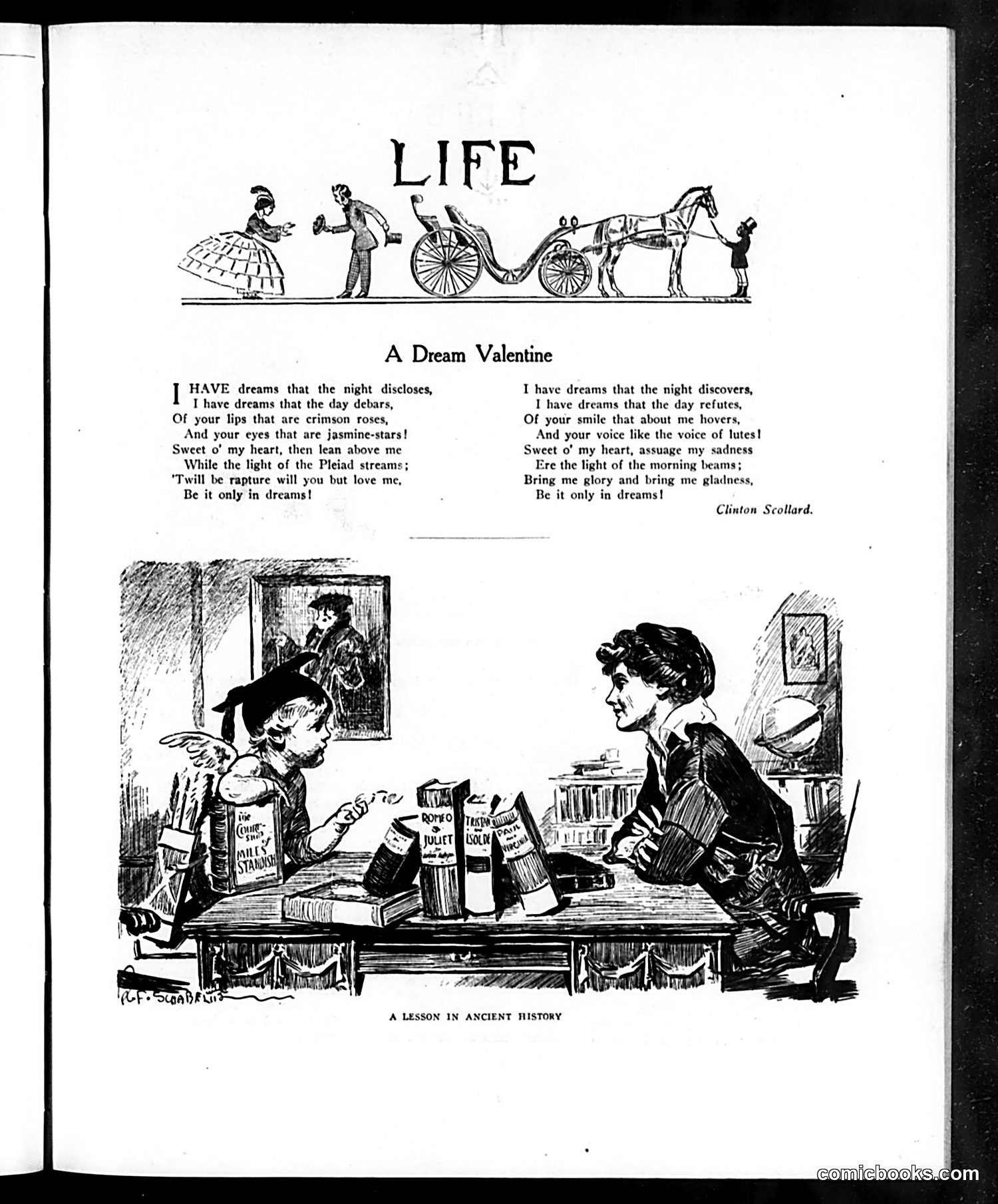
This page combines a romantic poem ("A Dream Valentine" by Clinton Scollard) with a satirical cartoon titled "A Lesson in Ancient History." The cartoon depicts two figures at a desk surrounded by books labeled with classical and literary titles (including "Romeo," "Juliet," and other classics). The angel-winged cherub on the left appears to be instructing or advising an adult woman on the right about romantic literature. **The satire**: The joke likely mocks how people—particularly women of the era—learned about romance primarily through literature and classical texts rather than lived experience. "Ancient history" suggests these literary romantic ideals are outdated. The contrast between the poem's flowery sentimentality and the cartoon's ironic treatment of romance-through-books creates the satirical point: real romance differs from literary fantasy.
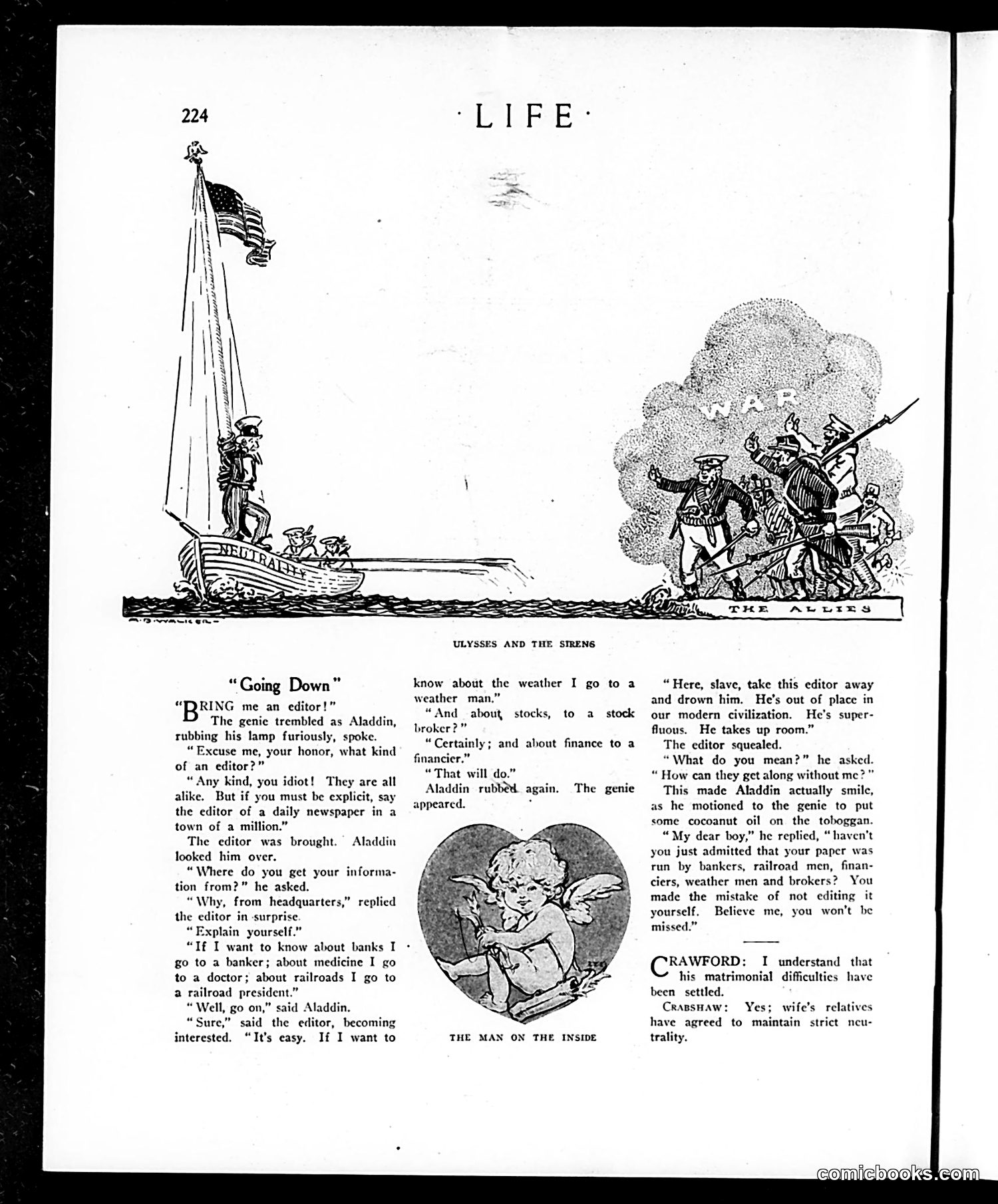
This page presents a satirical narrative about newspaper editorial authority. An editor summons Aladdin (a genie figure) to remove a rival editor he deems unfit, claiming newspapers should be run by "experts"—bankers, railroad men, and financiers—not editors themselves. The cartoon's satire targets **early 20th-century consolidation of newspaper ownership** by wealthy industrialists and financiers who believed businessmen, not journalists, should control media content. The "man on the inside" illustration reinforces this theme of hidden manipulation. The dialogue mocks the editor's pretension that professional expertise justifies removing editorial independence. The final exchange between Crawford and Crabshaw suggests this editorial takeover has actually caused marital trouble, undercutting the editor's confident justification for his actions.
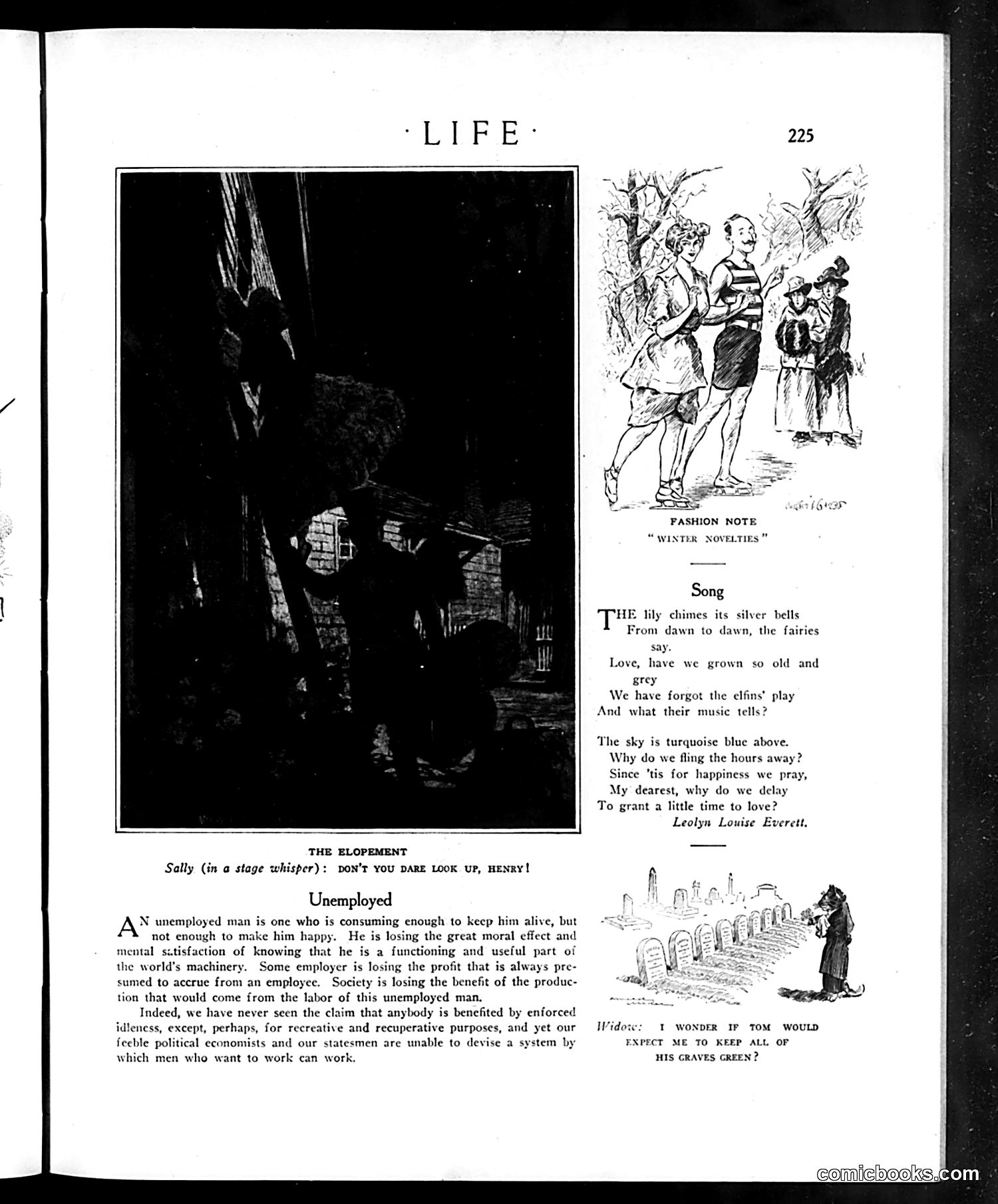
This page contains three distinct pieces: 1. **"The Elopement"** (left): A dark photograph showing a couple in what appears to be a nighttime escape scene. The caption quotes Sally warning "Henry" not to look up, suggesting a humorous take on a runaway marriage scenario. 2. **"Song"** (top right): A poem by Leelyn Louise Everett lamenting lost youth and forgotten "elins' play," reflecting nostalgic themes common to the era. 3. **"Unemployed"** (bottom): An essay discussing unemployment as a social problem, arguing that jobless men remain "useful" to society and that employers and policymakers fail those seeking work. This reflects early-20th-century concerns about labor and economic productivity. 4. **Bottom cartoon**: A widow at a graveyard, humorously questioning whether a gravedigger named Tom can maintain her family plots—domestic satire about responsibility.
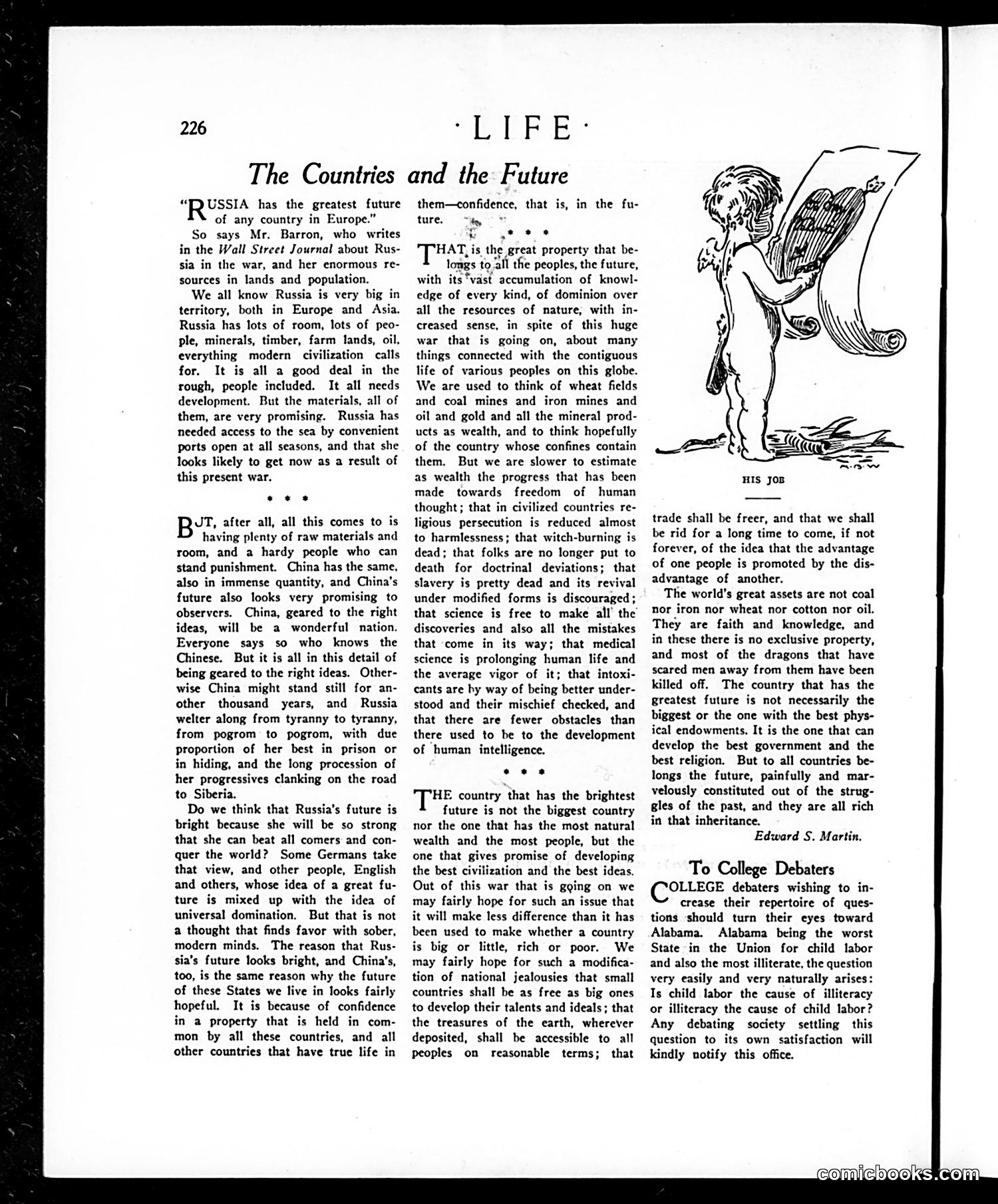
The main cartoon titled "HIS JOB" depicts a cherub or cupid-like figure holding what appears to be a torch or flame. This illustration accompanies an article titled "The Countries and the Future" discussing Russia's potential for growth based on natural resources. The satire appears to be about Russia's role in post-war development. The cherub figure likely represents hope, idealism, or future promise—ironic given the article's discussion of whether Russia or China will lead civilization forward. The text debates which nation can "beat all comers and conquer the world," mixing practical assessments of resources with philosophical questions about human progress, freedom, and which system will produce superior ideas and society. The cartoon's cherub with its job of bearing light suggests naive optimism about global futures amid serious geopolitical competition.
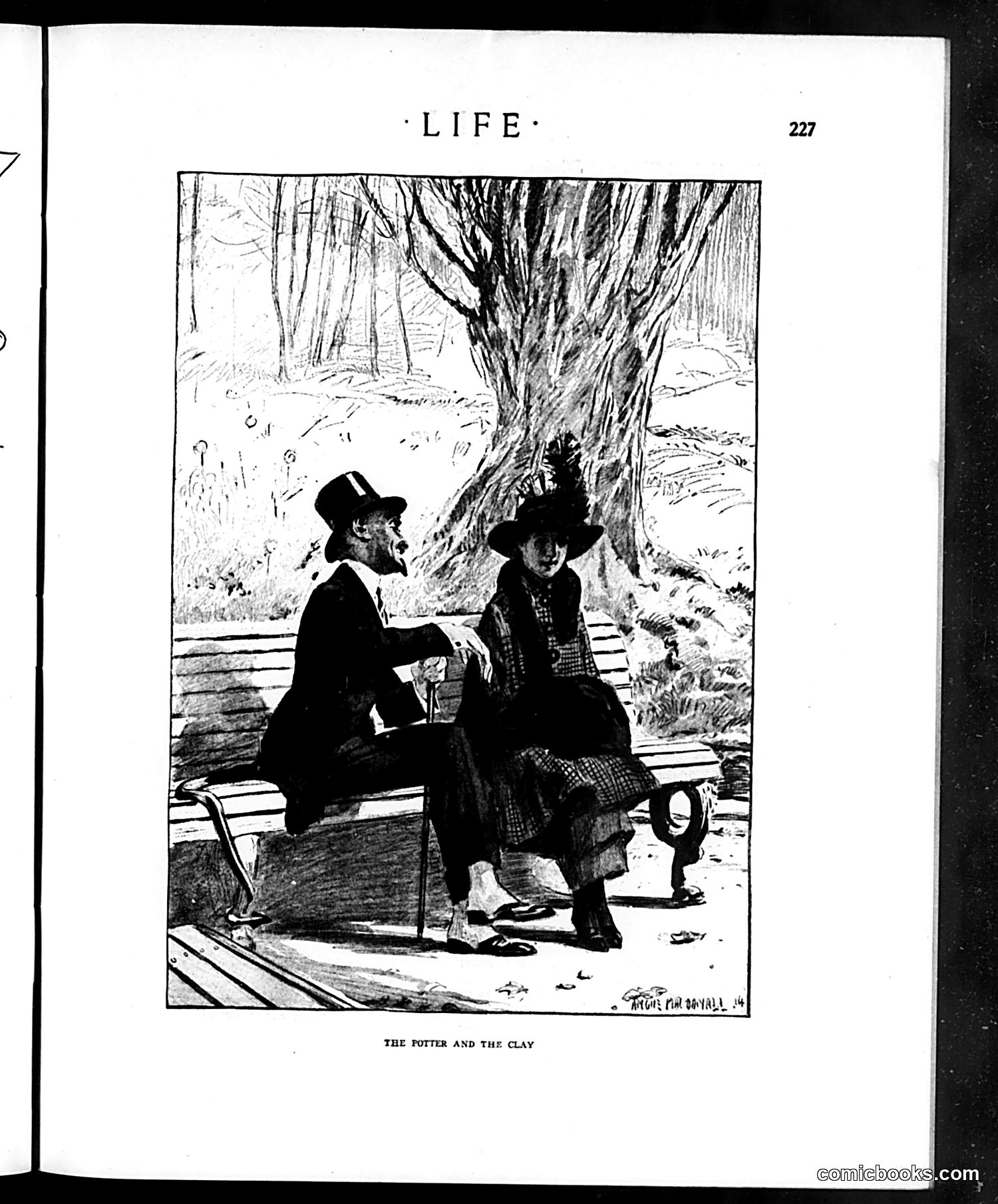
This illustration depicts two men seated on a bench beneath a large tree in a woodland setting. The caption reads "THE POTTER AND THE CLAY," referencing the biblical metaphor where a potter shapes clay—here suggesting one figure exercises control or influence over the other. Without additional context from the magazine's publication date or accompanying article text, the specific identities of these figures remain unclear. However, the title implies a commentary on power dynamics, manipulation, or political influence between two individuals or groups. The rural setting and formal attire suggest this may critique political or social relationships of the era, though the exact reference cannot be determined from the image alone.
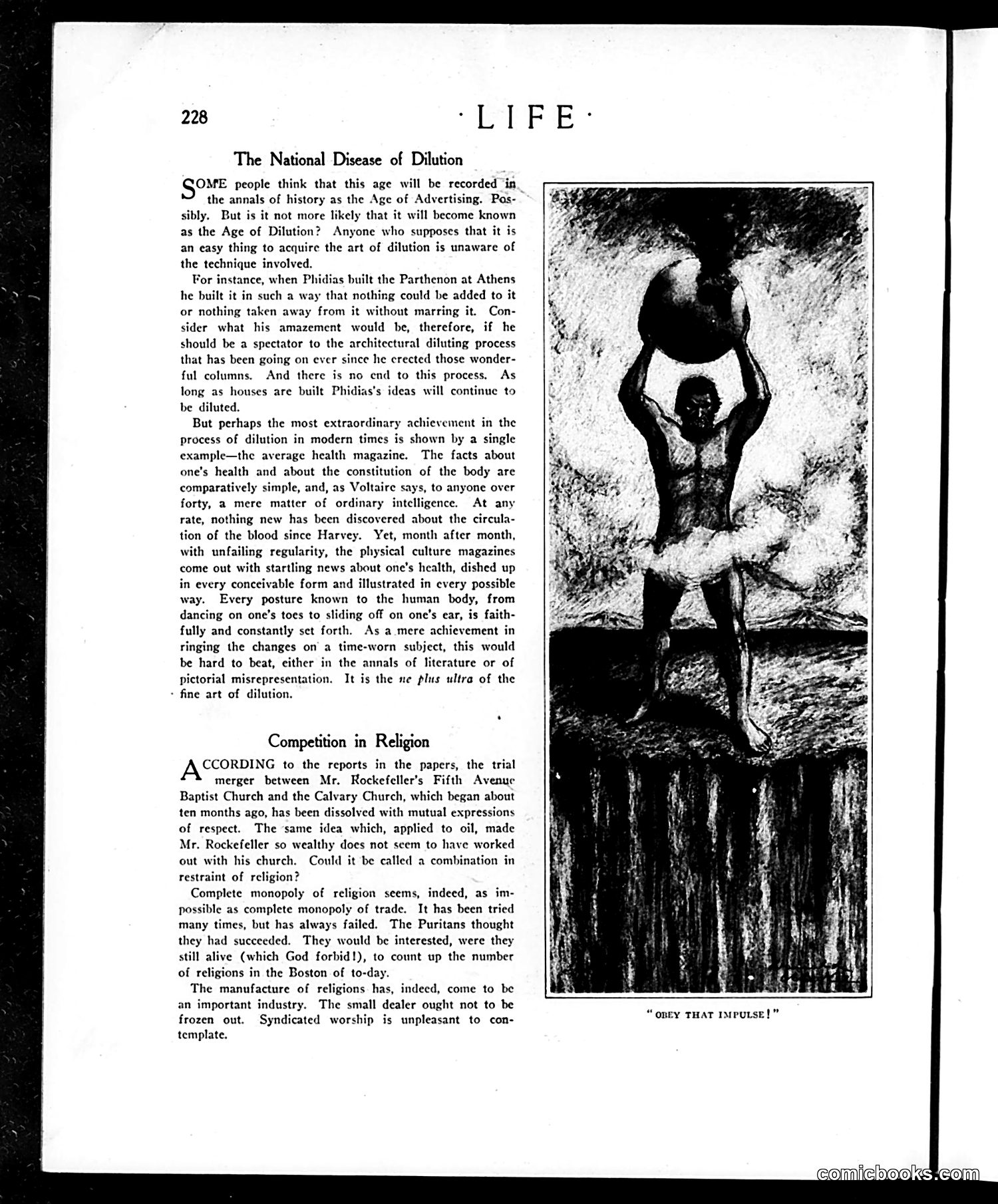
The page contains two distinct sections with different satirical targets: **"The National Disease of Dilution"** critiques how health and fitness magazines constantly repackage simple, well-known facts about the human body—discovered centuries ago by Harvey regarding blood circulation—as revolutionary new discoveries. The satire attacks the endless repetition and sensationalism of these publications. **"Competition in Religion"** comments on the dissolution of a trial merger between Rockefeller's Fifth Avenue Baptist Church and the Calvary Church. The author sarcastically suggests that monopolizing religion is impossible (unlike trade), citing the Puritans as historical example. The piece mocks the "manufacture" of religions as an industry and syndicated worship as undignified. The accompanying illustration (captioned "OBEY THAT IMPULSE!") appears to depict a muscular figure, likely reinforcing the dilution critique.
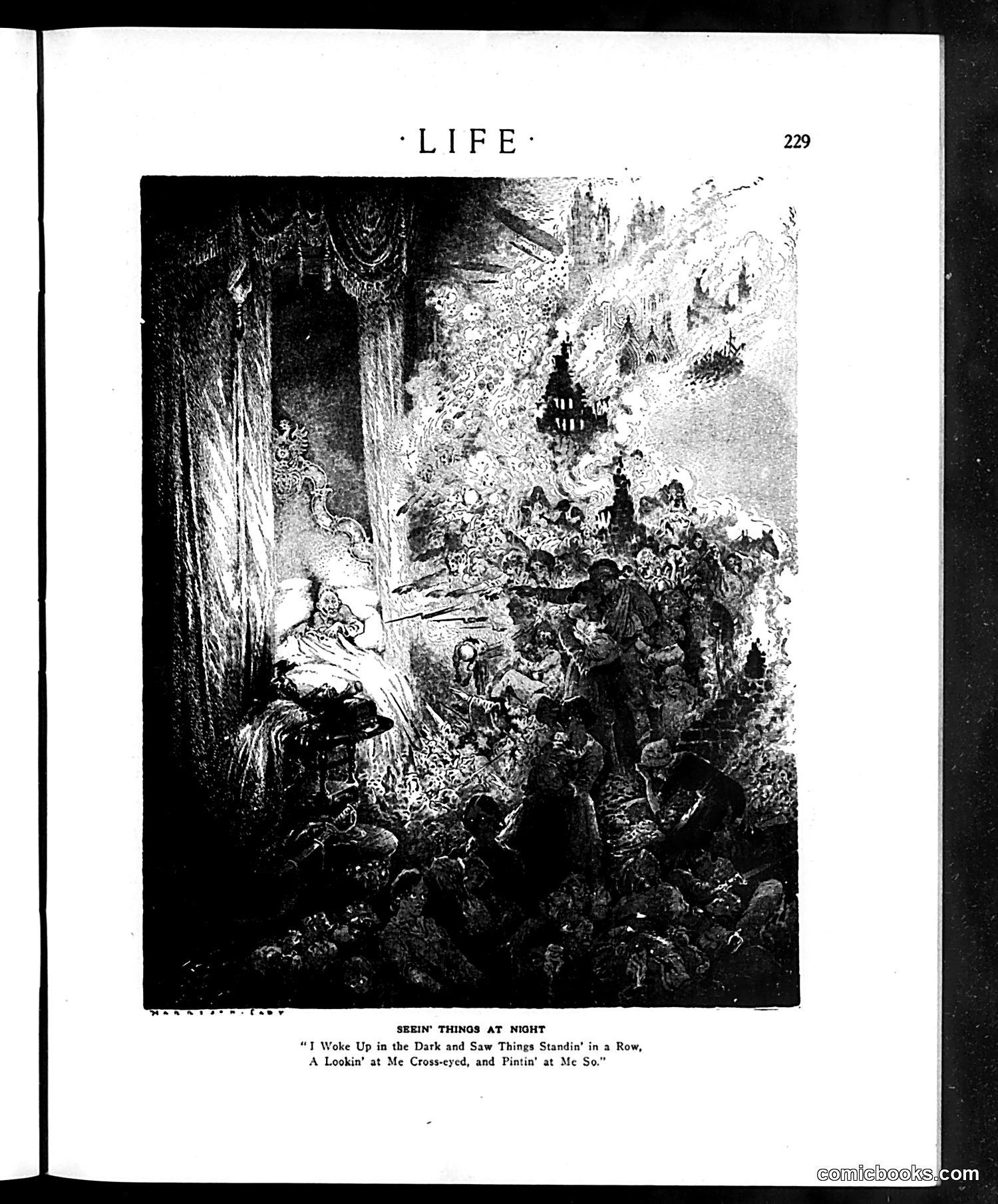
This satirical illustration depicts a nightmarish hallucination scene. The caption quotes a folk expression about waking in darkness and seeing disturbing visions—"things standin' in a row, a lookin' at me cross-eyed, and pinin' at me so." The engraving shows a person in bed on the left, while grotesque figures populate a fantastical landscape to the right, including what appears to be a castle or church structure. The densely-packed, distorted creatures embody the surreal quality of nightmares or alcohol-induced hallucinations. The satire likely mocks either superstition, paranoia, or possibly the effects of excessive drinking—common subjects for *Life* magazine's humor. The medieval/gothic aesthetic suggests fear of the unknown or supernatural anxieties, rendered through exaggerated visual chaos.
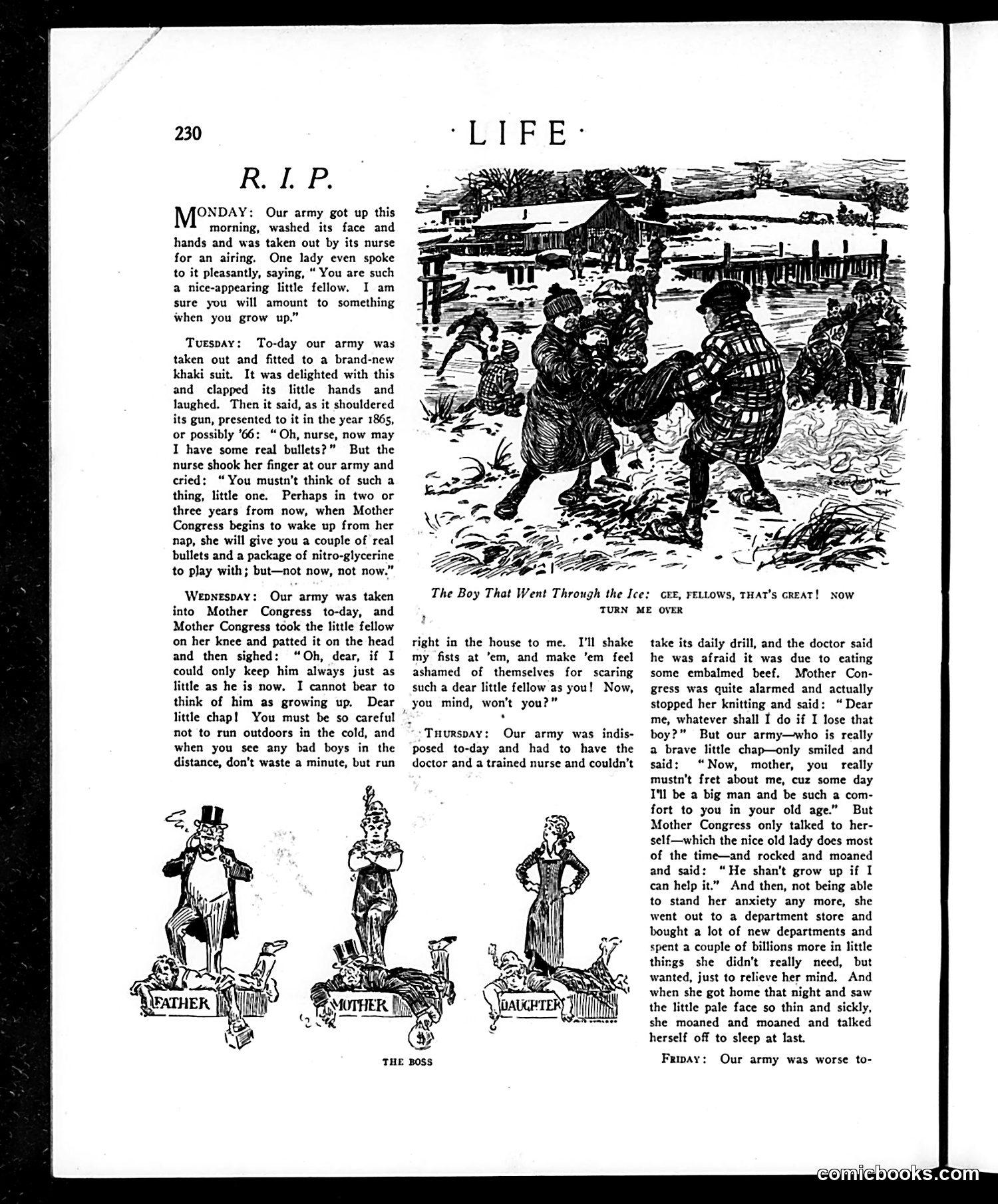
This piece presents a darkly satirical diary of a young boy enlisted as a soldier, chronicling his week from Monday through Friday. The humor derives from the contrast between the army's mistreatment of this child—washing him, dressing him in ill-fitting uniforms, and giving him an obsolete 1865 rifle—and the mother's anxious concerns about his safety and hardship. The three illustrated figures at bottom labeled "Father," "Mother," and "Daughter" appear to represent the family structure being disrupted. The cartoon critiques child recruitment into the military, suggesting the boy will not survive ("R.I.P." = Rest in Peace). The satire targets both institutional indifference to the child's welfare and parental powerlessness against military conscription, reflecting period debates about military expansion and child labor.
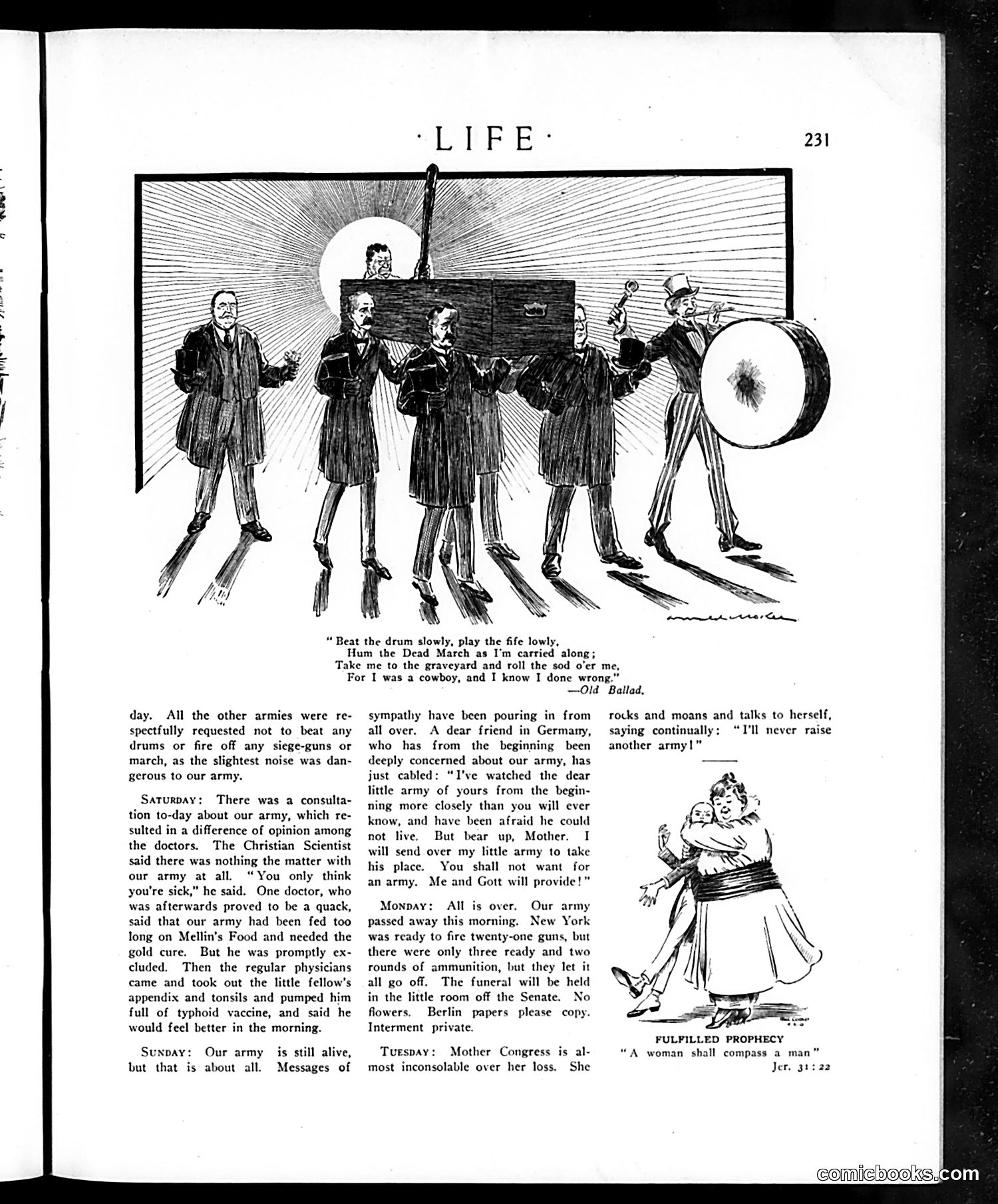
This is anti-war satire about American military unpreparedness, likely from the Spanish-American War era (1898). The top cartoon depicts five military/political figures carrying a coffin labeled "U.S. ARMY," with one beating a large drum. The accompanying text mocks the army's fragility—so weak that even drum noise threatens it. The diary entries (Saturday through Tuesday) chronicle the "death" of America's military through satirical vignettes: doctors debating treatment (Christian Science vs. medical quackery), vaccination procedures, and a funeral with insufficient ammunition for a proper twenty-one-gun salute. "Mother Congress" personifies the government, now mourning her loss and vowing to raise "another army"—suggesting cyclical military failures. The bottom illustration, captioned "A WOMAN SHALL COMPASS A MAN" (Jeremiah 31:22), shows a woman embracing a soldier, sarcastically implying women will have to replace the failed military. The satire targets military incompetence, inadequate resources, and questionable medical practices of the era.
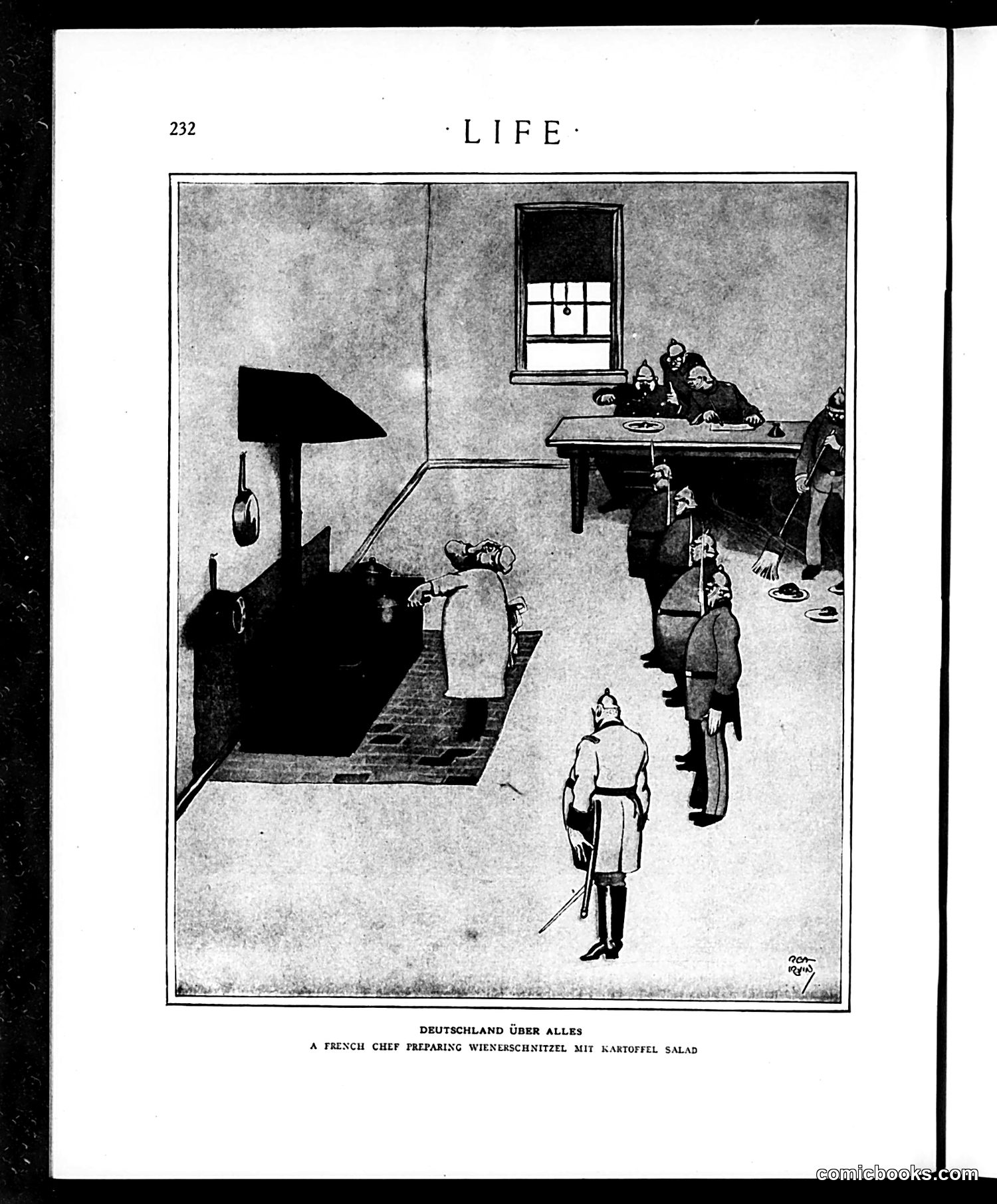
This is a satirical cartoon from Life magazine depicting a French chef being forced to prepare a German dish (Wienerschnitzel with potato salad) in what appears to be a prison or military cell. The caption "Deutschland Über Alles" (Germany Above All) references the German national motto, suggesting German cultural or political supremacy. The joke critiques German dominance over French culture, particularly through cuisine—traditionally France's domain. By showing a French chef subjugated to preparing German food, the cartoon satirizes the power dynamics between the nations, likely commenting on German military or political expansion. The soldier figures watching suggest coercion or occupation. This reflects early-to-mid 20th century tensions between France and Germany, probably referencing the interwar period or World War II era.
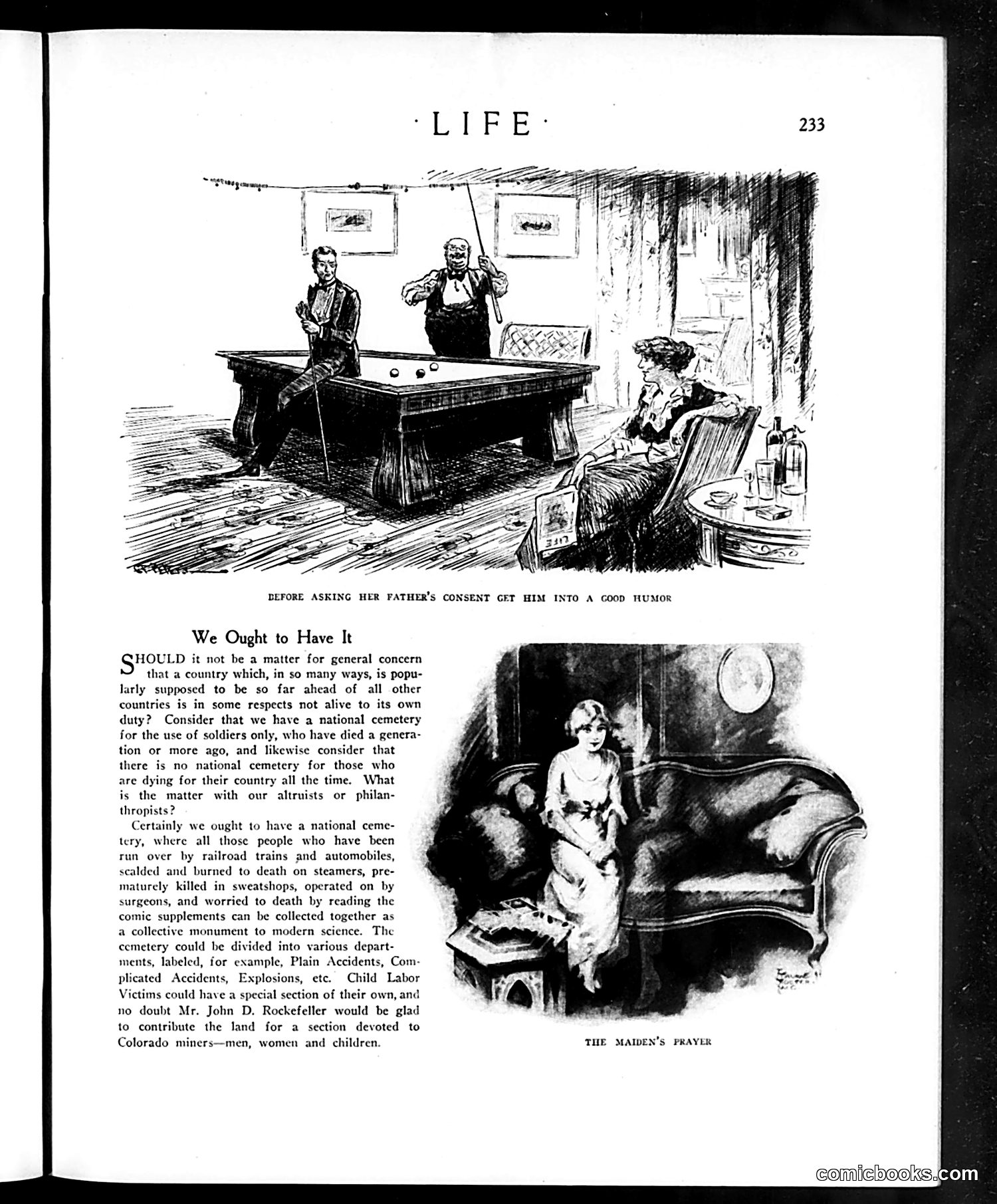
This satirical piece critiques American society's neglect of modern industrial casualties. The text proposes establishing a national cemetery—not for soldiers, but for victims of industrial accidents, railroad disasters, steamship explosions, sweatshop deaths, and medical malpractice. The satire is sharp: it mockingly suggests the cemetery be organized by accident type ("Plain Accidents, Complicated Accidents, Explosions") as if cataloging modern science's failures. The reference to John D. Rockefeller contributing land for a Colorado miners' section is particularly biting—Rockefeller's oil empire was notorious for worker exploitation and deaths, including the Ludlow Massacre. The piece sardonically suggests this would be an appropriate "monument to modern science." The top cartoon shows a billiards scene (likely illustrating how to "get him into good humor"), while the bottom illustration titled "The Maiden's Prayer" appears unrelated to the main text.
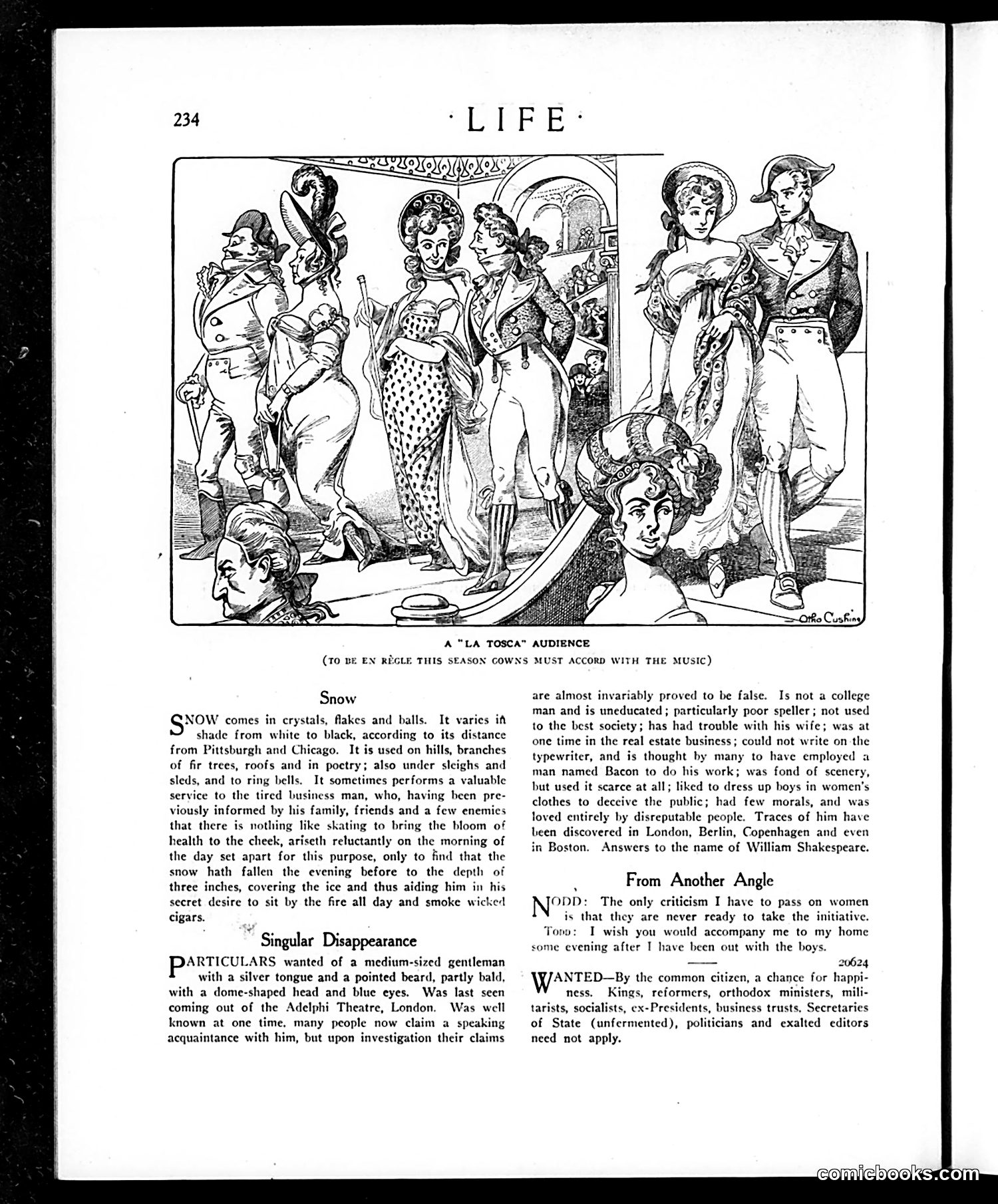
The top illustration satirizes opera-goers at a production of "La Tosca," mocking fashionable audiences who dress elaborately to match the opera's aesthetic rather than for genuine appreciation. The caption jokes that "gowns must accord with the music"—critiquing shallow social performance and conspicuous consumption among the elite. Below are three humorous prose pieces: "Snow" humorously describes winter's contradictions, particularly how tired businessmen use snow as an excuse to avoid skating. "Singular Disappearance" is a mock wanted poster for William Shakespeare, ironically listing his documented weaknesses (poor spelling, uneducated, cross-dressing boys) to suggest the historical Shakespeare couldn't have written his plays—a contemporary echo of authorship-doubt theories. The final section presents witty one-liners on gender relations and a satirical "wanted" ad for ordinary citizens' happiness, noting that kings, politicians, and editors needn't apply—mocking power structures and hypocrisy.
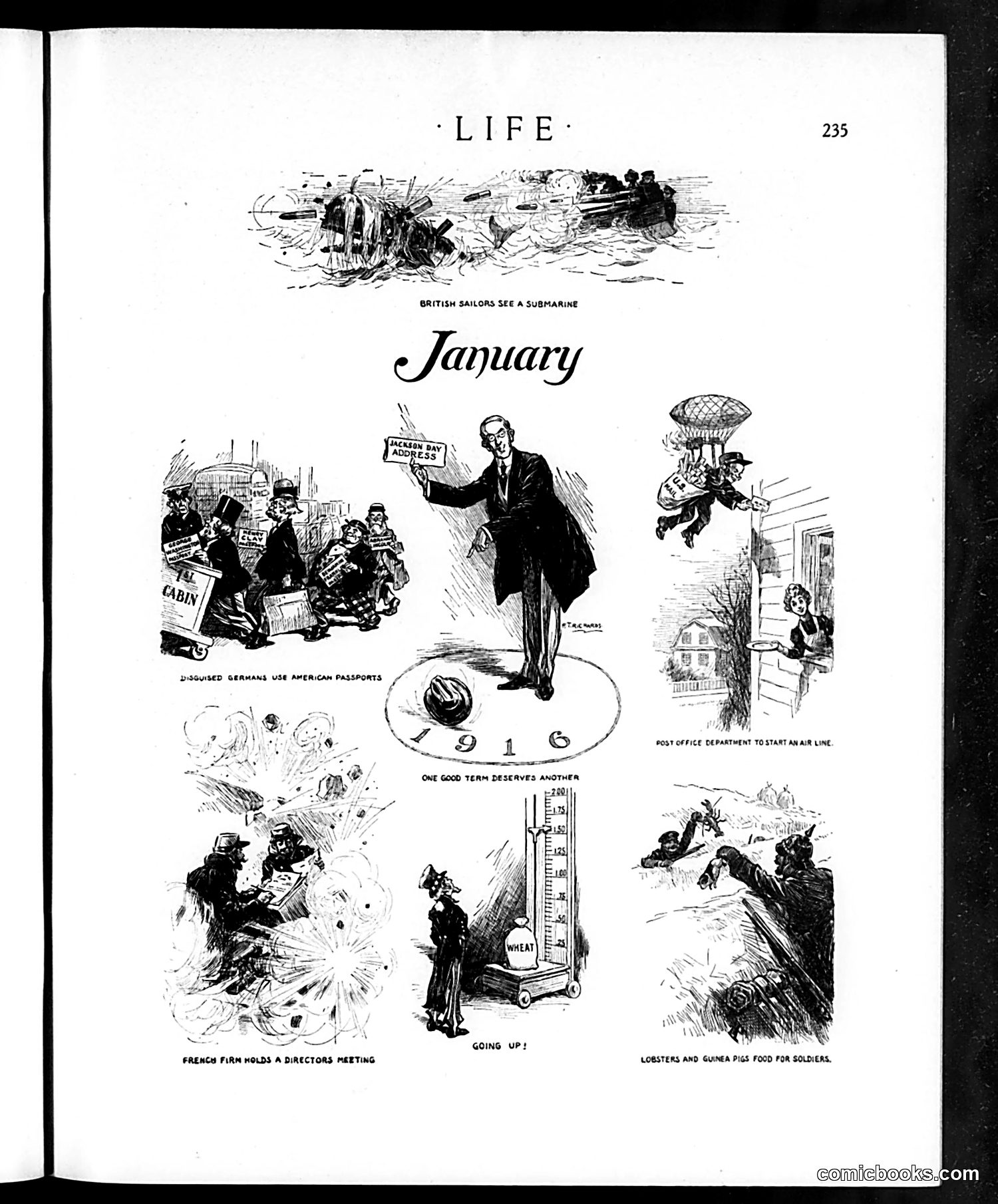
This Life magazine page satirizes WWI-era events. The central cartoon shows a man (likely representing a political figure) standing on "1916," holding a "Package Address" sign—suggesting postal service expansion or bureaucratic promises. "One Good Term Deserves Another" appears to mock political re-election cycles amid wartime. Surrounding vignettes reference: - **"Discouraged Germans Use American Passports"** (top left): satirizing German-Americans or espionage concerns - **"Post Office Department to Start an Air Line"** (right): poking fun at postal service ambitions - **"French Firm Holds a Directors Meeting"** (lower left): likely mocking French business during war - **"Lobsters and Guinea Pigs Food for Soldiers"** (lower right): criticizing poor military provisions The overall tone is cynical—politicians make grand promises while soldiers eat inadequate rations and administrative overreach flourishes.
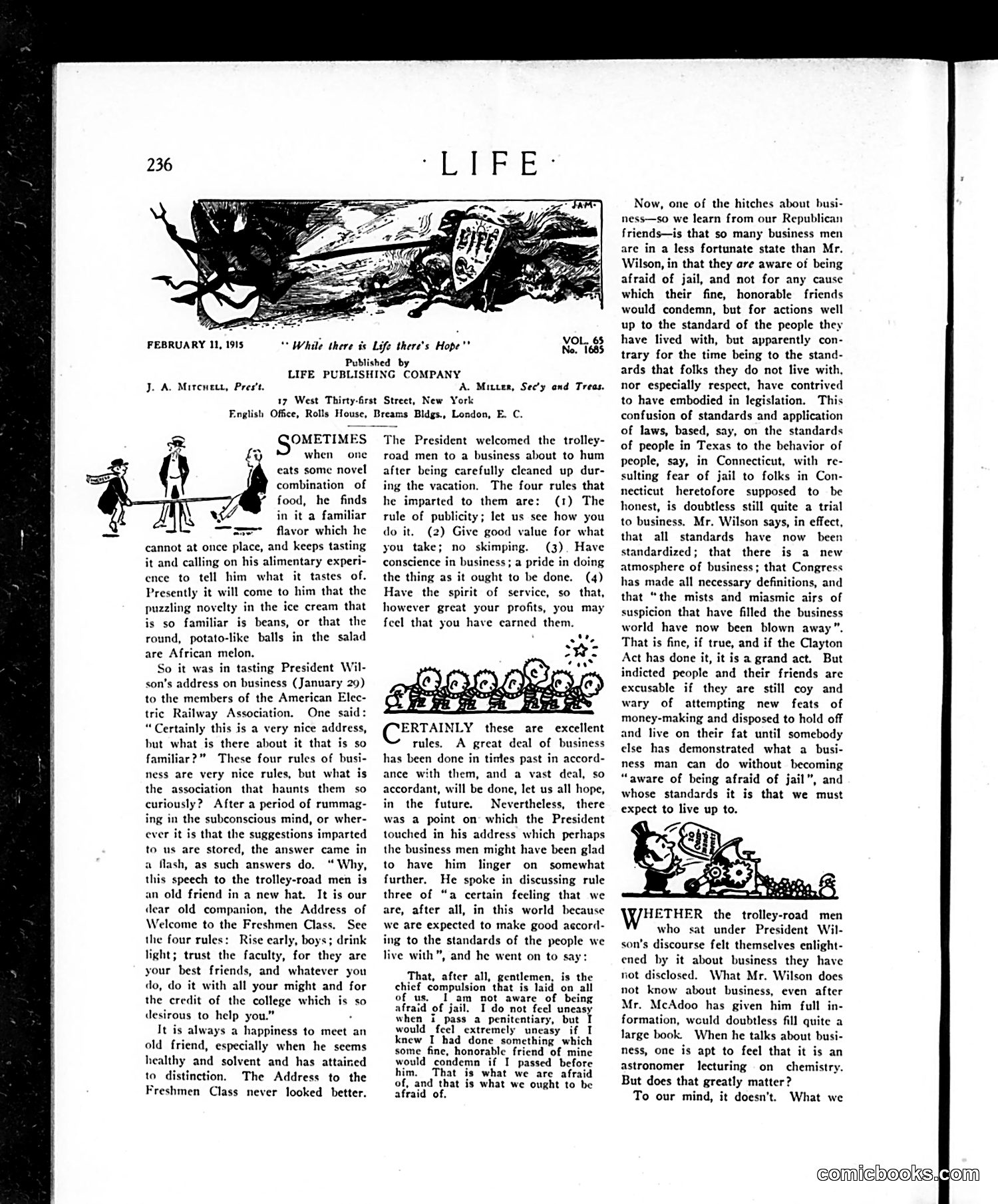
This page analyzes President Wilson's January 1915 speech to electric railway executives. The author compares Wilson's four business rules (publicity, fair value, business conscience, and service) to a familiar "Address to Freshmen"—suggesting Wilson recycled collegiate moralizing for businessmen. The satire's bite emerges in the closing argument: Wilson, speaking from moral high ground, says he fears friends' judgment more than jail. The author pointedly notes many businessmen *are* afraid of jail—but for actions their peers consider standard business practice, not immoral. This suggests Wilson's idealistic business ethics clash with actual American corporate culture, where questionable practices are normalized among peers. The cartoon criticizes both Wilson's naïveté and business corruption as socially acceptable.
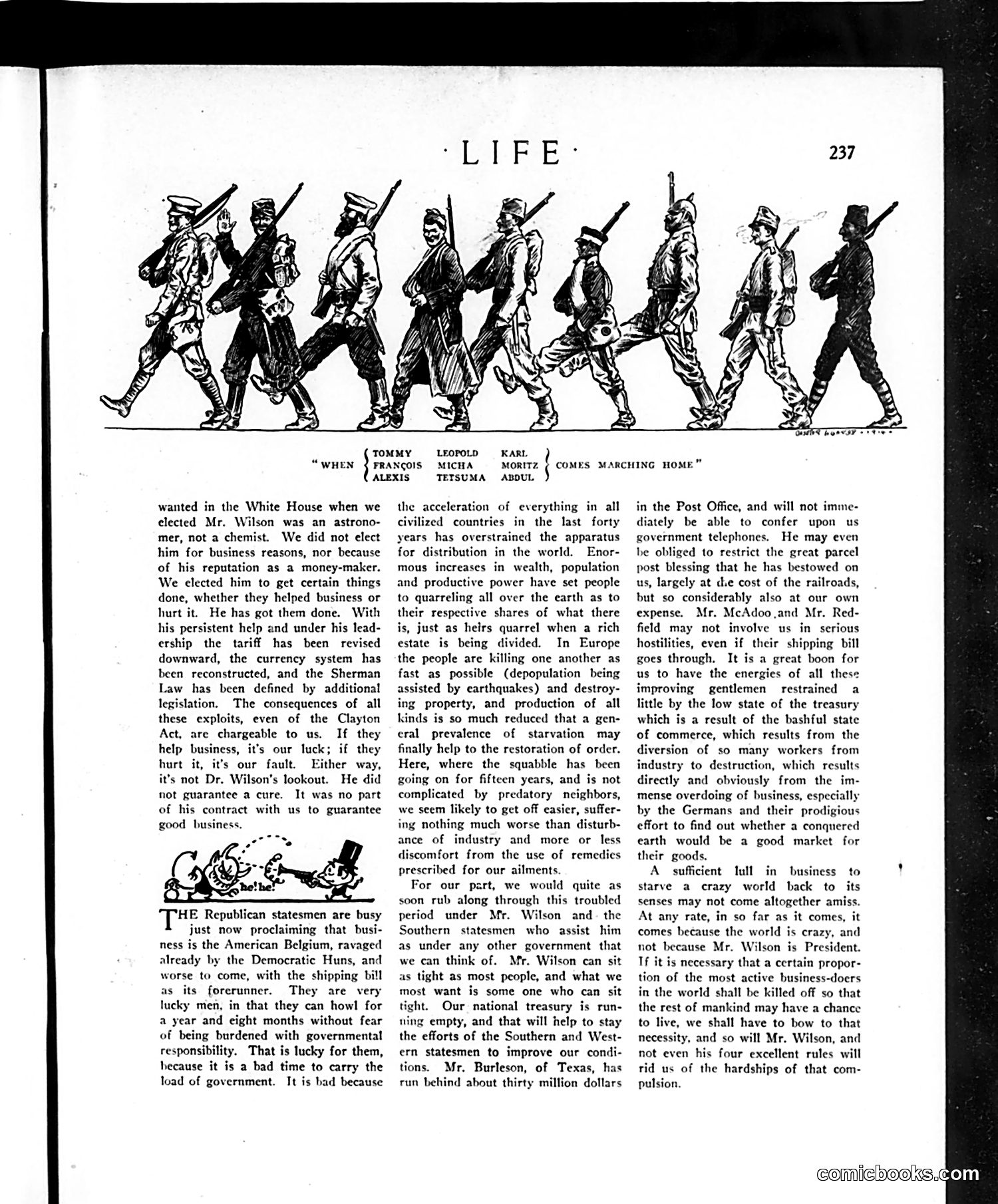
**The Cartoon:** The illustration shows nine soldiers marching in a line, labeled with names including "Tommy," "François," "Leopold," "Alexis," "Micha," "Karl," "Moritz," "Tetsuma," and "Abdul"—representing soldiers from Allied and Central Power nations during World War I, "coming marching home." **The Political Context:** The accompanying editorial defends President Woodrow Wilson's administration against Republican criticism. Republicans were blaming Democrats for economic problems, comparing business to "Belgium" ravaged by "Democratic Huns"—a reference to German militarism in WWI. **The Satire's Point:** The text argues Wilson shouldn't be held responsible for business troubles during wartime chaos. It suggests Republicans are conveniently criticizing without governing responsibility. The marching soldiers imagery reinforces that America is entangled in global conflict beyond any president's control—economic disruption stems from worldwide war, not Democratic policy. **For Modern Readers:** This reflects pre-1917 or early-war American political debate about whether the U.S. should enter WWI and how to assign blame for economic disruption.
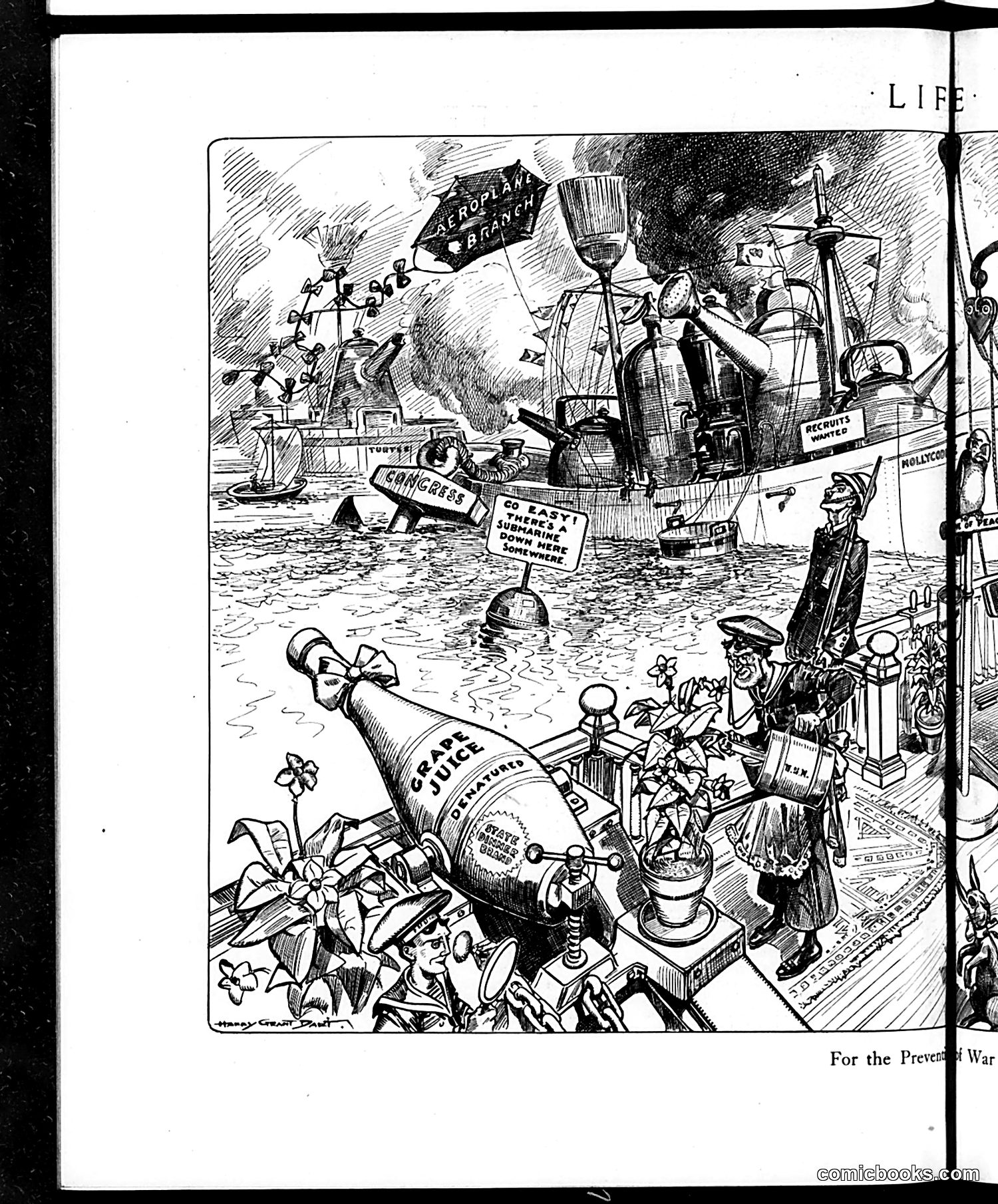
This Life magazine cartoon satirizes military preparedness, likely from the early 20th century. The central image shows a large bottle labeled "PEACE" surrounded by military vessels, weapons, and uniformed figures at what appears to be a harbor or dock. Visible text references include "ACROPOLIS BRANCH," "CONGRESS," "EASY," and "RECRUITS WANTED." The cartoon employs ironic visual contrast—depicting "peace" alongside aggressive military buildup and recruitment efforts. The satire suggests that contemporary peace efforts coexist with (or are undermined by) simultaneous militarization and war preparation. The bottom caption reads "For the Prevention of War," which reinforces the sardonic message: that military expansion is being justified as a peace-keeping measure.
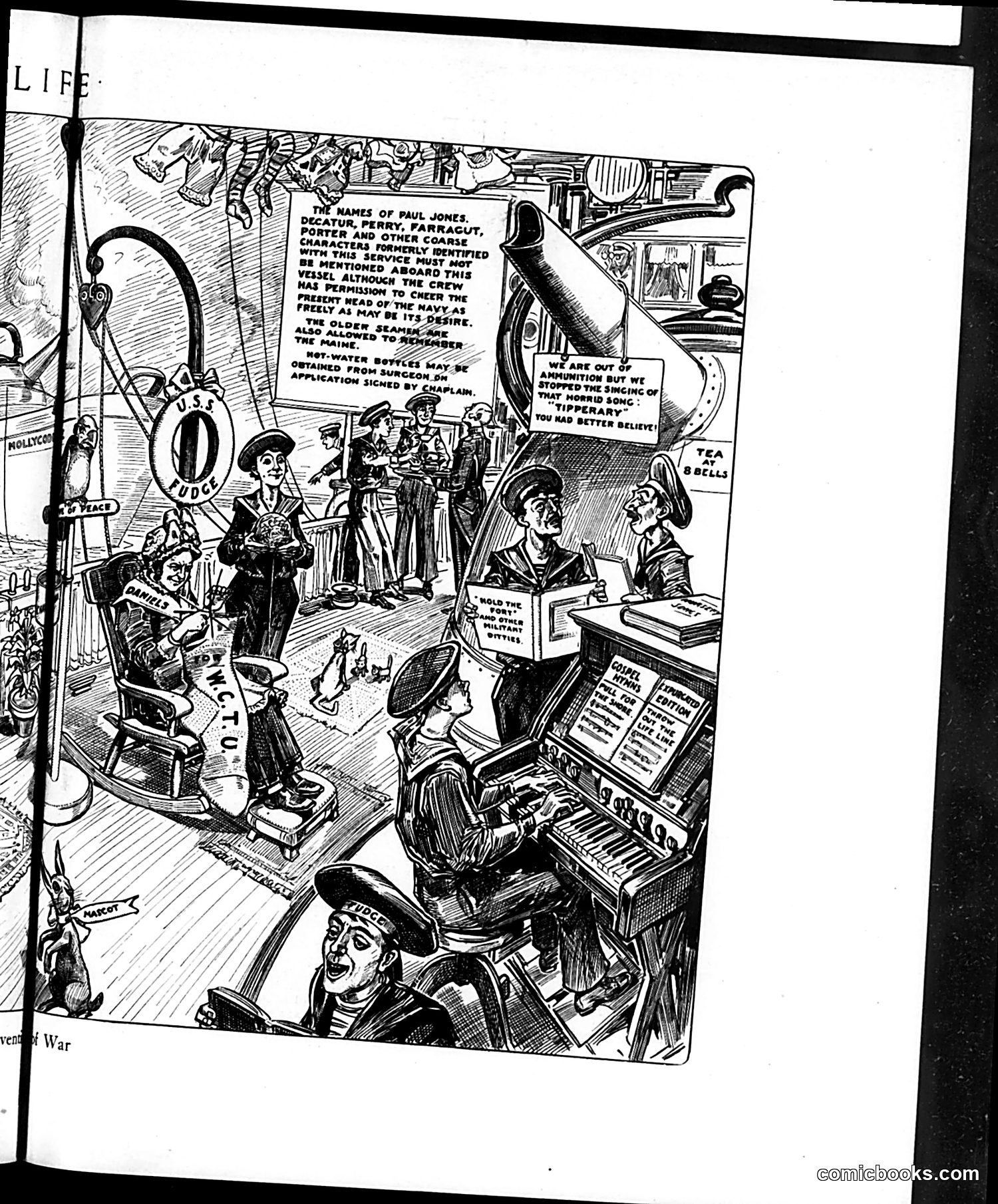
This cartoon satirizes American naval command during wartime (likely WWI, given the "War" notation). The scene depicts a ship's interior where sailors and officers are crammed together in chaotic conditions. The text references famous American naval commanders (John Paul Jones, Decatur, Perry, Farragut) whose names were invoked to legitimize current naval leadership, despite apparent poor conditions aboard ship. The satire suggests that while the Navy trades on its glorious historical legacy, present-day commanders fail to maintain proper standards—sailors are poorly treated, with references to inadequate hot water and sanitation ("application signed by the chaplain"). The joke critiques the gap between the Navy's storied reputation and its operational reality under contemporary leadership, mocking both the bureaucratic invocation of naval heroes and the actual mismanagement sailors endured.
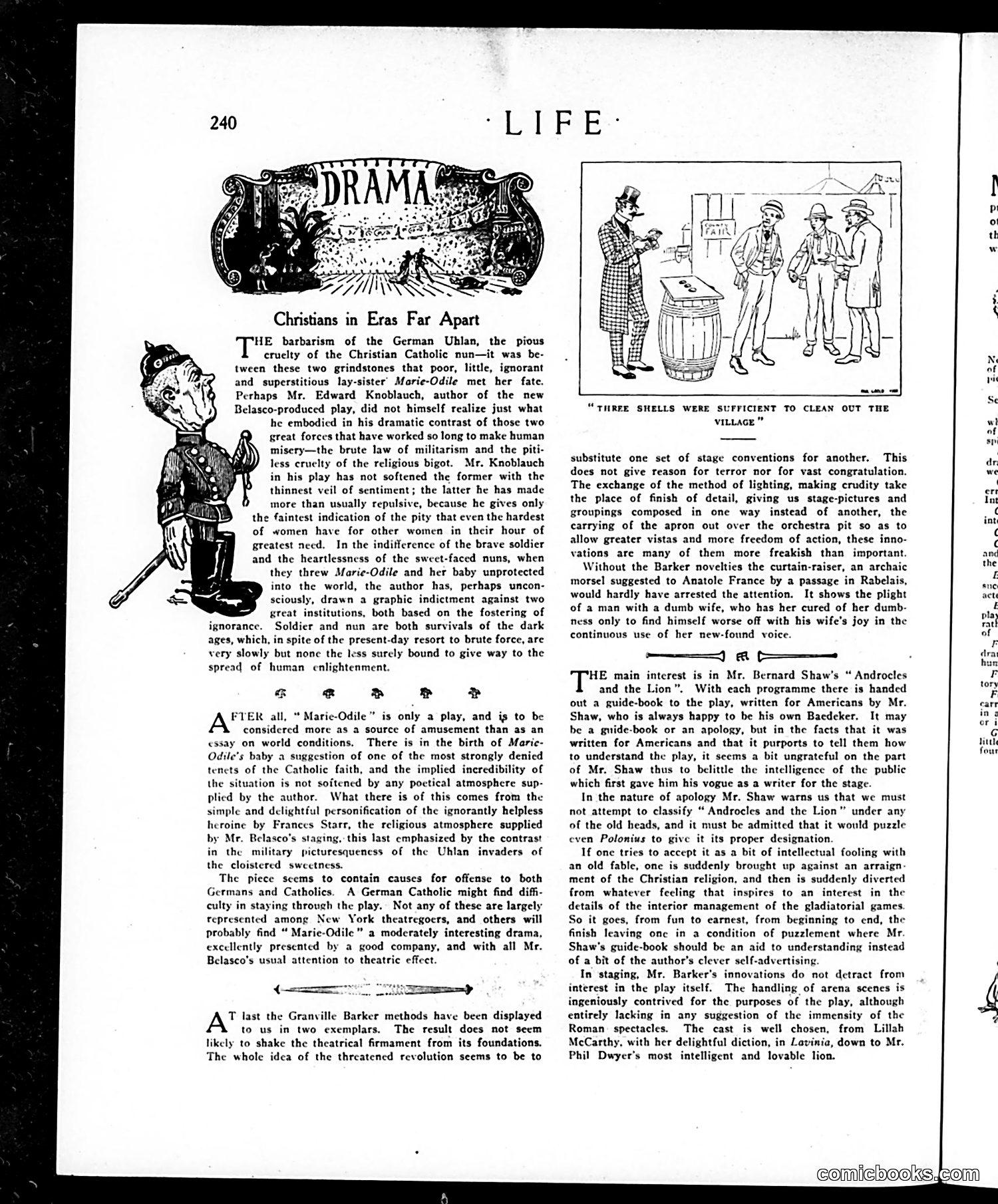
This page reviews "Marie-Odile," a David Belasco-produced play by Edward Knoblauch. The cartoon (left) depicts a German soldier, representing militarism's "barbarism." **The satire's point:** The play traps its heroine between two destructive forces—brutal German militarism (Uhlans were German cavalry) and the cruel rigidity of Catholic religious authority (represented by unfeeling nuns). Life's critic argues both institutions survive from the "dark ages" and depend on "fostering ignorance." **The social critique:** Though framed as theater review, this is really a swipe at institutional power structures. The plot apparently involves an unmarried nun bearing a child—directly contradicting Catholic doctrine—which Life sees as exposing the faith's hypocrisy. The right panel illustration shows men discussing clearing a village (likely a wartime reference), emphasizing the play's military brutality theme. Life positions itself as enlightened, mocking both German militarism and Catholic dogmatism as obsolete forces destined to "give way to the spread of human enlightenment."
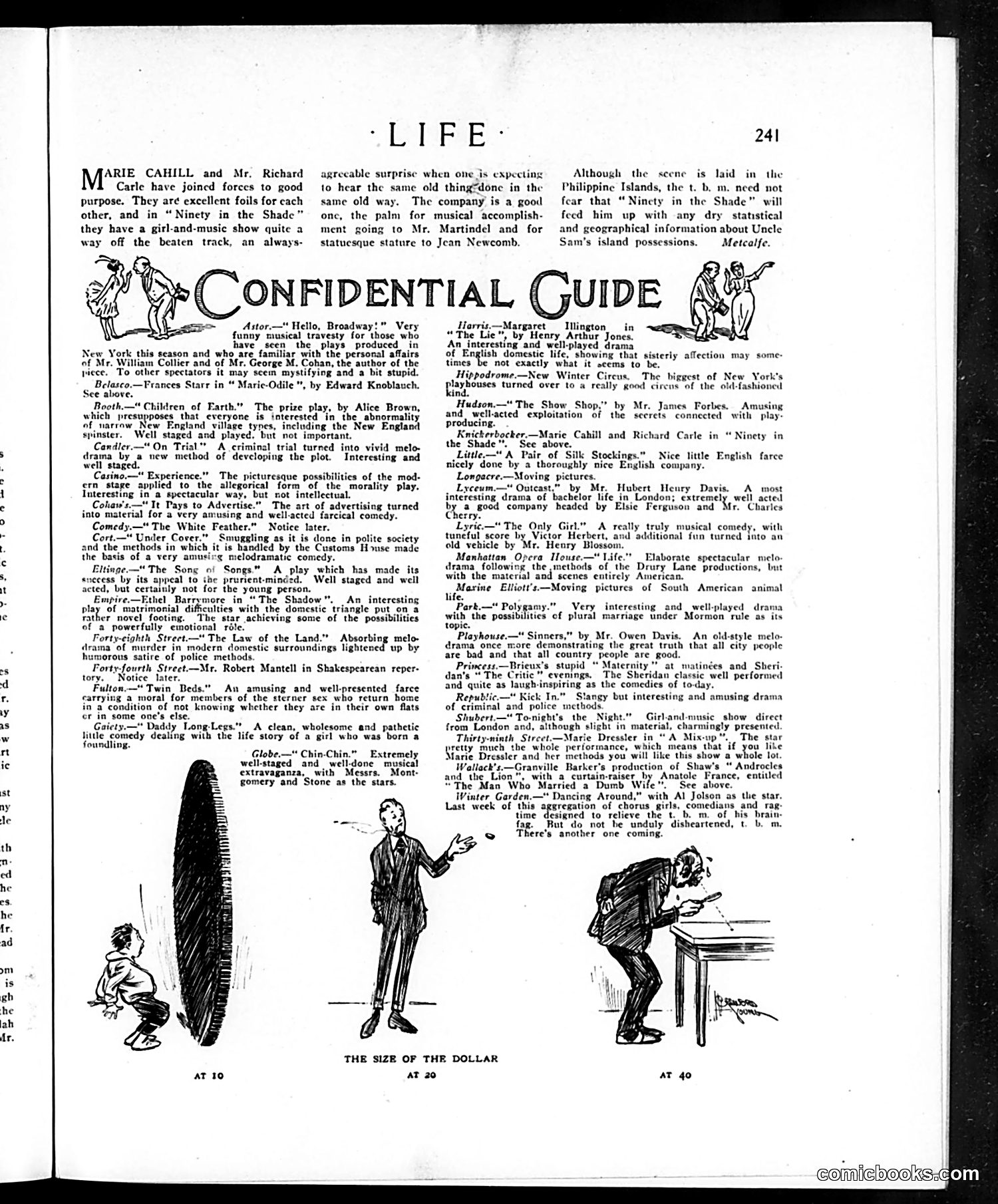
This page is a **theater review column** for Broadway productions, not a political cartoon. The three illustrations at the bottom titled "The Size of the Dollar" at ages 16, 20, and 40 use visual humor to comment on **changing attitudes toward money as men age**: at 16, a young man appears dwarfed by a large dollar bill; at 20, he gestures confidently at its size; at 40, he's hunched over a desk, presumably because financial responsibilities have diminished his sense of its value or because he's consumed by financial concerns. The page reviews contemporary 1916 Broadway plays, noting their merits and audiences. Critics mention specific actors (Ethel Barrymore, Frances Starr) and theatrical trends, with particular skepticism toward morality plays and prurient material ("certainly not for the young person").
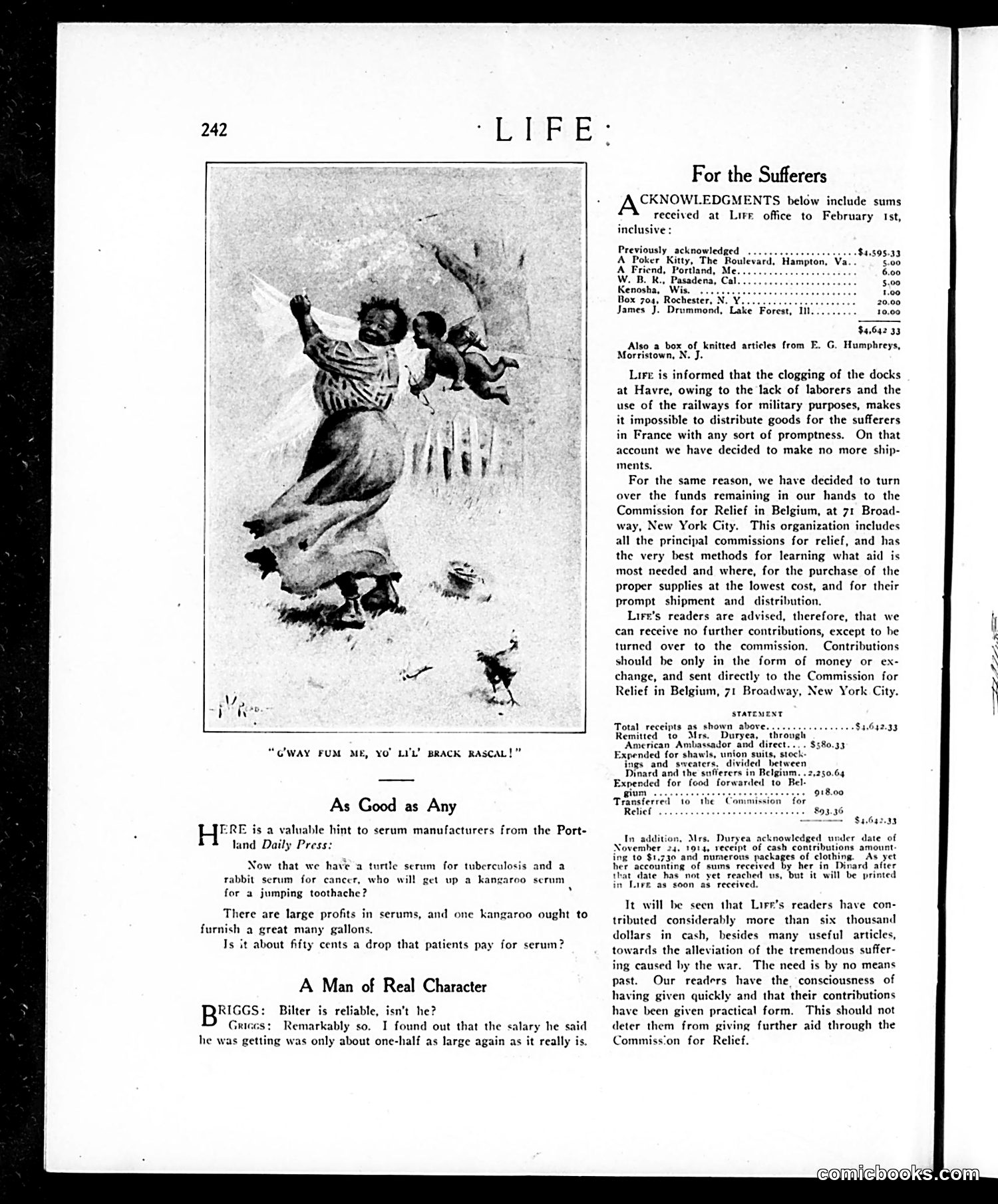
**The Main Cartoon ("G'way fum me, yo' li'l' black rascal!"):** This image depicts a figure in period dress (appears to be early 20th century) recoiling from or chasing away small cherub-like figures. The dialect caption uses offensive racial language typical of the era's minstrel show tradition. The cartoon appears to be satirizing something about childhood mischief or nuisance, though the exact reference is unclear without fuller context. **The Other Content:** The page primarily documents **World War I relief efforts**. Life magazine published acknowledgments of donations received for war sufferers in France and Belgium. Due to dock congestion at Le Havre, they redirected remaining funds to the Commission for Relief in Belgium rather than continuing direct shipments. The financial statement shows over $4,600 raised through reader contributions, with itemized expenses for clothing and food assistance. The two brief humor pieces below the cartoon ("As Good as Any" and "A Man of Real Character") are unrelated satirical vignettes mocking medical profiteers and dishonesty.
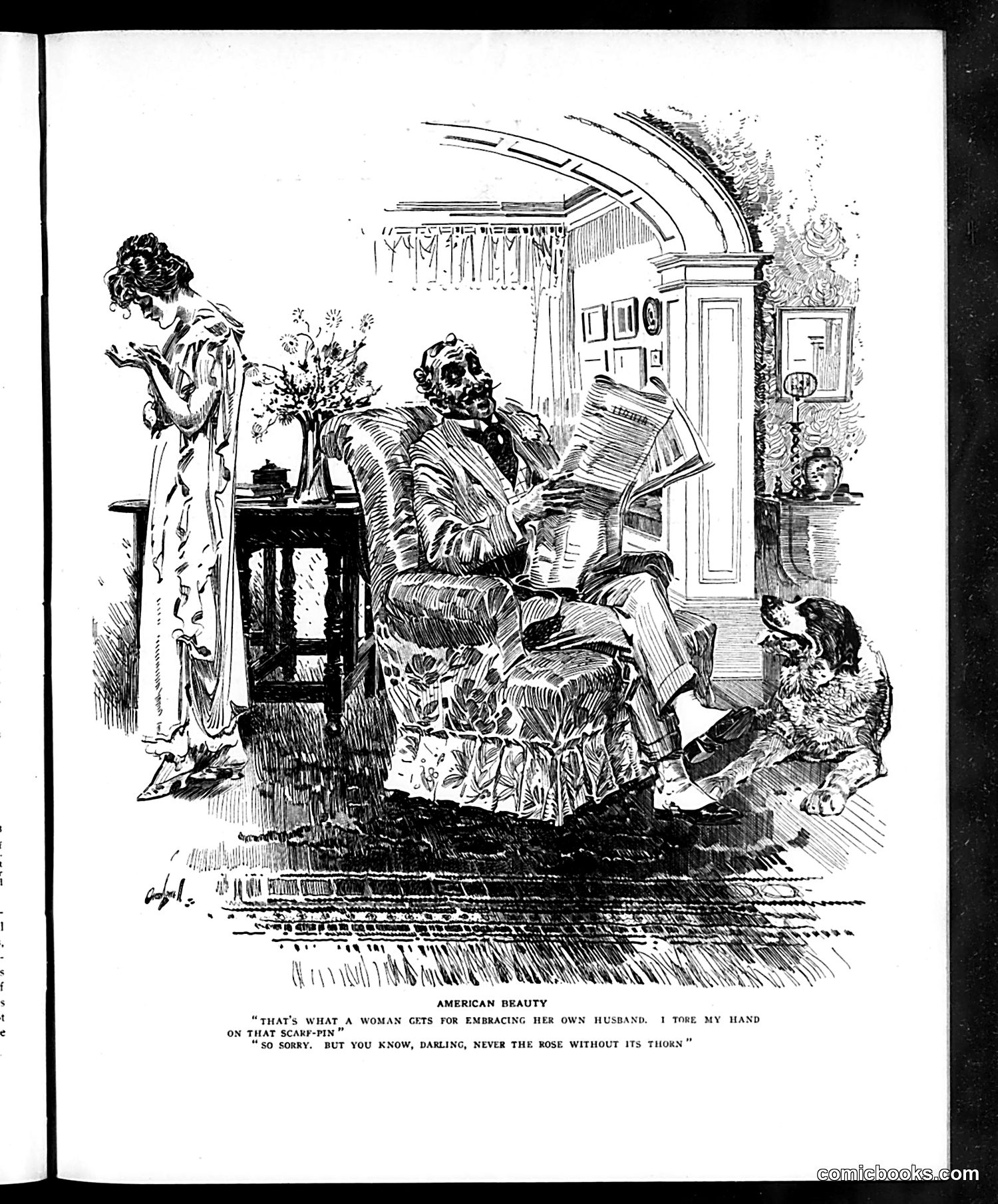
This satirical cartoon depicts a domestic scene where a man has injured his hand on a woman's decorative brooch (a "scare-pin") while embracing her. The title "American Beauty" references both the famous rose variety and contemporary ideals of femininity. The satire targets the impracticality of women's fashion accessories—specifically ornamental pins that were sharp and dangerous. When the man complains about his injury, the woman responds with the proverb "never the rose without its thorn," suggesting that beauty necessarily comes with painful consequences. The cartoon mocks both the elaborate dress standards women were expected to maintain and the notion that discomfort and danger were acceptable prices for feminine beauty and attractiveness. It's social commentary on the absurdity of fashionable but hazardous women's clothing during this era.
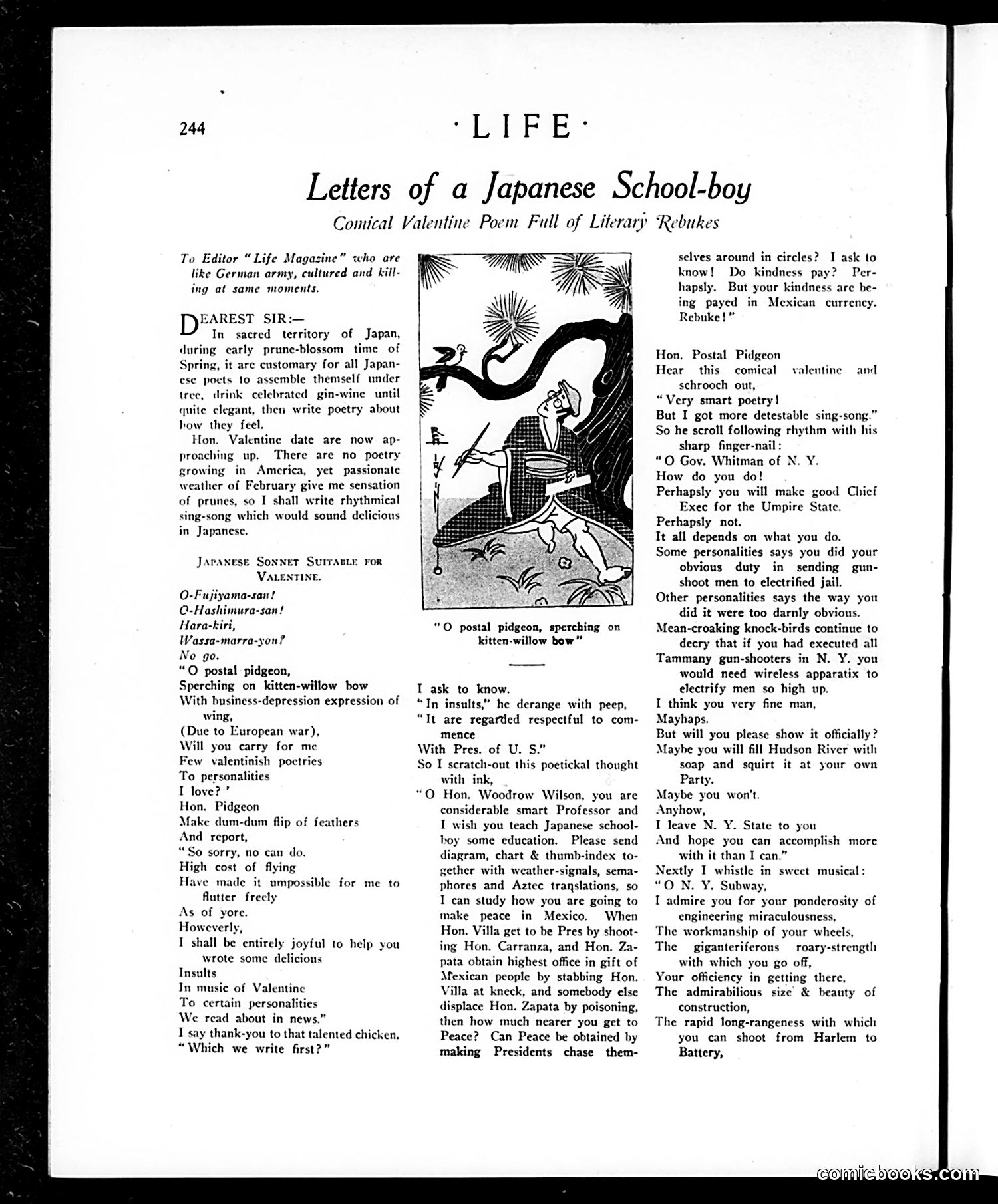
This is a satirical piece mocking a Japanese schoolboy writing Valentine's Day poetry to American political figures. The humor relies on broken English ("wassa-marra-you," "howeverly," "darnly obvious") and deliberate malapropisms to create comic effect. The boy addresses President Woodrow Wilson about making peace in Mexico (referencing the Mexican Revolution with Villa, Carranza, and Zapata), New York Governor Whitman regarding executions of criminals (likely the 1914 Sing Sing executions), and the NYC subway system. The satire targets American politics and institutions by having an outsider expose their absurdities through innocent questions: How can Wilson make peace when Mexican leaders constantly overthrow each other? Was Whitman's execution method too obvious? The positioning—a foreigner pointing out logical contradictions in American governance—was a standard Life magazine technique for political critique. The page's header notes it contains "Literary Rebukes," confirming the satirical intent.
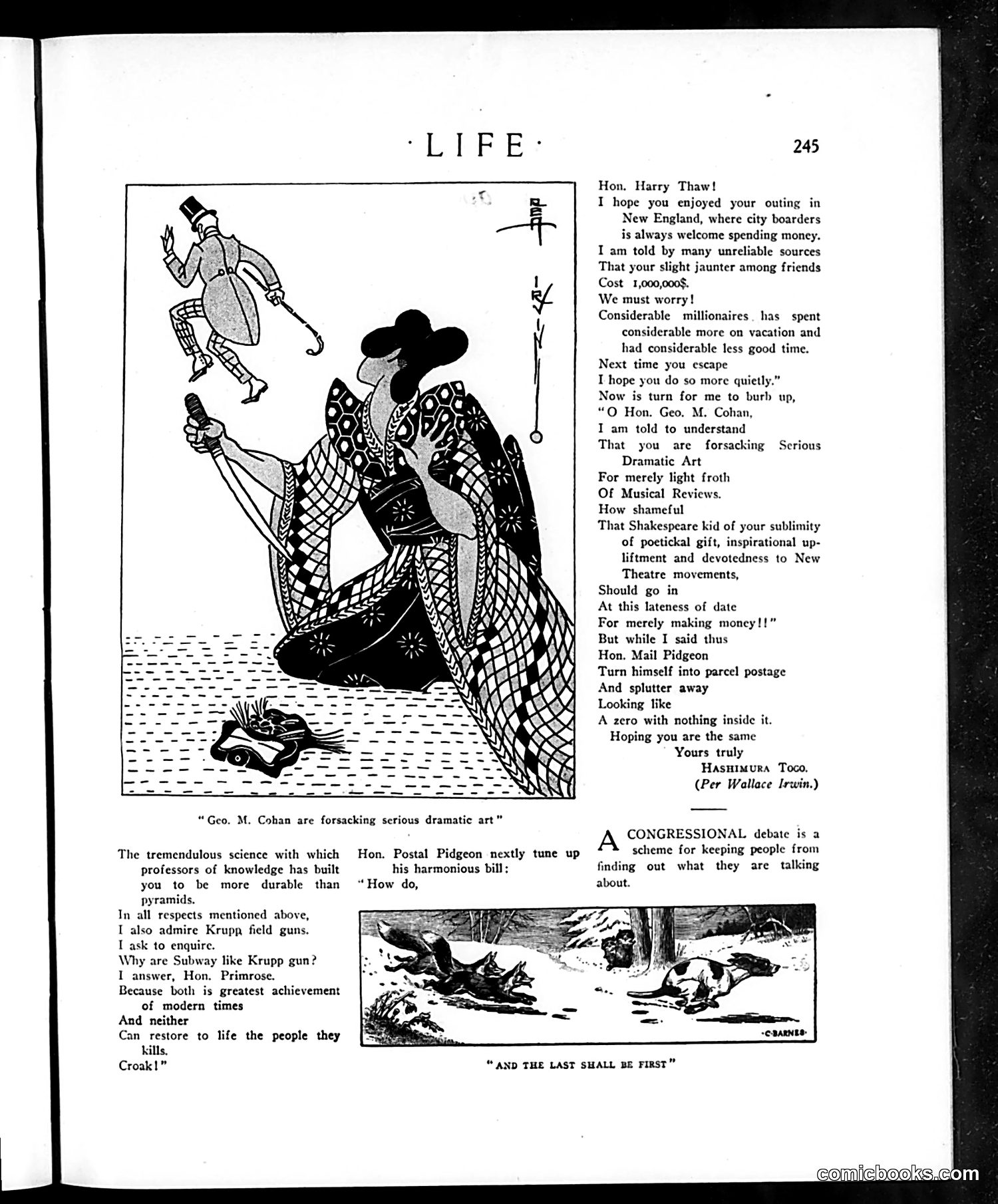
This page from *Life* magazine contains satirical commentary on early 1900s American celebrities and social figures, presented as mock letters from fictional "Hon." (Honorable) characters. **Main targets:** - **Harry Thaw**: A wealthy socialite mocked for spending $1,000,000 on a New England vacation - **George M. Cohan**: A celebrated playwright/performer criticized for abandoning serious dramatic art for profitable musical reviews (seen as commercial sellout) - **Krupp field guns**: A reference to German military weapons, used in a surreal joke comparing subway trains to weapons of war—both "achievements of modern times" that kill people **The satire's point**: The piece mocks wealthy elites for frivolous spending, artists compromising artistic integrity for money, and includes cynical commentary on warfare technology. The postal pigeon character literally deflates ("zero with nothing inside it"), suggesting these critiques are hollow gossip. The illustration shows a figure juggling—likely representing Cohan's divided attention between art forms.
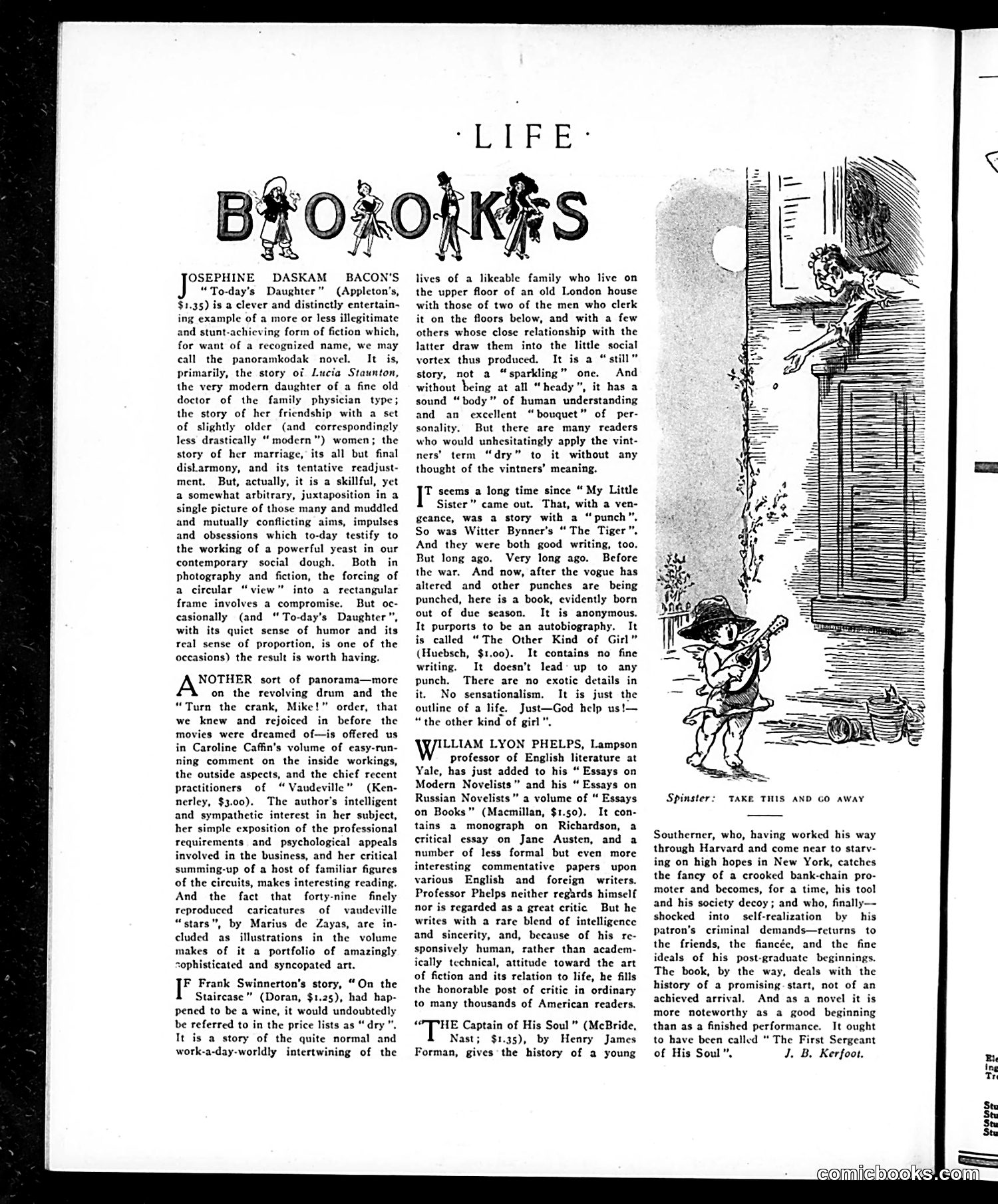
This page contains literary reviews and commentary from *Life* magazine's "Books" section. The main illustration shows a whimsical figure (likely representing a reader or critic) perched on stacked books, reading—a visual metaphor for literary consumption. The reviews discuss several contemporary novels, using wine-tasting terminology as metaphor. Notably, one review critiques an anonymous autobiography titled "The Other Kind of Girl," dismissing it as lacking sophistication, excitement, or literary merit—it's simply "the outline of a life" without "punch" or sensationalism. This reflects early 20th-century literary standards that valued stylistic flourish and dramatic narrative arc. The page exemplifies *Life*'s role as cultural arbiter, making judgments about which modern literature deserved serious attention. The tone is witty and somewhat condescending toward works deemed aesthetically or commercially unambitious.
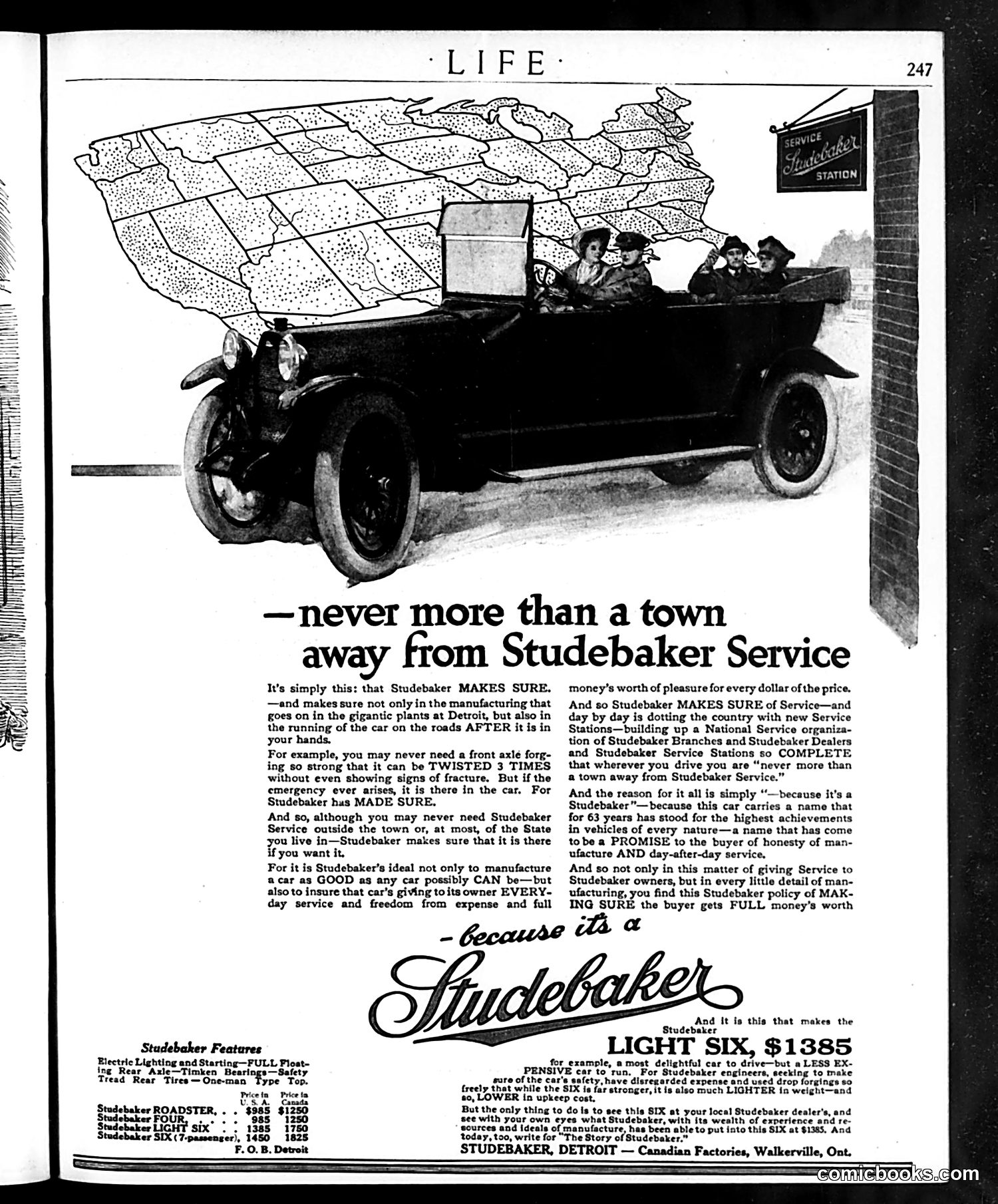
This page is primarily a car advertisement, not political satire. It promotes the Studebaker Light Six automobile ($1385) through a 1920s marketing campaign emphasizing nationwide service reliability. The image shows a vintage touring car filled with passengers near a "Studebaker Station" sign, illustrating the company's nationwide service network. The headline's promise—"never more than a town away from Studebaker Service"—represents the company's competitive advantage: extensive dealer and service station coverage across America. The ad emphasizes quality manufacturing ("MAKES SURE") and after-sale service as the brand's core values developed over 63 years. This reflects early automotive industry competition where reliable service networks were crucial selling points, as cars frequently broke down on period roads. The advertisement is straightforward commercial messaging rather than satire or political commentary.
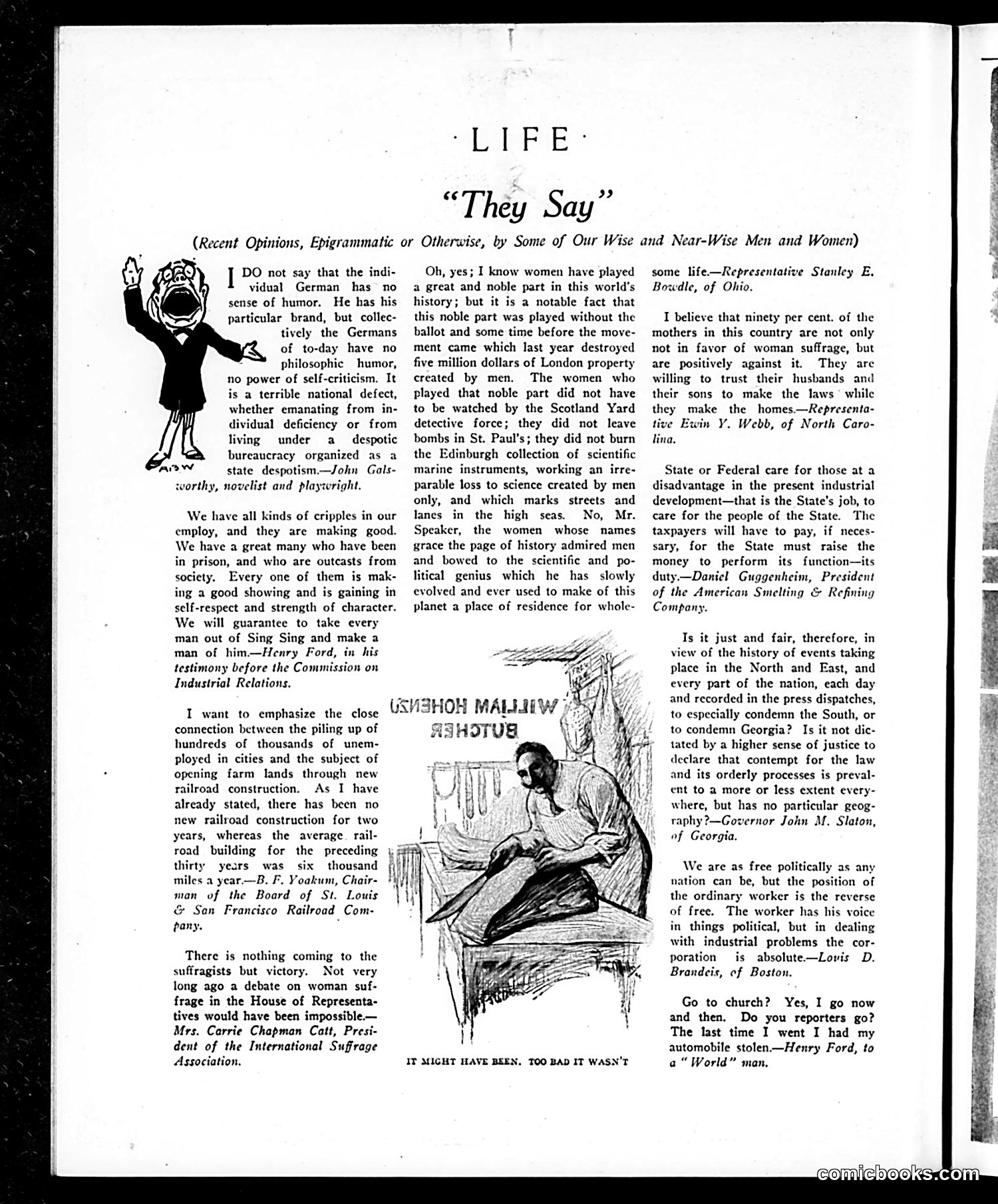
This page presents satirical quotes from prominent figures debating major early-20th-century social issues. The cartoon depicts a suffragist chained to a post labeled "William Booth" (the Salvation Army founder), illustrating anti-suffrage arguments. The opposing quotes reveal the debate's stakes: suffragists like Carrie Chapman Catt argue women deserve voting rights, while opponents—including congressmen Webb and Bowdle—claim women lack interest in suffrage or should remain domestic. Industrial figures like Henry Ford boast of employing "cripples" and prisoners, while railroad executive Yoakum argues unemployment links to insufficient railroad development. The satire works through juxtaposition: Life presents these conflicting statements without editorial comment, letting readers recognize the contradictions and evasions. The cartoon's imagery suggests suffragettes were portrayed as shackled or restrained—mocking anti-suffrage claims that women naturally prefer domesticity.
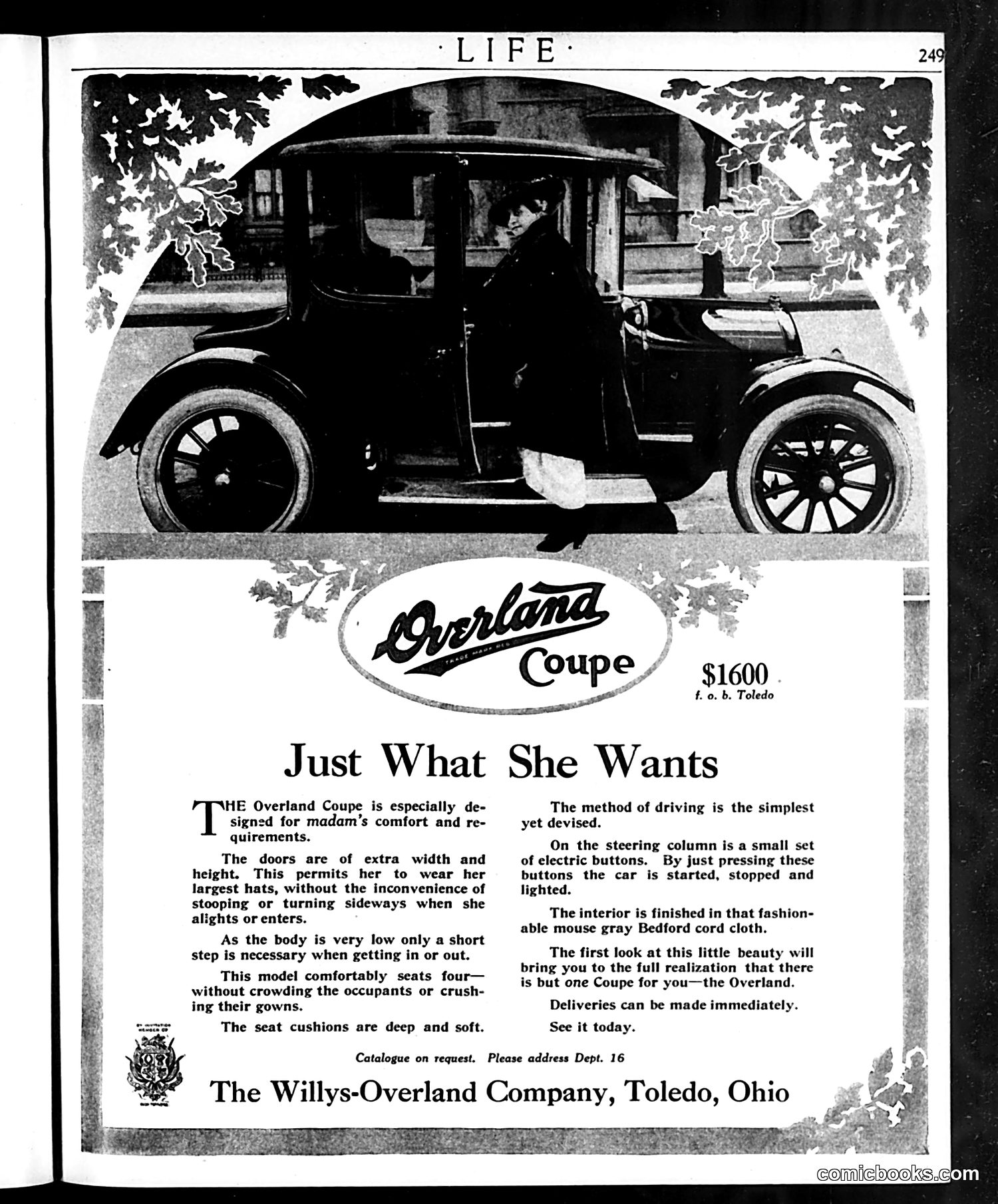
This is **advertising, not satire or political commentary**. The page features an Overland Coupe automobile advertisement ($1600, f.o.b. Toledo) marketed to women—specifically wealthy women concerned with fashion and comfort. The ad's humor is gentle and period-specific rather than satirical. It highlights features designed for female drivers and passengers: extra-wide doors to accommodate large hats (fashionable at the time), a low step for convenient entry, spacious seating that won't crush formal gowns, and simple electric button controls. The tagline "Just What She Wants" emphasizes tailored design for women's needs and aesthetic preferences. This reflects early 1900s-1910s automotive marketing that treated women as an emerging consumer demographic, though the paternalistic tone—emphasizing appearance, comfort, and simplicity—reveals period assumptions about female drivers' priorities and capabilities.
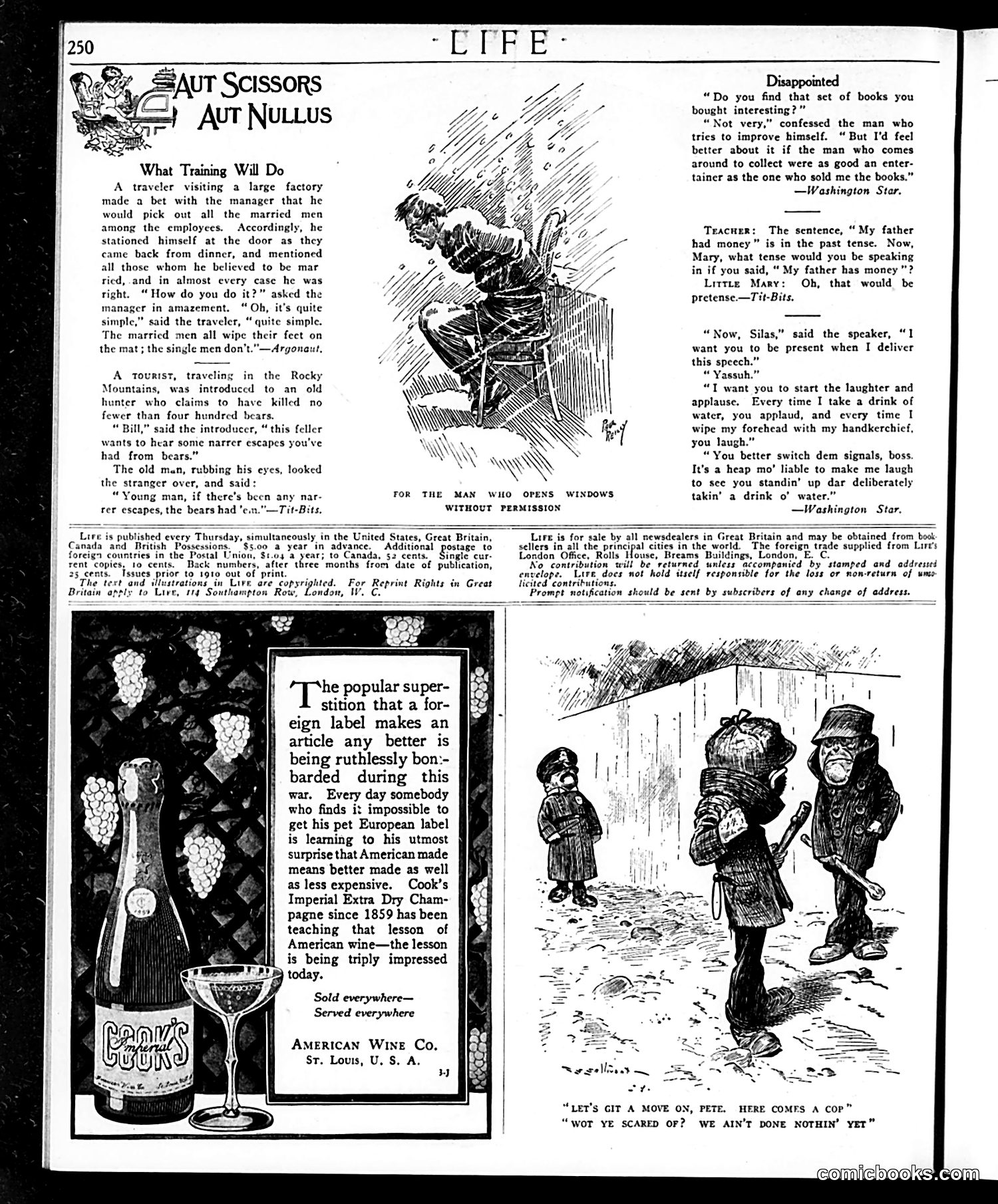
This page contains multiple short humorous pieces typical of early 20th-century American satire magazines: **Top cartoons** present brief jokes about human nature and social observation—a traveler recognizing married employees by their shoe-wiping habits, a hunter's deadpan response about bear escapes, and classroom humor about verb tenses. **The main cartoon** (center-right) depicts two figures encountering a policeman in rain, with dialogue about not being "done nothin' yet"—satirizing working-class anxiety about police authority and the assumption of guilt. **Context for modern readers:** Life magazine was America's premier satirical publication, using short comedic anecdotes and illustrations to comment on everyday social tensions: class differences, gender roles, and anxieties about authority. The humor assumes reader familiarity with popular speech patterns and recognizes universal human foibles. **The Cook's champagne advertisement** simultaneously promotes American-made products during wartime by mocking the superstition that foreign goods are superior—wartime patriotic marketing disguised as consumer wisdom.
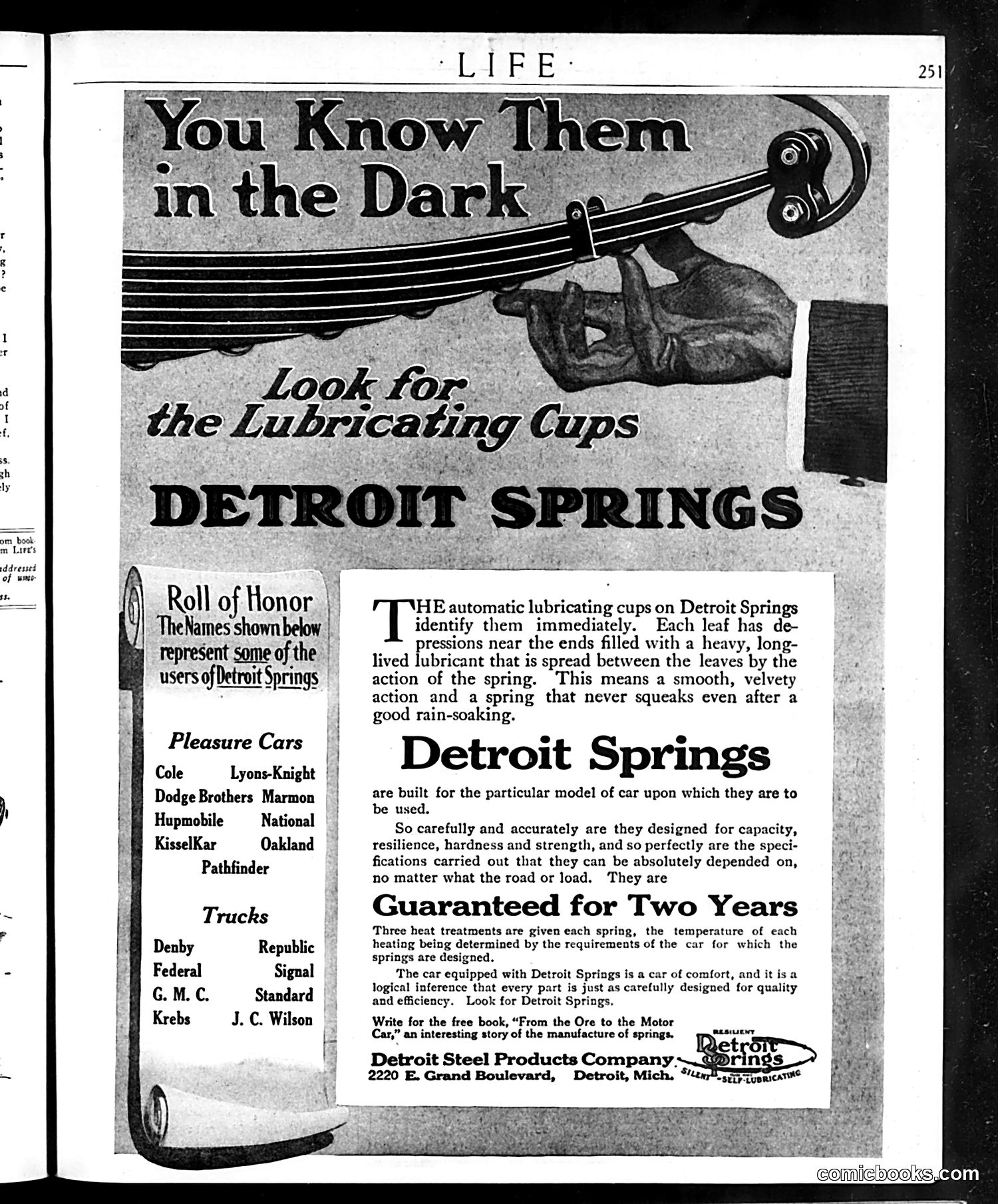
This is primarily a **product advertisement**, not satire or political commentary. The page promotes Detroit Springs—automobile suspension components—in *Life* magazine. The header "You Know Them in the Dark" is a marketing slogan emphasizing product recognition by the smooth, quiet ride Detroit Springs provide (no squeaking even when wet). The left sidebar lists a "Roll of Honor" of car manufacturers using Detroit Springs—both luxury brands (Cole, Dodge Brothers, Hupmobile, Kisselkar) and commercial vehicles (trucks from Federal, G.M.C., Krebs). This was a common advertising technique: endorsements by established manufacturers boosted credibility. The main text emphasizes technical superiority: specially designed lubricating cups, precise engineering for different car models, heat treatment, and a two-year guarantee. There is no cartoon, caricature, or political reference. This is straightforward early 20th-century industrial marketing emphasizing quality, engineering precision, and prestigious customer endorsements.
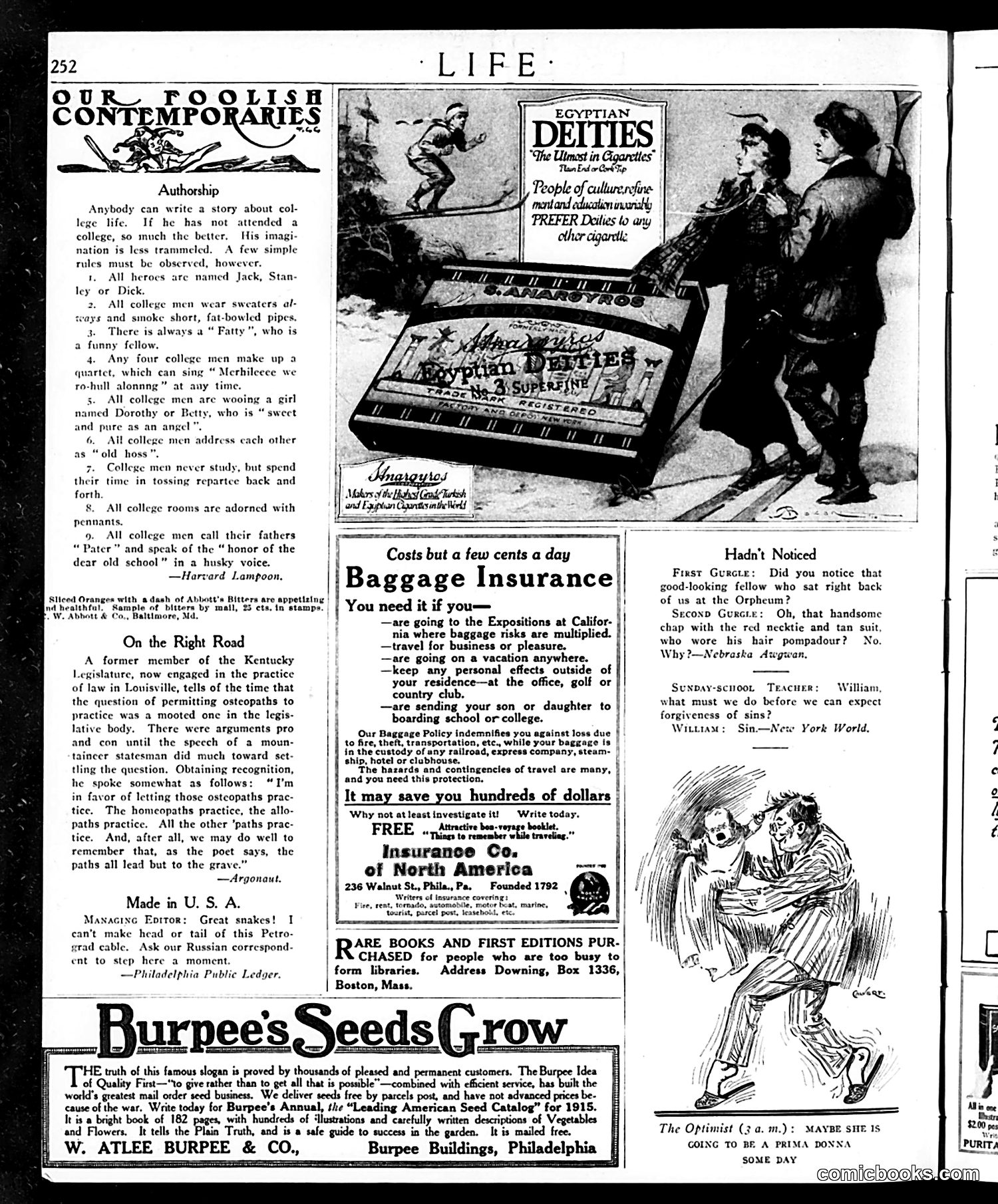
This page mixes satirical commentary with period advertising. The main satire is **"Authorship,"** which mocks formulaic college fiction writing. Life ridicules the clichéd conventions of early 1900s college stories: all heroes named Jack/Stanley/Dick, protagonists who smoke pipes and wear sweaters, stock characters like "Fatty," mandatory quartets singing "Merrileece," and romantic pursuits of girls named Dorothy or Betty. The satire undercuts these tropes by listing them as "simple rules"—suggesting such stories are lazy, predictable, and divorced from actual college life. The other content consists of humorous anecdotes (a Kentucky legislator's defense of osteopaths, a confused editor dealing with a Petrograd cable) and period advertisements (Baggage Insurance, Burpee's Seeds, Egyptian Dettes cigarettes). The **Egyptian Dettes advertisement** features what appears to be people examining cigarette packages, appealing to consumers with claims about quality. The cartoons and jokes reflect turn-of-the-century American humor—gently satirizing both literary pretension and contemporary social conventions rather than addressing serious political issues.
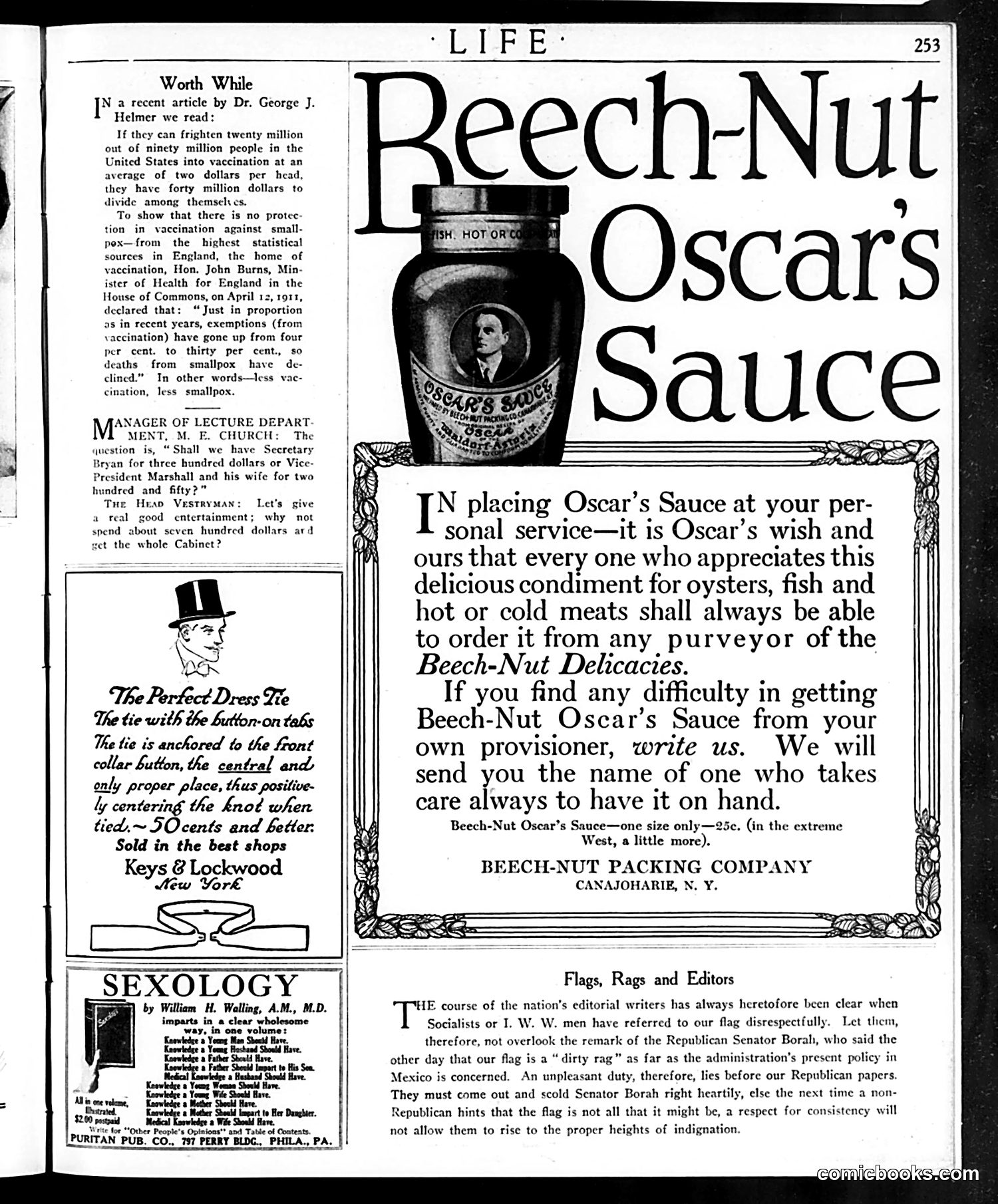
This page contains several satirical pieces typical of early 20th-century Life magazine: **"Worth While" editorial**: Satirizes anti-vaccination sentiment by quoting a Dr. Helmer who claims vaccination is a money-making scheme, then cites British Minister John Burns' claim that *reduced* vaccination correlates with *fewer* smallpox deaths. The satire mocks this logic—Life appears to be defending vaccination against growing skepticism. **Church humor**: A brief joke about church fundraising priorities, mocking debates over speaker fees. **"Flags, Rags and Editors"**: Criticizes Republican newspapers for hypocrisy. Senator Borah called the American flag a "dirty rag" regarding U.S. Mexico policy, yet conservative papers haven't condemned him as they would non-Republicans for similar flag disrespect. Life demands consistent editorial standards. The remainder comprises period advertisements (dress ties, textbooks, condiments) typical of the magazine's format.
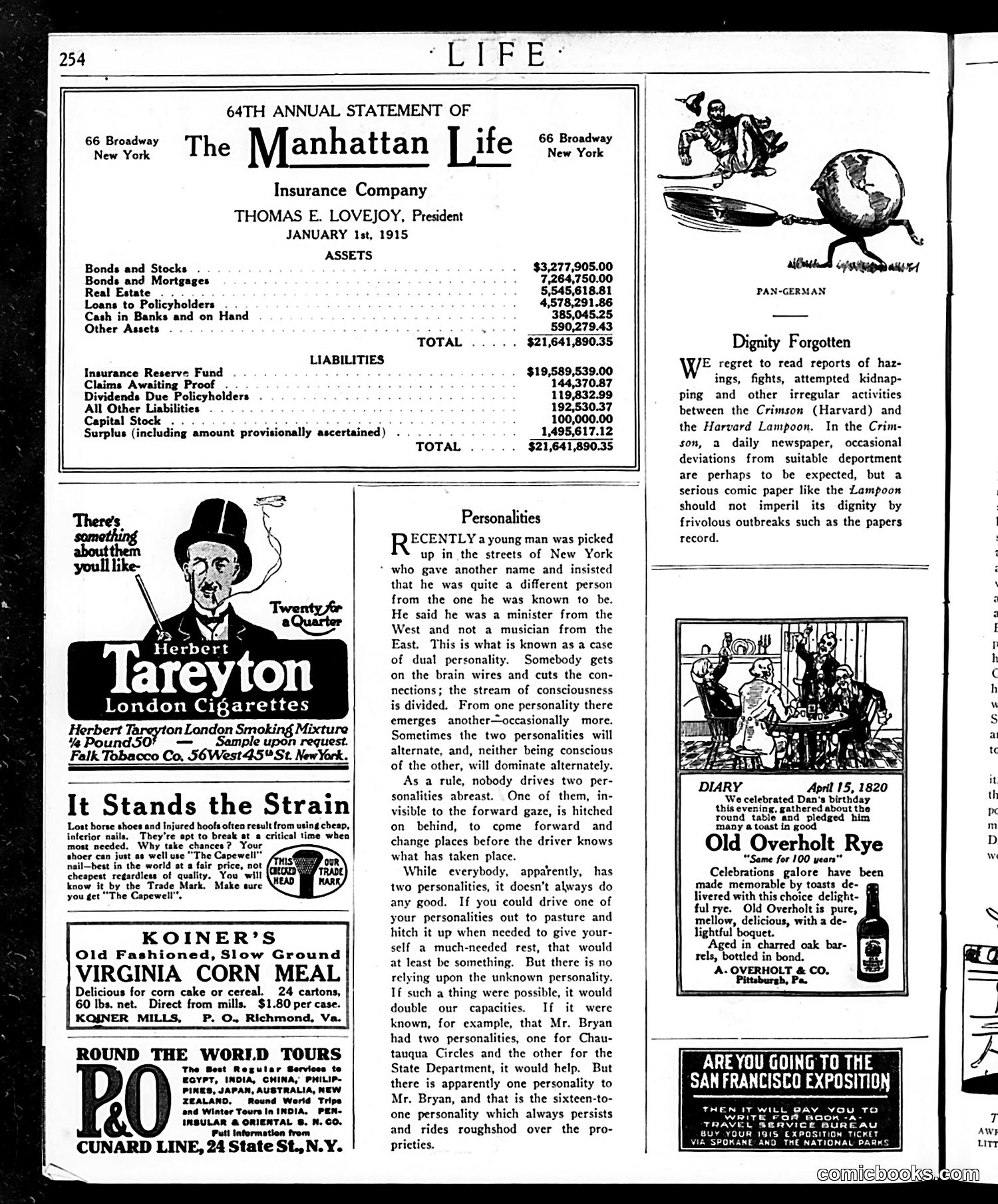
This page is primarily **corporate and advertising content** with minimal political satire. The main satirical element is the "Personalities" essay, which uses William Jennings Bryan as its political target. The piece discusses dual personality disorder, then pivots to mock Bryan by suggesting his consistency is actually a problem—his "sixteen-to-one personality" (referencing his famous free-silver campaign platform) "always persists and rides roughshod over the proprieties." The satire implies Bryan's rigid ideological commitment makes him unsuitable for government service, particularly the State Department. The "Pan-German" cartoon appears to reference World War I tensions, showing symbolic figures in conflict, though specific identities are unclear from the image alone. The rest of the page consists of insurance company financials, cigarette and product advertisements, and a brief diary entry. The content reflects 1915 American commercial publishing rather than sustained political commentary.
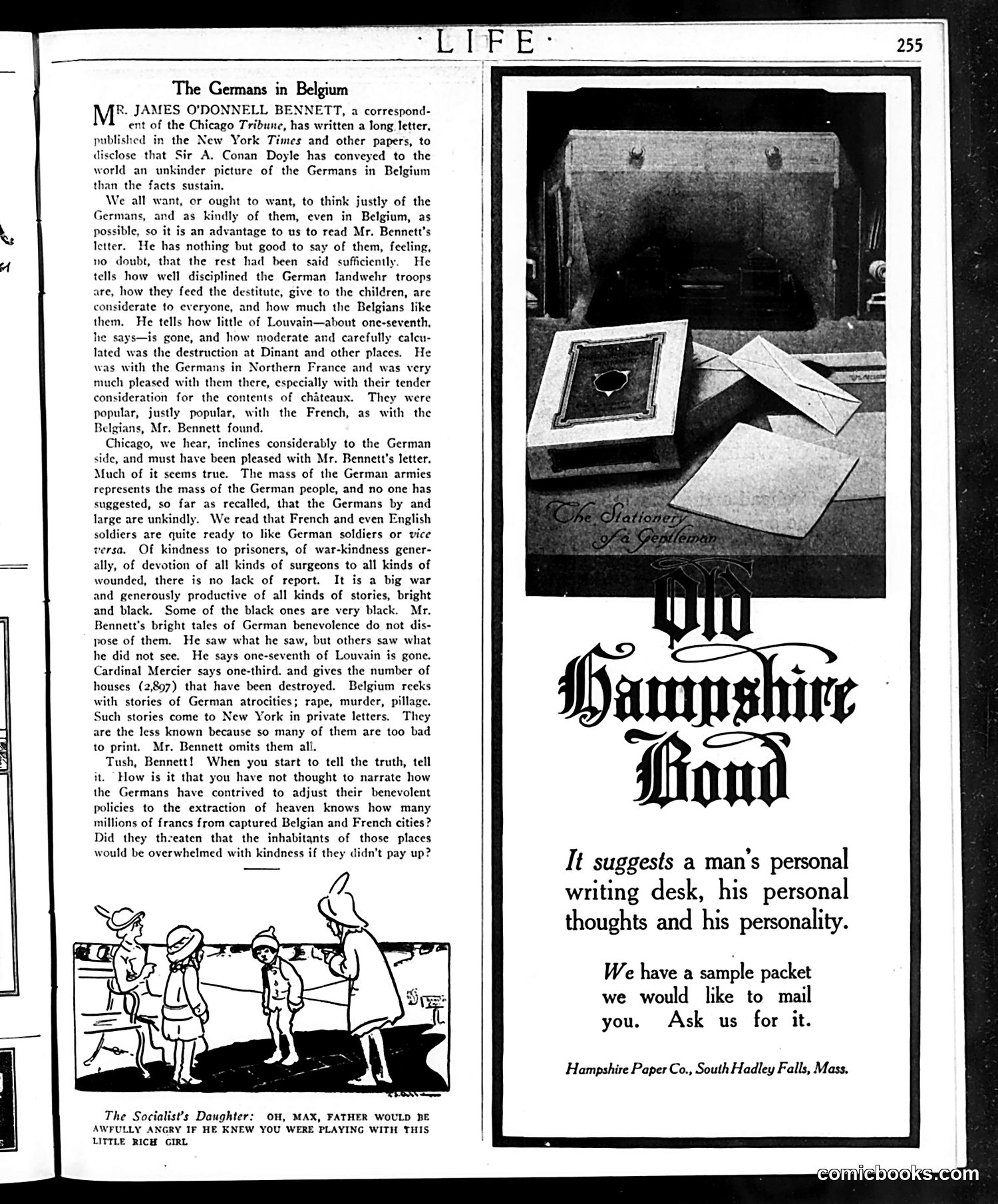
This *Life* magazine page from WWI era contains two distinct elements: **The Main Article**: A sharp editorial rebuttal to war correspondent James O'Donnell Bennett's letter defending German conduct in Belgium. Bennett claimed Germans were disciplined and kind—feeding the destitute, showing restraint in destroyed cities like Louvain. *Life's* editor sarcastically agrees Bennett "saw what he saw" but points out others witnessed atrocities he conveniently omitted. The editor challenges Bennett's rosy account by noting Belgium was filled with documented reports of rape, murder, and pillage—stories "too bad to print." The final paragraph mockingly asks how German "benevolence" squared with extracting millions in francs from conquered Belgian and French cities through threats. **The Cartoon**: Shows a "Socialist's Daughter" warning her boyfriend "Max" that her father would be angry seeing her with a "little rich girl"—a class-consciousness joke about socialist ideology clashing with romantic reality. **The Advertisement**: Hampshire Bond paper, occupying the right column. The page's purpose is wartime propaganda countering pro-German apologetics.
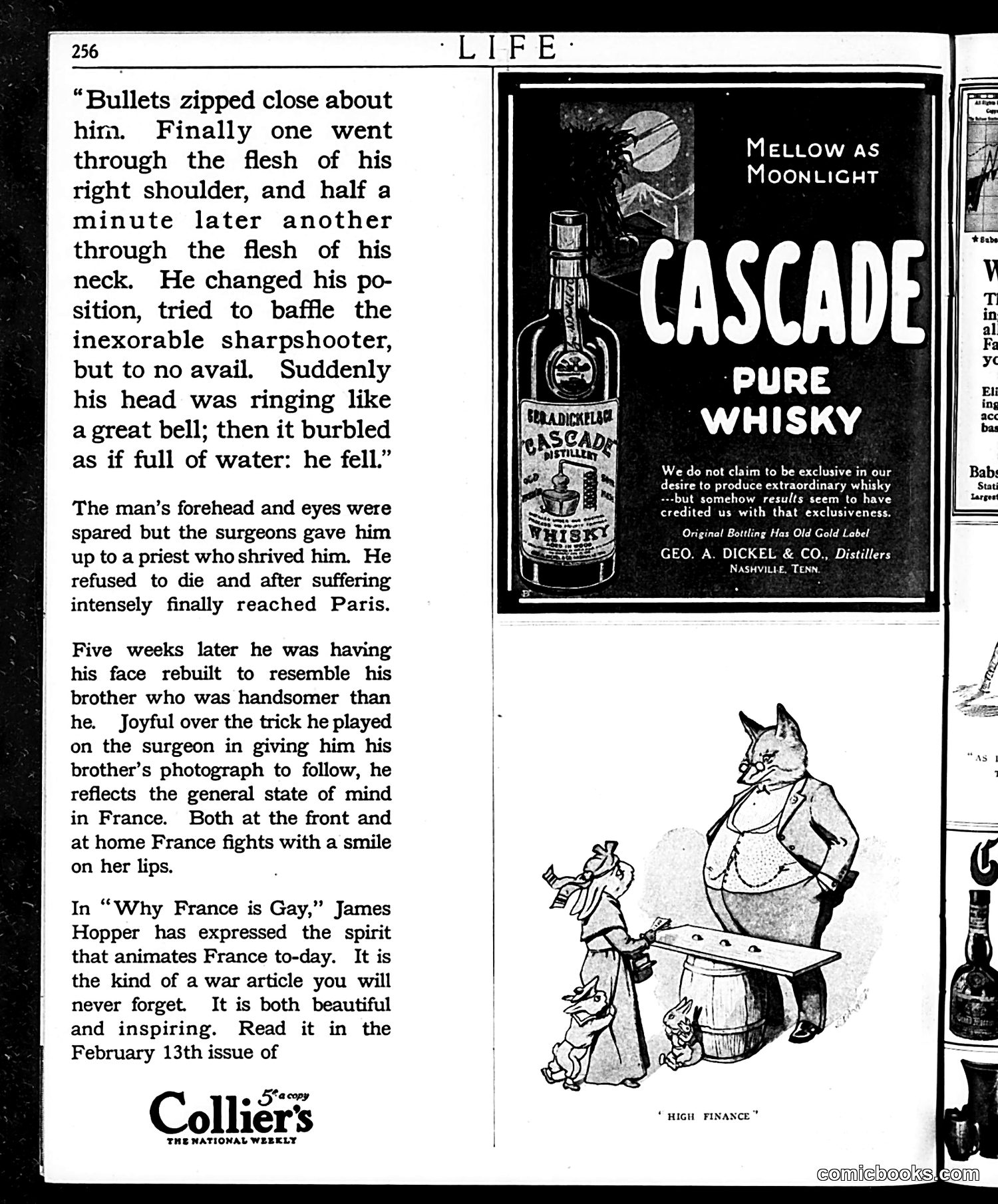
This page combines a dramatic WWI narrative with period advertisements. The text excerpt describes a severely wounded French soldier who survives multiple bullet wounds and undergoes facial reconstruction surgery in Paris. The narrative emphasizes French resilience and morale—the soldier even tricks his surgeon by submitting his handsome brother's photograph as a reconstruction guide, reflecting France's ability to "fight with a smile." The page promotes James Hopper's article "Why France is Gay" (using "gay" in its older sense: cheerful/spirited), celebrating French wartime optimism. The cartoon titled "High Finance" (bottom) appears to depict a pig in human clothing, likely satirizing profiteering or financial manipulation during wartime—a common target of WWI-era satire. The Cascade Whisky advertisement uses romantic wartime imagery unrelated to the editorial content.
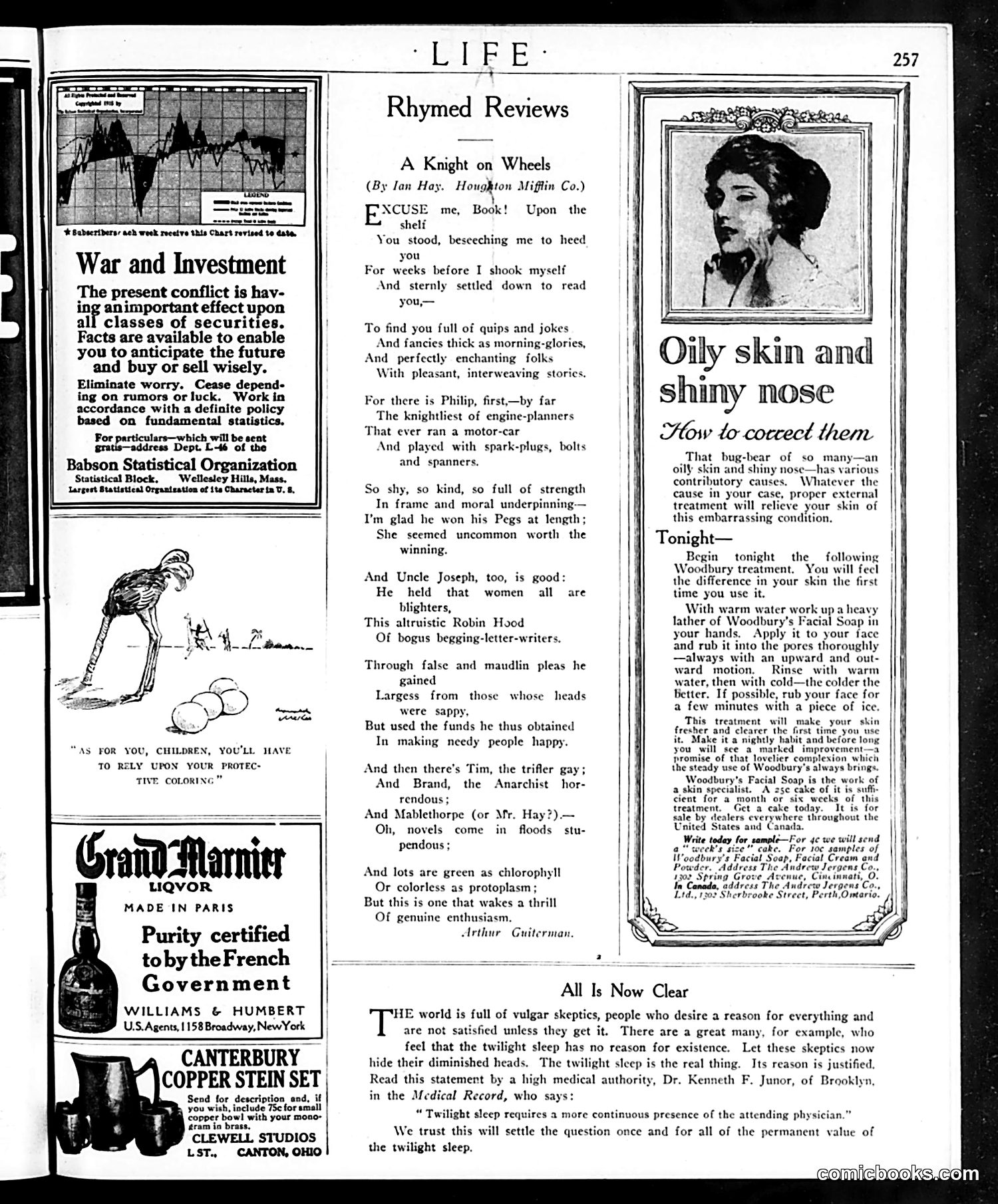
The page contains a political cartoon and advertisements from an early 20th-century *Life* magazine. **The Cartoon ("Protective Coloring"):** The image shows a bird or small creature camouflaged against a landscape. The caption reads: "As for you, children, you'll have to rely upon your protective coloring." This is satirizing how civilians during wartime must adapt and hide—a commentary on WWI's impact on civilian life. The "protective coloring" is a metaphor for camouflage, suggesting that ordinary people must blend in or disguise themselves to survive conflict. **Page Context:** The "War and Investment" advertisement above references how the current conflict (likely WWI) affects stock markets and securities, encouraging readers to invest wisely using statistical analysis rather than rumors. The rest of the page contains a book review of *A Knight on Wheels* by Ian Hay, and beauty advertisements for Woodbury's Facial Soap—typical commercial content of the era.
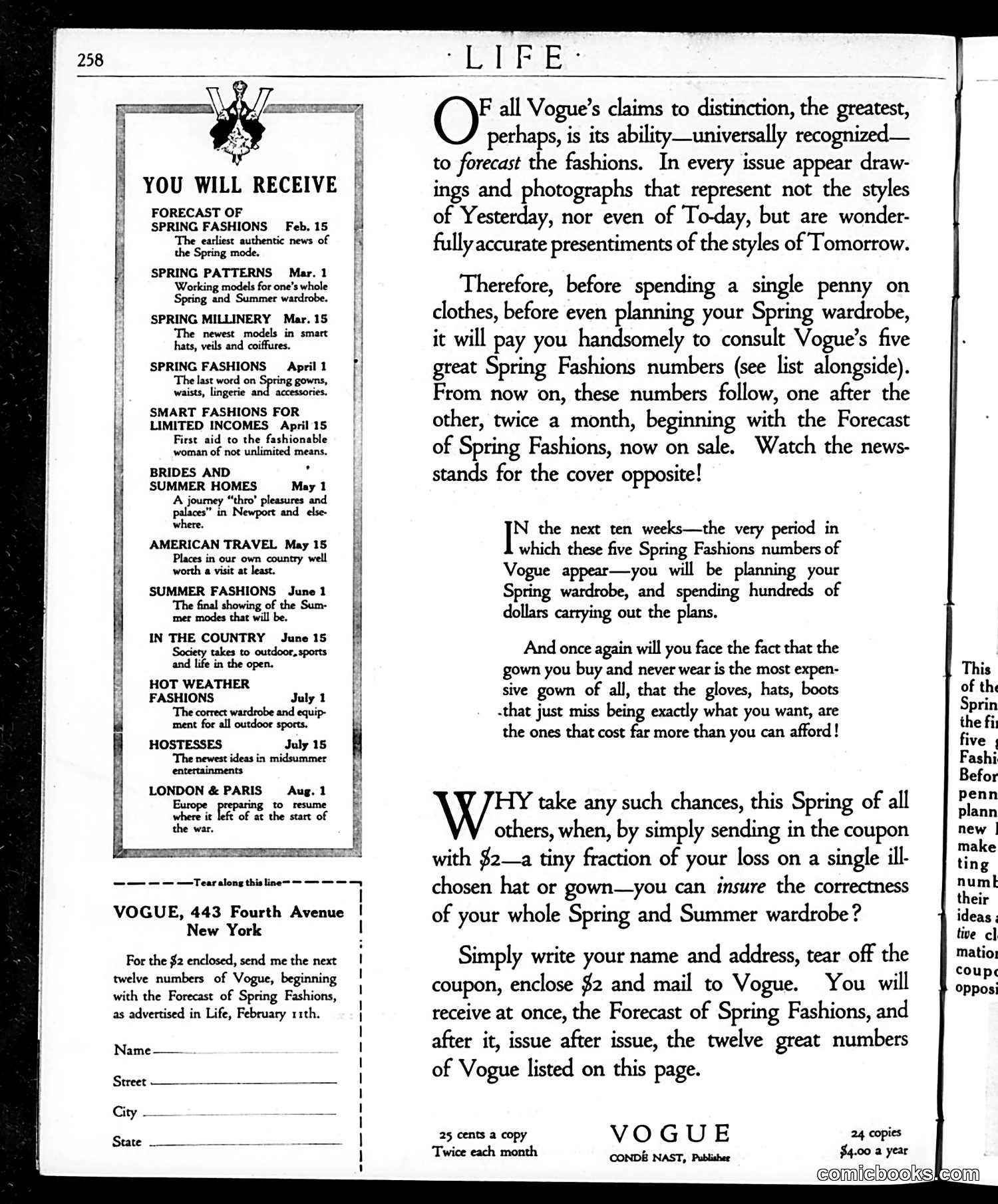
This is primarily a **Vogue subscription advertisement**, not a political cartoon. The page promotes Vogue magazine's fashion forecasting service to Life's readers. The "satire" is subtle and implicit rather than explicit. The advertisement ironically plays on consumer anxiety about fashion choices: it warns readers that clothes they buy often don't fit their needs or budgets, then offers Vogue's $2 subscription as insurance against such mistakes. The logic is circular—spend $2 on fashion forecasts to avoid wasting money on wrong purchases. The ad lists twelve Vogue issues spanning February through August, each targeting specific fashion needs (spring fashions, millinery, summer homes, travel, etc.). The coupon at bottom-left allows readers to subscribe. This reflects early 20th-century consumer culture, where fashion magazines positioned themselves as essential guides for middle-class women navigating seasonal style changes and budget constraints. The underlying message: expert advice prevents costly fashion blunders.
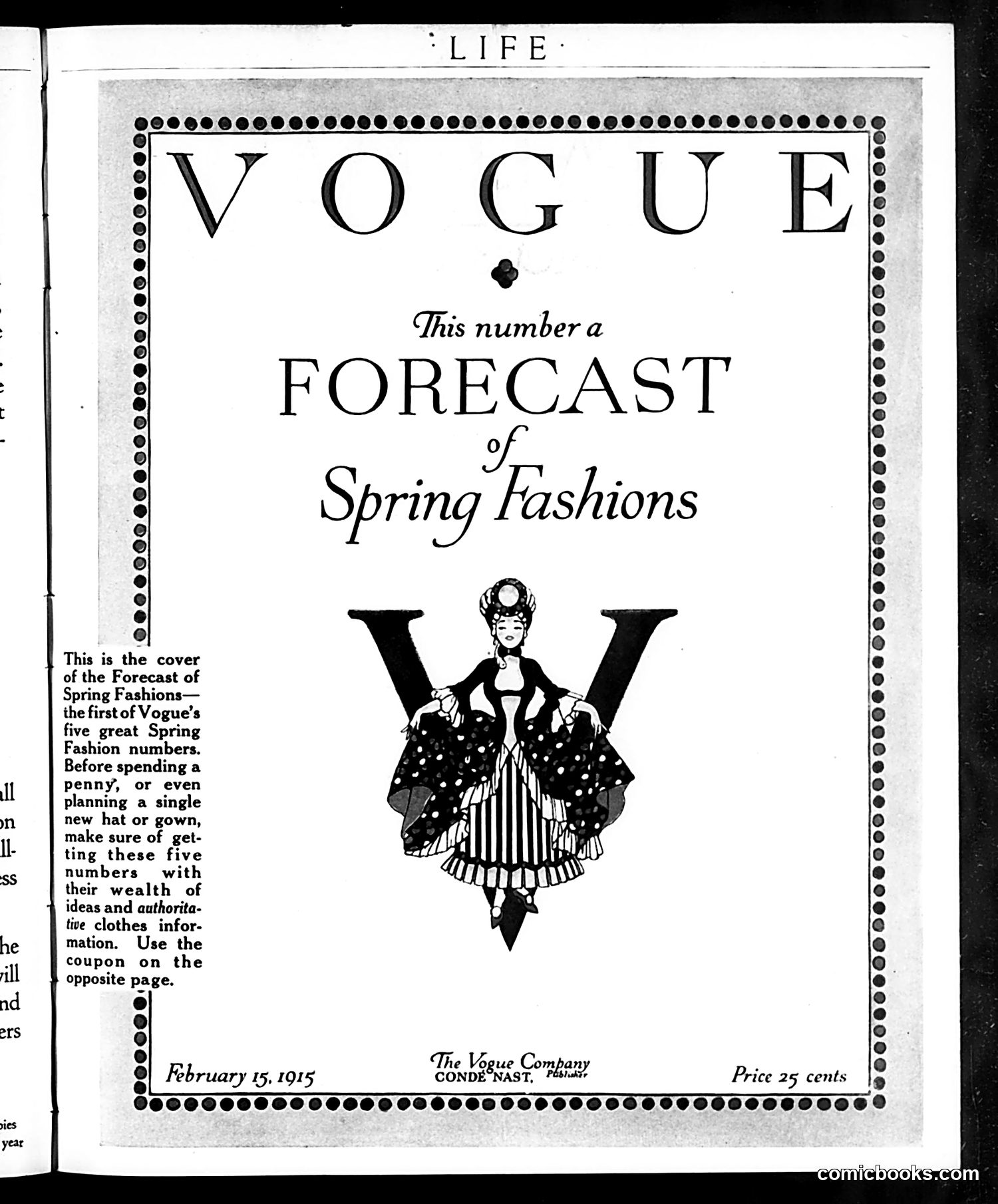
This is a cover page for *Life* magazine from February 15, 1915, not a satirical cartoon—it's an advertisement promoting *Vogue*'s spring fashion forecast. The central illustration shows an elegantly dressed woman in fashionable attire with a large decorative cape, embodying spring fashion ideals of the era. The page functions as promotional material encouraging readers to purchase *Vogue*'s five upcoming spring fashion numbers before buying clothing. It emphasizes that these issues contain authoritative fashion guidance—readers should consult them before spending money on "a penny" or even "planning a single new hat or gown." This reflects early-20th-century magazine publishing practices, where *Life* and *Vogue* (both owned by Condé Nast) cross-promoted each other to their audiences. There is no political satire present—it's straightforward fashion marketing.
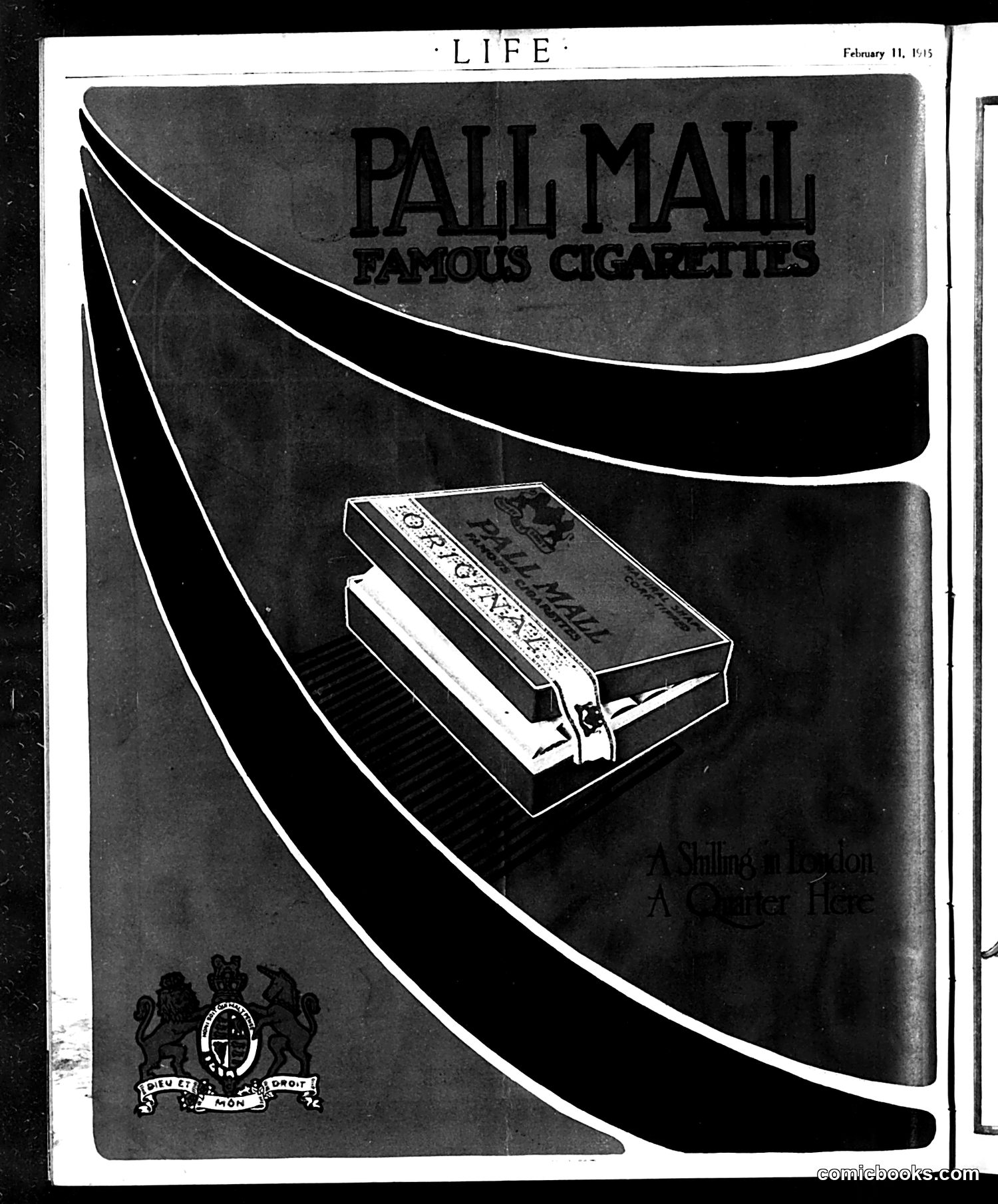
This is a **full-page advertisement** for Pall Mall Famous Cigarettes from *Life* magazine (February 11, 1915). The ad features a elegantly designed cigarette package displayed centrally against stylized black curved lines suggesting sophistication and modernity. At the bottom left is a coat of arms or royal insignia, lending prestige to the product. The visible tagline reads "A Shilling a Decision / A Gold There" (OCR unclear on exact wording), suggesting the product's value proposition. This represents early 20th-century cigarette marketing—a period before health warnings, when tobacco companies advertised openly in major publications. The design emphasizes luxury and British heritage through the heraldic imagery, appealing to *Life* magazine's affluent readership.