
Life, 1915-02-11 · page 12 of 44
Life — February 11, 1915 — page 12: what you’re looking at
What you’re looking at
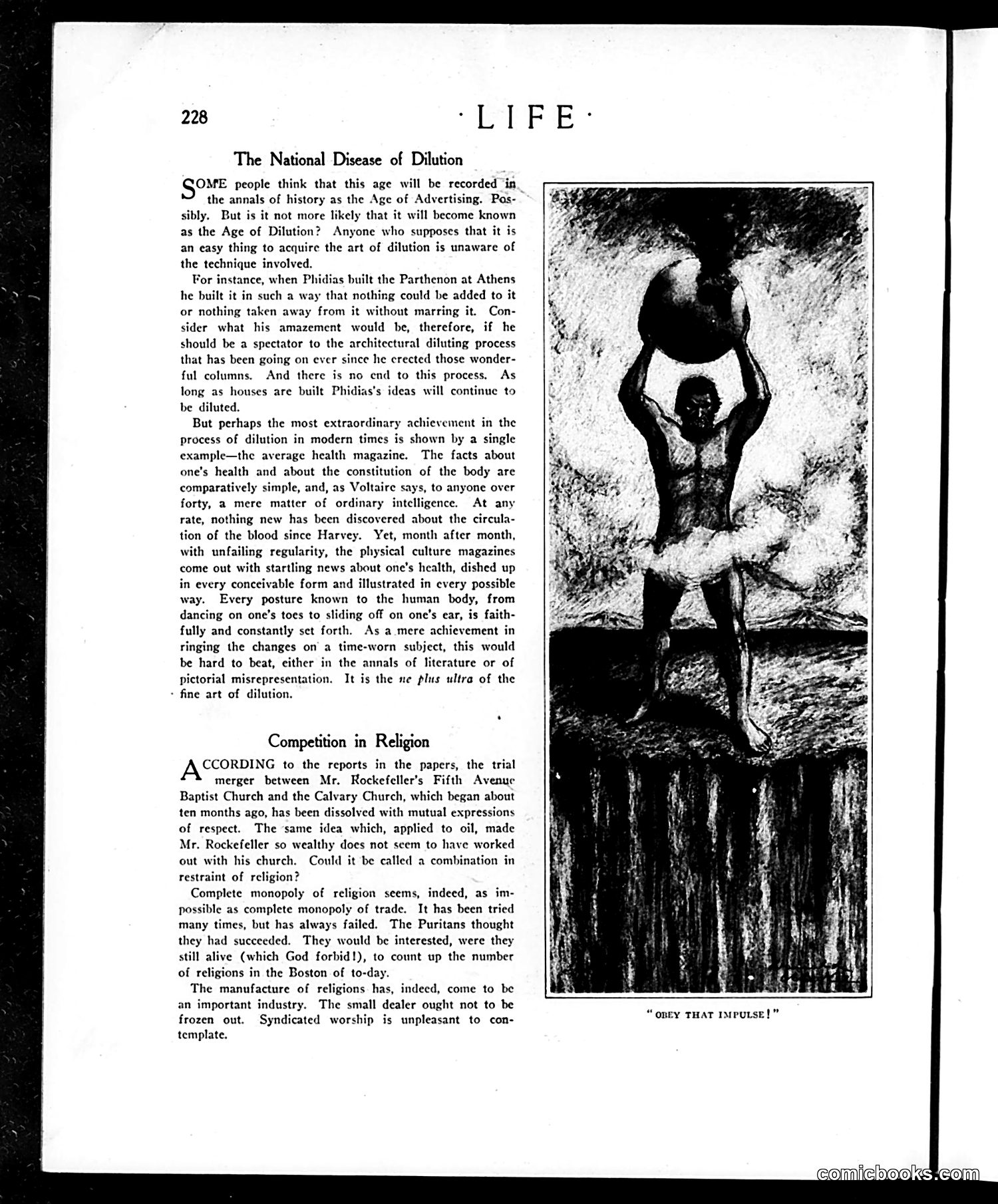
The page contains two distinct sections with different satirical targets: **"The National Disease of Dilution"** critiques how health and fitness magazines constantly repackage simple, well-known facts about the human body—discovered centuries ago by Harvey regarding blood circulation—as revolutionary new discoveries. The satire attacks the endless repetition and sensationalism of these publications. **"Competition in Religion"** comments on the dissolution of a trial merger between Rockefeller's Fifth Avenue Baptist Church and the Calvary Church. The author sarcastically suggests that monopolizing religion is impossible (unlike trade), citing the Puritans as historical example. The piece mocks the "manufacture" of religions as an industry and syndicated worship as undignified. The accompanying illustration (captioned "OBEY THAT IMPULSE!") appears to depict a muscular figure, likely reinforcing the dilution critique.
📄 Transcribed text from this page (OCR, searchable)
Machine-transcribed from the original scan — historical spelling and the odd misread are preserved.
228 *LIFE: The National Disease of Dilution Some people think that this age will be recorded in the annals of history as the Age of Advertising. Paos- sibly. But is it not more likely that it will become known as the Age of Dilution? Anyone who supposes that it is an easy thing to acquire the art of dilution is unaware of the technique involved. For instance, when Phidias built the Parthenon at Athens he built it in such a way that nothing could be added to it or nothing taken away from it without marring it. Con- sider what his amazement would be, therefore, if he should be a spectator to the architectural diluting process that has been going on ever since he erected those wonder- ful columns. And there is no end to this process. As long as houses are built Phidias’s ideas will continue to be diluted. But perhaps the most extraordinary achievement in the process of dilution in modern times is shown by a single example—the average health magazine. The facts about one’s health and about the constitution of the body are comparatively simple, and, as Voltaire says, to anyone over forty, a mere matter of ordinary intelligence. At any rate, nothing new has been discovered about the circula- tion of the blood since Harvey. Yet, month after month, with unfailing regularity, the physical culture magazines come out with startling news about one’s health, dished up in every conceivable form and illustrated in every possible way. Every posture known to the human body, from dancing on one’s toes to sliding off on one's ear, is faith- fully and constantly set forth. As a mere achievement in ringing the changes on a time-worn subject, this would be hard to beat, either in the annals of literature or of pictorial misrepresentation. It is the ne plus ultra of the + fine art of dilution. Competition in Religion ACCORDING to the reports in the papers, the trial merger between Mr. Rockefeller’s Fifth Avenuc Baptist Church and the Calvary Church, which began about ten months ago, has been dissolved with mutual expressions of respect. The ‘same idea which, applied to oil, made Mr. Rockefeller so wealthy does not seem to have worked out with his church. Could it be called a combination in restraint of religion? Complete monopoly of religion seems, indeed, as im- possible as complete monopoly of trade. It has been tried many times, but has always failed. The Puritans thought they had succeeded. They would be interested, were they still alive (which God forbid!), to count up the number of religions in the Boston of to-day. The manufacture of religions has, indeed, come to be an important industry. The small dealer ought not to be frozen out. Syndicated worship is unpleasant to con- template. “ney THAT IMPULSE!”