
Life, 1915-02-11 · page 32 of 44
Life — February 11, 1915 — page 32: what you’re looking at
What you’re looking at
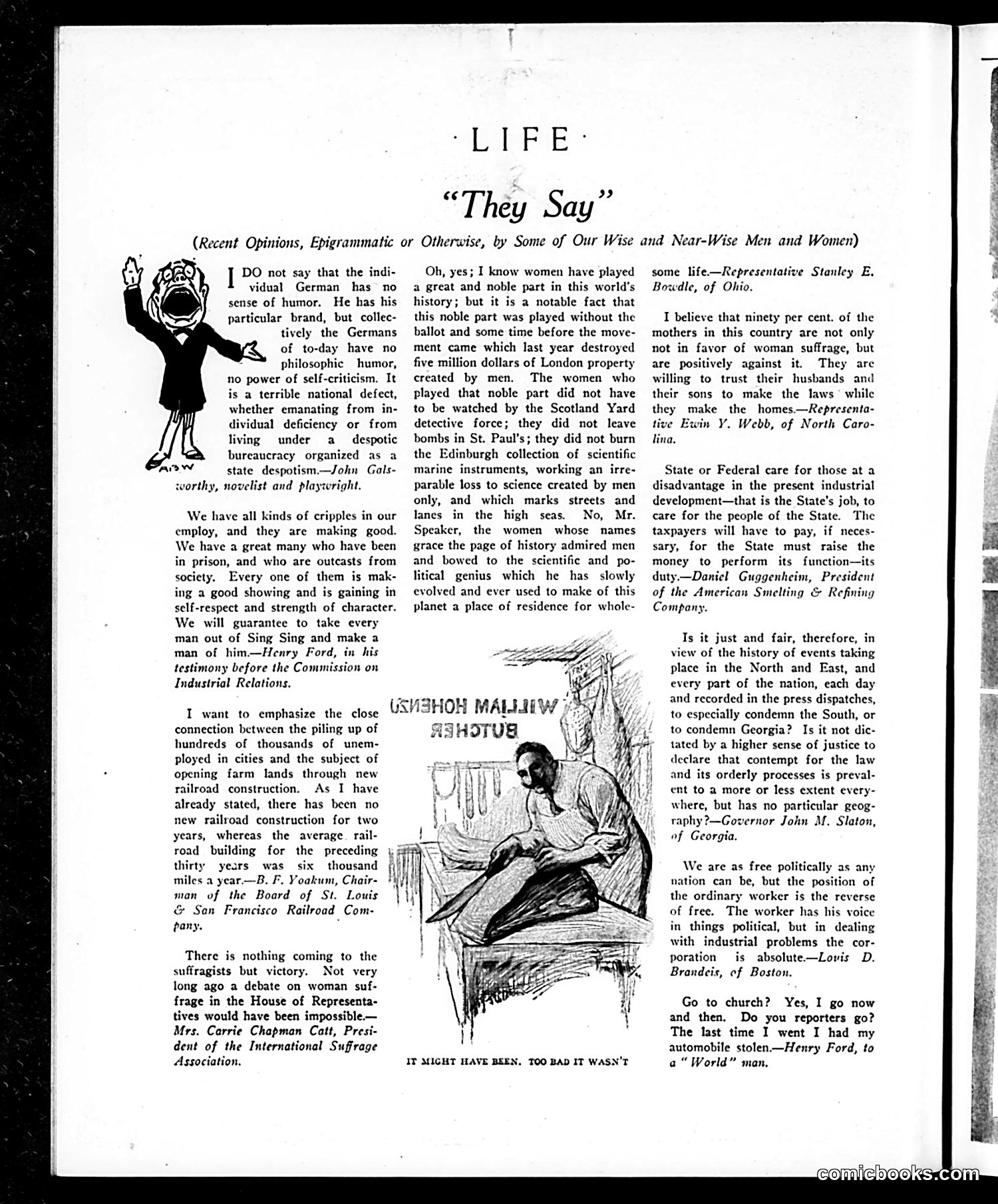
This page presents satirical quotes from prominent figures debating major early-20th-century social issues. The cartoon depicts a suffragist chained to a post labeled "William Booth" (the Salvation Army founder), illustrating anti-suffrage arguments. The opposing quotes reveal the debate's stakes: suffragists like Carrie Chapman Catt argue women deserve voting rights, while opponents—including congressmen Webb and Bowdle—claim women lack interest in suffrage or should remain domestic. Industrial figures like Henry Ford boast of employing "cripples" and prisoners, while railroad executive Yoakum argues unemployment links to insufficient railroad development. The satire works through juxtaposition: Life presents these conflicting statements without editorial comment, letting readers recognize the contradictions and evasions. The cartoon's imagery suggests suffragettes were portrayed as shackled or restrained—mocking anti-suffrage claims that women naturally prefer domesticity.
📄 Transcribed text from this page (OCR, searchable)
Machine-transcribed from the original scan — historical spelling and the odd misread are preserved.
“aR * “They Say” (Recent Opinions, Epigrammatic or Otherwise, by Some of Our Wise and Near-Wise Men and Women) I DO not say that the indi- vidual German has no sense of humor. He has his particular brand, but collec- tively the Germans of to-day have no 4 philosophic humor, no power of self-criticism. It is a terrible national defect, whether emanating from in- dividual deficiency or from ing under a_ despotic bureaucracy organized as a state despotism.—John Gals- worthy, novelist and playwright. We have all kinds of cripples in our employ, and they are making good. We have a great many who have been in prison, and who are outcasts from society, Every one of them is mak- ing a good showing and is gaining in self-respect and strength of character. We will guarantee to take every man out of Sing Sing and make a man of him—Henry Ford, in his testimony before the Commission on Industrial Relations. I want to emphasize the close connection between the piling up of hundreds of thousands of unem- ployed in cities and the subject of opening farm lands through new railroad construction. As I have already stated, there has been no new railroad construction for two years, whereas the average. rail- road building for the preceding thirty years was six thousand miles a year—B. F. Yoakum, Chair- man of the Board of St. Louis & San Francisco Railroad Com- pany, e There is nothing coming to the suffragists but victory. Not very long ago a debate on woman suf- frage in the House of Representa- tives would have been impossible — Mrs. Carrie Chapman Catt, Presi- dent of the International Suffrage Association. Oh, yes; I know women have played a great and noble part in this world’s history; but it is a notable fact that this noble part was played without the ballot and some time before the move- ment came which last year destroyed five million dollars of London property created by men. The women who played that noble part did not have to be watched by the Scotland Yard detective force; they did not leave bombs in St. Paul’s; they did not burn the inburgh collection of scientific marine instruments, working an irre- parable loss to science created by men only, and which marks streets and lanes in the high seas. No, Mr. Speaker, the women whose names grace the page of history admired men and bowed to the scientific and po- litical genius which he has slowly evolved and ever used to make of this planet a place of residence for whole- USM3HOH MALIIEW IT MIGHT HAVE BEEN, TOO BAD IT WASN'T some life—Representative Stanley BE. Bowdle, of Ohio. I believe that ninety per cent. of the mothers in this country are not only not in favor of woman suffrage, but are positively against it. They are willing to trust their husbands and their sons to make the laws’ while they make the homes.—Representa- tive Ewin Y. Webb, of North Caro- lina, State or Federal care for those at a disadvantage in the present industrial development—that is the State’s job, to care for the people of the State. The taxpayers will have to pay, if neces- sary, for the State must raise the money to perform its function—its duty.—Daniel Guggenheim, President of the American Smelting & Refining Company. Is it just and fair, therefore, in view of the history of events taking place in the North and East, and every part of the nation, each day and recorded in the press dispatches, to especially condemn the South, or to condemn Georgia? Is it not dic- tated by a higher sense of justice to declare that contempt for the law and its orderly processes is preval- ent to a more or less extent every- where, but has no particular geog- raphy?—Governor John M. Slaton, of Georgia. We are as free politically as any nation can be, but the position of the ordinary worker is the reverse of free. The worker has his voice in things political, but in dealing with industrial problems the cor- poration is absolute—Lowis D. Brandeis, of Boston, Go to church? Yes, I go now and then. Do you reporters go? The last time I went I had my automobile stolen—Henry Ford, to a “World” man,