
Life, 1915-02-11 · page 39 of 44
Life — February 11, 1915 — page 39: what you’re looking at
What you’re looking at
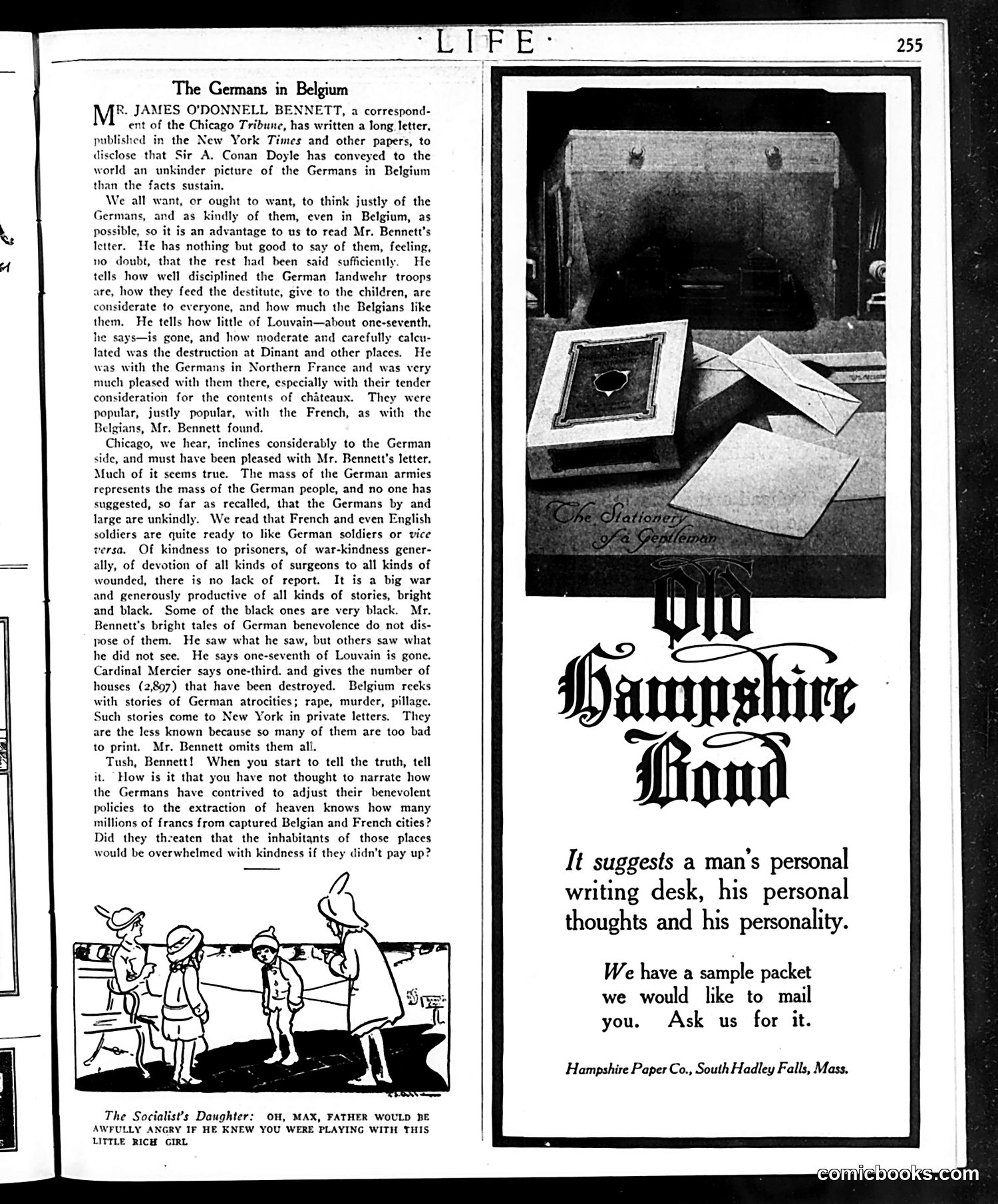
This *Life* magazine page from WWI era contains two distinct elements: **The Main Article**: A sharp editorial rebuttal to war correspondent James O'Donnell Bennett's letter defending German conduct in Belgium. Bennett claimed Germans were disciplined and kind—feeding the destitute, showing restraint in destroyed cities like Louvain. *Life's* editor sarcastically agrees Bennett "saw what he saw" but points out others witnessed atrocities he conveniently omitted. The editor challenges Bennett's rosy account by noting Belgium was filled with documented reports of rape, murder, and pillage—stories "too bad to print." The final paragraph mockingly asks how German "benevolence" squared with extracting millions in francs from conquered Belgian and French cities through threats. **The Cartoon**: Shows a "Socialist's Daughter" warning her boyfriend "Max" that her father would be angry seeing her with a "little rich girl"—a class-consciousness joke about socialist ideology clashing with romantic reality. **The Advertisement**: Hampshire Bond paper, occupying the right column. The page's purpose is wartime propaganda countering pro-German apologetics.
📄 Transcribed text from this page (OCR, searchable)
Machine-transcribed from the original scan — historical spelling and the odd misread are preserved.
The Germans in Belgium R. JAMES O'DONNELL BENNETT, a correspond- ent of the Chicago Tribune, has written a long letter, published in the New York Times and other papers, to disclose that Sir A. Conan Doyle has conveyed to the world an unkinder picture of the Germans in Belgium than the facts sustain. We all want, or ought to want, to think justly of the Germans, and as kindly of them, even in Belgium, as possible, so it is an advantage to us to read Mr. Bennett’s letter. He has nothing but good to say of them, feeling, no doubt, that the rest had been said sufficiently. He tells how well disciplined the German landwehr troops are, how they feed the destitute, give to the children, are considerate to everyone, and how much the Belgians like them. He tells how little of Louvain—about one-seventh, he says—is gone, and how moderate and carefully caleu- lated was the destruction at Dinant and other places. He was with the Germans in Northern France and was very much pleased with them there, especially with their tender consideration for the contents of chateaux. They were popular, justly popular, with the French, as with the Belgians, Mr. Bennett found. Chicago, we hear, inclines considerably to the German side, and must have been pleased with Mr. Bennett's letter. Much of it scems true. The mass of the German armies represents the mass of the German people, and no one has suggested, so far as recalled, that the Germans by and large are unkindly. We read that French and even English soldiers are quite ready to like German soldiers or vice versa. Of kindness to prisoners, of war-kindness gener- ally, of devotion of all kinds of surgeons to all kinds of wounded, there is no lack of report. It is a big war and generously productive of all kinds of stories, bright and black. Some of the black ones are very black. Mr. Bennett's bright tales of German benevolence do not dis- pose of them. He saw what he saw, but others saw what he did not see. He says one-seventh of Louvain is gone. Cardinal Mercier says one-third. and gives the number of houses (2,897) that have been destroyed. Belgium reeks with stories of German atrocities; rape, murder, pillage. Such stories come to New York in private letters. They are the less known because so many of them are too bad to print. Mr. Bennett omits them all, Tush, Bennett! When you start to tell the truth, tell it. “How is it that you have not thought to narrate how the Germans have contrived to adjust their benevolent policies to the extraction of heaven knows how many millions of francs from captured Belgian and French cities? Did they threaten that the inhabitants of those places would be overwhelmed with kindness if they didn’t pay up? The Socialist’s Daughter: OH, MAX, FATHER WOULD BE AWFULLY ANGRY IF HE KNEW YOU WERE PLAYING WITH THIS LITTLE RICH GIRL ‘ond It suggests a man’s personal writing desk, his personal thoughts and his personality. We have a sample packet we would like to mail you. Ask us for it. Hampshire Paper Co., South Hadley Falls, Mass.