
Life, 1915-02-11 · page 24 of 44
Life — February 11, 1915 — page 24: what you’re looking at
What you’re looking at
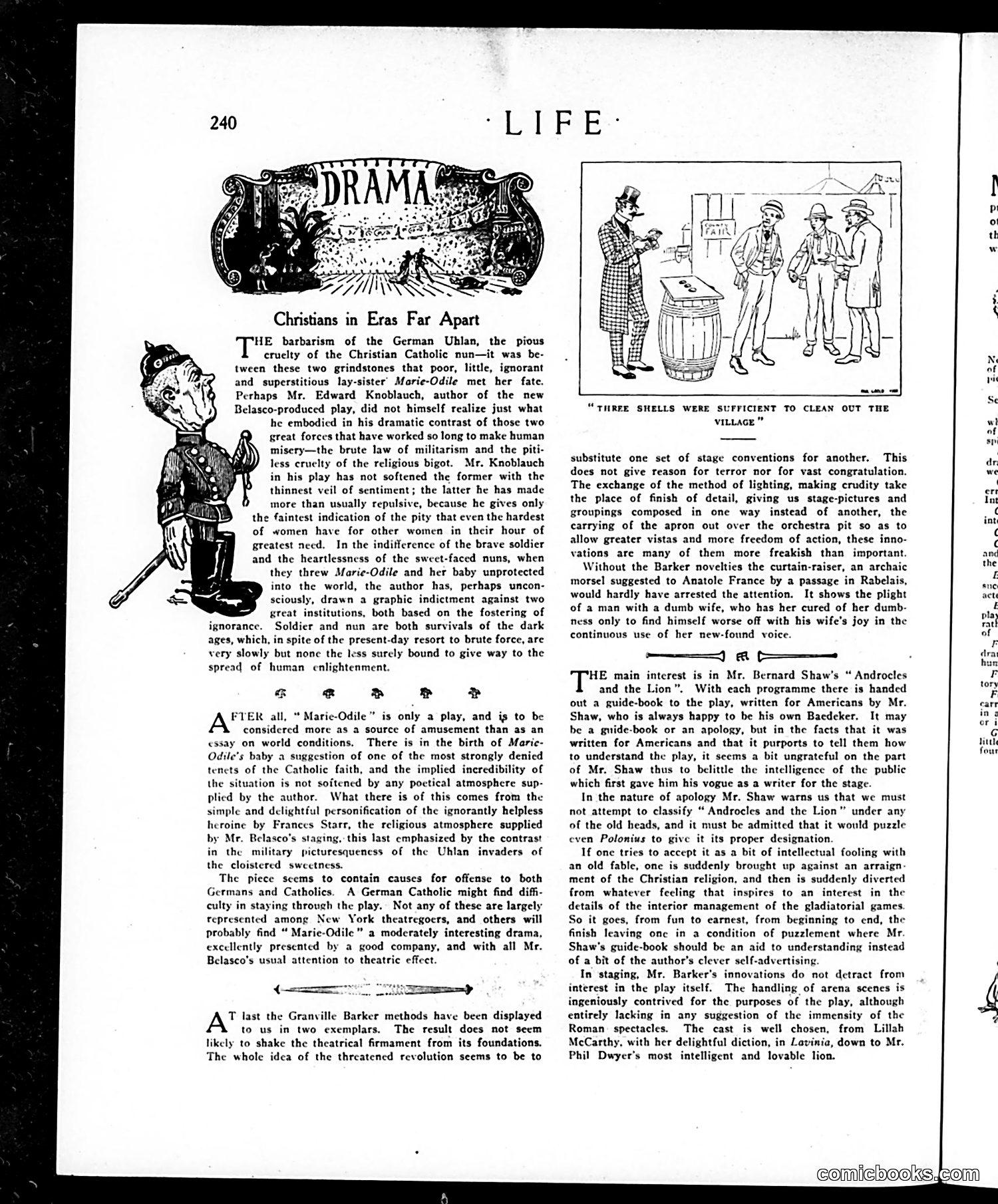
This page reviews "Marie-Odile," a David Belasco-produced play by Edward Knoblauch. The cartoon (left) depicts a German soldier, representing militarism's "barbarism." **The satire's point:** The play traps its heroine between two destructive forces—brutal German militarism (Uhlans were German cavalry) and the cruel rigidity of Catholic religious authority (represented by unfeeling nuns). Life's critic argues both institutions survive from the "dark ages" and depend on "fostering ignorance." **The social critique:** Though framed as theater review, this is really a swipe at institutional power structures. The plot apparently involves an unmarried nun bearing a child—directly contradicting Catholic doctrine—which Life sees as exposing the faith's hypocrisy. The right panel illustration shows men discussing clearing a village (likely a wartime reference), emphasizing the play's military brutality theme. Life positions itself as enlightened, mocking both German militarism and Catholic dogmatism as obsolete forces destined to "give way to the spread of human enlightenment."
📄 Transcribed text from this page (OCR, searchable)
Machine-transcribed from the original scan — historical spelling and the odd misread are preserved.
Christians in Eras Far Apart HE barbarism of the German Uhlan, the pious cruelty of the Christian Catholic nun—it was be- tween these two grindstones that poor, little, ignorant and superstitious lay-sister’ Marie-Odile met her fate. Perhaps Mr. Edward Knoblauch, author of the new Belasco-produced play, did not himself realize just what he embodied in his dramatic contrast of those two great forces that have worked so long to make human misery—the brute law of militarism and the pi less cruclty of the religious bigot. Mr. Knoblauch in his play has not softened the former with the thinnest veil of sentiment; the latter he has made more than usually repulsive, because he gives only the faintest indication of the pity that even the hardest of women have for other women in their hour of greatest necd. In the indifference of the brave soldier and the heartlessness of the sweet-faced nuns, when they threw Marie-Odile and her baby unprotected into the world, the author has, perhaps uncon- sciously, drawn a graphic indictment against two great institutions, both based on the fostering of ignorance. Soldier and nun are both survivals of the dark ages, which, in spite of the present-day resort to brute force, are very slowly but none the less surely bound to give way to the spread of human enlightenment. & J ® > 2 FTER all, “ Marie-Odile” is only a play, and is to be considered more as a source of amusement than as an essay on world conditions, There is in the birth of Maric- Odile’s baby a suggestion of one of the most strongly denied tenets of the Catholic faith, and the implied incredibility of the situation is not soitened by any poctical atmosphere sup- plicd by the author. What there is of this comes from the simple and delightful personification of the ignorantly helpless heroine by Frances Starr, the religious atmosphere supplied by Mr. Belasco’s staging, this last emphasized by the contrast in the military picturesquencss of the Uhlan invaders of the cloistered swectness. The piece seems to contain causes for offense to both Germans and Catholics. A German Catholic might find diffi- culty in staying through the play. Not any of these are largely represented among New York theatregocrs, and others will Probably find “ Marie-Odile ” a moderately interesting drama, excellently presented by a good company, and with all Mr. Belasco's usual attention to theatric effect. = T last the Granville Barker methods have been displayed to us in two exemplars. The result docs not seem likely to shake the theatrical firmament from its foundations. The whole idea of the threatencd revolution seems to be to “THREE SHELLS WERE SUFFICIENT TO CLEAN OUT THE VILLAGE" substitute one sct of stage conventions for another. This does not give reason for terror nor for vast congratulation. The exchange of the method of lighting, making crudity take the place of finish of detail, giving us stage-pictures and groupings composed in one way instead of another, the carrying of the apron out over the orchestra pit so as to allow greater vistas and more freedom of action, these inno- vations are many of them more freakish than important. Without the Barker novelties the curtain-raiser, an archaic morsel suggested to Anatole France by a passage in Rabelais, would hardly have arrested the attention. It shows the plight of a man with a dumb wife, who has her cured of her dumb- ness only to find himself worse off with his wife's joy in the continuous use of her new-found voice. —=<$<—=J A 'HE main interest is in Mr. Bernard Shaw's “ Androcles and the Lion”. With each programme there is handed out a guide-book to the play, written for Americans by Mr. Shaw, who is always happy to be his own Bacdeker. It may be a guide-book or an apology, but in the facts that it was written for Americans and that it purports to tell them how to understand the play, it seems a bit ungrateful on the part of Mr. Shaw thus to belittle the intelligence of the public which first gave him his vogue as a writer for the stage. In the nature of apology Mr. Shaw warns us that we must not attempt to classify “ Androcles and the Lion” under any of the old heads, and it must be admitted that it would puzzle even Polonius to give it its proper designation. If one tries to accept it as a bit of intellectual fooling with an old fable, one is suddenly brought up against an arraign ment of the Christian religion, and then is suddenly diverted from whatever feeling that inspires to an interest in the details of the interior management of the gladiatorial games. So it goes, from fun to earnest, from beginning to end, the finish leaving onc in a condition of puzzlement where Mr. Shaw's guide-book should be an aid to understanding instead of a bit of the author's clever self-advertising. In staging, Mr. Barker's innovations do not detract from interest in the play itself. The handling of arena scenes is ingeniously contrived for the purposes of the play, although entirely lacking in any suggestion of the immensity of the Roman spectacles. The cast is well chosen, from Lillah ith her delightful diction, in Lavinia, down to Mr. $s most intelligent and lovable lion. comichooks,