
Life, 1915-02-11 · page 30 of 44
Life — February 11, 1915 — page 30: what you’re looking at
What you’re looking at
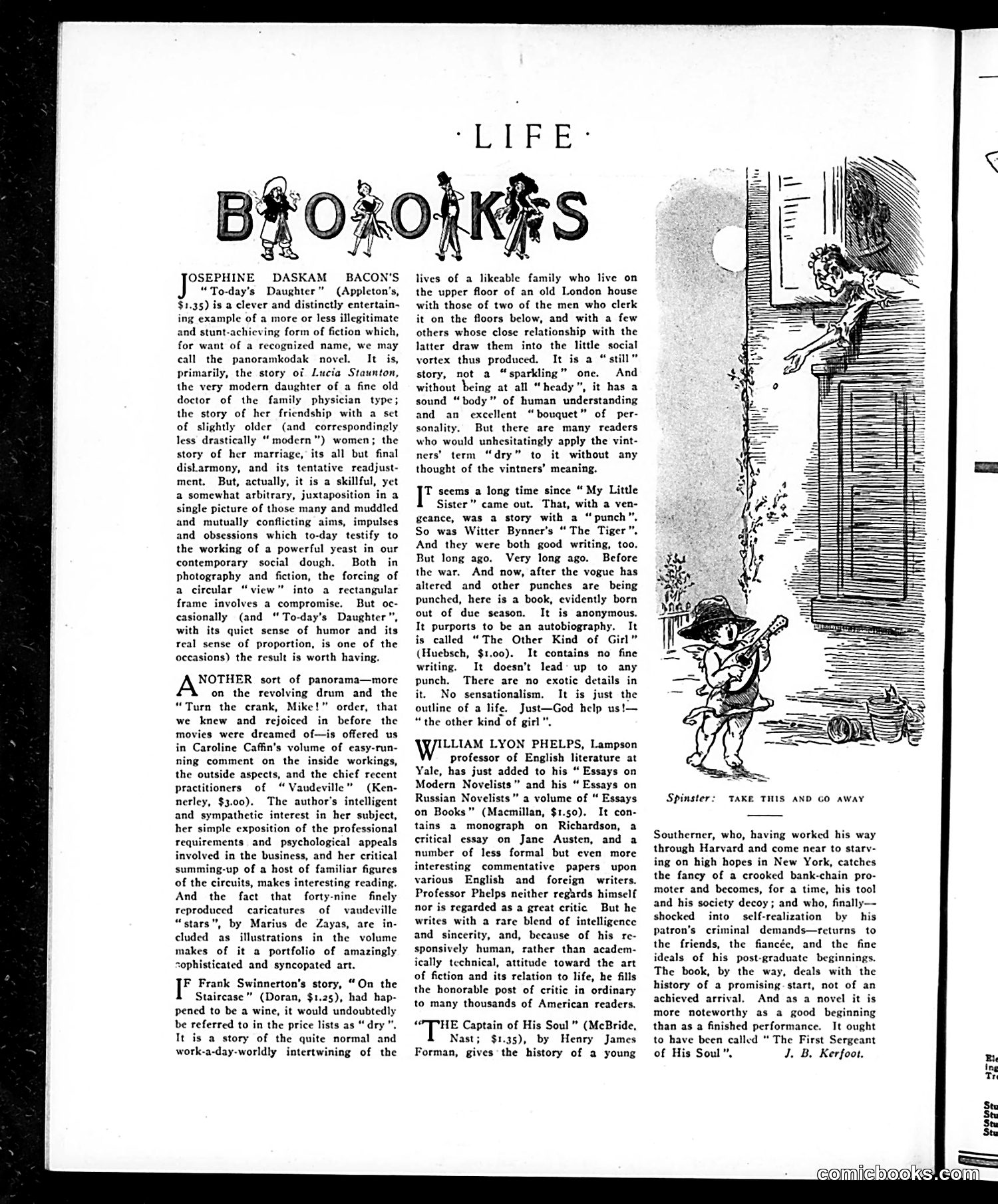
This page contains literary reviews and commentary from *Life* magazine's "Books" section. The main illustration shows a whimsical figure (likely representing a reader or critic) perched on stacked books, reading—a visual metaphor for literary consumption. The reviews discuss several contemporary novels, using wine-tasting terminology as metaphor. Notably, one review critiques an anonymous autobiography titled "The Other Kind of Girl," dismissing it as lacking sophistication, excitement, or literary merit—it's simply "the outline of a life" without "punch" or sensationalism. This reflects early 20th-century literary standards that valued stylistic flourish and dramatic narrative arc. The page exemplifies *Life*'s role as cultural arbiter, making judgments about which modern literature deserved serious attention. The tone is witty and somewhat condescending toward works deemed aesthetically or commercially unambitious.
📄 Transcribed text from this page (OCR, searchable)
Machine-transcribed from the original scan — historical spelling and the odd misread are preserved.
OSEPHINE DASKAM BACON'S “To-day’s Daughter” (Appleton’s, $1.35) is a clever and distinctly entertain-~ ing example of a more or less illegitimate and stunt-achieving form of fiction which, for want of a recognized name, we may call the panoramkodak novel. It is, primarily, the story of Lucia Staunton, the very modern daughter of a fine old doctor of the family physician type; the story of her friendship with a set of slightly older (and correspondingly less drastically “ modern”) women; the story of her marriage, its all but final disLarmony, and its tentative readjust- ment. But, actually, it is a skillful, yet a somewhat arbitrary, juxtaposition in a single picture of those many and muddled and mutually conflicting aims, impulses and obsessions which to-day testify to the working of a powerful yeast in our contemporary social dough. Both in photography and fiction, the forcing of a circular w" into a rectangular frame involves a compromise. But oc- casionally (and “To-day’s Daughter”, with its quict sense of humor and its real sense of proportion, is one of the occasions) the result is worth having. NOTHER sort of panorama—more on the revolving drum and the “Turn the crank, Mike!" order, that we knew and rejoiced in before the movies were dreamed of—is offered us in Caroline Caffin’s volume of easy-run- ning comment on the inside workings, the outside aspects, and the chief recent practitioners of “ Vaudeville” (Ken- nerley, $3.00). The author's intelligent and sympathetic interest in her subject, her simple exposition of the professional requirements and psychological appeals involved in the business, and her critical summing-up of a host of familiar figures of the circuits, makes interesting reading. And the fact that forty-nine finely reproduced caricatures of vaudeville “stars”, by Marius de Zayas, are in- cluded as illustrations in the volume makes of it a portfolio of amazingly sophisticated and syncopated art. F Frank Swinnerton’s story, “On the Staircase” (Doran, $1.25), had hap- pened to be a wine, it would undoubtedly be referred to in the price lists as “dry ". It is a story of the quite normal and work-a-day-worldly intertwining of the lives of a likeable family who live on the upper floor of an old London house with those of two of the men who clerk it on the floors below, and with a few others whose close relationship with the latter draw them into the little social vortex thus produced. It is a “still” story, not a “sparkling” one. And without being at all “heady”, it has a sound “body” of human understanding and an excellent “bouquet” of per- sonality. But there are many readers who would unhesitatingly apply the vint- ners’ term “dry” to it without any thought of the vintners’ meaning. T seems a long time since “ My Little Sister” came out. That, with a ven- geance, was a story with a “punch”, So was Witter Bynner’s “The Tiger”. And they were both good writing, too. But long ago. Very long ago. Before the war. And now, after the vogue has altered and other punches are being punched, here is a book, evidently born out of due season. It is anonymous. It purports to be an autobiography. It is called “The Other Kind of Girl” (Huebsch, $1.00). It contains no fine writing. It doesn’t lead: up to any punch, There are no exotic details in it. No sensationalism. It is just the outline of a life. Just—God help us!— “the other kind of girl”. LLIAM LYON PHELPS, Lampson professor of English literature at Yale, has just added to his “ Essays on Modern Novelists” and his “ Essays on Russian Novelists” a volume of “ Essays on Books” (Macmillan, $1.50). It con- tains a monograph on Richardson, a critical essay on Jane Austen, and a number of less formal but even more interesting commentative papers upon various English and foreign writers. Professor Phelps neither regards himself nor is regarded as a great critic But he writes with a rare blend of intelligence and sincerity, and, because of his re- sponsively human, rather than academ- ically technical, attitude toward the art of fiction and its relation to life, he fills the honorable post of critic in ordinary to many thousands of American readers. “THE Captain of His Soul” (McBride, Nast; $1.35), by Henry James Forman, gives the history of a young ii TT Spinster: TAKE THIS AND GO AWAY Southerner, who, having worked his way through Harvard and come near to starv- ing on high hopes in New York, catches the fancy of a crooked bank-chain pro- moter and becomes, for a time, his tool and his society decoy ; and who, finally— shocked into self-realization by his patron’s criminal demands—returns to the friends, the fiancée, and the fine ideals of his post-graduate beginnings. The book, by the way, deals with the history of a promising. start, not of an achieved arrival. And as a novel it is more noteworthy as a good beginning than as a finished performance. It ought to have been called “ The First Sergeant of His Soul”, J, B. Kerfoot,