
Life, 1915-02-11 · page 20 of 44
Life — February 11, 1915 — page 20: what you’re looking at
What you’re looking at
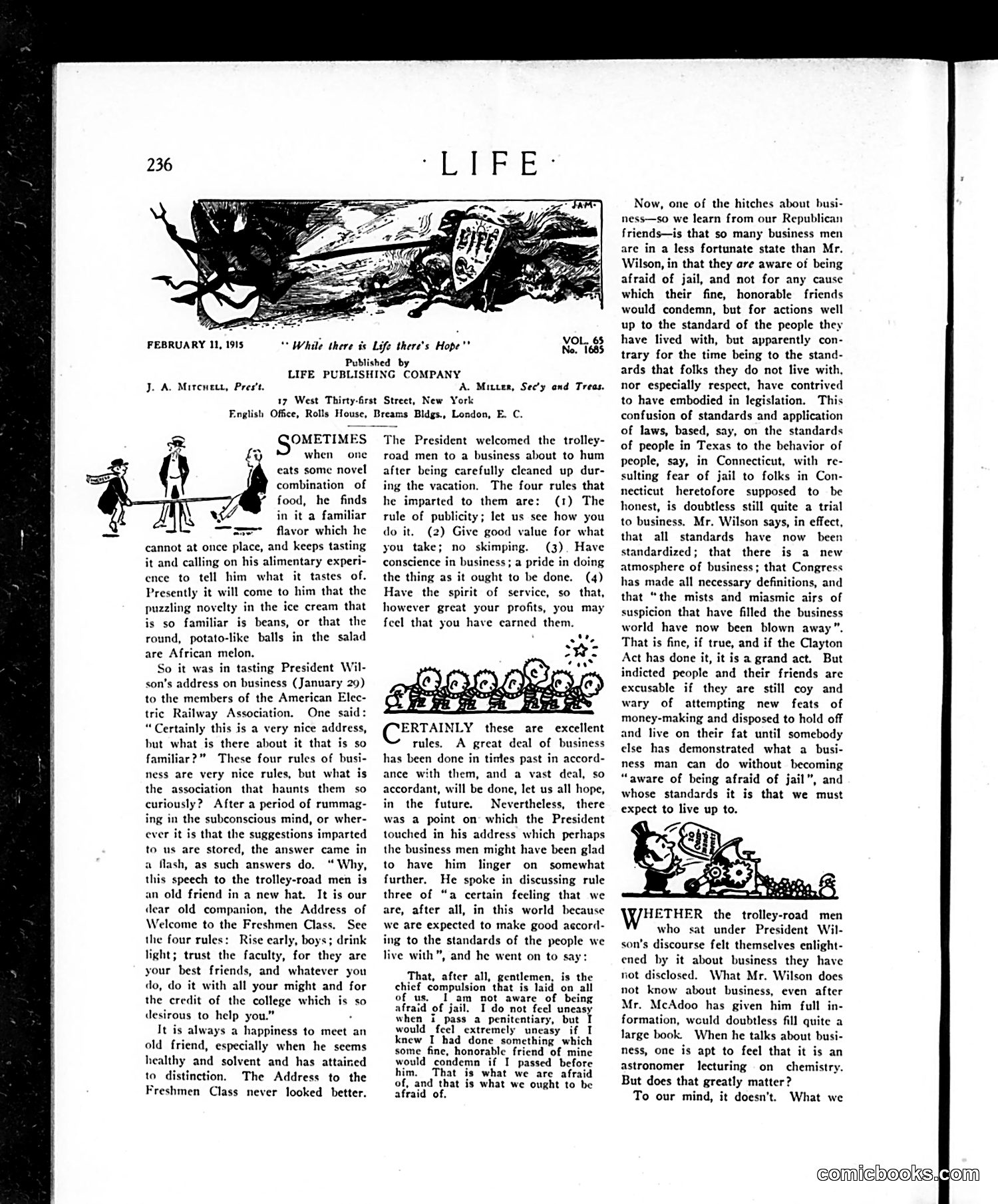
This page analyzes President Wilson's January 1915 speech to electric railway executives. The author compares Wilson's four business rules (publicity, fair value, business conscience, and service) to a familiar "Address to Freshmen"—suggesting Wilson recycled collegiate moralizing for businessmen. The satire's bite emerges in the closing argument: Wilson, speaking from moral high ground, says he fears friends' judgment more than jail. The author pointedly notes many businessmen *are* afraid of jail—but for actions their peers consider standard business practice, not immoral. This suggests Wilson's idealistic business ethics clash with actual American corporate culture, where questionable practices are normalized among peers. The cartoon criticizes both Wilson's naïveté and business corruption as socially acceptable.
📄 Transcribed text from this page (OCR, searchable)
Machine-transcribed from the original scan — historical spelling and the odd misread are preserved.
FEBRUARY 11, 1915 While there is Life there's Hope"* Published by LIFE J. A. Mirenett, Pres’t. PUBLISHING COMPANY A. Minter, Sec’y and Treas. 17 West Thirty-first Street, New York English Office, Rolls House, Breams Bldgs. London, E. C. OMETIMES when one eats some novel combination of food, he finds in it a familiar sae" flavor which he cannot at once place, and keeps tasting it and calling on his alimentary experi- ence to tell him what it tastes of. Presently it will come to him that the puzzling novelty in the ice cream that is so familiar is beans, or that the round, potato-like balls in the salad are African melon. So it was in tasting President Wil- son’s address on business (January 29) to the members of the American Elec- tric Railway Association. One said: “Certainly this is a very nice address, but what is there about it that is so familiar?” These four rules of busi- ness are very nice rules, but what is the association that haunts them so curiously? After a period of rummag- ing in the subconscious mind, or wher- ever it is that the suggestions imparted to us are stored, the answer came in a flash, as such answers do. “ Why, this speech to the trolley-road men is an old friend in a new hat. It is our dear old companion, the Address of Welcome to the Freshmen Class. See the four rules: Rise early, boys; drink light; trust the faculty, for they are your best friends, and whatever you do, do it with all your might and for the credit of the college which is so desirous to help you.” ; It is always a happiness to meet an old friend, especially when he seems healthy and solvent and has attained to distinction. The Address to the Freshmen Class never looked better. The President welcomed the trolley- road men to a business about to hum after being carefully cleaned up dur- ing the vacation. The four rules that he imparted to them are: (1) The rule of publicity; let us see how you do it. (2) Give good value for what you take; no skimping. (3). Have conscience in business; a pride in doing the thing as it ought to be done. (4) Have the spirit of service, so that, however great your profits, you may feel that you have carned them. YY these are excellent rules. A great deal of business has been done in tintes past in accord- ance with them, and a vast deal, so accordant, will be done, let us all hope, in the future. Nevertheless, there was a point on which the President touched in his address which perhaps the business men might have been glad to have him linger on somewhat further, He spoke in discussing rule three of “a certain feeling that we are, after all, in this world because we are expected to make good accord- ing to the standards of the people we live with”, and he went on to say: That, after all, gentlemen, is the chicf compulsion that is laid on all of us. I am not aware of being afraid of jail. I do not feel uneasy when i pass a penitentiary, but I would feel extremely uneasy if I knew I had done something which some fine, honorable friend of mine would condemn if I passed before him. That is what we are afraid of, and that is what we ought to be afraid of. Now, one of the hitches about busi- ness—so we learn from our Republican friends—is that so many business men are in a less fortunate state than Mr. Wilson, in that they are aware of being afraid of jail, and not for any cause which their fine, honorable friends would condemn, but for actions well up to the standard of the people they have lived with, but apparently con- trary for the time being to the stand- ards that folks they do not live with, nor especially respect, have contrived to have embodied in legislation. This confusion of standards and application of laws, based, say, on the standards of people in Texas to the behavior of people, say, in Connecticut, with re- sulting fear of jail to folks in Con- necticut heretofore supposed to be honest, is doubtless still quite a trial to business. Mr. Wilson says, in effect, that all standards have now been standardized; that there is a new atmosphere of business; that Congress has made all necessary definitions, and that “the mists and miasmic airs of suspicion that have filled the business world have now been blown away”. That is fine, if true, and if the Clayton Act has done it, it is a grand act. But indicted people and their friends are excusable if they are still coy and wary of attempting new feats of money-making and disposed to hold off and live on their fat until somebody else has demonstrated what a busi- ness man can do without becoming “aware of being afraid of jail”, and whose standards it is that we must expect to live up to. HETHER the trolley-road men who sat under President Wil- son’s discourse felt themselves enlight- ened by it about business they have not disclosed. What Mr. Wilson does not know about business, even after Mr. McAdoo has given him full in- formation, would doubtless fill quite a large book. When he talks about busi- ness, one is apt to feel that it is an astronomer lecturing on chemistry. But does that greatly matter? To our mind, it doesn’t. What we comichooks {om